Global Testing, Inspection, and Certification (TIC) for Agriculture & Food Market Snapshot
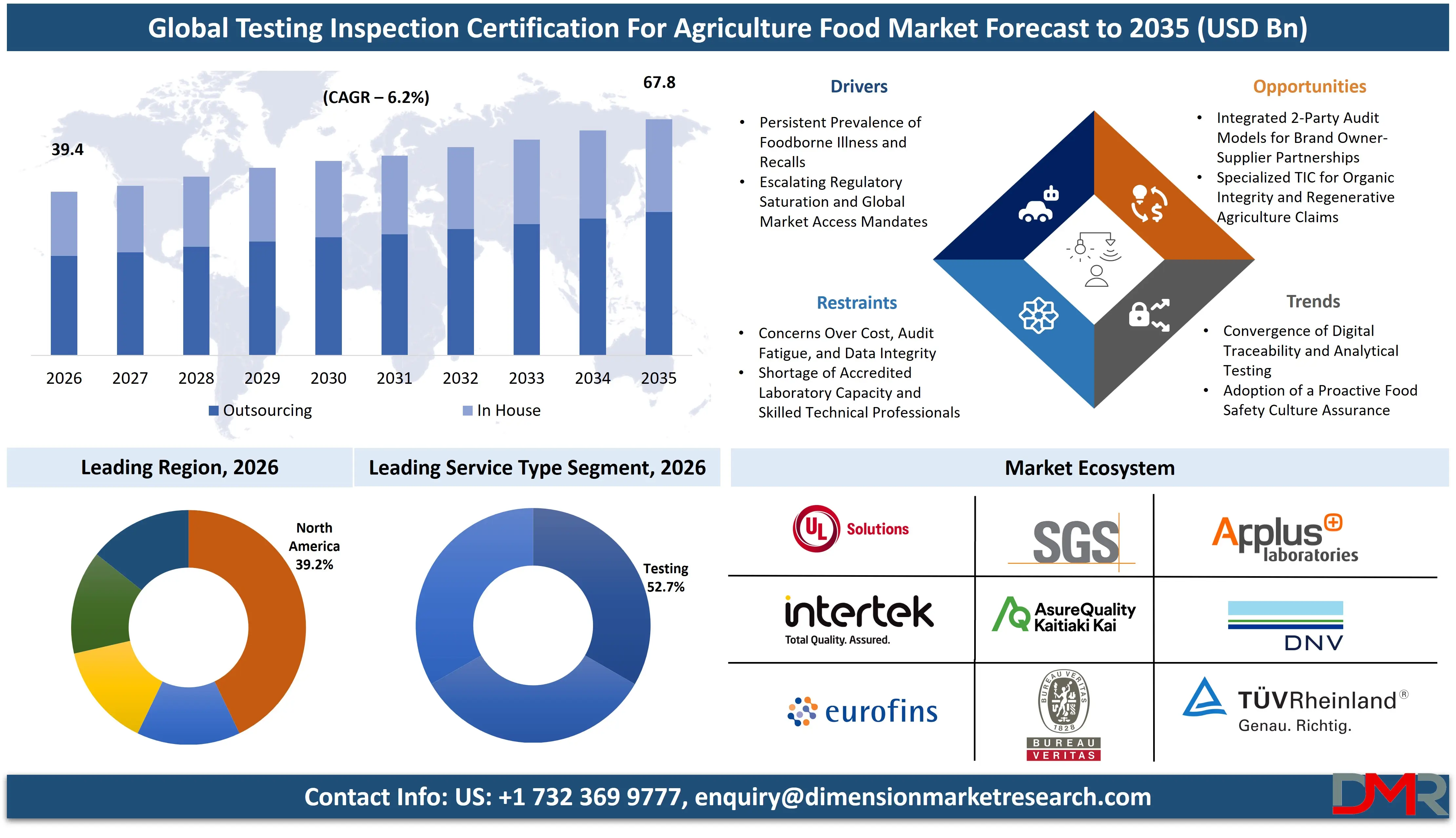
- Global TIC for Agriculture & Food Market Size in 2026: USD 39.4 Billion
- Global TIC for Agriculture & Food Market Size in 2035: USD 67.8 Billion
- Global CAGR from 2026 to 2035: 6.2%
- Outsourcing is the leading sourcing model in 2026: 68.4%
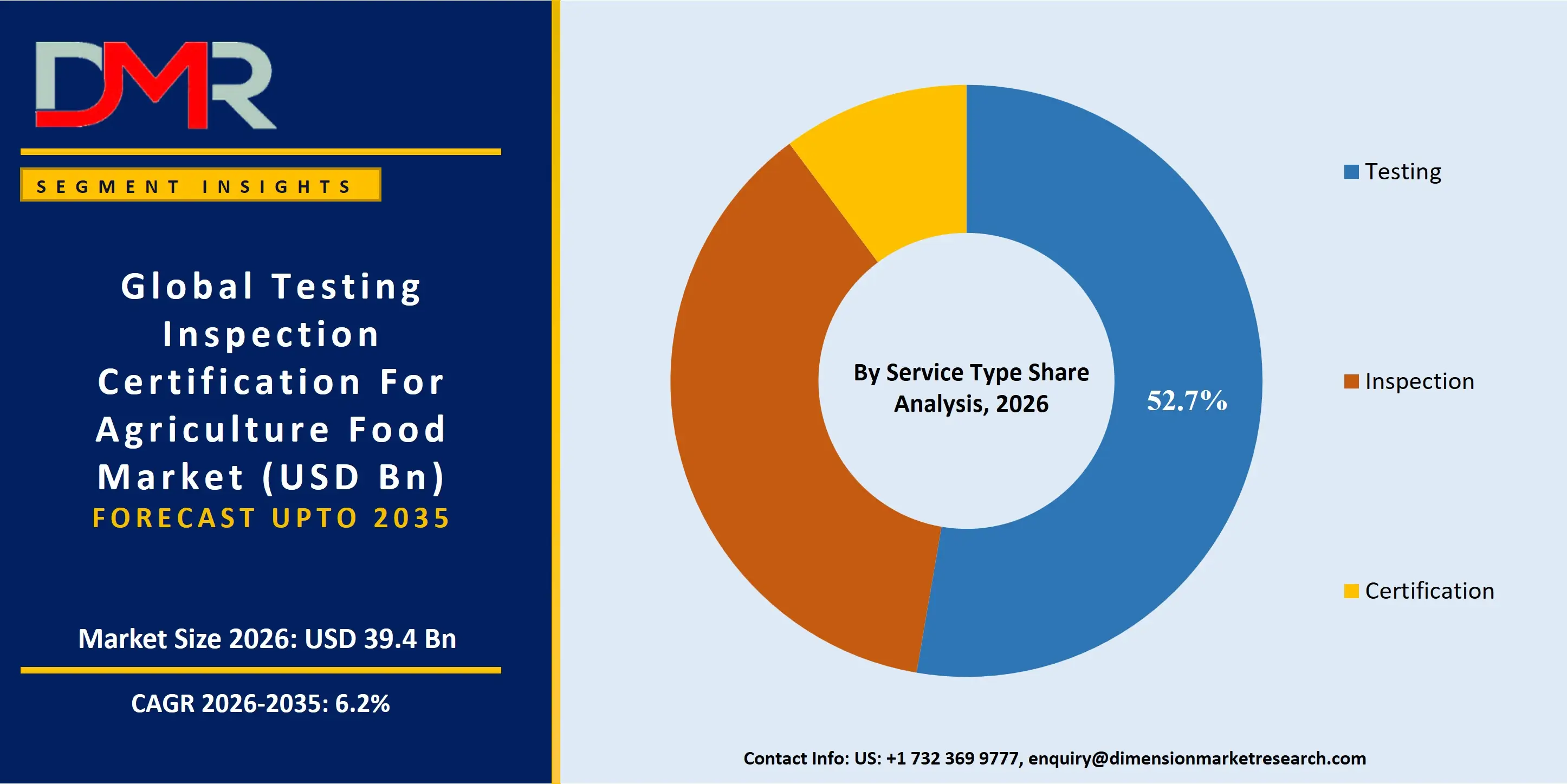
- Testing is the leading service type in 2026: 52.7%
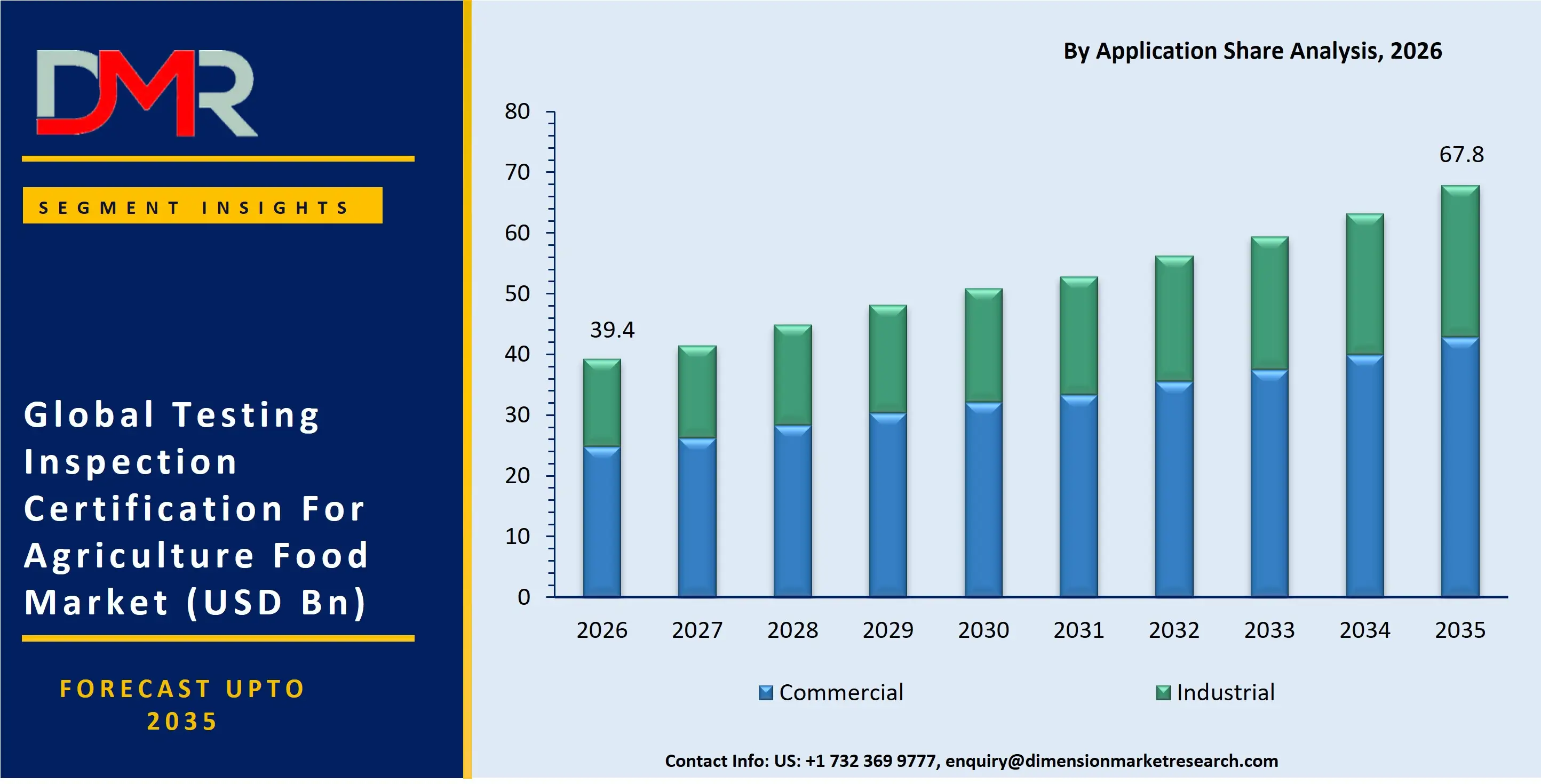
- Industrial Applications are the leading application segment in 2026: 61.9%
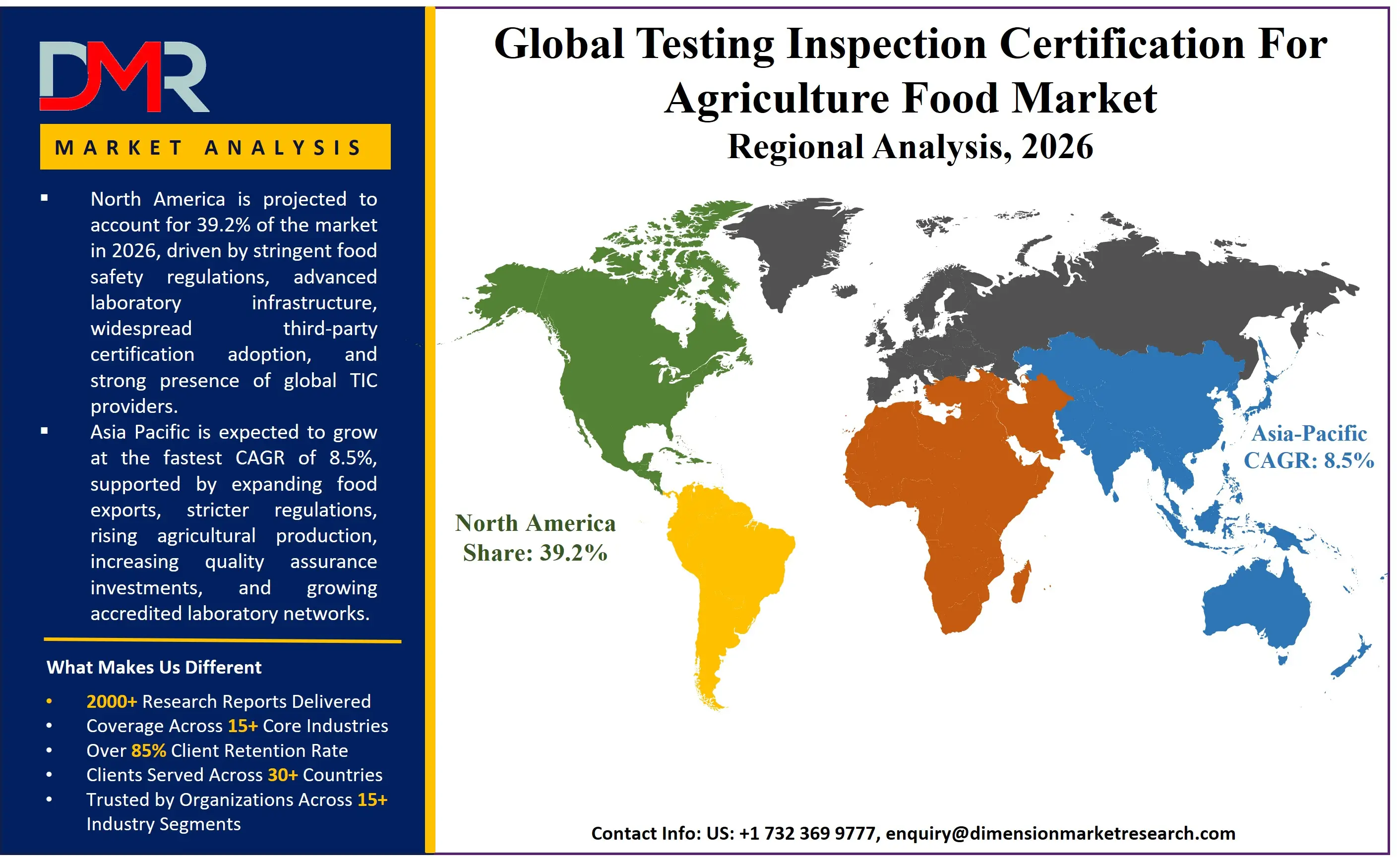
- North America is the leading region in 2026: 39.2%
What is the Global Testing, Inspection, and Certification (TIC) for Agriculture & Food Market and its Market Size?
The Global Testing, Inspection, and Certification (TIC) for Agriculture & Food Market is projected to be valued at USD 39.4 billion in 2026 and is projected to reach USD 67.8 billion by 2035, expanding at a CAGR of 6.2% during the forecast period.
ℹ
To learn more about this report –
Download Your Free Sample Report Here
Growth is being driven by the escalating frequency of foodborne illness outbreaks and food fraud scandals, the globalization of the agri-food supply chain, an increasingly stringent regulatory landscape for maximum residue levels and labeling, and surging consumer demand for verified product claims like organic, non-GMO, and clean-label. Investment is accelerating as food businesses move beyond reactive contaminant testing toward proactive risk-based assessment, continuous environmental monitoring, and blockchain-integrated traceability to validate and assure product integrity before it impacts brand equity and public health.
Use Cases
- Microbiological Risk Validation for Ready to Eat Processors: Ready to eat food processors use TIC services for environmental pathogen monitoring and batch release testing, verifying Listeria monocytogenes and Salmonella results before distribution to protect public health and prevent contaminated product entry.
- Supply Chain Integrity and Food Fraud Mitigation: Brand owners and importers use TIC inspection and testing to verify authenticity through stable isotope ratio analysis and DNA barcoding, detect adulteration in olive oil and honey, confirm provenance, and protect consumer trust.
- Regulatory Compliance and Export Market Access: Export oriented food producers use TIC certification to demonstrate compliance with destination market regulations, including organic standards and health certificates, producing auditable documentation that supports customs clearance and reduces shipment rejections at borders.
- Third Party Supplier Audit and Private Label Assurance: Retail chains and food service operators use independent TIC inspections for supplier qualification and performance monitoring, including Good Manufacturing Practices audits and on site swabbing at co packer facilities, ensuring private label production.
Key Takeaways
- Market Size: The Global TIC for Agriculture and Food Market is anticipated at USD 39.4 billion in 2026 and forecast to reach USD 67.8 billion by 2035, expanding at a CAGR of 6.2% during forecast years.
- Growth Outlook: Market growth is supported by industrialized food production, complex global supply chains, expanding e commerce grocery models, rising economically motivated adulteration, and corporate demand for demonstrable food safety due diligence beyond internal self assessment.
- Primary Growth Drivers: Global investment in outsourced TIC solutions is accelerating as supplier audit fatigue, multi ingredient product complexity, stringent pesticide and contaminant mandates, and limited internal capability for specialized allergen screening and speciation testing intensify worldwide.
- By Sourcing Model Analysis: Outsourcing is projected to lead with a 68.4% share in 2026, driven by demand for independent ISO/IEC 17025 accredited laboratories that deliver impartial certificates of analysis and specialized technical expertise.
- By Service Type Analysis: Testing is expected to dominate the service type segment with a 52.7% share in 2026, while Food Safety Certification leads certification services with a 38.1% share, supported by SQF, BRCGS, and FSSC 22000 adoption.
- By Application Analysis: Industrial applications is poised to lead with a 61.9% share in 2026, while Food Processors dominate industrial demand with a 27.5% share, owing to extensive validation, sanitation, monitoring, and product-release testing needs.
- By Region Analysis: North America is anticipated to lead with a 39.2% share in 2026, supported by FSMA requirements, consolidated food retail and foodservice sectors, strict private-label standards, and heightened legal liability concerns.
How AI is Transforming the Testing, Inspection, and Certification (TIC) for Agriculture & Food Market
Artificial intelligence is fundamentally transforming TIC services by enabling intelligent predictive analytics and automated visual inspection across vast food quality datasets. Machine learning algorithms dynamically baseline normal production parameters, classify genuine quality deviations from acceptable process variation in real-time, and predict a product's shelf-life under specific storage conditions. Generative AI assistants are being integrated into digital audit platforms, allowing food safety auditors to generate complex risk-based sampling plans and create bespoke HACCP verification queries using natural language prompts, significantly reducing manual paperwork time and human error in on-site conformity assessments.
The next frontier of adoption involves agentic AI workflows that orchestrate closed-loop supply chain quality assurance autonomously. In this paradigm, an AI algorithm analyzes a satellite weather data feed and predicts a high-risk mycotoxin prevalence in a specific grain origin, instantly instructs a TIC inspection platform to automatically trigger a revised sampling directive for incoming shipments, and then correlates laboratory information management system (LIMS) results with a specific supplier's historical performance to perform root-cause analysis. This capability compresses the risk detection cycle from days to hours. However, for these AI models to be trusted in automated regulatory decisions like Certificate of Analysis issuance, they require strict governance on high-integrity training data derived from historical laboratory proficiency tests and expert-validated audit reports to prevent business-disrupting false positive rejections.
Key Drivers in the Global Testing, Inspection, and Certification (TIC) for Agriculture & Food Market
Persistent Prevalence of Foodborne Illness and Recalls
The global recurrence of high-profile food safety failures and costly product recalls is a primary driver for the TIC market. Food businesses struggle to manage pathogen risk across complex, fragmented supply chains without independent, accredited laboratory and audit programs. This public health and brand equity vacuum directly fuels demand for outsourced microbiological testing, environmental monitoring, and certification services that provide immediate access to specialized scientists, rapid pathogen detection methods, and GFSI-qualified auditors. The growing sophistication of food fraud vectors, including melamine adulteration and synthetic origin masking, requires advanced analytical instrumentation and forensic skills that cannot be easily replicated in-house, making the expertise-as-a-service model essential for organizations that cannot compete for specialized scientific talent.
Escalating Regulatory Saturation and Global Market Access Mandates
A tightening web of global food safety and labeling regulations is forcing organizations to adopt continuous testing and certification capabilities. Frameworks like the U.S. FSMA's Foreign Supplier Verification Program, EU Official Controls Regulation, and China's updated food safety laws increasingly mandate demonstrable preventive controls and rapid traceability. Furthermore, international buyers are now strictly auditing supplier food safety posture before contract awards, often requiring an unbroken chain of third-party certification as a prerequisite for market access. TIC providers directly fulfill these requirements by providing accredited testing, HACCP certification, and a demonstrable technical audit trail for export health certificates, transforming their services from an optional cost center into a fundamental business and trade facilitation necessity.
Restraints in the Global Testing, Inspection, and Certification (TIC) for Agriculture & Food Market
Concerns Over Cost, Audit Fatigue, and Data Integrity
The operational backbone of a TIC program is its systematic, repetitive assessment, which can introduce significant concerns over cumulative cost, supplier audit fatigue, and the fragmentation of quality data. Entrusting critical product safety assessments to multiple different entities introduces potential inconsistencies in audit scoring and analytical judgment. Small and medium-sized food enterprises, particularly in emerging markets, may resist the financial burden of multiple unannounced certifications, fearing a loss of direct control over their operational schedule and a system where the cost of compliance becomes a barrier to growth. This economic and operational friction can delay or block comprehensive TIC adoption, particularly for low-margin commodity products.
Growth Opportunities in the Global Testing, Inspection, and Certification (TIC) for Agriculture & Food Market
Integrated 2-Party Audit Models for Brand Owner-Supplier Partnerships
A significant growth opportunity lies in co-managed 2nd-party audit programs where a TIC provider acts as a neutral extension of a brand owner's procurement quality team. This approach addresses the "loss of control" restraint by providing a unified digital platform where internal procurement specifications, historical supplier scorecards, and external laboratory results are integrated into a single supplier relationship management workflow. This model is particularly attractive to large retail chains with dedicated quality assurance teams who want to supplement their in-house capability, access specialized analytical chemistry expertise for authenticity testing, and benchmark their primary producers without fully outsourcing their approval decisions. It creates a sticky, recurring revenue relationship built on partnership and shared risk rather than pure transactional testing.
Specialized TIC for Organic Integrity and Regenerative Agriculture Claims
The convergence of consumer demand for climate-conscious diets with evolving regulatory definitions of "regenerative" creates a massive opportunity for specialized sustainability assurance. These systems require verification of soil carbon sequestration outcomes and biodiversity metrics, which are very different from standard food safety parameters. A generic TIC is ill-equipped to measure soil health indicators or audit outcome-based ecological claims. Providers who develop deep domain expertise in organic system plans, invest in soil spectroscopy and remote sensing validation tools, and offer guaranteed integrated pest management compliance assessment can unlock a high-value, underserved market segment where premium product positioning depends entirely on credible third-party verification.
Trends in the Global Testing, Inspection, and Certification (TIC) for Agriculture & Food Market
Convergence of Digital Traceability and Analytical Testing
The market is witnessing a convergence of blockchain-enabled traceability and laboratory testing into a unified, outcome-focused food safety stack. Rather than simply testing a final product, modern TIC contracts are defined by supply chain transparency and source attribution service level agreements. This trend is driving providers to tightly integrate Internet of Things (IoT) sensors, cloud-based supply chain mapping, and rapid on-site testing technologies into their service core. The focus is shifting from finding a contaminant to instantly tracing its root cause. This convergence simplifies vendor management for customers and delivers a more integrated defense, where a positive pathogen finding instantly triggers a digital chain-of-custody investigation, accelerating the entire food safety lifecycle from detection to root cause analysis and corrective action.
Adoption of a Proactive Food Safety Culture Assurance
A forward-looking trend is the integration of Food Safety Culture assessment into the traditional GFSI certification lifecycle. Certification bodies are evolving beyond a snapshot audit of documented procedures to proactively validate an organization's behavioral commitment to hygiene and quality. This involves continuous employee perception surveys, behavioral observation audits, and leading indicator data analysis to validate whether frontline commitment to food safety is effective against the normalization of deviance and complacency. By providing this holistic cultural maturity visibility program alongside a standard GFSI certificate, TIC providers are positioning themselves as strategic partners for organizational resilience, capable of validating a company's entire quality ethos, not just its procedural compliance at a single point in time.
Research Scope and Analysis
The Global Testing, Inspection, and Certification (TIC) for Agriculture & Food Market is segmented by sourcing model, service type, and application. Service types include testing, inspection, and certification. The study evaluates adoption across in-house and outsourced models, and key application end-users in commercial and industrial sectors.
ℹ
To learn more about this report –
Download Your Free Sample Report Here
By Sourcing Model
Outsourcing dominates the Global Testing, Inspection, and Certification for Agriculture and Food Market, accounting for an estimated 68.4% share in 2026. Food businesses increasingly depend on accredited third-party laboratories and inspection specialists to ensure impartial results, advanced analytical capability, and alignment with international food safety standards. Outsourced providers reduce the capital burden of maintaining sophisticated testing equipment, specialist staff, and continuously updated compliance systems. In House services remain important for routine checks and immediate production-line quality control, particularly among large manufacturers. However, In House operations are projected to record the highest CAGR of 6.8% during 2026–2035, supported by digital quality systems and rapid screening technologies.
By Service Type
Testing leads the market with an estimated 52.7% revenue share in 2026, as microbiological, chemical, allergen, nutritional, and contaminant analysis are essential before agricultural and food products reach consumers. Rising concern over foodborne illness, pesticide residues, adulteration, heavy metals, and undeclared allergens is increasing the frequency and depth of laboratory testing. Certification represents the fastest-growing service category, projected to expand at a CAGR of 7.1% from 2026 to 2035. Retailers, exporters, and foodservice operators are increasingly demanding documented compliance with food safety, organic, halal, kosher, and sustainable agricultural standards.
By Application
Industrial applications dominate the market, holding an estimated 61.9% share in 2026. Farms, food processors, manufacturers, logistics providers, and import-export operators require recurring TIC services throughout cultivation, sourcing, processing, warehousing, transport, and cross-border distribution.
ℹ
To learn more about this report –
Download Your Free Sample Report Here
Food manufacturers form the largest demand base within this segment because they must manage ingredient specifications, batch quality, contamination prevention, labeling compliance, and retailer requirements. Commercial applications are forecast to achieve the highest CAGR of 6.6% during 2026–2035, driven by expanding organized retail, restaurant chains, food delivery platforms, private-label brands, and stricter supplier-verification programs.
The Global Testing, Inspection, and Certification (TIC) for Agriculture & Food Market Report is segmented on the basis of the following:
By Sourcing Model
By Service Type
- Testing
- Microbiological Testing
- Chemical Testing
- Physical Testing
- Allergen Testing
- Nutritional Analysis
- Inspection
- Farm Inspection
- Processing Facility Inspection
- Storage and Distribution Inspection
- Import Export Inspection
- Certification
- Food Safety Certification
- Organic Certification
- Halal and Kosher Certification
- Agricultural Practice Certification
By Application
- Commercial
- Retail Chains
- Food Service
- Restaurants
- Distributors
- Brand Owners
- Industrial
- Farms and Primary Producers
- Food Processors
- Food Manufacturers
- Logistics and Storage Providers
- Import Export Operators
Regional Analysis
North America is the Leading Region in the Global TIC for Agriculture & Food Market
North America is poised to lead the Global TIC Market with an estimated 39.2% revenue share in 2026. The region's dominance is anchored by a dense concentration of multinational food and beverage conglomerates, a highly litigated product liability environment, and the proactive enforcement of the FDA's Food Safety Modernization Act (FSMA), which mandates science-based preventive controls and rigorous foreign supplier verification. Early adoption of whole-genome sequencing for pathogen outbreak investigations, a massive installed base of processed and ready-to-eat food manufacturing, and the presence of the world's most capitalized, technically advanced food testing and certification firms solidify its position as the primary global command center for comprehensive supply chain assurance.
ℹ
To learn more about this report –
Download Your Free Sample Report Here
Asia Pacific is the Fastest-Growing Region in the Global TIC for Agriculture & Food Market
Asia Pacific is projected to register the fastest CAGR of 8.5% through 2035, driven by its role as both a dominant food production engine and a rapidly formalizing consumer market for branded, packaged goods. Massive protein diversification, a booming middle-class population in India, China, and ASEAN nations demanding verified safe and clean-label products, and a severe deficit of ISO/IEC 17025 accredited laboratories necessitate rapid adoption of outsourced testing and inspection. Accelerating harmonization with Codex Alimentarius standards, government-led regulatory crackdowns on adulteration in edible oils and spices, and the expansion of aquaculture and shrimp processing for export further fuel demand for specialized TIC covering antibiotic residue screening, heavy metals analysis, and farm-level Good Agricultural Practices certification.
The Europe TIC for Agriculture & Food Market
The Europe TIC Market is estimated to represent a significant revenue stream in 2026 and is forecast to reach a substantial valuation by 2035, growing at a steady CAGR. Europe represents the second-largest regional market, distinguished by its deeply precautionary regulatory architecture under the General Food Law, and a sophisticated market for geographical indication (GI) protected products. The region's powerhouse artisanal dairy, wine, and confectionery sectors, particularly in France, Italy, and Germany, are significant growth engines, requiring specialized authenticity testing via nuclear magnetic resonance spectroscopy and stable isotope analysis to protect premium food heritage from fraud. The Farm to Fork Strategy's push for harmonized front-of-pack nutritional labeling and a 50% pesticide reduction target is creating sustained demand for nutritional analysis and multi-residue chemical testing.
Latin America TIC for Agriculture & Food Market
The Latin America TIC Market is expanding steadily as the region cements its role as the world's primary agricultural commodity breadbasket for beef, poultry, soy, and high-value fruits. Brazil and Mexico lead regional adoption, driven by their established meat export and fresh produce sectors, evolving domestic hygiene regulations like Brazil's RDC standards, and a sharp increase in demand for Rainforest Alliance and GlobalG.A.P. certification from discerning European and North American retail buyers. The prohibitive capital expenditure of building and staffing a BSL-2 accredited internal food microbiology lab makes the outsourcing model highly attractive for the region's fragmented supply base.
Middle East and Africa TIC for Agriculture & Food Market
The Middle East and Africa TIC Market is developing alongside massive food security-driven agribusiness investments, the construction of modern mega-logistics food hubs in the Gulf Cooperation Council region, and the modernization of export-oriented horticulture in East Africa. Saudi Arabia and the UAE are the primary import-reliant hubs, driven by strict Halal certification mandates from globally recognized bodies and rigorous Gulf Standardization Organization import regulations for food contact materials, which necessitate pre-shipment conformity assessment and port-of-entry organoleptic inspection. South Africa leads the African continent with its mature export-oriented citrus and table grape industries.
Major Countries Analysis
The US TIC for Agriculture & Food Market
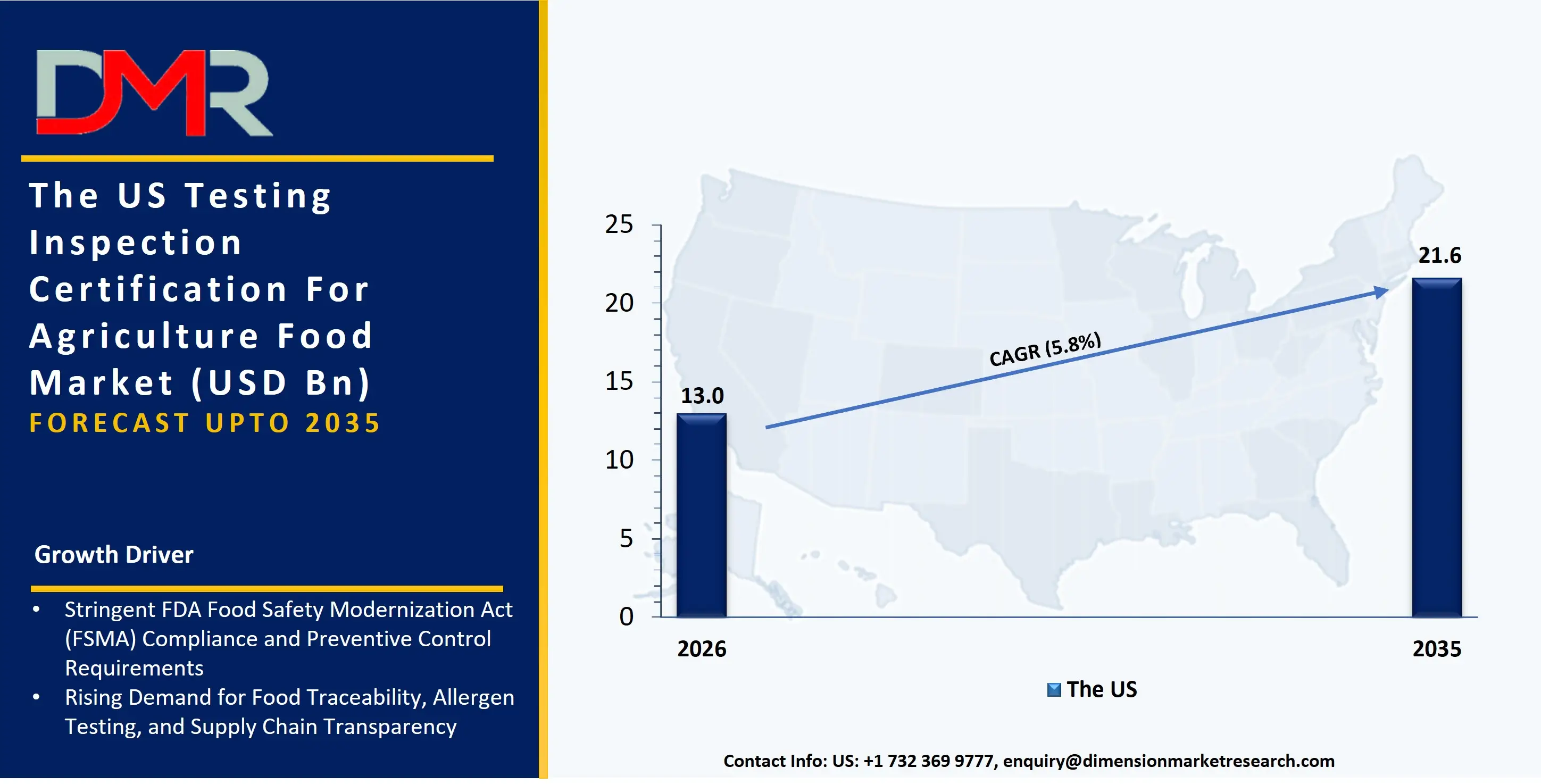
The United States TIC Market is projected to be valued at USD 13.0 billon in 2026 and is expected to reach a significant valuation of USD 21.6 billion by 2035, registering a 5.8% CAGR during the forecast period. This trajectory reflects the U.S.'s position as the world's largest and most strictly regulated import market for specialty foods and fresh produce. Growth is fueled by the FSMA's Intentional Adulteration and Foreign Supplier Verification Program rules, the widespread adoption of unannounced GFSI-benchmarked certification audits by retailers, and a relentless wave of pathogen-related recalls affecting romaine lettuce and poultry. The shift from simple certificate-of-analysis transactional testing to risk-based environmental monitoring and digital supplier scorecards is a defining driver of market expansion.
ℹ
To learn more about this report –
Download Your Free Sample Report Here
Japan TIC for Agriculture & Food Market
The Japan TIC Market is valued at a premium segment in 2026 and is forecast to reach a substantial valuation by 2035, expanding at a steady CAGR. Market development is heavily influenced by Japan's notoriously stringent Maximum Residue Limit (MRL) Positive List System for pesticides and the deep cultural importance of verified, high-quality labeling. The country's integrated convenience store food supply chains and high-end retail sector demand meticulous sanitation inspection and cold chain compliance for ready-to-eat sushi and bento products. A strong cultural preference for technical excellence and long-term supplier partnerships is driving sustained, quality-focused adoption of outsourced microbiological testing, radiocesium monitoring, and stringent third-party facility audits from trusted independent certification bodies.
Saudi Arabia TIC for Agriculture & Food Market
The Saudi Arabia TIC Market is estimated at a growing value in 2026 and is projected to reach a significantly higher valuation by 2035, expanding at a double-digit CAGR. Hyper-growth is directly tied to the Vision 2030 food security mega-projects and the Saudi Food and Drug Authority's (SFDA) rigorous mandatory conformity certification schemes for imported food commodities. These massive, centralized food import ecosystems require unbroken cold chain logistics verification, shelf-life validation, and certified Halal slaughtering protocols for meat and poultry imports. The market presents significant opportunities for international TIC providers who establish in-country, ISO 17025 accredited testing centers and partner with local agents to deliver SFDA-compliant, sovereignty-respecting product registration and clearance testing.
Regulatory Landscape
The regulatory landscape is the primary, non-negotiable catalyst for TIC market investment. In the United States, the FSMA's foundational shift from reactive response to preventive controls demands a 24/7 proactive food safety management system, making environmental monitoring programs and supplier verification mandatory activities that TIC services intrinsically provide. In the EU, the Official Controls Regulation mandates risk-based border controls, directly compelling exporting nations to invest in accredited testing for aflatoxins, pesticide residues, and prohibited substances. The China Food Safety Law's stringent de-registration penalties for non-compliant overseas manufacturers drive demand for comprehensive import/export inspection and product formulation review. These global frameworks collectively transform third-party assurance from a cost-optimization tactic into a legally mandated, demonstrable due diligence control for achieving continuous market access and protecting brand equity from regulatory detention.
Investment and White Space Analysis
The strongest investment opportunities lie in accredited laboratory networks specializing in next-generation analytical chemistry, such as liquid chromatography-mass spectrometry (LC-MS/MS) for multi-residue analysis and DNA-based authentication to combat food fraud, integrated with a single, client-facing digital LIMS portal that reduces audit time and data fragmentation. Significant white space exists in developing cost-effective, bundled TIC packages for smallholder farmers and SME processors in emerging markets who need to prove GlobalG.A.P. or organic compliance to access premium export channels. Providers can differentiate through "2nd-party digital audit" platforms that seamlessly integrate with a retailer's existing procurement software, and by offering "provenance assurance as a service" that combines stable isotope testing with blockchain tokenization. Emerging high-growth niches include specialized testing for plant-based protein ingredient purity, microplastic contamination screening in seafood and water, and dedicated certification services for the unregulated "regenerative agriculture" and "upcycled" product claims that are rapidly moving from niche to mainstream consumer demand.
By Region
North America
Europe
- Germany
- The U.K.
- France
- Italy
- Russia
- Spain
- Benelux
- Nordic
- Rest of Europe
Asia-Pacific
- China
- Japan
- South Korea
- India
- ANZ
- ASEAN
- Rest of Asia-Pacific
Latin America
- Brazil
- Mexico
- Argentina
- Colombia
- Rest of Latin America
Middle East & Africa
- Saudi Arabia
- UAE
- South Africa
- Israel
- Egypt
- Rest of MEA
Competitive Landscape
The Global TIC for Agriculture & Food Market features a dynamic and consolidating landscape ranging from pure-play food science laboratories to global quality assurance giants with integrated supply chain service portfolios. At the high end, multinational corporations like SGS, Bureau Veritas, Intertek, and Eurofins Scientific compete on the depth of their global accredited laboratory network, the sophistication of their analytical chemistry instrumentation such as LC-MS/MS and real-time PCR, and the speed of their turnaround times for pathogen and residue testing. This tier competes intensely on technical breadth, geographic footprint, and the ability to provide a single-vendor solution for multinational food processors. The competitive field broadens significantly in the certification and inspection domain, where firms like NSF International, TÜV SÜD, ALS Limited, and Merieux NutriSciences differentiate on deep vertical expertise in specific schemes like SQF, BRCGS, and GlobalG.A.P., their auditor talent pools with language and cultural fluency, and their ability to offer integrated digital supply chain mapping alongside traditional audit reports. Strategic differentiation increasingly hinges on providing a unified, cloud-based client platform that fuses laboratory information management with real-time supplier scorecards, supported by transparent pricing models and guaranteed regulatory acceptance in key export markets, not just test data generation.
Some of the prominent players in the Global Testing, Inspection, and Certification (TIC) for Agriculture & Food Market are:
- SGS SA
- Bureau Veritas SA
- Intertek Group plc
- Eurofins Scientific SE
- TÜV SÜD AG
- TÜV Rheinland AG
- TÜV NORD GROUP
- DNV Group
- DEKRA SE
- UL Solutions Inc.
- ALS Limited
- Mérieux NutriSciences
- NSF International
- AsureQuality Limited
- Control Union Certifications
- QIMA Limited
- Kiwa NV
- Cotecna Inspection SA
- Applus+
- Fera Science Limited
- Neogen Corporation
- Merck KGaA
- AGQ Labs
- Romer Labs
- Charm Sciences Inc.
- Microbac Laboratories Inc.
- Microchem Laboratory
- EMTEK Group
- Campden BRI
- Lloyd's Register Quality Assurance
- Other Key Players
Recent Developments
- May 2026: Intertek was appointed as the sole certification body for the True Source Certified programme, providing harmonized auditing, inspection, traceability and authenticity-testing support across the global honey supply chain.
- March 2026: SGS launched SGS Nexus by combining SGS Digicomply with Agroknow. The platform integrates regulatory intelligence, food-risk analytics and AI-powered insights to help food businesses manage supplier, compliance and food-safety risks.
- September 2025: Norevo completed an early pilot of Intertek's HoneyTrace platform, using blockchain-enabled traceability and authenticity verification to improve transparency and address honey fraud.
- March 2025: SGS introduced its FSMA 204 Food Traceability Solutions, combining food traceability audits, training and the TRAKKEY digital platform to support real-time supply-chain visibility and U.S. compliance.
Report Details
| Report Characteristics |
| Market Size (2026) |
USD 39.4 Bn |
| Forecast Value (2035) |
USD 67.8 Bn |
| CAGR (2026–2035) |
6.2% |
| The US Market Size (2026) |
USD 13.0 Bn |
| Historical Data |
2021 – 2025 |
| Forecast Data |
2027 – 2035 |
| Base Year |
2025 |
| Estimate Year |
2026 |
| Segments Covered |
By Sourcing Model, By Service Type, and By Application |
| Regional Coverage |
North America – The US and Canada; Europe – Germany, The UK, France, Russia, Spain, Italy, Benelux, Nordic, & Rest of Europe; Asia-Pacific – China, Japan, South Korea, India, ANZ, ASEAN, Rest of APAC; Latin America – Brazil, Mexico, Argentina, Colombia, Rest of Latin America; Middle East & Africa – Saudi Arabia, UAE, South Africa, Turkey, Egypt, Israel, & Rest of MEA |
Frequently Asked Questions
How big is the Global Testing, Inspection, and Certification (TIC) for Agriculture & Food Market?
▾ The Global TIC for Agriculture & Food Market is valued at USD 39.4 billion in 2026 and is projected to reach USD 67.8 billion by 2035, reflecting rising demand for outsourced food safety testing, supply-chain inspection, and third-party certification.
What is the CAGR of the Global TIC for Agriculture & Food Market from 2026 to 2035?
▾ The market is projected to expand at a CAGR of 6.2% from 2026 to 2035, supported by investment in accredited laboratory services, GFSI-benchmarked certification, and advanced analytical testing capabilities.
What factors are driving the growth of the Global TIC for Agriculture & Food Market?
▾ Growth is driven by foodborne illness risks, product recalls, complex global supply chains, stricter import regulations, specialized testing skill gaps, pesticide-residue monitoring requirements, and rising demand for food authenticity verification.
What are the major trends in the Global TIC for Agriculture & Food Market?
▾ Major trends include digital traceability integration, AI-enabled risk assessment and audit reporting, proactive food safety culture programs, environmental monitoring, and specialized verification for organic, regenerative agriculture, and non-GMO claims.
Which region held the largest share of the Global TIC for Agriculture & Food Market in 2026?
▾ North America is expected to lead the market with a 39.2% share in 2026, supported by FSMA compliance, stringent private-label standards, mature food retail and foodservice sectors, and strong third-party verification demand.
Which region is expected to grow the fastest in the Global TIC for Agriculture & Food Market?
▾ Asia Pacific is expected to record the fastest growth at an 8.5% CAGR through 2035, driven by expanding food processing, regulatory modernization, rising consumer quality expectations, and growing accredited testing infrastructure.
Who are the key players in the Global TIC for Agriculture & Food Market?
▾ Key participants include SGS SA, Bureau Veritas SA, Eurofins Scientific SE, Intertek Group plc, TÜV SÜD AG, ALS Limited, Mérieux NutriSciences Corporation, and NSF International.
How is the Global TIC for Agriculture & Food Market segmented?
▾ The market is segmented by Sourcing Model, Service Type, and Application. Service Type includes Testing, Inspection, and Certification, while applications cover Commercial and Industrial users. Regional analysis covers North America, Europe, Asia Pacific, Latin America, and the Middle East and Africa.