Global Testing, Inspection, and Certification (TIC) for Natural Resources Market Snapshot
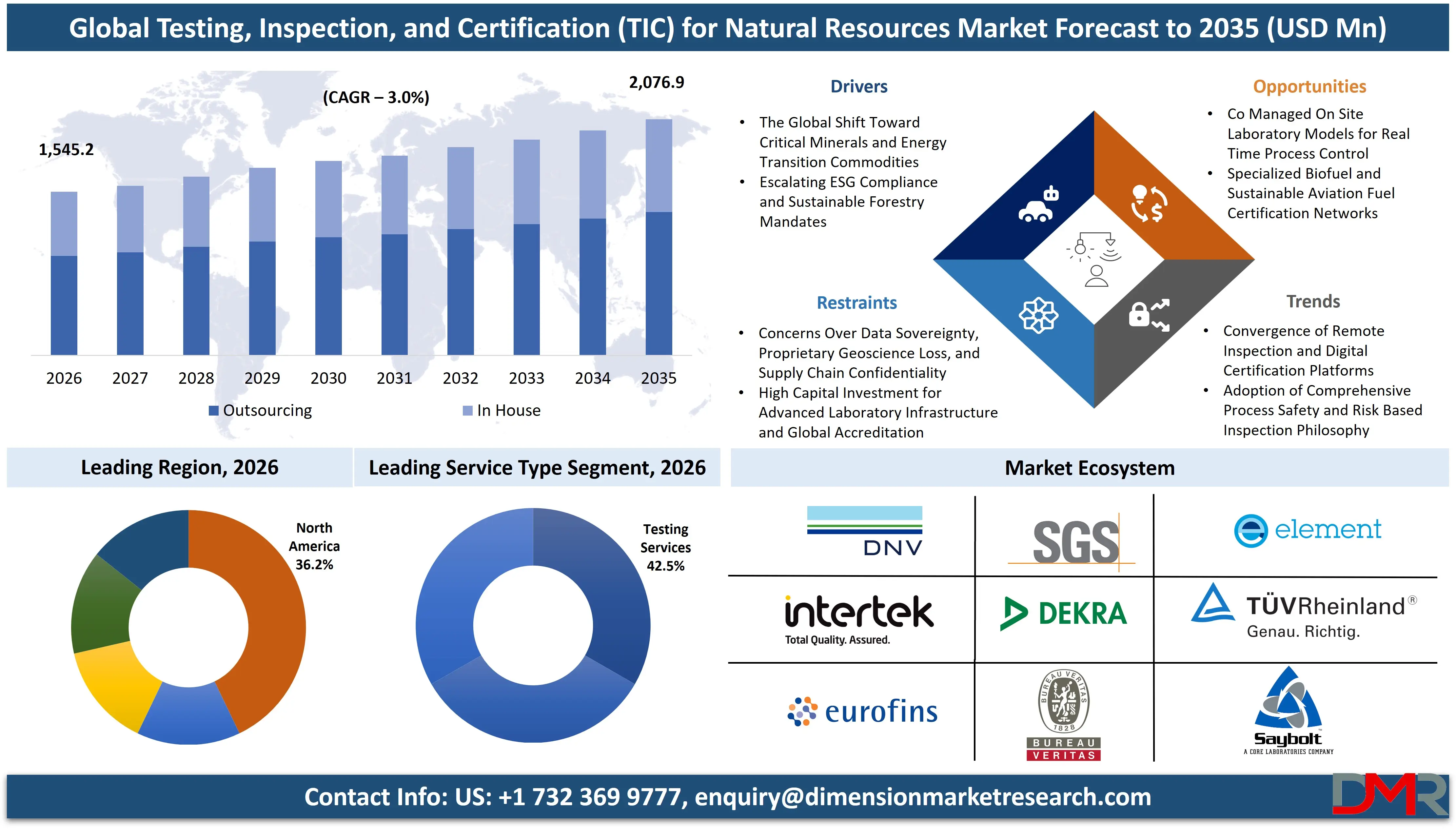
- Global TIC for Natural Resources Market Size in 2026: USD 1,545.2 Million
- Global TIC for Natural Resources Market Size in 2035: USD 2,076.9 Million
- Global CAGR from 2026 to 2035: 3.0%
- Testing Services is the leading service type segment in 2026: 42.5%
- In-House TIC is the leading sourcing type segment in 2026: 58.3%
- Oil and Gas is the leading end-user industry segment in 2026: 31.8%
- North America is the leading region in 2026: 36.2%
What is the Global Testing, Inspection, and Certification (TIC) for Natural Resources Market and its Market Size?
The Global Testing, Inspection, and Certification (TIC) for Natural Resources Market is projected to be valued at USD 1,545.2 million in 2026 and is projected to reach USD 2,076.9 million by 2035, expanding at a steady CAGR of 3.0% during the forecast period. Growth is being sustained by the escalating complexity of global supply chains for critical minerals, intensifying regulatory scrutiny on carbon intensity and sustainable sourcing, the need for real-time asset integrity management in aging oil and gas infrastructure, and the mainstream adoption of circular economy principles requiring rigorous material verification. Investment is accelerating as stakeholders move beyond basic pass/fail testing toward predictive asset life-cycle analytics, real-time process optimization, and integrated digital certification platforms to validate and de-risk every transaction in the physical commodities value chain.
ℹ
To learn more about this report –
Download Your Free Sample Report Here
Use Cases
- Critical Mineral Assay and Grade Validation for Battery Supply Chains: Mining operators use TIC services for definitive metallurgical assay and elemental characterization of lithium, cobalt, and nickel ores. This ensures that shipment-grade concentrates meet the precise chemical specifications demanded by cathode active material producers, de-risking offtake agreements and financing for new extraction projects.
- Non-Destructive Asset Integrity Inspection in Downstream Refining: Oil and gas facility operators deploy advanced non-destructive testing (NDT) and robotic crawler-based inspection for corrosion under insulation (CUI) monitoring on pressure vessels and piping. This predictive asset management approach validates fitness-for-service, prevents catastrophic loss of primary containment, and extends operational lifecycles in harsh processing environments.
- Renewable Fuel Carbon Intensity and Sustainability Certification: Biofuel producers leverage TIC services for conformity assessment against the Carbon Offsetting and Reduction Scheme for International Aviation (CORSIA) or the EU's Renewable Energy Directive (RED III). This involves complete mass-balance auditing, lifecycle greenhouse gas emission modeling, and issuing sustainability certificates that are non-negotiable for market access and premium pricing.
- Water Stewardship and Discharge Compliance for Mining Operations: Extractive industries utilize environmental testing for real-time monitoring of tailings dam seepage, groundwater quality, and operational discharge. Laboratories analyze heavy metal concentrations, pH, and total dissolved solids to demonstrate compliance with discharge permits, ensuring social license to operate and preventing ecological legacy liabilities.
Key Takeaways
- Market Size: The Global TIC for Natural Resources Market is anticipated to be valued at USD 1,545.2 million in 2026 and is forecast to reach USD 2,076.9 million by 2035, expanding at a stable CAGR of 3.0%.
- Growth Outlook: Market expansion is supported by the energy transition's demand for verified critical minerals, the globalization of liquefied natural gas (LNG) trade requiring precise custody transfer measurement, and the growing corporate mandate for third-party verified ESG reporting over self-declared sustainability claims.
- Primary Growth Drivers: An overwhelming volume of regulatory divergence across jurisdictions, the immense technical complexity of quantifying embedded carbon in commodities, strict safety mandates for asset integrity in extractive industries, and the inability of internal labs to perform specialized forensic metallurgy are accelerating global investment in outsourced and co-managed TIC solutions.
- By Service Type Analysis: Testing Services is projected to lead the service segment with a dominant 42.5% share in 2026, driven by the non-negotiable requirement for precise geochemical assay, advanced gas chromatography-mass spectrometry (GC-MS) for hydrocarbon fingerprinting, and contamination profiling to identify adulterants that devalue commodity cargos.
- By Sourcing Type Analysis: In-House TIC is expected to dominate the sourcing segment with a 58.3% share in 2026, supported by the massive installed base of upstream oil and gas operators and integrated mining giants who maintain proprietary laboratories for core sample analysis and real-time process control to protect proprietary extraction data.
- By End-User Industry Analysis: Oil and Gas is anticipated to dominate with a 31.8% share in 2026, driven by its sprawling upstream, midstream, and downstream infrastructure that generates massive logistical flows requiring continuous metrology verification, corrosion monitoring, and product purity certification for globally traded benchmark crudes and refined distillates.
- By Region Analysis: North America is projected to lead with a 36.2% share in 2026, driven by its position as a hub for shale-derived oil, natural gas liquids, and a burgeoning critical minerals mining sector, all operating under strict EPA and Bureau of Land Management regulatory oversight.
How AI/Gen AI is Transforming the Testing Inspection Certification For Natural Resources Market?
Artificial intelligence is fundamentally transforming TIC by enabling predictive asset failure modeling and automated defect recognition across vast digital twin datasets. Machine learning algorithms dynamically baseline "normal" corrosion rates or mineralogical variation patterns, classify genuine structural flaws from benign surface anomalies in radiographic weld images, and predict remaining useful life of a process column under specific operational conditions. Generative AI assistants are being integrated into laboratory information management systems (LIMS), allowing field inspectors to create complex geochemical interpretation reports and generate bespoke sampling plans using natural language prompts, significantly reducing manual reporting time and human error in material characterization and regulatory submission processes.
The next frontier of adoption involves agentic AI workflows that orchestrate closed-loop quality assurance autonomously. In this paradigm, an in-line sensor on a slurry pipeline detects a subtle divergence from target grind size, instantly instructs the laboratory execution system to prioritize a particle size distribution analysis, and then correlates the mineral liberation data against the flotation circuit's real-time recovery rate to perform root-cause analysis on yield degradation. This capability compresses quality deviation response cycles from shifts to minutes. However, for these AI models to be trusted in commercial release decisions like certifying a multi-million-dollar copper concentrate shipment, they require strict governance on high-integrity training data derived from historical round-robin assay results and expert-validated mineralogical reference standards to prevent commercially catastrophic misclassification.
Key Drivers in the Global Testing Inspection Certification For Natural Resources Market
The Global Shift Toward Critical Minerals and Energy Transition Commodities
The acute global imperative to secure a resilient supply of lithium, cobalt, rare earth elements, and high-purity copper is a primary driver for the TIC market. Investors and downstream OEMs struggle to validate the provenance, ethical footprint, and technical quality of these commodities without accredited third-party testing. This due diligence vacuum directly fuels demand for independent testing services that provide immediate access to definitive feasibility study data, responsible sourcing audits, and specialized analytical chemistry for mineral processing optimization. The growing complexity of battery metal specifications, including impurities at parts-per-million levels, requires advanced instrumental neutron activation analysis (INAA) and inductively coupled plasma mass spectrometry (ICP-MS) expertise, making the conformity assessment-as-a-service model essential for developers who cannot replicate such high-end laboratory infrastructure.
Escalating ESG Compliance and Sustainable Forestry Mandates
A tightening web of global regulations on deforestation-free supply chains, embodied carbon, and sustainable aviation fuel (SAF) integrity is forcing organizations to adopt continuous chain-of-custody verification. Frameworks like the EU Deforestation Regulation (EUDR) and International Sustainability and Carbon Certification (ISCC) increasingly mandate demonstrable geolocation-based traceability and mass balance reconciliation from feedstock origin to final fuel lot. Furthermore, global commodity exchanges are now strictly auditing the certification status of metal brands before allowing delivery against futures contracts, often requiring third-party verified conformity to ISO 14001 and responsible mining standards as a prerequisite for listing. TIC services directly fulfill these requirements by providing auditable forensic isotope analysis, remote sensing validation, and a demonstrable custody transfer audit trail, transforming them from optional advisory work into a business and market access necessity.
Restraints in the Global Testing Inspection Certification For Natural Resources Market
Concerns Over Data Sovereignty, Proprietary Geoscience Loss, and Supply Chain Confidentiality
The core function of a TIC provider is its access to hypersensitive geological data, proprietary drilling results, and exact chemical signatures of ore bodies or crude streams. Entrusting this data to an external laboratory or inspector introduces significant concerns over intellectual property theft, competitive mineral asset intelligence leaks, and unauthorized transfer of basin modeling data across borders. National oil companies, major mining houses, and state-controlled mineral resource agencies may resist granting external labs deep access to their exploratory core samples and stratigraphic test data, fearing a loss of direct competitive advantage and the creation of a new information supply chain risk where the testing provider itself could become a vector for resource nationalism threats. This data governance friction can delay or block outsourced TIC adoption, particularly for greenfield exploration and enhanced oil recovery (EOR) pilot programs.
Growth Opportunities in the Global Testing Inspection Certification For Natural Resources Market
Co-Managed On-Site Laboratory Models for Real-Time Process Control
A significant growth opportunity lies in co-managed TIC models that embed a provider's analytical chemists and asset integrity specialists within a client's existing mine-site or refinery laboratory. This approach addresses the "loss of control" restraint by providing a unified quality management platform where internal metallurgists and external test engineers collaborate on blast hole sample analysis, share predictive maintenance insights, and jointly define non-destructive testing (NDT) standard operating procedures. This model is particularly attractive to large-scale copper and gold porphyry operations with existing infrastructure who want to augment turnaround times for geometallurgical block modeling and access specialized expertise for autoclave corrosion monitoring without fully outsourcing their entire quality function. It creates a sticky, recurring revenue relationship built on operational partnership rather than pure transactional testing.
Specialized Biofuel and Sustainable Aviation Fuel (SAF) Certification Networks
The rapid scaling of advanced biofuel refineries for hydroprocessed esters and fatty acids (HEFA) and alcohol-to-jet (AtJ) pathways creates a massive opportunity for specialized TIC certification networks. These novel fuels require rigorous validation of lifecycle carbon intensity, nitrous oxide emissions profiles, and strict conformance to ASTM D7566 or ASTM D1655 specifications. A generic petrochemical testing lab is ill-equipped to handle the complex mass balance and feedstock traceability audits required for SAF tax credits or renewable identification number (RIN) generation. Providers who develop deep domain expertise in GHG quantification modeling, integrate with farm-level sustainable agriculture certification schemes, and offer guaranteed book-and-claim chain-of-custody solutions can unlock a high-value, underserved market segment critically tied to aviation decarbonization mandates.
Trends in the Global Testing Inspection Certification For Natural Resources Market
Convergence of Remote Inspection and Digital Certification Platforms
The market is witnessing a convergence of remote visual inspection (RVI) drones and blockchain-anchored digital certification into a unified, outcome-focused asset management stack. Rather than simply issuing a paper certificate of conformity, modern TIC contracts are defined by predictive risk scores and asset integrity key performance indicators. This trend is driving providers to tightly integrate thermographic imaging, unmanned aerial vehicle (UAV) wall-thickness measurements, and AI-driven defect classification into their service core. The focus is shifting from periodic manual spot-checks to continuous structural health monitoring and guided repair recommendations. This convergence simplifies vendor management for resource companies and delivers a more integrated asset stewardship program, where an inspection anomaly on a flare stack directly triggers a digital work order and updates the digital twin, accelerating the entire maintenance lifecycle from detection to closure.
Adoption of a Comprehensive Process Safety and Risk-Based Inspection (RBI) Philosophy
A forward-looking trend is the integration of Risk-Based Inspection (RBI) methodologies into the core TIC lifecycle. Service providers are evolving beyond traditional time-based inspection schedules to proactively model damage mechanisms and predict failure probabilities. This involves continuous corrosion rate monitoring, automated external corrosion direct assessment (ECDA), and quantitative RBI software to validate whether a pressure safety valve or distillation column is fit for continued service against specific sulfide stress cracking or high-temperature hydrogen attack mechanisms. By providing this holistic process safety management framework alongside standard non-destructive examination, TIC providers are positioning themselves as strategic partners for mechanical integrity, capable of calculating risk of loss of containment, not just measuring wall thickness.
Research Scope and Analysis
The Global Testing, Inspection, and Certification (TIC) for Natural Resources Market is segmented by service type, sourcing type, and end-user industry. Service types include testing, inspection, and certification. The study evaluates market dynamics across outsourced and in-house models, and across key verticals including metals and mining, oil and gas, chemicals, biofuels, and water resources.
ℹ
To learn more about this report –
Download Your Free Sample Report Here
By Service Type Analysis
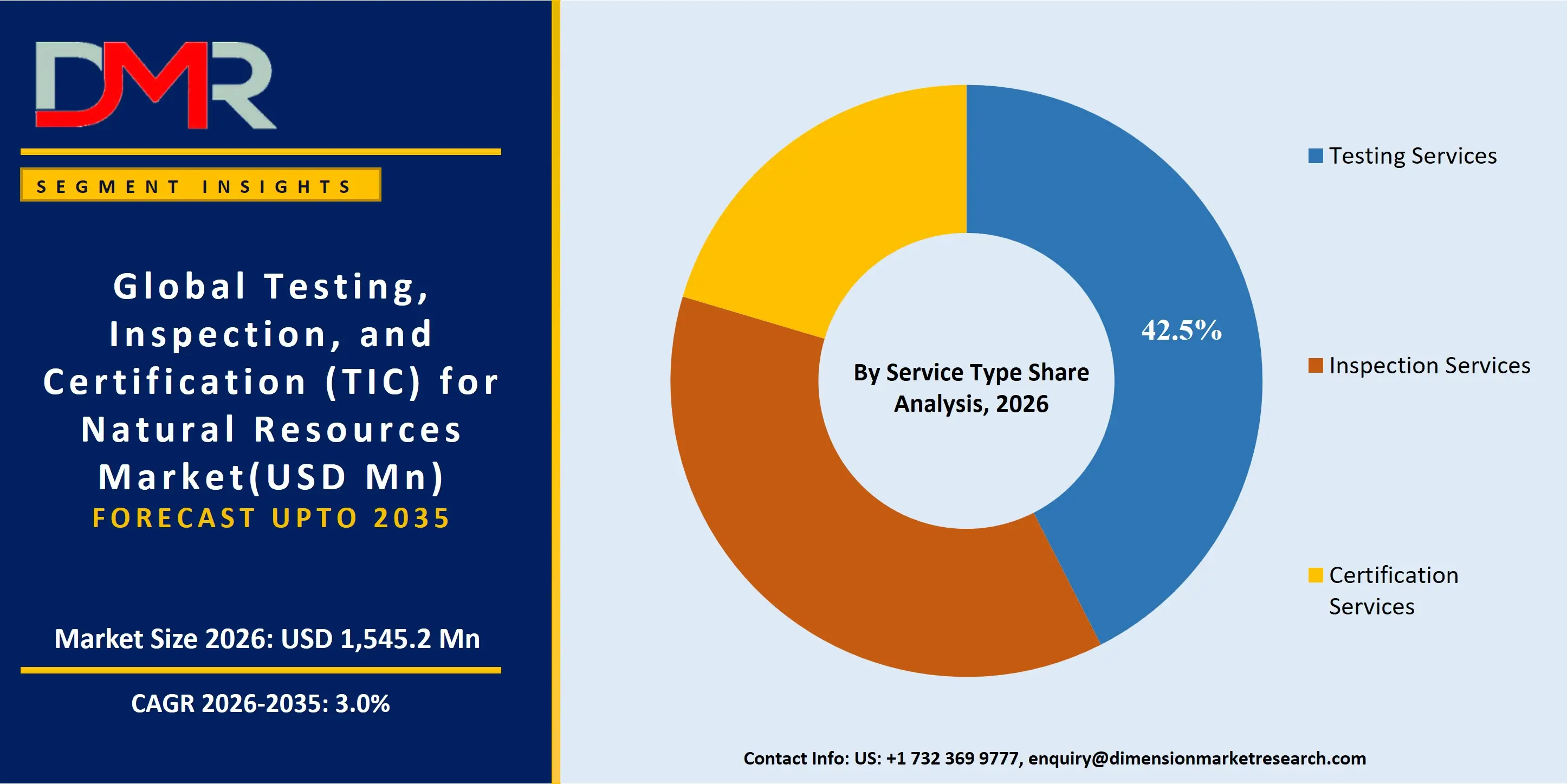
Testing Services is poised to dominate the Global TIC for Natural Resources Market with a 42.5% market share in 2026, underpinned by the core value proposition of definitive assay development, environmental baseline monitoring, and forensic failure analysis to validate the physical and chemical properties of natural resource commodities. These solutions are essential for achieving contractual product specification compliance, mineral resource estimation, and metallurgical accounting. Inspection Services holds the second-highest share, driven by the critical need for non-destructive evaluation (NDE), pipeline integrity digs, and cargo superintendence to manage operational risk when assets are in service. Certification Services are projected to record the strongest CAGR, as organizations increasingly demand accredited management system certification (ISO 14001, ISO 45001) and independent ESG assurance to proactively prove their social responsibility and market access credentials.
By Sourcing Type Analysis
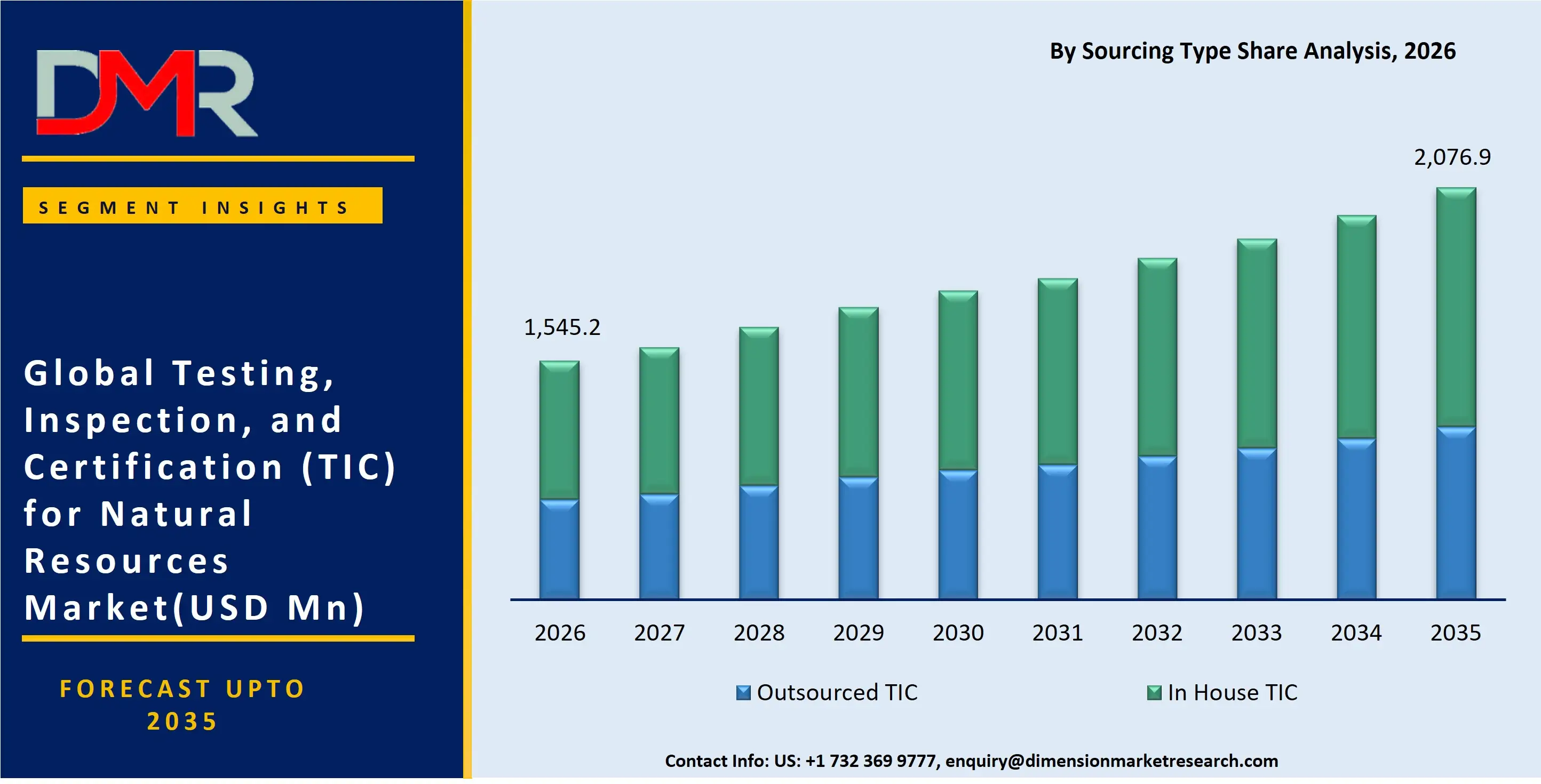
In-House TIC is anticipated to dominate the market with a 58.3% share in 2026, as operational control over time-sensitive core logging, process stream analysis, and real-time process control remains a strategic imperative for major operators. Deep institutional knowledge of an ore body's geochemical variability or a refinery's corrosion circuit is foundational to optimizing recovery rates and yields.
ℹ
To learn more about this report –
Download Your Free Sample Report Here
Outsourced TIC accounts for the remaining share but is projected to expand at a higher CAGR, supported by the burgeoning demand from junior mining explorers without capital-intensive lab infrastructure, the commodity trading sector requiring impartial cargo umpire and analysis services, and the specialized expertise needed for emerging sustainability certification and complex environmental impact assessments.
By End-User Industry Analysis
Oil and Gas is projected to lead with a 31.8% market share in 2026, due to the industry's complex, high-pressure, and globally traded portfolio of crude blends, natural gas liquids, and petrochemical feedstocks that require continuous custody transfer measurement, sediment and water content analysis (BS&W), and statutory pressure equipment inspection. These operations mandate TIC partners for upstream well integrity, midstream pipeline in-line inspection (ILI), and downstream catalyst condition monitoring. Metals and Mining is expected to register the highest CAGR, driven by an unprecedented surge in exploration expenditure for copper, lithium, and rare earths, where resource definition drilling and standardized mineral sampling protocols are the sole basis for securing project financing. Biofuels, though a smaller base, is anticipated to outpace overall market growth, fueled by the non-negotiable certification requirements for proving greenhouse gas reductions and feedstock sustainability for regulatory credit programs in the US and EU.
The Global Testing Inspection Certification For Natural Resources Market Report is segmented on the basis of the following:
By Service Type
- Testing Services
- Laboratory Testing
- Material Characterization
- Chemical and Composition Analysis
- Environmental Testing
- Inspection Services
- Pre Shipment Inspection
- Site and Facility Inspection
- Sampling and Cargo Inspection
- Asset Integrity Inspection
- Certification Services
- Management System Certification
- Product Certification
- Sustainability Certification
- Regulatory Compliance Certification
By Sourcing Type
- Outsourced TIC
- In-House TIC
By End User Industry
- Metals and Mining
- Precious Metals
- Base Metals
- Industrial Minerals
- Critical Minerals
- Oil and Gas
- Upstream
- Midstream
- Downstream
- Chemicals and Petrochemicals
- Basic Chemicals
- Specialty Chemicals
- Petrochemicals
- Biofuels
- Bioethanol
- Biodiesel
- Sustainable Aviation Fuel
- Water Resources
- Forestry
- Agriculture Related Commodities
- Others
Regional Analysis
North America is the Leading Region in the Global TIC for Natural Resources Market
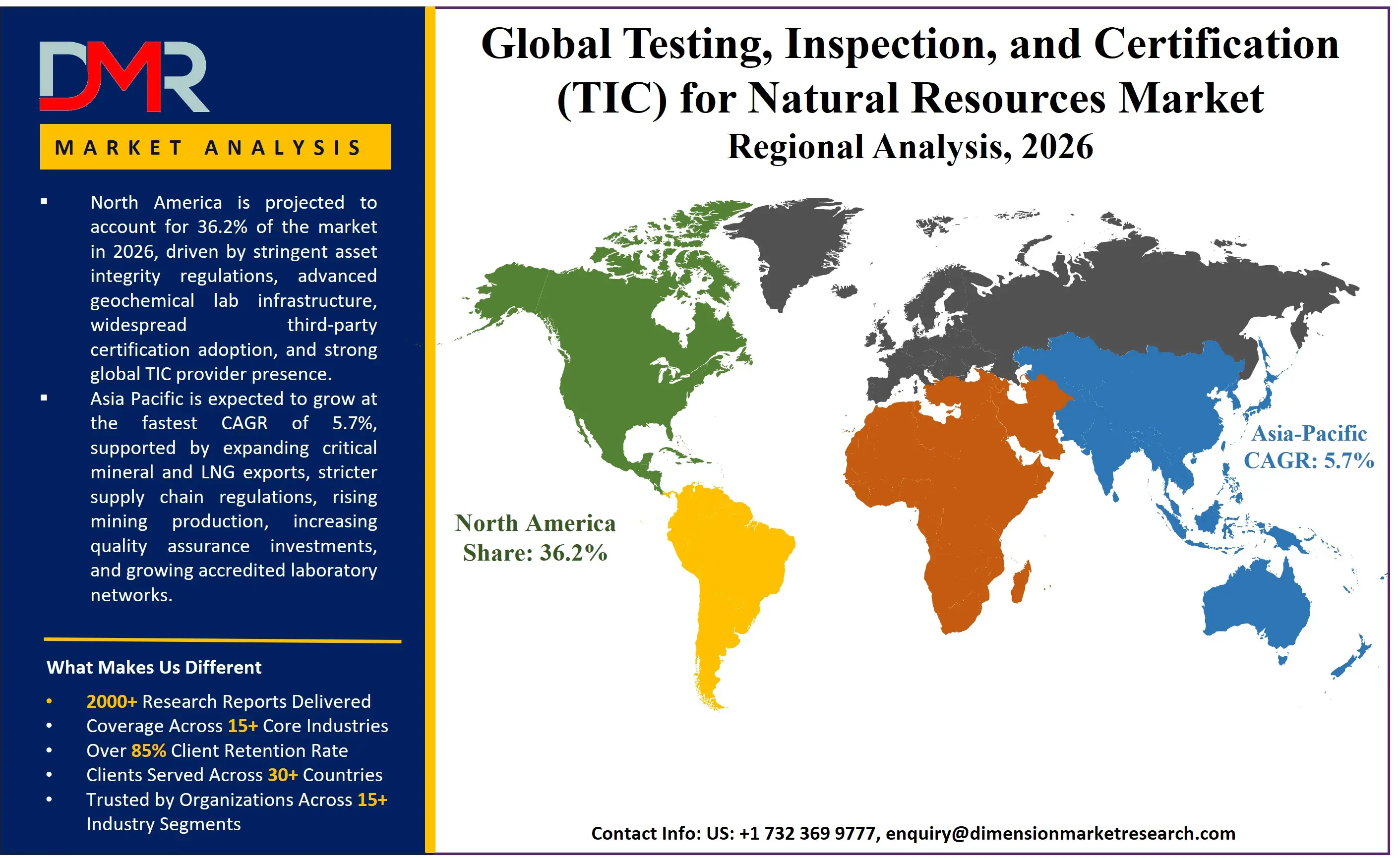
North America is poised to lead the Global TIC for Natural Resources Market with an estimated 36.2% revenue share in 2026, anchored by its position as the world's most liquid and transparent commodity trading hub. The region's dominance stems from a dense concentration of well-capitalized upstream shale operators in the Permian and Bakken basins requiring continuous well integrity verification, globally integrated refining and petrochemical complexes on the U.S. Gulf Coast mandating pressure equipment inspection, and a revitalized critical minerals mining sector spurred by the Inflation Reduction Act and Defense Production Act Title III. Aggressive early adoption of robotic tank inspection, real-time pipeline in-line inspection (ILI) data analytics, and the presence of the world's most sophisticated independent geochemical assay and metallurgical laboratory networks solidify its status as the primary global nexus for advanced conformity assessment, resource estimation, and chain-of-custody verification.
ℹ
To learn more about this report –
Download Your Free Sample Report Here
Asia Pacific is the Fastest-Growing Region in the Global TIC for Natural Resources Market
Asia Pacific is projected to register the fastest CAGR of 5.7% through 2035, driven by its status as the world's manufacturing forge and the dominant smelting and refining hub for base metals, battery minerals, and steelmaking raw materials. Massive greenfield mineral exploration across Australia's Paterson Province and rare earth development in Central Asia, combined with the rapid expansion of integrated refinery-petrochemical complexes in China's coastal provinces and India's Gujarat corridor, necessitates rapid adoption of independent cargo superintendence, umpire assay, and statutory equipment inspection. Accelerating LNG hub development in Indonesia and Papua New Guinea, government-led mandatory Indonesian Sustainable Palm Oil (ISPO) certification audits, and the expansion of deep-sea tailings placement monitoring for porphyry copper operations in the Coral Triangle further fuel demand for specialized TIC services covering geotechnical core logging, ISO 17025-accredited analytical chemistry, and continuous environmental discharge monitoring for the region's resource-intensive growth.
The Europe TIC for Natural Resources Market
Europe represents the second-largest regional market, distinguished by its world-leading regulatory framework driven by the EU Green Deal, the Corporate Sustainability Reporting Directive (CSRD), and the REACH regulation, which mandates rigorous ecotoxicological profiling and substance identity verification for all mineral concentrates, metal alloys, and petrochemical streams. The region's powerhouse automotive and aerospace original equipment manufacturers (OEMs), particularly Germany's demand for certified conflict-free smelter audits compliant with the EU Battery Passport, and Scandinavia's high-value underground hard rock mining of copper, zinc, and rare earths, is a significant growth engine. This necessitates specialized TIC for battery-grade lithium hydroxide monohydrate purity certification, certified sustainable forestry management per PEFC standards, and digital product passports that must fuse physical material integrity with immutable traceability data.
Latin America TIC for Natural Resources Market
The Latin America TIC for Natural Resources Market is expanding steadily as the region undergoes a historic mining super-cycle, with Chile, Peru, and Argentina forming the epicenter of global greenfield copper and lithium brine exploration and extraction. Brazil leads agricultural commodity certification demand, driven by stringent EUDR compliance requirements for its soybean, beef, and coffee exports, which now mandate polygon-mapped deforestation-free audits and segregated mass balance verification. The technical and capital-intensive nature of proving a National Instrument 43-101 or JORC-compliant mineral resource and ore reserve makes independent, third-party metallurgical test work and geometallurgical modeling highly attractive to junior exploration companies seeking project financing. International TIC players partnering with local geochemical laboratories for rapid sample preparation and Spanish and Portuguese-speaking, regulatory-fluent audit teams represent the key pathway to capturing this mineral-rich and agri-commodity market.
Middle East and Africa TIC for Natural Resources Market
The Middle East and Africa TIC for Natural Resources Market is developing alongside massive national oil company (NOC) upstream and downstream expansion programs, the Gulf's chemical industrialization into integrated refining and petrochemical mega-hubs like Jubail and Ruwais, and the formalization of artisanal and large-scale mining across the African Copperbelt and the West African gold belts. Saudi Arabia and the UAE are the primary investment hubs, driven by massive In-Country Value (ICV) programs that mandate certified local content verification and risk-based inspection (RBI) for new blue and green hydrogen, ammonia, and methanol mega-projects. South Africa, the Democratic Republic of Congo, and Ghana lead the African continent with their mature PGM, copper-cobalt, and gold sectors. The growing operational complexity of deepwater offshore developments and ultra-sour gas processing in the region is spurring demand for integrated RBI services, fitness-for-service (FFS) engineering assessments, and process safety management certification to build a foundational technical safety barrier against catastrophic loss of primary containment.
Major Countries Analysis
The US TIC for Natural Resources Market
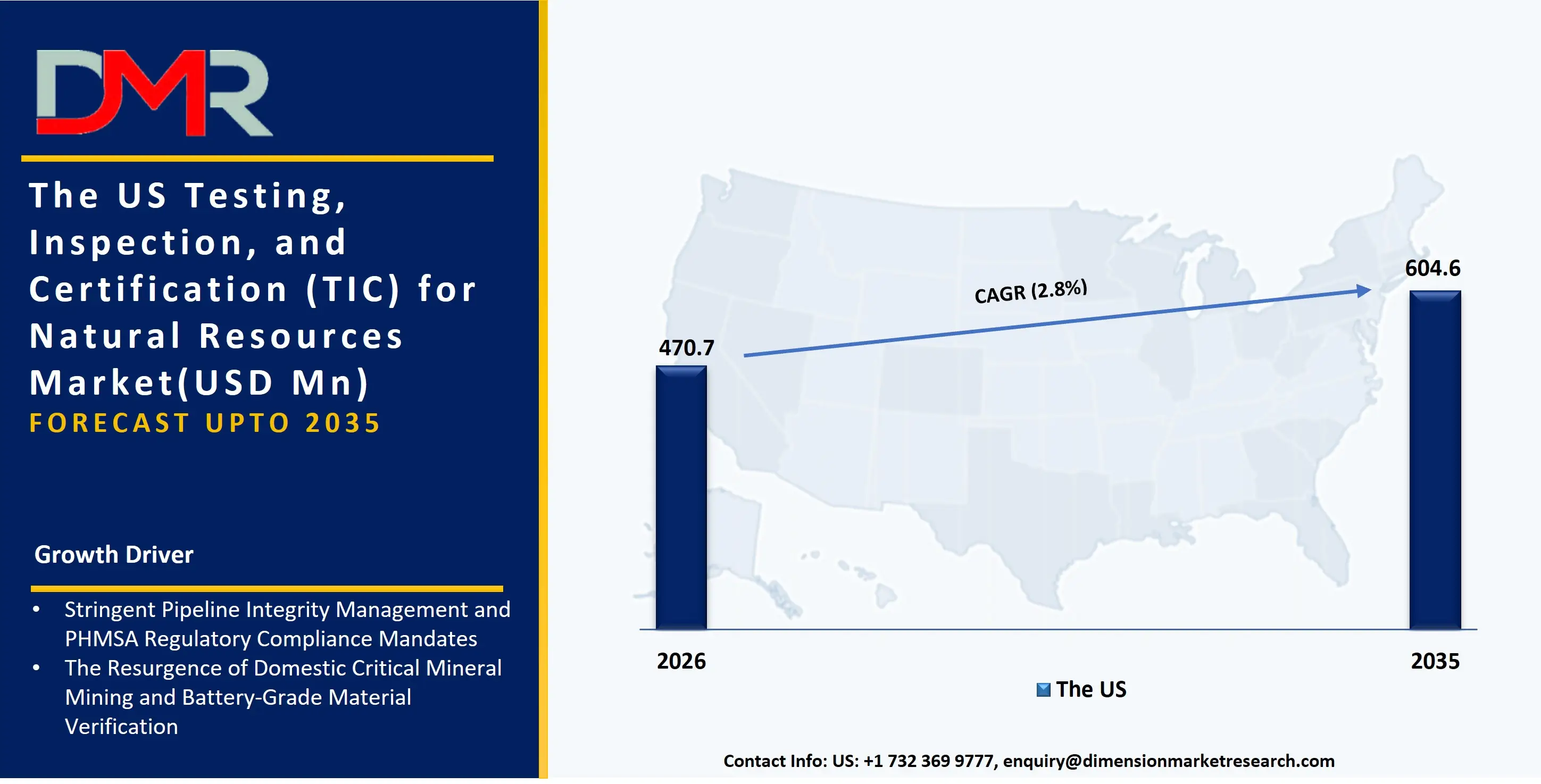
The United States TIC for Natural Resources Market is projected to be valued at USD 470.7 million in 2026 and is expected to reach USD 604.6 million by 2035, registering a CAGR of 2.8% from 2026 to 2035. This robust trajectory reflects the U.S.'s position as the world's leading producer of oil and natural gas liquids and a rapidly emerging lithium and rare earth processor. Growth is fueled by the Pipeline and Hazardous Materials Safety Administration's (PHMSA) stringent integrity management rules for gas transmission pipelines, the SEC's proposed climate disclosure rule requiring Scope 3 emissions verification, and a relentless wave of M&A activity in the Permian Basin demanding independent reserve-based lending audits and environmental site assessments. The shift from periodic manual ultrasonic thickness (UT) gauging to permanently installed fiber-optic corrosion monitoring arrays with third-party data validation is a defining driver of digital TIC expansion.
ℹ
To learn more about this report –
Download Your Free Sample Report Here
Japan Testing Inspection Certification For Natural Resources Market
The Japan Testing Inspection Certification For Natural Resources Market is estimated to be valued at USD 106.5 million in 2026 at a CAGR of approximately 3.0% between 2026 and 2035. Market growth is driven by increasing dependence on imported mineral resources, stringent industrial quality standards, and growing investments in battery materials and sustainable energy supply chains. Rising demand for laboratory testing, cargo inspection, environmental compliance verification, and certification of critical minerals supports market development. Japan's strong emphasis on resource efficiency, product quality, and ESG compliance continues to accelerate adoption of advanced Testing Inspection Certification services across natural resource industries.
Saudi Arabia Testing Inspection Certification For Natural Resources Market
The Saudi Arabia Testing Inspection Certification For Natural Resources Market is estimated at USD 58.4 million in 2026 at a CAGR of 4.7%. Growth is closely aligned with Vision 2030, which is accelerating investments in mining, mineral exploration, petrochemicals, and downstream industrial development. Expanding production of phosphate, gold, copper, and other strategic minerals is increasing demand for laboratory analysis, inspection, asset integrity management, environmental testing, and internationally recognized certification services. Continuous investment in infrastructure modernization and regulatory compliance further creates opportunities for third-party TIC providers across the Kingdom's evolving natural resources sector.
Regulatory Landscape
The regulatory landscape is the primary, non-negotiable structural catalyst for TIC investment in the natural resources sector. In the European Union, the EU Deforestation Regulation (EUDR) and Corporate Sustainability Due Diligence Directive (CSDDD) mandate geospatial polygon-mapped, auditable, and verifiable proof that commodities like palm oil, soy, and beef are not sourced from deforested land, creating an immense demand for satellite-monitoring-verified chain-of-custody certification. In North America, the SEC's climate disclosure rules and Canada's National Instrument 43-101 enforce liability around public resource statements, making independent qualified person (QP) audits and mineral resource validation legally binding exercises. The London Metal Exchange (LME) requires responsible sourcing certification aligned with OECD Due Diligence Guidance for all listed metal brands. For the global oil and gas industry, API 510, API 570, and ASME B31.8S pressure vessel, piping, and pipeline integrity codes demand periodic, third-party or authorized inspector-verified non-destructive examination.
Investment and White Space Analysis
The strongest investment opportunities lie in digital twin-native asset integrity platforms that fuse robotic inspection data, corrosion predictive analytics, and fitness-for-service engineering assessments into a single, real-time operational interface that moves clients from time-based maintenance to predictive, risk-based strategies. Significant white space exists in developing cost-effective, regulatory-aligned certification bundles for junior critical mineral explorers and mid-cap producers in emerging jurisdictions that are now being required by off-takers to demonstrate EU Battery Passport or IRMA-standard compliance but lack the internal expertise. Providers can differentiate through "co-managed" on-site laboratory models that seamlessly integrate a TIC firm's analytical chemists and mineralogists within a mining client's existing sample preparation facility, offering guaranteed turnaround times for geometallurgical models.
By Region
North America
Europe
- Germany
- The U.K.
- France
- Italy
- Russia
- Spain
- Benelux
- Nordic
- Rest of Europe
Asia-Pacific
- China
- Japan
- South Korea
- India
- ANZ
- ASEAN
- Rest of Asia-Pacific
Latin America
- Brazil
- Mexico
- Argentina
- Colombia
- Rest of Latin America
Middle East & Africa
- Saudi Arabia
- UAE
- South Africa
- Israel
- Egypt
- Rest of MEA
Competitive Landscape
The Global TIC for Natural Resources Market features a dynamic landscape ranging from pure-play geochemistry and metallurgical test labs to global conformity assessment giants with integrated assurance portfolios. At the high end, firms like SGS, Bureau Veritas, and Intertek compete on the depth of their global laboratory network footprint, the accreditation of their mineralogy and petrology capabilities, and the speed of their cargo inspection logistics. This tier competes intensely on turnaround time and data integrity. The competitive field broadens significantly in the specialized domain, where firms like ALS, Eurofins, and Core Laboratories, alongside engineering consultancies like DNV and Wood, differentiate on deep scientific expertise, mineral processing flowsheet development, and the human capital of their PhD-level chemists and geoscientists. Strategic differentiation increasingly hinges on providing a unified digital platform that fuses LIMS-based geochemical data with cloud-hosted asset integrity dashboards, supported by guaranteed turnaround times and third-party accredited, defensible data packages, not just transactional certificates of analysis.
Some of the prominent players in the Global Testing Inspection Certification For Natural Resources Market are:
- SGS SA
- Bureau Veritas SA
- Intertek Group plc
- Eurofins Scientific SE
- TÜV SÜD AG
- TÜV Rheinland AG
- DEKRA SE
- DNV Group
- Kiwa N.V.
- ALS Limited
- Applus+
- MISTRAS Group Inc.
- Element Materials Technology
- Cotecna Inspection SA
- Saybolt International BV
- Peterson Control Union Group
- Core Laboratories N.V.
- Inspectorate International Limited
- Bureau Veritas Commodities Division
- AHK Group Ltd.
- CCIC Group (China Certification & Inspection Group)
- CSA Group
- TÜV NORD Group
- LRQA Group Limited
- SAI Global Assurance
- Minerva Bunkering
- Alex Stewart International
- GeoChem Laboratories Pvt. Ltd.
- Veritas Petroleum Services (VPS)
- Socotec Group
- Other Key Players
Recent Developments
- In February 2026, SGS strengthened its critical minerals testing and mineralogy capabilities by expanding advanced analytical solutions that utilize automated mineralogy technologies such as QEMSCAN, TIMA-X, and Laser Ablation ICP-MS to support exploration, geometallurgy, process optimization, and resource characterization for lithium, rare earth elements, and other battery minerals.
- In October 2025, Bureau Veritas continued enhancing its digital inspection and asset integrity portfolio by integrating advanced automation, machine learning applications, and remote inspection technologies across its mining, metals, and industrial services, enabling faster laboratory analysis, improved mineral characterization, and more efficient infrastructure inspection for natural resource operators.
- In September 2025, Intertek expanded its end-to-end minerals assurance capabilities by strengthening automated laboratory operations, independent cargo inspection, sampling, testing, and certification services for mining and bulk commodity supply chains, helping customers improve quality assurance, reduce commercial risk, and enhance traceability across international mineral trade.
Report Details
| Report Characteristics |
| Market Size (2026) |
USD 1,545.2 Mn |
| Forecast Value (2035) |
USD 2,076.9 Mn |
| CAGR (2026–2035) |
3.0% |
| The US Market Size (2026) |
USD 470.7 Mn |
| Historical Data |
2021 – 2025 |
| Forecast Data |
2027 – 2035 |
| Base Year |
2025 |
| Estimate Year |
2026 |
| Segments Covered |
Market By Service Type, By Sourcing Type, and By End User Industry |
| Regional Coverage |
North America – The US and Canada; Europe – Germany, The UK, France, Russia, Spain, Italy, Benelux, Nordic, & Rest of Europe; Asia-Pacific – China, Japan, South Korea, India, ANZ, ASEAN, Rest of APAC; Latin America – Brazil, Mexico, Argentina, Colombia, Rest of Latin America; Middle East & Africa – Saudi Arabia, UAE, South Africa, Turkey, Egypt, Israel, & Rest of MEA |
Frequently Asked Questions
How big is the Global TIC for Natural Resources Market?
▾ The Global TIC for Natural Resources Market is valued at USD 1,545.2 million in 2026 and is projected to reach USD 2,076.9 million by 2035, reflecting steady global demand for independent quality verification, asset integrity assurance, and sustainability certification across the extractive and processing industries.
What is the CAGR of the Global TIC for Natural Resources Market from 2026 to 2035?
▾ The market is projected to expand at a compound annual growth rate (CAGR) of 3.0% between 2026 and 2035, supported by sustained investment in critical mineral exploration, LNG infrastructure inspection, and mandatory conformity assessment for the global energy transition.
What factors are driving the growth of the Global TIC for Natural Resources Market?
▾ Growth is driven by an unrelenting surge in demand for battery-grade metal verification, a global focus on methane emissions quantification in oil and gas, mandatory compliance with the EU Deforestation Regulation for commodity imports, and the adoption of digital twin models that necessitate continuous non-destructive testing and structural health monitoring.
What are the major trends in the Global TIC for Natural Resources Market?
▾ Major trends include the convergence of remote drone inspection and blockchain certification into unified integrity platforms, the integration of generative AI for metallurgical interpretation, a shift toward predictive risk-based inspection over time-based statutory checks, and the rapid rise of specialized certification schemes for sustainable aviation fuel and carbon removal credits.
Which region held the largest share of the Global TIC for Natural Resources Market in 2026?
▾ North America is expected to lead the global market with a 36.2% share in 2026, supported by a highly mature conformity assessment culture, stringent PHMSA pipeline integrity rules, widespread ESG investing mandates, and the presence of market-leading independent testing and metrology providers.
Which region is expected to grow the fastest in the Global TIC for Natural Resources Market?
▾ Asia Pacific is expected to record the fastest growth at a 5.7% CAGR through 2035, driven by a massive mineral processing base, expanding chemical manufacturing capacity, a tightening regulatory regime for commodity traceability, and government-led infrastructure certification initiatives.
Who are the key players in the Global TIC for Natural Resources Market?
▾ Key market participants include SGS, Bureau Veritas, Intertek, Eurofins, ALS, Core Laboratories, DNV, and MISTRAS Group, among other global conformity assessment and specialized geoscience testing firms.
How is the Global TIC for Natural Resources Market segmented?
▾ The market is segmented by service type, sourcing type, and end-user industry, with regional analysis covering North America, Europe, Asia Pacific, Latin America, and the Middle East and Africa.