What is the Testing, Inspection and Certification for the Transportation Market Size?
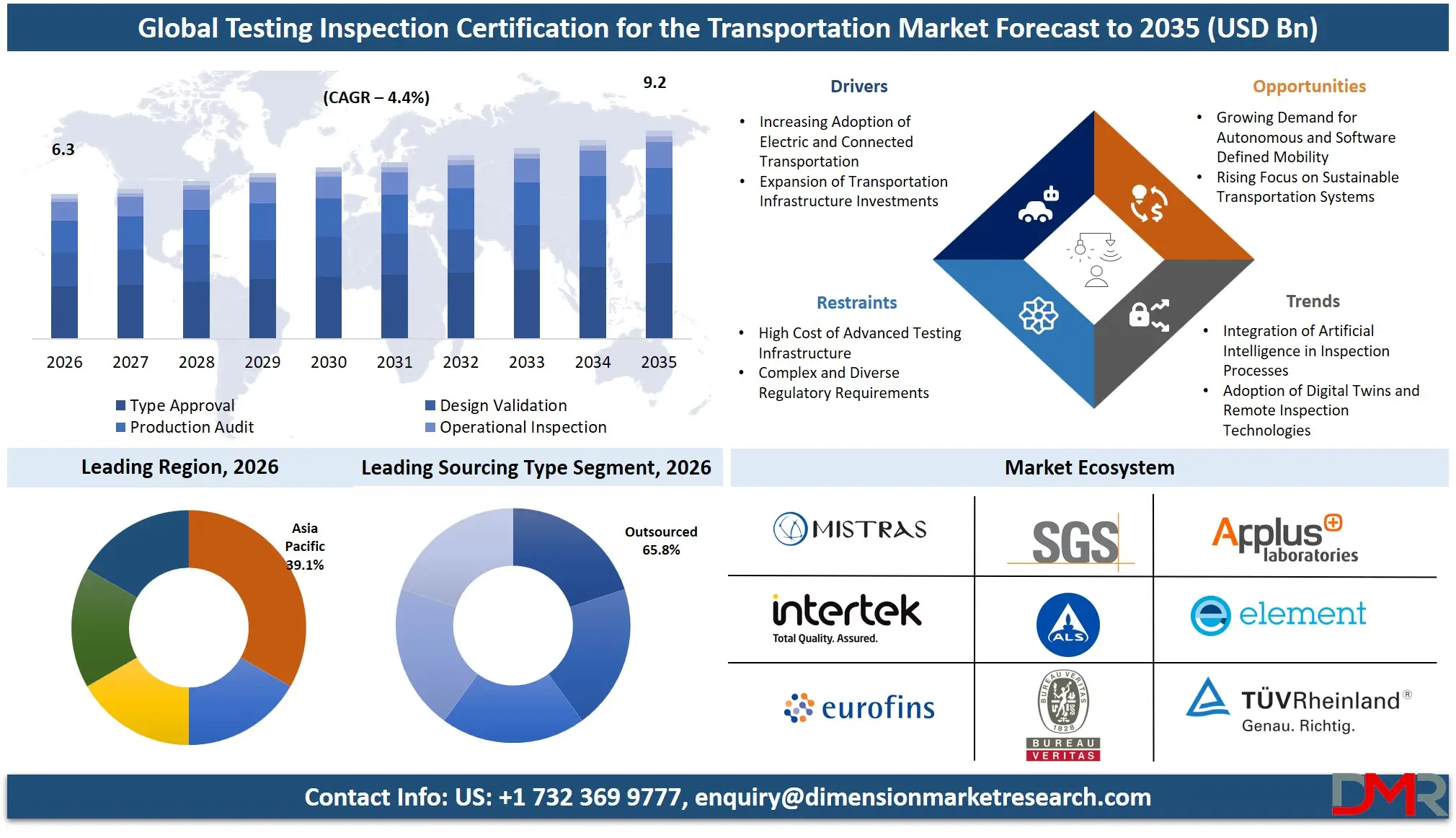
The Global Testing Inspection Certification for the Transportation Market is projected to grow from USD 6.3 billion in 2026 to USD 9.2 billion by 2035, at a CAGR of 4.4%. The market is expanding as governments strengthen transportation safety regulations and accelerate the adoption of connected, electric, and autonomous mobility solutions.
ℹ
To learn more about this report –
Download Your Free Sample Report Here
Rising investments in rail, road, aviation, and marine infrastructure are increasing demand for independent testing and certification services. According to the United Nations Economic Commission for Europe, member countries continue to harmonize transport regulations and safety standards, supporting greater demand for conformity assessment services. Growing digitalization, cybersecurity requirements, and sustainability initiatives will further expand opportunities for advanced testing, inspection, and certification providers worldwide.
United States Testing Inspection Certification For the Transportation Market
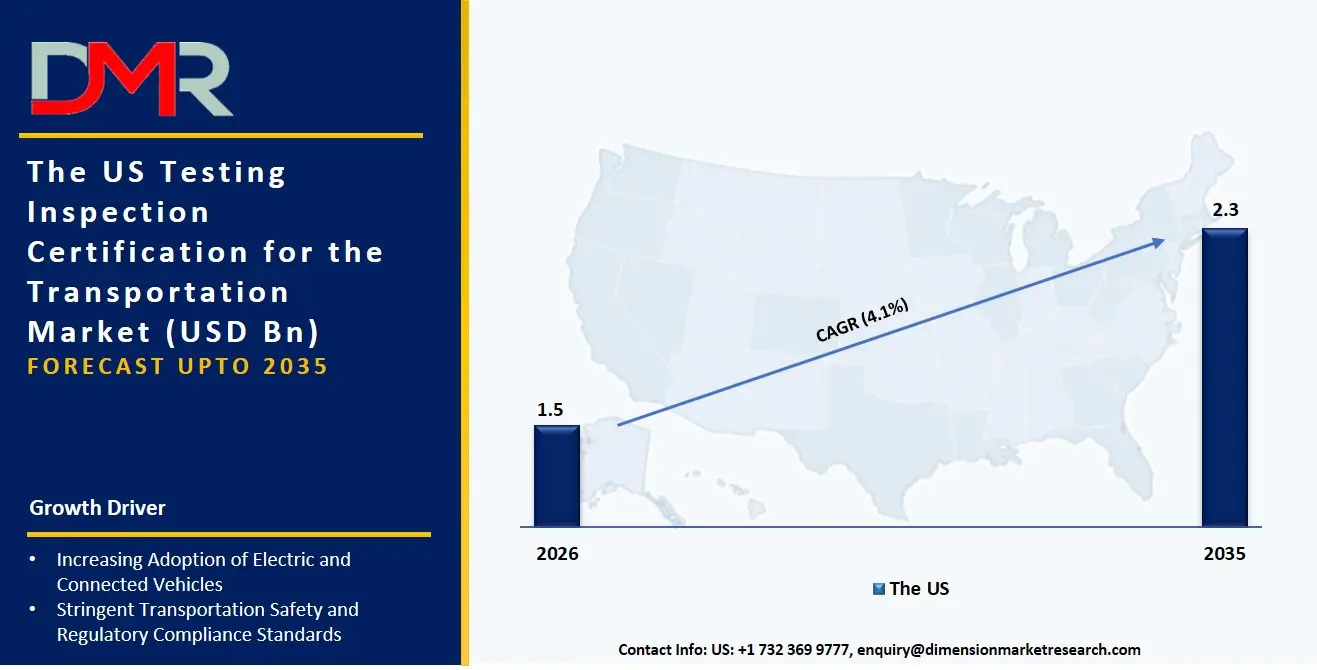
The United States Testing Inspection Certification for the Transportation Market is expected to increase from USD 1.5 billion in 2026 to USD 2.3 billion by 2035, at a CAGR of 5.2%.
ℹ
To learn more about this report –
Download Your Free Sample Report Here
The market benefits from stringent federal transportation safety regulations, increasing electric vehicle production, and modernization of freight and passenger transportation systems. The United States Department of Transportation maintains extensive inspection programs for commercial vehicles to ensure compliance with federal safety standards. Growing adoption of software defined vehicles, connected mobility, and automated driving technologies is creating additional demand for cybersecurity validation and functional safety testing. Continued infrastructure modernization and regulatory oversight are expected to support long term market expansion.
Europe Testing Inspection Certification For the Transportation Market
The Europe Testing Inspection Certification for the Transportation Market is forecast to expand from USD 1.5 billion in 2026 to USD 2.2 billion by 2035, at a CAGR of 4.1%. Market growth is supported by strict European transportation safety legislation, environmental regulations, and increasing investment in sustainable mobility. European countries continue to enhance vehicle safety, rail modernization, and cross border transport standards through harmonized regulatory frameworks. The United Nations Economic Commission for Europe works closely with European governments to standardize transport regulations and statistical methodologies across member nations. Growing adoption of electric mobility, intelligent transportation systems, and digital inspection technologies will continue to strengthen demand for transportation testing, inspection, and certification services.
Japan Testing Inspection Certification for the Transportation Market
The Japan Testing Inspection Certification for the Transportation Market is anticipated to grow from USD 570.0 million in 2026 at a CAGR of 4.9%. The market is driven by Japan's strong automotive manufacturing base, advanced railway infrastructure, and continuous investment in transportation safety. According to Japan's Ministry of Land, Infrastructure, Transport and Tourism, the government annually publishes transportation safety information and promotes comprehensive safety management across road, rail, aviation, and maritime sectors. In addition, Japan recorded approximately 83.1 million registered motor vehicles, requiring extensive inspection and certification activities throughout their lifecycle. Continued advancements in autonomous mobility, battery technologies, and smart transportation will support future market growth.
Key Takeaways
- Market Size: The Global Testing Inspection Certification for the Transportation Market is projected to increase from USD 6.3 billion in 2026 to USD 9.2 billion by 2035, reflecting steady demand for independent compliance, safety verification, regulatory assessment, and quality assurance services across transportation industries.
- Growth Rate and Outlook: The market is anticipated to expand at a CAGR of 4.4% from 2026 to 2035, supported by stricter transportation regulations, digital mobility technologies, infrastructure modernization, electric vehicle adoption, and increasing certification requirements across global road, rail, aviation, and marine networks.
- Primary Growth Drivers: Rising adoption of electric vehicles, autonomous transportation, connected mobility, and expanding infrastructure investments is increasing demand for testing, inspection, and certification services. Governments are also strengthening transportation safety, emissions, cybersecurity, and environmental compliance regulations across developed and emerging economies.
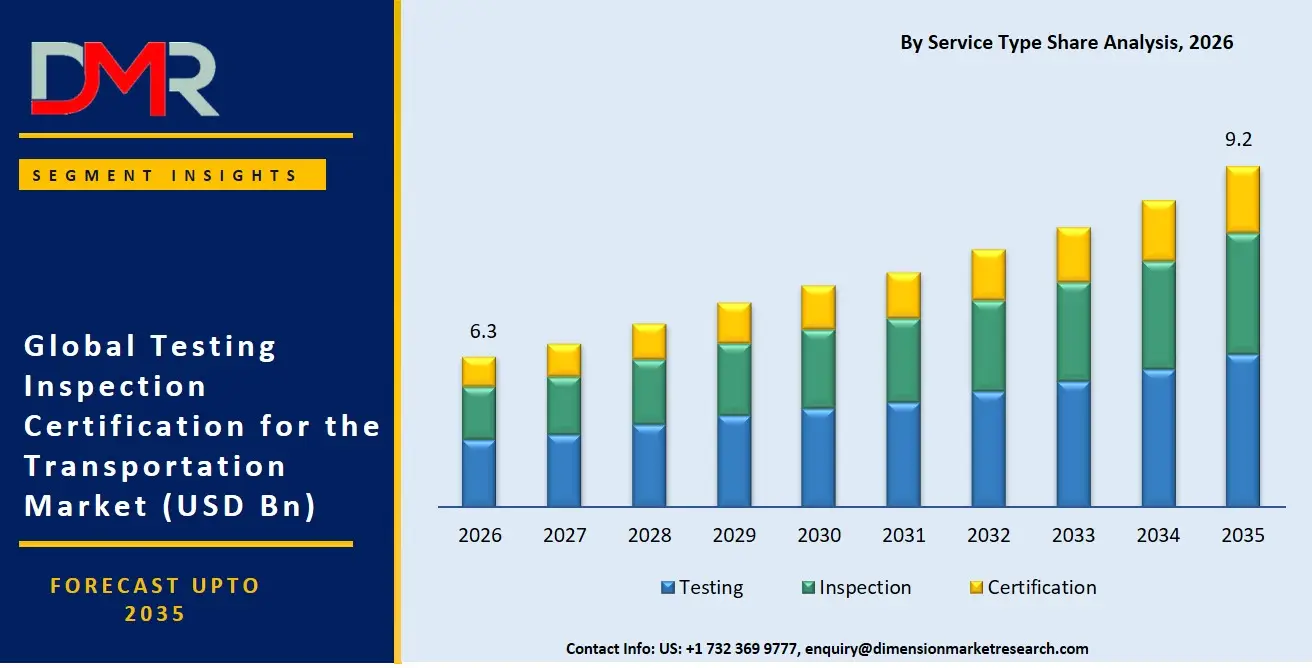
- By Service Type Analysis: Testing is expected to dominate the service type segment with approximately 58.9% of the market share in 2026, driven by extensive safety, environmental, electrical, software, cybersecurity, performance, and material validation requirements before the commercial deployment of transportation equipment and infrastructure.
- By Transportation Mode Analysis: Road transportation is projected to account for the largest market share in 2026, supported by the extensive global vehicle fleet, expanding electric vehicle production, mandatory vehicle inspections, emissions testing, homologation requirements, and increasing functional safety validation for advanced driver assistance systems.
- By End User Analysis: Vehicle manufacturers are expected to hold the largest end user share in 2026 because regulatory approvals, product validation, homologation, component testing, cybersecurity assessment, and continuous quality assurance are required throughout vehicle development, production, commercialization, and post production lifecycle management.
- Regional Leadership: Asia Pacific is expected to lead the market with approximately 39.1% of the global share in 2026 and is projected to grow at the highest CAGR of around 6.2%, supported by automotive manufacturing, railway investments, electric vehicle production, and infrastructure development.
What is the Testing Inspection Certification for the Transportation?
The Global Testing Inspection Certification for the Transportation Market represents the worldwide industry providing independent testing, inspection, auditing, verification, and certification services to ensure transportation systems comply with regulatory, safety, quality, and environmental standards. It supports manufacturers, infrastructure operators, logistics companies, and government agencies throughout product development and operational lifecycles. According to the International Transport Forum, global freight transport demand is projected to nearly triple by 2050 under current policies, increasing the need for standardized conformity assessment services. The market also benefits from expanding digital mobility, connected transportation, and sustainability initiatives that require continuous verification across transportation assets and infrastructure.
Use Cases
- Vehicle Type Approval and Homologation: Manufacturers rely on testing and certification providers to verify compliance with national and international safety regulations before introducing new passenger and commercial vehicles into domestic and export markets.
- Railway Infrastructure Safety Assessment: Inspection organizations evaluate railway tracks, signalling systems, rolling stock, and bridges to ensure operational reliability, minimize maintenance risks, and comply with government transportation safety regulations.
- Aviation Maintenance and Airworthiness Certification: Testing and inspection services validate aircraft components, maintenance procedures, and operational systems to support regulatory approvals, improve passenger safety, and maintain fleet airworthiness throughout service life.
- Marine Vessel Compliance Verification: Certification bodies inspect commercial ships, passenger vessels, and port infrastructure to verify compliance with international maritime safety, environmental protection, and operational performance standards before deployment and during operation.
How AI is Transforming the Testing, Inspection and Certification for the Transportation Market?
Artificial intelligence is significantly improving transportation testing, inspection, and certification by automating defect detection, predictive maintenance, and compliance verification. Computer vision systems inspect vehicle components, railway infrastructure, aircraft surfaces, and marine assets with greater speed and consistency than manual inspections. The U.S. Federal Aviation Administration has highlighted the growing application of machine learning for aviation safety data analysis, while the European Union Agency for Railways supports digital inspection technologies for rail infrastructure monitoring. AI also analyzes sensor data from connected vehicles to identify anomalies before failures occur, reducing downtime and maintenance costs. Digital twins combined with AI enable virtual validation of transportation systems before physical deployment, shortening testing cycles while improving product quality, regulatory compliance, and operational safety across the transportation ecosystem.
Market Dynamics
Key Drivers in the Global Testing Inspection Certification for the Transportation Market
Increasing Adoption of Electric and Connected Transportation
The rapid expansion of electric vehicles, connected mobility, and autonomous transportation systems is increasing demand for comprehensive testing, inspection, and certification services. Manufacturers must validate battery safety, software reliability, cybersecurity, and functional performance before commercialization. Governments worldwide are strengthening regulatory frameworks for zero emission mobility and intelligent transportation systems, encouraging higher compliance requirements. As transportation technologies become increasingly software driven and digitally connected, independent conformity assessment services are becoming essential to verify safety, quality, and operational performance. This growing technological complexity continues to create sustained opportunities for testing, inspection, and certification providers across all transportation modes.
Expansion of Transportation Infrastructure Investments
Governments are investing heavily in highways, railways, airports, ports, and urban mobility infrastructure, creating significant demand for inspection and certification services throughout project lifecycles. Transportation assets require continuous structural integrity assessments, material verification, safety inspections, and regulatory compliance to ensure reliable operations. Modernization of aging infrastructure and construction of new transportation networks are increasing requirements for third party quality assurance. Growing emphasis on operational safety, environmental sustainability, and long term asset management is encouraging public authorities and infrastructure developers to engage specialized testing and inspection organizations for independent verification and certification services.
Restraints in the Global Testing Inspection Certification For the Transportation Market
High Cost of Advanced Testing Infrastructure
Transportation testing and certification require sophisticated laboratories, simulation equipment, digital inspection systems, and highly trained technical professionals. Establishing and maintaining accredited facilities demands substantial capital investment, particularly for electric vehicles, autonomous systems, aerospace, and railway technologies. Smaller service providers often face financial barriers when upgrading equipment to meet evolving international standards. Continuous investment in calibration, laboratory accreditation, and technical expertise further increases operational expenses, limiting market entry for new participants and creating challenges for organizations operating in price sensitive markets with constrained testing budgets.
Complex and Diverse Regulatory Requirements
Transportation regulations differ significantly across countries and regions, requiring manufacturers and certification providers to comply with multiple national and international standards. Products intended for global markets frequently undergo repeated testing and certification processes to satisfy varying regulatory frameworks. Differences in documentation requirements, technical specifications, and approval procedures increase project complexity and certification timelines. Frequent updates to safety, cybersecurity, and environmental regulations also require continuous adaptation of testing methodologies and compliance processes, increasing administrative burdens for both transportation manufacturers and testing, inspection, and certification organizations.
Growth Opportunities in the Global Testing Inspection Certification For the Transportation Market
Growing Demand for Autonomous and Software Defined Mobility
Autonomous driving technologies and software defined vehicles are creating new opportunities for testing and certification providers specializing in functional safety, artificial intelligence validation, cybersecurity assessment, and over the air software verification. Transportation manufacturers increasingly require independent evaluation of advanced driver assistance systems, autonomous navigation platforms, and connected communication technologies. As governments introduce dedicated regulations for intelligent mobility, demand for digital verification, simulation based testing, and software certification services is expected to expand significantly, creating high value opportunities across automotive, aviation, railway, and marine transportation industries.
Rising Focus on Sustainable Transportation Systems
Global efforts to reduce transportation emissions are accelerating investments in electric mobility, hydrogen powered vehicles, battery technologies, and low carbon transportation infrastructure. These technologies require extensive safety testing, environmental validation, and certification before commercial deployment. Growing adoption of renewable energy powered transportation and alternative propulsion systems is increasing demand for specialized testing laboratories and conformity assessment services. As governments strengthen sustainability regulations and climate commitments, testing, inspection, and certification providers are expected to benefit from expanding requirements for environmental compliance, product validation, and lifecycle performance verification.
Trends in the Global Testing Inspection Certification For the Transportation Market
Integration of Artificial Intelligence in Inspection Processes
Artificial intelligence is increasingly being integrated into transportation inspection activities through computer vision, predictive analytics, and automated defect detection systems. Digital inspection platforms analyze large volumes of operational data to identify structural defects, component failures, and maintenance requirements more efficiently than traditional manual methods. AI powered inspection technologies improve consistency, reduce human error, and accelerate certification workflows across automotive manufacturing, railway infrastructure, aviation maintenance, and maritime operations. The adoption of intelligent inspection systems continues to improve operational efficiency while supporting higher safety and regulatory compliance standards.
Adoption of Digital Twins and Remote Inspection Technologies
Transportation manufacturers and infrastructure operators are increasingly implementing digital twins, remote monitoring platforms, drones, and sensor based inspection technologies to improve asset management. Virtual simulations enable testing organizations to evaluate transportation systems before physical deployment, reducing development time and improving design validation. Remote inspection technologies also enhance monitoring of bridges, railways, ports, and aircraft while minimizing operational disruptions. Growing digital transformation across the transportation sector is encouraging testing, inspection, and certification providers to expand technology enabled service portfolios for faster, more accurate, and data driven compliance assessments.
Research Scope and Analysis
ℹ
To learn more about this report –
Download Your Free Sample Report Here
By Service Type Analysis
Testing is projected to dominate the Global Testing Inspection Certification for the Transportation Market, accounting for 58.9% of the market, as transportation manufacturers increasingly require comprehensive validation of vehicle safety, structural integrity, software performance, emissions, cybersecurity, and component reliability before commercialization.
ℹ
To learn more about this report –
Download Your Free Sample Report Here
The complexity of electric vehicles, autonomous mobility, and connected transportation continues to expand the scope of testing across road, rail, aviation, and marine sectors. Certification is projected to register the highest CAGR of 4.9% during the forecast period, driven by tightening international regulatory requirements, sustainability standards, and digital compliance frameworks. Inspection represents the second-largest segment, supported by mandatory periodic inspections, infrastructure monitoring, asset integrity assessments, and preventive maintenance programs that help transportation operators improve operational safety, reliability, regulatory compliance, and lifecycle asset performance.
By Sourcing Type Analysis
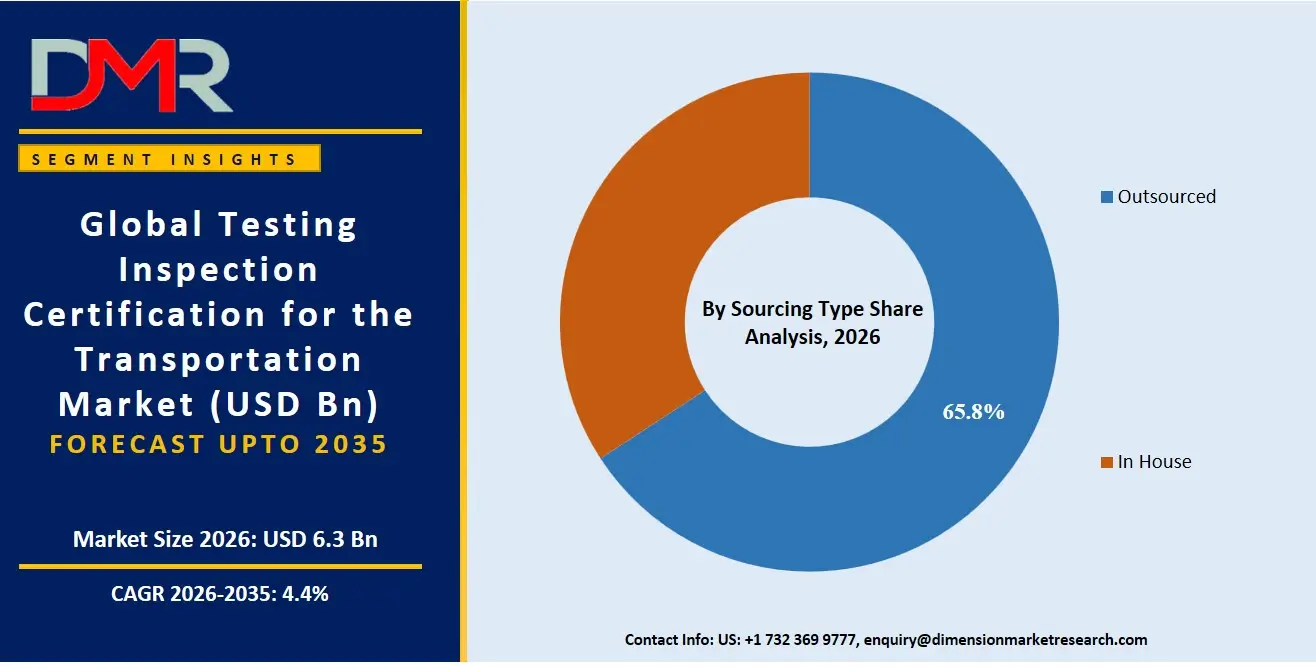
Outsourced services is poised to hold the dominant position with 65.8% of the Global Testing Inspection Certification for the Transportation Market, as manufacturers increasingly depend on accredited third-party organizations for independent verification, specialized technical expertise, laboratory infrastructure, and internationally recognized certifications. Outsourcing enables organizations to reduce operational costs while ensuring compliance with evolving regulatory standards across multiple jurisdictions. The outsourced segment is also expected to witness the highest CAGR of 4.6%, supported by increasing demand for specialized testing in electric vehicles, autonomous systems, railway modernization, and aviation safety. In-house testing and inspection remains the second-largest segment, particularly among large transportation manufacturers that maintain internal laboratories for product development, quality assurance, prototype validation, and confidential research activities.
By Transportation Mode Analysis
Road transportation is anticipated to represent the dominant segment of the Global Testing Inspection Certification for the Transportation Market owing to the vast global vehicle fleet, increasing passenger and commercial vehicle production, and stringent safety, emissions, and homologation regulations. Growing adoption of electric vehicles and advanced driver assistance systems further strengthens demand for comprehensive testing and certification services. Aviation is expected to record the highest CAGR during the forecast period due to rising investments in aircraft modernization, digital avionics, cybersecurity validation, and predictive maintenance technologies. Rail transportation remains the second-largest segment, supported by expanding high-speed rail projects, modernization of signaling systems, rolling stock certification, infrastructure inspections, and increasing government investment in sustainable public transportation networks.
By Application Stage Analysis
Type Approval is expected to be the leading application stage in the Global Testing Inspection Certification for the Transportation Market because every transportation product must satisfy regulatory safety, environmental, and technical standards before entering commercial operation. Manufacturers rely extensively on independent certification bodies to obtain regulatory approvals across multiple international markets. Maintenance Inspection is projected to experience the highest CAGR as transportation operators increasingly adopt predictive maintenance, digital asset monitoring, and lifecycle management strategies to improve operational reliability while minimizing downtime. In Service Inspection represents the second-largest application segment due to mandatory periodic inspections of vehicles, railway infrastructure, aircraft, ships, and critical transportation assets, ensuring continued compliance with evolving safety regulations and operational performance standards.
By End User Analysis
Vehicle manufacturers is poised to be account for the largest share of the Global Testing Inspection Certification for the Transportation Market due to extensive product validation requirements throughout design, development, production, and commercialization. Increasing production of electric, connected, and autonomous vehicles continues to expand demand for independent testing, certification, and quality assurance services. Transport operators are expected to witness the highest CAGR during the forecast period as fleet owners increasingly invest in asset integrity management, predictive maintenance, operational safety, and regulatory compliance across road, rail, aviation, and marine transportation systems. Component suppliers constitute the second-largest segment because critical automotive, aerospace, railway, and marine components require continuous material testing, performance validation, durability assessment, and certification before integration into transportation platforms.
The Global Testing, Inspection and Certification for the Transportation Market Report is segmented on the basis of the following:
By Service Type
- Testing
- Safety Testing
- Performance Testing
- Environmental Testing
- Electrical and Electronic Testing
- Software and Cybersecurity Testing
- Material Testing
- Nondestructive Testing
- Inspection
- Pre Production Inspection
- In Process Inspection
- Final Inspection
- Periodic Inspection
- Asset Integrity Inspection
- Infrastructure Inspection
- Certification
- Product Certification
- System Certification
- Process Certification
- Personnel Certification
- Regulatory Compliance Certification
- Quality Management Certification
By Sourcing Type
By Transportation Mode
- Road
- Passenger Vehicles
- Commercial Vehicles
- Two Wheelers
- Electric Vehicles
- Rail
- Rolling Stock
- Rail Infrastructure
- Signalling Systems
- Aviation
- Commercial Aircraft
- Military Aircraft
- Unmanned Aircraft
- Airport Systems
- Marine
- Commercial Vessels
- Passenger Vessels
- Naval Vessels
- Port Systems
By Application Stage
- Type Approval
- Design Validation
- Production Audit
- Operational Inspection
- Maintenance Assessment
- Regulatory Certification
By End User
- Vehicle Manufacturers
- Component Suppliers
- Transport Operators
- Infrastructure Authorities
- Maintenance Providers
- Government Agencies
Regional Analysis
Leading Region by Market Share
ℹ
To learn more about this report –
Download Your Free Sample Report Here
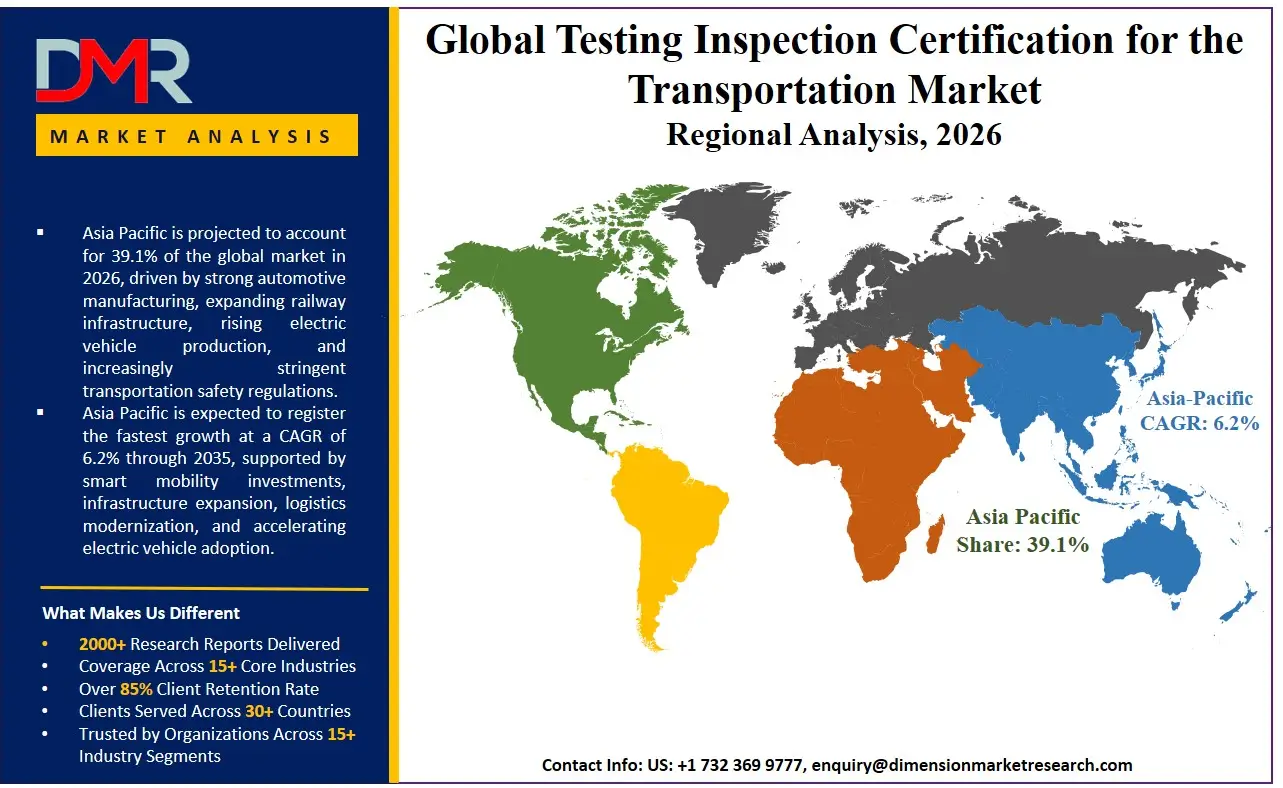
Asia Pacific is projected to dominate the Global Testing Inspection Certification for the Transportation Market, accounting for 39.1% of the global market in 2026. The region's leadership is driven by its extensive automotive manufacturing ecosystem, expanding railway infrastructure, growing commercial aviation sector, and increasing investments in maritime transportation. China, Japan, South Korea, and India continue to strengthen transportation safety regulations while accelerating electric vehicle production and smart mobility initiatives, increasing the demand for independent testing and certification services. The presence of large-scale manufacturing facilities and export-oriented industries further supports market expansion. Rising investments in high-speed rail, intelligent transportation systems, connected vehicles, and sustainable mobility solutions continue to reinforce Asia Pacific's position as the largest regional market for transportation testing, inspection, and certification services.
Fastest-Growing Regional Market
Asia Pacific is also projected to register the highest CAGR of 6.2% during the forecast period, supported by rapid industrialization, urbanization, and government investments in next-generation transportation infrastructure. Increasing adoption of electric vehicles, autonomous driving technologies, battery manufacturing, and intelligent transportation networks is creating substantial demand for advanced testing, inspection, and certification services. Countries across the region are strengthening regulatory compliance for vehicle safety, emissions, railway modernization, aviation operations, and maritime transport to align with international standards. Growing investments in smart cities, digital infrastructure, logistics modernization, and cross-border trade are further accelerating market growth. Continuous expansion of transportation manufacturing capacity and technological innovation positions Asia Pacific as the fastest-growing regional market throughout the forecast period.
By Region
North America
Europe
- Germany
- The U.K.
- France
- Italy
- Russia
- Spain
- Benelux
- Nordic
- Rest of Europe
Asia-Pacific
- China
- Japan
- South Korea
- India
- ANZ
- ASEAN
- Rest of Asia-Pacific
Latin America
- Brazil
- Mexico
- Argentina
- Colombia
- Rest of Latin America
Middle East & Africa
- Saudi Arabia
- UAE
- South Africa
- Israel
- Egypt
- Rest of MEA
Competitive Landscape
The competitive landscape of the Global Testing, Inspection and Certification for the Transportation Market is moderately consolidated, with multinational TIC groups competing through laboratory networks, accreditation breadth, digital capabilities, and transportation expertise. SGS provides automotive cybersecurity, functional-safety, battery, component, and vehicle certification services, while Bureau Veritas supports homologation, V2X, EMC, connected-vehicle cybersecurity, marine classification, and market access. DEKRA competes through vehicle inspection, type approval, ADAS, automated-driving, e-mobility, and digital trust services. TÜV Rheinland and TÜV SÜD offer automotive component testing, rail assurance, functional safety, emissions, and cybersecurity validation. Intertek delivers assurance, testing, inspection, and certification across automotive, aerospace, and marine applications, while Applus+ IDIADA specializes in vehicle engineering, proving-ground testing, homologation, and passive safety. Competition increasingly centers on AI-enabled inspection, remote assessment, software-defined mobility, acquisition-led expansion, and multi-country certification.
Some of the prominent players in the Global Testing, Inspection and Certification for the Transportation Market are:
- SGS SA
- Bureau Veritas SA
- DEKRA SE
- TÜV SÜD AG
- TÜV Rheinland AG
- Intertek Group plc
- Applus+
- Applus+ IDIADA
- UL Solutions Inc.
- DNV AS
- Lloyd's Register Group
- RINA S.p.A.
- Kiwa Group
- Eurofins Scientific
- Element Materials Technology
- MISTRAS Group, Inc.
- ALS Limited
- British Standards Institution
- Japan Quality Assurance Organization
- Korea Testing Laboratory
- Other Key Players
Recent Developments
- May 2026: Jet Aviation launched an automated drone and artificial-intelligence-powered aircraft inspection service in the United States. The service supports digital exterior inspections for aircraft transactions, insurance assessments, warranty evaluations, and maintenance decision-making.
- April 2026: TÜV Rheinland opened an advanced Automotive Component Testing Laboratory in Manesar, India. The facility provides testing for automotive and electric-vehicle components, helping manufacturers address regulatory compliance, emerging technologies, component performance, and faster product commercialization.
- January 2026: SGS completed its acquisition of Applied Technical Services after receiving regulatory approvals. The transaction expanded SGS's North American portfolio of specialized testing, inspection, calibration, engineering, and forensic services.
Report Details
| Report Characteristics |
| Market Size (2026) |
USD 6.3 Bn |
| Forecast Value (2035) |
USD 9.2 Bn |
| CAGR (2026–2035) |
4.4% |
| The US Market Size (2026) |
USD 1.5 Bn |
| Historical Data |
2021 – 2025 |
| Forecast Data |
2027 – 2035 |
| Base Year |
2025 |
| Estimate Year |
2026 |
| Segments Covered |
By Service Type, By Sourcing Type, By Transportation Mode, By Application Stage, By End User |
| Regional Coverage |
North America – The US and Canada; Europe – Germany, The UK, France, Russia, Spain, Italy, Benelux, Nordic, & Rest of Europe; Asia-Pacific – China, Japan, South Korea, India, ANZ, ASEAN, Rest of APAC; Latin America – Brazil, Mexico, Argentina, Colombia, Rest of Latin America; Middle East & Africa – Saudi Arabia, UAE, South Africa, Turkey, Egypt, Israel, & Rest of MEA |
Frequently Asked Questions
How big is the Global Testing Inspection Certification for the Transportation Market?
▾ The Global Testing Inspection Certification for the Transportation Market is valued at USD 6.3 billion in 2026 and is projected to reach approximately USD 9.2 billion by 2035 worldwide overall steadily.
What is the CAGR of the Global Testing Inspection Certification for the Transportation Market from 2026 to 2035?
▾ The Global Testing Inspection Certification for the Transportation Market is expected to expand at a CAGR of 4.4% from 2026 to 2035, reflecting steady long-term demand across transportation sectors worldwide overall.
What factors are driving the growth of the Global Testing Inspection Certification for the Transportation Market?
▾ Market growth is driven by stricter safety regulations, electric and autonomous vehicle adoption, infrastructure modernization, expanding mobility networks, cybersecurity requirements, emissions compliance, and rising demand for independent conformity assessment services globally.
What are the major trends in the Global Testing Inspection Certification for the Transportation Market?
▾ Major trends include AI-enabled inspection, digital twins, remote assessment, automated defect detection, predictive maintenance, cybersecurity validation, simulation-based testing, and broader certification requirements for software-defined and connected transportation systems worldwide today increasingly.
Which region held the largest share of the Global Testing Inspection Certification for the Transportation Market in 2026?
▾ Asia Pacific held the largest share in 2026, supported by extensive automotive manufacturing, expanding rail infrastructure, strong electric vehicle production, export activity, and strengthening transportation safety regulations across regional economies overall.
Which region is expected to grow the fastest in the Global Testing Inspection Certification for the Transportation Market?
▾ Asia Pacific is expected to grow fastest, driven by urbanization, smart mobility investments, electric vehicle expansion, high-speed rail development, logistics modernization, infrastructure spending, and increasingly rigorous regulatory compliance requirements regionally overall.
Who are the key players in the Global Testing Inspection Certification for the Transportation Market?
▾ Key players include SGS, Bureau Veritas, DEKRA, TÜV SÜD, TÜV Rheinland, Intertek, Applus+, UL Solutions, DNV, Lloyd’s Register, RINA, Kiwa, Element Materials Technology, MISTRAS, and BSI globally today prominently worldwide.
How is the Global Testing Inspection Certification for the Transportation Market segmented?
▾ The market is segmented by service type, sourcing type, transportation mode, application stage, and end user, covering testing, inspection, certification, in-house, outsourced, road, rail, aviation, marine, manufacturers, and operators globally overall.