Global Testing, Inspection, and Certification in Consumer Goods and Retail Market Snapshot
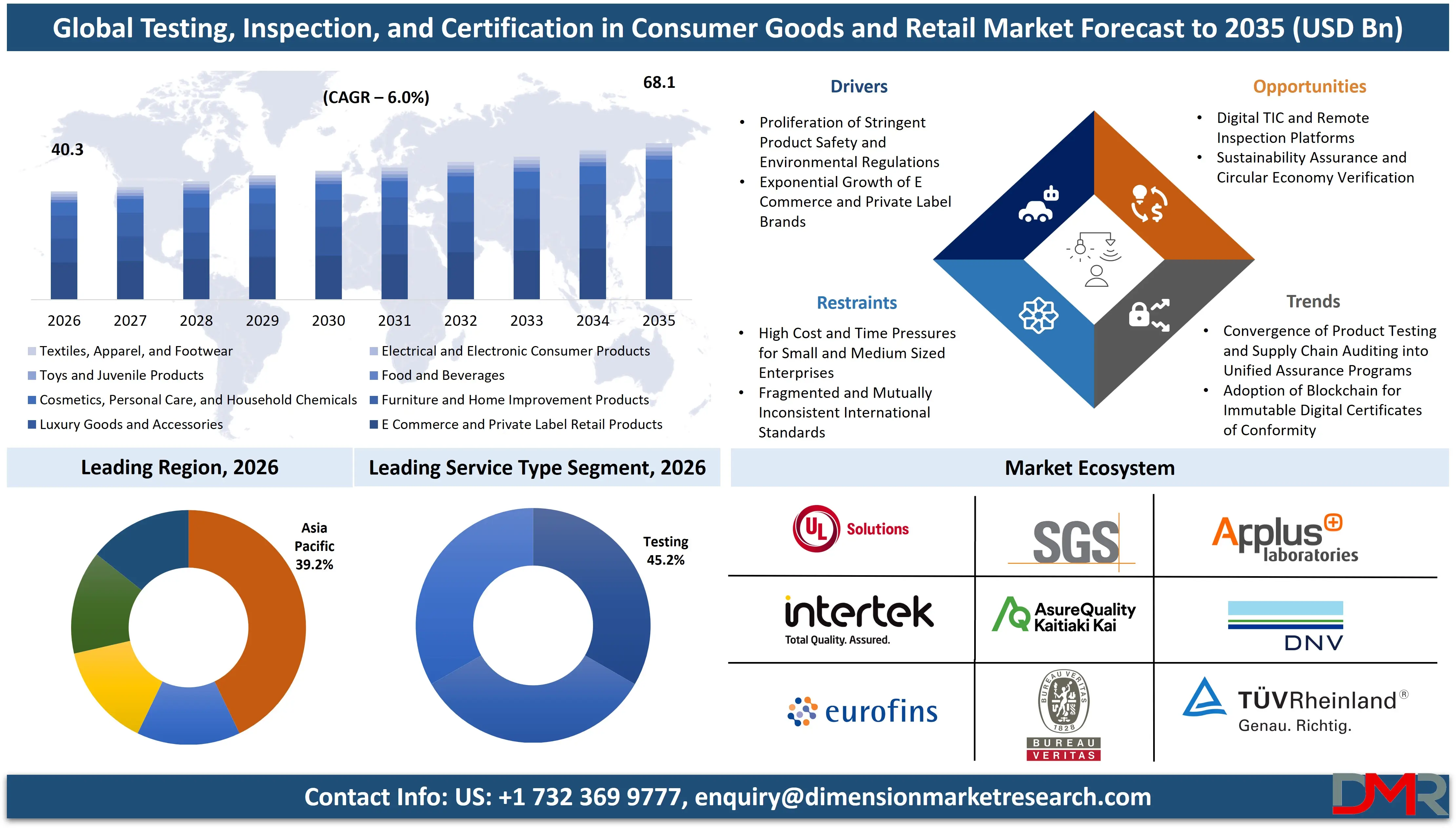
- Global TIC in Consumer Goods & Retail Market Size in 2026: USD 40.3 Billion
- Global TIC in Consumer Goods & Retail Market Size in 2035: USD 68.1 Billion
- Global CAGR from 2026 to 2035: 6.0%
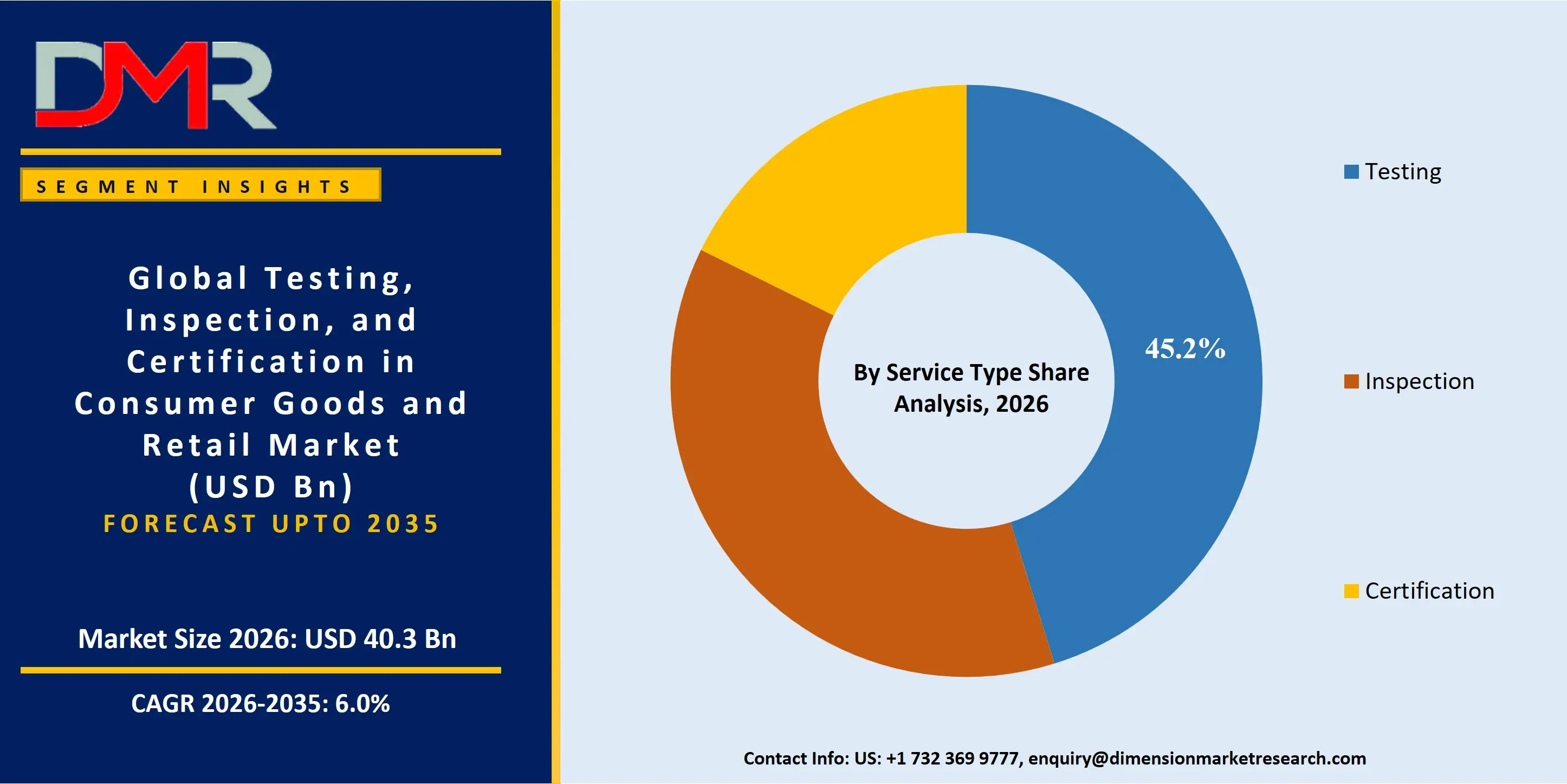
- Testing is the leading service type segment in 2026: 45.2%
- Electrical and Electronic Consumer Products is the leading application segment in 2026: 28.3%
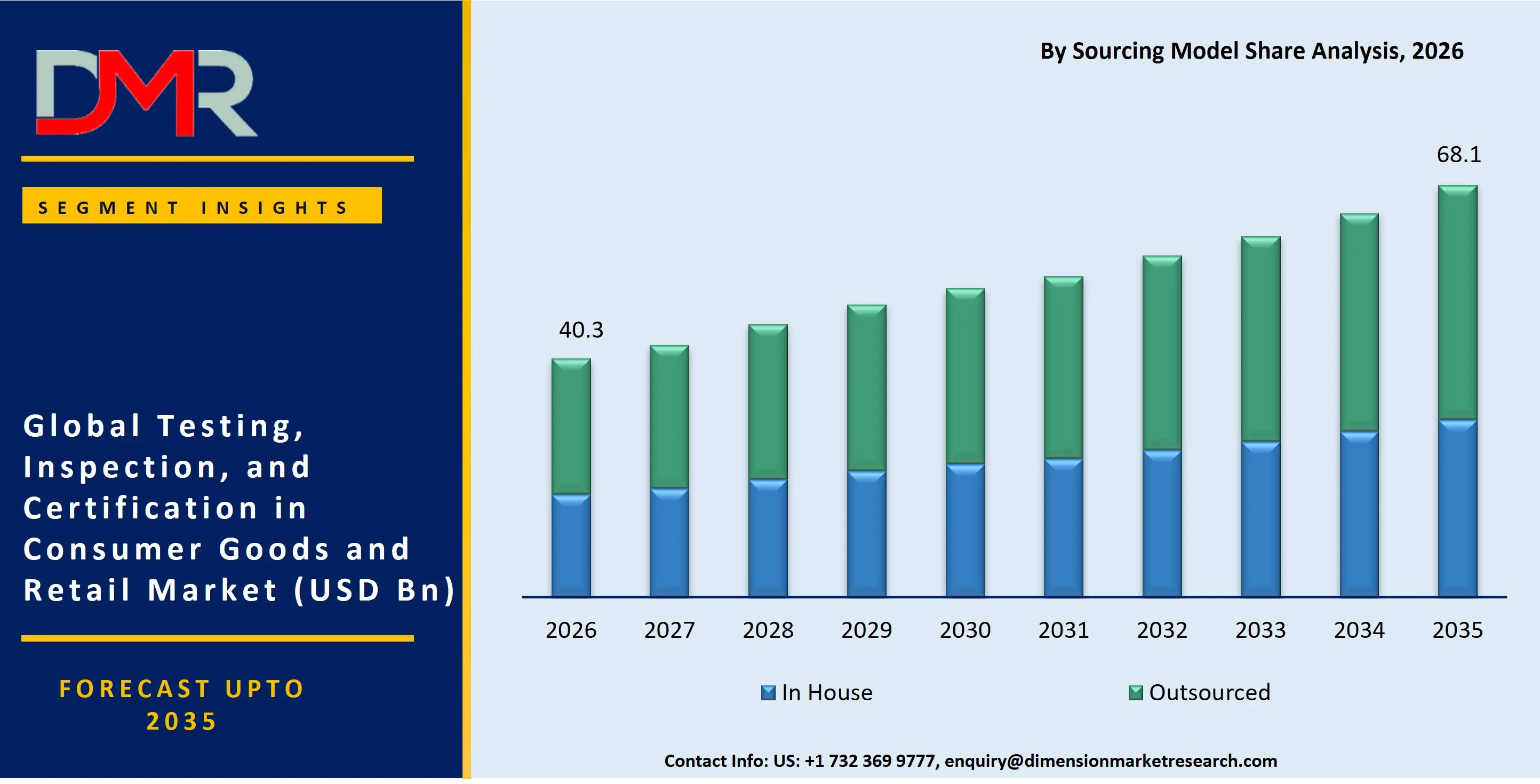
- Outsourced is the leading sourcing model segment in 2026: 67.5%
- Manufacturers and Brand Owners is the leading end user segment in 2026: 44.8%
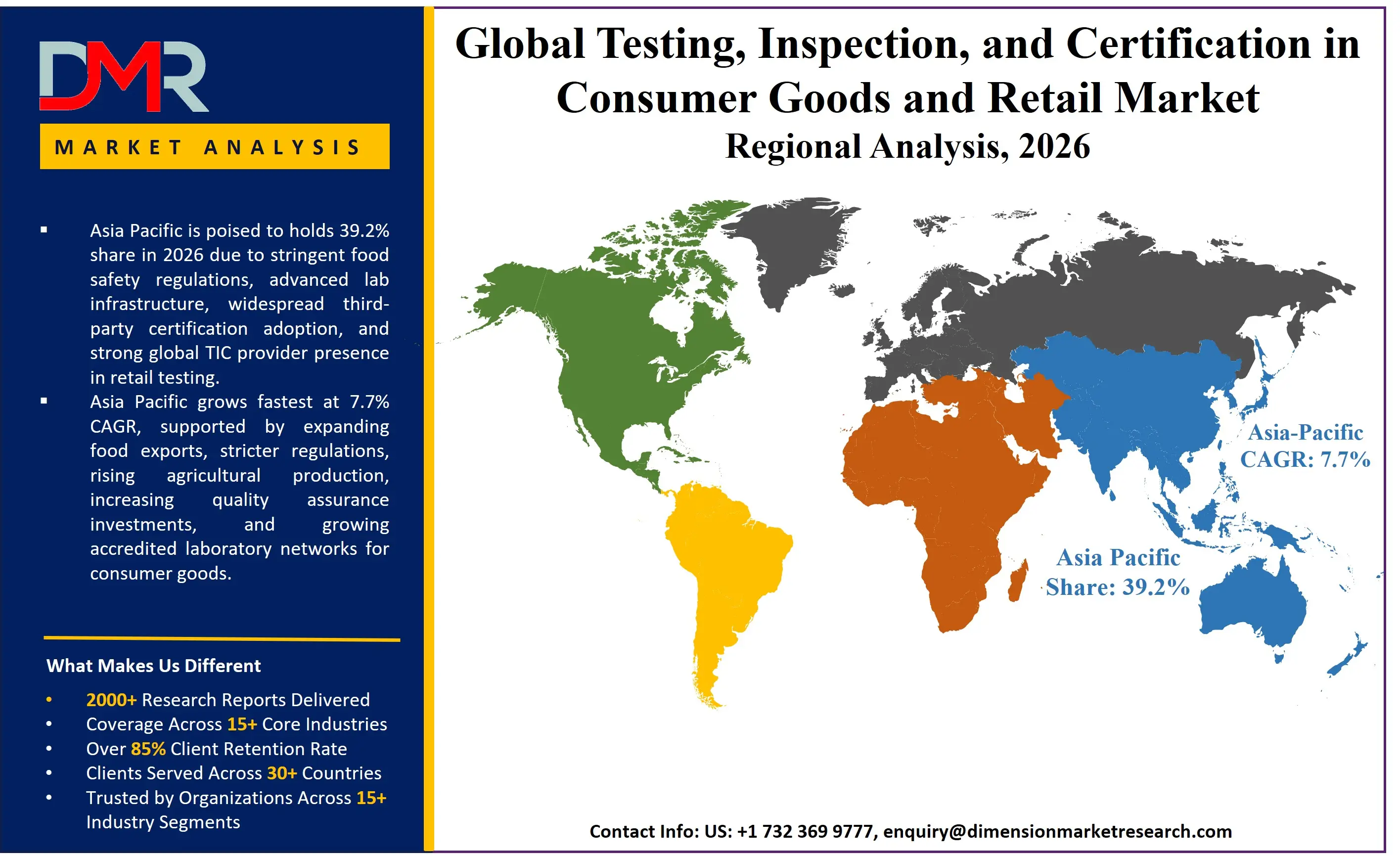
- Asia Pacific is the leading region in 2026: 39.2%
What is the Global Testing, Inspection, and Certification in Consumer Goods and Retail Market and its Market Size?
The Global Testing, Inspection, and Certification (TIC) in Consumer Goods & Retail Market is projected to be valued at USD 40.3 billion in 2026 and is forecast to reach USD 68.1 billion by 2035, expanding at a CAGR of 6.0% during the forecast period.
ℹ
To learn more about this report –
Download Your Free Sample Report Here
Growth is being driven by the unrelenting expansion of global trade in consumer merchandise, the proliferation of mandatory safety standards in emerging economies, the exponential growth of e-commerce and direct-to-consumer channels, heightened consumer activism around product safety and sustainability, and the continuous introduction of novel materials and smart products that demand new testing protocols. Investment is accelerating as retailers and manufacturers shift from reactive, pass/fail quality checks toward predictive, data-driven quality assurance models that integrate digital twins, AI-enabled visual inspection, and blockchain-anchored certification to deliver real-time supply chain transparency and proactive risk mitigation.
Use Cases
- Pre-Production Material Verification for Apparel and Footwear: International fashion brands and retailers utilize TIC providers for laboratory testing of raw textiles, dyes, and accessories before bulk production. Chemical testing screens for restricted substances listed under REACH and AFIRM, while mechanical testing validates zipper durability and seam strength, preventing costly non-compliance and safeguarding brand integrity in global markets.
- In-Process and Pre-Shipment Inspection of Consumer Electronics: Electronics manufacturers commission in-process inspections and pre-shipment audits to verify that assembled devices meet electrical safety, EMC, and energy efficiency standards. Third-party inspectors check soldering quality, grounding continuity, and label accuracy, ensuring that products comply with CE, FCC, or CCC requirements and avoiding shipment holds at destination ports.
- Social and Ethical Compliance Audits in Toy Supply Chains: Toy brands and large retailers leverage TIC partners for social and ethical factory audits aligned with ICTI Ethical Toy Program or amfori BSCI standards. Audits assess working hours, health and safety, and child labor risks at manufacturing sites, delivering the transparency required by regulatory due diligence laws and conscious consumers.
- Certification and Compliance Management for E-Commerce Private Labels: E-commerce platforms offering private label home goods and electronics engage TIC firms for end-to-end product certification. This includes obtaining mandatory marks such as CE, GS, or FCC, alongside management system certification (ISO 9001), to build consumer trust, reduce return rates, and satisfy marketplace listing requirements.
- Food Contact Material Safety Verification for Kitchenware and Packaging: Retailers and importers of food containers, utensils, and kitchen appliances commission food contact material testing for migration limits of formaldehyde, bisphenol A, and heavy metals under EU Framework Regulation (EC) 1935/2004 and FDA 21 CFR. Certification assures that products are safe for intended use and free from chemical contamination.
Key Takeaways
- Market Size: The Global TIC in Consumer Goods & Retail Market is anticipated to be valued at USD 40.3 billion in 2026 and is forecast to reach USD 68.1 billion by 2035, registering a CAGR of 6.0%.
- Growth Outlook: Market expansion is underpinned by deepening regulatory harmonization across trading blocs, the mainstreaming of sustainable and circular product claims that require verification, the growth of e commerce and cross-border digital trade, and rising corporate demand for integrated quality and ethical compliance programs.
- Primary Growth Drivers: Escalating frequency of product recalls, tightening chemical and safety regulations worldwide, the imperative for brand protection in hyper-competitive online marketplaces, and the increasing complexity of multi-country supply chains are propelling global investment in outsourced TIC services.
- By Service Type Analysis: Testing services are projected to lead the segment with a dominant 45.2% share in 2026, driven by non-negotiable laboratory testing mandates for electronics, toys, textiles, and food contact materials. The safety and chemical testing sub-segments are especially critical for market access in the EU, North America, and China.
- By Application Analysis: Electrical and Electronic Consumer Products are expected to dominate the application segment with a 28.3% share in 2026, supported by the ubiquity of connected devices, stringent EMC and safety standards, and continuous product innovation cycles that require constant re-testing and certification.
- By Sourcing Model Analysis: Outsourced TIC services are expected to hold a commanding 67.5% share in 2026, as brands and retailers seek independent, accredited third-party conformity assessment to demonstrate impartiality, gain global market access, and reduce fixed costs associated with in-house labs.
- By End User Analysis: Manufacturers and Brand Owners are projected to be the largest end user segment with a 44.8% share in 2026, driven by their direct responsibility for product compliance, quality assurance, and the need to obtain mandatory certifications prior to exporting to regulated markets.
- By Region Analysis: Asia Pacific is anticipated to lead the global market with a 39.2% revenue share in 2026, owing to its status as the world's manufacturing hub for consumer goods, the rapid expansion of domestic consumer markets, and aggressive enforcement of mandatory product certification schemes such as China Compulsory Certification (CCC).
How AI and Digitalization are Transforming the TIC in Consumer Goods & Retail Market?
Artificial intelligence and digitalization are fundamentally reshaping the TIC landscape by automating high-volume, repetitive testing and inspection tasks and generating predictive insights that preempt quality failures. Machine vision systems powered by deep learning are being deployed on production lines for real-time defect detection in textiles, electronics assemblies, and packaging, dramatically reducing human error and accelerating in-process inspection. Natural language processing (NLP) engines are transforming regulatory intelligence by autonomously scanning, interpreting, and summarizing thousands of global regulatory updates, enabling TIC providers to push tailored compliance alerts to clients and automatically update test protocols.
Generative AI is emerging as a powerful assistant in technical report writing, auto-generating test summaries, certificate drafts, and corrective action plans from raw laboratory data, drastically cutting report turnaround times while maintaining full traceability. Digital twin technology allows brands to simulate product performance under diverse usage and environmental conditions, reducing the need for physical destructive testing and enabling virtual certification previews.
Key Drivers in the Global Testing, Inspection, and Certification in Consumer Goods and Retail Market
Proliferation of Stringent Product Safety and Environmental Regulations
The continuous tightening of consumer product safety, chemical restriction, and environmental sustainability regulations worldwide is the foremost driver of TIC demand. Landmark frameworks such as the EU's REACH, RoHS, General Product Safety Regulation (GPSR), and Ecodesign for Sustainable Products Regulation (ESPR), the US CPSIA and state-specific chemical laws, and China's GB standards and CCC system mandate exhaustive third-party testing and certification for market access. The regulatory net is widening to include previously unregulated product categories and e-commerce imports, compelling manufacturers and retailers to embed conformity assessment at every stage of the product lifecycle.
Exponential Growth of E-Commerce and Private Label Brands
The explosive growth of online retail and the proliferation of private label products across platforms like Amazon, Walmart, and regional marketplaces have created an urgent need for scalable, trust-building quality verification. E commerce platforms are instituting mandatory testing and certification requirements for third-party sellers to combat counterfeit goods, reduce return rates, and protect platform reputation. This structural shift is driving high-volume, standardized TIC engagements for pre shipment inspection, performance testing, and label claim validation tailored to the unique risk profiles of online-sold consumer goods.
Restraints in the Global Testing, Inspection, and Certification in Consumer Goods and Retail Market
High Cost and Time Pressures for Small and Medium-Sized Enterprises (SMEs)
Comprehensive TIC programs, especially those covering chemical and safety testing across multiple product SKUs, represent a significant cost burden for SMEs and emerging brands. The per unit cost of accredited laboratory testing and periodic factory audits can erode thin margins and extend time to market, creating a competitive disadvantage against larger firms. While digital TIC platforms promise to reduce unit costs, the upfront investment and complexity of navigating diverse regulatory frameworks remain substantial barriers for resource-constrained businesses.
Fragmented and Mutually Inconsistent International Standards
Despite decades of harmonization efforts, product standards and certification requirements continue to diverge significantly across major markets. A product compliant with EU CE marking may still require separate, duplicative testing to obtain China's CCC or Brazil's INMETRO certification. This fragmentation forces global brands to manage parallel testing and certification workstreams, increasing cost, lead time, and operational complexity. Mutual recognition agreements remain limited in scope, and the risk of regulatory divergence post pandemic and amid geopolitical tensions adds further uncertainty.
Growth Opportunities in the Global Testing, Inspection, and Certification in Consumer Goods and Retail Market
Digital TIC and Remote Inspection Platforms
A significant growth frontier is the development and scaling of digital TIC ecosystems that integrate remote video inspections, AI based image recognition, and cloud based compliance dashboards. These platforms enable real time defect documentation and corrective action tracking across global supplier networks, drastically compressing inspection cycle times and enabling more frequent, risk based quality interventions. Providers that can deliver a seamless hybrid of physical and remote TIC services will capture share from buyers seeking supply chain resilience and speed without sacrificing compliance rigor.
Sustainability Assurance and Circular Economy Verification
The global pivot towards circular economy models, net zero pledges, and corporate ESG disclosures is generating massive new demand for sustainability related TIC services. Opportunities abound in verifying recycled content claims, biodegradability, carbon footprint, supply chain due diligence for conflict minerals and forced labor, and product durability for repairability scores. TIC firms that invest in specialized sustainability auditing, lifecycle assessment capabilities, and trusted ecolabel certification programs are positioned to serve a high growth, premium priced market segment.
Trends in the Global Testing, Inspection, and Certification in Consumer Goods and Retail Market
Convergence of Product Testing and Supply Chain Auditing into Unified Assurance Programs
Leading TIC providers are shifting from siloed testing, inspection, and certification offerings to integrated "total quality assurance" programs that encompass raw material screening, factory capability audits, in process quality control, pre shipment inspection, and post market surveillance under a single digital platform. This trend streamlines vendor management for retailers and brands and creates a single source of truth for product quality and compliance, driving long term, strategic partnerships rather than transactional spot checks.
Adoption of Blockchain for Immutable Digital Certificates of Conformity
Blockchain technology is gaining traction as a means to issue tamper proof, instantly verifiable digital certificates that can be linked to a product's unique digital identity. These blockchain anchored credentials reduce counterfeiting of test reports, accelerate customs clearance through mutual recognition of trusted data, and enable end consumers to verify the authenticity and sustainability claims of a product by scanning a QR code. This trend is particularly strong in luxury goods, organic food and beverages, and high risk children's products.
Research Scope and Analysis
The Global Testing, Inspection, and Certification (TIC) in Consumer Goods and Retail Market is segmented by service type, sourcing model, application, and end user. Services comprise testing, inspection, and certification. The study covers in-house and outsourced delivery, key product categories, and demand from manufacturers, retailers, e-commerce platforms, importers, and private-label product owners.
ℹ
To learn more about this report –
Download Your Free Sample Report Here
By Service Type Analysis
Testing is poised to dominate the Global TIC in Consumer Goods & Retail Market with a 45.2% market share in 2026, underpinned by the universal, non negotiable requirement for laboratory based verification of product safety, chemical composition, and performance characteristics before market entry. Within testing, Safety Testing and Chemical Testing are the largest sub segments, driven by regulations such as EU REACH, US CPSIA, and China GB standards that mandate exhaustive restricted substance screening and flammability, electrical, and mechanical hazard assessments. Laboratory Testing forms the backbone, accounting for the highest sub segment revenue, as accredited labs conduct standardized tests for a vast range of consumer products. Electromagnetic Compatibility (EMC) Testing and Electrical Testing are projected to record above average growth, propelled by the proliferation of wireless and IoT enabled consumer electronics.
By Sourcing Model Analysis
Outsourced TIC services are anticipated to dominate with a 67.5% share in 2026. The inherent need for independent, third party assessment to demonstrate impartiality to regulators, retailers, and consumers makes outsourcing the default model. Large global TIC companies possess multi jurisdictional accreditations, specialized equipment, and deep domain expertise that is cost prohibitive for individual manufacturers to replicate in house.
ℹ
To learn more about this report –
Download Your Free Sample Report Here
In House TIC operations maintain a significant niche among very large multinational brand owners with dedicated quality and materials labs, particularly in the automotive adjacent consumer goods and luxury sectors, where proprietary testing methods and speed are critical. However, even firms with strong internal capabilities often co source with third party TIC providers for regulatory testing in export markets or for peak demand periods, creating a blended model.
By Application or Product Category Analysis
Electrical and Electronic Consumer Products is projected to dominate the application segment with a 28.3% share in 2026, supported by the category's intrinsic complexity, rapid innovation cycles, and the heaviest regulatory burden spanning electrical safety, EMC, radio frequency, energy efficiency, and chemical substance restrictions (RoHS, REACH). Textiles, Apparel, and Footwear is the second largest category, driven by voluminous global trade, intensive chemical and physical testing requirements, and the growth of sustainable fashion claims that demand third party verification. Toys and Juvenile Products maintains a substantial, regulation driven share, while E Commerce and Private Label Retail Products is forecast to register the highest CAGR, fueled by the explosive growth of online only brands and marketplaces instituting mandatory quality checks. Food and Beverages and Cosmetics, Personal Care, and Household Chemicals are also key segments with stringent safety and labeling verification needs.
By End User Analysis
Manufacturers and Brand Owners is anticipated to lead the end user segment with a 44.8% share in 2026, as these entities bear primary responsibility for product compliance and must commission testing and certification to export, gain retailer shelf space, and protect their brands. Retailers are the second largest end user group, increasingly mandating their own independent pre shipment inspections and factory audits to mitigate liability and assure private label quality. E Commerce Platforms are emerging as a high growth end user, driven by platform policies requiring third party test reports and certifications before allowing sellers to list in regulated categories. Importers and Distributors rely heavily on TIC for pre shipment verification and customs clearance, while Private Label Product Owners constitute a fast expanding client base seeking turnkey TIC solutions to compete with established brands on quality and safety.
The Global Testing, Inspection, and Certification in Consumer Goods and Retail Market Report is segmented on the basis of the following:
By Service Type
- Testing
- Laboratory Testing
- Performance Testing
- Safety Testing
- Chemical Testing
- Mechanical Testing
- Electrical Testing
- Electromagnetic Compatibility Testing
- Textile Testing
- Food Contact Material Testing
- Inspection
- Pre-Production Inspection
- In-Process Inspection
- Pre-Shipment Inspection
- Factory Audits
- Social and Ethical Audits
- Certification
- Product Certification
- CE Certification
- GS Certification
- FCC Certification
- IEC Certification
- Management System Certification
- ISO 9001
- ISO 14001
- ISO 45001
By Sourcing Model
By Application or Product Category
- Textiles, Apparel, and Footwear
- Electrical and Electronic Consumer Products
- Toys and Juvenile Products
- Food and Beverages
- Cosmetics, Personal Care, and Household Chemicals
- Furniture and Home Improvement Products
- Luxury Goods and Accessories
- E Commerce and Private Label Retail Products
By End User
- Manufacturers and Brand Owners
- Retailers
- E Commerce Platforms
- Importers and Distributors
- Private Label Product Owners
Regional Analysis
Asia Pacific is the Leading Region in the Global TIC in Consumer Goods & Retail Market
Asia Pacific is poised to lead the Global TIC in Consumer Goods & Retail Market with an estimated 39.2% revenue share in 2026. The region's dominance is anchored by its unrivaled position as the world's manufacturing factory for consumer goods from apparel and footwear in Vietnam and Bangladesh to electronics in Shenzhen and toys in Guangdong. China alone constitutes the single largest national TIC market due to its massive domestic consumption, compulsory CCC certification for a wide range of products, and a dense network of accredited testing laboratories. The region is also the fastest growing, with a projected CAGR of 7.7% through 2035, driven by rapid expansion of domestic middle-class consumption, stricter enforcement of national quality standards across ASEAN and India, and the deepening of social compliance and sustainability auditing in global supply chains.
ℹ
To learn more about this report –
Download Your Free Sample Report Here
North America TIC in Consumer Goods & Retail Market
North America is projected to hold a 31.0% share in 2026, valued at approximately USD 12.5 billion. The region is characterized by an extremely rigorous consumer product safety regime enforced by the U.S. Consumer Product Safety Commission (CPSC) and Health Canada, mandatory third-party testing for children's products, and a highly litigious environment that makes product liability a major driver of thorough TIC engagement. The U.S. is the world's largest consumer market, and retailer-driven quality programs, particularly by giants like Walmart, Target, and Amazon, mandate extensive testing and factory audits for all imported goods. The shift towards nearshoring in Mexico is also generating new demand for factory audits and local lab testing capabilities. The region is expected to grow at a CAGR of approximately 5.2% through 2035.
Europe TIC in Consumer Goods & Retail Market
The Europe TIC Market for consumer goods and retail is estimated to be valued at USD 8.3 billion in 2026 and is further anticipated to reach USD 12.5 billion by 2035 at a CAGR of 4.8%. Europe represents the most regulated TIC environment globally, driven by the EU's comprehensive New Legislative Framework (NLF) that mandates CE marking, the expansive REACH and RoHS directives, and the new General Product Safety Regulation (GPSR) that tightens obligations for online marketplaces. The European Green Deal and circular economy action plan are creating significant new testing and verification service lines related to product durability, repairability, and recycled content. Germany, with its strong industrial base and leading retail groups, is the region's largest national market.
Latin America TIC in Consumer Goods & Retail Market
The Latin America TIC Market is expanding steadily as the region's consumer markets modernize and regulatory frameworks mature. Brazil and Mexico are the primary markets, driven by INMETRO certification requirements in Brazil and the NOM standards in Mexico, which mandate testing for a wide range of imported consumer goods including electronics, toys, and textiles. The growth of e commerce and the entry of international retailers are raising quality expectations and driving demand for independent inspection and certification services. Argentina, Colombia, and Chile also present growth opportunities, although economic volatility can impact investment cycles.
Middle East and Africa TIC in Consumer Goods & Retail Market
The Middle East and Africa TIC Market is developing alongside massive retail infrastructure investments in the Gulf states and the modernization of consumer goods import regulations across the region. Saudi Arabia's Product Safety Programme (SALEEM) and the UAE's Conformity Assessment Scheme (ECAS) are powerful drivers of mandatory testing and certification for regulated products. In Africa, South Africa leads with its NRCS compulsory specifications for electronics and goods, while Nigeria's SONCAP and Kenya's PVoC programs create structured demand for pre export verification of conformity for imported consumer goods. The growing presence of international retail chains in urban centers across the continent is spurring demand for supply chain audits and quality control services.
Major Countries Analysis
The United States TIC in Consumer Goods & Retail Market
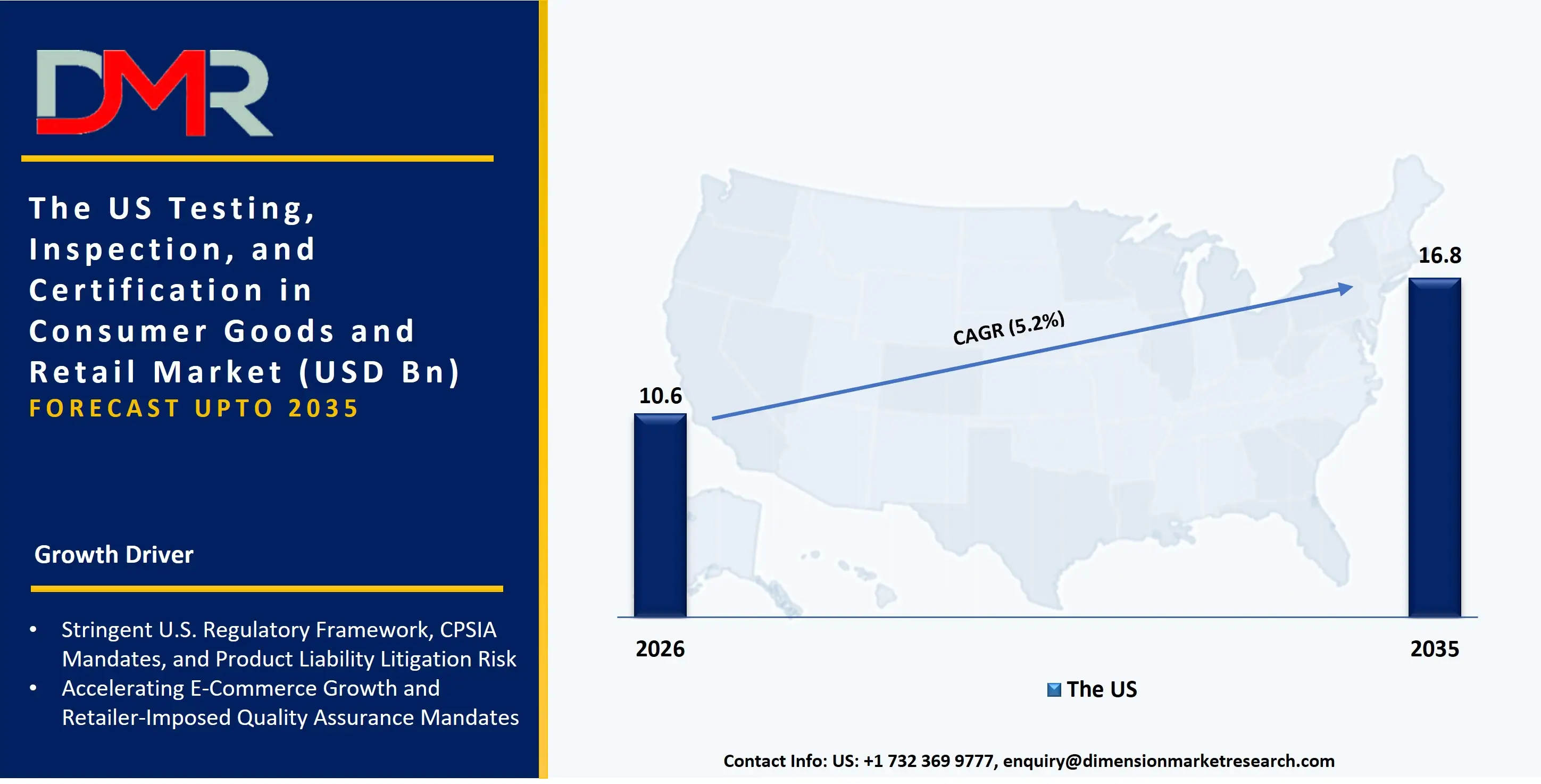
The United States TIC Market for consumer goods is projected to be valued at USD 10.6 billion in 2026 and is expected to reach USD 16.8 billion by 2035, registering a CAGR of 5.2%. The market is propelled by the world's most active consumer product safety regulator (CPSC), mandatory third-party testing under CPSIA for children's products, and a class-action litigation environment that makes product liability a board-level risk. Major retailers enforce stringent vendor compliance programs, while the FDA's oversight of food contact materials and cosmetics adds another layer of required testing. The rapid growth of e commerce marketplaces and their product safety obligations under the proposed INFORM Consumers Act is a powerful incremental demand driver.
ℹ
To learn more about this report –
Download Your Free Sample Report Here
China TIC in Consumer Goods & Retail Market
The market is uniquely large due to the dual demand from China as the world's manufacturing export base and as a massive domestic consumer market. The China Compulsory Certification (CCC) system covers a broad range of consumer products from electronics to children's toys, driving continuous testing and factory inspection demand. Beijing's crackdown on product quality and safety, regulatory reforms opening the TIC sector to more private and foreign participation, and the soaring growth of domestic e commerce platforms like Tmall and JD.com with their own quality assurance requirements are all fueling robust market expansion.
India TIC in Consumer Goods & Retail Market
The expansion of the Bureau of Indian Standards (BIS) compulsory registration scheme to cover an ever-widening array of electronics and consumer goods, combined with the surge in domestic manufacturing under the "Make in India" initiative, is driving immense demand for testing, factory audits, and product certification. The rapid growth of organized retail and e commerce, food safety regulation under FSSAI, and the demand for social compliance audits in the textile and apparel export sector further amplify market growth.
Germany TIC in Consumer Goods & Retail Market
The market is driven by Germany's leading consumer goods brands, a powerful retail sector, and strict enforcement of EU CE marking and REACH by the market surveillance authorities. The GS Mark (Geprüfte Sicherheit), a voluntary but highly trusted German safety certification, remains a unique demand driver for testing of electrical appliances, toys, and furniture sold in the German market. The country's strong environmental movement is further propelling testing for chemical safety and sustainability claims.
Regulatory Landscape
The regulatory landscape is the foundational driver of the TIC market, with global frameworks mandating independent conformity assessment for consumer goods. In the European Union, the CE marking framework under the New Legislative Framework requires manufacturers to perform or commission testing, compile technical documentation, and issue a Declaration of Conformity; the GPSR now extends obligations to online marketplaces. The US CPSC enforces mandatory third-party testing for children's products under CPSIA and maintains broad recall authority. China's CCC system mandates factory inspections and product testing for a listed catalog of goods. India's BIS Compulsory Registration Scheme (CRS) now covers dozens of electronics categories.
Investment and White Space Analysis
The most attractive investment opportunities lie in digital TIC platforms that combine remote inspection, blockchain certification, and AI driven test report generation into a unified customer portal. Significant white space exists in providing cost effective, scaled TIC solutions for the exploding universe of e commerce private label sellers, many of whom lack the knowledge or budget for traditional high touch TIC services. Specialized testing for the smart home and connected consumer device market covering cybersecurity, data privacy, interoperability, and EMC alongside traditional safety remains underserved. The circular economy creates white space in verification of recycled content, repairability, and product lifespan claims, where standardized testing methodologies are still evolving.
By Region
North America
Europe
- Germany
- The U.K.
- France
- Italy
- Russia
- Spain
- Benelux
- Nordic
- Rest of Europe
Asia-Pacific
- China
- Japan
- South Korea
- India
- ANZ
- ASEAN
- Rest of Asia-Pacific
Latin America
- Brazil
- Mexico
- Argentina
- Colombia
- Rest of Latin America
Middle East & Africa
- Saudi Arabia
- UAE
- South Africa
- Israel
- Egypt
- Rest of MEA
Competitive Landscape
The Global TIC in Consumer Goods & Retail Market features a concentrated tier of multinational giants with global laboratory networks and comprehensive service portfolios, competing alongside a fragmented landscape of regional specialists and niche testing labs. At the apex, companies like SGS, Bureau Veritas, Intertek, Eurofins, and TÜV SÜD dominate through immense accreditation breadth, multi‑industry coverage, and the ability to deliver global supplier audit programs for the world's largest brands and retailers. These leaders are investing heavily in digital transformation, acquiring specialized labs, and expanding in high‑growth Asian and e‑commerce service segments. The competitive field also includes strong regional players such as TÜV Rheinland, DEKRA, UL Solutions, and ALS Limited, as well as emerging digital‑first inspection platforms that challenge traditional in‑person models. Strategic differentiation increasingly hinges on the ability to provide a seamless, tech‑enabled experience offering real‑time data dashboards, predictive compliance analytics, and integrated product certification and social audit packages under a single contract.
Some of the prominent players in the Global Testing, Inspection, and Certification in Consumer Goods and Retail Market are:
- SGS SA
- Bureau Veritas SA
- Intertek Group plc
- TÜV SÜD AG
- TÜV Rheinland AG
- DEKRA SE
- UL Solutions Inc.
- Eurofins Scientific SE
- ALS Limited
- Applus+
- DNV AS
- Element Materials Technology
- QIMA Limited
- SIRIM QAS International Sdn. Bhd.
- CSA Group
- Kiwi Technologies India Pvt. Ltd.
- Japan Quality Assurance Organization
- Korea Testing Laboratory
- Korea Conformity Laboratories
- China Certification & Inspection Group
- Cotecna Inspection SA
- RINA S.p.A.
- LRQA Group Limited
- NSF International
- Mérieux NutriSciences
- Smithers
- Hohenstein Group
- Consumer Testing Laboratories Inc.
- TÜV NORD Group
- V-Trust Inspection Service
- Other Key Players
Recent Developments
- In February 2026, SGS highlighted the TIC industry's increasing use of digital technologies to strengthen conformity assessment, supporting more efficient and trusted inspection, testing, and certification workflows.
- In February 2026, Bureau Veritas emphasized its digital transformation approach, including AI, IoT, automation, remote inspections, and secure digital traceability to support quality assurance and trust.
- In June 2026, Eurofins continued to provide consumer product testing for softlines and hardlines, including food contact material assessments covering migration, composition, and hygiene requirements.
Report Details
| Report Characteristics |
| Market Size (2026) |
USD 40.3 Bn |
| Forecast Value (2035) |
USD 68.1 Bn |
| CAGR (2026–2035) |
6.0% |
| The US Market Size (2026) |
USD 10.6 Bn |
| Historical Data |
2021 – 2025 |
| Forecast Data |
2027 – 2035 |
| Base Year |
2025 |
| Estimate Year |
2026 |
| Segments Covered |
By Sourcing Model, By Service Type, and By Application |
| Regional Coverage |
North America – The US and Canada; Europe – Germany, The UK, France, Russia, Spain, Italy, Benelux, Nordic, & Rest of Europe; Asia-Pacific – China, Japan, South Korea, India, ANZ, ASEAN, Rest of APAC; Latin America – Brazil, Mexico, Argentina, Colombia, Rest of Latin America; Middle East & Africa – Saudi Arabia, UAE, South Africa, Turkey, Egypt, Israel, & Rest of MEA |
Frequently Asked Questions
How big is the Global Testing, Inspection, and Certification in Consumer Goods & Retail Market?
▾ The global TIC market for consumer goods and retail is valued at USD 40.3 billion in 2026 and is projected to reach USD 68.1 billion by 2035, reflecting sustained demand for independent product safety, quality, and compliance verification.
What is the CAGR of the Global TIC in Consumer Goods & Retail Market from 2026 to 2035?
▾ The market is projected to expand at a compound annual growth rate (CAGR) of 6.0% between 2026 and 2035, supported by tightening regulations, e-commerce growth, and the globalization of consumer goods supply chains.
What factors are driving the growth of the Global TIC in Consumer Goods & Retail Market?
▾ Growth is driven by the proliferation of mandatory product safety and environmental regulations, the rapid expansion of e-commerce and private labels requiring trust verification, rising product recall incidents, and growing brand protection and sustainability verification demands.
What are the major trends in the Global TIC in Consumer Goods & Retail Market?
▾ Major trends include digital TIC platforms using AI and remote inspection, blockchain-based immutable certificates, the convergence of testing and supply chain auditing into unified assurance programs, and the rise of risk-based predictive compliance models.
Which region held the largest share of the Global TIC in Consumer Goods & Retail Market in 2026?
▾ Asia Pacific is expected to lead the global market with a 39.2% share in 2026, driven by its dominance in consumer goods manufacturing and the rapid expansion of domestic regulatory enforcement and consumption.
Which region is expected to grow the fastest in the Global TIC in Consumer Goods & Retail Market?
▾ Asia Pacific is expected to record the fastest growth at a 7.7% CAGR through 2035, fueled by industrialization, rising consumer safety awareness, and the deepening of mandatory certification schemes across China, India, and Southeast Asia.
Who are the key players in the Global TIC in Consumer Goods & Retail Market?
▾ Key market participants include SGS, Bureau Veritas, Intertek, Eurofins, TÜV SÜD, TÜV Rheinland, DEKRA, UL Solutions, ALS Limited, and Applus+, among other global and regional conformity assessment bodies.
How is the Global TIC in Consumer Goods & Retail Market segmented?
▾ The market is segmented by service type, sourcing model, application or product category, and end user.