Thailand Cold Chain Logistics Market Snapshot
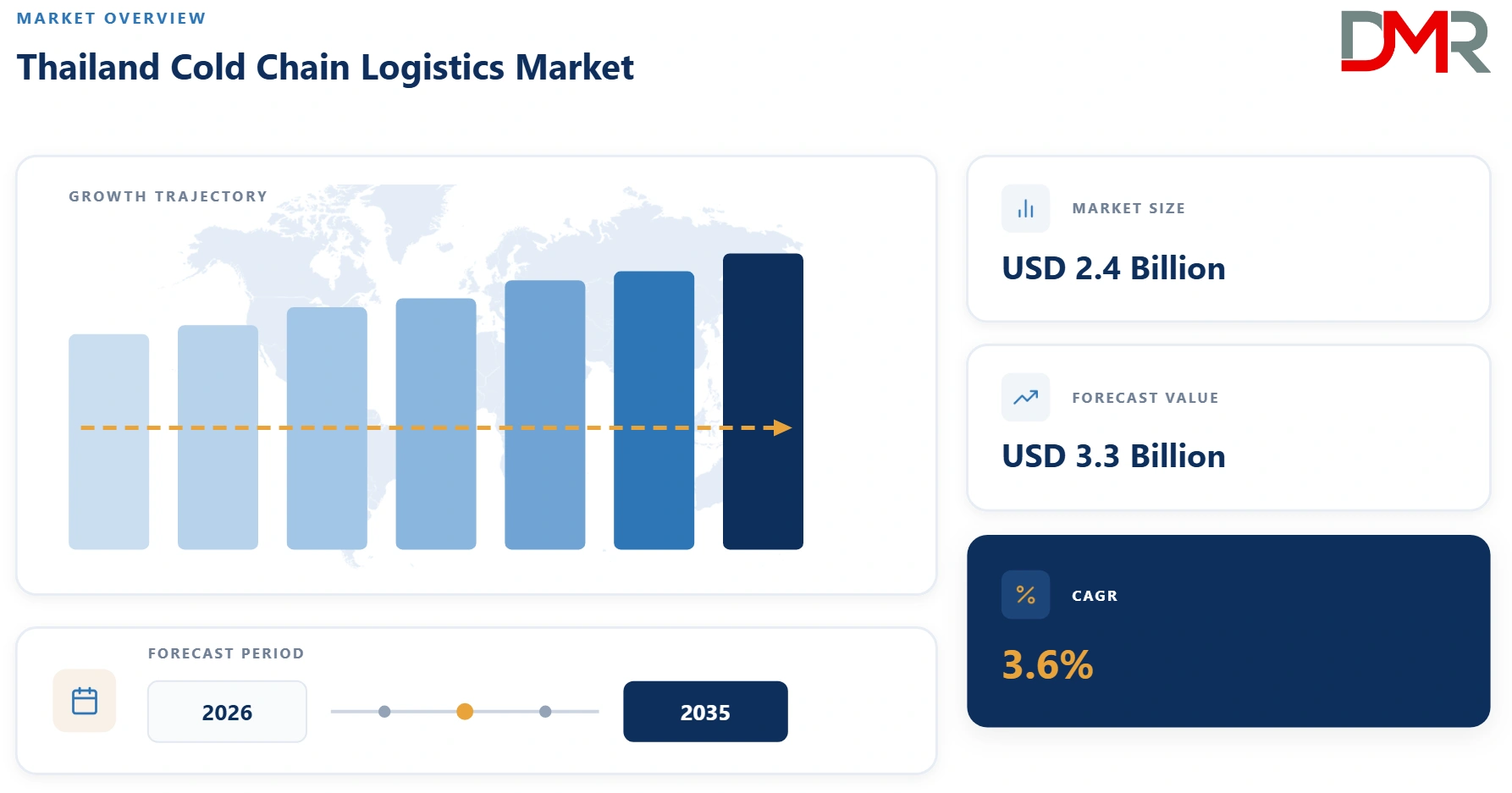
- Thailand Cold Chain Logistics Market Size in 2026: USD 2.4 Billion
- Thailand Cold Chain Logistics Market Size in 2035: USD 3.3 Billion
- Thailand CAGR from 2026 to 2035: 3.6%
- Refrigerated Storage is the leading Service Type segment in 2026: 40.6%
- Frozen is the leading Temperature Type segment in 2026: 52.6%
- Meat & Poultry is the leading Application segment in 2026: 21.7%
- Value-Added Services is the fastest-growing Service Type segment: 4.4% CAGR
- Central Thailand is the leading regional market in 2026: 28.7%
What is the Thailand Cold Chain Logistics Market and its Market Size?
The Thailand Cold Chain Logistics Market is projected to reach USD 2.4 billion in 2026 and grow at a compound annual growth rate of 3.6% from there until 2035 to reach a value of USD 3.3 billion.
ℹ
To learn more about this report –
Download Your Free Sample Report Here
Cold chain logistics encompasses refrigerated storage, temperature-controlled transportation, inventory handling, packaging, monitoring, and distribution services that preserve temperature-sensitive products throughout the supply chain. Thailand’s market serves agricultural exporters, food processors, modern retailers, restaurants, healthcare providers, pharmaceutical manufacturers, chemical companies, and online grocery platforms. Rising demand for frozen foods, processed seafood, fresh produce, biologics, vaccines, and convenience products is encouraging investment in multi-temperature warehouses, refrigerated vehicles, automated systems, digital monitoring, and integrated third-party logistics networks.
Use Cases
- Export-oriented food distribution: Thailand’s seafood, poultry, tropical fruit, frozen food, and processed food exporters use cold chain logistics to maintain freshness from production facilities to ports and international customers. Refrigerated warehouses, blast freezers, pre-cooling systems, reefer containers, quality inspections, and continuous temperature monitoring reduce spoilage, extend shelf life, maintain certification requirements, and support compliance with destination-market food safety standards.
- Pharmaceutical and biologics distribution: Pharmaceutical companies, hospitals, laboratories, wholesalers, and public health agencies require temperature-controlled logistics for vaccines, biologics, insulin, diagnostic materials, and specialty medicines. Qualified packaging, validated vehicles, data loggers, backup refrigeration, controlled access, excursion management, and documented handling procedures protect product integrity while helping distributors comply with Thailand’s Good Distribution Practice requirements and manufacturer specifications.
- Modern retail and food-service fulfillment: Supermarkets, convenience stores, restaurants, hotels, cloud kitchens, and online grocery platforms depend on cold chain providers for frequent deliveries of chilled meat, dairy products, frozen desserts, seafood, prepared meals, and fresh produce. Multi-temperature distribution centers and route-optimized refrigerated fleets allow businesses to consolidate inventory, shorten replenishment cycles, improve product availability, reduce waste, and serve geographically dispersed outlets efficiently.
Key Takeaways
- Market Size: The Thailand Cold Chain Logistics Market is anticipated to be valued at USD 2.40 billion in 2026 and is forecast to reach USD 3.35 billion by 2035, expanding at a CAGR of 3.6%.
- Growth Rate and Outlook: Market expansion is supported by Thailand’s strong food-processing base, extensive agricultural production, modern retail development, pharmaceutical distribution requirements, rising consumption of convenience foods, expanding restaurant networks, online grocery adoption, and increasing demand for reliable temperature monitoring across domestic and export supply chains.
- Primary Growth Drivers: Growth is being driven by seafood, poultry, fruit, frozen food, dairy, and processed food distribution. Investments in refrigerated warehouses, energy-efficient cooling, reefer vehicles, warehouse automation, route optimization, real-time tracking, and Good Distribution Practice-compliant pharmaceutical logistics are further supporting market development.
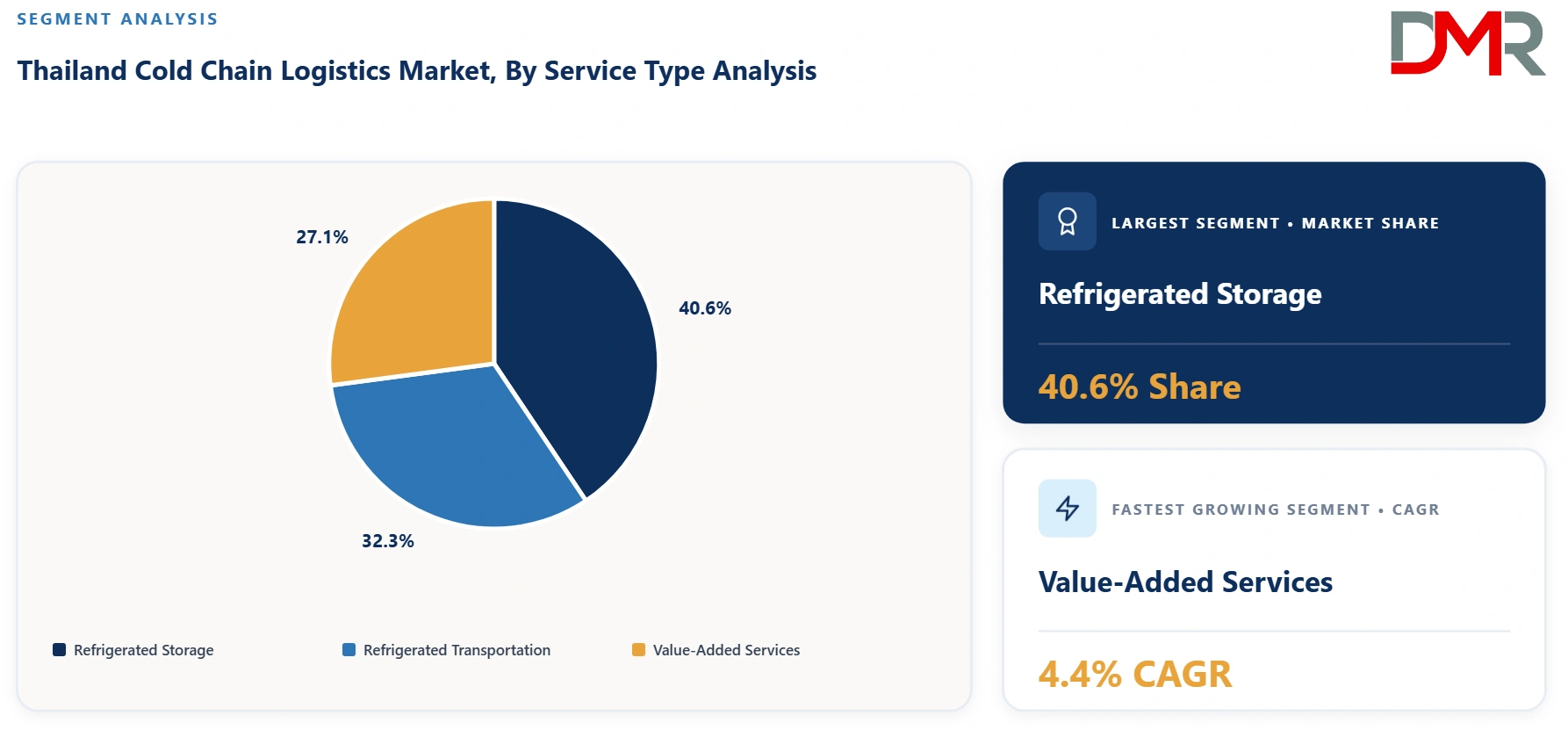
- By Service Type Analysis: Refrigerated Storage is projected to dominate with approximately 40.6% of revenue in 2026. Its position is supported by the need for inventory consolidation, frozen product preservation, export staging, seasonal agricultural storage, and multi-temperature fulfillment. Value-Added Services is expected to grow fastest at approximately 4.4% CAGR.
- By Temperature Type Analysis: Frozen is anticipated to lead with approximately 52.6% of market revenue in 2026, reflecting substantial demand from seafood, poultry, frozen food, ice cream, and prepared meal supply chains. Deep-Frozen / Ultra-Low Temperature services are expected to record the highest growth at approximately 4.7% CAGR.
- By Application Analysis: Meat & Poultry is projected to lead applications with approximately 21.7% of revenue in 2026 due to Thailand’s sizeable food-processing industry and domestic consumption. Pharmaceuticals & Biologics are expected to expand fastest at approximately 5.0% CAGR, supported by strict product-integrity requirements and growing specialty medicine distribution.
How AI and Generative AI are Transforming the Thailand Cold Chain Logistics Market?
Artificial intelligence is improving demand forecasting, warehouse capacity planning, vehicle routing, energy management, and predictive maintenance across Thailand’s cold chain networks. AI systems analyze temperature readings, traffic conditions, delivery schedules, equipment performance, and inventory movement to identify risks before product quality is affected. Generative AI assists operators with compliance documentation, incident summaries, customer communication, and operating procedures. Computer vision supports pallet inspection and inventory accuracy, while digital twins help evaluate warehouse layouts. These applications lower waste, improve asset utilization, strengthen traceability, and enable faster responses to temperature excursions.
Key Drivers in the Thailand Cold Chain Logistics Market
Expansion of Agricultural, Food and Seafood Trade
Thailand’s large agricultural and food-export economy creates sustained requirements for refrigeration, pre-cooling, freezing, reefer transportation, and port-connected storage. In 2024, Thailand ranked as the world’s eighth-largest agricultural and food exporter, generating approximately USD 50.9 billion in exports, with these products contributing around 17% of national exports. Fresh fruits, seafood, prepared meat, poultry, dairy products, frozen meals, and processed foods require consistent temperature control to satisfy shelf-life and destination-market standards. Exporters are consequently adopting certified warehouses, monitoring devices, blast-freezing systems, and integrated transportation services to reduce rejection risks and maintain quality over longer international routes.
Modernization of Thailand’s Logistics Infrastructure
Expansion of organized warehousing, industrial corridors, modern retail, and regional distribution networks is improving the commercial foundation for cold chain services. Thailand’s ready-built warehouse stock reached approximately 6.4 million square meters in 2024, with occupancy ranging between 86% and 88%. Cold chain providers are establishing facilities near Bangkok, Samut Prakan, Samut Sakhon, Chachoengsao, Chonburi, Chiang Mai, ports, and food-processing clusters. Better road connectivity and industrial infrastructure allow companies to develop multi-temperature distribution centers serving manufacturers, retailers, restaurants, and exporters. Greater warehouse availability also supports automated storage systems, shared-user facilities, and integrated storage and transportation contracts.
Restraints in the Thailand Cold Chain Logistics Market
High Energy and Infrastructure Costs
Cold storage facilities operate continuously and require substantial electricity for compressors, ventilation, freezing, monitoring, lighting, and backup systems. Thailand’s warm climate increases cooling loads, while fluctuating electricity prices can materially affect operating margins. Modern refrigerated warehouses also demand insulation, fire protection, specialized flooring, loading docks, backup generators, and advanced control equipment, creating high initial investment requirements. Smaller regional operators may struggle to finance automation or energy-efficient upgrades. Refrigerated fleets face additional fuel, maintenance, and equipment-replacement costs. Providers must therefore balance service pricing with customer affordability, potentially delaying infrastructure development outside Bangkok and major industrial corridors where shipment volumes are less predictable.
Fragmented Networks and Operational Skill Gaps
Thailand’s cold chain ecosystem includes large integrated logistics providers alongside many smaller warehouse and trucking companies with varying technology, certification, and service standards. Fragmentation can create breaks in temperature control when goods move between farms, processors, storage facilities, ports, retailers, and last-mile operators. Limited availability of technicians, refrigeration specialists, qualified drivers, warehouse engineers, and pharmaceutical logistics professionals can affect equipment reliability and regulatory compliance. Smaller operators may rely on manual records or basic tracking systems, reducing end-to-end visibility. Standardizing operating procedures, data formats, temperature thresholds, sanitation practices, and incident reporting across multiple participants remains complex and can increase administrative costs.
Growth Opportunities in the Thailand Cold Chain Logistics Market
Pharmaceutical and Ultra-Low Temperature Logistics
Vaccines, biologics, diagnostic materials, cell-based products, insulin, and specialty medicines create opportunities for qualified cold rooms, validated packaging, ultra-low freezers, control towers, and time-critical transportation. Thailand’s pharmaceutical distributors must demonstrate product traceability, documented handling, temperature mapping, calibration, excursion management, and risk-based quality processes. The Thai FDA issued updated Good Distribution Practice inspection guidance in January 2026, reinforcing demand for professionally managed facilities and transportation. Logistics companies can differentiate through validated lanes, redundant cooling, specialized packaging, trained personnel, and real-time monitoring. Partnerships with hospitals, laboratories, drug manufacturers, research organizations, and wholesalers can generate higher-value contracts than conventional food logistics.
Regional Multi-Temperature Distribution Hubs
Thailand’s location within mainland Southeast Asia provides an opportunity to develop cross-border cold chain corridors connecting Cambodia, Laos, Malaysia, Myanmar, southern China, and regional ports. Providers can establish shared-user facilities near the Eastern Economic Corridor and major border gateways to consolidate seafood, fruit, poultry, processed food, and pharmaceutical cargo. Multi-temperature warehouses can handle chilled, frozen, ambient, and ultra-low temperature goods within one logistics campus. Customs support, quality inspections, repacking, labeling, inventory management, and reefer-container services can expand revenue per customer. Reliable regional networks would also help manufacturers centralize inventory in Thailand and serve neighboring markets through coordinated road, sea, and air transportation.
Trends in the Thailand Cold Chain Logistics Market
Adoption of Automated and Connected Cold Storage
Operators are deploying warehouse management systems, automated storage and retrieval systems, IoT sensors, telematics, electronic proof of delivery, and cloud-based control towers. These technologies provide continuous visibility into product temperature, door openings, vehicle location, refrigeration performance, and inventory status. Automated pallet movement reduces employee exposure to low-temperature environments while improving space utilization and order accuracy. Predictive maintenance helps detect equipment deterioration before a refrigeration failure occurs. The increasing use of integrated dashboards also enables customers to access shipment status and compliance records. Technology adoption is gradually shifting competition from basic storage capacity toward reliability, traceability, data quality, and operational efficiency.
Growth of Sustainable and Energy-Efficient Operations
Energy consumption and environmental performance are becoming important purchasing and investment considerations. Cold storage operators are introducing rooftop solar systems, high-efficiency compressors, natural refrigerants, insulated dock shelters, LED lighting, heat recovery, variable-speed drives, and automated temperature controls. Refrigerated transport companies are exploring route optimization, fuel-efficient vehicles, electric delivery vans, and improved thermal packaging. These measures can reduce emissions and protect margins from electricity and fuel volatility. Food manufacturers and multinational customers are also incorporating supply-chain emissions into procurement decisions. Providers able to document energy savings, refrigerant management, waste reduction, and renewable-energy use can improve contract competitiveness and strengthen access to sustainability-linked financing.
Research Scope and Analysis
Cold chain logistics market is segmented by service type into refrigerated storage refrigerated transportation and value added services, by temperature type into chilled frozen and deep frozen ultra low temperature, by application into fruits vegetables meat poultry fish seafood dairy frozen desserts bakery confectionery ready to eat processed foods pharmaceuticals biologics chemicals specialty materials and others.
ℹ
To learn more about this report –
Download Your Free Sample Report Here
By Service Type Analysis
Refrigerated Storage is expected to dominate the Service Type segment with approximately 40.6% of market revenue in 2026. Its leadership is supported by demand for frozen inventory, export staging, seasonal agricultural storage, and retail distribution.
Value-Added Services are projected to grow fastest at approximately 4.4% CAGR from 2026 to 2035, driven by increasing demand for labeling, repacking, order fulfillment, quality inspection, customs support, inventory management, and real-time monitoring.
By Temperature Type Analysis
Frozen is projected to lead the Temperature Type segment with approximately 52.6% of revenue in 2026. Strong demand from seafood, poultry, meat, frozen desserts, ready meals, and processed food supply chains supports its leading position.
Deep-Frozen / Ultra-Low Temperature is expected to record the highest growth at approximately 4.7% CAGR, supported by biologics, vaccines, specialty medicines, research materials, premium seafood, and products requiring highly controlled temperature environments.
By Application Analysis
Meat & Poultry is anticipated to dominate the Application segment with approximately 21.7% of revenue in 2026. Large processing volumes, food-service demand, retail consumption, and strict requirements for hygiene and product preservation support the segment.
Pharmaceuticals & Biologics are projected to grow fastest at approximately 5.0% CAGR, driven by stronger GDP compliance, vaccine distribution, specialty medicine adoption, and demand for validated packaging and temperature-monitoring services.
The Thailand Cold Chain Logistics Market Report is Segmented Based on the Following
By Service Type
- Refrigerated Storage
- Refrigerated Transportation
- Value-Added Services
By Temperature Type
- Chilled
- Frozen
- Deep-Frozen / Ultra-Low Temperature
By Application
- Fruits & Vegetables
- Meat & Poultry
- Fish & Seafood
- Dairy & Frozen Desserts
- Bakery & Confectionery
- Ready-to-Eat & Processed Foods
- Pharmaceuticals & Biologics
- Chemicals & Specialty Materials
- Others
Technology Analysis
Thailand’s cold chain logistics technology landscape is shifting toward connected warehouses, automated handling, digital traceability, and intelligent transportation. IoT sensors and telematics provide continuous temperature, humidity, vehicle-location, and equipment-performance data. Automated storage and retrieval systems improve pallet density, order accuracy, and employee safety in frozen environments. AI-supported route planning and predictive maintenance lower fuel consumption and refrigeration downtime. Opportunities exist in affordable monitoring platforms for smaller operators and interoperable systems connecting exporters, carriers, ports, and retailers. However, cybersecurity exposure, incompatible data formats, connectivity gaps, and implementation costs create risks. Technology adoption will increasingly determine service reliability, regulatory readiness, and provider competitiveness.
Investment and White Space Analysis
Investment opportunities are concentrated in multi-temperature warehouses, pharmaceutical-grade facilities, provincial distribution centers, cross-border corridors, and energy-efficient refrigeration. Central Thailand has the strongest infrastructure, but underserved production areas in northern, northeastern, and southern provinces offer white-space potential for agriculture, seafood, and food-processing logistics. SCGJWD has been expanding across ten Thai cold-storage warehouses in six provinces, representing more than 160,000 square meters and capacity exceeding 100,000 tonnes or 240,000 pallets. Opportunities also exist in shared-user facilities, solar-powered cold rooms, rental reefer fleets, and specialized last-mile services. Risks include capital intensity, energy volatility, uncertain utilization, land costs, and uneven regional shipment density.
Competitive Landscape
Thailand’s cold chain logistics market is fragmented, with competition among domestic cold-storage specialists, regional logistics groups, multinational third-party logistics providers, pharmaceutical distributors, and refrigerated transport companies. Large providers compete through nationwide networks, automation, integrated storage and transportation, regulatory compliance, and multinational customer relationships. Local operators differentiate through proximity to food-processing clusters, flexible pricing, regional expertise, and specialized product handling. Investment is increasingly directed toward multi-temperature facilities, real-time visibility, pharmaceutical-grade services, energy efficiency, and cross-border distribution. Partnerships with manufacturers and retailers are becoming important for securing stable warehouse utilization and recurring transportation volumes.
Some of the Prominent Players in the Thailand Cold Chain Logistics Market Are
- SCGJWD Logistics Public Company Limited
- Thai Yokorei Co., Ltd.
- Linfox Logistics Thailand
- DHL Supply Chain Thailand
- Kerry Logistics Network
- Kuehne + Nagel Thailand
- DSV Solutions Thailand
- CEVA Logistics Thailand
- Yusen Logistics Thailand
- Nippon Express Logistics Thailand
- M-Senko Logistics Co., Ltd.
- Konoike Cool Logistics Co., Ltd.
- LOGISTEED Thailand
- Nichirei Logistics Group
- CJ Logistics Thailand
- Maersk Logistics Thailand
- Thai Max Cold Storage Co., Ltd.
- Bangkok Cold Storage Service Co., Ltd.
- Sinchai Cold Storage Co., Ltd.
- Kainoke Cold Storage Co., Ltd.
- Cool Train Co., Ltd.
- Best Cold Chain Co., Ltd.
- Pacific Cold Storage Co., Ltd.
- Thai Global Logistics Co., Ltd.
- Integrated Logistics Services Co., Ltd.
- Inter Express Logistics Co., Ltd.
- TVC Transport Thailand Co., Ltd.
- Thai Rath Logistics Co., Ltd.
- Fuze Post Co., Ltd.
- WICE Logistics Public Company Limited
- Leo Global Logistics Public Company Limited
- Siam Nistrans Co., Ltd.
- NRS Logistics Thailand Co., Ltd.
- BJC Logistics
- DKSH Thailand
- Zuellig Pharma Thailand
- DCH Auriga Thailand
- FedEx Express Thailand
- UPS Thailand
- DB Schenker Thailand
- Other Key Players
Recent Developments
- In March 2026, DHL Supply Chain Thailand and Thaifoods Group established a strategic partnership to operate a centralized multi-temperature fulfillment center supporting nationwide distribution. DHL provides dedicated warehousing designed to improve inventory consolidation, operational visibility, and temperature-controlled fulfillment for Thaifoods Group’s poultry, swine, food-processing, and retail operations.
- In September 2025, SCGJWD outlined the expansion of ten cold-storage warehouses across six Thai provinces. The network covers strategic areas including Samut Sakhon, Samut Prakan, Pathum Thani, Chachoengsao, Saraburi, and Chiang Mai, with combined space exceeding 160,000 square meters and capacity for more than 100,000 tonnes of products.
- In June 2025, Linfox progressed with a major multi-temperature facility in Thailand designed for cold chain and quick-service restaurant customers. Future expansion is planned to increase the location to approximately 49,000 square meters and strengthen its ability to serve temperature-controlled healthcare, food-service, retail, and consumer-product supply chains.
Report Details
| Report Characteristics |
| Market Size (2026) |
USD 2.40 Bn |
| Forecast Value (2035) |
USD 3.35 Bn |
| CAGR (2026–2035) |
3.6% |
| Historical Data |
2021 – 2025 |
| Forecast Data |
2026 – 2035 |
| Base Year |
2025 |
| Segments Covered |
By Service Type, By Temperature Type, By Application |
Frequently Asked Questions
How big is the Thailand Cold Chain Logistics Market?
▾ The Thailand Cold Chain Logistics Market is projected to be valued at USD 2.40 billion in 2026 and reach USD 3.35 billion by 2035.
What is the CAGR of the Thailand Cold Chain Logistics Market from 2026 to 2035?
▾ The Thailand Cold Chain Logistics Market is expected to expand at a compound annual growth rate of 3.6% from 2026 to 2035.
What factors are driving the growth of the Thailand Cold Chain Logistics Market?
▾ Growth is driven by food and agricultural exports, frozen-food consumption, pharmaceutical distribution, modern retail, online grocery services, warehouse automation, refrigerated transportation, and demand for reliable product traceability.
What are the major trends in the Thailand Cold Chain Logistics Market?
▾ Major trends include automated cold storage, IoT-based temperature monitoring, AI-supported route planning, multi-temperature fulfillment centers, sustainable refrigeration, renewable-energy adoption, and pharmaceutical-grade logistics.
Who are the key players in the Thailand Cold Chain Logistics Market?
▾ Key players include SCGJWD Logistics, Thai Yokorei, Linfox, DHL Supply Chain, Kerry Logistics, Kuehne + Nagel, DSV, CEVA Logistics, Yusen Logistics, M-Senko Logistics, and Thai Max Cold Storage.
How is the Thailand Cold Chain Logistics Market segmented?
▾ The market is segmented by Service Type into Refrigerated Storage, Refrigerated Transportation, and Value-Added Services, by Temperature Type into Chilled, Frozen, and Deep-Frozen / Ultra-Low Temperature, and by Application into food, pharmaceutical, chemical, and other temperature-sensitive product categories.