Thailand Food Ingredients Market Snapshot
- Thailand Food Ingredients Market Size in 2026: USD 11.2 Billion
- Thailand Food Ingredients Market Size in 2035: USD 14.2 Billion
- CAGR from 2026 to 2035: 2.7%
- Sweeteners is the leading Product Type segment in 2026: 28.7%
- Bakery & Confectionery is the leading Application segment in 2026: 24.6%
- Direct Sales is the leading Distribution Channel segment in 2026: 62.4%
What is the Thailand Food Ingredients Market and its Market Size?
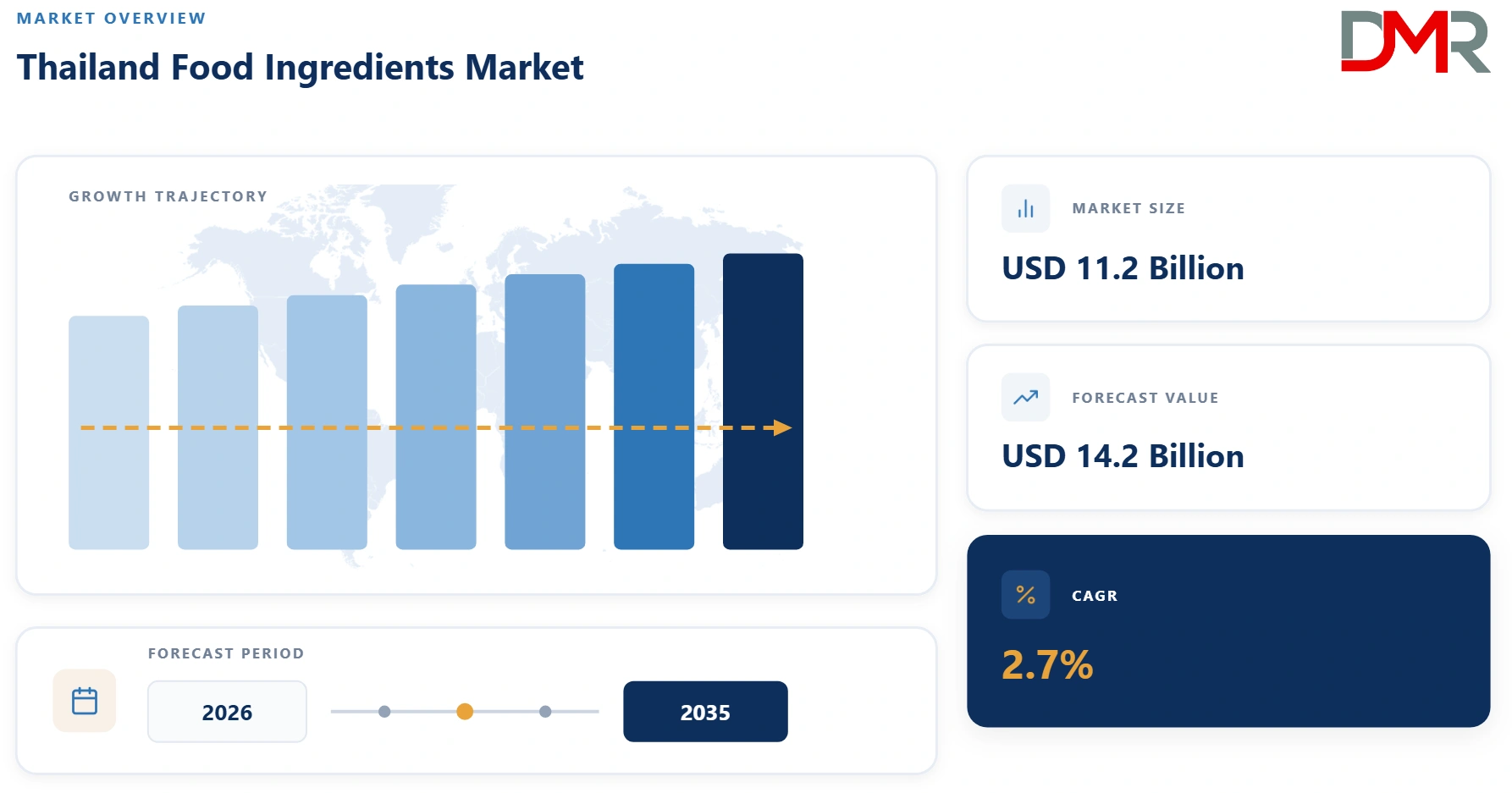
The Thailand Food Ingredients Market is projected to reach USD 11.2 billion in 2026 and grow at a compound annual growth rate of 2.7% from there until 2035 to reach a value of USD 14.2 billion.
ℹ
To learn more about this report –
Download Your Free Sample Report Here
The Thailand food ingredients market supplies flavors, sweeteners, emulsifiers, preservatives, colors, functional compounds, and enzymes to a broad food processing base. Demand is shaped by urban lifestyles, tourism, export manufacturing, convenience foods, and greater interest in nutrition. Domestic strengths in sugar, cassava, rice, fruits, and herbs support local production, while dairy proteins, specialty cultures, premium flavors, and selected functional inputs remain import-dependent. Suppliers increasingly compete through clean label formulation, technical support, traceability, cost control, application-specific innovation, and capabilities.
Use Cases
- Food and beverage manufacturers use ingredient systems to standardize taste, color, texture, nutrition, and shelf life across high-volume production. Sweeteners, emulsifiers, preservatives, enzymes, and flavors help processors manage raw materials while meeting safety, cost, and sensory targets. Application support is especially important for beverages, bakery products, dairy desserts, sauces, snacks, seafood, and export-oriented ready meals produced in Thailand.
- Health-focused brands use functional ingredients to create fortified beverages, high-protein snacks, digestive health products, elderly nutrition, low-sugar foods, and plant-based alternatives. Vitamins, minerals, probiotics, fibers, botanical extracts, proteins, enzymes, and masking flavors improve nutritional positioning and consumer acceptance. Suppliers also support dosage, stability, permitted claims, sensory balance, and Thai FDA compliance during formulation and scale-up.
- Retailers, restaurant groups, and private label producers use customized ingredient blends to launch products matched to Thai preferences and tourism-driven demand. Flavors, beverage syrups, bakery premixes, sauce systems, and shelf-life solutions shorten development cycles and simplify procurement. Direct supplier collaboration enables reformulation for clean labels, lower sodium, reduced sugar, affordability, halal requirements, export specifications, and seasonal menu innovation.
Key Takeaways
- Market Size: The Thailand Food Ingredients Market is anticipated to be valued at USD 11.2 billion in 2026 and is forecast to reach USD 14.2 billion by 2035, expanding at a CAGR of 2.7%.
- Growth Rate and Outlook: Market growth is supported by Thailand’s established food processing industry, expanding exports, recovering tourism, convenience food consumption, urbanization, functional nutrition, premium bakery and beverage demand, clean label formulations, plant-based products, and investment in future food manufacturing.
- Primary Growth Drivers: Thailand has 19,321 registered food industry companies, approximately 93% of which are small businesses. Extensive food manufacturing activity creates recurring requirements for sweeteners, flavors, starches, emulsifiers, enzymes, preservatives, colors, proteins, cultures, and functional ingredients.
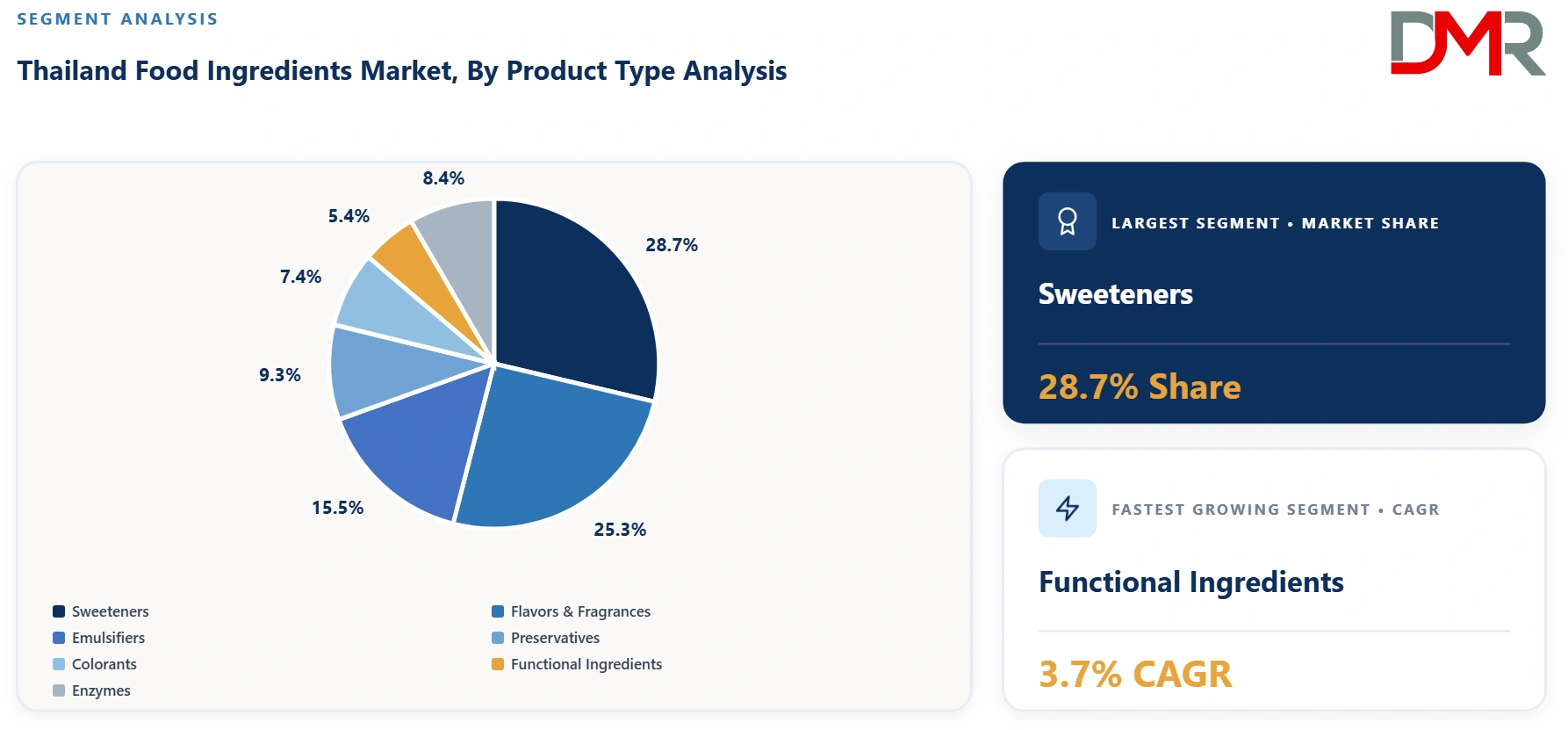
- By Product Type Analysis: Sweeteners is projected to lead with an approximate 28.7% share in 2026, supported by Thailand’s large sugar, beverage, bakery, confectionery, sauce, and processed food industries. Functional Ingredients is expected to record the highest CAGR of approximately 3.7% through 2035.
- By Application Analysis: Bakery & Confectionery is expected to dominate with an approximate 24.6% share in 2026. Beverages is anticipated to record the highest CAGR of around 3.4%, driven by functional drinks, reduced sugar beverages, café culture, tourism, and new flavor combinations.
- By Distribution Channel Analysis: Direct Sales is projected to lead with approximately 62.4% of market revenue in 2026 because major food processors require customized formulations, technical assistance, consistent quality, and volume contracts. Online Retail is forecast to expand at the highest CAGR of approximately 3.9%.
How AI and Generative AI are Transforming the Thailand Food Ingredients Market?
Artificial intelligence and generative AI are reshaping ingredient discovery, formulation, production, and customer collaboration in Thailand. Predictive models can screen flavor combinations, estimate shelf stability, optimize sweetener systems, and identify lower cost substitutes before physical trials. Computer vision improves raw material grading, while machine learning supports demand planning, process control, and preventive maintenance. Generative tools accelerate concept creation for Thai and export tastes. Adoption will favor suppliers with reliable formulation data, skilled food scientists, and strong governance protecting recipes, claims, consumer information, and intellectual property across increasingly connected manufacturing operations.
Key Drivers in the Thailand Food Ingredients Market
Large and Export-Oriented Processing Base
Thailand has 19,321 registered food industry companies, and about 93% are small businesses, creating broad demand for scalable ingredients, premixes, application support, and distributor coverage. Processors serve domestic consumption, tourism, and export markets across seafood, fruit, vegetables, bakery, beverages, ready meals, and pet food. Thailand exported USD 50.9 billion of food and agricultural products in 2024, demonstrating the industrial reach supporting ingredient consumption. Manufacturers require consistent taste, shelf stability, safety, and export-compliant formulations, which encourages recurring purchases of flavors, sweeteners, emulsifiers, preservatives, enzymes, starches, proteins, and functional systems. USDA Foreign Agricultural Service
Health, Urbanization and Convenience Demand
Thailand’s urban population represented 53.5% of residents in 2025 and is projected to reach 58.4% by 2030, supporting demand for convenient, packaged, and premium food formats. Consumers increasingly seek high-protein, low-sugar, digestive health, plant-based, clean-label, and personalized nutrition products. The country’s foodservice sector remained resilient during 2025, while tourism continued to stimulate beverages, bakery, desserts, sauces, and ready meals. These shifts increase the need for functional fibers, cultures, proteins, natural flavors, alternative sweeteners, shelf life solutions, and texture systems capable of delivering health benefits without sacrificing affordability or familiar Thai sensory profiles.
Restraints in the Thailand Food Ingredients Market
Dependence on Imported Specialty Inputs
Thailand produces abundant sugar, cassava, rice, fruits, herbs, and basic starches, yet many high-value inputs remain import-dependent, including dairy proteins, wheat-based materials, premium bakery ingredients, cultures, plant proteins, and specialized functional compounds. Ingredient imports reached USD 3.7 billion in 2025, exposing buyers to freight costs, exchange rates, tariffs, documentation, and geopolitical disruptions. Supplier movements were volatile, with imports from Indonesia rising 58.2% while Singapore declined 17.2%. Small processors have limited bargaining power and inventory capacity, so sudden landed cost increases can delay launches, compress margins, encourage lower-cost substitutions, or reduce formulation quality.
Complex Approval and Claim Requirements
Thai FDA controls permitted additives, use levels, product registration, nutrition labeling, health claims, and import documentation. Manufacturers introducing novel functional ingredients may need safety assessments, scientific substantiation, Thai language materials, testing, and formulation changes before commercialization. Regulatory interpretation can vary by ingredient form, dosage, application, and intended claim, raising time and advisory costs. The government is developing a Positive List exceeding 150 approved ingredients and claims by 2027, but products outside it may still face extended review. Noncompliant labels or unsupported claims create risks of shipment holds, advertising restrictions, recalls, and reputational damage, particularly for smaller suppliers without local regulatory teams.
Growth Opportunities in the Thailand Food Ingredients Market
Future Food and Functional Formulation
Thailand aims to build future food activities around functional products, medical and personalized nutrition, organic and clean foods, and alternative proteins. Government policy targets THB 500 billion in future food industry value by 2027, while the Thai FDA Positive List is intended to reduce repeated evidence requirements and speed approved health claim use. This creates white space for probiotics, prebiotic fibers, botanical extracts, elderly nutrition, sports nutrition, immunity products, plant proteins, and reduced sugar systems. Ingredient companies can capture value by combining locally sourced crops and herbs with clinical evidence, sensory optimization, pilot production, regulatory dossiers, and export ready quality systems. Thailand NXPO
Import Substitution and Regional Export Platforms
Thailand imported USD 3.7 billion in food ingredients during 2025, including products that local processors cannot source consistently at required quality. This leaves room for domestic production of dairy alternatives, plant proteins, fermentation derived ingredients, clean label preservatives, specialty starches, natural colors, and premium bakery systems. Thailand’s established food manufacturing base, ports, ASEAN connectivity, and cassava, rice, sugarcane, fruit, and herbal feedstocks can support regional production platforms. Suppliers that localize manufacturing may reduce lead times and currency exposure while qualifying for investment support. Risks include technical scale up, raw material variability, intellectual property protection, certification costs, and competition from lower priced imports.
Trends in the Thailand Food Ingredients Market
Sugar Reduction and Clean Label Reformulation
The final phase of Thailand’s sugar based beverage excise tax took effect in April 2025. Beverages containing no more than six grams of sugar per liter remain exempt, while higher bands face increased rates, strengthening incentives to reformulate. In 2026, nine major coffee chains also agreed to cut default sugar in selected drinks by half, reflecting broader public health pressure. Demand is therefore moving toward high intensity sweeteners, flavor modulation, fibers, natural colors, recognizable preservatives, and texture systems that maintain body and taste. The technical challenge is avoiding bitterness, aftertaste, instability, and higher costs while satisfying familiar consumer preferences.
Premium Sensory Experiences and Functional Convenience
Thailand’s 2026 food and beverage trends emphasize holistic wellness, convenience, premiumization, layered sensory experiences, and inclusive products. Beverage chains, convenience stores, bakeries, and ready meal producers are using novel flavors, contrasting textures, botanical notes, and culturally familiar profiles to create differentiation. At the same time, consumers expect portability, longer shelf life, lower sugar, high protein, and digestive or immunity support. This convergence encourages multifunctional ingredient systems rather than single additives. Suppliers are expanding co-creation, rapid prototyping, and small batch applications. Success depends on balancing novelty with affordability, regulatory compliance, local taste preferences, and manufacturing compatibility at commercial scale.
Research Scope and Analysis
Thailand Food Ingredients Market is segmented by product type: flavors and fragrances, sweeteners, emulsifiers, preservatives, colorants, functional ingredients and enzymes, by application covering beverages, dairy and frozen desserts, bakery and confectionery, snacks, sauces, dressings and condiments, meat, poultry and seafood, and others, by distribution channel: direct sales, online retail, hypermarkets supermarkets, specialty stores and convenience stores.
ℹ
To learn more about this report –
Download Your Free Sample Report Here
By Product Type Analysis
Sweeteners is projected to hold the largest Product Type share of approximately 28.7% in 2026, supported by demand from beverages, bakery, confectionery, sauces, dairy desserts, and processed foods. Thailand’s integrated sugarcane industry, domestic production capacity, and widespread use of sugar systems reinforce the segment’s position.
Functional Ingredients is expected to record the highest CAGR of approximately 3.7% from 2026 to 2035. Growth will be driven by high protein foods, digestive health, immunity support, elderly nutrition, fortified beverages, probiotics, prebiotics, botanical extracts, and plant based formulations.
By Application Analysis
Bakery & Confectionery is anticipated to lead the Application segment with approximately 24.6% of revenue in 2026. Bakery chains, convenience stores, cafés, industrial processors, tourism, and demand for packaged snacks support the consumption of sweeteners, emulsifiers, flavors, enzymes, starches, preservatives, and texture systems.
Beverages is forecast to register the highest CAGR of approximately 3.4% through 2035. Functional drinks, café beverages, low sugar products, botanical infusions, dairy alternatives, protein drinks, and premium sensory experiences will stimulate ingredient demand.
By Distribution Channel Analysis
Direct Sales is expected to dominate the Distribution Channel segment with approximately 62.4% of revenue in 2026. Large food and beverage manufacturers favor direct relationships because they require customized formulations, volume pricing, application trials, regulatory support, quality assurance, traceability, and dependable supply schedules.
Online Retail is projected to record the highest CAGR of approximately 3.9% from 2026 to 2035. Digital procurement platforms are improving product discovery and access to specialty ingredients for small processors, bakeries, restaurants, cafés, startups, and home based food businesses.
The Thailand Food Ingredients Market Report is Segmented Based on the following:
By Product Type
- Flavors & Fragrances
- Sweeteners
- Emulsifiers
- Preservatives
- Colorants
- Functional Ingredients
- Enzymes
By Application
- Beverages
- Dairy & Frozen Desserts
- Bakery & Confectionery
- Snacks
- Sauces, Dressings & Condiments
- Meat, Poultry & Seafood
- Others
By Distribution Channel
- Direct Sales
- Online Retail
- Hypermarkets/Supermarkets
- Specialty Stores
- Convenience Stores
Regulatory Landscape
Thailand’s food ingredient regulatory environment is governed by the Food Act and Thai FDA notifications covering permitted additives, specifications, maximum use levels, labeling, nutrition claims, and import approval. Notifications issued in 2025 updated nutrition labeling, beverages, pesticide residues, and additive conditions, increasing compliance work for formulators and distributors. The Positive List initiative creates an important opportunity by targeting more than 150 preapproved functional ingredients and health claims by 2027, potentially shortening commercialization. However, novel ingredients still require safety evidence, documentation, and local interpretation. Suppliers that maintain Thai language dossiers, traceability, analytical testing, and claim substantiation can gain trust, while noncompliance risks shipment delays, reformulation, recalls, advertising restrictions, and reputational damage.
Export Import Analysis
Thailand combines a strong agricultural base with material dependence on imported high value ingredients. Food ingredient imports reached USD 3.7 billion in 2025, rising 8%, as processors purchased dairy proteins, wheat inputs, premium bakery materials, plant proteins, flavors, and functional compounds unavailable locally. China remained the largest supplier, while New Zealand, Indonesia, Malaysia, Vietnam, Australia, and the United States provided volumes. Thailand also exports sugar, cassava derivatives, starches, processed fruits, seafood ingredients, and food preparations through regional and global networks. Opportunities exist in import substitution and export grade formulation, but exchange rates, tariffs, sanitary requirements, logistics disruptions, and customer country standards can alter landed costs, sourcing decisions, and margins.
Competitive Landscape
The Thailand food ingredients market is moderately fragmented, combining local sugar, cassava, starch, seasoning, botanical, and distribution specialists with multinational flavor, enzyme, culture, sweetener, emulsifier, and nutrition companies. Competition centers on price, regulatory support, local application laboratories, formulation speed, supply reliability, clean label performance, and export compliance. Large processors favor strategic direct supply relationships, while smaller manufacturers rely more on distributors and premix providers. Local agricultural integration supports cost advantages, whereas international suppliers differentiate through proprietary technologies, sensory expertise, validated health benefits, and broader ingredient portfolios.
Some of the Prominent Players in the Thailand Food Ingredients Market Are
- Ajinomoto Co., Inc.
- Mitr Phol Group
- Thai Wah Public Company Limited
- Ingredion Incorporated
- Archer Daniels Midland Company
- Cargill, Incorporated
- Kerry Group plc
- dsm-firmenich
- International Flavors & Fragrances Inc.
- Givaudan SA
- Symrise AG
- Tate & Lyle PLC
- Roquette Frères
- BENEO GmbH
- Corbion N.V.
- Novonesis A/S
- Palsgaard A/S
- AAK AB
- BASF SE
- Sensient Technologies Corporation
- Kemin Industries, Inc.
- Lesaffre
- Glanbia plc
- Fonterra Co-operative Group Limited
- FrieslandCampina Ingredients
- ofi
- Fuji Oil Holdings Inc.
- Nagase & Co., Ltd.
- Döhler GmbH
- MANE Group
- Robertet Group
- Silesia Gerhard Hanke GmbH & Co. KG
- Brenntag SE
- DKSH Holding Ltd.
- Caldic B.V.
- SMS Corporation Co., Ltd.
- Siam Modified Starch Co., Ltd.
- Nithi Foods Co., Ltd.
- Vicchi Enterprise Co., Ltd.
- Food Specialize Co., Ltd.
- Other Key Players
Recent Developments
- May 2026: Mitr Phol introduced a low glycemic index natural cane sugar at THAIFEX - Anuga Asia 2026, supporting growing demand for lower sugar and health oriented sweetening solutions in Thailand. Mitr Phol
- September 2025: Ingredion presented texture, health, formulation, and consumer experience solutions at Food Ingredients Asia Thailand 2025 in Bangkok, emphasizing technical collaboration and locally relevant product development. Ingredion
- 2025: Thai Wah expanded its food and starch innovation portfolio, reporting 60 functional solutions, 10 clean label products, and 10 healthy solutions within its starch related business. Its food business sales increased by 7.8% during the year.
Report Details
| Report Characteristics |
| Market Size (2026) |
USD 11.2 Bn |
| Forecast Value (2035) |
USD 14.2 Bn |
| CAGR (2026–2035) |
2.7% |
| Historical Data |
2021 – 2025 |
| Forecast Data |
2026 – 2035 |
| Base Year |
2025 |
| Segments Covered |
By Product Type, By Application, By Distribution Channel |
Frequently Asked Questions
How big is the Thailand Food Ingredients Market?
▾ The Thailand Food Ingredients Market is projected to be valued at USD 11.2 billion in 2026 and reach USD 14.2 billion by 2035.
What is the CAGR of the Thailand Food Ingredients Market from 2026 to 2035?
▾ The market is expected to expand at a compound annual growth rate of 2.7% during 2026-2035.
What factors are driving the growth of the Thailand Food Ingredients Market?
▾ Growth is driven by Thailand’s large food processing base, processed food exports, tourism, urbanization, convenience foods, functional nutrition, bakery and beverage demand, clean label formulations, sugar reduction, plant based products, and future food investments.
What are the major trends in the Thailand Food Ingredients Market?
▾ Major trends include functional ingredients, reduced sugar formulations, clean labels, natural preservatives, plant proteins, personalized nutrition, premium flavors, texture innovation, AI assisted formulation, sustainable sourcing, and direct technical collaboration between ingredient suppliers and processors.
Who are the key players in the Thailand Food Ingredients Market?
▾ Key players include Ajinomoto, Mitr Phol, Thai Wah, Ingredion, ADM, Cargill, Kerry Group, dsm-firmenich, IFF, Givaudan, Symrise, Tate & Lyle, Roquette, Corbion, Novonesis, and Palsgaard.
How is the Thailand Food Ingredients Market segmented?
▾ The market is segmented by Product Type into flavors and fragrances, sweeteners, emulsifiers, preservatives, colorants, functional ingredients, and enzymes. By Application, it covers beverages, dairy and frozen desserts, bakery and confectionery, snacks, sauces, meat, poultry, seafood, and others. Distribution channels include direct sales, online retail, hypermarkets, supermarkets, specialty stores, and convenience stores.