Thailand Food Packaging Market Snapshot
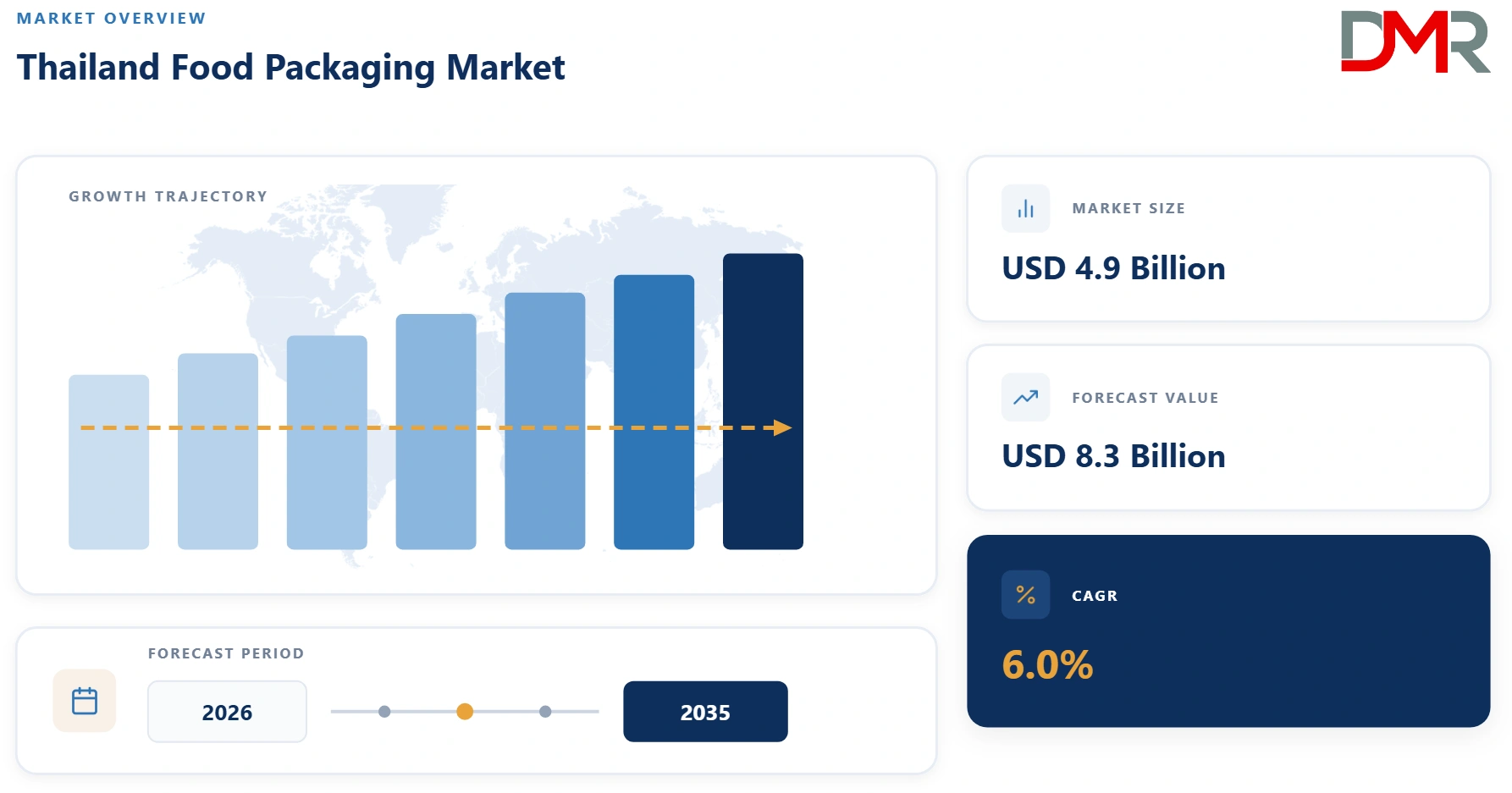
- Thailand Food Packaging Market Size in 2026: USD 4.9 Billion
- Thailand Food Packaging Market Size in 2035: USD 8.3 Billion
- Thailand CAGR from 2026 to 2035: 6.0%
- Flexible is the leading Type segment in 2026: 58.5%
- Plastics is the leading Material segment in 2026: 41.8%
- Meat & Seafood is the leading Application segment in 2026: 28.7%
- Pouches is the leading Packaging Type segment in 2026: 30.2%
- Frozen Food is the leading Food Type segment in 2026: 34.6%
What is the Thailand Food Packaging Market and its Market Size?
The Thailand Food Packaging Market is projected to reach USD 4.9 billion in 2026 and grow at a compound annual growth rate of 6.0% until 2035 to reach a value of USD 8.3 billion.
ℹ
To learn more about this report –
Download Your Free Sample Report Here
Thailand’s food packaging market spans materials and formats designed to protect processed, fresh, chilled, frozen, canned, and shelf-stable foods throughout manufacturing, distribution, retail, foodservice, and export channels. Demand reflects the country’s large food-processing base, strong seafood and agricultural exports, expanding convenience retail, tourism recovery, and growing consumption of ready meals. Suppliers compete through barrier performance, lightweighting, recyclability, food safety, digital printing, shelf-life extension, and packaging compatible with automated filling, sealing, retort, and cold-chain operations across Thailand.
Use Cases
- Packaged Food Manufacturing: Packaged food manufacturers use flexible films, rigid containers, trays, cans, and cartons to protect bakery, dairy, produce, sauces, seafood, and convenience foods. Appropriate barriers manage oxygen, moisture, grease, light, and contamination while supporting high-speed filling and sealing. Brand owners also use print quality, portion sizes, reseal features, and lightweight structures to strengthen differentiation and consumer convenience across modern retail.
- Food Export and Cold-Chain Distribution: Thailand seafood, meat, fruit, and prepared-food exporters rely on retort pouches, frozen-food bags, cans, barrier trays, and shelf-stable cartons to withstand long distribution cycles. Temperature resistance, seal integrity, puncture strength, traceability, and compliance documentation reduce spoilage and rejected shipments. Export packaging enables processors to tailor portions, labels, and formats for retail, foodservice, and private-label customers overseas.
- Retail, Foodservice, and Delivery: Restaurants, convenience stores, supermarkets, delivery kitchens, and online grocers use cups, bottles, pouches, trays, and tamper-evident containers for takeaway meals, sauces, beverages, chilled items, and ready foods. Packaging supports portion control, hygiene, leak resistance, reheating, stackability, and delivery durability. Growing interest in fiber-based, recyclable, and reusable formats gives foodservice operators ways to meet sustainability commitments and customer expectations.
Key Takeaways
- Market Size: The Thailand Food Packaging Market is anticipated to be valued at USD 4.9 billion in 2026 and is forecast to reach USD 8.3 billion by 2035, expanding at a CAGR of 6.0%.
- Growth Outlook: Market expansion is supported by Thailand’s established food-processing industry, growing processed-food exports, tourism recovery, modern retail penetration, convenience-store expansion, food-delivery services, urban lifestyles, demand for longer shelf life, and investment in recyclable and lightweight packaging.
- Primary Growth Drivers: Rising production of processed seafood, frozen foods, bakery products, dairy products, sauces, ready meals, and packaged fruits is expanding packaging consumption. Food-safety requirements, export compliance, automated processing, cold-chain development, portion control, brand differentiation, and sustainability commitments are supporting higher-value packaging adoption.
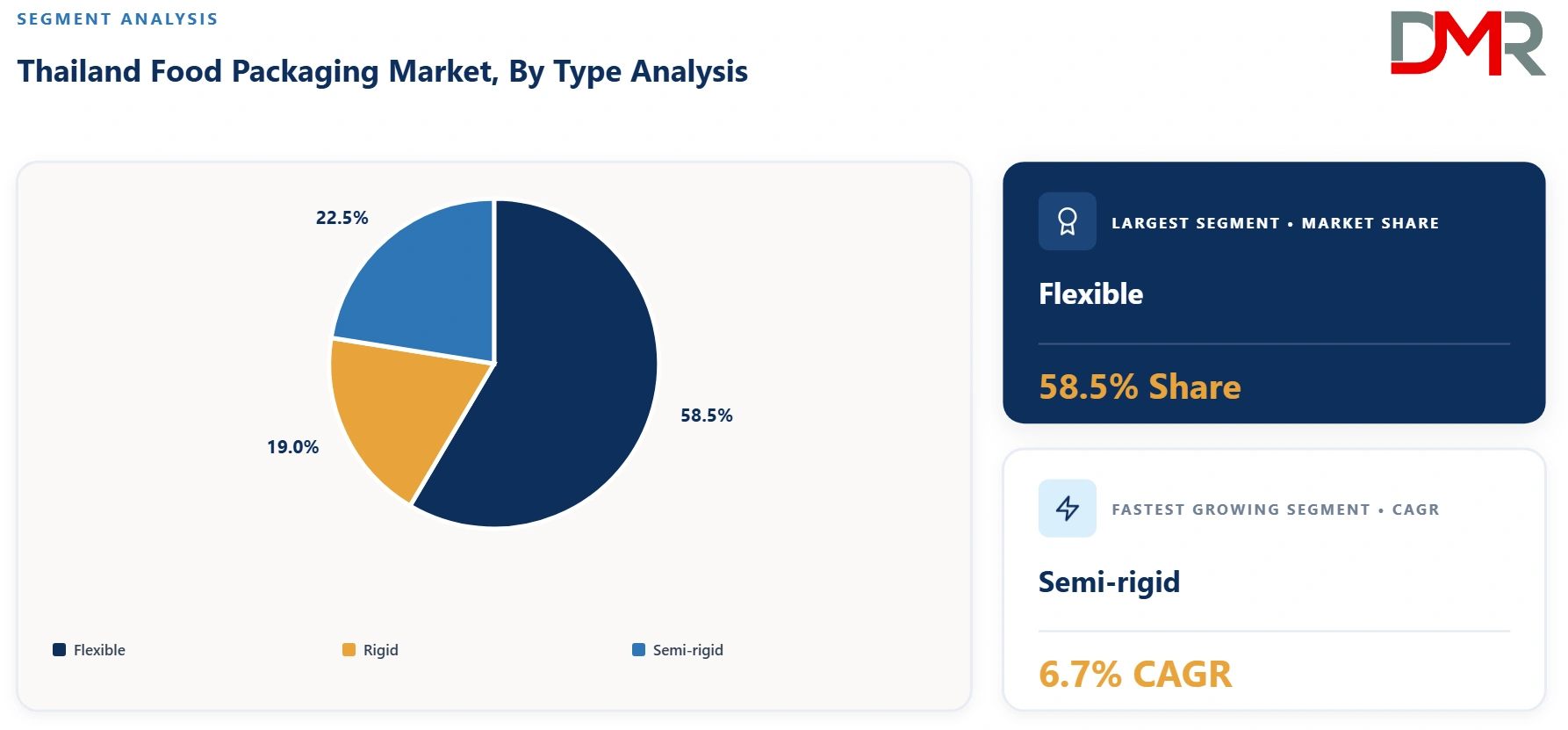
- By Type Analysis: Flexible packaging is projected to dominate with approximately 58.5% of market revenue in 2026. Its leadership is supported by low material consumption, transportation efficiency, printable surfaces, resealability, and compatibility with snacks, seafood, frozen food, sauces, bakery products, and ready meals.
- By Material Analysis: Plastics is expected to lead with approximately 41.8% in 2026 due to its moisture resistance, sealability, durability, lightweight structure, clarity, and compatibility with flexible and rigid formats. Paper and paper-based materials are expected to expand faster as food companies pursue recyclable and renewable alternatives.
- By Application Analysis: Meat & Seafood is projected to account for approximately 28.7% in 2026. Thailand’s seafood-processing and export activities generate significant demand for frozen-food bags, vacuum packaging, retort pouches, trays, cans, absorbent packaging, high-barrier films, and temperature-resistant labels.
- By Packaging Type Analysis: Pouches are anticipated to hold approximately 30.2% of the market in 2026. Stand-up, flat, retort, vacuum, spouted, and resealable pouches offer strong shelf visibility, efficient transportation, portion flexibility, barrier protection, and compatibility with numerous processed-food categories.
- By Food Type Analysis: Frozen Food is projected to lead with approximately 34.6% in 2026. Demand is supported by frozen seafood, poultry, ready meals, fruits, vegetables, desserts, and convenience foods requiring puncture-resistant, moisture-resistant, low-temperature-compatible packaging.
How AI and Generative AI are Transforming the Thailand Food Packaging Market?
AI and generative AI are improving packaging development, production, and supply planning across Thailand. Machine vision detects print, seal, label, and dimensional defects at line speed, while predictive maintenance reduces unplanned downtime on converting and filling equipment. Generative design tools evaluate package geometry, material use, pallet efficiency, and consumer appeal before physical prototyping. Demand forecasting improves resin, paper, and inventory decisions. Digital twins simulate barrier and transport performance, and AI-enabled sorting supports recycling. Adoption remains constrained by data quality, integration costs, cybersecurity, and limited technical skills among smaller converters.
Key Drivers in the Thailand Food Packaging Market
Expansion of Food Processing and Export Activities
Thailand has a well-developed food-processing industry serving domestic and international customers. In 2024, the country exported approximately USD 28 billion in processed food products, while its broader food-processing industry generated an estimated USD 36 billion. Seafood, prepared poultry, fruits, rice products, sauces, bakery goods, and pet food require high-barrier and export-compliant packaging. Manufacturers increasingly need vacuum packs, cans, retort pouches, aseptic formats, frozen-food films, and durable secondary packaging capable of maintaining quality during long-distance distribution. This export-oriented production base supports demand for food-contact-certified materials, advanced printing, traceability, and packaging engineered for tropical storage conditions. Growth of Retail, Convenience, and Foodservice Channels
Thailand’s food retail sales reached approximately USD 7.9 billion in 2024, representing about 6% of total retail sales, while its foodservice sector benefited from tourism recovery and store expansion. Consumers increasingly purchase ready meals, snacks, chilled products, portioned foods, sauces, beverages, and delivery-friendly meals. Convenience stores and supermarkets require packaging that provides shelf visibility, tamper evidence, easy opening, resealability, microwave compatibility, and extended freshness. Food-delivery operators also need leak-resistant and stackable containers. Expansion across these channels encourages investment in pouches, trays, cups, bottles, paper-based containers, labels, and lightweight rigid packaging designed for high-volume distribution.
Restraints in the Thailand Food Packaging Market
Volatile Raw Material and Conversion Costs
Food-packaging manufacturers remain exposed to fluctuations in polymer resins, aluminum, steel, paperboard, coatings, adhesives, printing inks, energy, and transportation expenses. Many high-performance substrates depend on imported materials or specialized technologies, making costs sensitive to exchange rates, oil prices, shipping conditions, and geopolitical disruptions. Smaller converters may struggle to maintain margins when food producers resist price increases or demand shorter contracts. Redesigning packaging to reduce material use can lower costs but may require testing, tooling, and equipment modifications. Persistent volatility can delay capacity expansion, encourage inventory reduction, and make long-term pricing agreements more difficult across the packaging supply chain.
Recycling Infrastructure and Multi-Material Complexity
Many food packages use multilayer films, coatings, adhesives, aluminum barriers, labels, or mixed materials to achieve safety and shelf-life requirements. These structures can be difficult to collect, separate, and recycle using Thailand’s existing waste-management infrastructure. Converters face a technical balance between reducing environmental impact and maintaining moisture, oxygen, grease, heat, and contamination protection. Mono-material alternatives may require new sealants, equipment adjustments, and extensive shelf-life validation. Limited access to consistent food-grade recycled resin also restricts adoption. Without stronger collection systems and end-market demand, recyclable package designs may not achieve practical circularity, potentially increasing compliance costs without delivering proportional environmental benefits.
Growth Opportunities in the Thailand Food Packaging Market
Recyclable, Fiber-Based, and Low-Carbon Packaging
Growing sustainability commitments create opportunities for recyclable mono-material pouches, paper-based trays, molded-fiber containers, lightweight bottles, aluminum formats, certified paperboard, compostable foodservice products, and packages containing recycled material. Food brands need solutions that lower plastic use without reducing product protection or manufacturing efficiency. Suppliers that provide material assessment, life-cycle analysis, migration testing, package redesign, and recycling guidance can capture higher-value contracts. Thailand’s developing extended producer responsibility framework may further increase demand for measurable packaging reductions and improved recyclability. Partnerships between converters, recyclers, retailers, and food processors can help establish closed-loop systems and strengthen domestic availability of suitable recycled feedstock.
Smart Packaging and Export Traceability
Connected packaging offers substantial opportunities in Thailand’s export-oriented food industry. QR codes, digital watermarks, serialization, freshness indicators, temperature sensors, and cloud-linked labels can provide sourcing information, authenticity verification, cold-chain records, preparation guidance, and disposal instructions. Seafood, meat, dairy, frozen foods, supplements, and premium exports are particularly suitable for traceability-enabled formats. Smart features help processors improve recall readiness, regulatory documentation, customer engagement, and counterfeit protection. Falling digital-printing costs also support personalized and short-run packaging for seasonal products and private labels. Suppliers that integrate physical packaging with data platforms can differentiate beyond price and build recurring service relationships with food manufacturers.
Trends in the Thailand Food Packaging Market
Shift Toward Flexible and Convenience-Oriented Formats
Flexible packaging is gaining preference because pouches, bags, wraps, and lidding films use less material than many traditional rigid alternatives and offer favorable storage and transportation economics. Stand-up pouches, resealable packs, retort formats, single-serve portions, and microwave-ready bags are increasingly used for snacks, sauces, seafood, prepared meals, frozen foods, and confectionery. High-barrier layers and improved seals are expanding the range of products suitable for flexible structures. Brands are also adopting matte finishes, transparent windows, tactile effects, and high-quality digital printing. The continuing shift supports demand for advanced film extrusion, lamination, coating, printing, and pouch-making technologies.
Automation, Lightweighting, and High-Barrier Performance
Thai packaging converters and food processors are investing in faster filling, sealing, inspection, labeling, and palletizing systems to improve consistency and reduce labor dependency. Packaging must therefore run efficiently on automated lines while using thinner materials and maintaining seal strength. High-barrier coatings, multilayer structures, retort-resistant films, modified-atmosphere packaging, anti-fog materials, and oxygen-control solutions are helping extend shelf life and reduce food waste. Lightweighting remains a central design objective, but excessive downgauging can create puncture or leakage risks. Suppliers are increasingly using simulation, line trials, machine vision, and performance testing to balance material reduction with safety and processing speed.
Research Scope and Analysis
Thailand food packaging market covers flexible, rigid and semi rigid formats across plastics, paper and paper based materials, glass, metal and substrates serving bakery and confectionery, dairy, fruits and vegetables, meat and seafood, sauces and dressings and other foods through cups, bottles, cans, pouches, trays and other packages for frozen, chilled, canned and shelf stable products.
ℹ
To learn more about this report –
Download Your Free Sample Report Here
By Type Analysis
Flexible packaging is projected to lead the Type segment with approximately 58.5% of revenue in 2026. Its low weight, reduced transportation costs, barrier flexibility, printability, and compatibility with high-speed lines support broad adoption. Semi-rigid packaging is expected to record the fastest CAGR of approximately 6.7% from 2026 to 2035. Growth will be supported by ready meals, chilled foods, portion packs, and recyclable tray development.
By Material Analysis
Plastics is expected to dominate the Material segment with approximately 41.8% in 2026 due to its durability, sealability, moisture resistance, flexibility, and cost efficiency. Paper and paper-based materials are forecast to grow at the fastest CAGR of approximately 7.1% through 2035. Adoption is increasing across cups, trays, cartons, wraps, and foodservice packaging as manufacturers reduce dependence on conventional plastics.
By Application Analysis
Meat & Seafood is projected to lead the Application segment with approximately 28.7% in 2026. Vacuum packs, retort pouches, cans, frozen-food bags, trays, and barrier films are widely required for preservation and exports. Bakery & Confectionery is expected to register the fastest CAGR of approximately 6.8% through 2035, supported by convenience retail, packaged snacks, portion formats, and premium presentation.
By Packaging Type Analysis
Pouches are anticipated to dominate the Packaging Type segment with approximately 30.2% in 2026. Stand-up, vacuum, retort, spouted, and resealable pouches provide shelf impact, product protection, and logistics efficiency. Trays are expected to grow at the fastest CAGR of approximately 7.0% through 2035 as ready meals, fresh meat, seafood, chilled foods, bakery products, and takeaway consumption expand.
By Food Type Analysis
Frozen Food is projected to lead the Food Type segment with approximately 34.6% of revenue in 2026. Frozen seafood, meat, fruits, vegetables, desserts, and convenience meals require durable packaging with reliable low-temperature performance. Chilled Food is anticipated to grow at the fastest CAGR of approximately 6.9% through 2035, driven by fresh meals, dairy products, processed meat, retail refrigeration, and food delivery.
The Thailand Food Packaging Market Report is Segmented Based on the Following
By Type
- Flexible
- Rigid
- Semi-rigid
By Material
- Plastics
- Paper & Paper-Based Materials
- Glass
- Metal
- Others
By Application
- Bakery & Confectionery
- Dairy Products
- Fruits & Vegetables
- Meat & Seafood
- Sauces & Dressings
- Others
By Packaging Type
- Cups
- Bottles
- Cans
- Pouches
- Trays
- Others
By Food Type
- Frozen Food
- Chilled Food
- Canned Food
- Shelf Stable Food
Regulatory Landscape
Thailand’s food-packaging regulation centers on food-contact safety, material migration, labeling, hygiene, and environmental responsibility. Thai FDA Notification No. 435 establishes requirements for plastic food packaging, increasing demand for documented resin composition, migration testing, clean production, and compliant inks. The national Plastic Waste Management Roadmap and developing extended producer responsibility framework are pushing converters toward recyclable structures, source reduction, recycled content, and clearer disposal information. Opportunities favor mono-material films, fiber alternatives, certified recycled polymers, and traceable supply chains. Risks include testing costs, uncertain implementation schedules, and inconsistent collection infrastructure. Compliance will increasingly influence supplier qualification, package redesign, capital spending, and access to multinational food-brand contracts in Thailand.
Technology Analysis
Technology development is moving Thailand’s food-packaging industry toward thinner high-barrier films, recyclable mono-material laminates, paper-based barriers, aseptic cartons, active packaging, digital printing, and connected labels. High-barrier thermoforming, retort compatibility, antimicrobial surfaces, and improved sealants support seafood, chilled foods, sauces, and shelf-stable products, while automation raises throughput and consistency. AI-enabled inspection, predictive maintenance, digital twins, and serialization create opportunities for lower waste, stronger traceability, and shorter product launches. However, advanced coatings, specialized resins, imported equipment, and intellectual-property licensing can raise costs. Smaller converters may struggle with upgrades. Market impact will favor suppliers combining food safety, shelf life, sustainability, and efficient high-speed processing.
Competitive Landscape
Thailand’s food packaging market is moderately fragmented, combining large integrated packaging groups, regional converters, specialist can and glass producers, flexible packaging manufacturers, and multinational carton and food-protection suppliers. Competition centers on food-safety certifications, barrier performance, printing quality, shorter production runs, local technical support, price, and delivery reliability. Larger companies invest in recyclable materials, automation, connected packaging, and acquisitions, while domestic firms compete through customization and relationships with food exporters. Resin volatility, sustainability compliance, and brand-owner qualification requirements encourage scale, partnerships, and product-portfolio expansion.
Some of the Prominent Players in the Thailand Food Packaging Market Are
- SCG Packaging Public Company Limited
- BG Container Glass Public Company Limited
- TPAC Packaging Public Company Limited
- Thai Beverage Can Limited
- TPBI Public Company Limited
- Amcor plc
- Huhtamäki Oyj
- Tetra Pak International S.A.
- SIG Group AG
- Elopak ASA
- Greatview Aseptic Packaging Company Limited
- Sealed Air Corporation
- Mondi plc
- Sonoco Products Company
- Crown Holdings, Inc.
- Graphic Packaging Holding Company
- Smurfit WestRock plc
- Stora Enso Oyj
- Metsä Board Corporation
- Oji Holdings Corporation
- Rengo Co., Ltd.
- Nippon Paper Industries Co., Ltd.
- Toyo Seikan Group Holdings, Ltd.
- Dai Nippon Printing Co., Ltd.
- TOPPAN Holdings Inc.
- Constantia Flexibles Group GmbH
- ProAmpac Holdings Inc.
- UFlex Limited
- Polyplex Thailand Public Company Limited
- Thantawan Industry Public Company Limited
- Pongsilp Plastic Company Limited
- Siam Flexible Industries Company Limited
- Thung Hua Sinn Group
- Foil Packaging Company Limited
- Royal Can Industries Company Limited
- Swan Industries Thailand Limited
- Ampack Company Limited
- Express Plaspack Thailand Company Limited
- Hoei Thailand Company Limited
- Lion Packaging Company Limited
- Other Key Players
Recent Developments
- In February 2026, Tetra Pak extended its paper-based barrier technology to high-speed A3 Speed filling lines in Asia. The technology supports output of up to 24,000 packages per hour and allows manufacturers to reduce reliance on conventional aluminum barrier layers while retaining production efficiency and food protection.
- In 2025, SCG Packaging completed several strategic investments and formed a 25% joint venture with Japan-based Howa Sangyo to manufacture advanced flexible packaging for wet pet food. SCGP also increased its ownership in Duy Tan Plastics to 100% and expanded its focus on automation, robotics, and consumer packaging.
- In July 2025, Huhtamaki launched recyclable and compostable ice-cream cups designed for both home and industrial composting. The development expanded the company’s sustainable food-packaging portfolio and demonstrated increasing commercial activity around fiber-based alternatives for dairy and frozen-food applications.
Report Details
| Report Characteristics |
| Market Size (2026) |
USD 4.9 Bn |
| Forecast Value (2035) |
USD 8.3 Bn |
| CAGR (2026–2035) |
6.0% |
| Historical Data |
2021 – 2025 |
| Forecast Data |
2026 – 2035 |
| Base Year |
2025 |
| Segments Covered |
By Type, By Material, By Application, By Packaging Type, By Food Type |
Frequently Asked Questions
How big is the Thailand Food Packaging Market?
▾ The Thailand Food Packaging Market is projected to reach USD 4.9 billion in 2026 and approximately USD 8.3 billion by 2035.
What is the CAGR of the Thailand Food Packaging Market from 2026 to 2035?
▾ The market is expected to expand at a compound annual growth rate of 6.0% during the forecast period from 2026 to 2035.
What factors are driving the growth of the Thailand Food Packaging Market?
▾ Growth is driven by processed-food exports, convenience retail, tourism recovery, food delivery, urban lifestyles, cold-chain expansion, food-safety requirements, longer shelf-life needs, and demand for sustainable packaging.
What are the major trends in the Thailand Food Packaging Market?
▾ Major trends include recyclable mono-material structures, paper-based packaging, lightweighting, retort pouches, smart labels, digital printing, automated inspection, active packaging, and high-barrier solutions.
Who are the key players in the Thailand Food Packaging Market?
▾ Major participants include SCG Packaging, BG Container Glass, TPAC Packaging, Thai Beverage Can, TPBI, Amcor, Huhtamaki, Tetra Pak, SIG, Sealed Air, Mondi, Sonoco, Crown Holdings, and Constantia Flexibles.
How is the Thailand Food Packaging Market segmented?
▾ The market is segmented by Type, Material, Application, Packaging Type, and Food Type. Major categories include flexible packaging, plastics, meat and seafood applications, pouches, and frozen-food packaging.