What is the Thermal Energy Storage Market Size?
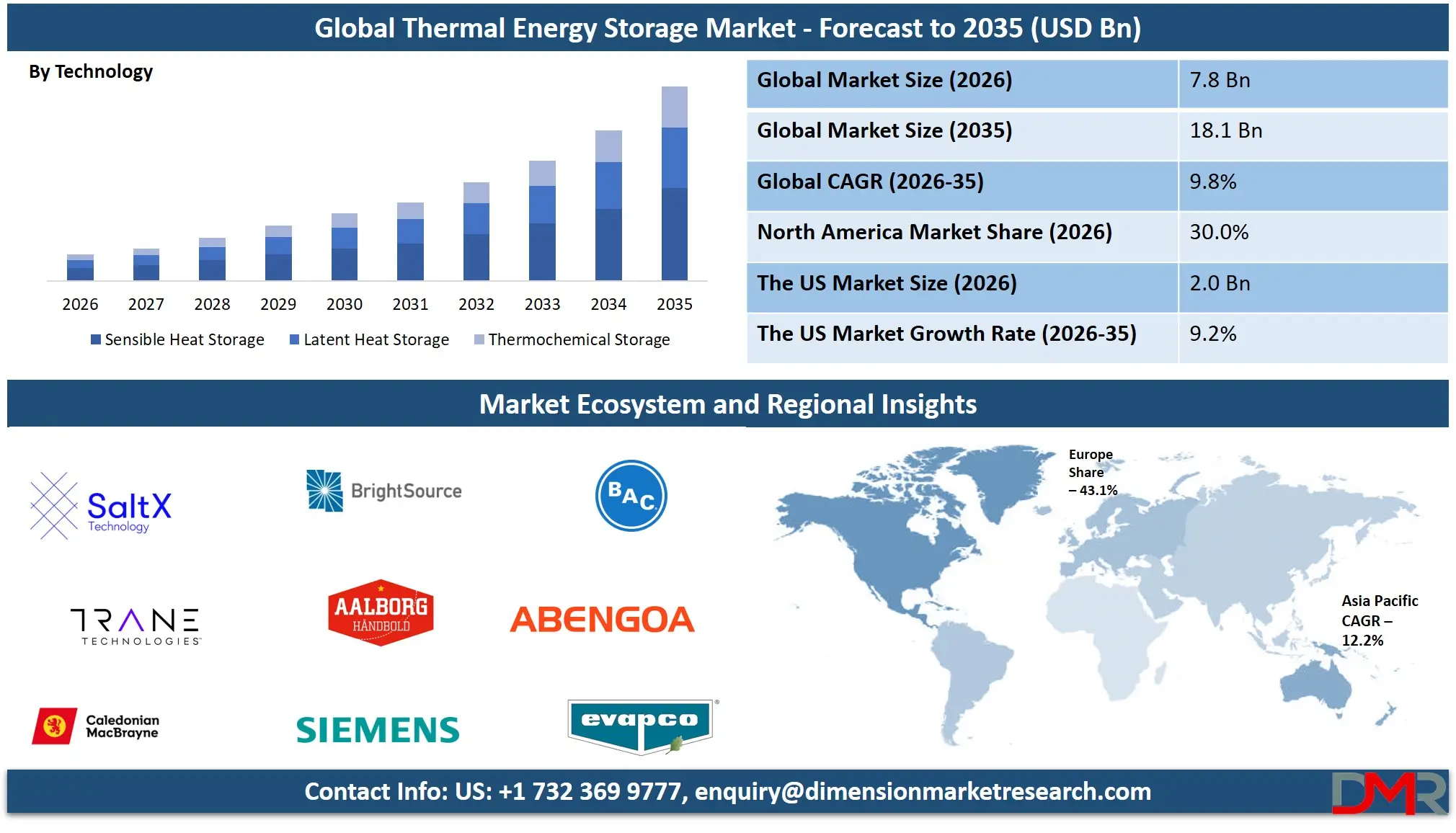
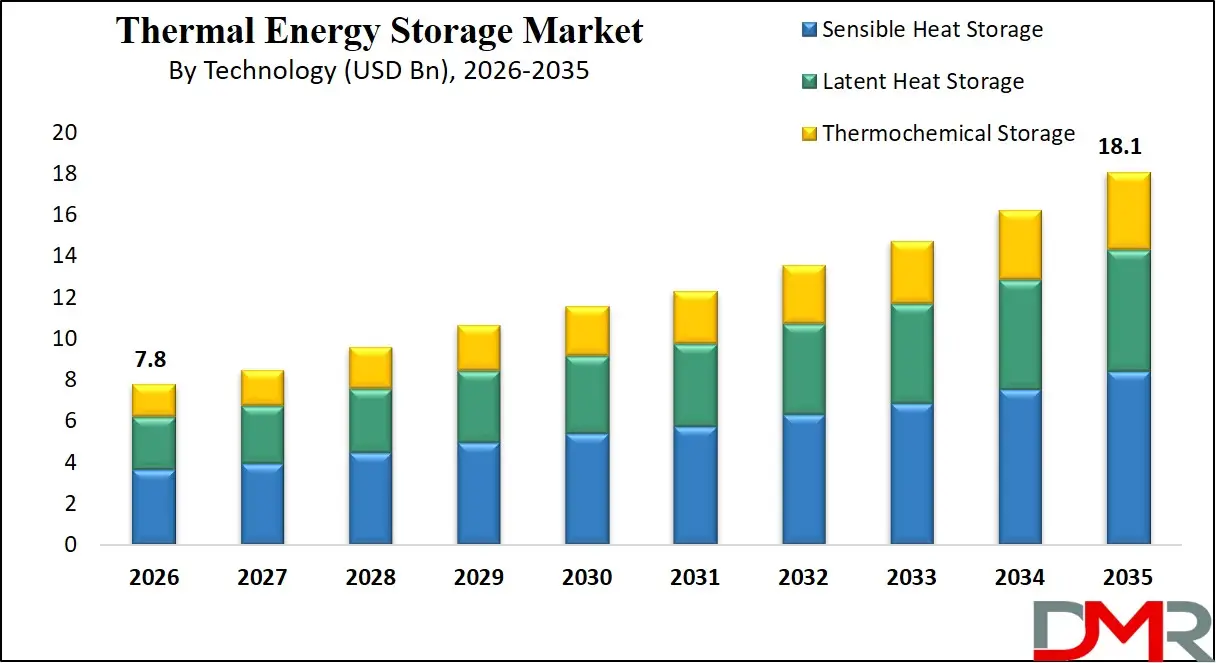
The Thermal Energy Storage Market size is expected to be USD 7.8 billion in 2026 and increase at a compound annual growth rate of 9.8% to USD 18.1 billion in 2035 due to the growing use of renewable energy sources like solar and wind.
ℹ
To learn more about this report –
Download Your Free Sample Report Here
The market for Thermal Energy Storage is steadily growing because of the rising need for energy efficiency, reliability of the grid, and integration of renewable energy sources. This refers to the technologies that can store excess thermal energy that can be used later for power generation, heating, and cooling purposes. The growing adoption of these technologies is because of the increasing usage of solar and wind energy, and also the growing requirement for efficient management of process heat in industries. There are advancements in phase change material and thermochemical storage systems that have enhanced the efficiency of storage systems and extended their life cycle.
ℹ
To learn more about this report –
Download Your Free Sample Report Here
The US Thermal Energy Storage Market
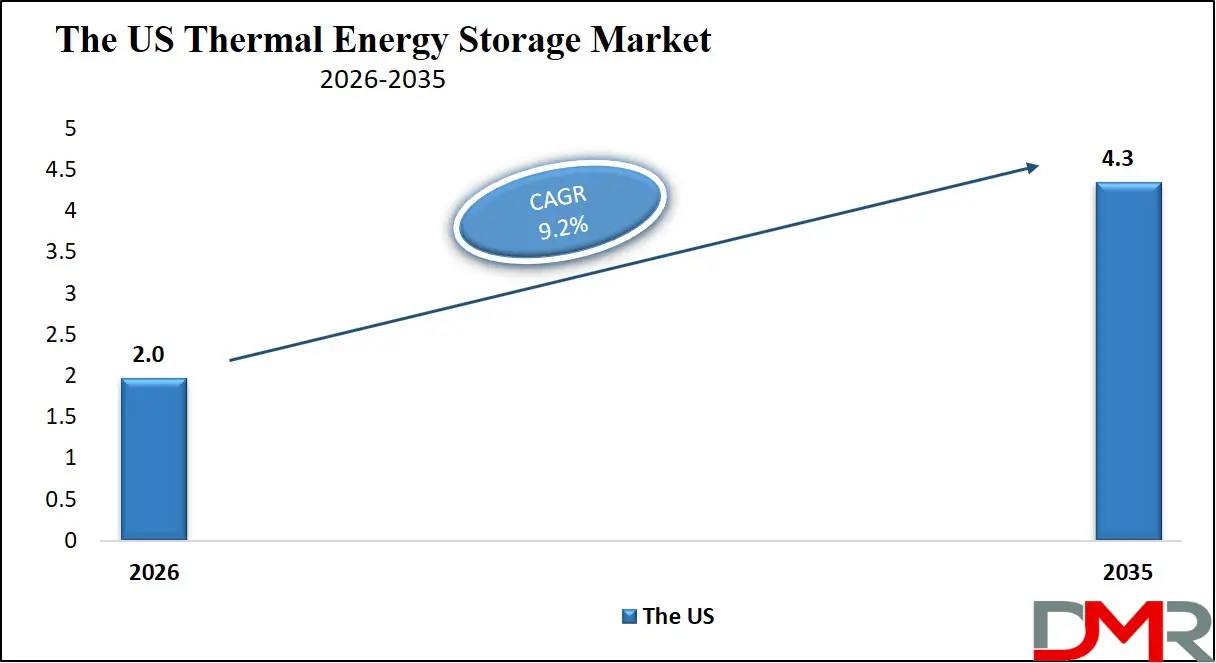
The US Thermal Energy Storage Market size is estimated to be USD 2.0 billion in 2026 and is expected to increase at a CAGR of 9.2% over the forecast period.
ℹ
To learn more about this report –
Download Your Free Sample Report Here
The US market is driven by high investments in renewable energy infrastructure and grid modernization projects. The incentives at the federal and state level encourage the use of energy storage, especially in solar thermal power plants and commercial HVAC systems. The availability of high-tech technology suppliers and the growing interest in decarbonization also reinforce the market. Moreover, the increasing need in peak load control and grid outage resilience promotes the implementation of TES.
Europe Thermal Energy Storage Market
The Europe Thermal Energy Storage Market size is estimated to be USD 2.9 billion in 2026 and at a CAGR of 9.0% over the forecast period.
The reason for Europe's impressive growth in recent times can be attributed to the stringent regulations related to the environment and initiatives such as the European Green Deal. Nordic nations have been making significant investments in renewable energy integration and development of district heating systems. Stringent regulation and carbon emissions limit are encouraging companies to adopt TES solutions.
Japan Thermal Energy Storage Market
The market size of Japan Thermal Energy Storage will be USD 312 million in 2026 and at a CAGR of 9.5% in the forecast period.
The market in Japan is growing because of its emphasis on energy security and effective use of resources. The major drivers are government efforts to encourage smart cities and low-carbon technologies. Industrial industries are implementing TES in waste heat recovery and optimization of processes. Nevertheless, space limitations and initial expenses are a challenge, and technological innovation and improvements in urban infrastructure provide significant growth opportunities.
Key Takeaways
- Market Size & Forecast: The Thermal Energy Storage Market size is projected to reach USD 7.8 billion in 2026 and is anticipated to have a value of USD 18.1 billion in 2035.
- Growth Rate & Outlook: The Thermal Energy Storage Market size is set to grow at a compound annual growth rate of 9.8% during the forecast period of 2026 to 2035.
- Primary Growth Drivers: Some of the major growth drivers in the market include integration of renewable energy sources, rising demand for energy efficiency and cost savings, and more.
- Key Market Trends: Some of the major trends in the market are the adoption of smart and integrated energy systems, shift toward sustainable and low-carbon solutions, and more.
- By Technology: The sensible heat storage segment is anticipated to get the majority share of the Thermal Energy Storage market in 2026.
- By Application: The power generation segment is expected to get the largest revenue share in 2026 in the Thermal Energy Storage market.
- By Storage Material: The molten salt segment is expected to get the largest revenue share in 2026 in the Thermal Energy Storage market.
- Regional Leadership: Europe is set to lead the Thermal Energy Storage market with an estimated 36.8% share in 2026.
What is the Thermal Energy Storage?
The Thermal Energy Storage (TES) involves the storing of thermal energy as heat or cold for later usage in several applications such as energy production, industrial operations, and buildings heating and cooling. Sensible heat, latent heat through the use of phase change materials, and thermochemical technologies are some of the methods involved in TES. The role played by TES includes the balance between energy supply and demand, higher utilization of renewable energy sources, and improvement of the efficiency level. Some emerging trends include TES systems' application in smart grid, development of materials, and district heating/cooling systems.
Use Cases
- Renewable Energy Integration: TES systems store surplus solar or wind energy in the form of heat, so that there is a steady supply of energy even when the generation is low. This increases grid reliability and curtailment of renewable is minimized.
- Industrial Process Optimization: TES is used in industries to store excess heat produced during the operation and reuse it in the future to enhance efficiency and save fuel in processes that consume a lot of energy.
- District Heating and Cooling: TES helps to support centralized heating and cooling systems, where thermal energy is stored during low peak periods and distributed efficiently during peak periods.
- Building Energy Management: TES is commonly applied in commercial buildings to optimize HVAC, especially with ice storage systems that can move energy consumption to off-peak periods, lowering operational expenses.
How AI Is Transforming the Thermal Energy Storage Market
Artificial intelligence is revolutionizing thermal energy storage through its ability to enable predictive analytics, monitor performance and optimize the process. The AI technology will be capable of predicting energy demand and altering the energy storage process in order to increase efficiency and reduce energy loss. This results in an efficient TES system within the context of the dynamic system such as the smart grid.
Moreover, AI facilitates material design and analysis to ensure fast discovery of storage materials. AI helps in reducing cost and operation downtime through prediction diagnostics. AI is generally contributing towards making TES systems smarter and efficient in addition to being economical.
Market Dynamic
Driving Factors in the Thermal Energy Storage Market
Integration of Renewable Energy Sources
One of the key reasons for the increase in the importance of thermal energy storage lies in the use of renewable sources of energy such as solar energy and wind energy. The main challenge with renewable sources of energy lies in the fact that they are unreliable in terms of production capacity. The solution to the problem comes from thermal energy storage which can store excess energy during high energy production periods and release energy when needed.
Rising Demand for Energy Efficiency and Cost Savings
The business sector is now becoming more aware of reducing energy prices and improving efficiency. Shifting of peak loads can be done using TES, which reduces energy expenses and the use of expensive peak time energy. Besides, the ability to reuse stored thermal energy reduces the consumption of fuels. This economic benefit is gaining popularity across several industries.
Restraints in the Thermal Energy Storage Market
High Initial Capital Investment
The installation cost of TES systems can be high, and in some cases, even very high because of the advanced TES systems like thermoelectric storage. SMEs may find it difficult to adopt TES systems due to high cost implications. Moreover, the payback period is long, and thus adoption becomes feasible only after some time.
Technical and Material Limitations
The TES systems, especially the ones based on phase change material technology and thermochemical technology, face problems such as material instability, efficiency issues, and scalability problems. The reliability of these technologies may be hampered due to wear and tear of the system over time, as well as the lack of good materials for making them.
Opportunities in the Thermal Energy Storage Market
Expansion of District Heating and Cooling Networks
The increasing trend in the development of district energy systems is a significant opportunity to TES technologies. The need to centralize heating and cooling is being fueled by urbanization and smart city projects. The efficiency of these systems is improved by TES, which allows energy storage and redistribution, which opens up considerable growth opportunities in urban infrastructure projects.
Advancements in Storage Materials and Technologies
Continued development of new materials like high-performance phase change materials and thermochemical compounds is providing new opportunities in the application of TES. These inventions enhance storage capacity, efficiency and life span and make systems more economical. With the maturity of technology, both industrial and residential adoption will increase at a faster rate.
Trends in the Thermal Energy Storage Market
Adoption of Smart and Integrated Energy Systems
Integration of TES with smart grid technology and digital energy management systems has become one of the most prevalent trends in the market. Application of sophisticated monitoring and control systems ensures optimum energy consumption and preventive maintenance for the system. This trend is making the TES solution more efficient and popular among large-scale applications.
Shift Toward Sustainable and Low-Carbon Solutions
Innovations in TES are driven by sustainability considerations, whereby emphasis is placed on environmentally-friendly material usage and reduced carbon footprints. Priority is also being accorded to low-emission solutions by both governments and industries, and this leads to more financing of TES technology. This trend reflects the current global climate goals, and ultimately promotes market growth.
Research Scope and Analysis
By Technology Analysis
Sensible heat storage is expected to lead the technology segment due to its simplicity and efficiency in addition to its affordability. It is employed in water and molten salts, and the share of this technology segment could reach 46.3% in 2026. Sensible heat storage is characterized by high reliability, scalability, wide operation range, and suitability for various large-scale applications such as power plants, solar thermal power plants, and district heating systems. This technology is mature, reliable, and reduces maintenance costs. Latent heat storage with phase change material (PCM), on the other hand, is the most dynamic segment since it features high energy density, compact system design, and ability to store and release energy with minimal variation in temperatures. Its use will increase with advancements in PCM and encapsulation technologies.
By Storage Material Analysis
The molten salts dominate the market for storage materials with an expected market share of 38.7 percent in 2026 due to their wide application in CdS solar power and thermal storage plants. These materials are highly preferred for grid-scale applications owing to their high thermal stability, low cost per unit energy storage, and high energy storage capabilities in long periods. Moreover, it also has the advantage of being compatible with high-temperature systems, thus making them efficient in energy production processes in industries. On the other hand, the phase change materials segment is experiencing the highest rate of growth because of the increased application of such materials in providing energy storage systems in buildings, refrigeration, and optimizing industrial process.
By Temperature Range Analysis
The medium temperature storage market is set to hold the largest market share of 41.5% in 2026 due to its broad application in industrial applications, district heating, and commercial energy applications. The flexible operational nature of this technology has helped it become highly adaptable in different end-use industries, making it an excellent choice for energy balancing and efficiency improvement. The market is highly demanded in manufacturing industries where there is significant energy recovery through heat recovery processes that help cut costs. The fastest-growing segment in the thermal energy storage market is the high temperature storage market, driven by rising demand from energy-intensive industries such as cement, steel, and chemical industries.
By Application Analysis
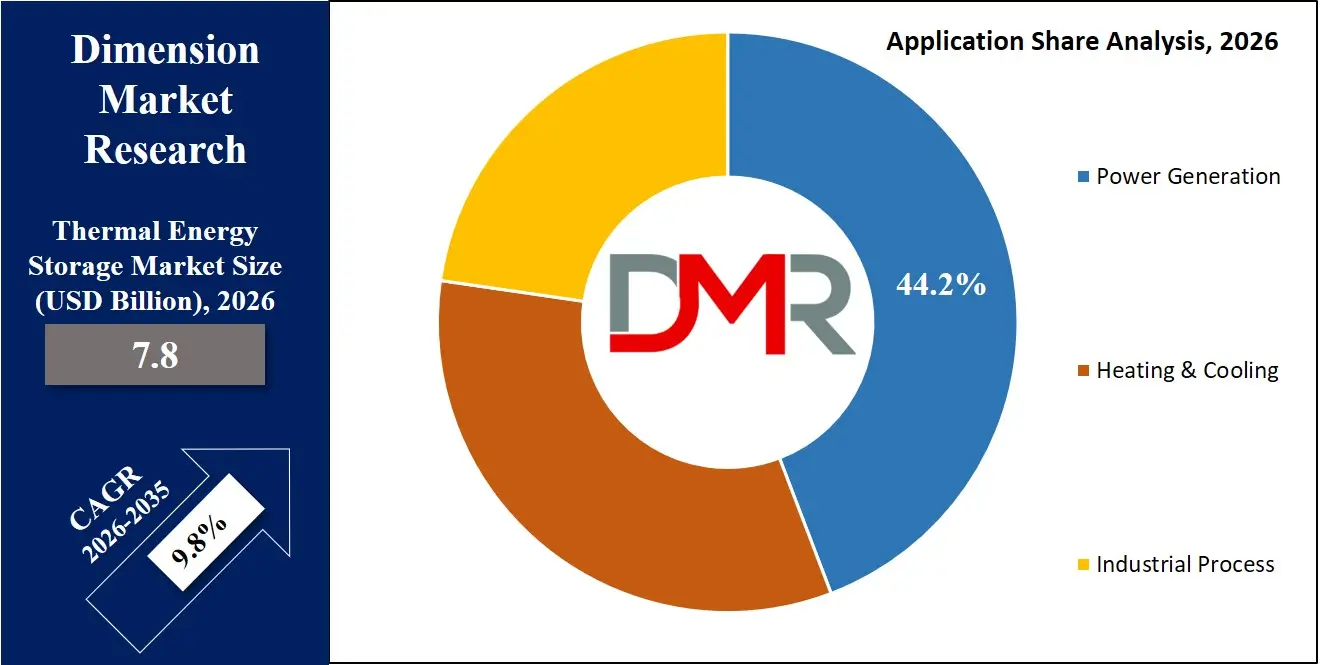
The application category comprises power generation, with a projected market size of 44.2 in 2026, driven significantly by the integration of thermal energy storage in CSP and renewable energy hybrid systems. Thermal energy storage technology ensures steady power supply through the storage of extra heat energy and discharging it during the time of peak demand, reducing the use of non-renewable energy sources. The fastest-growing category is heating and cooling, especially in large commercial buildings and hospitals and district energy systems. There is an increasing necessity for efficient energy utilization, HVAC optimization, and temperature control that are inexpensive to implement.
ℹ
To learn more about this report –
Download Your Free Sample Report Here
By End Use Analysis
Utilities and energy is the most significant market accounting for an estimated 48.6 percent in 2026 as a result of the large application of TES in renewable energy generation, stabilization of power grid, and peaking load control. Increased flexibility in energy dispatch and low operating costs are advantageous for utilities and energy sector, and TES plays a very critical role in today's power systems. The highest growth is expected from industrial end-uses owing to the increased adoption of thermal energy storage technology for efficient process heating, effective utilization of waste heat and reduced energy costs.
The Thermal Energy Storage Market Report is segmented on the basis of the following:
By Technology
- Sensible Heat Storage
- Water
- Molten Salt
- Solid Media (rocks, concrete, ceramics)
- Latent Heat Storage (PCM)
- Organic PCM
- Inorganic PCM
- Thermochemical Storage
By Storage Material
- Water
- Molten Salt
- Phase Change Materials (PCM)
- Solid Media
By Temperature Range
- Low Temperature (<100°C)
- Medium Temperature (100–400°C)
- Industrial heat
- District heating
- High Temperature (>400°C)
By Application
- Power Generation
- Heating & Cooling
- District Heating & Cooling
- HVAC / Ice Storage
- Industrial Processes
- Process Heat
- Waste Heat Recovery
By End-Use
- Utilities / Energy
- Residential & Commercial Buildings
- Industrial
Regional Analysis
Leading Region in the Thermal Energy Storage Market
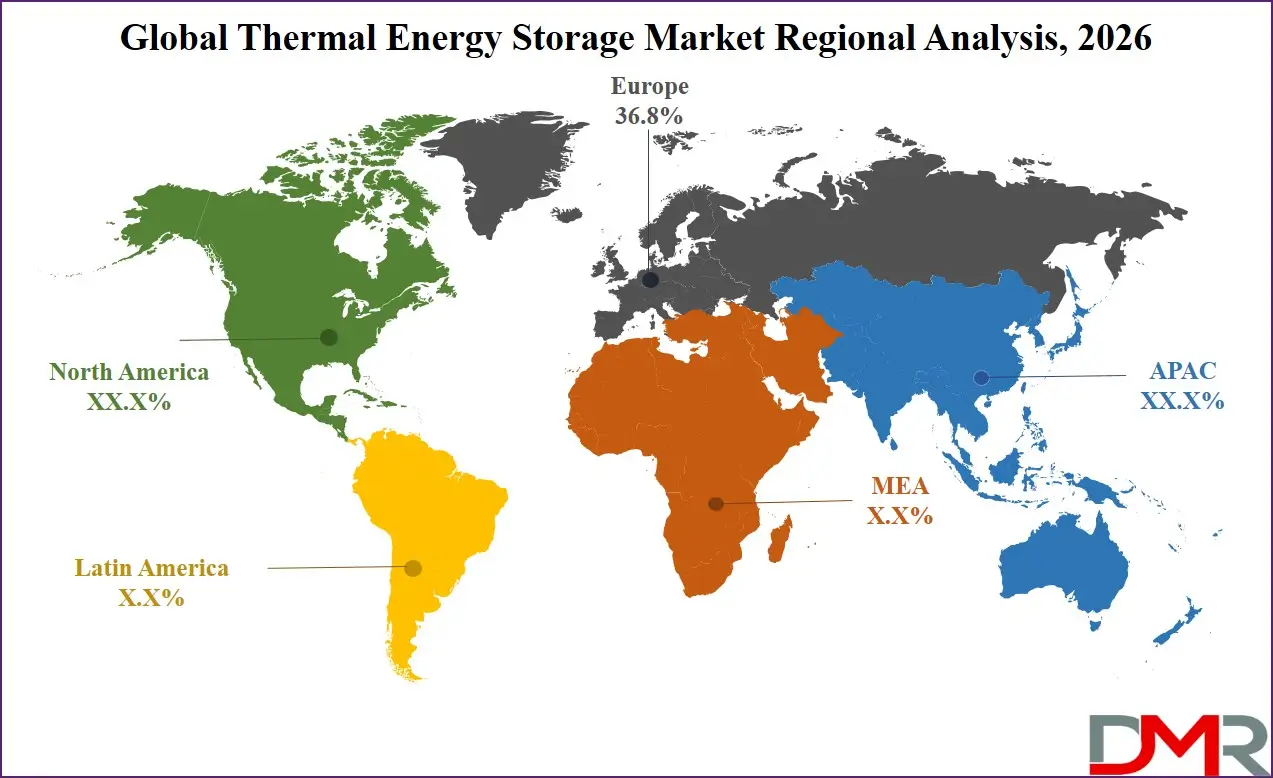
The TES market is led by Europe, having a predicted market share of 36.8% in 2026. Climate-friendly policies like the European Green Deal that emphasize massive decarbonization and renewables' integration act as significant drivers behind this dominance. This region is highly advanced in district heating systems and predominantly uses thermal energy storage systems for efficient energy distribution in countries such as the Nordics and Central Europe. Investments in solar thermal systems, industrial heat recovery systems, and novel storage systems further consolidate the region's leadership position in this industry. In addition, stringent regulations, carbon pricing mechanisms, and government subsidies encourage widespread adoption in utility and industrial segments, making Europe a global leader in thermal energy storage technology development and deployment.
ℹ
To learn more about this report –
Download Your Free Sample Report Here
Fastest Growing Region in the Thermal Energy Storage Market
The Asia-Pacific is the most rapidly developing region in thermal energy storage market because of the rapid industrialization, urbanization and rising electricity demand. China, India, Japan, and South Korea are among the countries that are investing heavily in renewable energy infrastructure and smart grid development, which contributes greatly to the adoption of TES. Market penetration is further accelerating with government policies that encourage energy efficiency, carbon reduction, and clean energy transitions. The growing manufacturing base and increasing interest in industrial waste heat recovery in the region makes thermal storage solutions that are economical in terms of cost highly demanded. Also, the increased investments in smart cities, commercial buildings, and district cooling systems are also driving long-term and rapid market growth in Asia-Pacific.
By Region
North America
Europe
- Germany
- The U.K.
- France
- Italy
- Russia
- Spain
- Benelux
- Nordic
- Rest of Europe
Asia-Pacific
- China
- Japan
- South Korea
- India
- ANZ
- ASEAN
- Rest of Asia-Pacific
Latin America
- Brazil
- Mexico
- Argentina
- Colombia
- Rest of Latin America
Middle East & Africa
- Saudi Arabia
- UAE
- South Africa
- Israel
- Egypt
- Rest of MEA
Competitive Landscape
The market of thermal energy storage is highly competitive due to the innovation and technological development. Businesses are also concentrating on research and development to enhance efficiency in storage and minimize expenses. Pilot projects, strategic collaborations, and partnerships are typical methods of increasing market presence. The barriers to entry are high because of capital requirements and technical expertise, and the existing players have economies of scale and advanced technologies that enable them to sustain competitive advantage.
Some of the prominent players in the global Thermal Energy Storage are:
- Siemens Energy AG
- Abengoa S.A.
- Aalborg CSP A/S
- BrightSource Energy Inc.
- CALMAC Corporation
- EVAPCO Inc.
- Baltimore Aircoil Company
- Trane Technologies plc
- SaltX Technology Holding AB
- EnergyNest AS
- Rondo Energy
- Antora Energy
- Brenmiller Energy Ltd.
- Hyme Energy
- Malta Inc.
- Terrafore Technologies LLC
- Ice Energy
- Burns & McDonnell
- Steffes LLC
- Caldwell Energy Company
- Other Key Players
Recent Developments
- In April 2026, Rivian and Redwood Materials collaborated to install a battery energy storage system at Rivian Illinois manufacturing plant with more than 100 second-life EV battery packs. The system will first provide 10 MWh of energy to lower the peak demand costs and contribute to grid reliability. The solution provides scalable cost-effective storage by repurposing used batteries, which can be used to meet the increasing energy demand and the increasing energy storage capacity requirement.
- In November 2025, Nostromo Energy launched IceBrick®360, a cold thermal energy storage system that serves high-demand data centers. The solution allows shifting of loads by storing cooling energy when the load is low and releasing it when the load is high, to alleviate grid constraints. It has a high 360 TRh capacity, which enables quicker deployment and higher efficiency, enabling data centers to scale operations without compromising performance and straining electricity networks.
- In October 2025, Rondo Energy began commercial operation of the first 100 MWh thermal battery of industrial scale at an oil facility in California. The system, which uses a solar array to heat refractory bricks, produces steam to extract oil instead of gas-fired boilers. Although it will decrease emissions by approximately 13,000 metric tons per year, the project points out a trade-off of reducing operational emissions and promoting fossil fuel production as the company expands its thermal storage technology.
Report Details
| Report Characteristics |
| Market Size (2026) |
USD 7.8 Bn |
| Forecast Value (2035) |
USD 18.1 Bn |
| CAGR (2026–2035) |
9.8% |
| Historical Period |
2021 – 2025 |
| Forecast Period |
2027 – 2035 |
| Base Year |
2025 |
| Estimate Year |
2026 |
| Segments Covered |
By Technology (Sensible Heat Storage, Latent Heat Storage (PCM), Thermochemical Storage), By Storage Material (Water, Molten Salt, Phase Change Materials (PCM), Solid Media), By Temperature Range (Low Temperature (<100°C), Medium Temperature (100–400°C), High Temperature (>400°C)), By Application (Power Generation, Heating & Cooling, Industrial Processes), By End-Use (Utilities / Energy, Residential & Commercial Buildings, Industrial) |
| Regional Coverage |
North America – The US and Canada; Europe – Germany, The UK, France, Russia, Spain, Italy, Benelux, Nordic, & Rest of Europe; Asia-Pacific – China, Japan, South Korea, India, ANZ, ASEAN, Rest of APAC; Latin America – Brazil, Mexico, Argentina, Colombia, Rest of Latin America; Middle East & Africa – Saudi Arabia, UAE, South Africa, Turkey, Egypt, Israel, & Rest of MEA |
Frequently Asked Questions
How big is the Thermal Energy Storage Market?
▾ The Thermal Energy Storage Market size is expected to reach USD 7.8 billion by 2026 and is projected to reach USD 18.1 billion by the end of 2035.
What is the CAGR of the Thermal Energy Storage Market from 2026 to 2035?
▾ The market is growing at a CAGR of 9.8 percent over the forecasted period.
What factors are driving the growth of the Thermal Energy Storage Market?
▾ Integration of renewable energy sources, rising demand for energy efficiency and cost savings, and more are the factors driving the growth of the Thermal Energy Storage Market.
What are the major trends in the Thermal Energy Storage Market?
▾ Adoption of smart and integrated energy systems, shift toward sustainable and low-carbon solutions, and more are some of the major trends in the market.
Who are the key players in the Thermal Energy Storage Market?
▾ Some of the key players in the Thermal Energy Storage Market include Siemens, Abengoa, Aalborg, and more.
How is the Thermal Energy Storage Market segmented?
▾ The Thermal Energy Storage Market is segmented by technology, storage material, temperature range, application, and end-use.
Which region held the largest share of the Thermal Energy Storage Market in 2026?
▾ Europe is set to lead the Thermal Energy Storage market with an estimated 36.8% share in 2026.
Which region is expected to grow the fastest in the Thermal Energy Storage Market?
▾ Asia-Pacific is the fastest-growing region in the Thermal Energy Storage market during the forecast period.