Market Snapshot
- Global Thoracic Surgery Devices Market size stood at USD 13.21 Billion in 2025 and is projected to reach USD 27.47 Billion by 2035 at a CAGR of 7.6%.
- By Procedure Type, Video-Assisted Thoracoscopic Surgery led with a 51.4% share; Robotic-Assisted Thoracic Surgery is the fastest-growing sub-segment.
- By Product Type, Robotic Platforms captured 34.7% share; Endoscopes and Imaging Systems is the fastest-growing category.
- By Indication, Esophageal Cancer commanded 37.5% share; Mediastinal Tumors is the fastest-growing indication.
- By End User, Hospitals held 46.87% share; Specialty Thoracic Centers is the fastest-growing segment.
- North America dominated by region with a 40.71% share; Asia-Pacific is the fastest-growing region.
Market Overview
The thoracic surgery devices market covers instruments, platforms, and energy systems used for surgical access and intervention within the thoracic cavity. Procedures addressed include lobectomy, pneumonectomy, esophageal resection, mediastinal dissection, and pleural interventions. The market excludes cardiac open-heart implants, vascular stents, and non-surgical pulmonary diagnostics. At USD 13.21 Billion in 2025, the market sits at the intersection of oncology devices, robotic surgery, and minimally invasive endosurgery.
Thoracic surgery devices connect directly to the broader minimally invasive surgical instrument market, drawing capital investment patterns from robotic surgery platforms and hospital operating room procurement cycles. Clinicians performing video-assisted thoracoscopic surgery (VATS) increasingly depend on imaging-guided visualization systems. Research published in 2025 found that robotic-assisted partial pulmonary resection reduced postoperative chest drainage tube duration by approximately 0.68 days compared with VATS, as reported by PMC. That measurable clinical differentiation shapes device selection decisions at the procurement level. Ethicon's launch of the ECHELON FLEX Powered Vascular Stapler in February 2024 at the Society of Thoracic Surgeons meeting signaled how consumable stapling products continue to capture share alongside platform investments.
Artificial intelligence is reshaping intraoperative decision-making within Thoracic Surgery Devices Market . AI-assisted imaging navigation, integrated with existing endosurgical instrument portfolios, extends the clinical utility of installed robotic platforms without requiring full system replacement. Hospital procurement committees are beginning to evaluate software capability alongside hardware specifications. That shift benefits vendors with proprietary software layers attached to cleared hardware platforms.
Market Size and Forecast
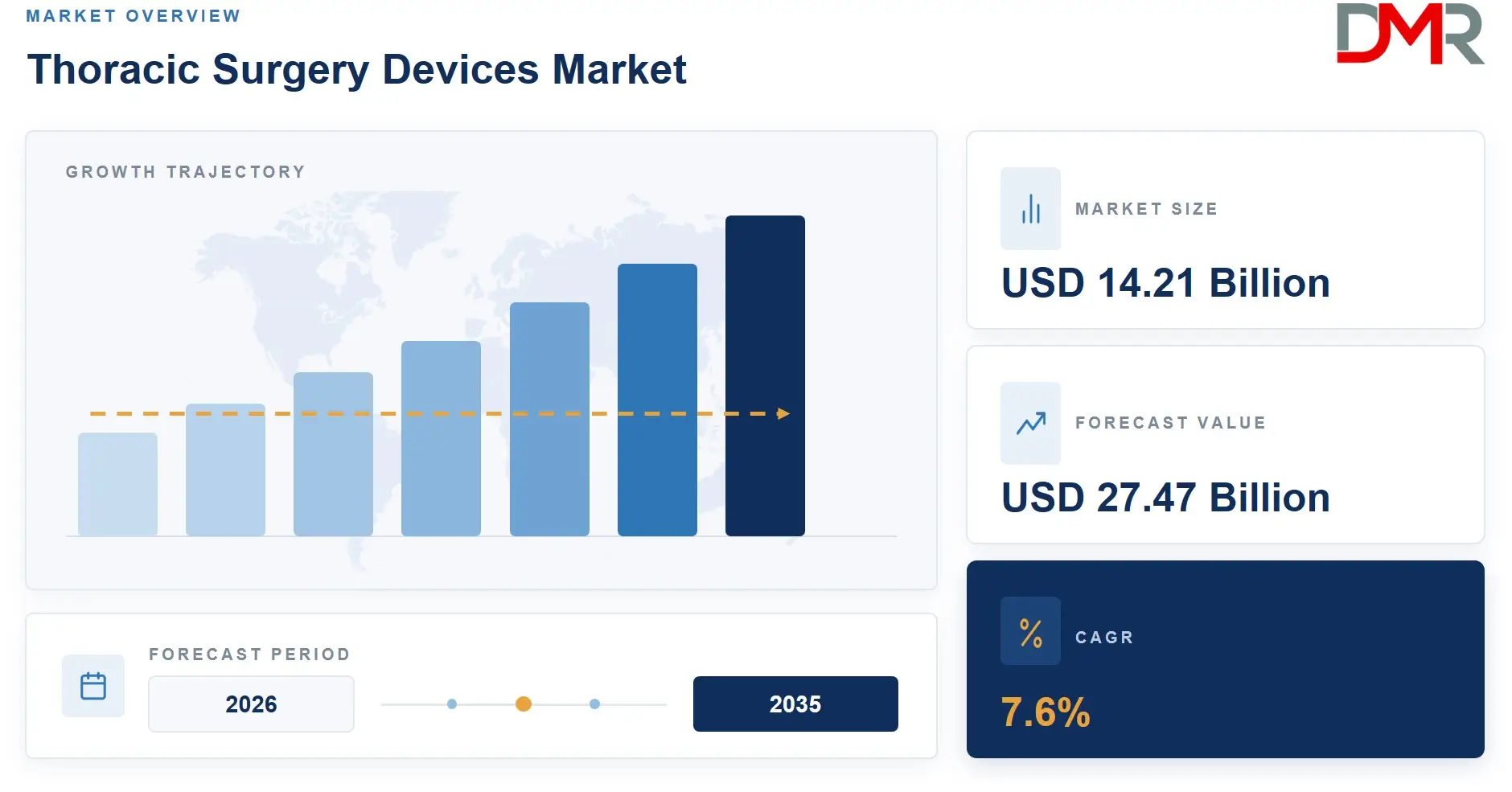
The Global Thoracic Surgery Devices Market size is estimated at USD 14.21 Billion in 2026 from USD 13.21 Billion in 2025, and is projected to reach USD 27.47 Billion by 2035, exhibiting a CAGR of 7.6% during the forecast period.
Procedural volume growth in minimally invasive thoracic surgery underpins this trajectory. One 2025 cohort study included in the PMC meta-analysis reported that robotic surgery reduced estimated blood loss to 69.8 mL versus 136.5 mL for thoracoscopy, and cut hospital stay from 10.8 to 8.6 days. Those outcomes drive hospital volume shifts toward robotic-eligible cases, expanding disposable instrument consumption per facility. Intuitive Surgical's FDA 510(k) clearance for the da Vinci 5 multiport robotic system in March 2024 accelerated procurement discussions at high-volume academic medical centers already operating first-generation da Vinci systems.
ℹ
To learn more about this report –
Download Your Free Sample Report Here
The forecast also prices in a meaningful operational friction: robotic platform setup adds approximately 10.2 minutes of non-operative time per case, and even after surgeons achieve proficiency, robotic-assisted partial pulmonary resection remains roughly 9.69 minutes longer than equivalent VATS procedures, as reported by the 2025 PMC meta-analysis. That time premium translates to roughly USD 824 in additional operating room cost per robotic lobectomy. Adoption curves at community hospitals will therefore lag academic centers by two to three years, moderating near-term volume growth from the mid-market segment.
Procedure Type Analysis
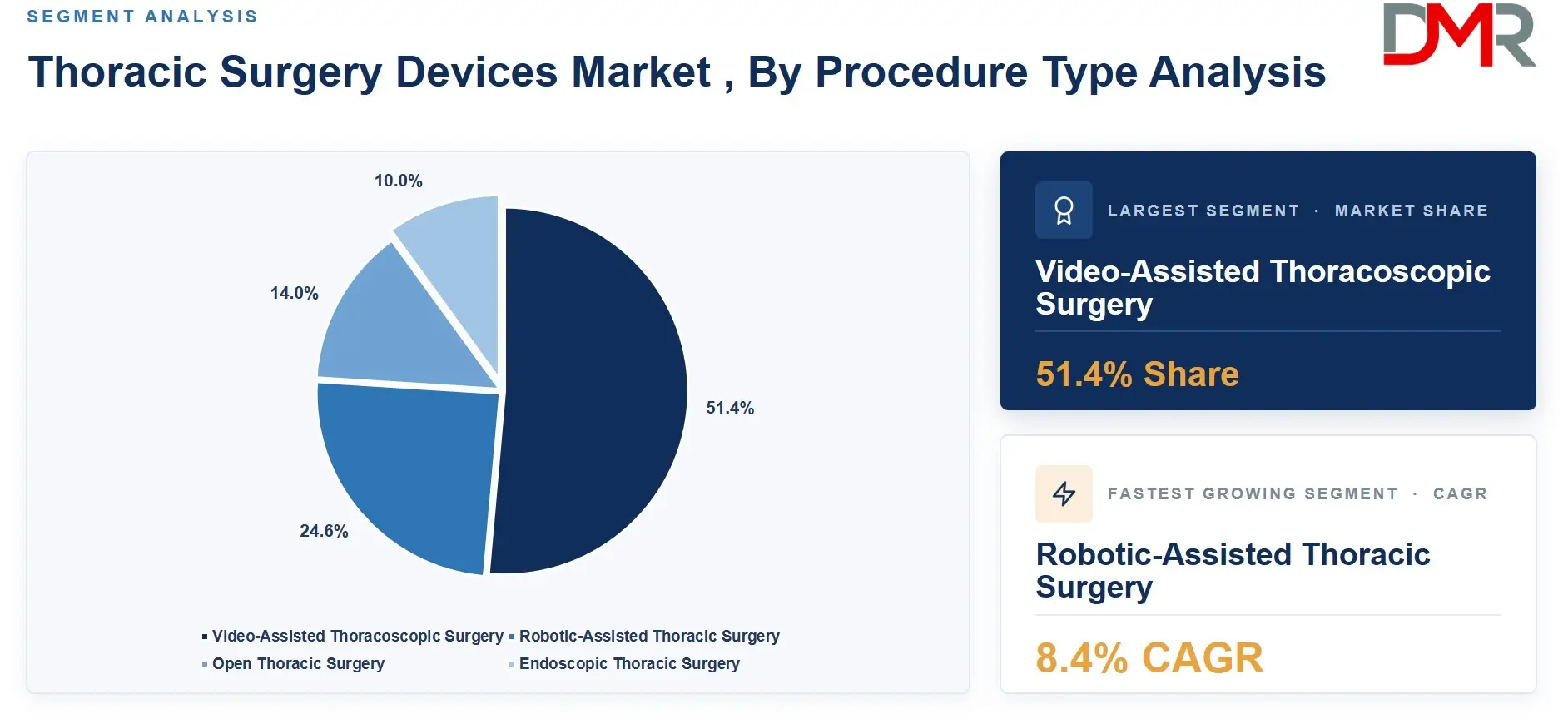
Video-Assisted Thoracoscopic Surgery led the Procedure Type segment with a 51.4% share in 2026.
VATS commands majority procedure share because the technique is both clinically validated and capital-accessible. Hospitals that cannot afford robotic platform expenditure still perform high VATS volumes using standard endoscopic towers. A 2025 study published in ScienceDirect reported that uniportal VATS cut operating time to 146 minutes versus 180 minutes for multiportal approaches, reduced ICU stay to 2.1 versus 2.6 days, and shortened hospital stay to 4.8 versus 6.4 days. Uniportal conversion is therefore a margin improvement lever available to centers that have already absorbed their VATS capital costs.
ℹ
To learn more about this report –
Download Your Free Sample Report Here
Robotic-Assisted Thoracic Surgery (RATS) is the fastest-growing procedure category and is shifting from niche adoption to standard-of-care positioning across high-volume centers. A 2025 meta-analysis across 5 studies and 1,091 patients found RATS produced a significantly shorter hospital stay (standardized mean difference −0.53, p=0.008) and shorter chest tube duration (SMD −0.35, p=0.03) versus VATS, as reported in the Journal of Interventional & Noninvasive Advances in Vascular Analysis. Open Thoracic Surgery persists in complex reconstruction cases where robotic access geometry is insufficient. Endoscopic Thoracic Surgery retains procedural volume in hyperhidrosis and limited pleural interventions where full robotic deployment is disproportionate to case complexity.
Product Type Analysis
With a 34.7% share in 2026, Robotic Platforms outpaced all other Product Type categories.
Robotic Platforms dominate device revenue because platform cost per unit is measured in millions, while other product categories compete on volume and per-unit margins. Hospitals purchasing a robotic system commit to multi-year disposable contracts, locking in downstream instrument revenue. Endoscopes and Imaging Systems is the fastest-growing product category as AI-integrated intraoperative imaging extends functionality of existing thoracoscopic towers without platform replacement. Surgical Instruments and Accessories and Energy and Stapling Devices compete primarily on per-procedure cost and surgeon preference, remaining volume-driven categories with steady but non-accelerating demand.
Indication Analysis
Esophageal Cancer accounted for 37.5% of Indication demand in 2026, the highest of any category.
Esophageal cancer procedures are anatomically complex, requiring precision dissection tools and extended operative access. That complexity creates demand for both robotic platforms and specialized endoscopic instrumentation. Mediastinal Tumors is the fastest-growing indication, reflecting expanding diagnostic capture through low-dose CT screening programs that identify previously undetected mediastinal pathology. Lung Cancer procedures are a high-volume indication but distribute across a wide range of platforms and instrument combinations, diluting per-device revenue concentration. Pneumothorax and Hyperhidrosis cases represent lower acuity indications where simpler endoscopic instruments suffice.
End User Analysis
A 46.87% share made Hospitals the clear leader across End User categories in 2026.
Hospitals absorb the majority of device spend because they are the only setting with capital budget access for robotic platform acquisition. Specialty Thoracic Centers are the fastest-growing end user category as procedure consolidation concentrates high-complexity VATS and RATS volume into dedicated thoracic surgical programs. Ambulatory Surgical Centers (ASCs) remain a smaller but strategically important segment. Subscription and pay-per-procedure robotic access models are designed specifically to serve ASC economics, removing the USD multimillion capital barrier that currently limits robotic procedure volumes outside hospital settings.
Key Market Segments
By Procedure Type
- Video-Assisted Thoracoscopic Surgery (VATS)
- Uniportal VATS
- Multiportal VATS
- Robotic-Assisted Thoracic Surgery (RATS)
- Open Thoracic Surgery
- Endoscopic Thoracic Surgery
By Product Type
- Robotic Platforms
- Multiport Systems
- Single-Port Systems
- Endoscopes and Imaging Systems
- Surgical Instruments and Accessories
- Energy and Stapling Devices
By Indication
- Esophageal Cancer
- Mediastinal Tumors
- Lung Cancer
- Pneumothorax
- Hyperhidrosis
By End User
- Hospitals
- Specialty Thoracic Centers
- Ambulatory Surgical Centers
Regional Analysis
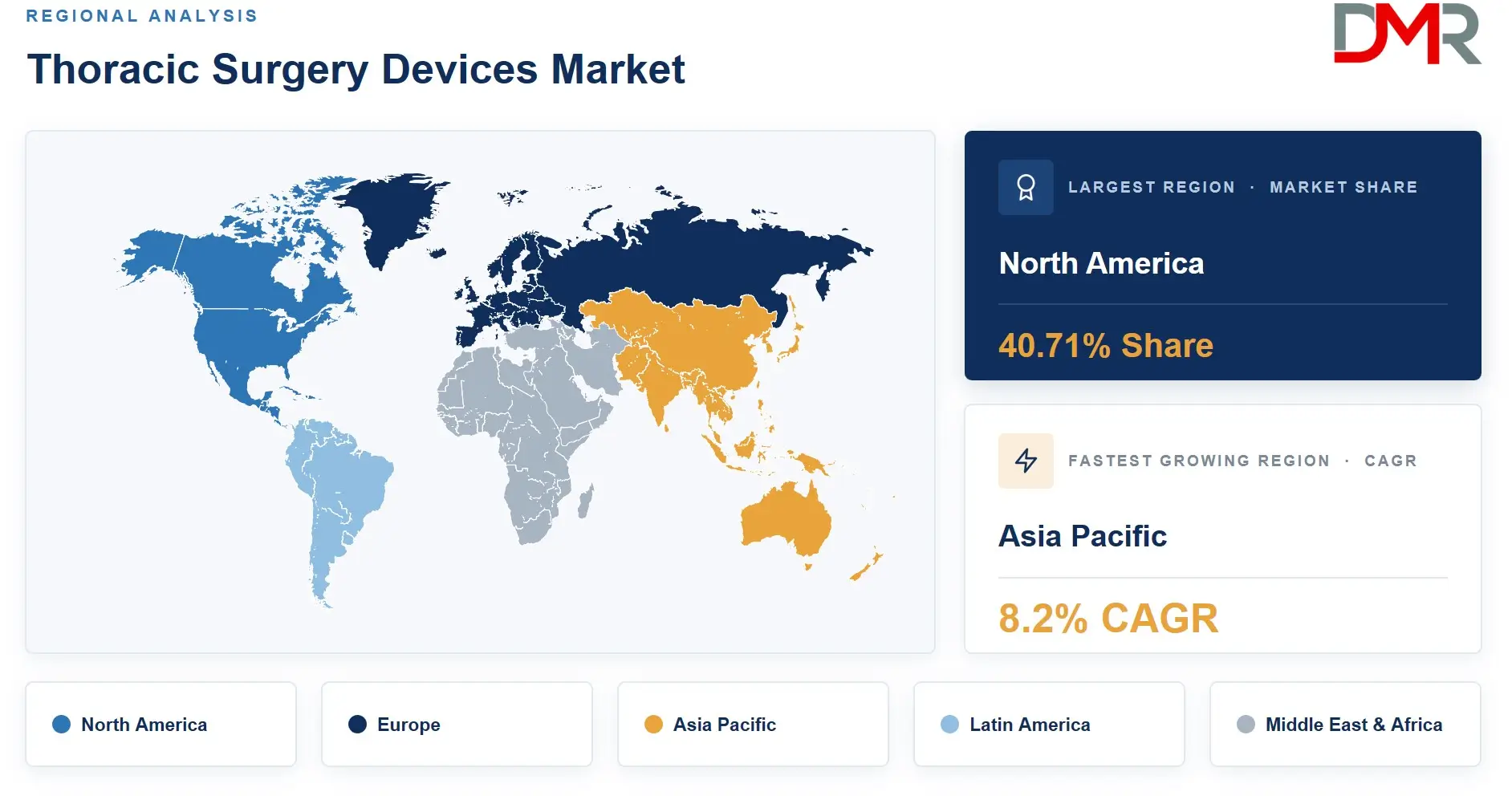
North America led all regions with a 40.71% share, equivalent to approximately USD 5.38 Billion in 2025.
North America's dominance reflects the co-location of robotic platform manufacturers, high-volume academic thoracic centers, and favorable reimbursement structures relative to other geographies. The U.S. accounts for the majority of installed robotic systems globally. Hospital procurement cycles in the U.S. move faster than in Europe because capital allocation for surgical technology is less dependent on public budget timelines. Surgeon training infrastructure for both VATS and RATS is also more developed in the U.S. than in any other single market.
ℹ
To learn more about this report –
Download Your Free Sample Report Here
Asia-Pacific is the fastest-growing region, propelled by healthcare infrastructure expansion in China, India, and Japan. Medical tourism, particularly for complex esophageal and lung cancer procedures, is concentrating procedure volume at private tertiary centers in South Korea and Thailand. Europe holds the second largest revenue share, with Germany and France leading device adoption in the public hospital system. Latin America and Middle East and Africa represent smaller but developing markets where thoracic surgery device penetration remains far below procedure potential, particularly in Brazil, the GCC, and South Africa.
Key Regions and Countries
North America
Europe
- Germany
- France
- The UK
- Spain
- Italy
- Rest of Europe
Asia Pacific
- China
- Japan
- South Korea
- India
- Australia
- Rest of APAC
Latin America
- Brazil
- Mexico
- Rest of Latin America
Middle East & Africa
- GCC
- South Africa
- Rest of MEA
Market Dynamics
Minimally Invasive Surgery Outcomes Accelerate Device Replacement Cycles
A 2025 IASLC WCLC meta-analysis of randomized trials found that VATS lobectomy reduced the overall risk of death by 21% versus open lobectomy, with pooled hazard ratio 0.79. That survival signal is now sufficient for hospital quality committees to mandate minimally invasive approaches as standard care, directly triggering capital equipment upgrades. Lung cancer incidence continues to grow across aging populations in North America and Europe, expanding the eligible patient pool for anatomic resection and mediastinal procedures that require specialized devices.
Johnson & Johnson launched the ETHICON 4000 Stapler in the U.S. in June 2025, incorporating proprietary 3D Stapling Technology designed for reduced tissue trauma. Medtronic received FDA clearance for its Hugo robotic-assisted surgery system in December 2025, adding a second robotic competitor to a market previously dominated by a single vendor. Both events signal active competitive investment in thoracic surgical consumables and platforms, which sustains device innovation spending and keeps procurement budgets under discussion at hospital executive level.
Robotic System Costs Compress Margins at Community Hospitals
Robotic partial pulmonary resection carries approximately USD 3,300 more in medical costs per case than VATS, as reported in the 2025 PMC meta-analysis. Annual maintenance for a complete da Vinci system ranges from USD 100,000 to USD 150,000, with per-surgery disposable instrument costs of USD 400 to USD 1,200. At USD 40 per operating room minute, the additional operative time of robotic-assisted lobectomy translates to roughly USD 824 per case in incremental OR cost. Community hospitals performing fewer than 100 robotic thoracic cases per year cannot absorb these fixed and variable costs within prevailing reimbursement bands.
Subscription Models and AI Navigation Open Mid-Tier Market Access
A March 2026 comparative-effectiveness study found that robotic thoracic surgery reduced pneumonia and atrial fibrillation rates versus VATS, while 30- and 90-day mortality remained statistically similar. That safety profile supports the commercial case for broadening robotic access beyond academic centers. Subscription and pay-per-procedure access models remove the multimillion-dollar capital barrier for ambulatory surgical centers, converting a cost structure that previously excluded mid-tier facilities into a variable operating expense model.
The FDA approved AI-driven software advancements for Intuitive Surgical's Ion lung biopsy platform in October 2025. AI-integrated intraoperative imaging bundled with existing endosurgical portfolios creates a software revenue layer that extends platform economics without requiring new hardware purchases. Vendors capable of attaching AI navigation modules to cleared platforms will capture reorder revenue from installed base customers while simultaneously lowering the switching cost for new entrants evaluating competing systems.
Market Trends
RATS Normalizes While ERAS Protocols Reshape Device Requirements
Robotic-assisted thoracic surgery is completing its transition from innovation to standard clinical practice across high-volume centers. A 2025 PMC meta-analysis found robotic-assisted partial pulmonary resection dissected significantly more lymph nodes than VATS (weighted mean difference +2.05 nodes, p=0.02), reinforcing oncologic adequacy at scale. Enhanced Recovery After Surgery (ERAS) protocols are simultaneously shifting device selection toward reduced-trauma instruments that support day-case thoracic pathways. Vendors whose instrument portfolios align with ERAS timelines — shorter operative duration, lower blood loss, faster drain removal — will capture disproportionate share in hospital formulary reviews.
Market Competition Overview
The thoracic surgery devices market is moderately concentrated at the platform level and fragmented across surgical instruments and consumables. One vendor held near-monopoly position in robotic thoracic platforms for over a decade, enabling aggressive disposable instrument pricing and long-term service contract lock-in. That structure is now under active challenge. New robotic entrants with cleared or filing-stage systems are introducing competitive platform procurement negotiations for the first time at high-volume academic medical centers.
On the instruments side, a large number of device manufacturers compete across stapling, energy, and endoscopic imaging categories, none holding dominant share. The learning curve for robotic lobectomy averaged 25.3 cases before surgeons reached proficiency, as cited in the 2025 PMC meta-analysis. Vendors that invest in surgeon training programs and simulation infrastructure at the point of platform installation hold a durable retention advantage, because switching costs compound with every additional surgeon trained on a specific robotic architecture.
Company Profiles
Intuitive Surgical holds the largest installed robotic platform base in thoracic surgery globally. The da Vinci 5 system provides seven-degrees-of-freedom instrument articulation, 360° robotic arm rotation, tremor filtration, and 3D high-definition visualization, as detailed in the 2025 PMC meta-analysis. FDA 510(k) clearance for da Vinci 5 for certain cardiac procedures was granted in January 2026, extending platform utility beyond thoracic indications and strengthening the commercial case for hospital capital investment. Intuitive's 2026 acquisition of Orpheus Medical added a dedicated platform for robotically-assisted lung cancer surgery, deepening its indication-specific portfolio and reducing competitive surface area for single-indication robotic entrants.
Johnson & Johnson competes across both stapling devices and robotic platforms. The ETHICON 4000 Stapler, launched in the U.S. in 2025 and cleared in Europe via CE Mark in April 2026, positions J&J to defend consumable revenue as robotic adoption grows. The January 2026 FDA submission of the OTTAVA surgical robot represents J&J's direct challenge to Intuitive Surgical's platform dominance, introducing procurement competition at the hospital executive level for the first time in high-volume thoracic centers.
Key Players
- Applied Medical Resources Corporation
- Asensus Surgical
- B. Braun Melsungen AG
- Boston Scientific Corporation
- CMR Surgical
- CONMED Corporation
- Danaher Corporation
- Fujifilm Holdings Corporation
- Getinge AB
- Intuitive Surgical
- Johnson & Johnson
- Karl Storz SE & Co. KG
- Medtronic
- MicroPort Scientific Corporation
- Olympus Corporation
- Richard Wolf GmbH
- Shenzhen Mindray Bio-Medical Electronics Co., Ltd.
- Smith & Nephew plc
- Stryker Corporation
- Teleflex Incorporated
Recent Developments
- June 2024 — SS Innovations conducted a human telesurgery trial in India using the SSi Mantra surgical robotic system, demonstrating remote robotic capability in a live clinical setting.
- July 2025 — Intuitive Surgical's da Vinci 5 received CE Mark approval in Europe, clearing the fifth-generation multiport platform for commercial use across European Union member states.
- January 2026 — Johnson & Johnson submitted its OTTAVA surgical robot to the FDA for regulatory authorization, formally entering the robotic surgery platform competition in the U.S. market.
- April 2026 — Johnson & Johnson received European CE Mark approval for the ETHICON 4000 Stapler, extending the 3D Stapling Technology platform to European hospital procurement channels.
- January 2025 — Boston Scientific signed a definitive agreement to acquire Bolt Medical and its laser-based intravascular lithotripsy platform, broadening its procedural device portfolio beyond traditional thoracic stapling and energy categories.
- 2026 — Intuitive Surgical acquired the da Vinci and Ion-related distribution operations of ab medica, Abex, and Excelencia Robotica across Italy, Spain, Portugal, Malta, and San Marino, consolidating direct sales control in Southern Europe.
- May 2026 — Medtronic consolidated its Cardiac Surgery and Aortic units into a single Cardiovascular Surgery business, centralizing commercial strategy for surgical platforms that overlap with thoracic device procurement pathways.
Report Details
| Report Characteristics |
| Market Value (2025) |
USD 13.21 Billion |
| Market Value (2026) |
USD 14.21 Billion |
| Forecast Revenue (2035) |
USD 27.47 Billion |
| CAGR (2026–2035) |
7.6% |
| Base Year for Estimation |
2025 |
| Historic Period |
2020 to 2024 |
| Forecast Period |
2026 to 2035 |
| Report Coverage |
Revenue Forecast, Market Dynamics, Competitive Landscape, Recent Developments |
| Segments Covered |
By Procedure Type (VATS, RATS, Open Thoracic Surgery, Endoscopic Thoracic Surgery), By Product Type (Robotic Platforms, Endoscopes and Imaging Systems, Surgical Instruments and Accessories, Energy and Stapling Devices), By Indication (Esophageal Cancer, Mediastinal Tumors, Lung Cancer, Pneumothorax, Hyperhidrosis), By End User (Hospitals, Specialty Thoracic Centers, Ambulatory Surgical Centers) |
| Regional Analysis |
North America – US and Canada; Europe – Germany, France, The UK, Spain, Italy, and Rest of Europe; Asia Pacific – China, Japan, South Korea, India, Australia, and Rest of APAC; Latin America – Brazil, Mexico, and Rest of Latin America; Middle East & Africa – GCC, South Africa, and Rest of MEA |
| Competitive Landscape |
Applied Medical Resources Corporation, Asensus Surgical, B. Braun Melsungen AG, Boston Scientific Corporation, CMR Surgical, CONMED Corporation, Danaher Corporation, Fujifilm Holdings Corporation, Getinge AB, Intuitive Surgical, Johnson & Johnson, Karl Storz SE & Co. KG, Medtronic, MicroPort Scientific Corporation, Olympus Corporation, Richard Wolf GmbH, Shenzhen Mindray Bio-Medical Electronics Co., Ltd., Smith & Nephew plc, Stryker Corporation, Teleflex Incorporated |
| Customization Scope |
Customization for segments and region or country level will be provided. Additional customization can be done based on requirements. |
| Purchase Options |
Three license options: Single User License, Multi-User License (Up to 5 Users), Corporate Use License (Unlimited Users and Printable PDF) |
Frequently Asked Questions
What is the biggest investment opportunity in Thoracic Surgery Devices Market ?
▾ Subscription and pay-per-procedure robotic access models represent the clearest high-return entry point. Ambulatory Surgical Centers and mid-tier hospitals cannot absorb robotic platform capital costs, leaving a large volume base underserved. Vendors that deploy flexible financing structures can capture procedure volume from the fastest-growing end user segment without competing head-to-head on hardware specifications.
Who are the top companies in Thoracic Surgery Devices Market ?
▾ Intuitive Surgical holds the largest installed robotic platform base and the broadest cleared system portfolio in thoracic surgery. Johnson & Johnson competes across both stapling consumables and the emerging OTTAVA robotic platform. Medtronic entered the robotic segment after receiving FDA clearance for the Hugo RAS system in December 2025.
Which segment is growing fastest in Thoracic Surgery Devices Market and why?
▾ Robotic-Assisted Thoracic Surgery is the fastest-growing Procedure Type, and Endoscopes and Imaging Systems is the fastest-growing Product Type. Clinical evidence published in 2025 confirmed RATS delivers significantly shorter hospital stay and chest tube duration versus VATS, providing the outcomes-based justification needed for health system adoption. AI-integrated imaging extends platform revenue without full hardware replacement, accelerating both segments simultaneously.
Which region is growing fastest in Thoracic Surgery Devices Market and why?
▾ Asia-Pacific is the fastest-growing region, driven by healthcare infrastructure investment in China, India, and Japan and rising medical tourism for complex thoracic procedures in South Korea and Thailand. Public hospital expansion budgets in China and private hospital capital allocation in India are both actively funding robotic surgery platform procurement. That combination of public and private investment channels accelerates adoption faster than in regions dependent on a single funding source.
What is the biggest challenge holding Thoracic Surgery Devices Market back?
▾ High robotic system costs constrain adoption among community hospitals and lower-volume centers. Annual maintenance for a da Vinci system costs between USD 100,000 and USD 150,000, with additional per-surgery disposable costs of USD 400 to USD 1,200. Community facilities performing fewer than 100 robotic thoracic cases annually cannot spread those fixed costs across sufficient procedure volume to achieve positive contribution margins under current reimbursement rates.