Market Overview
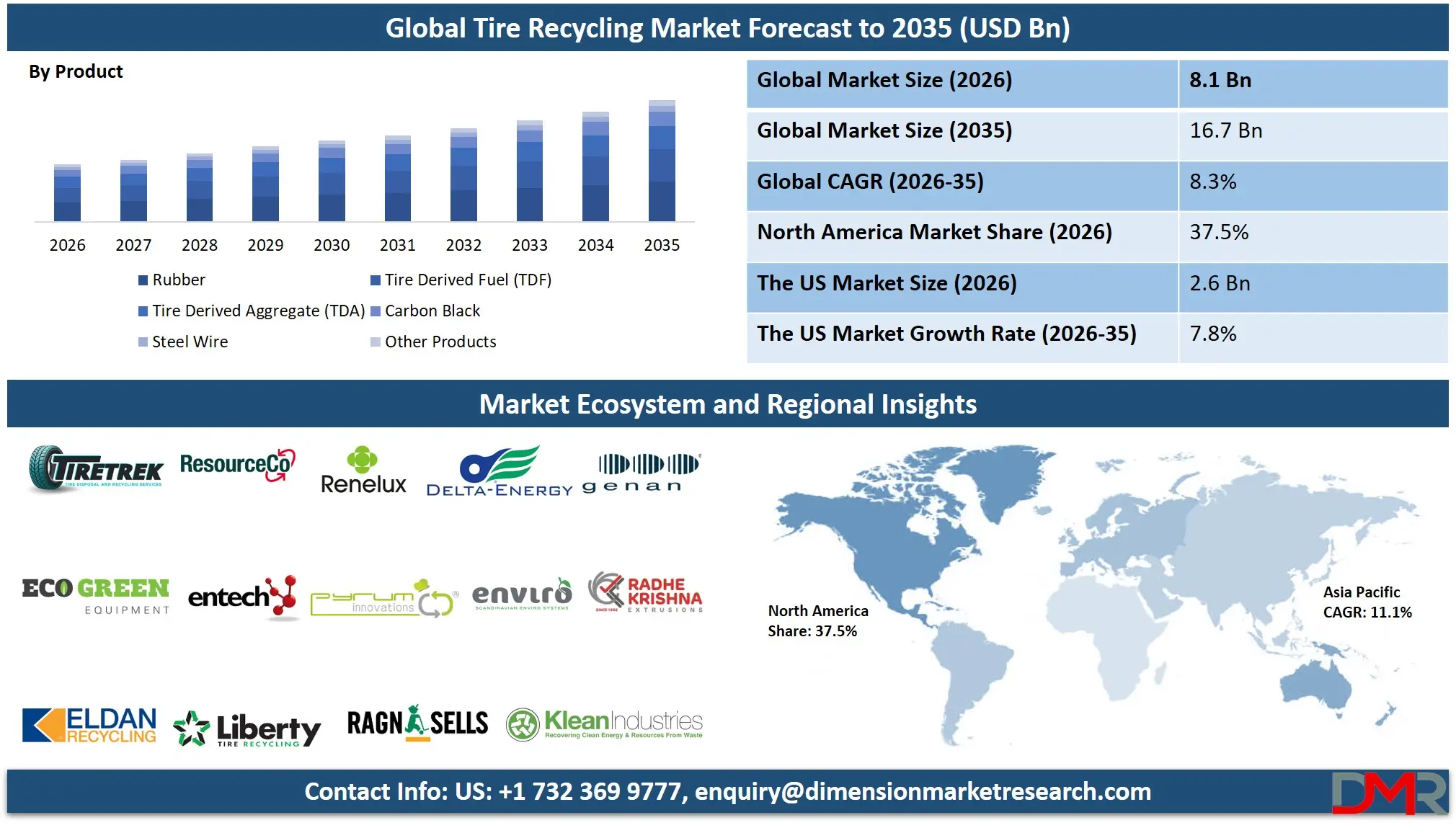
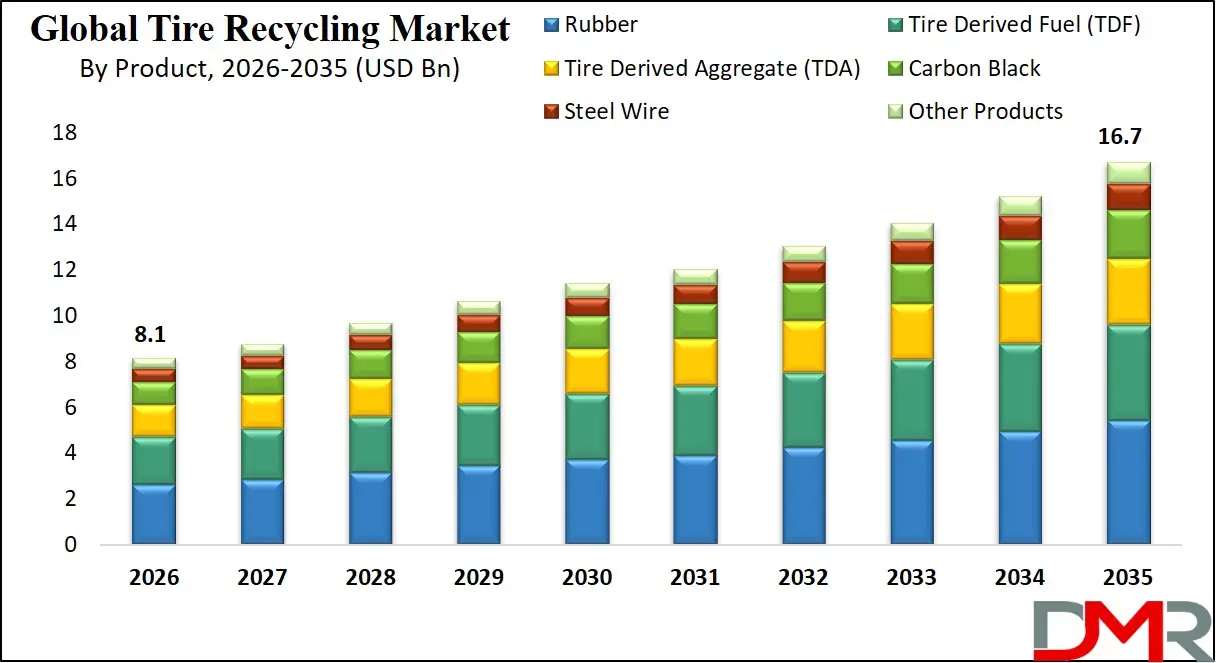
The Global Tire Recycling Market is set for substantial expansion, reaching an estimated USD 8.1 billion in 2026 and projected to grow at a strong CAGR of 8.3% from 2026 to 2035, to the market value of USD 16.7 billion by 2035. This robust growth trajectory is fueled by the escalating global volume of end-of-life tires (ELTs), stringent environmental regulations regarding waste management, and the increasing adoption of recycled tire products across various industries.
ℹ
To learn more about this report –
Download Your Free Sample Report Here
Rising environmental concerns over illegal tire dumping, stockpile fires, and health hazards are compelling governments and organizations to implement advanced tire collection, sorting, and recycling frameworks. The rapid expansion of the automotive industry, coupled with growing consumer awareness of circular economy principles, is significantly increasing the demand for reliable and efficient tire recycling technologies.
Additionally, growing regulatory pressure related to landfill bans, extended producer responsibility (EPR), and sustainable material sourcing are further accelerating market adoption. Industries are increasingly integrating recycled tire products like crumb rubber, tire-derived fuel (TDF), and recovered steel into their operations to enhance sustainability profiles and reduce raw material costs.
Technological advancements in recycling processes, such as ambient and cryogenic grinding, pyrolysis, and devulcanization, are enabling the production of high-quality secondary raw materials. As infrastructure development and industrialization continue to rise worldwide, particularly in developing economies, the Tire Recycling Market is expected to witness sustained growth through 2035, driven by environmental imperatives and resource efficiency goals.
ℹ
To learn more about this report –
Download Your Free Sample Report Here
Growing government initiatives promoting sustainable waste management, green public procurement, and circular economy models further accelerate global adoption. However, barriers such as high capital costs for advanced recycling facilities, inconsistent quality of recycled products, and challenges in efficient collection and logistics remain. Despite these limitations, the convergence of innovative processing technologies, supportive policies, and increasing industrial demand positions tire recycling as a central pillar of the global circular economy through 2035.
The US Tire Recycling Market
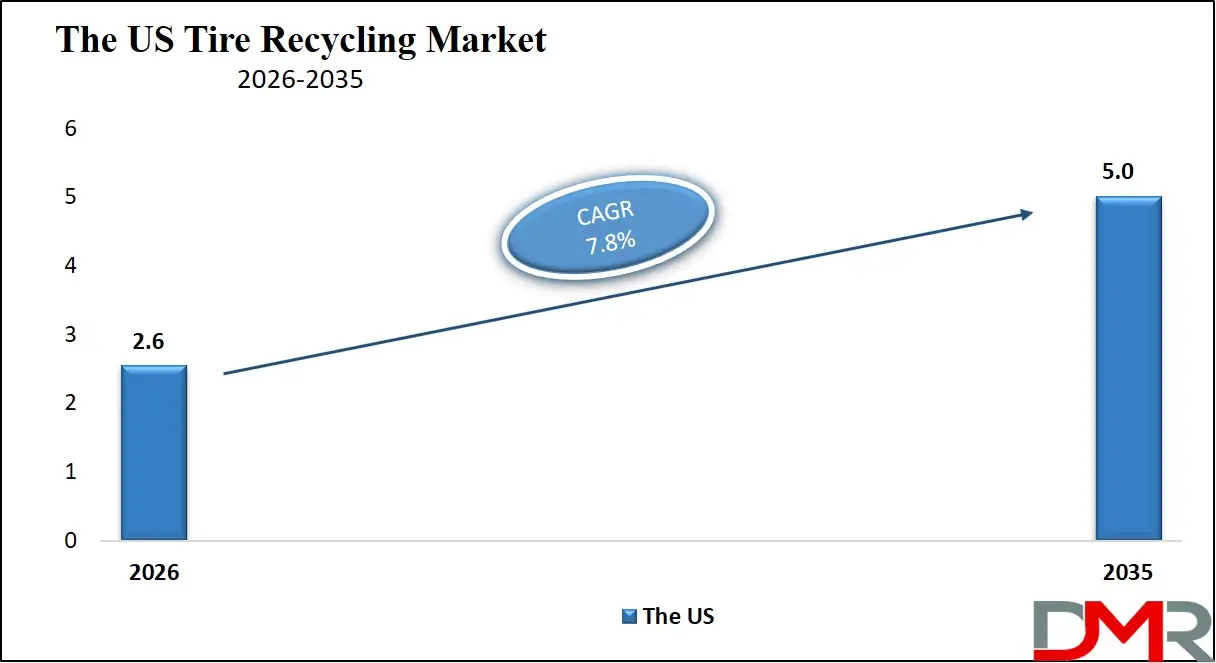
The U.S. Tire Recycling Market is projected to reach USD 2.6 billion in 2026 and grow at a CAGR of 7.8%, reaching USD 5.0 billion by 2035. The U.S. leads global adoption due to its mature automotive sector, well-established tire collection programs, and strong regulatory push for waste tire management from bodies like the Environmental Protection Agency (EPA).
ℹ
To learn more about this report –
Download Your Free Sample Report Here
The proliferation of end-use applications for recycled tire products in construction, civil engineering, and manufacturing, coupled with corporate sustainability commitments, fuels demand for advanced recycling solutions. Major players in the construction, automotive, and sports surfacing industries are increasingly integrating crumb rubber and tire-derived aggregate into their projects to meet green building standards and enhance material performance.
U.S. regulatory support for infrastructure modernization, alongside frameworks promoting the use of recycled materials in federal and state-funded projects, encourages investment in recycling technologies. The market is witnessing a shift toward high-value applications like rubber-modified asphalt and molded rubber products, moving beyond traditional low-value outputs. The rise of state-level EPR programs has further intensified the focus on efficient collection and processing, positioning the U.S. as a critical innovator in this space.
The Europe Tire Recycling Market
The Europe Tire Recycling Market is projected to be valued at approximately USD 2.5 billion in 2026 and is projected to reach around USD 5.1 billion by 2035, growing at a CAGR of about 7.7% from 2026 to 2035. Europe's leadership is anchored by its stringent regulatory environment, particularly the Circular Economy Action Plan and the End-of-Life Vehicles (ELV) Directive, which mandate high rates of recovery and recycling for automotive materials.
Countries such as Germany, the U.K., France, and the Nordic region are widely adopting advanced recycling technologies, driven by a high emphasis on environmental protection and resource efficiency. The EU's ambitious targets for reducing landfilling and promoting recycled content in new products further necessitate robust tire recycling infrastructure across member states.
Europe's mature automotive industry, strong network of producer responsibility organizations (PROs), and a technologically advanced recycling sector drive the demand for high-quality recycled materials. Funding and support for research and innovation initiatives encourage the development of novel recycling processes like devulcanization and advanced pyrolysis, aiming to close the loop for tire materials. With a sophisticated regulatory landscape and a public that prioritizes sustainability, Europe remains a highly advanced and essential region for tire recycling services.
The Japan Tire Recycling Market
The Japan Tire Recycling Market is anticipated to be valued at approximately USD 734.2 million in 2026 and is expected to attain nearly USD 1,401.0 million by 2035, expanding at a CAGR of about 7.1% during the forecast period. Japan's resource-scarce economy and government push for a "Sound Material-Cycle Society" are driving the adoption of advanced recycling technologies, making tire recycling a cornerstone of national resource security.
The Ministry of the Environment actively supports the development of recycling infrastructure, promoting the use of recovered materials like rubber, carbon black, and steel wire in various industrial applications. Japan's leadership in manufacturing technology and strict quality standards provide a robust foundation for advanced recycling methods, including thermal treatment and material recovery.
Japan's concept of "Circulating and Ecological Economy," driven by major corporations and industrial groups, integrates recycled tire materials into everything from construction materials to new automotive components. Companies are deploying advanced recycling processes to ensure the stable supply of secondary raw materials and reduce reliance on imports. Japan's cultural emphasis on mottainai (a sense of wastefulness) and resource efficiency positions it as a high-growth, quality-focused market for tire recycling solutions.
Global Tire Recycling Market: Key Takeaways
- Strong Global Market Growth Outlook: The Global Tire Recycling Market is expected to be valued at USD 8.1 billion in 2026 and is projected to reach USD 16.7 billion by 2035, showcasing rapid expansion supported by rising environmental awareness and circular economy principles.
- Steady CAGR Driven by Sustainability Mandates: The market is expected to grow at a CAGR of 8.3% from 2026 to 2035, fueled by accelerating industrialization, stricter waste management policies, and increasing demand for sustainable materials worldwide.
- Steady Growth Trajectory in the United States: The U.S. Tire Recycling Market stands at USD 2.6 billion in 2026 and is projected to reach USD 5.0 billion by 2035, expanding at a CAGR of 7.8% due to robust collection infrastructure and growing end-use markets.
- Regional Dominance: North America is expected to capture approximately 37.5% of the global market share in 2026, supported by stringent environmental regulations, a mature automotive sector, and high producer responsibility standards.
- Rapid Advancement in Recycling Technologies: Innovations including advanced ambient grinding, high-yield pyrolysis for recovered carbon black, devulcanization for high-quality rubber, and automated sorting systems are significantly enhancing the efficiency, purity, and economic viability of tire recycling.
- Growing Waste Tire Volumes Boost Adoption: Rising global vehicle ownership and tire replacement rates, coupled with stringent landfill bans, is driving sustained demand for robust, scalable tire collection and recycling solutions.
Global Tire Recycling Market: Use Cases
- Rubber-Modified Asphalt (RMA): Municipalities and construction companies use crumb rubber from recycled tires to enhance the durability, noise reduction, and longevity of road pavements, while also diverting waste from landfills.
- Tire-Derived Fuel (TDF) in Cement Kilns: Cement, paper, and utility industries utilize shredded tires as a supplemental fuel source, taking advantage of its high calorific value to replace fossil fuels like coal and reduce overall energy costs.
- Playground and Sports Surfaces: Crumb rubber is used to create safe, durable, and shock-absorbing surfaces for playgrounds, athletic tracks, and equestrian arenas, providing a valuable outlet for recycled material.
- Civil Engineering Applications: Tire-derived aggregate (TDA) is used as a lightweight fill material in construction projects for retaining walls, road embankments, and landfill drainage layers, offering engineering and cost benefits.
- New Automotive Components: Recovered rubber and carbon black from pyrolysis are being reintegrated into the manufacturing of new tires, mats, hoses, and other automotive parts, closing the material loop for the industry.
Global Tire Recycling Market: Stats & Facts
European Tyre & Rubber Manufacturers' Association (ETRMA)
- Approximately 4 million tonnes of end-of-life tires (ELTs) are generated annually in the EU.
- The EU achieves a recovery rate of over 95% for ELTs, with material recovery and energy recovery being the primary pathways.
- Material recovery accounts for over 60% of ELT treatment in Europe.
- Over 50% of recovered material from ELTs is used in civil engineering and construction applications.
U.S. Tire Manufacturers Association (USTMA)
- The U.S. generates approximately 280 million scrap tires per year.
- In 2021, an estimated 76% of scrap tires were recycled into new products or used in tire-derived fuel markets.
- Tire-derived fuel (TDF) represents nearly 40% of the market for scrap tires in the U.S.
- Ground rubber applications, including molded products and asphalt, account for roughly 25% of the scrap tire market.
World Business Council for Sustainable Development (WBCSD) - Tire Industry Project (TIP)
- It is estimated that over 1 billion tires reach the end of their life annually worldwide.
- By 2030, the number of ELTs generated globally could exceed 1.2 billion per year.
- The global ELT management market is valued at over USD 6 billion annually.
- Approximately 70% of ELTs globally are recovered for material or energy, with the remainder going to landfills or being illegally dumped.
Global Tire Recycling Market: Market Dynamic
Driving Factors in the Global Tire Recycling Market
Stringent Environmental Regulations and Landfill Bans
The growing global enforcement of regulations prohibiting the landfilling of whole tires and, in some cases, shredded tires, is a primary driver for the tire recycling market. These mandates, coupled with extended producer responsibility (EPR) schemes that hold tire manufacturers responsible for the end-of-life management of their products, create a steady and regulated stream of waste tires. This compels governments and industries to invest in collection, processing, and recycling infrastructure to ensure compliance and avoid penalties, providing a stable foundation for market growth.
Growing Industrial Demand for Sustainable Materials
The increasing commitment of industries, particularly construction, automotive, and manufacturing, to sustainability goals and the use of recycled content is a major driver. Recycled tire products like crumb rubber, recovered steel, and carbon black offer a lower-carbon alternative to virgin materials. Their use in applications such as rubber-modified asphalt, molded products, and new tires helps companies meet ESG (Environmental, Social, and Governance) targets, reduce their carbon footprint, and appeal to environmentally conscious consumers and clients.
Restraints in the Global Tire Recycling Market
High Capital and Operational Costs
Establishing and operating advanced tire recycling facilities, particularly those using pyrolysis or devulcanization, requires significant capital investment. The cost of specialized machinery for shredding, grinding, and material separation, along with energy consumption and maintenance, can be prohibitive. This high cost barrier can limit the entry of new players and the expansion of existing facilities, particularly in developing economies, and can impact the overall profitability and economic viability of recycling operations.
Inconsistent Quality and Limited End-Markets
The quality and purity of recycled materials, such as crumb rubber or recovered carbon black, can vary significantly depending on the input tire composition and the recycling process used. This inconsistency can make it difficult for these materials to compete with consistent, high-quality virgin alternatives in demanding applications. Developing stable, high-value end-markets for all output streams (rubber, steel, fiber) remains a challenge, and market fluctuations can impact the economic sustainability of recycling operations.
Opportunities in the Global Tire Recycling Market
Expansion into High-Value Applications
Moving beyond traditional markets like TDF and low-grade crumb rubber into higher-value applications presents a significant opportunity. This includes producing ultra-fine rubber powders for high-performance molded goods, devulcanized rubber for use in new tire compounds, and high-quality recovered carbon black (rCB) from pyrolysis for use as a reinforcing agent in rubber and plastics. Developing these premium markets improves the economics of recycling and drives innovation in processing technologies.
Integration of Advanced Pyrolysis and Chemical Recycling
Advancements in pyrolysis technology offer the opportunity to efficiently break down tires into valuable chemical components: recovered carbon black (rCB), tire pyrolysis oil (TPO), steel, and syngas. Optimizing these processes to produce consistent, high-purity rCB and TPO that can serve as drop-in replacements for virgin materials in various industries (including new tire manufacturing and chemicals) creates a powerful circular economy model and opens up multi-billion dollar markets.
Trends in the Global Tire Recycling Market
Devulcanization for Circular Rubber
The rise of devulcanization technologies, which reverse the vulcanization process to make recycled rubber reusable in high-quality applications like new tires and technical rubber goods, is gaining significant traction. This trend moves beyond downcycling, enabling a true circular economy for rubber. It is becoming the gold standard for tire manufacturers seeking to close the material loop and meet ambitious recycled content targets.
Digitalization and AI-Driven Sorting
Centralized platforms and AI-powered sorting systems are enabling smart management and optimization of tire collection and processing. This includes using sensors and machine vision to identify and sort tires by type (e.g., passenger car vs. truck tire) and composition, which is crucial for producing higher-quality recyclate. This trend supports operational efficiency, improves material purity, and ensures processors can meet the specific quality requirements of diverse end-users.
Global Tire Recycling Market: Research Scope and Analysis
By Product Analysis
The rubber segment is projected to dominate the Global Tire Recycling Market, accounting for the largest revenue share. This dominance is primarily driven by the high rubber content in tires due to the versatility of recycled rubber in numerous downstream applications. Crumb rubber and ground rubber, derived from mechanical processing, are extensively used in playground surfacing, sports tracks, molded products, automotive parts, and as an additive in asphalt.
Modern rubber recovery processes provide advanced capabilities such as producing fine mesh powders with consistent quality and cleanliness. These features enable their use in higher-value applications like new tire manufacturing and rubber goods. Businesses prefer customisable and high-purity rubber powders that offer performance characteristics suitable for specific industrial needs.
While products like TDF, TDA, recovered carbon black, and steel wire are important revenue contributors, the sheer volume and breadth of applications for rubber ensure it remains the largest segment. As the demand for sustainable materials grows across construction, automotive, and consumer goods, the rubber segment is expected to maintain its leadership position due to its versatility and established market demand.
By Process Analysis
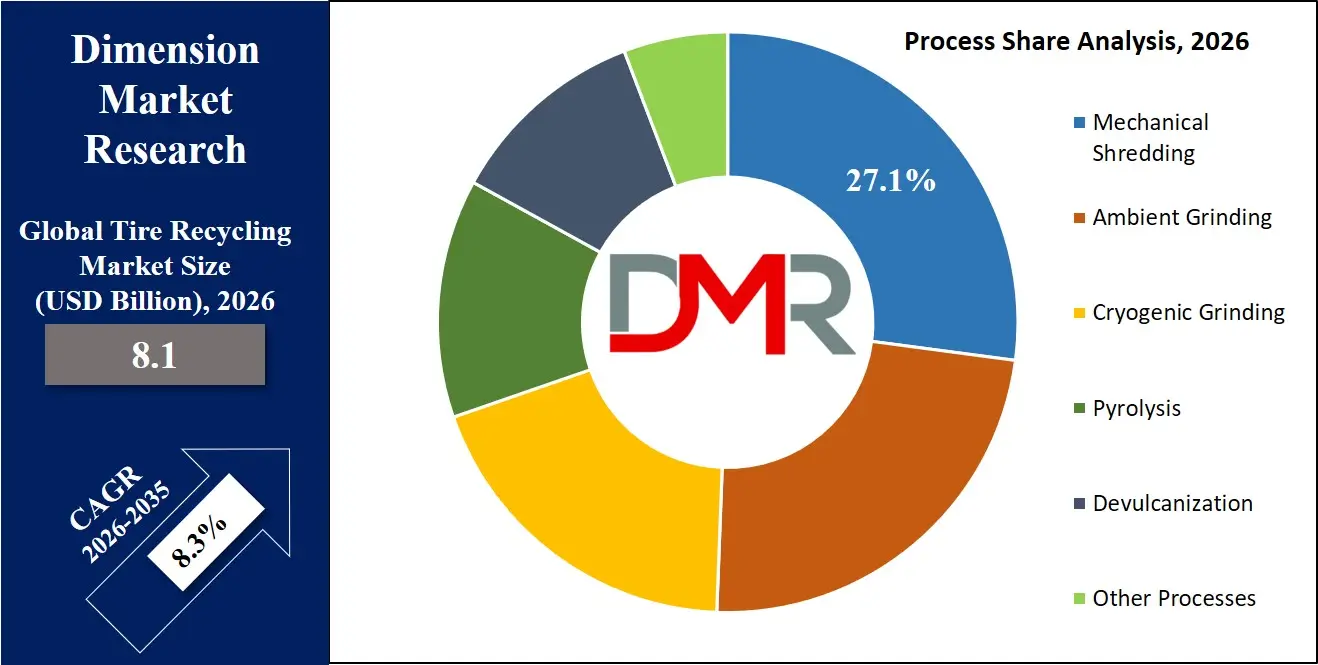
Mechanical shredding and ambient grinding is expected to dominate the process segment due to its technological maturity, cost-effectiveness, and ability to process large volumes of tires. This mechanical approach is the most widely adopted method globally for reducing whole tires into chips, shreds, and crumb rubber. It serves as the foundational step for producing both feedstock for other processes (like TDF) and finished products for various applications.
ℹ
To learn more about this report –
Download Your Free Sample Report Here
Mechanical processing allows for the efficient separation of tire components rubber, steel, and fiber through a series of shredding, granulating, and magnetic separation stages. It is a well-understood, reliable technology with relatively lower capital costs compared to advanced thermal or chemical processes. This makes it accessible to a wide range of operators, from small recyclers to large-scale processors.
Although pyrolysis and devulcanization are gaining attention for their ability to recover higher-value materials and enable true circularity, their adoption is currently limited by higher costs and technological complexity. Consequently, mechanical processes, particularly ambient grinding, continue to generate the majority of recycled tire volume and revenue, and are expected to maintain their dominant position over the forecast period.
By Tire Type Analysis
Passenger car tires is anticipated to dominate the tire type segment due to the sheer volume of vehicles on the road and the relatively short replacement cycle (3-5 years). These tires constitute the largest portion of the global ELT stream, providing a massive and consistent feedstock for the recycling industry. Their uniform construction also makes them suitable for processing into a wide range of standard recycled products.
The continuous generation of scrap passenger tires from automotive service centers, dealerships, and individual consumers ensures a steady supply for recyclers. Processes are well-optimized for this tire type, allowing for efficient conversion into crumb rubber, TDF, and other outputs. The demand for applications like rubber-modified asphalt and playground surfaces, which often use crumb rubber from passenger tires, further drives this dominance.
While commercial truck/bus tires are larger and contain more valuable rubber, their lower volume and longer life cycle make them a secondary feedstock. Therefore, passenger car tires remain the primary driver of collection volumes and processing activity, solidifying their dominant position in the market.
By End-User Analysis
The construction industry is projected to dominate the end-user segment due to its vast scale and ability to consume large volumes of recycled tire materials. Construction projects utilize tire-derived aggregate (TDA) as lightweight fill for embankments and retaining walls, and crumb rubber is increasingly used in asphalt paving and concrete applications. This sector's demand is volume-driven, providing a critical outlet for the millions of tons of tires recycled annually.
Furthermore, the push for green building certifications like LEED (Leadership in Energy and Environmental Design) encourages construction companies and civil engineers to specify recycled materials. Government infrastructure projects, particularly road construction, are increasingly mandating the use of rubber-modified asphalt, creating a stable and growing demand channel. The construction industry's ability to absorb bulk quantities of recycled material makes it the largest and most reliable end-user.
While the automotive, manufacturing, and rubber & plastics sectors are important for creating higher-value applications, they typically consume smaller volumes. The construction sector's appetite for large quantities of materials like TDA and crumb rubber ensures its continued dominance in the end-user segment.
The Global Tire Recycling Market Report is segmented on the basis of the following:
By Product
- Rubber
- Crumb Rubber
- Ground Rubber
- Powdered Rubber
- Tire Derived Fuel (TDF)
- Tire Derived Aggregate (TDA)
- Carbon Black
- Steel Wire
- Other Products
By Process
- Mechanical Shredding
- Ambient Grinding
- Cryogenic Grinding
- Pyrolysis
- Devulcanization
- Other Processes
By Tire Type
- Passenger Car Tires
- Light Truck and SUV Tires
- Commercial Truck/ Bus Tires
- Off-the-Road (OTR) Tires
- Other Tire Types
By End-User
- Construction
- Road Construction & Asphalt
- Civil Engineering
- Automotive
- New Tire Manufacturing
- Automotive Parts
- Manufacturing
- Consumer Goods
- Industrial Products
- Rubber and Plastics
- Other End Users
Impact of Artificial Intelligence in the Global Tire Recycling Market
- AI for Automated Sorting and Quality Control: AI-powered vision systems analyze tires on conveyor belts to identify tire type, size, and condition. This allows for automated sorting before processing, ensuring feedstock consistency and improving the purity and quality of the final recycled materials like rubber and steel.
- AI-Driven Process Optimization: AI algorithms analyze real-time data from recycling machinery (shredders, grinders, reactors) to optimize parameters like speed, temperature, and pressure. This maximizes throughput, reduces energy consumption, minimizes equipment wear, and ensures consistent product quality.
- Predictive Maintenance for Recycling Equipment: AI systems monitor the performance and vibration of critical machinery to predict potential failures before they occur. This enables proactive maintenance, reducing costly downtime and extending the lifespan of expensive recycling equipment.
- AI-Based Market Forecasting and Supply Chain Management: AI analyzes global trends in tire generation, commodity prices (for rubber, steel, oil), and regulatory changes to forecast market demand for different recycled products. This helps recyclers optimize their production mix and manage logistics efficiently.
- Developing New Applications for Recycled Materials: Machine learning models can simulate the properties of new composite materials incorporating recycled rubber or carbon black. This can accelerate the development of innovative, high-value applications in construction, automotive, and consumer goods, expanding market opportunities.
Global Tire Recycling Market: Regional Analysis
Region with the Largest Revenue Share
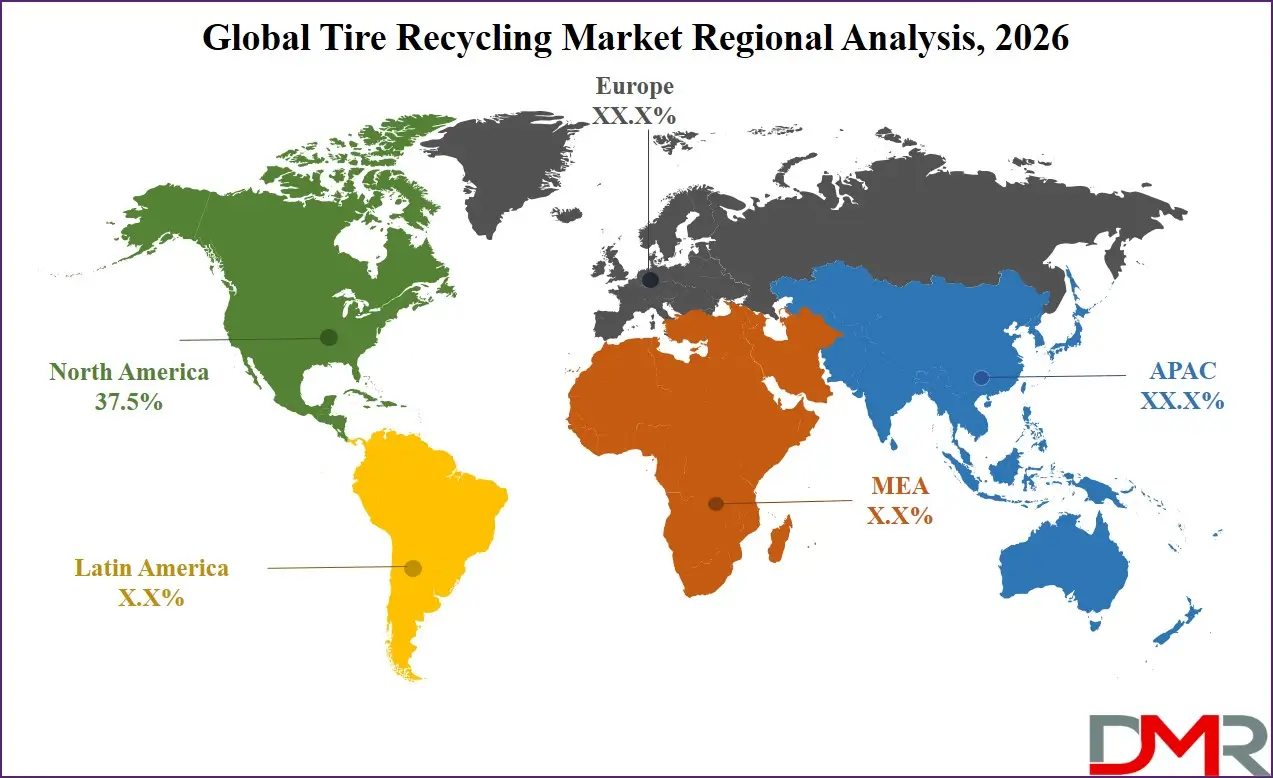
North America is projected to dominate the regional segment with the highest market share as it is anticipated to hold 37.5% of the total market revenue by the end of 2026. North America dominates this market mainly due to strong regulatory support, advanced recycling infrastructure, and high waste tire generation. The United States is the largest contributor because of its massive automotive fleet, strict environmental policies, and growing demand for sustainable waste management solutions. Government regulations such as extended producer responsibility (EPR) programs encourage tire recycling and recovery technologies.
ℹ
To learn more about this report –
Download Your Free Sample Report Here
Technological leadership also supports market dominance, as North American companies invest heavily in advanced processing methods such as pyrolysis and devulcanization. The presence of key industry players like Liberty Tire Recycling, LLC strengthens the supply chain and operational efficiency.
High awareness of environmental sustainability, rising adoption of recycled rubber in construction and infrastructure projects, and strong R&D funding further drive market growth. Additionally, well-established collection networks and favorable industrial policies in the region support large-scale recycling operations, making North America the leading market globally.
Region with the Highest CAGR
Asia-Pacific holds the highest CAGR and is poised to achieve rapid market share growth due to its massive and rapidly growing vehicle fleet, generating the world's largest volume of ELTs. Booming economies like China and India, along with Southeast Asian nations, are witnessing a surge in tire consumption. This, combined with increasing, albeit still developing, environmental regulations and a growing focus on resource recovery, creates immense growth potential.
Countries like China and India are investing heavily in waste-to-energy and material recovery infrastructure. Government initiatives promoting "Zero Waste" cities and industrial park symbiosis, where waste from one industry becomes a resource for another, are creating fertile ground for adoption. The immense volume of feedstock, coupled with gradually improving regulatory enforcement and a push for domestic raw materials, positions APAC as the fastest-growing market for tire recycling.
By Region
North America
Europe
- Germany
- The U.K.
- France
- Italy
- Russia
- Spain
- Benelux
- Nordic
- Rest of Europe
Asia-Pacific
- China
- Japan
- South Korea
- India
- ANZ
- ASEAN
- Rest of Asia-Pacific
Latin America
- Brazil
- Mexico
- Argentina
- Colombia
- Rest of Latin America
Middle East & Africa
- Saudi Arabia
- UAE
- South Africa
- Israel
- Egypt
- Rest of MEA
Global Tire Recycling Market: Competitive Landscape
The Global Tire Recycling Market is fragmented, featuring a mix of large-scale international waste management firms, specialized tire recyclers, and technology providers. Leading players like Genan Holding, Liberty Tire Recycling, and CRM (Colorado) LLC leverage their extensive collection networks and large processing capacities to dominate the supply of crumb rubber and TDF. Pyrolysis technology specialists such as Scandinavian Enviro Systems, Klean Industries, and Pyrum Innovations AG are driving market dynamics with advanced technology that recovers valuable carbon black and oil.
Tire manufacturing giants like Michelin, Bridgestone, and Continental are increasingly investing in or partnering with recycling technology companies to secure access to sustainable raw materials for new tire production. Regional players are also crucial, serving local markets and specializing in specific applications like civil engineering or molded products.
Some of the prominent players in the Global Tire Recycling Market are:
- Genan Holding A/S
- Liberty Tire Recycling, LLC
- CRM (Colorado) LLC
- Lakin Tire West, Inc.
- Scandinavian Enviro Systems AB
- Klean Industries Inc.
- Pyrum Innovations AG
- Delta-Energy Group, LLC
- ResourceCo Pty Ltd
- Radhekrishna Tires Private Limited
- Entech, Inc.
- Ragn-Sells AB
- Renelux Cyprus Ltd.
- Eldan Recycling A/S
- ECO Green Equipment
- Tire Disposal & Recycling, Inc.
- Emanuel Tire, LLC
- BDS Tire Recycling, LLC
- Contec S.A.
- Globarket
- Other Key Players
Recent Developments in the Global Tire Recycling Market
- November 2025: Scandinavian Enviro Systems announced a long-term supply agreement with a major European tire manufacturer to provide recovered carbon black (rCB) from its pyrolysis plant, for use in new tire production.
- October 2025: Liberty Tire Recycling unveiled a new, state-of-the-art ambient grinding facility in the U.S. Midwest, designed to produce high-purity crumb rubber for the growing rubber-modified asphalt market.
- September 2025: Michelin and Bridgestone jointly announced an investment in a technology startup specializing in advanced enzymatic devulcanization, signaling a major industry push for true circularity in tire rubber.
- August 2025: Pyrum Innovations AG completed the expansion of its main plant in Germany, significantly increasing its capacity to process ELTs into high-quality rCB, pyrolysis oil, and recovered steel.
- July 2025: An EU innovation grant was awarded to a consortium including Genan and several technical universities to develop a method for producing high-grade再生 rubber for use in demanding technical rubber goods.
- June 2025: ResourceCo Pty Ltd partnered with a major Australian construction firm to supply tire-derived aggregate (TDA) for use as lightweight fill in a major highway infrastructure project in New South Wales.
Report Details
| Report Characteristics |
| Market Size (2026) |
USD 8.1 Bn |
| Forecast Value (2035) |
USD 16.7 Bn |
| CAGR (2026–2035) |
8.3% |
| The US Market Size (2026) |
USD 2.6 Bn |
| Historical Data |
2020 – 2025 |
| Forecast Data |
2027 – 2035 |
| Base Year |
2025 |
| Estimate Year |
2026 |
| Report Coverage |
Market Revenue Estimation, Market Dynamics, Competitive Landscape, Growth Factors and etc. |
| Segments Covered |
By Product (Rubber, Tire Derived Fuel (TDF), Tire Derived Aggregate (TDA), Carbon Black, Steel Wire, Other Products), By Process (Mechanical Shredding, Ambient Grinding, Cryogenic Grinding, Pyrolysis, Devulcanization, Other Processes), By Tire Type (Passenger Car Tires, Light Truck and SUV Tires, Commercial Truck/Bus Tires, Off-the-Road (OTR) Tires, Other Tire Types), By End-User (Construction, Automotive, Manufacturing, Rubber and Plastics, Other End Users) |
| Regional Coverage |
North America – The US and Canada; Europe – Germany, The UK, France, Russia, Spain, Italy, Benelux, Nordic, & Rest of Europe; Asia-Pacific – China, Japan, South Korea, India, ANZ, ASEAN, Rest of APAC; Latin America – Brazil, Mexico, Argentina, Colombia, Rest of Latin America; Middle East & Africa – Saudi Arabia, UAE, South Africa, Turkey, Egypt, Israel, & Rest of MEA |
| Prominent Players |
Genan Holding A/S, Liberty Tire Recycling, LLC, CRM (Colorado) LLC, Lakin Tire West, Inc., Scandinavian Enviro Systems AB, Klean Industries Inc., Pyrum Innovations AG, Delta-Energy Group, LLC, ResourceCo Pty Ltd, Radhekrishna Tires Private Limited, Entech, Inc., Ragn-Sells AB, Renelux Cyprus Ltd., Eldan Recycling A/S, ECO Green Equipment, Tire Disposal & Recycling, Inc., Emanuel Tire, LLC, BDS Tire Recycling, LLC, Contec S.A.; Global Market, and Other Key Players |
| Purchase Options |
We have three licenses to opt for: Single User License (Limited to 1 user), Multi-User License (Up to 5 Users) and Corporate Use License (Unlimited User) along with free report customization equivalent to 0 analyst working days, 3 analysts working days and 5 analysts working days respectively. |
Frequently Asked Questions
How big is the Global Tire Recycling Market?
▾ The Global Tire Recycling Market size is estimated to have a value of USD 8.1 billion in 2026 and is expected to reach USD 16.7 billion by the end of 2035.
What is the growth rate in the Global Tire Recycling Market?
▾ The market is growing at a CAGR of 8.3 percent over the forecasted period of 2026-2035.
What is the size of the US Tire Recycling Market?
▾ The US Tire Recycling Market is projected to be valued at USD 2.6 billion in 2026. It is expected to witness subsequent growth as it holds USD 5.0 billion in 2035 at a CAGR of 7.8%.
Which region accounted for the largest Global Tire Recycling Market?
▾ North America is expected to have the largest market share in the Global Tire Recycling Market with a share of about 37.5% in 2026.
Who are the key players in the Global Tire Recycling Market?
▾ Some of the major key players in the Global Tire Recycling Market are Genan Holding, Liberty Tire Recycling, CRM, Scandinavian Enviro Systems, Klean Industries, Pyrum Innovations, and many others.