What is the Transactional Video on Demand Market Size in 2026?
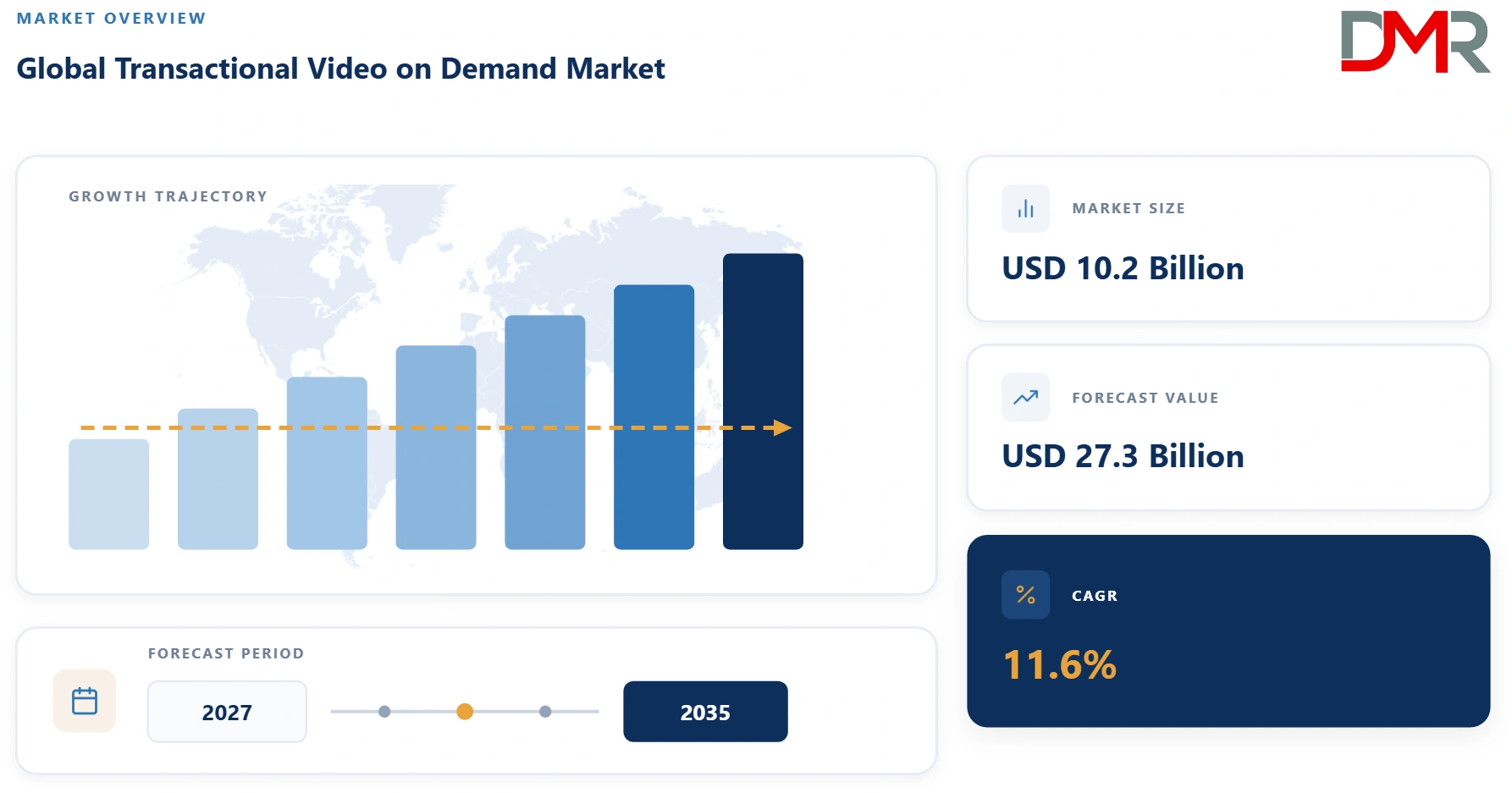
The global transactional video on demand (TVOD) market is valued at USD 10.2 billion in 2026 and is projected to reach USD 27.3 billion by 2035, growing at a CAGR of 11.6% from 2027 to 2035. New movie releases, smart television and mobile, mobile payments to facilitate consumption in developing markets and on-demand, title-by-title sales and rental are stimulating growth. However, SVOD and shortening windows are restraining consumption in developed markets.
ℹ
To learn more about this report –
Download Your Free Sample Report Here
The TVOD is where consumers access content and pay for specific titles, either to rent them for a defined period; to electronically purchase (EST) them or to view newly-released content at an enhanced early stage in the post-theatrical distribution window. TVOD is offered by digital retail sites and apps together with pay-TV and telecommunications on-demand. Pay-per-view is also part of the offering. In addition, there are self-run TVOD websites which enable producers and distributors to sell specific content. Consumers’ rental and purchase payments, early access premium payments and pay-per-view charges are all therefore sources of income.
Whilst this research analyses consumer rental, purchase and pay-per-view expenditure within the TVOD sector, it excludes SVOD, AVOD and tangible media (such as DVD and cinema) income streams. Consumers, as well as those wishing to watch live and sports-based pay-per-view content, and hotels, air companies and other business locations, all form demand sectors. Within five geographical regions, the research analyses five industry sections and key national markets.
Transactional Video on Demand Market Snapshot
Transactional Video on Demand Market Snapshot, 2027-2035
| Metric |
Value |
| Market Size (2026) |
USD 10.2 Billion |
| Forecast Value (2035) |
USD 27.3 Billion |
| CAGR (2027-2035) |
11.6% |
| Largest Region (2026) |
North America, 44.0% share |
| Fastest-Growing Region (2027-2035) |
Asia Pacific, 14.4% CAGR |
| Leading Content Type (2026) |
Movies, 68.0% share |
| Leading Transaction Model (2026) |
Rental (Pay Per View), 45.0% share |
| Key Players |
Apple, Amazon, Alphabet (YouTube), Fandango, Comcast, Charter, DirecTV, Sky, Rakuten |
Key Takeaways
- Market growth: The market is valued at USD 10.2 billion in 2026 and is expected to reach USD 27.3 billion by 2035, expanding at an 11.6% CAGR from 2027 to 2035.
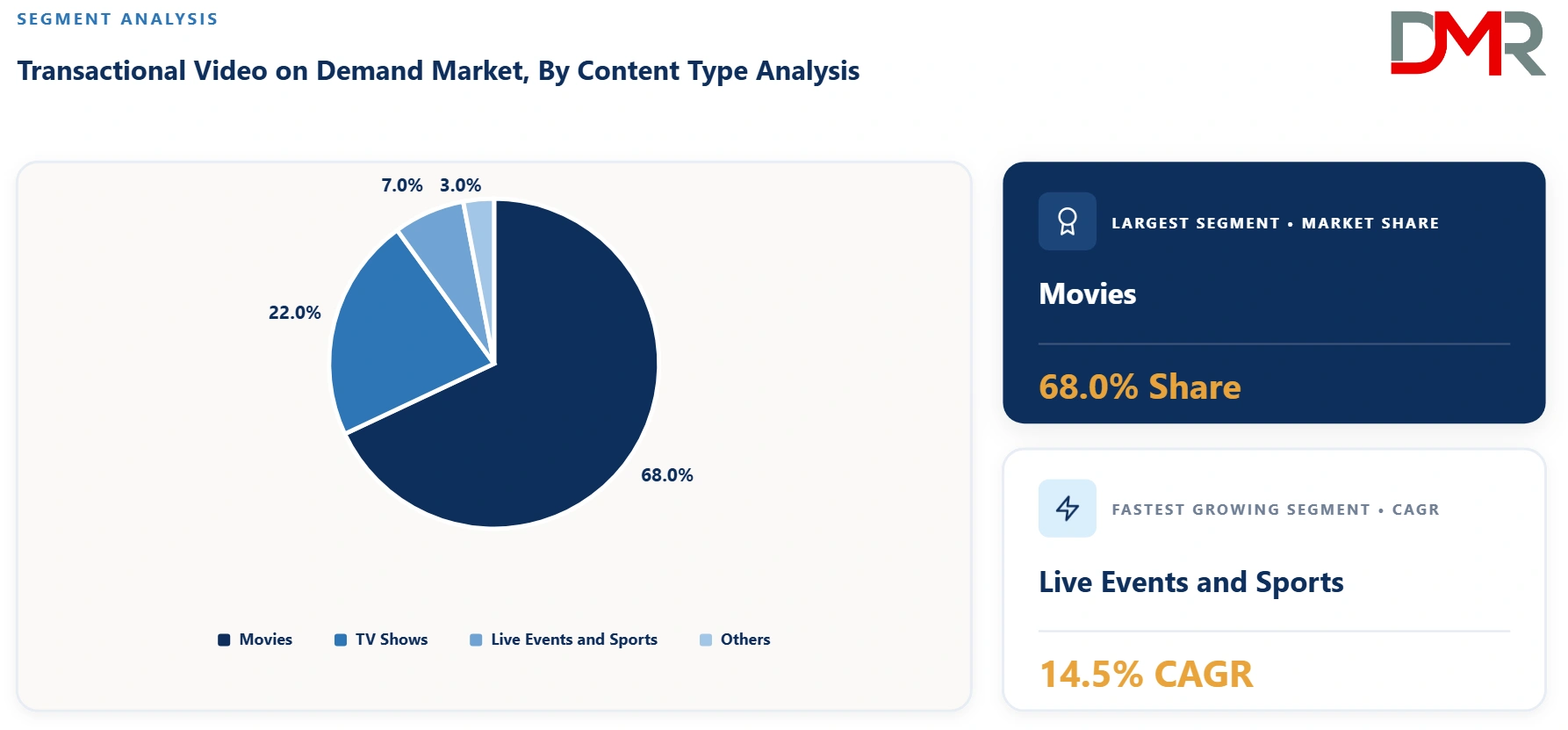
- Content type leader: Movies hold a 68.0% share of the market in 2026, as new theatrical releases and premium early-window titles drive most paid transactions, while Live Events and Sports are the fastest-growing content type at a 14.5% CAGR through 2035 on pay-per-view demand.
- Fastest transaction model: Premium Early-Window Release is set to grow at a 15.5% CAGR through 2035, ahead of the overall market, as studios offer new films to rent or buy within weeks of cinemas, although Rental still holds 45.0% of 2026 revenue.
- Device leader: Smartphones and Tablets account for 36.0% of 2026 demand, as viewers rent and buy on handheld devices with easy mobile payments and downloads for travel.
- Fastest device: Smart TVs and Connected TVs are projected to grow at a 12.4% CAGR, supported by storefront apps built into televisions and the move of paid viewing to the living room screen.
- Regional picture: North America leads with a 44.0% share in 2026, while Asia Pacific is the fastest-growing region at a 14.4% CAGR.
What are the Key Use Cases of Transactional Video on Demand?
- Premium Rental of New Theatrical Releases: People can rent new films from their homes in high quality and for a 48-hour period, so that studios continue to earn money from views who skip theaters, who are unwilling to wait for on-demand digital streaming.
- Digital Ownership and Library Building: Customers purchase digital content (often in 4K) and store it in a shared retail ‘library’ system such as Movies Anywhere. This continues to add value to an individual’s and brand’s library.
- Live Events and Pay-Per-View: Pay-TV and digital streaming services sell live sporting events, music and unique events. Rights owners therefore receive money directly from consumers for these.
- Creator and Distributor Direct Sales: Independent directors, teachers and specialist distributors use online and app-based self-distribution systems including Vimeo and Uscreen. This allows them to continue to manage both the sales and consumer engagement for their own content or shows.
How are AI and Personalization Transforming the Transactional Video on Demand Market?
AI is being used to facilitate sales from TVODs. Alongside recommendation, personalisation and bundling, platforms analyse content and pricing data to determine when to push high-value content. Rebranded as Fandango in July 2026, the company now provides integrated ad-supported streaming, ticketing and rental and sale services. It has also enhanced search and content information. In the last 12 months, Fandango has seen in excess of 30 million video-on-demand sales and rentals. In 2026, Amazon further developed its Sponsored Tiles service to allow movie studios to analyse specific content sales and rentals as a conversion. Consumers can more easily search for content to rent using natural language and voice-activated search. Additionally, AI is used by producers and micro-distributors to analyse, price and market content for different regions. Consequently, the areas of competition are: search functionality, pricing and the standard of first-party consumer data available.
Transactional Video on Demand Market Dynamics at a Glance
Drivers, Restraints, Opportunities and Trends in the Transactional Video on Demand Market
| Type |
Factor |
Impact |
| Driver |
Premium Early-Window Releases and Event Titles |
High |
| Driver |
Connected TV and Mobile Device Adoption |
High |
| Restraint |
Subscription Streaming Competition and Shrinking Windows |
High |
| Restraint |
Digital Ownership Concerns and Regulatory Disclosure |
Medium |
| Opportunity |
Emerging Market Growth and Mobile Billing |
High |
| Opportunity |
Direct to Consumer Pay-per-Title Platforms and Live Events |
Medium |
| Trend |
Free Ad-Supported Funnels into Paid Rentals |
High |
| Trend |
Retail Concentration and Cross-Platform Digital Libraries |
Medium |
What is Driving the Growth of the Transactional Video on Demand Market?
Premium Early-Window Releases and Event Titles
Studios are increasingly releasing films on digital platforms shortly after their theatrical runs, allowing consumers to rent or purchase premium content before its availability on subscription streaming services. This distribution strategy enables studios to generate additional revenue while catering to audiences seeking early access to newly released films. Major digital storefronts such as Apple TV, Prime Video, and Fandango at Home offer premium releases, blockbuster movies, and exclusive entertainment content. Growing consumer interest in accessing high-profile films from the comfort of their homes encourages individual transactions. Furthermore, flexible pricing strategies and exclusive digital release windows support revenue generation and strengthen the commercial position of transactional video on demand platforms.
Connected TV and Mobile Device Adoption
Increasing adoption of smart televisions, smartphones, tablets, and connected streaming devices is expanding consumer access to transactional video on demand services. Digital storefronts integrated into these devices allow viewers to rent or purchase entertainment content conveniently. The availability of digital wallets, carrier billing, and secure payment systems further simplifies transactions and improves the customer experience. Cross-platform digital libraries also enable consumers to access purchased content across compatible devices, increasing the appeal of digital ownership. Additionally, improvements in high-resolution streaming, premium audio formats, and personalized content recommendations encourage consumer spending. Expanding digital connectivity and changing entertainment consumption habits continue to support market growth.
What are the Key Restraints in the Transactional Video on Demand Market?
Subscription Streaming Competition and Shrinking Windows
The growing popularity of subscription-based streaming platforms presents a significant challenge to transactional video on demand services. Consumers increasingly prefer subscription models that provide access to extensive content libraries through recurring payments rather than paying separately for individual titles. Studios are also reducing the exclusive availability period of premium digital releases before introducing content on subscription platforms. This encourages price-sensitive consumers to postpone purchases or rentals until content becomes available through existing subscriptions. Furthermore, the expansion of free ad-supported streaming services and alternative entertainment platforms intensifies competition.
Digital Ownership Concerns and Regulatory Disclosure
Growing concerns regarding digital content ownership create challenges for transactional video on demand platforms. Consumers purchasing digital films generally receive licensing rights rather than permanent ownership, potentially resulting in restricted access when distribution agreements expire. This uncertainty can discourage customers from purchasing digital content at premium prices. Increasing regulatory scrutiny of digital ownership practices also requires service providers to maintain greater transparency regarding licensing conditions, purchase terms, and content accessibility. Compliance requirements may increase administrative expenses and require modifications to checkout processes and marketing communications. Additionally, physical media remains an alternative for consumers seeking permanent ownership and greater control over their entertainment collections.
What are the Key Opportunities in the Transactional Video on Demand Market?
Emerging Market Growth and Mobile Billing
Asia Pacific, Latin America and the Middle East have large and growing smartphone and smart TV bases, where many viewers prefer to pay per title rather than commit to several subscriptions. Mobile wallets, carrier billing and prepaid cards let platforms charge small amounts, and local-language films, regional sports and festivals suit pay-per-title sales. Telecom operators and local storefronts can bundle rentals into data plans, and global platforms can add local pricing and payment options. Growth in connected TV and broadband access across these regions supports faster expansion of the market there.
Direct to Consumer Pay-per-Title Platforms and Live Events
Creators, independent distributors, educators and event organizers want to sell titles directly without a large storefront owning the customer relationship. Platforms such as Vimeo and Uscreen, together with video technology providers such as Brightcove, Kaltura and Cleeng, give them paywalls, rentals, bundles and analytics. Live concerts, sports bouts, film premieres and festivals can be sold as pay-per-view events, with replay rentals afterward. Vendors that combine payments, rights management, anti-piracy tools and audience data can grow from simple paywalls into broader monetization platforms.
What are the Latest Trends in the Transactional Video on Demand Market?
Free Ad-Supported Funnels into Paid Rentals
Storefronts are using free content to attract viewers and then sell premium titles. In July 2026 Fandango, owned by Versant, expanded its free ad-supported streaming service and unified it with movie ticketing and rentals and purchases under one brand, and reported that monthly active users of its free service grew more than 300% year over year. A one-click free viewing experience brings in viewers who may later rent a new release, and shared accounts across ticketing, free streaming and transactions give the platform data to target offers. Expect more TVOD storefronts to combine free, paid and ticketing features in single apps.
Retail Concentration and Cross-Platform Digital Libraries
The Transactional Video on Demand Market is witnessing increasing concentration among established digital storefronts offering extensive content libraries and premium releases. With similar content availability and pricing across major platforms, service providers are focusing on personalized recommendations, high-resolution streaming, promotional bundles, loyalty programs, and seamless access across connected devices. Cross-platform digital libraries also improve consumer convenience by allowing purchased content to remain accessible through compatible services. These developments are strengthening competition around customer experience, platform accessibility, and content distribution capabilities.
Research Scope and Analysis
The report segments the transactional video on demand market by content type, transaction model, access device, application, and platform type across five regions and key countries.
ℹ
To learn more about this report –
Download Your Free Sample Report Here
By Content Type Analysis
Movies lead the content type segment with a 68.0% share in 2026 because new theatrical releases, premium early-window titles and catalog favorites generate most paid rentals and purchases. TV Shows follow as viewers buy full seasons and rent series that are not on their subscriptions. Live Events and Sports are the fastest-growing content type at a 14.5% CAGR from 2027 to 2035 as fights, concerts and special events are sold on a pay-per-view basis, and Others, including documentaries, education and special-interest titles, add steady demand.
By Transaction Model Analysis
Rental, including pay-per-view transactions outside premium early-release windows, leads the transaction model segment with a 45.0% share in 2026, supported by affordable pricing and flexible viewing periods. Electronic Sell-Through accounts for 40.0% of market revenue, driven by demand for long-term access to purchased digital content and expanding digital libraries. Premium Early-Window Release represents 15.0% of market revenue in 2026 and is projected to grow fastest at a CAGR of 15.5% from 2027 to 2035, supported by the increasing availability of newly released films through premium digital channels. Transactions occurring within designated premium early-release windows are classified separately from standard rentals and digital purchases to avoid double counting.
By Access Device Analysis
Smartphones and Tablets lead the access device segment with a 36.0% share in 2026 because handheld devices are the most widely owned screens and support easy mobile payments, downloads for travel and one-tap purchase. Smart TVs and Connected TVs hold 28.0% and are the fastest-growing group at a 12.4% CAGR from 2027 to 2035 as storefront apps come built into televisions. Streaming Devices and Set-Top Boxes hold 22.0%, Desktops and Laptops 10.0%, and Others, including game consoles and in-vehicle screens, 4.0%.
By Application Analysis
Residential use leads the application segment with a 90.0% share in 2026 because households rent and buy films and shows for home viewing. Commercial use, covering hotels, airlines and other venues that offer per-title content, holds 10.0% and is the fastest-growing application at a 12.9% CAGR from 2027 to 2035 as hospitality and transport operators digitize in-room and in-flight entertainment.
By Platform Type Analysis
Digital Storefronts and Apps lead the platform type segment with a 58.0% share in 2026, supported by established third-party digital marketplaces offering extensive movie and television content libraries. Pay-TV and Telecom Operators account for 32.0% of market revenue through transactional services delivered across operator-managed applications, set-top boxes, and television networks. Independent and Direct-to-Consumer Platforms represent 10.0% of market revenue and are projected to grow fastest at a CAGR of 15.0% from 2027 to 2035, driven by content creators, distributors, and event organizers selling directly to audiences. Platforms are classified according to their primary commercial distribution model to minimize revenue overlap.
How is the Transactional Video on Demand Market Segmented?
By Content Type
- Movies
- TV Shows
- Live Events and Sports
- Others
By Transaction Model
- Rental (Pay Per View)
- Electronic Sell-Through (Download to Own)
- Premium Early-Window Release
By Access Device
- Smartphones and Tablets
- Smart TVs and Connected TVs
- Streaming Devices and Set-Top Boxes
- Desktops and Laptops
- Others
By Application
By Platform Type
- Digital Storefronts and Apps
- Pay-TV and Telecom Operators
- Independent and Direct-to-Consumer Platforms
Which Region Leads the Transactional Video on Demand Market?
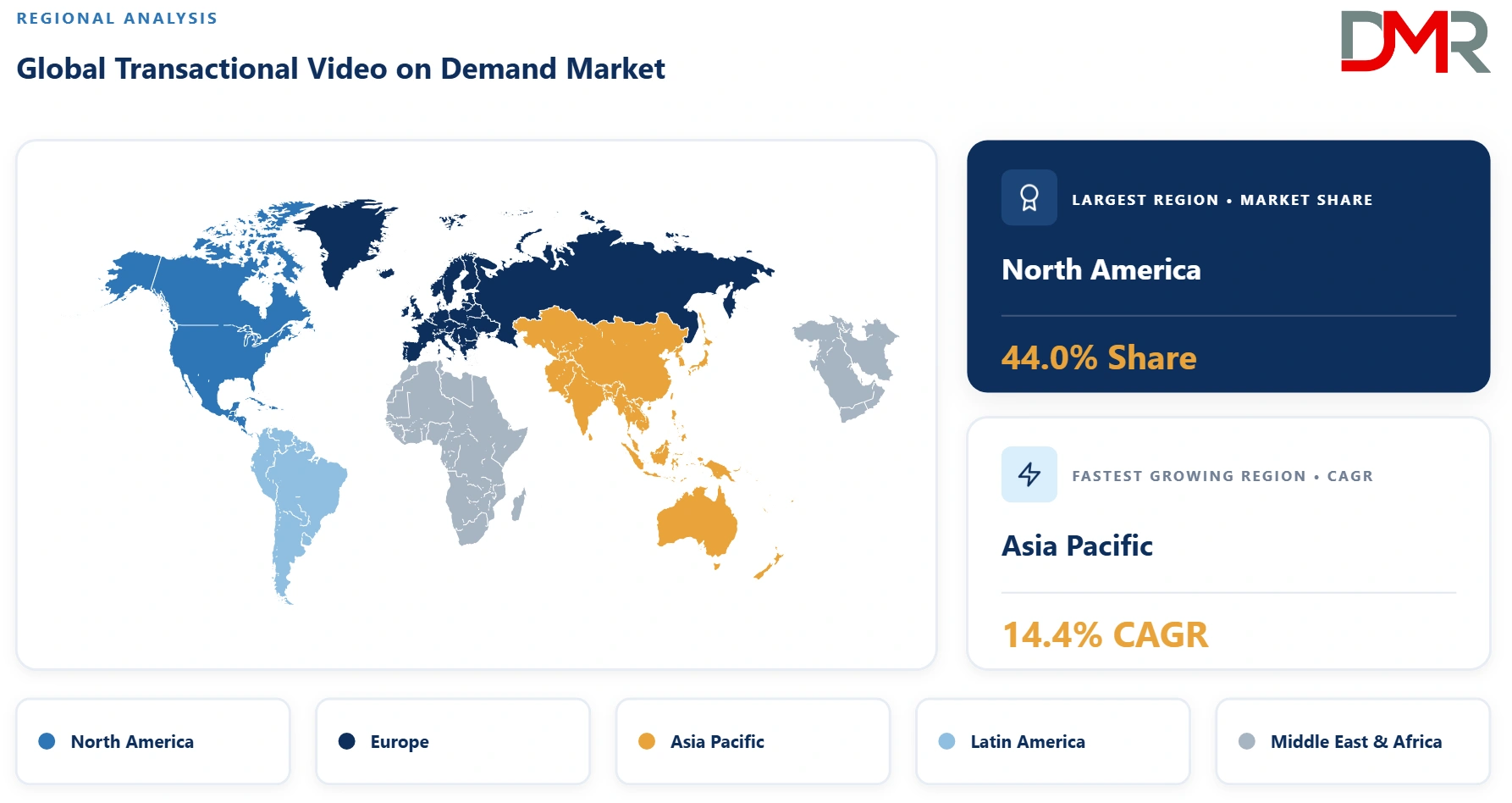
North America leads the transactional video on demand market with a 44.0% share in 2026, while Asia Pacific is projected to grow at a 14.4% CAGR from 2027 to 2035.
ℹ
To learn more about this report –
Download Your Free Sample Report Here
Region with the Largest Revenue Share
North America accounted for 44.0% of global revenue in 2026, supported by the home markets of leading storefronts such as Apple, Amazon, Google and Fandango, a large base of connected TVs and a strong box office that feeds premium early-window releases. The United States dominates regional sales, while Canada adds steady demand. Although the Digital Entertainment Group reported lower US electronic sell-through and rental spending in 2025, the region keeps the largest share because of the scale of its audience and the premium prices of new releases, and it should keep that lead despite slower growth than Asia Pacific.
Region with the Highest CAGR
Asia Pacific is projected to grow at a 14.4% CAGR from 2027 to 2035, the fastest of any region. China, Japan and South Korea add demand from large connected-device bases, strong film and animation audiences and advanced mobile payments, while India and Australia are expanding quickly as smartphone ownership, broadband access and local-language content grow. Telecom operators and local storefronts bundle rentals with data plans, and expanding cinema chains feed new releases into premium windows. Rising incomes and digital payment adoption support growth through 2035.
Regional Analysis
Europe Transactional Video on Demand Market
Europe is a mature, multi-language market led by the United Kingdom, Germany, France, Italy and Spain. Sky Store, Rakuten TV, CHILI, Canal+ and operator services compete with Apple, Amazon and Google, and the United Kingdom is the most developed transactional market, where digital transactional spending grew 3.5% to GBP 382 million in 2025 and electronic sell-through rose 7.4%. EU audiovisual rules, local content requirements and data protection under the GDPR shape catalogs and marketing. Growth is steady, driven by premium releases and sales of sports and events.
Latin America Transactional Video on Demand Market
Latin America is an emerging market where mobile devices, smart TVs and pay-TV operators drive demand. Brazil and Mexico generate most regional revenue, with Chile, Colombia and Argentina contributing smaller volumes. Piracy, low credit card use, currency volatility and price sensitivity limit spending, so carrier billing, prepaid cards and local pricing matter. Cinema recovery, growing connected TV bases and live events sold per view support healthy growth from a small base.
Middle East & Africa Transactional Video on Demand Market
Middle East and Africa is a smaller but steadily developing market led by Saudi Arabia, the UAE and South Africa. Hospitality, airlines and pay-TV operators in the Gulf sell per-title and per-event content, and growing smartphone and connected TV use adds consumer demand. South Africa has an established pay-TV base and growing use of digital storefronts. Payment access, piracy, bandwidth costs and territorial licensing shape deployments, and sales run mainly through international storefronts and regional operators.
By Region
North America
Europe
- Germany
- France
- The U.K.
- Italy
- Spain
- Rest of Europe
Asia-Pacific
- China
- Japan
- India
- Australia
- South Korea
- Rest of APAC
Latin America
- Mexico
- Brazil
- Rest of LATAM
Middle East & Africa
- Saudi Arabia
- The UAE
- South Africa
- Rest of MEA
Regulatory Landscape
Regulation shapes how transactional video is priced, advertised and delivered. In California, AB 2426, in force since 1 January 2025, requires sellers of digital goods such as movies to disclose clearly when a buy or purchase grants only a license that may be revoked, through an affirmative acknowledgment or a conspicuous pre-purchase disclosure, with civil penalties of up to USD 2,500 per violation. Consumer protection and price transparency rules in other jurisdictions affect how premium rental prices, refund terms and viewing windows are presented. In Europe, the Audiovisual Media Services Directive sets rules on content quotas and protection of minors for on-demand services, the GDPR governs viewer data, and VAT on digital services applies by country. Copyright licensing is territorial, so rights holders and platforms must manage regional availability, digital rights management and anti-piracy controls. Platforms that make license terms clear and keep libraries accessible can build consumer trust and reduce legal risk.
Investment and White Space Analysis
Capital and strategic attention are moving toward platforms that combine free streaming, ticketing and transactions, and toward enabling technology for direct sales. Versant, which Comcast separated as an independent public company in early 2026, owns Fandango, acquired INDY Cinema Group to extend Fandango's cinema software and, in July 2026, unified its streaming, ticketing and rental offerings under the Fandango brand. White space remains in premium early-window and event releases, 4K and premium-format catalog sales, bundles with hardware and telecom plans, pay-per-view live events, emerging markets in Asia Pacific, Latin America and the Gulf, and creator and distributor platforms. Risks include the decline in US transactional spending reported for 2025, shortening windows before titles reach subscription services, free ad-supported competition, piracy, concentration of sales in a few retailers, and digital ownership regulation. Investors should favor assets with large installed bases, first-party viewer data, premium release access and diversified payment options.
Who are the Leading Companies in the Transactional Video on Demand Market?
The TVOD market is moderately concentrated at the storefront level and fragmented elsewhere, with global technology storefronts, pay-TV and telecom operators, studio-led libraries, regional platforms and technology enablers all competing. Apple, Amazon, Alphabet's YouTube and Fandango sell most digital rentals and purchases in the United States, while Comcast, Charter, DirecTV and Verizon sell on-demand and pay-per-view content through pay-TV and broadband. Sky, Rakuten, Canal+, Telstra and CHILI serve regional markets, studios such as Disney, Warner Bros. Discovery, Paramount, Lionsgate and Sony supply the content, and Vimeo, Uscreen, Brightcove, Kaltura, Cleeng, JW Player, Dacast, Nagra and Verimatrix supply the platforms, paywalls and rights protection for direct sales.
- Apple Inc. (Cupertino, US): Operator of the Apple TV app and store, where viewers rent and buy films and shows across Apple devices and many smart TVs, and a regular launch partner for premium early-window releases.
- Amazon.com, Inc. (Seattle, US): Operator of Prime Video, whose rent and buy store sells new releases, including premium titles at USD 19.99, without requiring a Prime membership.
- Alphabet Inc. (Mountain View, US): Operator of YouTube Movies & TV, which sells and rents films and series across mobile, web and connected TV and launches premium titles alongside the other major storefronts.
- Fandango (New York, US): Versant-owned platform, formerly Fandango at Home and Vudu, combining movie tickets, rentals and purchases, and free streaming under one brand since July 2026, with more than 30 million video-on-demand transactions in the past 12 months.
- Comcast Corporation (Philadelphia, US): Pay-TV and broadband operator whose Xfinity platform sells on-demand rentals, purchases and pay-per-view events to its subscribers, and which separated Fandango into Versant in early 2026.
Some of the prominent players in the Global Transactional Video on Demand Market are:
- Apple Inc. (Apple TV)
- Amazon.com, Inc. (Prime Video)
- Alphabet Inc. (YouTube and Google TV)
- Fandango (Versant Media Group, Inc.)
- Comcast Corporation (Xfinity)
- Charter Communications, Inc.
- DirecTV, LLC
- Verizon Communications Inc.
- Comcast Corporation (Xfinity and Sky)
- Rakuten Group, Inc. (Rakuten TV)
- Canal+ Group
- Telstra Group Limited
- CHILI S.p.A.
- The Walt Disney Company (Movies Anywhere)
- Warner Bros. Discovery, Inc.
- Paramount Skydance Corporation
- Lionsgate Studios Corp.
- Sony Group Corporation
- iQIYI, Inc.
- Vimeo, Inc.
- Uscreen, Inc.
- Brightcove Inc.
- Kaltura, Inc.
- Muvi Technologies
- Cleeng
- JW Player
- Dacast, Inc.
- Nagra (Kudelski Group)
- Verimatrix, Inc.
- Other Key Players
Recent Developments
- In January 2026, Versant, the media company that owns Fandango, Rotten Tomatoes and Fandango at Home, separated from Comcast as an independent public company, after announcing its acquisition of INDY Cinema Group to extend Fandango's cinema software.
- In February 2026, the Digital Entertainment Group reported that US electronic sell-through fell 3.3% to USD 2.2 billion and digital rentals fell 4.7% to USD 1.6 billion in 2025, while total US home entertainment spending rose 17.4% to USD 62.2 billion.
- In February 2026, BASE and DEGI reported that a record 79 films reached UK premium digital windows in 2025 and that premium titles accounted for more than 20% of UK transactional spending, with a forecast of 25% in 2026.
- In July 2026, Fandango expanded its free ad-supported streaming service and unified its consumer entertainment services under the Fandango brand, retiring the Fandango at Home name.
Report Scope and Research Methodology
Market definition: The Transactional Video on Demand Market encompasses revenue generated from individual payments for digital content rentals, electronic sell-through purchases, premium early-window releases, and pay-per-view events delivered through internet-based platforms and operator networks. The market includes residential and commercial transactions across households, hospitality establishments, transportation providers, and other relevant commercial environments. It excludes subscription video on demand, advertising-supported video on demand, physical media sales, cinema ticket revenue, and standalone video platform technology revenue.
Methodology: Dimension Market Research estimates the Transactional Video on Demand Market through a combination of top-down and bottom-up research approaches, supported by published industry research, platform and operator disclosures, studio release data, home entertainment and box office trade data, and device adoption patterns. Market estimates and segment-level assessments consider content type, transaction model, access device, application, platform type, and regional demand. The findings are cross-validated against broader video streaming, home entertainment, and digital payment spending patterns.
Report Details
| Report Characteristics |
Details |
| Market Size (2026) |
USD 10.2 Billion |
| Forecast Value (2035) |
USD 27.3 Billion |
| CAGR (2027-2035) |
11.6% |
| Historical Data |
2021–2026 |
| Forecast Data |
2027–2035 |
| Base Year |
2026 |
| Estimate Year |
2027 |
| Segments Covered |
By Content Type, By Transaction Model, By Access Device, By Application, By Platform Type |
| Regional Coverage |
North America (The US, Canada); Europe (Germany, France, The UK, Italy, Spain, Rest of Europe); Asia Pacific (China, Japan, India, Australia, South Korea, Rest of APAC); Latin America (Mexico, Brazil, Rest of LATAM); Middle East & Africa (Saudi Arabia, The UAE, South Africa, Rest of MEA) |
Frequently Asked Questions
How big is the Transactional Video on Demand Market in 2026?
▾ The global transactional video on demand market is valued at about USD 10.2 billion in 2026 and is projected to reach USD 27.3 billion by 2035.
What is the growth rate of the Transactional Video on Demand Market?
▾ The market is expected to grow at a CAGR of 11.6% from 2027 to 2035, driven by premium early-window releases, smart TV and mobile adoption, emerging market growth and direct-to-consumer platforms.
Which region leads the Transactional Video on Demand Market?
▾ North America leads with a 44.0% share in 2026, while Asia Pacific is the fastest-growing region at a 14.4% CAGR over 2027 to 2035.
Which transaction model dominates the Transactional Video on Demand Market?
▾ Rental, including pay-per-view, dominates with a 45.0% share in 2026, while Premium Early-Window Release is the fastest-growing model at a 15.5% CAGR.
Which content type is growing fastest in the Transactional Video on Demand Market?
▾ Live Events and Sports is the fastest-growing content type at a 14.5% CAGR from 2027 to 2035, as fights, concerts and special events are sold on a pay-per-view basis.
Who are the key players in the Transactional Video on Demand Market?
▾ Key players include Apple, Amazon, Alphabet (YouTube), Fandango, Comcast, Charter, DirecTV, Sky, Rakuten and Vimeo.
What are the main challenges facing the Transactional Video on Demand Market?
▾ Main challenges include competition from subscription and free ad-supported streaming, shrinking release windows, piracy, digital ownership concerns and regulation, and the concentration of sales in a few retailers.