Market Snapshot
- Market Size (2026): USD 34.6 Mn
- Forecast Value (2035): USD 64.1 Mn
- CAGR (2026-2035): 7.1%
- Leading Product Type (2026): Oil-soluble asphaltene inhibitors, approximately 58%
- Leading Application (2026): Upstream oil production, approximately 63%
- Key Players: SLB, Baker Hughes, Halliburton, ChampionX and others
What is UAE Asphaltene Inhibitor Market and its Market Size?
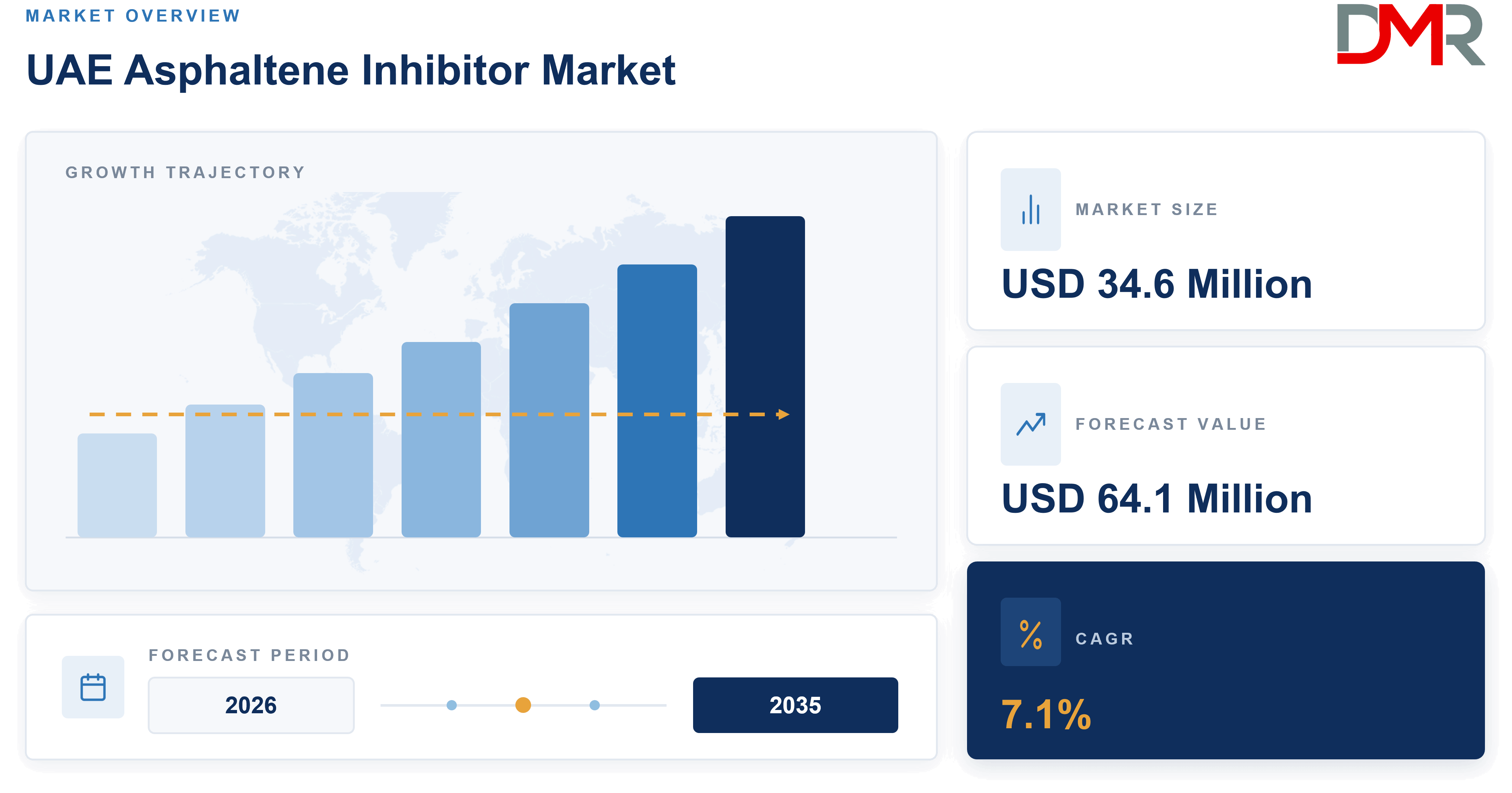
The UAE Asphaltene Inhibitor Market is estimated at USD 34.6 Mn in 2026 and is projected to reach USD 64.1 Mn by 2035, expanding at a CAGR of 7.1% from 2026 to 2035.
ℹ
To learn more about this report –
Download Your Free Sample Report Here
Asphaltene inhibitors are specialty production chemicals used to reduce asphaltene precipitation, aggregation and deposition in crude-oil production systems. They are applied where pressure depletion, temperature changes, crude composition, gas liberation and fluid incompatibility can destabilize asphaltenes. Treatment programs can protect near-wellbore regions, tubing, flowlines, separators and other production equipment from deposits that restrict flow and increase intervention requirements.
The UAE represents a technically important market because its hydrocarbon industry combines large onshore and offshore production assets with sophisticated production-chemistry requirements. ADNOC's process-treatment chemicals program explicitly identifies corrosion, scale and asphaltene control chemicals as opportunities for UAE production. ADNOC Distribution has also disclosed its first asphaltene inhibitor supply order and described localization of these specialty solutions as a future direction.
Upstream production is expected to remain the dominant application. Asphaltene deposition is strongly linked to changes in reservoir and well conditions, so chemical treatment is generally selected after laboratory screening, crude characterization and field evaluation. The commercial value of an inhibitor is therefore measured not simply by chemical price but by its ability to maintain production, control deposits and reduce remedial intervention.
Demand is also supported by the UAE's expanding domestic chemicals ecosystem. In May 2026, TA'ZIZ and Alpha Dhabi announced a strategic collaboration targeting up to 14 industrial chemicals and approximately 2.2 million tonnes per annum of additional capacity, reinforcing the country's industrialization and import-substitution agenda. While the announced portfolio is broader than asphaltene inhibitors, the development strengthens the local infrastructure and supply-chain environment for specialty chemicals.
Use Cases
- Wellbore and Near-Wellbore Treatment: Continuous or batch inhibitor programs can reduce asphaltene precipitation around producing wells where pressure changes destabilize crude components.
- Flowline Protection: Inhibitors can limit deposition in production flowlines, helping maintain hydraulic performance and reduce cleaning or pigging requirements.
- Production Facility Protection: Treatment can control deposits in separators and associated crude-handling equipment where destabilized asphaltenes can accumulate.
- Enhanced Production Chemistry: Inhibitor programs can be combined with laboratory testing, crude analysis and field monitoring to optimize dosage for changing production conditions.
Key Takeaways
- Market Size & Share: The UAE market is estimated at USD 34.6 Mn in 2026, with oil-soluble formulations accounting for approximately 58% of product demand.
- Application Concentration: Upstream oil production is projected to represent approximately 63% of 2026 application demand because asphaltene instability is closely linked to reservoir and well operating conditions.
- Growth Segment: Water-dispersible and polymer-enhanced formulations are expected to expand faster as operators seek more adaptable chemistry for changing production conditions.
- Technical Procurement: Product qualification depends on crude characterization, laboratory screening, compatibility and field performance rather than price alone.
- Localization Opportunity: ADNOC has identified asphaltene control chemicals as a UAE process-treatment opportunity, while ADNOC Distribution has already reported an asphaltene-inhibitor supply order.
- Supply Chain: Local blending, storage and technical service can improve response times and support the UAE's broader chemicals localization agenda.
How AI/Gen AI is Transforming the UAE Asphaltene Inhibitor Market?
AI is increasingly relevant to production-chemistry programs because asphaltene deposition depends on interacting fluid and operating variables. Machine-learning models can analyze pressure, temperature, crude composition, flow rate, water cut and historical deposition observations to identify wells with elevated precipitation risk. These models can support prioritization of laboratory testing and field monitoring rather than relying solely on fixed treatment rules.
Generative AI can accelerate engineering workflows by organizing crude-assay results, laboratory reports, treatment histories and production data. Digital twins and predictive models can also help engineers test changes in operating conditions before altering inhibitor dosage. AI does not replace laboratory compatibility testing or field validation; its value is in improving data interpretation, surveillance and treatment optimization.
- Predictive Deposition Risk: Models can flag wells where changing pressure, temperature or fluid composition increases asphaltene risk.
- Dosage Optimization: Analytics can correlate treatment rates with deposition observations and production response.
- Laboratory Data Automation: AI can organize screening results and historical inhibitor performance for faster comparison.
- Digital Production Models: Simulations can assess changing operating conditions before field treatment changes are implemented.
Key Drivers in the UAE Asphaltene Inhibitor Market
- Large-Scale Hydrocarbon Production: The UAE has a substantial upstream production base and ADNOC reports oil production capacity of 4.85 million barrels per day. Large and technically complex production systems create recurring demand for flow-assurance chemicals where crude instability can threaten production continuity.
- Production Chemistry and Flow Assurance: Asphaltene deposition is a recognized flow-assurance challenge in UAE oilfield operations. Khalifa University has documented production-chemistry work focused on mitigating asphaltene deposition in ADNOC onshore and offshore wells, including modeling deposition at wellbore conditions. This established technical focus supports demand for customized inhibitor programs and analytical services.
Restraints in the UAE Asphaltene Inhibitor Market
- Crude-Specific Formulation Requirements: Asphaltene behavior differs by crude composition and operating conditions, so an inhibitor that performs well in one field may not deliver equivalent results elsewhere. Suppliers must conduct compatibility and performance testing, which increases qualification time and technical cost.
- High Qualification and Switching Barriers: Production chemicals are linked to asset reliability and output, making operators cautious about replacing established products. New suppliers must demonstrate measurable performance through laboratory screening and field trials. This can extend sales cycles and favour incumbent vendors with established technical relationships.
Growth Opportunities in the UAE Asphaltene Inhibitor Market
- Localization of Specialty Production Chemicals: ADNOC has explicitly identified corrosion, scale and asphaltene control chemicals among opportunities for production in the UAE, citing stable and predictable demand and relatively limited local production. ADNOC Distribution has separately stated that localization is a future direction for these specialty solutions.
- Digital Flow-Assurance Services: Suppliers can increase value by combining inhibitor supply with crude characterization, deposition modeling, online monitoring and dosage optimization. Such integrated programs create recurring service revenue and help operators link chemical treatment to measurable production outcomes.
Trends in the UAE Asphaltene Inhibitor Market
- Condition-Based Chemical Treatment: Operators are moving toward data-supported dosing that considers changing production and fluid conditions rather than relying only on fixed injection rates.
- Polymeric and Multifunctional Formulations: Formulations designed to interfere with asphaltene aggregation while remaining compatible with crude-handling processes are gaining importance in technically demanding applications.
- Local Supply and Blending: UAE industrial policy is encouraging domestic chemical production, supply-chain resilience and import substitution, creating opportunities for local specialty-chemical formulation.
- Integrated Flow Assurance: Asphaltene control is increasingly considered alongside scale, wax, corrosion and emulsion management, encouraging suppliers to offer broader production-chemistry programs.
Research Scope and Analysis
The market is segmented across product type, chemistry, application, end use industry and distribution channel. The estimates below are analytical market estimates for 2026 and 2026-2035 growth, designed to provide a UAE-specific commercial framework rather than represent published company guidance.
ℹ
To learn more about this report –
Download Your Free Sample Report Here
By Product Type
Oil-soluble asphaltene inhibitors are projected to lead with approximately 58% of 2026 demand because they are well suited to direct interaction with crude-oil systems and continuous treatment programs. Water-dispersible formulations are projected to expand faster at approximately 9.2% CAGR through 2035 as operators seek flexible treatment options for changing water cut and production conditions. The fastest-growing products are expected to be formulations that combine dispersion, deposition control and compatibility with broader production-chemical programs.
By Chemistry
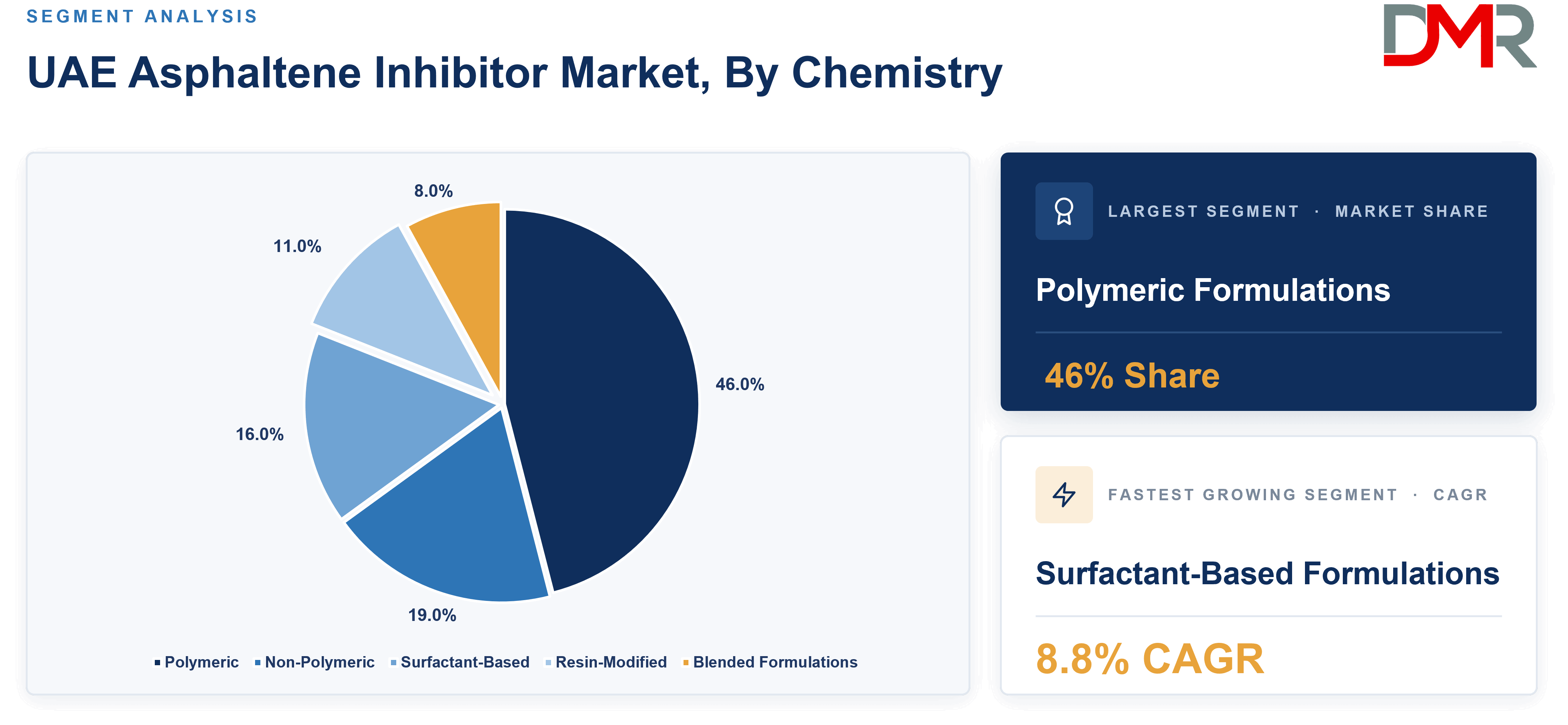
Polymeric formulations are estimated to hold approximately 46% of 2026 chemistry demand because polymeric chemistry can be engineered for adsorption and dispersion characteristics across difficult crude systems. Surfactant-based formulations are expected to record the faster CAGR of approximately 8.8% through 2035 as suppliers develop formulations that improve dispersion and compatibility across changing fluid conditions. Chemistry selection remains highly field-specific and is normally supported by laboratory testing.
By Application
Upstream oil production is projected to account for approximately 63% of 2026 application demand. Reservoir pressure changes, crude instability and near-wellbore deposition create the strongest requirement for continuous or squeeze-based treatment. Midstream crude transportation is expected to grow faster at approximately 8.4% CAGR through 2035 as operators focus on maintaining flow assurance across gathering systems and long-distance transportation infrastructure. Downstream applications remain smaller but support demand for deposit-control chemistry in crude processing and handling.
By End Use Industry
Oil and gas is expected to represent approximately 82% of 2026 end-use demand, reflecting the highly specialized nature of asphaltene control. Petrochemical and refining operations account for the balance, with demand linked to crude handling and process stability. Refining and crude-processing applications are projected to grow at approximately 7.9% CAGR through 2035 as UAE downstream integration increases the volume and complexity of crude-processing operations.
By Distribution Channel
Direct sales and technical contracts are projected to account for approximately 67% of 2026 distribution because oilfield customers require product qualification, field trials, technical support and treatment optimization. Specialty chemical distributors are expected to grow at approximately 9.0% CAGR through 2035 as local inventory and faster delivery become more important. Distributor competitiveness will depend increasingly on application knowledge rather than logistics alone.
The UAE Asphaltene Inhibitor Market Report is Segmented Based on the Following
By Product Type
- Oil-Soluble Asphaltene Inhibitors
- Water-Dispersible Asphaltene Inhibitors
- Solvent-Based Asphaltene Inhibitors
- Polymer-Enhanced Inhibitors
- Others
By Chemistry
- Polymeric
- Non-Polymeric
- Surfactant-Based
- Resin-Modified
- Blended Formulations
By Application
- Upstream Oil Production
- Midstream Crude Transportation
- Downstream Crude Processing
- Well Intervention and Stimulation
- Others
By End Use Industry
- Oil and Gas
- Refining
- Petrochemicals
- Industrial Hydrocarbon Processing
- Others
By Distribution Channel
- Direct Sales and Technical Contracts
- Specialty Chemical Distributors
- Industrial Trading Companies
- Local Blending and Formulation Partners
- Others
Pricing Analysis
Asphaltene inhibitor pricing in the UAE is strongly influenced by formulation complexity, active-ingredient concentration, solvent system, dosage rate, laboratory qualification, field-service requirements and contract structure. Commodity-style price comparison is less meaningful than total treatment cost because a lower-priced product may require higher dosage or produce weaker deposition control. Oilfield contracts commonly incorporate technical support and performance evaluation, raising the value of suppliers that can demonstrate production benefits. Imported specialty formulations remain exposed to freight, raw-material and currency costs, while local blending can improve inventory economics and responsiveness.
Export/Import Analysis
The UAE currently operates as both a major oil-producing market and a regional logistics hub for specialty chemicals. Asphaltene inhibitor supply can therefore combine direct imports of specialty formulations with local storage, distribution and increasingly local formulation. ADNOC Distribution has already reported its first asphaltene inhibitor supply order and described localization as a future direction, indicating a transition from pure distribution toward localized specialty-chemical capability. citeturn0search0 The opportunity for suppliers is strongest where imported active chemistry can be paired with UAE-based inventory, testing and technical support.
Competitive Landscape
The competitive environment includes global oilfield service companies, specialty chemical manufacturers, production-chemistry providers and UAE-based suppliers. Major vendors compete through proprietary formulations, laboratory screening, field engineering and established relationships with national oil companies. UAE suppliers can compete through local inventory, shorter response times and formulation support. Chemya, a UAE-based oilfield chemicals company, specifically lists asphaltene management among its production-chemical capabilities and describes its solutions as controlling precipitation and deposition from crude oil.
Some of the prominent players in the UAE Asphaltene Inhibitor Industry are:
- SLB
- Baker Hughes
- Halliburton
- ChampionX
- Ecolab
- Clariant
- BASF
- Innospec
- Dorf Ketal
- Nalco Water
- Solenis
- Kemira
- Nouryon
- Evonik Industries
- Dow
- LANXESS
- Lubrizol
- Italmatch Chemicals
- Arxada
- Baker Hughes Production Chemicals
- Croda International
- Huntsman
- Stepan Company
- King Industries
- Afton Chemical
- Infineum
- Chevron Phillips Chemical
- ExxonMobil Chemical
- Shell Chemicals
- TotalEnergies
- ADNOC Distribution
- Chemya Chemicals
- REDA Industrial Materials
- Brenntag Middle East
- Univar Solutions Middle East
- IMCD Middle East
- Gulf Chemical & Metallurgical
- AlMansoori Specialized Engineering
- Emirates National Chemical Industries
- Al Shirawi Group
- Other Key Players
Recent Developments
- May 2026: TA'ZIZ and Alpha Dhabi announced a strategic collaboration targeting up to 14 industrial chemicals and approximately 2.2 million tonnes per annum of additional capacity, reinforcing UAE chemicals localization and import-substitution ambitions.
- May 2026: TA'ZIZ announced long-term agreements valued at $28.5 billion across its chemicals portfolio, strengthening domestic feedstock, offtake and chemical-production infrastructure.
Report Details
| Report Characteristics |
| Market Size (2026) |
USD 34.6 Mn |
| Forecast Value (2035) |
USD 64.1 Mn |
| CAGR (2026-2035) |
7.1% |
| Historical Data |
2021 - 2025 |
| Forecast Data |
2026 - 2035 |
| Base Year |
2025 |
| Segments Covered |
By Product Type, By Chemistry, By Application, By End Use Industry, By Distribution Channel |
| Regional Coverage |
The UAE |
Frequently Asked Questions
How big is the UAE Asphaltene Inhibitor Market?
▾ The UAE Asphaltene Inhibitor Market is estimated at USD 34.6 Mn in 2026 and is projected to reach USD 64.1 Mn by 2035.
What is the CAGR of the UAE Asphaltene Inhibitor Market?
▾ The market is projected to expand at a CAGR of 7.1% from 2026 to 2035.
What is driving the UAE Asphaltene Inhibitor Market?
▾ Large-scale oil production, flow-assurance requirements, pressure-related asphaltene deposition risks, production-chemistry programs and UAE specialty-chemical localization are key demand drivers.
Which application dominates the UAE Asphaltene Inhibitor Market?
▾ Upstream oil production is projected to dominate, accounting for approximately 63% of 2026 demand.
Who are the key players in the UAE Asphaltene Inhibitor Market?
▾ Key participants include SLB, Baker Hughes, Halliburton, ChampionX, Ecolab, Innospec, Dorf Ketal and other global and UAE-based production-chemistry suppliers.
What is the fastest-growing segment?
▾ Water-dispersible product formulations are projected to record the fastest growth among product types, supported by demand for flexible treatment under changing production and water conditions.
Why is localization important for this market?
▾ ADNOC has identified asphaltene control chemicals as a UAE process-treatment opportunity and ADNOC Distribution has reported an asphaltene-inhibitor supply order while highlighting localization as a future direction. This creates opportunities for local blending, storage, formulation and technical support.