UAE Cold Chain Logistics Market Snapshot
- UAE Cold Chain Logistics Market Size in 2026: USD 1.6 Billion
- UAE Cold Chain Logistics Market Size in 2035: USD 3.2 Billion
- UAE CAGR from 2026 to 2035: 7.8%
- Refrigerated Warehouse is the leading service type segment in 2026: 52.1%
- Meat is the leading application segment in 2026: 25.2%
- Frozen is the leading temperature type segment in 2026: 60.5%
- Dry Ice is the leading technology segment in 2026: 34.5%
What is the UAE Cold Chain Logistics Market and its Market Size?
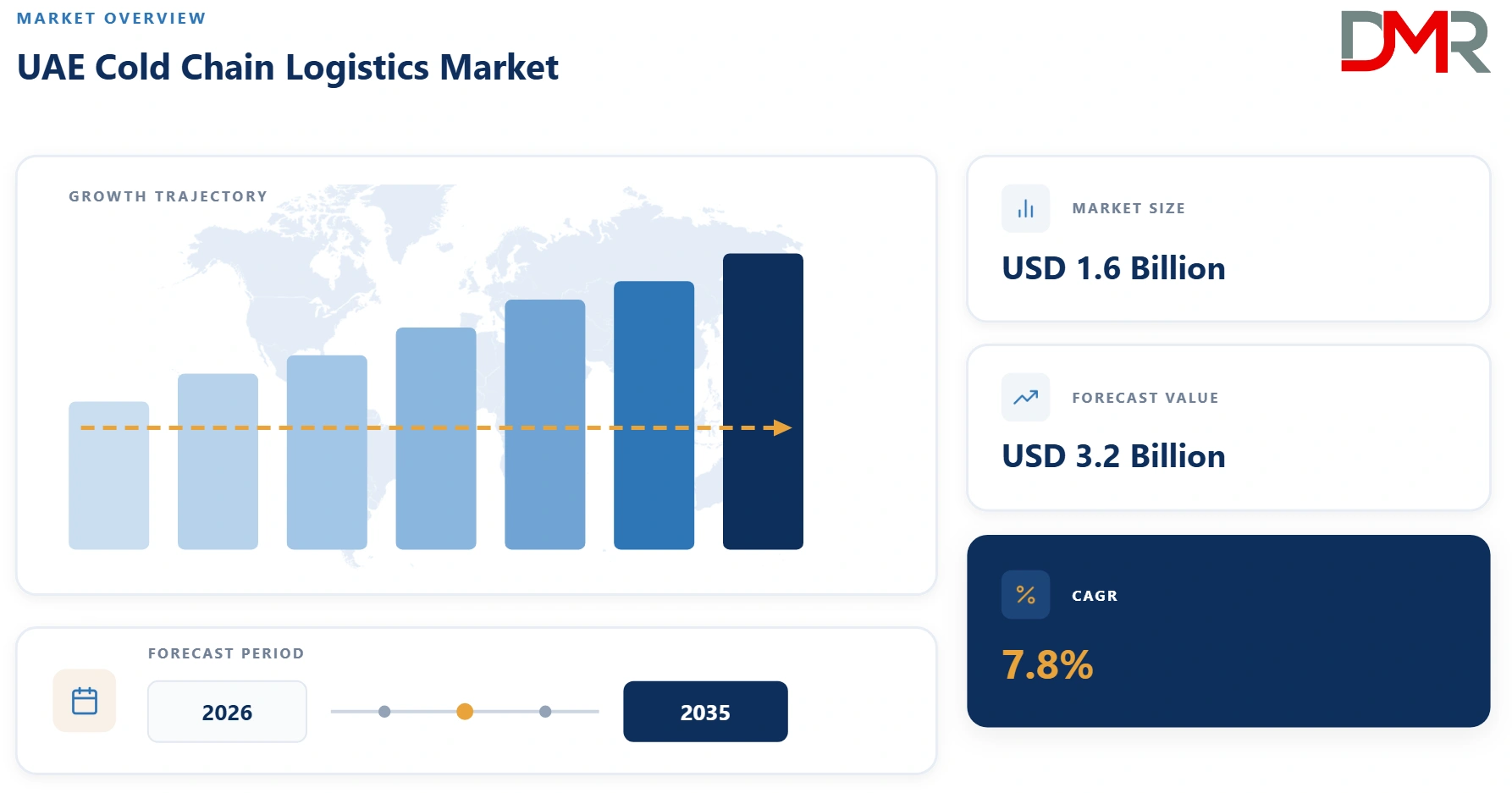
The UAE Cold Chain Logistics Market is projected to reach USD 1.6 billion in 2026 and grow at a compound annual growth rate of 7.8% from there until 2035 to reach a value of USD 3.2 billion.
ℹ
To learn more about this report –
Download Your Free Sample Report Here
The UAE cold chain logistics market comprises temperature-controlled storage, transportation, packaging, monitoring, and distribution services that preserve food, beverages, pharmaceuticals, and other sensitive products. Demand is supported by high food import dependence, rising consumption of fresh and frozen products, tourism, organized retail, online grocery delivery, and healthcare logistics. Dubai and Abu Dhabi function as major regional gateways, while investment in multi-temperature warehouses, refrigerated fleets, automated handling, real-time monitoring, and energy-efficient refrigeration is improving service reliability and supporting the UAE’s food-security and trade-hub ambitions.
Use Cases
- Imported Food Storage and Distribution: UAE importers use multi-temperature warehouses and refrigerated vehicles to move meat, seafood, dairy, fruits, and vegetables from ports and airports to wholesalers, supermarkets, hotels, and restaurants. Continuous temperature monitoring, customs coordination, inventory rotation, and rapid cross-docking reduce spoilage, preserve quality, and support year-round availability of products sourced from diverse international markets.
- Retail and Online Grocery Fulfilment: Supermarkets, quick-commerce platforms, and food-delivery operators rely on urban cold rooms, micro-fulfilment facilities, insulated packaging, and refrigerated last-mile fleets. These systems maintain chilled and frozen conditions across short delivery windows, improve order accuracy, support wider fresh-food assortments, and help retailers meet consumer expectations for convenience, safety, traceability, and dependable same-day delivery throughout UAE cities.
- Pharmaceutical and Healthcare Logistics: Hospitals, distributors, laboratories, and pharmaceutical companies require validated cold-chain services for vaccines, biologics, insulin, diagnostics, and clinical materials. Qualified packaging, calibrated sensors, controlled airport handling, documented chain of custody, contingency power, and rapid exception management protect product efficacy. Specialized providers also support regional redistribution from Dubai and Abu Dhabi to healthcare markets across the Middle East.
- Hospitality and Foodservice Supply: Hotels, restaurants, caterers, airlines, and institutional kitchens use cold-chain partners to consolidate and distribute imported meat, seafood, dairy, produce, and frozen prepared foods. Scheduled deliveries, portion-controlled inventory, food-safety documentation, and multi-temperature vehicles help operators manage demand fluctuations driven by tourism, events, and seasonal peaks while reducing wastage and maintaining consistent menu quality.
Key Takeaways
- Market Size: The UAE Cold Chain Logistics Market is anticipated to be valued at USD 1.6 billion in 2026 and is forecast to reach USD 3.2 billion by 2035, expanding at a CAGR of 7.8%.
- Growth Rate and Outlook: Market expansion is supported by rising imports of perishable food, population and tourism growth, organized retail, online grocery delivery, pharmaceutical distribution, and the UAE’s role as a regional re-export hub. New multi-temperature facilities, real-time monitoring, automation, and integrated port-airport-road connectivity are improving capacity, reliability, and service value.
- Primary Growth Drivers: Food-security initiatives, increasing consumption of frozen and chilled products, tighter food-safety requirements, expanding hospitality activity, specialized healthcare logistics, and investment around Jebel Ali, Dubai South, Khalifa Port, and Zayed International Airport are accelerating demand for dependable temperature-controlled storage and transportation.
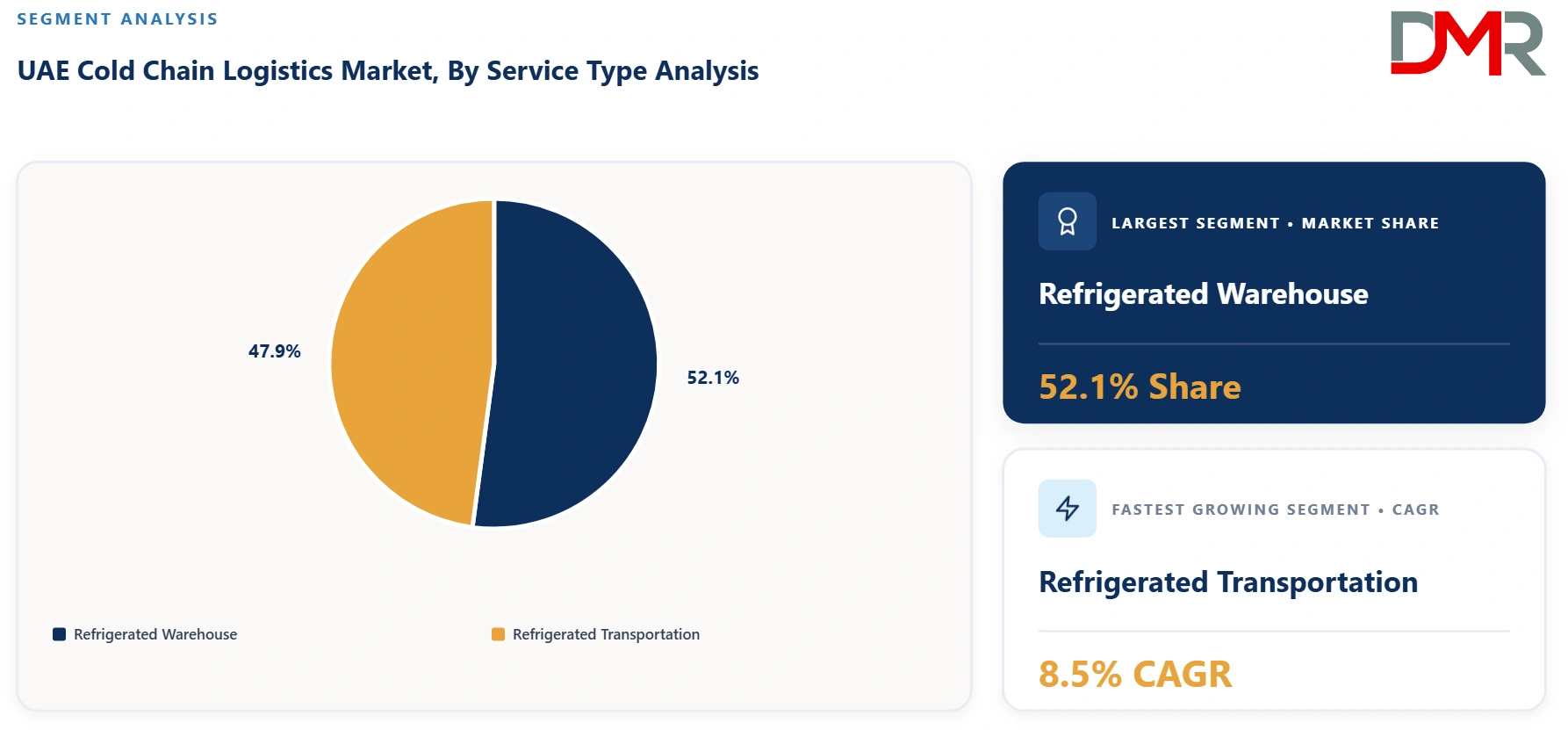
- By Service Type Analysis: Refrigerated Warehouse is projected to lead with a 52.1% share in 2026 because importers, retailers, food processors, and distributors require buffer inventory and multi-temperature storage. Refrigerated Transportation is expected to grow fastest at approximately 8.5%, supported by e-grocery, urban delivery, regional distribution, and demand for end-to-end cold-chain integrity.
- By Application Analysis: Meat is anticipated to dominate with a 25.2% share in 2026 due to substantial imported beef, poultry, lamb, and processed-meat flows serving retail and foodservice. Alternative Protein is expected to post the fastest CAGR of about 9.4% as health, sustainability, product innovation, and expanding plant-based assortments stimulate specialized chilled and frozen handling.
- By Temperature Type Analysis: Frozen is expected to account for 60.5% of the market in 2026, supported by meat, seafood, frozen foods, and longer inventory cycles. Chilled is projected to grow fastest at around 8.4% as consumers purchase more fresh dairy, produce, beverages, meal solutions, and temperature-sensitive healthcare products requiring frequent replenishment.
- By Technology Analysis: Dry Ice is projected to lead with a 34.5% share in 2026 because it is portable, widely available, and effective for frozen products and healthcare shipments. Liquid Nitrogen is expected to record the fastest CAGR of approximately 9.2%, supported by ultra-low-temperature pharmaceutical, biotechnology, laboratory, and premium food applications.
How AI and Generative AI are Transforming the UAE Cold Chain Logistics Market?
AI is improving demand forecasting, warehouse slotting, route planning, energy management, predictive maintenance, and temperature-excursion detection across UAE cold chains. Machine-learning systems combine shipment, weather, traffic, inventory, and equipment data to reduce delays and spoilage. Computer vision can automate pallet inspection and product counting, while digital twins simulate warehouse capacity and refrigeration performance. Generative AI supports operating procedures, compliance documentation, customer communication, and incident summaries. Adoption will expand as connected sensors and warehouse systems improve, although fragmented data, integration costs, cybersecurity exposure, and model governance remain important implementation challenges.
Key Drivers in the UAE Cold Chain Logistics Market
Rising Perishable Imports and Food-Security Requirements
The UAE’s limited domestic agricultural capacity makes resilient handling of imported meat, seafood, dairy, produce, and frozen foods strategically important. Jebel Ali Free Zone supports a dense food and beverage ecosystem serving retail, grocery, hospitality, quick-service restaurants, and re-export markets. In September 2025, Americold, RSA Cold Chain, and DP World opened a regional import-export hub with 40,000 pallet positions, demonstrating the scale of capacity being added. Population growth, international tourism, diversified consumer diets, and food-security planning are increasing the need for multi-temperature storage, customs-linked handling, inventory visibility, and reliable refrigerated distribution from ports to consumption centres.
Growth of Healthcare, Retail, and Time-Critical Distribution
Healthcare and digital retail are raising service requirements beyond conventional frozen-food storage. Vaccines, biologics, insulin, diagnostic materials, and clinical products require validated facilities, calibrated monitoring, documented custody, and rapid response to temperature excursions. Abu Dhabi inaugurated a regional vaccine distribution hub in April 2025, reinforcing investment in healthcare logistics. Meanwhile, supermarkets and online grocery platforms require smaller, more frequent deliveries of chilled and frozen products. These demand patterns support urban cold rooms, multi-temperature vehicles, insulated packaging, route optimization, and round-the-clock fulfilment. Providers able to combine compliance, visibility, last-mile delivery, and regional airfreight connectivity can capture higher-value contracts.
Restraints in the UAE Cold Chain Logistics Market
High Energy, Fleet, and Compliance Costs
Cold warehouses operate continuously in an extremely hot climate, making electricity, insulation, refrigeration maintenance, backup generation, and equipment efficiency central cost considerations. Refrigerated vehicles also carry higher acquisition, fuel, maintenance, and cleaning expenses than standard fleets. Operators must fund calibrated sensors, food-safety systems, staff training, pest control, validation, and audit documentation while competing for contracts that may emphasize price. Refrigerant transitions and sustainability investments can require additional capital. Smaller providers may struggle to maintain utilization across seasonal demand cycles, while customers with volatile volumes can create underused capacity. These pressures constrain margins and lengthen investment payback periods.
Fragmented Data and Last-Mile Execution Risks
Cold-chain performance depends on coordination among overseas suppliers, shipping lines, airlines, customs, warehouses, transporters, retailers, and final recipients. Different software platforms, manual records, inconsistent sensor standards, and limited data sharing can create visibility gaps. Port congestion, customs delays, traffic, vehicle breakdowns, improper loading, repeated door openings, and unsuccessful deliveries increase excursion and spoilage risks. Last-mile conditions are especially demanding during peak summer temperatures. Smaller suppliers may lack digital capability or validated processes, making end-to-end assurance difficult. Cybersecurity and data-ownership concerns can also slow platform integration, preventing operators from fully using real-time analytics and automated exception management.
Growth Opportunities in the UAE Cold Chain Logistics Market
Regional Re-Export and Integrated Multimodal Hubs
The UAE can expand as a consolidation and redistribution centre for temperature-sensitive trade serving the Gulf, Middle East, Africa, and South Asia. Jebel Ali Port, Al Maktoum International Airport, Zayed International Airport, Khalifa Port, free zones, and improving rail connectivity support sea-air-road combinations. Operators can develop bonded multi-temperature hubs offering storage, customs clearance, labeling, repacking, quality inspection, halal-compliant handling, and onward distribution. The 100,000-square-metre JAFZA site developed by RSA Cold Chain with DP World illustrates the opportunity for port-adjacent capacity. Integrated providers can reduce handoffs, improve transit reliability, and capture value-added revenue beyond conventional warehousing.
Specialized Pharmaceutical and Sustainable Cold Chains
Biologics, vaccines, cell and gene therapies, diagnostics, and clinical materials create opportunities for validated storage and transport across refrigerated, frozen, and ultra-low-temperature ranges. Service providers can invest in GDP-aligned facilities, active containers, dry ice replenishment, liquid nitrogen systems, control towers, and qualified packaging. Sustainability also creates differentiation through solar-supported warehouses, low-global-warming-potential refrigerants, electric refrigerated vehicles, reusable packaging, and energy analytics. Customers increasingly evaluate emissions, waste, and product-loss performance alongside cost and reliability. Providers that combine compliance expertise with measurable environmental improvements can win premium contracts from multinational pharmaceutical, food, retail, and hospitality customers operating regional distribution programmes.
Trends in the UAE Cold Chain Logistics Market
Automation, IoT Monitoring, and Control Towers
Operators are connecting temperature sensors, telematics, warehouse-management systems, transport-management platforms, and customer dashboards to create continuous shipment visibility. Automated alerts help teams intervene before excursions become product losses, while predictive maintenance reduces refrigeration failures. High-bay storage, automated retrieval, barcode and RFID scanning, and computer vision improve throughput and inventory accuracy in labour-intensive cold environments. Control towers increasingly combine customs status, vessel and flight schedules, traffic, equipment condition, and order priorities. As new capacity enters the market, technology-enabled service quality will become a competitive differentiator, particularly for pharmaceuticals, premium foods, quick commerce, and regional redistribution contracts.
Multi-Temperature and Urban Fulfilment Networks
Demand is shifting from single-temperature bulk storage toward facilities and vehicles that can manage frozen, chilled, and ambient products within one network. Retailers and foodservice customers want consolidated deliveries that reduce receiving complexity, while online grocery platforms require proximity to urban consumers. Providers are developing compartmentalized vehicles, cross-docking operations, micro-fulfilment cold rooms, and smaller distribution nodes linked to large port-side warehouses. These networks support faster replenishment, wider assortments, and shorter delivery windows. However, operators must balance responsiveness with utilization, energy use, and route density, making data-driven network design and flexible customer contracts increasingly important.
Research Scope and Analysis
The UAE Cold Chain Logistics Market covers refrigerated warehouse and refrigerated transportation services, seafood, meat, fruit and vegetable, dairy products, alternative protein and other applications, frozen and chilled temperature types, dry ice, gel packs, eutectic plates, liquid nitrogen and quilts technologies, market value, growth outlook, competitive positioning, regulatory conditions, investment patterns and strategic opportunities through 2035
By Service Type Analysis
Refrigerated Warehouse is projected to hold the highest share of 52.1% in 2026, reflecting demand for import buffering, inventory consolidation, and multi-temperature storage. Refrigerated Transportation is expected to grow fastest at a CAGR of approximately 8.5%, slightly above the overall market rate, as e-commerce, foodservice, and healthcare customers require frequent, traceable, and time-sensitive deliveries.
ℹ
To learn more about this report –
Download Your Free Sample Report Here
By Application Analysis
Meat is expected to lead the application segment with a 25.2% share in 2026, supported by imported poultry, beef, lamb, and processed products. Alternative Protein is projected to register the highest CAGR of around 9.4%, above the market average, driven by expanding plant-based ranges, health-focused consumption, food innovation, and specialized chilled or frozen distribution requirements.
By Temperature Type Analysis
Frozen is anticipated to dominate temperature type with a 60.5% share in 2026, reflecting long-duration storage requirements for meat, seafood, frozen meals, and other imported products. Chilled is forecast to expand fastest at approximately 8.4% CAGR, marginally exceeding the overall market, supported by fresh produce, dairy, beverages, meal solutions, and healthcare distribution.
By Technology Analysis
Dry Ice is expected to lead technology with a 34.5% share in 2026 because of its portability, cooling performance, and broad use in food and healthcare shipments. Liquid Nitrogen is projected to grow fastest at nearly 9.2% CAGR, above the market rate, as ultra-low-temperature requirements expand across biotechnology, pharmaceuticals, laboratories, and specialized premium food logistics.
The UAE Cold Chain Logistics Market Report is Segmented Based on the following:
By Service Type
- Refrigerated Warehouse
- Refrigerated Transportation
By Application
- Seafood
- Meat
- Fruit & Vegetable
- Dairy Products
- Alternative Protein
- Others
By Temperature Type
By Technology
- Dry Ice
- Gel Packs
- Eutectic Plates
- Liquid Nitrogen
- Quilts
Technology Analysis
Technology adoption is shifting UAE cold chains toward connected, automated, and exception-driven operations. IoT sensors, telematics, warehouse-management systems, and cloud control towers provide continuous temperature, location, door-status, and equipment data. Automation improves pallet movement, order accuracy, worker safety, and throughput inside harsh frozen environments. AI supports forecasting, slotting, route optimization, energy control, and predictive maintenance, while blockchain-enabled records can strengthen traceability. Opportunities exist for sensor platforms, reusable smart packaging, digital twins, and integrated customer dashboards. Risks include fragmented legacy systems, uneven supplier digitization, cyberattacks, inaccurate sensors, and unclear data ownership. Technology ultimately raises service quality and supports premium, compliance-sensitive contracts. This improves resilience across complex regional distribution networks and partnerships.
Regulatory Landscape
UAE cold-chain operators must comply with federal and emirate-level food-safety, transport, facility, customs, occupational-safety, and environmental requirements. Dubai Municipality requires food businesses to maintain safe receiving, storage, handling, and distribution practices, including temperature control and documentation. Pharmaceutical logistics adds product validation, qualified equipment, monitoring, chain-of-custody, and good distribution practice expectations. Regulation creates opportunities for certified providers that can offer auditable records and consistent performance, but it also raises investment, training, calibration, and reporting costs. Variations between emirate procedures can complicate network operations. Increasing scrutiny of refrigerants, energy use, food waste, and traceability will encourage efficient systems while penalizing poorly controlled operators. This favours operators with standardized quality and governance systems.
Competitive Landscape
The UAE cold chain logistics market is fragmented, combining international groups, regional operators, port and airport specialists, airlines, food distributors, and dedicated cold-chain providers. Competition centres on multi-temperature capacity, location, fleet coverage, customs integration, certifications, real-time visibility, service reliability, and pricing. Large participants are investing in port-adjacent hubs, automation, energy efficiency, and integrated end-to-end solutions. Smaller providers compete through local relationships, flexible capacity, and last-mile responsiveness. Partnerships among infrastructure owners, global cold-storage specialists, carriers, and technology vendors are expected to intensify as customers seek fewer handoffs and stronger compliance.
Some of the Prominent Players in the UAE Cold Chain Logistics Market Are
- RSA Cold Chain
- Americold Realty Trust
- DP World
- A.P. Moller–Maersk
- Emirates Logistics
- Mohebi Logistics
- Al-Futtaim Logistics
- Aramex
- Emirates SkyCargo
- Etihad Cargo
- dnata Logistics
- CEVA Logistics
- DHL Supply Chain
- Kuehne+Nagel
- DSV
- DB Schenker
- Hellmann Worldwide Logistics
- GAC Group
- Agility Logistics
- Gulf Warehousing Company
- Global Shipping & Logistics
- RAK Logistics
- RHS Logistics
- Clarion Shipping Services
- Modern Freight Company
- Transcorp International Logistics
- TruKKer
- Al Naboodah Logistics
- Al-Fares Cargo Service
- Freight Systems
- Kibsons International
- Barakat Group
- Fresh Fruits Company
- National Food Products Company
- Al Ain Farms
- Al Rawabi Dairy Company
- Almarai Company
- Gulf Drug
- Rafed
- Life Logistics
- Other Key Players
Recent Developments
- September 2025: Americold, RSA Cold Chain, and DP World opened a flagship import-export cold-chain hub at Jebel Ali in Dubai. The facility provides approximately 40,000 pallet positions and multi-temperature, bonded, and non-bonded capabilities for regional food flows.
- April 2025: Abu Dhabi inaugurated a regional vaccine distribution hub following collaboration involving the Department of Health–Abu Dhabi and GSK. The initiative strengthens the emirate’s healthcare logistics infrastructure and supports regional access to temperature-sensitive vaccines.
- June 2024: Etihad Cargo, the Department of Health–Abu Dhabi, Abu Dhabi Investment Office, and KEZAD signed an agreement to develop Abu Dhabi as a pharmaceutical and life-sciences distribution hub, including logistics, local manufacturing, and packaging capabilities.
- July 2023: Maersk opened its first UAE cold store at Dubai Industrial City. The 13,000-square-metre facility offers 12,500 pallet positions across frozen, chilled, and ambient conditions, along with fulfilment and value-added logistics services.
Report Details
| Report Characteristics |
| Market Size (2026) |
USD 1.6 Bn |
| Forecast Value (2035) |
USD 3.2 Bn |
| CAGR (2026–2035) |
7.8% |
| Historical Data |
2021 – 2025 |
| Forecast Data |
2026 – 2035 |
| Base Year |
2025 |
| Segments Covered |
By Service Type, By Application, By Temperature Type, By Technology |
Frequently Asked Questions
How big is the UAE Cold Chain Logistics Market?
▾ The UAE Cold Chain Logistics Market is valued at USD 1.6 billion in 2026 and is projected to reach USD 3.2 billion by 2035.
What is the CAGR of the UAE Cold Chain Logistics Market from 2026 to 2035?
▾ The UAE Cold Chain Logistics Market is expected to expand at a CAGR of 7.8% during the 2026–2035 forecast period.
What factors are driving the growth of the UAE Cold Chain Logistics Market?
▾ Growth is driven by perishable food imports, food-security initiatives, population and tourism growth, organized retail, e-grocery, pharmaceutical distribution, infrastructure investment, and demand for reliable multi-temperature logistics.
What are the major trends in the UAE Cold Chain Logistics Market?
▾ Major trends include IoT-based monitoring, AI-enabled forecasting and routing, automated warehouses, control towers, energy-efficient refrigeration, sustainable packaging, multi-temperature facilities, and urban last-mile cold-chain networks.
Who are the key players in the UAE Cold Chain Logistics Market?
▾ Key participants include RSA Cold Chain, Americold, DP World, Maersk, Emirates Logistics, Mohebi Logistics, Al-Futtaim Logistics, Aramex, Emirates SkyCargo, Etihad Cargo, dnata Logistics, DHL Supply Chain, CEVA Logistics, and Kuehne+Nagel.
How is the UAE Cold Chain Logistics Market segmented?
▾ The market is segmented by service type into refrigerated warehouse and refrigerated transportation, by application, by frozen and chilled temperature type, and by dry ice, gel packs, eutectic plates, liquid nitrogen, and quilts technology.