Market Snapshot
- Market Size (2026): USD 58.4 Mn
- Forecast Value (2035): USD 104.7 Mn
- CAGR (2026-2035): 6.7%
- Leading Product (2026): Organic corrosion inhibitors, around 57%
- Leading Type (2026): Water-based corrosion inhibitors, close to 54%
- Key Players: Baker Hughes, Ecolab, Envirocon LLC and others
What is UAE Corrosion Inhibitor Market and its Market Size?
The UAE Corrosion Inhibitor Market size is estimated to reach USD 58.4 Mn in 2026 and is further anticipated to reach USD 104.7 Mn by 2035, at a CAGR of 6.7%.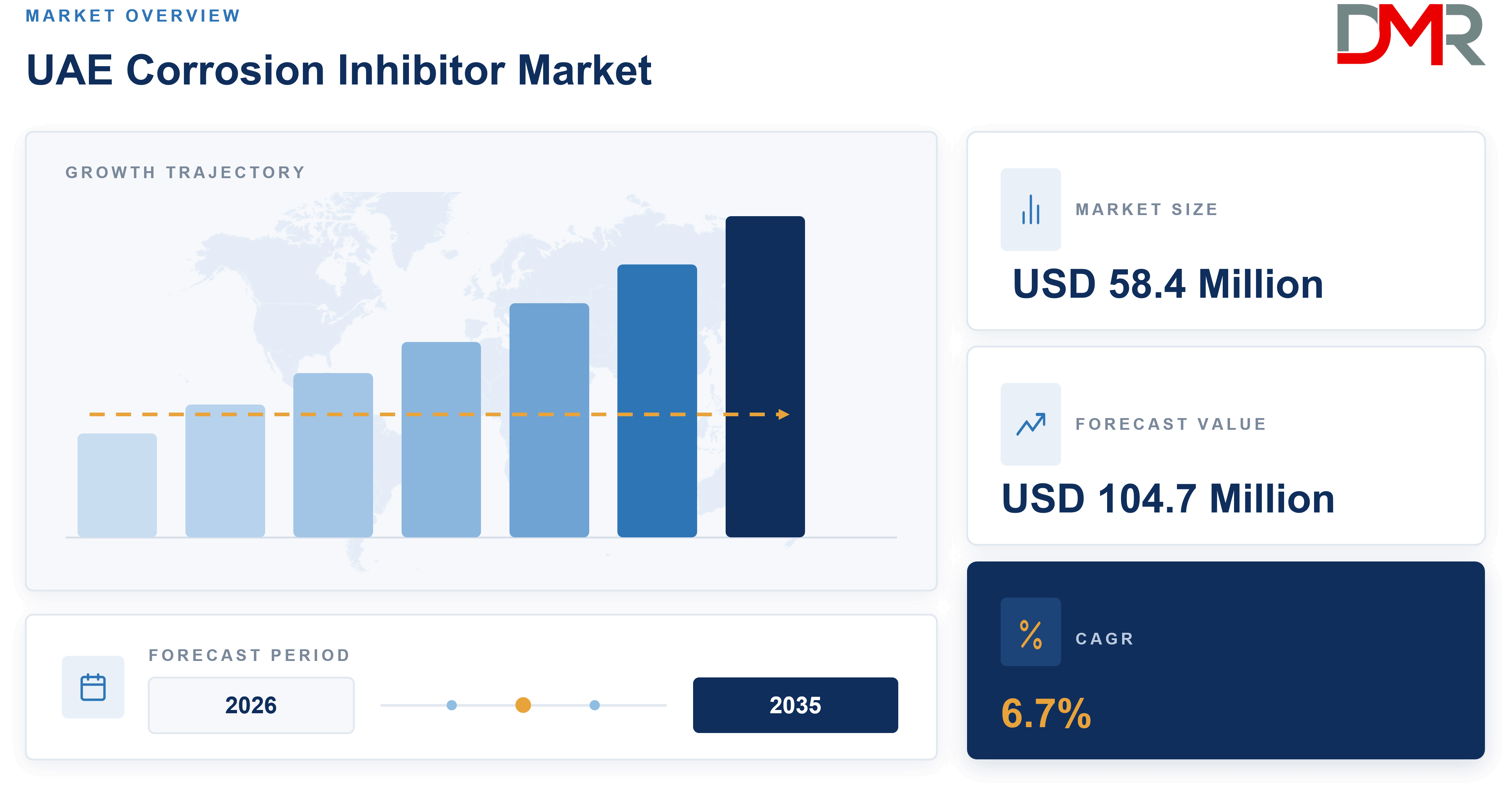
ℹ
To learn more about this report –
Download Your Free Sample Report Here
The market covers formulated chemicals used to reduce the electrochemical attack of metals in pipelines, vessels, tanks, heat exchangers, cooling circuits, production systems, water infrastructure and other assets exposed to corrosive fluids. Demand is concentrated in applications where carbon steel, chloride-rich water, dissolved gases, acids or elevated operating temperatures create recurring integrity costs.
Oil and gas remains the commercial anchor because upstream gathering, gas processing, crude transportation, refining and storage require continuous control of internal corrosion. UAE operating conditions also support demand for chemistries that tolerate high temperature, salinity, sour service and multiphase flow. ADNOC procurement activity has specifically included corrosion inhibitors among locally sourced industrial products, reinforcing the importance of domestic supply capability.
Water treatment is a second structural demand pool. Desalination, industrial cooling, boiler systems and water reuse expose metallic equipment to dissolved salts, oxygen and changing water chemistry. Reverse osmosis capacity expansion adds a further requirement for compatible corrosion-control programs around pretreatment, energy recovery, pumping and associated plant equipment. Buyers increasingly evaluate inhibitor performance alongside chemical handling, monitoring, environmental profile and total treatment cost.
Use Cases
- Upstream Production: Oilfield operators inject corrosion inhibitors into production streams and gathering systems where water, carbon dioxide, hydrogen sulfide and salts can accelerate internal metal loss. Treatment programs help protect flowlines and process equipment while reducing unplanned maintenance and inspection exposure.
- Refining and Petrochemicals: Refinery and chemical plant operators apply inhibitors in process circuits, crude transport and equipment exposed to acidic or water-containing streams. Formulation selection is tied to metallurgy, temperature, residence time and contaminant profile, helping maintenance teams manage corrosion without disrupting throughput.
- Desalination and Water Treatment: Utilities and industrial water operators use compatible corrosion-control chemistries around pumping, cooling and auxiliary water systems. The objective is to limit metal deterioration while preserving downstream water quality, membrane performance and equipment reliability across long operating cycles.
- Industrial Manufacturing: Maintenance and utilities teams in metal processing, fabrication and general manufacturing use inhibitors in closed-loop cooling, cleaning and temporary preservation applications. Treatment reduces corrosion-related replacement of equipment and supports more predictable operation where water chemistry varies across production schedules.
Key Takeaways
- Market Size & Share: UAE demand is estimated at USD 58.4 Mn in 2026, with organic formulations expected to hold around 57% of product revenue.
- Type Analysis: Water-based formulations are projected to account for close to 54% of 2026 type demand because of their fit with continuous water and process treatment.
- Demand Concentration: Oil and gas is expected to represent nearly 49% of 2026 end-use demand, reflecting the UAE asset base across production, processing, transport and storage.
- Water Infrastructure: Water treatment and desalination are positioned as a faster-expanding application area as new capacity and water reuse increase treatment requirements.
- Local Supply: Domestic blending, distribution and technical service are gaining commercial relevance as buyers seek shorter lead times, formulation customization and local procurement compliance.
- Technology Direction: Monitoring-linked dosing, longer-lasting film-forming chemistries and lower-toxicity formulations are shifting competition from commodity supply toward measured asset performance.
How AI/Gen AI is Transforming the UAE Corrosion Inhibitor Market?
AI is influencing corrosion-control programs mainly through better interpretation of operating and inspection data rather than through the chemistry itself. Asset owners can combine corrosion probe readings, process conditions, water chemistry, production rates and maintenance records to identify changes that precede accelerated metal loss. Machine learning models can support treatment optimization by relating inhibitor dosage to temperature, pressure, flow regime and contaminant levels.
Generative AI is becoming useful around technical documentation and engineering workflows. It can organize inspection findings, compare treatment histories, draft chemical-management summaries and help engineers retrieve operating knowledge from large maintenance archives. These tools do not replace laboratory compatibility testing or field validation, but they can shorten the analytical cycle between detection, diagnosis and corrective action.
- Predictive Corrosion Analytics: Machine learning models can rank assets by corrosion risk using sensor, inspection and process datasets.
- Digital Twins: Digital representations of pipelines and process systems can test treatment scenarios before field changes are implemented.
- LLM Technical Documentation: Large language models can summarize inspection reports, chemical logs and maintenance records for engineering review.
- AI-Assisted Dosing: Optimization models can recommend treatment adjustments when water chemistry, flow conditions or production profiles change.
Key Drivers in the UAE Corrosion Inhibitor Market
Two demand forces have the greatest influence on the UAE market: sustained hydrocarbon asset integrity requirements and expanding water infrastructure. Both generate recurring chemical consumption, but their procurement logic differs.
- Hydrocarbon Asset Integrity Spending: Corrosion control remains embedded in the operating economics of production, gas processing, refining, pipelines and storage. UAE engineering practice recognizes corrosion inhibitors as part of the broader protection system for relevant hydrocarbon pipelines, while major operators continue investing in domestic energy capacity and downstream integration. The market therefore benefits from recurring treatment requirements rather than one-time equipment purchases. Demand is strongest where carbon steel is exposed to condensed water, carbon dioxide, hydrogen sulfide or high-salinity fluids, creating a need for continuously optimized inhibitor programs.
- Desalination and Industrial Water Expansion: Water treatment creates a second, more diversified demand engine. Large reverse osmosis projects require extensive pumping, pretreatment and auxiliary water systems, while industrial users maintain cooling and process-water circuits. As the UAE expands desalination and water reuse, corrosion-control programs must balance metal protection with membrane compatibility, discharge requirements and operating cost. This supports demand for water-compatible formulations and technical dosing services. The opportunity is especially attractive for suppliers able to combine chemical supply with monitoring, troubleshooting and performance documentation rather than selling a single treatment product.
Restraints in the UAE Corrosion Inhibitor Market
Commercial constraints are concentrated around formulation economics, qualification requirements and the consequences of incorrect dosing. Buyers in critical assets rarely select an inhibitor on price alone because treatment failure can create integrity and production risks.
- Qualification and Compatibility Requirements: Corrosion inhibitor selection must match metallurgy, fluid composition, temperature, pressure, flow regime and other chemicals already present in the system. A formulation that performs well in one asset can underperform in another. Field trials, laboratory testing, monitoring and operator approvals extend sales cycles and make entry difficult for suppliers without local technical capability. These requirements also favour established vendors with documented performance and service teams, limiting rapid substitution even when a competing product offers a lower purchase price.
- Volatility in Feedstock and Logistics Costs: Many inhibitor formulations depend on specialty amines, surfactants, solvents, polymers and other chemical intermediates whose costs can move with energy prices, refinery conditions and international freight. UAE buyers also expect reliable inventory because offshore and remote assets cannot tolerate long supply interruptions. Suppliers therefore need regional stock, blending capability or dependable import channels. Margin pressure can emerge when customers seek multi-year price agreements while formulation costs remain variable, particularly for smaller distributors that lack purchasing scale.
Growth Opportunities in the UAE Corrosion Inhibitor Market
The clearest opportunities sit where corrosion chemistry can be bundled with monitoring, local blending and application engineering. Buyers increasingly value measurable asset outcomes rather than standalone chemical deliveries.
- Locally Blended Specialty Formulations: UAE industrial policy is encouraging domestic chemical manufacturing and import substitution. This creates room for suppliers to establish local blending, packaging and formulation support for corrosion inhibitors tailored to oilfield brines, sour service, cooling water and refinery streams. Local production can shorten lead times and improve responsiveness to operator-specific specifications while also supporting regional exports.
- Monitoring-Linked Treatment Services: Combining inhibitor supply with corrosion probes, coupons, inspection data and dosing optimization can create recurring service revenue. This model is particularly relevant for pipelines, tanks and water systems where chemical consumption varies with operating conditions. Suppliers that can demonstrate lower corrosion rates, fewer interventions or longer inspection intervals can defend premium pricing more effectively than commodity distributors.
Trends in the UAE Corrosion Inhibitor Market
Market behaviour is shifting from simple chemical procurement toward application-specific treatment programs. Buyers are asking suppliers to demonstrate compatibility, monitoring capability, environmental performance and continuity of supply alongside basic inhibitor efficiency.
- Lower-Toxicity Formulations: Environmental and operational considerations are increasing interest in chemistries that reduce hazardous components without sacrificing film persistence or high-temperature performance. This trend is strongest in water-linked applications and facilities with tighter chemical-management requirements.
- Condition-Based Dosing: Operators are increasingly connecting treatment decisions with corrosion monitoring, water chemistry and process data. Instead of maintaining a fixed chemical rate under every operating condition, treatment programs can be adjusted to changing risk, improving chemical efficiency and reducing over-treatment.
- Domestic Supply and Import Substitution: Local procurement programs are strengthening interest in UAE-based blending and distribution. Suppliers with local inventory and technical teams can respond faster to operator trials, emergency requirements and formulation changes.
- Multi-Function Treatment Packages: Oilfield and industrial customers increasingly prefer integrated packages combining corrosion control with scale management, biocide treatment, oxygen scavenging or other production chemicals when the chemistry and application allow it. This simplifies vendor management and field support.
Research Scope and Analysis
Segment performance is assessed across five axes: product, type, application, end use industry and distribution channel. Each axis identifies the sub-segment carrying the largest share of 2026 revenue and the one expanding fastest through 2035, with the commercial reason behind each position.
ℹ
To learn more about this report –
Download Your Free Sample Report Here
By Product
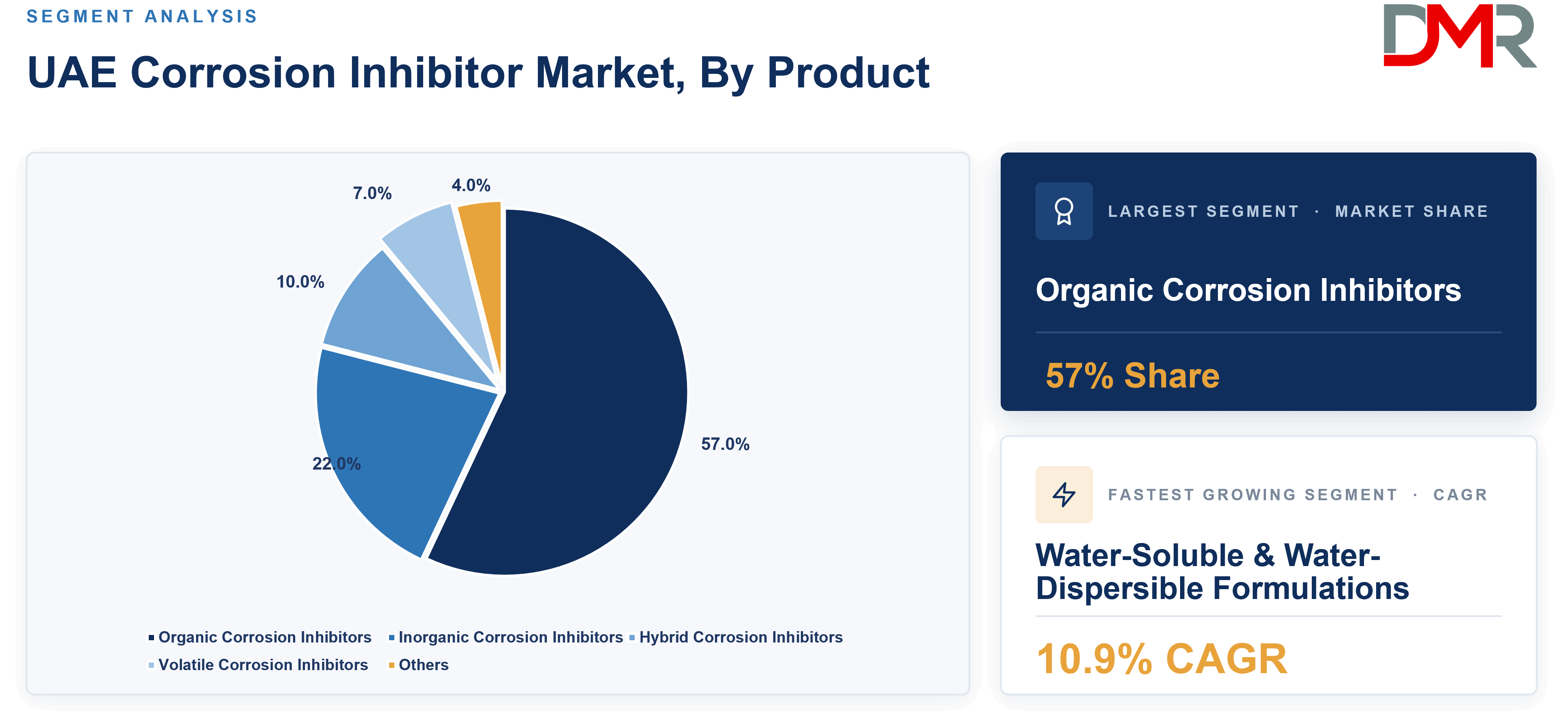
Organic corrosion inhibitors are projected to hold the largest product share in 2026, accounting for around 57% of revenue, because film-forming organic chemistries offer flexible protection across hydrocarbon and water-containing systems. Their formulation range also supports customization for specific process conditions. Growth, however, is concentrated in water-soluble and water-dispersible formulations, expanding at a CAGR of 10.9% between 2026 and 2035 as desalination, cooling and industrial water systems favour easy dosing and compatibility with continuously circulating water. Suppliers that can combine water compatibility with low residual impact and stable performance are positioned to gain share in new utility projects.
By Type
Water-based corrosion inhibitors are expected to account for close to 54% of type demand in 2026 because they align with continuous treatment in cooling, water treatment and several process applications where handling and dilution requirements favour aqueous systems. Oil-based and solvent-based inhibitors remain important in hydrocarbon service where water displacement, film persistence and storage protection are priorities. The steeper trajectory sits with oil-based and solvent-based specialty formulations, growing at a CAGR of 10.4% through 2035 as higher-value pipeline, tank and preservation applications demand durable films under difficult service conditions.
By Application
Oil and gas production is projected to carry approximately 46% of application revenue in 2026, supported by continuous requirements across gathering systems, wells, flowlines and production equipment. Treatment is recurring because corrosion risk changes with water cut, gas composition, temperature and operating regime. Growth, however, is concentrated in water treatment and desalination, advancing at a CAGR of 11.3% through 2035 as reverse osmosis projects, industrial water reuse and expanding cooling-water infrastructure add treated assets. Demand in this application depends on membrane compatibility, water chemistry and long equipment life, making formulation performance a key competitive factor.
By End Use Industry
Oil and gas is expected to represent nearly 49% of 2026 end-use demand, reflecting the concentration of corrosion-sensitive pipelines, processing equipment, tanks and production assets in the UAE energy sector. Procurement is often tied to technical qualification and asset-specific treatment programs, which supports recurring demand for approved formulations. Power generation is set to record the steeper trajectory, expanding at a CAGR of 10.7% through 2035 as thermal generation, desalination-linked utilities and cooling systems require tighter water chemistry management. Suppliers that integrate chemical treatment with monitoring and technical service can capture a larger portion of this growing spend.
By Distribution Channel
Direct sales and technical contracts are expected to hold just over 63% of 2026 distribution demand because critical oilfield, refinery and utility buyers require qualification, application support and dependable supply arrangements. Direct engagement also allows suppliers to tailor formulations and dosing programs to individual assets. Specialty chemical distributors, however, are expanding faster, with a CAGR of 9.8% between 2026 and 2035 as smaller industrial buyers seek local inventory and access to multiple treatment chemistries without maintaining large technical procurement teams. Distributor growth is strongest where suppliers provide field support and maintain stock close to industrial clusters.
The UAE Corrosion Inhibitor Market Report is Segmented Based on the Following
By Product
- Organic Corrosion Inhibitors
- Inorganic Corrosion Inhibitors
- Hybrid Corrosion Inhibitors
- Volatile Corrosion Inhibitors
- Others
By Type
- Water-Based Corrosion Inhibitors
- Oil-Based Corrosion Inhibitors
- Solvent-Based Corrosion Inhibitors
- Emulsion-Based Corrosion Inhibitors
- Others
By Application
- Oil and Gas Production
- Water Treatment and Desalination
- Refining and Petrochemicals
- Industrial Cooling
- Metal Processing and Fabrication
- Others
By End Use Industry
- Oil and Gas
- Power Generation
- Water and Wastewater
- Chemical and Petrochemical
- Metal Processing
- Manufacturing and Other Industries
By Distribution Channel
- Direct Sales and Technical Contracts
- Specialty Chemical Distributors
- Industrial Trading Companies
- Online and Catalogue Channels
- Others
Pricing Analysis
UAE corrosion inhibitor pricing is shaped less by a single commodity benchmark than by formulation complexity, active chemistry, treatment concentration, qualification requirements, packaging, technical service and delivered inventory. Standard water-treatment products compete more directly on unit economics, while oilfield and refinery formulations can command stronger value when they solve a specific corrosion mechanism or operating constraint. The commercial opening is therefore in application-specific products supported by monitoring, local stock and formulation adjustment. The principal brake is price pressure from imported alternatives and distributors with broad chemical portfolios. Overall, pricing favours suppliers that demonstrate total treatment cost and asset protection rather than only chemical cost per kilogram.
Export/Import Analysis
The UAE operates as both a domestic consumer and a regional distribution hub for specialty chemicals. Imported intermediates and finished formulations remain relevant, while local blending and packaging can reduce lead times and support operator-specific specifications. Current industrial policy is encouraging more domestic chemical production, creating an opening for UAE suppliers to replace selected imports and build export-oriented capacity. The risk is exposure to freight disruption, feedstock volatility and qualification barriers when customers require proven products. For corrosion inhibitors, the commercial effect is a gradual shift toward regional inventory, local technical service and UAE-based formulation without eliminating international suppliers that offer differentiated chemistries.
Competitive Landscape
Competition is fragmented across global oilfield chemical companies, water-treatment specialists, specialty chemical manufacturers and UAE-based distributors and blenders. Large suppliers compete through formulation breadth, field engineering, monitoring and long-term operator relationships, while local companies differentiate through inventory, response time, customization and knowledge of UAE procurement processes. The market is therefore not defined by product price alone. Qualification history, technical service, local availability and ability to integrate corrosion monitoring with treatment selection are important competitive filters.
Some of the Prominent Players in the UAE Corrosion Inhibitor Market Are
-
ADNOC
- Baker Hughes
- SLB
- Halliburton
- ChampionX
- Ecolab
- Nalco Water
- Clariant
- Nouryon
- BASF
- LANXESS
- Lubrizol
- Solenis
- Kurita Water Industries
- Veolia Water Technologies
- SUEZ
- Buckman
- Cortec Corporation
- Dorf Ketal
- Innospec
- Italmatch Chemicals
- Evonik Industries
- Dow
- Arxada
- King Industries
- Afton Chemical
- Henkel
- Daubert Chemical
- Zerust Oil & Gas
- Univar Solutions
- Brenntag
- IMCD
- Envirocon LLC
- Evergreen Chemical International Company
- Orange Chemicals FZ LLC
- Abu Dhabi Chemicals
- Al Taher Chemicals Trading LLC
- Hazchem Chemicals LLC
- North Group Co FZCO
- Al Mawad Chemicals Trading LLC
- Other Key Players
Recent Developments
- In May 2026, TA’ZIZ and Alpha Dhabi announced a strategic collaboration targeting up to 14 industrial chemicals and about 2.2 million tonnes per year of additional capacity. The initiative strengthens the UAE chemicals ecosystem and creates a larger domestic customer base for specialty treatment suppliers.
- In November 2025, ADNOC approved a five-year capital expenditure plan of USD 150 billion for 2026-2030 while continuing expansion across energy and chemical activities. Sustained asset investment supports recurring requirements for corrosion management across production and downstream infrastructure.
- In August 2025, DEWA reported substantial progress on the Hassyan seawater reverse osmosis desalination project, planned at 180 million gallons per day. Expanding desalination capacity increases the installed base of water infrastructure requiring controlled chemistry and equipment protection.
Report Details
| Report Characteristics |
| Market Size (2026) |
USD 58.4 Mn |
| Forecast Value (2035) |
USD 104.7 Mn |
| CAGR (2026-2035) |
6.7% |
| Historical Data |
2021 - 2025 |
| Forecast Data |
2026 - 2035 |
| Base Year |
2025 |
| Segments Covered |
By Product, By Type, By Application, By End Use Industry, By Distribution Channel |
| Regional Coverage |
The UAE |
Frequently Asked Questions
How big is the UAE Corrosion Inhibitor Market?
▾ The UAE Corrosion Inhibitor Market is estimated at USD 58.4 Mn in 2026. Demand is supported mainly by oil and gas production, refining, storage, industrial water systems and desalination, where recurring treatment is required to manage corrosion exposure and maintain equipment reliability.
What is the growth rate of the UAE Corrosion Inhibitor Market?
▾ The market is projected to expand at a CAGR of 6.7% from 2026 to 2035, reaching USD 104.7 Mn by 2035. Growth reflects continued energy infrastructure spending, expanding water treatment assets and greater use of application-specific chemical programs.
What is driving demand in the UAE Corrosion Inhibitor Market?
▾ Demand is being driven primarily by the need to protect hydrocarbon production and processing assets exposed to water, carbon dioxide, hydrogen sulfide, salts and elevated temperatures. Expansion of desalination and industrial water systems adds a second recurring demand pool for compatible corrosion-control formulations.
Who are the key players in the UAE Corrosion Inhibitor Market?
▾ Key participants include Baker Hughes, Ecolab, SLB, Halliburton, ChampionX, Clariant, Envirocon LLC and Evergreen Chemical International Company. The competitive field also includes specialty chemical manufacturers and UAE-based distributors that provide local inventory, formulation support and technical services.
Which product segment leads the UAE Corrosion Inhibitor Market?
▾ Organic corrosion inhibitors are expected to lead product demand in 2026, accounting for around 57% of revenue. Their broad formulation flexibility and effectiveness in film-forming treatment programs support use across hydrocarbon, refinery, storage and water-containing applications.
Which application is expected to grow fastest?
▾ Water treatment and desalination are projected to be the fastest-growing application, with a CAGR of 11.3% from 2026 to 2035. New desalination capacity, industrial water reuse and cooling-water requirements increase the number of systems where corrosion control must be integrated with water chemistry management.
What is changing in UAE corrosion inhibitor procurement?
▾ Procurement is moving toward technical treatment contracts that combine chemical supply with field support, monitoring and dosing optimization. Buyers are also placing greater value on local inventory, formulation customization and lower-toxicity options, which favours suppliers capable of supporting assets after the initial chemical sale.