UAE Data Annotation & AI Training Market Snapshot
- UAE Data Annotation & AI Training Market Size in 2026: USD 97.4 Million
- UAE Data Annotation & AI Training Market Size in 2035: USD 641.8 Million
- UAE CAGR from 2026 to 2035: 23.4%
- Image and Video Annotation is the leading annotation type segment in 2026: 38.6%
- Hybrid (Human-in-the-Loop) Technique is the leading technique segment in 2026: 47.9%
- Computer Vision is the leading application segment in 2026: 41.3%
- Government and Smart City Programmes is the leading industry vertical segment in 2026: 22.7%
- Outsourced/Managed Annotation Services is the leading sourcing model segment in 2026: 61.5%
What is the UAE Data Annotation & AI Training and its Market Size?
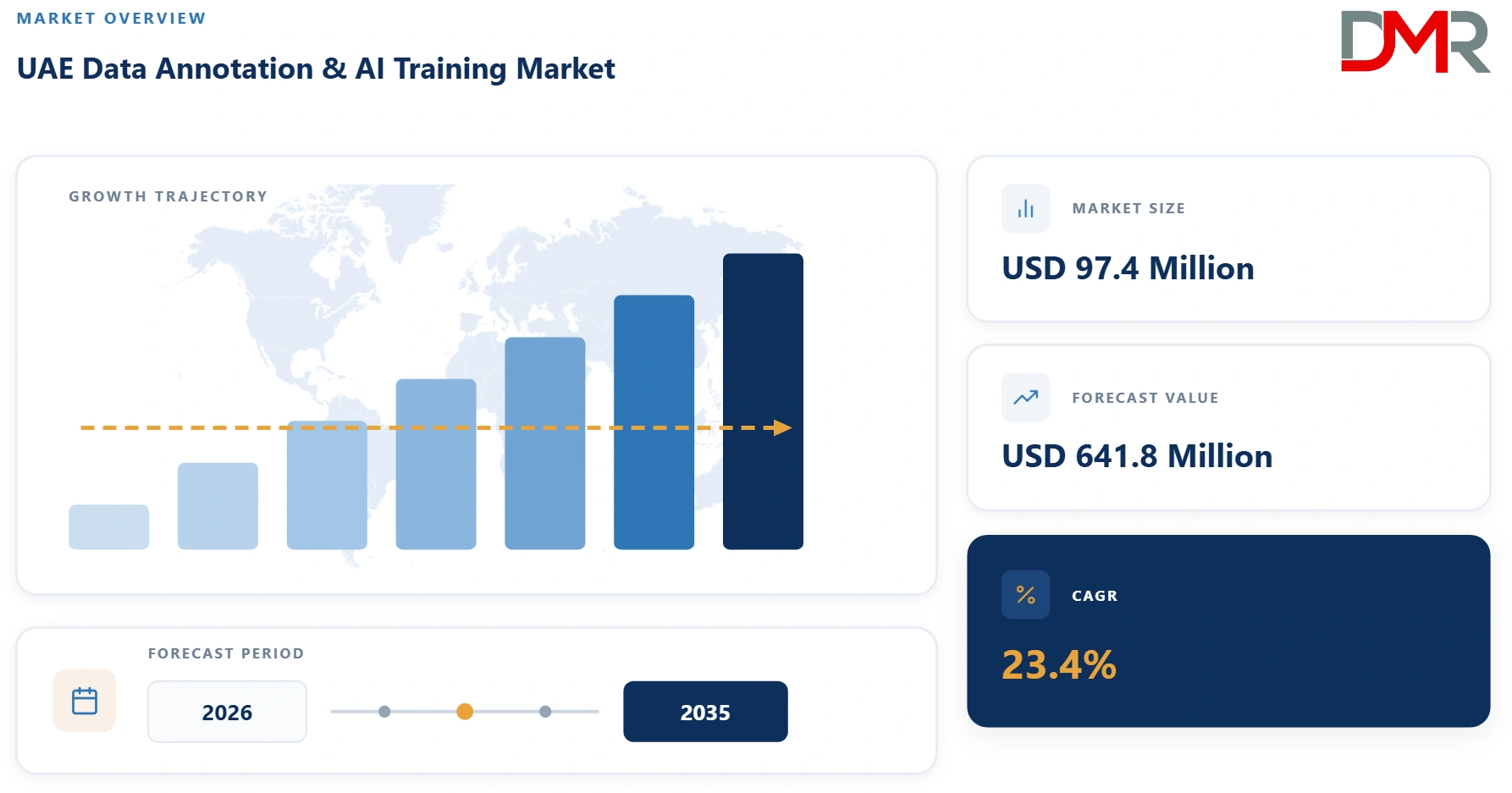
The UAE Data Annotation & AI Training Market is projected to be valued at USD 97.4 million in 2026 and is projected to reach USD 641.8 million by 2035, expanding at a CAGR of 23.4% during the forecast period.
ℹ
To learn more about this report –
Download Your Free Sample Report Here
Growth is being propelled by the surging volume of proprietary enterprise and government data being prepared for model training across banking, smart city infrastructure, autonomous mobility pilots, and Arabic-language natural language processing initiatives. The scarcity of high-quality, dialect-accurate Arabic training datasets, the rise of human-in-the-loop annotation workflows that pair AI-assisted pre-labelling with human quality review, and growing insistence from regulated sectors that sensitive training data be annotated within UAE jurisdiction are reshaping the market from ad hoc, project-based labelling tasks toward structured, ongoing data operations partnerships. Investment is accelerating as enterprises recognise that model performance gains increasingly depend on training data quality and diversity rather than model architecture alone, elevating annotation from a low-value outsourced task to a strategically managed function.
Use Cases
- Gulf Arabic Dialect Corpus Development for Conversational AI: Government entities and banks commission large-scale transcription and annotation of Gulf Arabic dialect speech and text to train customer service and citizen-facing conversational agents, addressing the acute shortage of dialect-accurate labelled datasets relative to Modern Standard Arabic resources.
- Autonomous Vehicle and Smart Mobility Sensor Labelling: Transport authorities and mobility technology firms piloting autonomous shuttle and delivery programmes contract specialist annotation teams to label LiDAR point clouds, radar returns, and multi-camera video for object detection and path-planning model training.
- Financial Document and KYC Data Annotation for Compliance AI: Banks and fintech firms engage annotation vendors to label historical transaction records, identity documents, and compliance case files, generating the ground-truth data required to train fraud detection and anti-money-laundering classification models.
- Medical Imaging Annotation for Diagnostic AI Development: Healthcare technology developers and hospital groups commission radiologist-supervised annotation of medical imaging datasets to train diagnostic support models, requiring specialist clinical annotators rather than generalist labelling staff.
Key Takeaways
- Market Size: The UAE Data Annotation & AI Training Market is anticipated to be valued at USD 97.4 million in 2026 and is forecast to reach USD 641.8 million by 2035, expanding at a CAGR of 23.4%.
- Growth Outlook: Market expansion is sustained by rapidly growing enterprise and government AI model development activity, acute scarcity of Gulf Arabic dialect training data, and increasing recognition that annotation quality is a primary determinant of downstream model accuracy.
- Primary Growth Drivers: Expanding smart city and autonomous mobility pilots, rising banking sector investment in compliance and fraud AI, growing domestic demand for dialect-accurate Arabic language datasets, and data residency requirements steering annotation work toward UAE-based providers are accelerating vendor engagement.
- By Annotation Type Analysis: Image and Video Annotation is projected to lead with a 38.6% share in 2026, driven by smart city, retail, and autonomous mobility applications. Sensor and LiDAR Annotation is the fastest-growing annotation type at 27.8% CAGR, propelled by expanding autonomous vehicle and drone pilot programmes.
- By Technique Analysis: Hybrid (Human-in-the-Loop) Technique is expected to dominate with a 47.9% share in 2026, combining AI-assisted pre-labelling with human quality review to balance speed and accuracy. Fully Automated/AI-Assisted Annotation is projected to exhibit the highest CAGR at 26.5%, as pre-labelling models mature and reduce required human correction volume.
- By Application Analysis: Computer Vision is poised to lead with a 41.3% share in 2026, reflecting extensive smart city, retail, and security surveillance annotation demand. Natural Language Processing is the fastest-growing application segment at 25.9% CAGR, driven by Arabic-language conversational AI and document processing initiatives.
- By Industry Vertical Analysis: Government and Smart City Programmes is expected to command a 22.7% share in 2026, underpinned by public infrastructure and mobility sensor labelling contracts. BFSI is the fastest-growing vertical at 24.6% CAGR, fuelled by expanding compliance and fraud detection model development.
- By Sourcing Model Analysis: Outsourced/Managed Annotation Services is projected to lead with a 61.5% share in 2026. In-House Annotation Teams is the fastest-growing sourcing model at 21.8% CAGR, as regulated entities increasingly build dedicated internal annotation capability for their most sensitive datasets.
How AI/Gen AI is Transforming the Data Annotation & AI Training Market?
Advances in AI-assisted pre-labelling and active learning are fundamentally reshaping the economics of data annotation in the UAE, shifting human annotator effort from labelling raw data from scratch toward reviewing and correcting machine-generated draft labels. This human-in-the-loop model has compressed per-unit annotation costs while improving consistency, allowing vendors to take on larger and more complex labelling contracts without proportionally scaling headcount. At the same time, foundation models fine-tuned specifically for Gulf Arabic dialects are beginning to bootstrap portions of the annotation pipeline itself, creating a virtuous cycle in which better dialect models reduce the annotation burden required to build the next generation of dialect-fluent AI systems.
Key Drivers in the UAE Data Annotation & AI Training Market
Acute Scarcity of Gulf Arabic Dialect Training Data
The scarcity of high-quality Gulf Arabic dialect datasets is a major driver of the UAE Data Annotation & AI Training Market. Global training datasets remain concentrated on English and Modern Standard Arabic, creating limitations for conversational AI, virtual assistants, government service agents, and customer-facing applications requiring localized language understanding. Enterprises increasingly require native-speaker annotation for dialect variations, cultural expressions, pronunciation, and contextual meaning. This creates strong demand for UAE-based vendors maintaining qualified Arabic-speaking annotator networks. Government digitalization and enterprise adoption of localized generative AI further increase requirements for proprietary language datasets, positioning dialect-specialized annotation providers as strategically important participants within the market.
Expansion of Smart City, Mobility, and Surveillance Sensor Deployments
Expansion of smart city infrastructure, autonomous mobility, intelligent transportation, drones, robotics, and public safety systems is generating significant annotation demand across the UAE. Cameras, LiDAR sensors, radar systems, and connected infrastructure continuously produce image, video, and sensor datasets requiring accurate classification, segmentation, object detection, and tracking. As smart mobility initiatives progress from pilot programs toward broader deployment, training datasets become larger and increasingly complex. Government investment in traffic optimization and urban monitoring further strengthens demand. Annotation providers capable of handling large-scale multimodal datasets, maintaining security standards, and delivering high labeling accuracy are positioned to benefit from sustained smart infrastructure investment.
Restraints in the UAE Data Annotation & AI Training Market
Limited Domestic Annotator Workforce for Specialised and Dialect-Sensitive Tasks
Limited availability of specialized domestic annotators constrains scalability within the UAE Data Annotation & AI Training Market. General image and text labeling can often be outsourced internationally, but tasks involving Gulf Arabic dialects, medical imaging, financial compliance, or sensitive government datasets require qualified specialists, native speakers, or security-cleared personnel. These talent pools remain comparatively limited and command higher compensation. Workforce shortages can extend project timelines, increase annotation costs, and restrict vendor capacity for complex assignments. Providers are responding through specialized recruitment, training programs, AI-assisted labeling, and hybrid delivery models. Nevertheless, maintaining consistent quality while rapidly scaling expert annotation remains an important operational challenge.
Growth Opportunities in the UAE Data Annotation & AI Training Market
Specialist Dialect and Domain-Expert Annotation Studios
Specialized annotation studios represent a substantial growth opportunity as UAE organizations demand higher-quality datasets for increasingly sophisticated artificial intelligence applications. Providers developing dedicated pools of Gulf Arabic speakers, medical professionals, financial compliance specialists, and other domain experts can differentiate themselves from generalist labeling companies. Expert annotation improves contextual accuracy for healthcare imaging, financial documents, conversational AI, and regulated government applications. These capabilities support premium pricing because errors in specialized datasets can significantly affect model performance and compliance. As enterprises increasingly treat training data quality as a strategic requirement rather than a commodity service, specialized annotation providers can secure longer contracts and stronger client relationships.
Synthetic Data Generation as a Complementary Service Line
Synthetic data generation offers an emerging opportunity for UAE annotation vendors seeking to expand beyond conventional human labeling services. Artificially generated datasets can supplement limited, expensive, sensitive, or difficult-to-collect real-world information used for training AI models. Applications are particularly relevant for autonomous mobility edge cases, rare fraud patterns, healthcare scenarios, surveillance environments, and computer vision systems. Vendors can combine synthetic dataset creation with human validation and annotation to improve accuracy and diversity. This approach may reduce privacy risks and data acquisition costs while accelerating model development. Growing adoption of generative AI and simulation platforms is expected to expand demand for integrated synthetic data services.
Trends in the UAE Data Annotation & AI Training Market
Shift From Project-Based Labelling to Managed Data Operations Partnerships
The UAE Data Annotation & AI Training Market is increasingly shifting from one-time labeling projects toward recurring managed data operations partnerships. Enterprises recognize that production AI models require continuous access to freshly annotated information as customer behavior, language patterns, fraud techniques, and operating environments change. Annotation vendors are consequently providing ongoing dataset collection, labeling, validation, quality assurance, and model feedback services. These recurring engagements improve revenue predictability and create deeper relationships between vendors and enterprise customers. Managed data operations also allow organizations to maintain model performance without developing large internal annotation teams. This trend is strengthening demand for scalable platforms and specialized long-term annotation capabilities.
Integration of Annotation Platforms With MLOps and Model Monitoring Pipelines
Integration between annotation platforms and MLOps infrastructure is becoming increasingly important as UAE enterprises seek continuous improvement of production AI systems. Modern platforms can identify low-confidence model predictions and automatically route uncertain data into human review queues for correction and labeling. Validated information is subsequently returned to model training pipelines, creating continuous feedback loops that improve accuracy over time. This approach reduces manual workflow management and enables organizations to prioritize data requiring human intervention. Annotation vendors offering APIs, automated quality controls, model monitoring integration, and active-learning capabilities can deliver greater strategic value. Increasing enterprise AI maturity is expected to accelerate adoption of integrated annotation ecosystems.
Research Scope and Analysis
The UAE Data Annotation & AI Training Market is segmented by annotation type, technique, application, industry vertical, and sourcing model, covering text, image, video, speech, LiDAR, automated and human annotation, computer vision, NLP, government, BFSI, healthcare, mobility, and managed services.
ℹ
To learn more about this report –
Download Your Free Sample Report Here
By Annotation Type Analysis
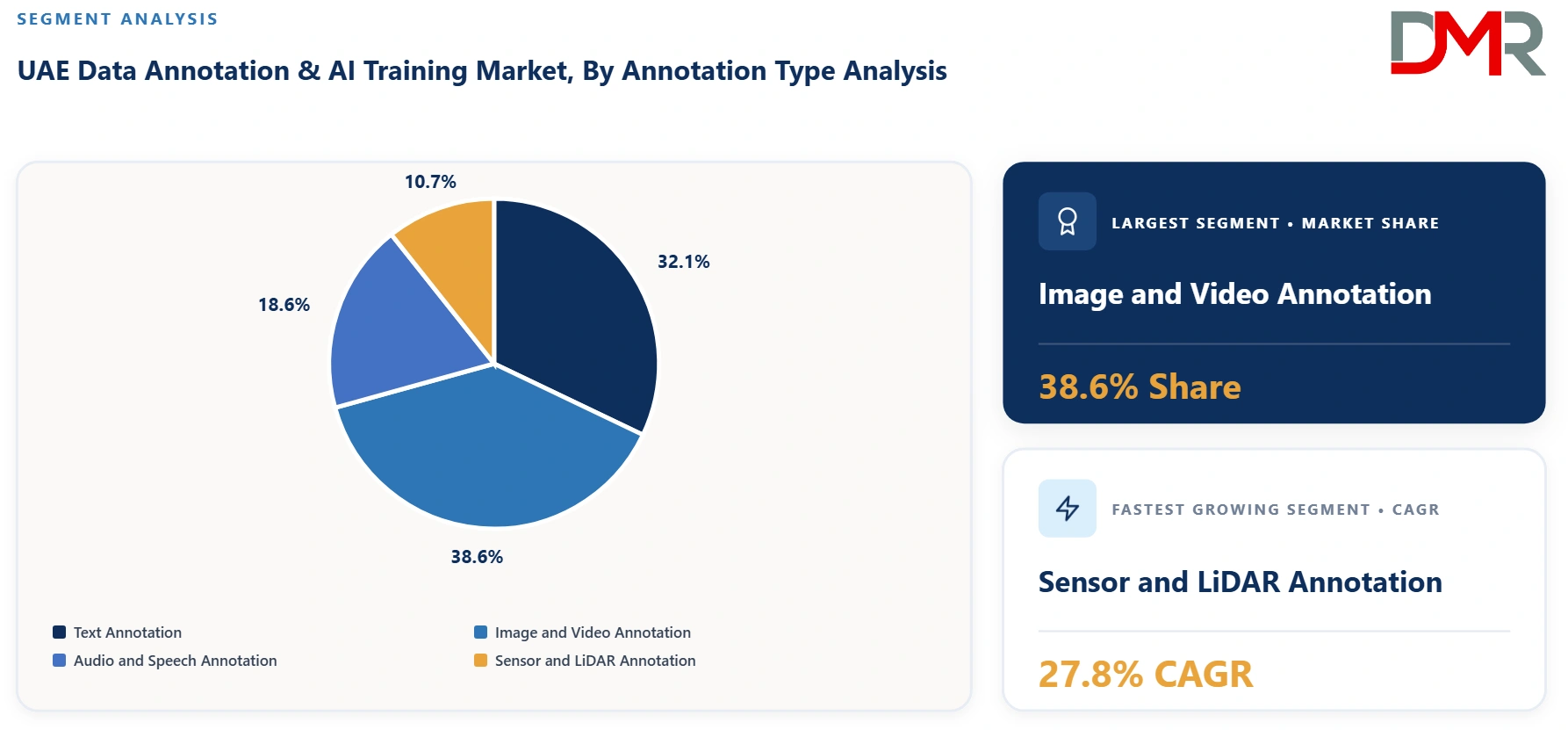
Image and Video Annotation is projected to dominate the UAE Data Annotation & AI Training Market with 38.6% share in 2026. Leadership is supported by extensive demand from smart cities, surveillance systems, retail analytics, traffic monitoring, computer vision, and public safety applications requiring segmentation, object detection, and tracking. Sensor and LiDAR Annotation is anticipated to register the highest CAGR of 27.8% during 2026–2035. Growth is driven by autonomous vehicles, drones, robotics, mapping, and intelligent transportation programs requiring precise three-dimensional point-cloud labeling. Increasing deployment of advanced sensors and mobility technologies will further strengthen demand for specialized multimodal annotation capabilities across the UAE.
By Technique Analysis
Hybrid Human-in-the-Loop Annotation is anticipated to dominate the UAE Data Annotation & AI Training Market with an estimated 47.9% share in 2026. This approach combines AI-assisted pre-labeling with human validation, enabling enterprises to achieve greater speed while maintaining accuracy for complex datasets. It is particularly valuable for regulated, dialect-sensitive, and high-risk applications requiring expert oversight. Fully Automated or AI-Assisted Annotation is projected to register the highest CAGR of 26.5% during 2026–2035. Improvements in foundation models, computer vision, and automated labeling technologies are reducing manual workloads. Increasing dataset volumes and pressure to control annotation costs will accelerate adoption of automation-driven labeling workflows.
By Application Analysis
Computer Vision is projected to dominate the UAE Data Annotation & AI Training Market by application, accounting for 41.3% share in 2026. Demand is supported by smart city cameras, surveillance, autonomous mobility, retail analytics, traffic monitoring, drones, and industrial vision applications requiring large volumes of accurately labeled visual data. Natural Language Processing is expected to register the fastest CAGR of 25.9% through 2035. Growth is driven by increasing development of Gulf Arabic conversational AI, generative AI applications, government service agents, document processing, and multilingual customer support systems. Continued investment in localized language models will significantly increase demand for high-quality Arabic text datasets.
By Industry Vertical Analysis
Government and Smart City Programmes are expected to dominate the UAE Data Annotation & AI Training Market by industry vertical, accounting for 22.7% share in 2026. Large-scale investments in intelligent transportation, public safety, urban monitoring, government AI services, and mobility infrastructure generate substantial requirements for annotated image, video, language, and sensor datasets. BFSI is projected to register the fastest CAGR of 24.6% during 2026–2035. Banks and financial institutions increasingly require labeled datasets for fraud detection, credit risk assessment, compliance automation, customer analytics, and document intelligence. Growing adoption of AI-enabled financial services is expected to strengthen specialized annotation demand significantly.
By Sourcing Model Analysis
Outsourced and Managed Annotation Services are projected to dominate the UAE Data Annotation & AI Training Market with an estimated 61.5% share in 2026. Enterprises prefer specialist vendors because they provide scalable annotator networks, dedicated platforms, quality assurance, and domain expertise without requiring large internal teams. Outsourcing also enables organizations to adjust capacity according to changing dataset volumes. In-House Annotation Teams are projected to register the highest CAGR of 21.8% through 2035. Growth is driven primarily by government agencies, banks, and other regulated organizations requiring greater control over confidential datasets, security protocols, annotation quality, and compliance with strict data residency requirements.
The UAE Data Annotation & AI Training Market Report is segmented based on the following:
By Annotation Type
- Text Annotation
- Named Entity Recognition
- Sentiment and Intent Labelling
- Image and Video Annotation
- Bounding Box and Segmentation
- Object Tracking
- Audio and Speech Annotation
- Transcription
- Speaker Diarisation
- Sensor and LiDAR Annotation
- Point Cloud Labelling
- Sensor Fusion Annotation
By Technique
- Manual Annotation
- Fully Automated/AI-Assisted Annotation
- Hybrid Annotation
By Application
- Computer Vision
- Natural Language Processing
- Autonomous Systems
- Speech Recognition
By Industry Vertical
- Government and Smart City Programmes
- BFSI
- Healthcare
- Retail and E-Commerce
- Automotive and Mobility
- Others
By Sourcing Model
- Outsourced/Managed Annotation Services
- In-House Annotation Teams
Technology Analysis
Technology Analysis is highly relevant to the Data Annotation & AI Training Market as AI-assisted labeling, synthetic data, active learning, and human-in-the-loop platforms transform dataset preparation. Advanced foundation models increasingly perform pre-labeling, while specialist annotators validate complex outputs, improving productivity and reducing turnaround times. Integration with MLOps enables continuous identification and correction of low-confidence predictions. Opportunities are expanding in multimodal annotation, LiDAR labeling, Arabic language datasets, and synthetic training environments. However, automated labeling errors, model bias, privacy concerns, and inconsistent annotation quality remain significant risks. Continued technology advancement will reduce routine labeling costs while shifting market value toward expert validation, specialized datasets, platform integration, and managed data operations services.
Investment and White Space Analysis
Investment and White Space Analysis is particularly relevant as demand for high-quality training datasets expands across generative AI, autonomous systems, computer vision, speech recognition, and natural language processing. Attractive opportunities exist in specialized Arabic datasets, medical annotation, financial compliance labeling, LiDAR data, synthetic datasets, and secure government applications. Providers developing proprietary annotation platforms, qualified domain-expert workforces, and recurring managed data operations can differentiate themselves from commodity labeling vendors. Investors are increasingly attracted to scalable technology-enabled providers combining automation with expert human oversight. However, intense offshore competition, pricing pressure, workforce shortages, and rapid improvements in automated annotation create risks. Market growth will increasingly favor specialized providers delivering secure, accurate, differentiated datasets.
Competitive Landscape
The UAE Data Annotation & AI Training Market is fragmented, with competition spanning global annotation specialists, AI data platforms, outsourcing providers, and UAE-based technology companies. Vendors increasingly compete on annotation accuracy, Gulf Arabic capabilities, domain expertise, data security, scalability, and integration with enterprise MLOps environments. Demand for image, video, speech, text, and LiDAR annotation is encouraging providers to combine AI-assisted pre-labeling with expert human validation. Government, BFSI, healthcare, and autonomous mobility projects create opportunities for companies offering secure and locally compliant services. Competitive differentiation is shifting toward synthetic data, specialized annotator networks, and managed data operations. Strategic partnerships with AI developers and cloud providers are also strengthening capabilities as customers increasingly require continuous training-data pipelines rather than isolated annotation projects.
Some of the prominent players in the UAE Data Annotation & AI Training Market are:
- Scale AI
- Appen
- TELUS Digital
- Sama
- iMerit
- Labelbox
- SuperAnnotate
- CloudFactory
- Defined.ai
- Centific
- Toloka
- Cogito Tech
- Shaip
- DataForce by TransPerfect
- LXT
- TaskUs
- Invisible Technologies
- Surge AI
- Snorkel AI
- V7
- Encord
- Dataloop
- Supervisely
- Kili Technology
- Keymakr
- Hive
- G42
- Core42
- Inception
- Presight
- AIQ
- Microsoft
- Amazon Web Services
- Google Cloud
- IBM
- Accenture
- Tata Consultancy Services
- Infosys
- Wipro
- Tech Mahindra
- Other Key Players
Recent Developments
- July 2026: Inception and Microsoft strengthened their UAE agentic AI collaboration, increasing demand for localized, validated enterprise training datasets needed to develop and continuously improve production-grade AI agents.
- July 2026: Core42 and e& UAE announced sovereign AI infrastructure collaboration, strengthening domestic environments for processing sensitive datasets and supporting secure AI training requirements across government and regulated enterprises.
- May 2026: The UAE introduced a federal framework for expanding agentic AI across government operations, creating additional requirements for Arabic-language datasets, human feedback, validation, model evaluation, and continuous data preparation for public-sector AI applications.
- February 2025: Microsoft and G42 launched the Responsible AI Foundation in Abu Dhabi, strengthening research around responsible AI practices and highlighting growing requirements for reliable datasets, evaluation processes, and AI governance.
Report Details
| Report Characteristics |
| Market Size (2026) |
USD 97.4 Mn |
| Forecast Value (2035) |
USD 641.8 Mn |
| CAGR (2026–2035) |
23.4% |
| Historical Data |
2021 – 2025 |
| Forecast Data |
2026 – 2035 |
| Base Year |
2025 |
| Segments Covered |
By Annotation Type, By Technique, By Application, By Industry Vertical, and By Sourcing Model |
| Country Coverage |
UAE |
Frequently Asked Questions
How big is the UAE Data Annotation & AI Training Market?
▾ The UAE Data Annotation & AI Training Market is projected to be valued at USD 97.4 million in 2026 and is projected to reach USD 641.8 million by 2035, reflecting strong demand for image, video, text, and sensor annotation supporting government, banking, and enterprise AI initiatives.
What is the CAGR of the UAE Data Annotation & AI Training Market from 2026 to 2035?
▾ The market is projected to expand at a compound annual growth rate (CAGR) of 23.4% between 2026 and 2035, supported by smart city and autonomous mobility expansion, scarcity of Gulf Arabic dialect training data, and rising banking sector compliance AI investment.
What factors are driving the growth of the UAE Data Annotation & AI Training Market?
▾ Growth is driven by acute scarcity of dialect-accurate Arabic training data, expanding smart city and autonomous mobility sensor deployments, rising BFSI investment in fraud and compliance AI, and tightening data residency requirements steering annotation work toward UAE-based vendors.
What are the major trends in the UAE Data Annotation & AI Training Market?
▾ Major trends include the shift from project-based labelling to managed data operations partnerships, deeper integration of annotation platforms with client MLOps pipelines, and growing vendor investment in synthetic data generation as a complementary service line.
Who are the key players in the UAE Data Annotation & AI Training Market?
▾ Key market participants include G42, Presight AI, Bayanat AI, Appen, Telus International, Scale AI, Sama, and a growing cohort of homegrown Emirati annotation studios, among other global and regional data operations providers.
How is the UAE Data Annotation & AI Training Market segmented?
▾ The market is segmented by annotation type, technique, application, industry vertical, and sourcing model, with demand analysis concentrated across Dubai, Abu Dhabi, and the remaining northern emirates.