Market Snapshot
- Market Size (2026): USD 72.8 Mn
- Forecast Value (2035): USD 140.7 Mn
- CAGR (2026-2035): 7.6%
- Leading Type (2026): Silicone-based, around 34%
- Leading Form (2026): Emulsion, close to 29%
- Key Players: Dow Inc., BASF SE, Evonik Industries AG and others
What is UAE Defoamer Market and its Market Size?
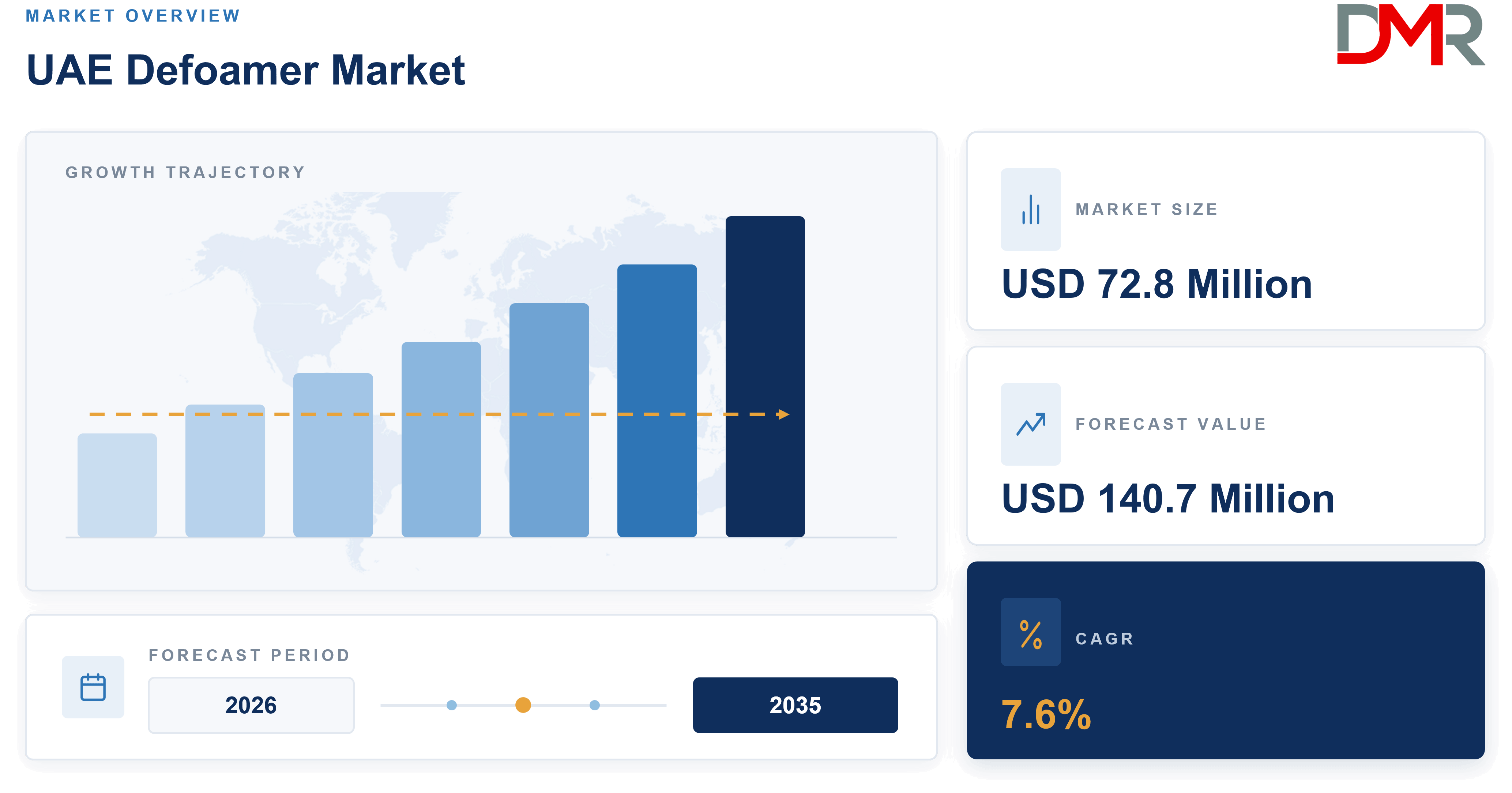
UAE Defoamer Market size is estimated to reach USD 72.8 Mn in 2026 and is further anticipated to reach USD 140.7 Mn by 2035, at a CAGR of 7.6%.
ℹ
To learn more about this report –
Download Your Free Sample Report Here
The market covers chemical additives sold for suppressing, preventing or rapidly breaking unwanted foam in liquid processing systems within the United Arab Emirates. The scope includes silicone, mineral oil, polymeric and water-compatible formulations supplied as emulsions, liquids and powders. It covers direct sales, distributor channels and locally blended or repackaged products, while excluding finished paints, drilling fluids, wastewater treatment systems and other end products themselves.
Demand is tied to several industrial workflows rather than one end product. Water and wastewater operators use defoamers when aeration, biological treatment, sludge handling or chemical dosing creates persistent foam. Oil and gas operators require foam control in drilling, completion and production fluids. Paint, coatings, construction chemical and cement producers use the additives to protect surface appearance, filling behaviour, pumping stability and production throughput.
The UAE has a service-oriented supply structure. International additive producers compete alongside specialist distributors, local formulators and water-treatment chemical suppliers. Buyers generally evaluate foam-control performance at the lowest practical dosage, compatibility with process chemistry, storage stability, technical support, delivery reliability and compliance documentation. This makes formulation know-how and local inventory important even where the active chemistry is imported.
Structurally, demand is moving toward formulations that work in water-rich processes, tolerate high salinity and temperature, reduce unwanted residues and support lower-emission coating systems. Expansion of desalination and water infrastructure, chemical manufacturing and industrial production creates additional process points where foam can reduce equipment efficiency or product quality. The market therefore grows through recurring chemical consumption, qualification of specialty grades and wider adoption of tailored dosing programs.
Use Cases
- Desalination and Water Treatment: Municipal and industrial water operators deploy defoamers when treatment stages generate persistent surface foam that interferes with sensors, skimming or downstream clarification. Controlled foam suppression helps maintain stable operation without changing the core treatment chemistry.
- Oilfield Operations: Drilling and production teams apply defoamers when entrained gas or surface-active additives create foam in circulating fluids, separators or treatment systems. The intervention supports smoother pumping, better fluid handling and more predictable process control.
- Paint and Coatings Production: Formulation and production managers use foam-control additives during high-speed mixing, dispersion, filling and application. The right grade limits bubbles and surface defects while protecting gloss, film appearance and production consistency in water-based and solvent-compatible systems.
- Construction Chemical Manufacturing: Cement, mortar and admixture producers use defoamers where surfactants, polymers and mixing energy trap air in slurries. Foam reduction improves density control, pumping behaviour and finished-material consistency without requiring major changes to the manufacturing line.
Key Takeaways
- Market Size & Share: The UAE market reaches USD 72.8 Mn in 2026, with silicone-based products expected to hold around 34% of type revenue.
- Type Analysis: Silicone-based grades lead 2026 demand, while polymer-based formulations are projected to expand at a CAGR of 10.9% through 2035.
- Demand Concentration: Water treatment and utilities are set to represent approximately 28% of 2026 end-use industry demand.
- Application Analysis: Paints and coatings account for close to 21% of 2026 application demand, with the segment growing at 10.4% CAGR.
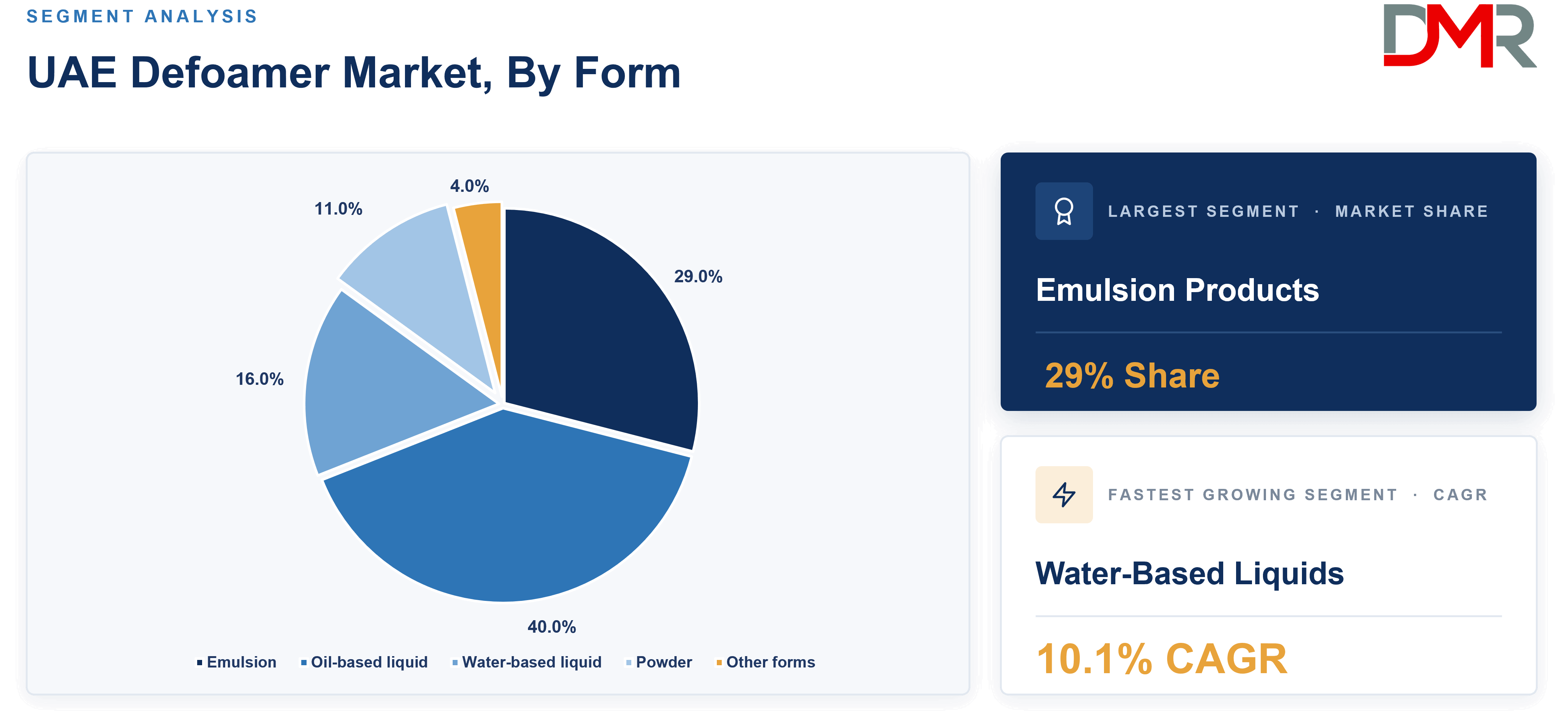
- Form Analysis: Emulsions hold nearly 29% of 2026 form demand, while water-based liquids are expected to grow at 10.1% CAGR.
- Oilfield Opportunity: Oil and gas is projected to represent about 24% of 2026 end-use industry demand and grow at 9.8% CAGR.
How AI/Gen AI is Transforming the UAE Defoamer Market?
Artificial intelligence is affecting the UAE defoamer value chain mainly through process monitoring, formulation support and demand planning rather than by replacing the chemical itself. Industrial operators can combine sensor streams with production variables to identify when foam is increasing, estimate the likely cause and adjust dosing before an overflow, carryover event or product-quality issue becomes material.
For suppliers, AI can improve technical service by linking historical formulations, customer trials and process conditions to candidate grades. Generative AI is also useful for document processing, including SDS and technical data review, quotation preparation and customer-specific product comparisons. The commercial effect is a move toward more data-supported dosing and faster technical qualification, especially where local teams manage diverse imported product portfolios.
- Predictive Process Monitoring: Machine-learning models can combine foam sensors, flow, pressure, temperature and dosing data to flag unstable operating conditions before manual intervention is required.
- Digital Twins: Process simulations can test how changes in surfactant load, salinity, temperature or mixing intensity may affect foam behaviour and chemical demand.
- Generative Formulation Support: AI-assisted formulation workflows can screen ingredient combinations and summarize prior laboratory trials, helping chemists narrow the number of physical tests required.
- LLM Document Processing: Language models can organize technical specifications, SDS files, customer requirements and compliance records so sales and technical teams can respond faster without replacing final expert review.
Key Drivers in the UAE Defoamer Market
Two demand forces stand out because they originate in different parts of the UAE industrial base. Water infrastructure creates recurring process demand, while industrial and energy activity expands the number of high-performance formulations that need reliable foam control.
- Expansion of Water Treatment Capacity: Water treatment and utilities are expected to represent approximately 28% of 2026 end-use industry demand. Desalination, reuse, wastewater treatment and industrial water circuits create repeated opportunities for foam suppression because aeration, surfactants, biological loads and chemical conditioning can generate foam at different stages. Operators value products that work at low dosage, tolerate high ionic strength and do not disrupt downstream membranes or biological processes. As treatment capacity expands, suppliers with local stock and application support can win recurring contracts rather than one-time transactions. The mechanism is straightforward: more treated water volume creates more process throughput, and more throughput raises the number of points where foam control is operationally useful.
- Industrial Chemical and Energy Processing: Oil and gas is projected to account for about 24% of 2026 end-use industry demand. Drilling fluids, production chemicals, gas treatment and downstream processing can experience foam from surfactants, gas entrainment and changing pressure conditions. Buyers in these applications prioritize persistence, compatibility and performance under heat or salinity rather than the lowest unit price. Local chemical production also broadens the addressable base for specialty additives because new manufacturing lines create additional mixing, transfer and wastewater stages. The result is stronger demand for tailored grades, technical trials and supply arrangements that protect production continuity.
Restraints in the UAE Defoamer Market
The main brakes are not a lack of applications. They are qualification risk and procurement economics, particularly when a low-cost grade appears to solve a short-term foam problem but creates downstream defects or treatment instability.
- Qualification and Compatibility Risk: Silicone and non-silicone products can behave very differently across coatings, drilling fluids, wastewater systems and cementitious slurries. An additive that breaks foam quickly may also affect surface appearance, adhesion, membrane behaviour, rheology or downstream separation if the formulation is poorly matched. Buyers therefore tend to test products before switching, especially where a process has narrow operating tolerances. This slows substitution and gives established suppliers an advantage, while distributors must maintain technical staff capable of running application trials. The commercial brake is strongest for specialty grades because a cheaper product cannot compensate for an unplanned process upset or rejected batch.
- Imported Feedstock and Supply-Cost Exposure: Much of the UAE market relies on imported active chemistries, intermediates or finished specialty additives. Freight, inventory carrying cost, currency movements and minimum order quantities can therefore affect delivered economics even when demand remains stable. Standard grades face stronger price competition because buyers can compare multiple distributors, while specialty grades have greater switching costs after qualification. Suppliers that hold stock locally can charge for service and availability, but they must balance inventory against shelf life and uncertain demand across several end uses. This limits aggressive price reductions and can slow adoption when customers have not yet proved the operating value of a premium formulation.
Growth Opportunities in the UAE Defoamer Market
The clearest white space sits where local process complexity meets the need for lower residue and faster technical response. Suppliers that package chemistry with application engineering can capture more value than vendors selling undifferentiated drums.
- Water-Compatible Specialty Grades: Water treatment and utilities already represent approximately 28% of 2026 end-use industry demand, creating room for formulations designed around high salinity, membrane processes, biological treatment and reuse systems. Suppliers can differentiate through dosing guidance, compatibility testing and application-specific packaging instead of competing only on active content. The opportunity is particularly attractive for customers operating multiple treatment trains, where a common technical program can simplify procurement. Products that control foam without harming membrane performance or biological activity can support premium positioning and longer customer retention.
- Polymer-Based Formulations for Coatings and Industrial Processes: Polymer-based defoamers are projected to grow at a CAGR of 10.9% from 2026 to 2035. Their opportunity comes from buyers seeking controlled foam management without the surface defects or incompatibility risks associated with some conventional grades. UAE formulators serving architectural coatings, industrial finishes and construction chemicals can use these products to improve water-based systems while meeting tighter performance requirements. A local technical center that supports trial batches and troubleshooting would reduce qualification time and create a practical barrier against simple price-led substitution.
Trends in the UAE Defoamer Market
Current market change is visible in formulation choices, procurement models and the role of technical service. Buyers increasingly expect chemical suppliers to solve a process problem, not simply provide an additive name.
- Shift Toward Water-Compatible and Lower-Residue Chemistry: Water-based manufacturing is increasing the importance of defoamers that disperse predictably and avoid surface defects, deposits or unwanted interactions. In coatings, suppliers are developing grades that manage microfoam while preserving appearance and application behaviour. In water treatment, compatibility with membranes and biological stages matters more than a simple foam knockdown claim. The practical result is greater segmentation of products by process chemistry and less willingness to treat all antifoams as interchangeable.
- Service-Led Distribution and Local Inventory: UAE buyers increasingly value rapid sampling, technical documentation and local availability because imported specialty chemicals can create lead-time risk. Distributors are therefore expanding from trading into application support, blending and smaller-volume packaging. This model is well suited to defoamers because dosage, process conditions and compatibility determine value. Suppliers that can run trials, recommend dosing ranges and maintain stock near major industrial clusters can defend margins better than companies competing only through bulk pricing.
Research Scope and Analysis
Segment performance is assessed across five axes: type, form, application, end use industry and function. Each axis identifies the sub-segment carrying the largest share of 2026 revenue and the one expanding fastest through 2035, showing how product chemistry and buyer requirements shape demand.
ℹ
To learn more about this report –
Download Your Free Sample Report Here
By Type
Silicone-based products are expected to hold around 34% of 2026 type revenue because they deliver fast foam knockdown and broad compatibility across industrial processes. Existing qualification and distributor familiarity also support repeat purchasing. Growth, however, is concentrated in polymer-based formulations, expanding at a CAGR of 10.9% between 2026 and 2035 as coatings and process users seek controlled foam management with lower residue and more predictable behaviour in water-rich systems.
By Form
Emulsion products are projected to account for close to 29% of 2026 form revenue because they disperse readily in water-rich industrial systems and are widely suited to treatment and coating formulations. Familiar handling and dosing practices reinforce their position. The steeper trajectory sits with water-based liquids, growing at a CAGR of 10.1% from 2026 to 2035 as formulators seek lower-residue products and simpler incorporation into aqueous manufacturing streams.
By Application
Water and wastewater treatment is expected to represent approximately 24% of 2026 application revenue because the UAE's water infrastructure creates recurring foam-control needs across aeration, sludge and chemical dosing stages. Contracted treatment operations also support repeat consumption. Growth, however, is concentrated in paints and coatings, expanding at a CAGR of 10.4% through 2035 as water-based formulations, high-speed mixing and appearance requirements increase the need for controlled microfoam management.
By End Use Industry
Water treatment and utilities are set to account for around 28% of 2026 end-use industry revenue because desalination, wastewater and reuse processes generate continuous demand for reliable foam control. Procurement is often tied to operating programs, supporting recurring volumes. The steeper trajectory sits with oil and gas, growing at a CAGR of 9.8% from 2026 to 2035 as drilling, production and downstream processing require products that remain effective under changing pressure, salinity and temperature conditions.
By Function
Foam prevention is projected to hold nearly 57% of 2026 function revenue because preventing accumulation protects throughput and reduces the need for corrective dosing after foam has already formed. Preventive programs fit continuous industrial processes and planned chemical management. Growth, however, is concentrated in foam knockdown, expanding at a CAGR of 9.6% through 2035 as operators address episodic foam events, production upsets and process changes that require faster intervention.
The UAE Defoamer Market Report is Segmented Based on the Following
By Type
- Silicone-based
- Mineral oil-based
- Polymer-based
- Water-based
- Other types
By Form
- Emulsion
- Oil-based liquid
- Water-based liquid
- Powder
- Other forms
By Application
- Water and wastewater treatment
- Oil and gas
- Paints and coatings
- Construction and cement
- Pulp, paper and other processes
By End Use Industry
- Water treatment and utilities
- Oil and gas
- Paints and coatings
- Construction materials
- Other industrial users
By Function
- Foam prevention
- Foam knockdown
- Air release and deaeration support
- Process stability
- Other functions
Pricing Analysis
UAE defoamer pricing is shaped by chemistry, active concentration, packaging, application qualification and the service content attached to the sale. Standard silicone and mineral oil grades face stronger comparison across distributors, while specialty polymeric and process-specific formulations can command higher value when they reduce defects or stabilize difficult operations. Current purchasing behaviour favours suppliers that can combine local stock with small trial quantities and technical guidance. The commercial opening is therefore in application-specific formulations and service bundles rather than blanket price increases. The main brake is substitution: buyers can often test a second supplier for standard grades, making inventory discipline, documentation and reliable delivery essential to preserve margins and demand continuity.
Export/Import Analysis
The UAE market depends on international chemical supply chains while also functioning as a distribution hub for the wider region. Imported silicone fluids, polymers, surfactant systems and finished antifoam formulations enter through established logistics networks, while local traders and formulators can blend, package or redistribute products closer to end users. The current shift is toward stronger local availability as industrial customers seek shorter lead times and greater supply resilience. Commercial white space exists for suppliers that combine imported specialty chemistry with UAE-based warehousing, application testing and regional distribution. The principal risk is exposure to freight costs, upstream raw-material volatility and minimum order quantities, which can raise delivered prices even when underlying end-user demand remains steady.
Competitive Landscape
Competition in the UAE is moderately fragmented across multinational additive producers, oilfield chemical specialists, water-treatment suppliers and industrial chemical distributors. Global manufacturers compete on formulation depth, consistency and technical support, while regional suppliers compete on stock availability, responsiveness, smaller order sizes and customer-specific blending. The basis of competition is therefore shifting from product availability alone toward application engineering and supply assurance. Buyers with demanding process conditions tend to retain qualified products longer, whereas standard grades remain more price-sensitive. The result is a two-speed market in which premium specialty grades support differentiation and local distribution keeps commodity-like products competitive.
Some of the Prominent Players in the UAE Defoamer Market Are,
- Dow Inc.
- BASF SE
- Evonik Industries AG
- Wacker Chemie AG
- Momentive Performance Materials Inc.
- Shin-Etsu Chemical Co., Ltd.
- Clariant AG
- Ashland Inc.
- The Lubrizol Corporation
- Elementis plc
- BYK, a division of ALTANA AG
- Münzing Chemie GmbH
- Elkem ASA
- CHT Germany GmbH
- LEVACO Chemicals GmbH
- Halliburton Company
- SLB
- Baker Hughes Company
- ChampionX Corporation
- Dorf Ketal Chemicals
- Azelis Group NV
- Brenntag SE
- IMCD N.V.
- Univar Solutions Inc.
- Safic-Alcan
- Tajchem
- Raykem FZE
- Fluidz Chemical Industries LLC
- Gulfchem Solutions
- Hazchem
- Orange Chemicals FZ LLC
- Green WTS
- SNS International Chemicals LLC
- Gulf Water Treatment (GWT)
- Sheran Chemicals
- DUBI Chem Marine
- GENOME Specialities FZC
- C1 Water Industries
- Norvick Chemicals
- Befran Chemicals Trading
- Other Key Players
Recent Developments
- In May 2026, TA'ZIZ and Alpha Dhabi Holding announced a strategic collaboration targeting up to 14 industrial chemicals and approximately 2.2 million tonnes per year of additional capacity in Abu Dhabi's chemicals ecosystem, strengthening the local industrial customer base for specialty process inputs.
- In May 2026, TA'ZIZ announced long-term agreements across methanol, PVC, EDC, VCM, caustic soda, salt and natural gas valued at USD 28.5 billion, reinforcing local chemical manufacturing and downstream demand for process additives.
- In January 2026, DEWA reported that the first phase of its Hassyan seawater reverse-osmosis project was nearly 90% complete, supporting the expansion of desalination infrastructure and creating additional process demand across water treatment operations.
Report Details
| Report Characteristics |
| Market Size (2026) |
USD 72.8 Mn |
| Forecast Value (2035) |
USD 140.7 Mn |
| CAGR (2026-2035) |
7.6% |
| Historical Data |
2021 - 2025 |
| Forecast Data |
2026 - 2035 |
| Base Year |
2025 |
| Segments Covered |
By Type, By Form, By Application, By End Use Industry and By Function |
| Regional Coverage |
The UAE |
Frequently Asked Questions
How big is the UAE Defoamer Market?
▾ The UAE Defoamer Market size is estimated to reach USD 72.8 Mn in 2026. The estimate covers defoamers and antifoaming agents used across water treatment, oil and gas, coatings, construction chemicals and other industrial processes within the UAE. The market boundary excludes finished end products and unrelated process equipment.
What is the growth rate of the UAE Defoamer Market?
▾ The UAE Defoamer Market is projected to expand at a CAGR of 7.6% from 2026 to 2035, reaching USD 140.7 Mn by 2035. Growth is supported by water infrastructure, industrial processing, specialty coatings demand and wider use of application-specific foam-control programs.
What is driving demand in the UAE Defoamer Market?
▾ Demand is being supported by water treatment expansion, desalination, oilfield activity and industrial chemical production. Water treatment and utilities are expected to represent around 28% of 2026 end-use industry revenue, reflecting the recurring need to manage foam across treatment and process stages.
Who are the key players in the UAE Defoamer Market?
▾ The competitive field includes Dow Inc., BASF SE, Evonik Industries AG, Wacker Chemie AG, Momentive Performance Materials Inc., Shin-Etsu Chemical Co., Ltd. and BYK, a division of ALTANA AG, alongside UAE-based suppliers and distributors.
Which type leads the UAE Defoamer Market?
▾ Silicone-based products are projected to lead the type segmentation in 2026, accounting for around 34% of revenue. Their broad process compatibility, rapid foam-control performance and established qualification across industrial applications support their leading position.
Which application segment is growing fastest in the UAE Defoamer Market?
▾ Paints and coatings are expected to be among the fastest-growing applications, expanding at a CAGR of 10.4% from 2026 to 2035. The trajectory reflects continued formulation changes toward water-based systems and tighter requirements for surface appearance and production consistency.
What is the forecast value of the UAE Defoamer Market by 2035?
▾ The UAE Defoamer Market is further anticipated to reach USD 140.7 Mn by 2035. Expansion should remain linked to recurring process consumption, local chemical manufacturing, water infrastructure and demand for specialty formulations that perform under difficult operating conditions.