Market Snapshot
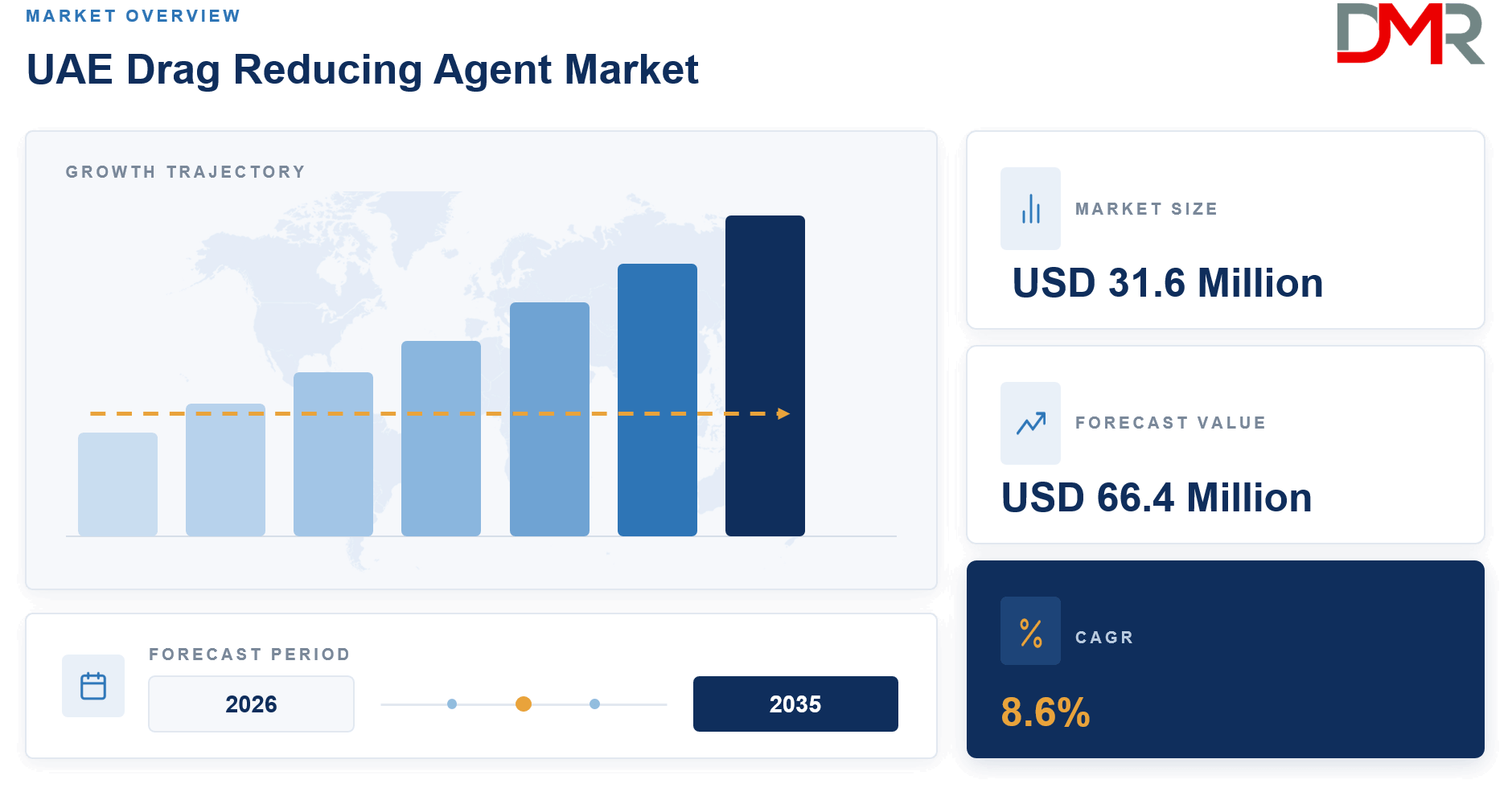
- Market Size (2026): USD 31.6 Mn
- Forecast Value (2035): USD 66.4 Mn
- CAGR (2026-2035): 8.6%
- Leading Chemistry (2026): Polymer, approximately 57%
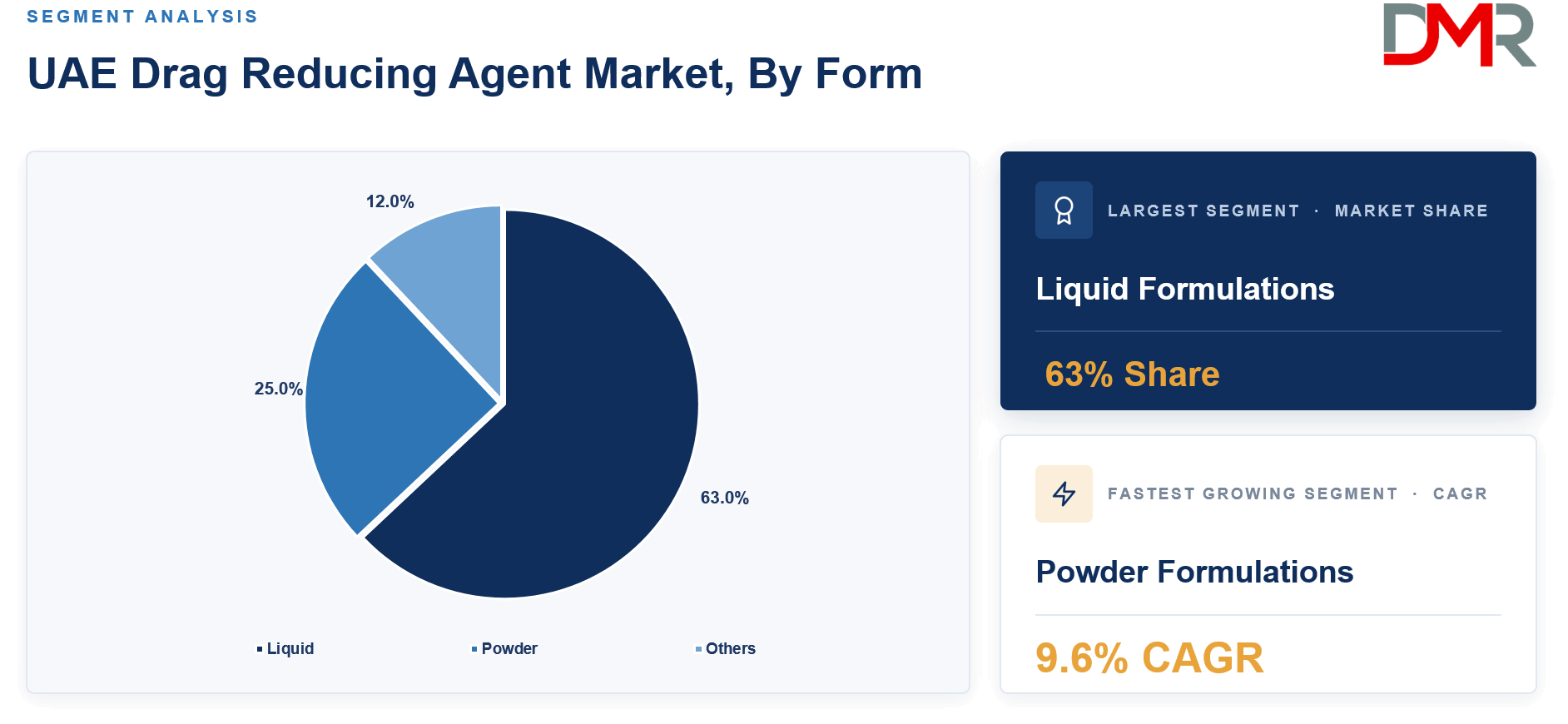
- Leading Form (2026): Liquid, around 63%
- Key Players: Baker Hughes, SLB, ChampionX and others
What is UAE Drag Reducing Agent Market and its Market Size?
The UAE Drag Reducing Agent Market size is estimated to reach USD 31.6 Mn in 2026 and is further anticipated to reach USD 66.4 Mn by 2035, at a CAGR of 8.6%.
ℹ
To learn more about this report –
Download Your Free Sample Report Here
The market covers chemical additives injected into flowing liquids to reduce turbulent friction, lower pressure losses and improve pipeline throughput without requiring a proportional increase in pipe diameter or pumping infrastructure. In the UAE, the commercial boundary is demand generated inside the country, rather than worldwide revenue reported by suppliers headquartered elsewhere.
Crude oil transportation remains the core demand environment because long-distance hydrocarbon pipelines operate under tight pressure, throughput and energy constraints. ADNOC states that its crude export infrastructure includes a roughly 406 km pipeline connecting Abu Dhabi production areas with Fujairah, while its public materials note that drag reducing agents can increase the pipeline's designed throughput.
Refined-product and gas infrastructure broadens the addressable market. ADNOC Refining operates an active pipeline network of more than 1,600 km, while ADNOC Gas reports a UAE gas network exceeding 3,260 km. These networks create recurring opportunities for flow optimization, particularly where operators seek higher utilization, reduced pumping demand and better asset productivity.
Commercial demand is therefore shaped by pipeline operating conditions, injection-system reliability, chemical compatibility, fluid composition, supplier service capability and the economics of improving throughput versus adding pumping capacity. Recent UAE pipeline investment also increases the strategic relevance of flow-efficiency technologies.
Use Cases
- Crude Export Pipelines: Oil pipeline operators deploy drag reducing agents where turbulent friction limits throughput between production hubs, storage facilities and export terminals. Controlled chemical injection can improve hydraulic performance and help operators move additional crude through existing assets while managing pumping requirements.
- Refined Product Distribution: Refiners and terminal operators use flow-improvement programs in product pipelines carrying gasoline, diesel, jet fuel and other liquid hydrocarbons. The objective is to maintain dependable transfer rates across interconnected storage and distribution systems without relying solely on additional pumping equipment.
- Gas and Condensate Infrastructure: Gas processors and pipeline operators evaluate drag reduction where liquid hydrocarbon or condensate transport creates frictional losses. Treatment selection depends on fluid properties, line conditions and compatibility requirements, with the commercial focus placed on stable transport and efficient use of installed capacity.
- Industrial Fluid Transfer: Chemical and industrial facilities can apply flow-modifying additives to selected liquid transport duties when hydraulic resistance constrains operating efficiency. Buyers typically assess injection accuracy, chemical stability, downstream compatibility and measurable operating savings before expanding treatment across a wider network.
Key Takeaways
- Market Size & Growth: The market is estimated at USD 31.6 Mn in 2026 and is projected to reach USD 66.4 Mn by 2035.
- Chemistry Analysis: Polymer chemistry is expected to account for approximately 57% of 2026 demand because hydrocarbon pipeline applications prioritize high drag-reduction performance.
- Demand Concentration: Oil and gas is expected to represent around 52% of 2026 revenue, reflecting the UAE's extensive hydrocarbon transportation infrastructure.
- Form Analysis: Liquid formulations are projected to hold close to 63% of 2026 demand because metered injection integrates readily with established pipeline dosing systems.
- Application Outlook: Crude oil transport remains the largest application, while refined-product transport is expanding as distribution networks become more interconnected.
- Technology Direction: Real-time flow monitoring and automated chemical dosing are increasing the emphasis on measurable hydraulic performance rather than fixed treatment rates.
How AI/Gen AI is Transforming the UAE Drag Reducing Agent Market?
Artificial intelligence is entering drag reduction programs mainly through operational analytics rather than through the chemical itself. Pipeline operators can combine pressure, flow, temperature, pump-load and injection data to identify operating conditions associated with elevated frictional losses. Machine learning models can then support treatment-rate recommendations, anomaly detection and maintenance prioritization. In a UAE operating environment, where large pipeline systems connect production, refining, storage and export assets, these tools can help convert chemical dosing from a periodic operating decision into a continuously optimized control activity.
Generative AI adds value around engineering documentation and operational knowledge. Large language models can organize historical operating records, maintenance notes, chemical compatibility documents and standard operating procedures so engineers can retrieve relevant information faster. Digital twins can also combine hydraulic models with live operating data to test alternative flow conditions before changing pump settings or injection rates. The practical benefit is better decision support, not replacing pipeline engineers or chemical specialists.
- Predictive Dosing: Machine learning models estimate treatment requirements from changing flow and pressure conditions.
- Anomaly Detection: AI identifies unusual pressure-drop patterns that may indicate injection, pump or pipeline issues.
- Digital Twins: Hydraulic simulations test throughput and energy scenarios before operational changes are introduced.
- LLM Documentation: Generative AI organizes technical records, operating procedures and supplier documentation for engineering teams.
Key Drivers in the UAE Drag Reducing Agent Market
Pipeline utilization and export resilience are strengthening the economic case for flow optimization in the UAE.
- Higher Throughput from Existing Pipeline Assets: Operators can use drag reduction to improve hydraulic capacity where adding new pumping equipment or expanding pipe infrastructure would require greater capital, construction interfaces and downtime. ADNOC's public information on the Abu Dhabi Crude Oil Pipeline specifically identifies drag reducing agents as a means of increasing the system's capacity from its base design toward a higher throughput level. This creates a direct commercial logic for DRA deployment: incremental chemical expenditure can support higher asset utilization when pipeline demand approaches hydraulic constraints. As UAE hydrocarbon production, refining and export infrastructure evolves, buyers are increasingly evaluating chemical treatment as an operating lever alongside pump upgrades and network expansion.
- Expansion and Strategic Diversification of Export Routes: The UAE's investment in alternative oil export infrastructure increases the importance of dependable pipeline throughput. Recent reporting indicates that the country is accelerating pipeline investment intended to increase Fujairah export capacity and reduce exposure to the Strait of Hormuz. New or upgraded pipeline corridors create opportunities for flow optimization because operators need to balance throughput, pressure management and energy consumption across long-distance systems. The commercial impact extends beyond crude transport because associated storage, terminal and product-transfer infrastructure can also benefit from more efficient hydraulic operation. This supports recurring demand for high-performance polymeric drag reducing formulations and specialized dosing services.
Restraints in the UAE Drag Reducing Agent Market
Technical qualification and operating economics remain the main brakes on wider adoption.
- Fluid Compatibility and Treatment Control: Drag reducing agents do not deliver identical performance across every hydrocarbon stream. Crude composition, temperature, shear exposure, pipeline geometry and downstream processing requirements can alter treatment effectiveness. Operators therefore need controlled injection, laboratory validation and field monitoring before scaling a formulation. Mechanical degradation can also reduce polymer performance when the additive passes through pumps and other high-shear equipment. These considerations increase the technical burden of switching suppliers and can favor incumbent formulations with established field histories. For UAE buyers, qualification requirements are particularly important where a pipeline connects multiple facilities and chemical treatment must remain compatible with downstream separation, refining or terminal operations.
- Variable Economics of Chemical Treatment: A DRA program competes with alternative approaches such as pump optimization, network debottlenecking and physical expansion. The business case depends on the relationship between additive cost, incremental throughput, electricity consumption, operating hours and the value of the transported product. When pipeline utilization is low, the economic benefit may not justify continuous chemical injection. Operators may consequently adjust dosing around seasonal demand, maintenance schedules or changes in production. This creates a more selective purchasing environment in which suppliers must demonstrate measurable hydraulic improvement rather than relying on generic performance claims.
Growth Opportunities in the UAE Drag Reducing Agent Market
White space is emerging where chemical suppliers can connect formulations with monitoring, dosing automation and pipeline engineering services.
- Integrated DRA Monitoring and Dosing Services: Suppliers can move beyond chemical sales by combining formulation supply with metering equipment, pressure-drop monitoring and performance analytics. Such models allow pipeline operators to evaluate treatment using measurable throughput and energy indicators. The opportunity is strongest for large hydrocarbon networks where several injection points and changing operating conditions make manual dosing less efficient. Automated systems can also reduce overdosing risk and improve chemical inventory planning.
- Refined Product and Terminal Applications: Crude transport is the largest demand pool, but refined-product networks offer an adjacent growth area. UAE refining and distribution infrastructure includes extensive pipeline connections, creating opportunities for formulations designed around specific product characteristics and transfer conditions. Suppliers that can demonstrate compatibility across gasoline, diesel, jet fuel and other refined streams can broaden their addressable customer base.
Trends in the UAE Drag Reducing Agent Market
Buyer behavior is shifting toward measurable performance, operational integration and formulation specialization.
- Performance-Based Chemical Programs: Customers increasingly evaluate DRA purchases through measurable changes in pressure drop, throughput, pump load and energy use. This favors suppliers able to establish baseline performance and quantify improvement during field trials. Commercial contracts can increasingly incorporate technical service and monitoring rather than treating the additive as a simple commodity input.
- Automation of Injection Systems: Metering accuracy is becoming more important as pipeline conditions change. Automated injection can respond to flow variations and maintain a targeted treatment concentration, reducing unnecessary chemical consumption. Integration with plant control systems also creates a more transparent record of treatment performance and chemical usage.
Research Scope and Analysis
Segment performance is assessed across five axes: chemistry, form, application, end use industry and distribution channel. Each axis identifies where 2026 revenue is concentrated and which sub-segment is positioned for faster expansion through 2035, with the commercial mechanisms behind each position.
ℹ
To learn more about this report –
Download Your Free Sample Report Here
By Chemistry
Polymer formulations are expected to hold the largest chemistry share in 2026, accounting for approximately 57% of UAE revenue, because polymeric agents are well suited to turbulent hydrocarbon pipeline transport and high-throughput crude applications. Established operating experience and compatibility with metered injection systems reinforce their position in major pipeline programs. Growth, however, is concentrated in surfactant formulations, expanding at a CAGR of 11.0% between 2026 and 2035 as operators evaluate alternatives that can provide flow improvement under selected fluid and operating conditions while addressing formulation stability and treatment flexibility. Biological additives and suspensions remain more specialized, with adoption depending strongly on application-specific performance evidence and lifecycle economics.
By Form
Liquid formulations are projected to lead the form segment in 2026, representing around 63% of revenue, because liquid products can be metered continuously through established chemical injection systems and are practical for large pipeline operations. Their handling profile also supports centralized dosing at strategic injection locations. The steeper trajectory sits with powder formulations, advancing at a CAGR of 9.6% through 2035 as operators and distributors seek concentrated products that can simplify storage and transport before on-site preparation. Powder adoption remains constrained by dissolution requirements, handling procedures and the need for consistent preparation, but these products can become commercially attractive where logistics and inventory density are important purchasing considerations.
By Application
Crude oil transport is expected to command approximately 48% of 2026 application revenue, reflecting the UAE's extensive crude pipeline infrastructure and the economic value of increasing flow through existing lines. Long-distance transport and high-volume operations provide a strong setting for friction reduction because even modest hydraulic improvements can influence pump requirements and asset utilization. Growth, however, is concentrated in refined-product transport, which is forecast to expand at a CAGR of 10.3% from 2026 to 2035 as refining, storage and distribution networks become more integrated. The application benefits from the need to move multiple liquid products efficiently through interconnected infrastructure while maintaining transfer reliability and controlled operating costs.
By End Use Industry
Oil and gas is projected to represent close to 52% of 2026 market revenue, supported by crude production, export pipelines, gathering systems and associated liquid hydrocarbon infrastructure. The sector has the strongest direct incentive to optimize pipeline hydraulics because throughput and pumping efficiency affect high-value product movement. The steeper trajectory sits with refining and petrochemicals, expanding at a CAGR of 10.1% through 2035 as UAE downstream capacity and product distribution requirements create more opportunities for specialized flow-improvement programs. Demand from chemical facilities and utilities remains smaller but provides additional applications where liquid transfer efficiency can be improved without major changes to physical infrastructure.
By Distribution Channel
Direct supply is expected to account for approximately 55% of 2026 revenue because major pipeline operators typically require technical qualification, formulation support, field trials and reliable replenishment, all of which favor direct supplier relationships. Large contracts also make technical service and inventory planning important components of procurement. Growth, however, is concentrated in specialty distributors, which are projected to expand at a CAGR of 9.4% between 2026 and 2035 as distributors broaden access to specialty chemical products, local stock and application support. Distributor-led models are particularly relevant for smaller industrial users and buyers seeking faster procurement without establishing a direct relationship with an international formulation supplier.
The UAE Drag Reducing Agent Market Report is Segmented Based on the Following
By Chemistry
- Polymer
- Surfactant
- Suspension
- Biological Additive
- Others
By Form
By Application
- Crude Oil Transport
- Refined Products Transport
- Gas and Condensate Transport
- Water and Industrial Fluids
- Others
By End Use Industry
- Oil and Gas
- Refining and Petrochemicals
- Chemicals
- Utilities and Industrial
- Others
By Distribution Channel
- Direct Supply
- Specialty Distributor
- Other Channels
Pricing Analysis
Pricing in the UAE drag reducing agent market is shaped less by a single commodity benchmark than by formulation chemistry, active concentration, treatment dosage, fluid compatibility, logistics and technical service. Polymer products generally command stronger value where performance at high flow rates is demonstrated, while buyers evaluate total treatment cost rather than purchase price alone. The commercial opening is strongest for suppliers that can prove lower chemical consumption for a defined hydraulic benefit and combine supply with dosing optimization. Imported specialty formulations also face freight, inventory and currency considerations, while local stockholding can shorten replenishment cycles. These factors make technical qualification and delivered cost important competitive variables, particularly for large pipeline operators.
Export/Import Analysis
The UAE is positioned as a regional energy and chemical trading hub, but specialty drag reducing formulations can still depend on international supply chains for advanced polymer chemistry and formulation components. Import exposure therefore influences lead times, inventory strategy and supplier selection. The commercial opportunity lies in regional stocking, local blending where technically viable and stronger distributor networks that reduce dependence on long replenishment cycles. At the same time, international suppliers benefit from the UAE's export infrastructure and proximity to major Gulf energy markets. The principal brake is supply-chain concentration for specialized formulations, because a disruption affecting a qualified product can require technical revalidation before an alternative can be introduced. This favors suppliers with resilient sourcing and local technical support.
Competitive Landscape
The competitive landscape combines diversified oilfield chemical companies, water and process treatment suppliers, specialty chemical manufacturers and UAE-based distributors. Competition is primarily based on formulation performance, field validation, injection support, chemical availability and the ability to demonstrate measurable hydraulic benefits. Global suppliers compete for large pipeline programs, while regional distributors can differentiate through local inventory, faster service and customer access. The market therefore rewards suppliers that combine chemistry with application engineering rather than relying on product availability alone.
Some of the Prominent Players in the UAE Drag Reducing Agent Market Are
- Baker Hughes
- SLB
- ChampionX
- Innospec
- Dorf Ketal
- Halliburton
- Clariant
- BASF
- Dow
- Solvay
- Arkema
- LANXESS
- Ecolab
- Kurita Water Industries
- Kemira
- Veolia Water Technologies
- SUEZ
- Solenis
- Buckman
- REDA Chemicals
- Metito
- Al-Jazira Water Treatment Chemicals
- EMVEES Water Treatment
- Fouz Chemical Company
- Sheran Chemicals
- Anglo Gulf FZE
- Crikem
- Innotech Water Treatment & Purification Chemicals Trading
- Hydroguard Enviro Solutions
- Cauldron
- Dutco Tennant
- Gulfstar Group
- Abu Dhabi Chemicals
- Orange Chemicals FZ LLC
- Hazchem
- Dubi Chem
- Blue Line Industries
- Nirvana Water
- Innova Priority Solutions
- International Industrial Chemical Trading
- Other Key Players
Recent Developments
- In August 2026, UAE pipeline investment remained closely tied to export-route resilience, with expanded attention on infrastructure serving Fujairah and alternative routes that can reduce dependence on the Strait of Hormuz. This strengthens the commercial case for flow-efficiency technologies on high-throughput lines.
- In May 2026, reporting indicated that the UAE was accelerating a new oil pipeline initiative intended to increase export capacity through Fujairah. Additional long-distance transport capacity can expand the addressable base for hydraulic optimization and chemical flow-management programs.
Report Details
| Report Characteristics |
| Market Size (2026) |
USD 31.6 Mn |
| Forecast Value (2035) |
USD 66.4 Mn |
| CAGR (2026-2035) |
8.6% |
| Historical Data |
2021 - 2025 |
| Forecast Data |
2026 - 2035 |
| Base Year |
2025 |
| Segments Covered |
By Chemistry, By Form, By Application, By End Use Industry, By Distribution Channel |
| Regional Coverage |
The UAE |
Frequently Asked Questions
How big is the UAE Drag Reducing Agent Market?
▾ The UAE Drag Reducing Agent Market is estimated at USD 31.6 Mn in 2026. Demand is concentrated in hydrocarbon transportation because drag reducing agents can lower turbulent friction and improve the utilization of pipeline assets. Crude oil, refined products and selected condensate transport applications form the main commercial base, supported by the UAE's extensive energy infrastructure and continuing investment in pipeline capacity.
What is the growth rate of the UAE Drag Reducing Agent Market?
▾ The market is projected to expand at a CAGR of 8.6% from 2026 to 2035, reaching USD 66.4 Mn by 2035. Growth reflects demand for higher pipeline utilization, energy-efficient transport and operational optimization. Expansion of export infrastructure and continued development of refining and petrochemical networks provide additional application opportunities for flow-improvement chemistry.
What is driving demand in the UAE Drag Reducing Agent Market?
▾ Demand is primarily driven by the need to improve throughput and hydraulic efficiency across long-distance oil and gas pipelines. UAE operators can use drag reducing agents as an operating tool alongside pumping optimization and physical infrastructure expansion. The strategic development of alternative export routes and Fujairah-linked infrastructure further increases the value of dependable, high-capacity pipeline transport.
Who are the key players in the UAE Drag Reducing Agent Market?
▾ Key participants include Baker Hughes, SLB, ChampionX, Innospec, Dorf Ketal, Halliburton and Clariant, alongside regional suppliers and distributors. Competition centers on polymer performance, chemical compatibility, field validation, dosing support, local availability and technical service. Major buyers generally favor suppliers that can demonstrate measurable hydraulic improvement under the actual pipeline operating conditions.
Which chemistry segment leads the UAE Drag Reducing Agent Market?
▾ Polymer chemistry is expected to lead with approximately 57% of 2026 market revenue. Polymeric formulations are widely suited to turbulent hydrocarbon flow and are particularly relevant to high-throughput crude and refined-product pipelines. Their established operating history and compatibility with continuous injection systems support continued demand among large pipeline operators.
Which form is expected to dominate demand?
▾ Liquid formulations are projected to account for around 63% of 2026 demand. Their position reflects the practical advantages of direct metered injection into operating pipelines, particularly where chemical dosing must respond to changing flow conditions. Powder formulations remain relevant where concentrated storage and transport provide logistical advantages, but preparation requirements can limit adoption.
Which application offers the strongest growth opportunity?
▾ Refined-product transport is projected to be among the faster-growing applications, with a CAGR of 10.3% from 2026 to 2035. Expansion of downstream distribution and storage infrastructure creates additional opportunities for hydraulic optimization. Suppliers that can provide formulations compatible with multiple refined products, combined with dosing and monitoring support, are positioned to capture this adjacent demand.