UAE Drone Delivery Market Snapshot
- UAE Drone Delivery Market Size in 2026: USD 142.6 Million
- UAE Drone Delivery Market Size in 2035: USD 1,318.4 Million
- UAE CAGR from 2026 to 2035: 28.0%
- Services is the leading component segment in 2026: 44.3%
- Rotary-Wing/Multirotor is the leading drone type segment in 2026: 56.9%
- Food and Beverage Delivery is the leading application segment in 2026: 34.7%
- Up to 2 Kg is the leading payload capacity segment in 2026: 48.1%
- Logistics and Delivery Service Providers is the leading end user segment in 2026: 39.5%
What is the UAE Drone Delivery and its Market Size?
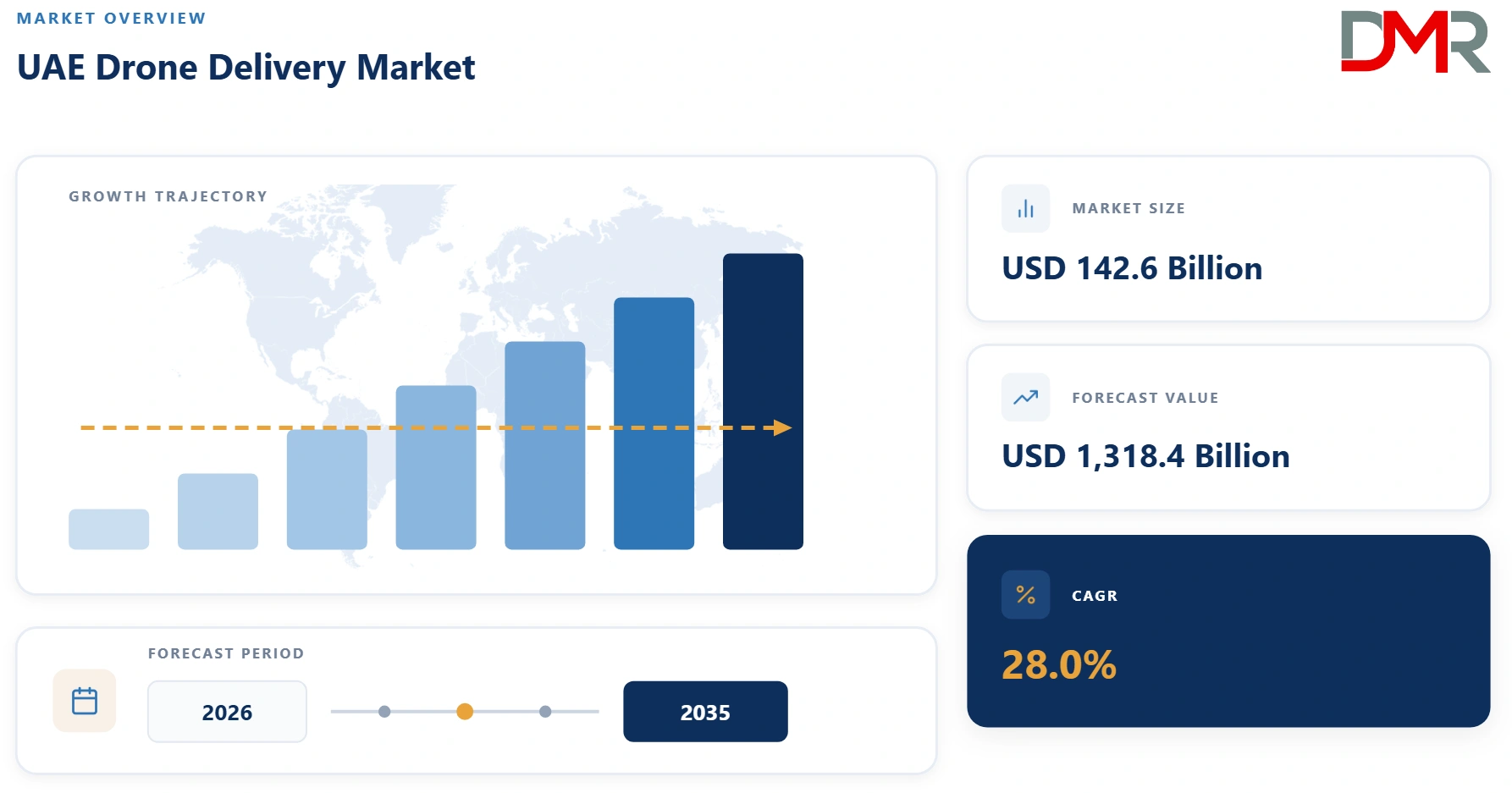
The UAE Drone Delivery Market is projected to be valued at USD 142.6 Million in 2026 and is projected to reach USD 1,318.4 Million by 2035, expanding at a CAGR of 28.0% during the forecast period.
ℹ
To learn more about this report –
Download Your Free Sample Report Here
Growth is being propelled by proactive national regulatory support for unmanned aircraft operations, the UAE's dense high-rise urban geography that creates persistent last-mile congestion challenges well suited to aerial delivery, and sustained government investment in smart city and future-mobility infrastructure across Dubai and Abu Dhabi. The maturing of beyond-visual-line-of-sight approval pathways, growing willingness of food delivery platforms, retailers, and healthcare providers to pilot and scale drone-based fulfillment, and the entry of both regional and international drone logistics operators into the market are reshaping drone delivery from isolated pilot programs into structured, commercially licensed delivery networks integrated with existing e-commerce and food delivery ecosystems. Investment is accelerating as operators expand vertiport and charging infrastructure while regulators formalize airspace management frameworks capable of supporting scaled, multi-operator drone traffic.
Use Cases
- Restaurant and Quick-Commerce Food Delivery: Food delivery platforms and quick-commerce operators deploy drones to fulfill short-distance orders in dense urban and master-planned residential communities, reducing delivery times and easing ground-traffic congestion during peak demand periods.
- Time-Critical Medical and Pharmaceutical Delivery: Hospitals, pharmacies, and healthcare logistics providers use drones to transport medications, diagnostic samples, and emergency medical supplies between facilities, particularly across island communities and locations with limited road access.
- Last-Mile E-Commerce Parcel Delivery: E-commerce platforms and logistics providers pilot drone delivery for small, lightweight parcels in designated urban zones and free zones, aiming to reduce last-mile delivery costs and congestion-related delays.
- Grocery and Convenience Delivery in Master-Planned Communities: Grocery retailers and convenience platforms deploy drone delivery within gated residential communities and integrated developments, leveraging controlled airspace and predictable delivery routes to support rapid, scheduled fulfillment.
Key Takeaways
- Market Size: The UAE Drone Delivery Market is anticipated to be valued at USD 142.6 Million in 2026 and is forecast to reach USD 1,318.4 Million by 2035, expanding at a CAGR of 28.0%.
- Growth Outlook: Market expansion is sustained by proactive UAE aviation regulatory support for unmanned operations, growing commercial adoption among food delivery and retail platforms, and continued government investment in smart city and future-mobility infrastructure.
- Primary Growth Drivers: Formalization of beyond-visual-line-of-sight and urban airspace regulatory frameworks, persistent last-mile congestion in dense urban centers, expanding vertiport and charging infrastructure investment, and growing healthcare sector interest in time-critical aerial logistics are accelerating commercial deployment.
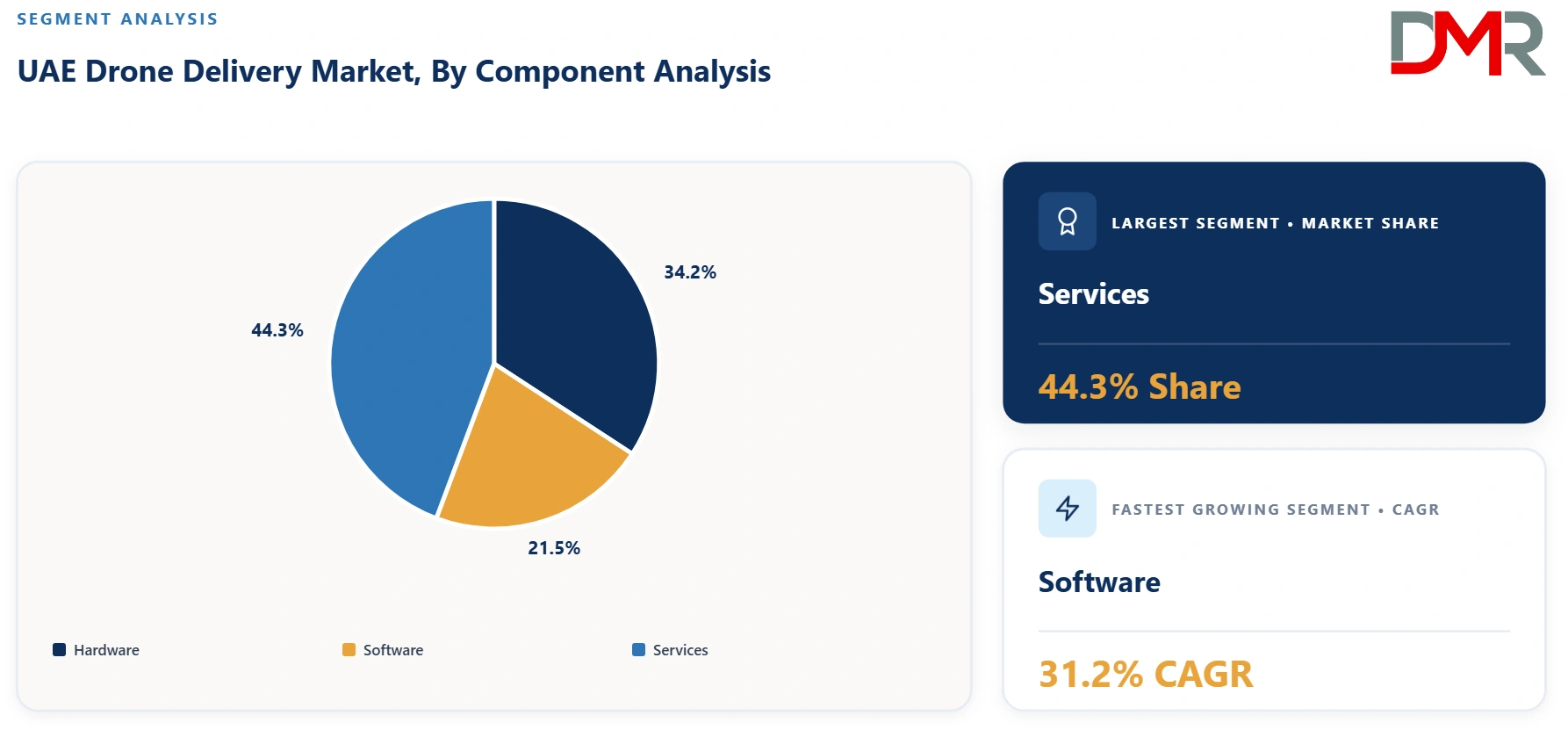
- By Component Analysis: Services is projected to lead the component segment with a 44.3% share in 2026, reflecting strong demand for operator, maintenance, and fleet management services alongside hardware deployment. Software is the fastest-growing component segment at 31.2% CAGR, driven by rising demand for fleet coordination, airspace management, and route optimization platforms.
- By Drone Type Analysis: Rotary-Wing/Multirotor is expected to dominate with a 56.9% share in 2026, supported by suitability for short-range, precision urban delivery. Hybrid VTOL is the fastest-growing drone type segment at 30.8% CAGR, driven by growing demand for longer-range delivery combining vertical takeoff flexibility with fixed-wing efficiency.
- By Application Analysis: Food and Beverage Delivery is poised to lead with a 34.7% share in 2026, reflecting early commercial traction among quick-commerce and restaurant delivery platforms. Medical and Pharmaceutical Delivery is the fastest-growing application segment at 32.6% CAGR, driven by healthcare sector investment in time-critical aerial logistics networks.
- By Payload Capacity Analysis: Up to 2 Kg is expected to command a 48.1% share in 2026, aligning with typical food and small-parcel delivery weights. 2-5 Kg is the fastest-growing payload capacity segment at 29.4% CAGR, driven by expanding grocery and multi-item order delivery use cases.
- By End User Analysis: Logistics and Delivery Service Providers are projected to dominate with a 39.5% share in 2026, reflecting their central role coordinating drone fleets on behalf of retail and food delivery platform clients. Healthcare and Pharmaceutical Providers is the fastest-growing end user segment at 31.9% CAGR, fuelled by expanding medical logistics pilot programs and inter-facility supply networks.
How AI/Gen AI is Transforming the Drone Delivery Market?
AI and generative AI are transforming the drone delivery market by improving autonomy, route planning, safety, and operational efficiency. AI-powered systems analyze weather, traffic, terrain, battery status, and airspace restrictions to identify optimal delivery paths in real time. Computer vision enables drones to detect obstacles, recognize landing zones, and navigate complex urban environments accurately. Predictive analytics supports fleet maintenance, reducing downtime and extending equipment life. Generative AI can simulate delivery scenarios, create synthetic training data, optimize drone designs, and assist operators through intelligent decision-support tools. AI also strengthens demand forecasting, parcel allocation, and fleet scheduling, enabling faster deliveries at lower costs. As regulations evolve, AI-driven monitoring and compliance systems will further support scalable, secure, and reliable drone delivery networks across logistics, healthcare, retail, and food delivery sectors.
Key Drivers in the UAE Drone Delivery Market
Proactive National Regulatory Support for Unmanned Aircraft Operations
The UAE's forward-leaning aviation regulatory environment is a central driver of growth in the Drone Delivery Market. The General Civil Aviation Authority, alongside emirate-level authorities such as the Dubai Civil Aviation Authority, has progressively established structured licensing pathways, designated drone corridors, and beyond-visual-line-of-sight operational approvals that allow commercial operators to move from constrained pilot trials toward scaled delivery networks. This regulatory clarity reduces approval timelines and operational uncertainty relative to many other global markets, encouraging both regional and international drone logistics companies to prioritize UAE market entry and expansion.
Persistent Last-Mile Congestion in Dense Urban Centers
Rapid urban density growth across Dubai and Abu Dhabi, combined with high-rise residential concentration and increasing e-commerce and food delivery order volumes, continues to strain ground-based last-mile delivery networks. Drone delivery offers retailers, restaurants, and logistics providers a means of bypassing road congestion for short-distance, time-sensitive deliveries, particularly within master-planned communities and designated urban delivery zones. As order volumes continue to rise, aerial delivery is increasingly viewed as a structural complement to, rather than a replacement for, ground-based logistics networks.
Restraints in the UAE Drone Delivery Market
Airspace Integration Complexity in Congested Urban and Aviation-Dense Zones
Integrating commercial drone delivery operations within the UAE's dense, aviation-active airspace, particularly around major international airports and high-rise urban corridors, represents a meaningful restraint on market growth. Operators must navigate complex coordination requirements with air traffic control, maintain strict geofencing around restricted zones, and demonstrate robust detect-and-avoid capabilities before receiving expanded operating approvals. These requirements can lengthen the transition from pilot programs to full commercial-scale operations and increase compliance costs, particularly for smaller or newly entering operators.
Growth Opportunities in the UAE Drone Delivery Market
Integrated Vertiport and Charging Infrastructure Networks
The build-out of dedicated vertiport, landing pad, and automated charging infrastructure across residential communities, commercial districts, and hospital campuses presents a substantial opportunity for infrastructure developers and drone operators alike. Companies that establish early infrastructure partnerships with master-planned community developers and healthcare networks can secure preferential access and long-term operating agreements, creating durable competitive advantages as the market scales toward multi-operator, high-frequency delivery networks.
Cross-Sector Partnerships Between Drone Operators and Retail/Healthcare Platforms
Growing willingness among food delivery platforms, e-commerce retailers, and healthcare providers to integrate drone delivery as a native fulfillment option, rather than a standalone pilot service, presents an opportunity for drone logistics companies to embed directly within existing digital ordering and dispatch systems. Deep API-level integration with established platforms can accelerate order volume scaling and strengthen operator retention, positioning early-integrating drone companies favorably as adoption expands beyond initial trial zones.
Trends in the UAE Drone Delivery Market
Expansion of Designated Drone Delivery Corridors and Free Zones
UAE authorities are increasingly designating specific urban corridors, free zones, and master-planned communities as approved drone delivery testing and operating areas, allowing operators to scale commercial service within clearly defined regulatory boundaries before broader citywide expansion. This zoned expansion approach is enabling faster time-to-market for operators while allowing regulators to monitor safety performance and refine broader airspace integration policy based on operational data from controlled environments.
Growing Convergence Between Drone Delivery and Broader Urban Air Mobility Initiatives
Drone delivery development in the UAE is increasingly converging with the country's broader urban air mobility ambitions, including passenger-carrying air taxi initiatives. Shared investment in airspace management systems, vertiport infrastructure, and regulatory frameworks is creating operational and infrastructure synergies between cargo drone delivery and future passenger air mobility services. This convergence is expected to accelerate infrastructure investment and regulatory maturity benefiting the drone delivery market as a secondary beneficiary of urban air mobility policy development.
Research Scope and Analysis
The UAE Drone Delivery Market is segmented by component, drone type, application, payload capacity, and end user, covering hardware, software, services, fixed-wing, rotary-wing, hybrid VTOL drones, food delivery, e-commerce, medical, and grocery applications, and retail, healthcare, logistics, and government end users.
ℹ
To learn more about this report –
Download Your Free Sample Report Here
By Component Analysis
Services is projected to dominate the UAE Drone Delivery Market with approximately 44.3% share in 2026, reflecting strong demand for fleet operation, maintenance, pilot training, and airspace compliance services alongside hardware deployment. Software is expected to register the highest CAGR of 31.2% during 2026-2035, driven by increasing operator investment in fleet coordination, route optimization, and real-time airspace management platforms as delivery networks scale.
By Drone Type Analysis
Rotary-Wing/Multirotor drones are anticipated to dominate the UAE Drone Delivery Market by drone type, accounting for approximately 56.9% share in 2026, supported by their maneuverability and suitability for short-range, precision urban and last-mile delivery. Hybrid VTOL drones are projected to register the highest CAGR of 30.8% between 2026 and 2035, driven by growing demand for extended-range delivery routes that combine vertical takeoff and landing flexibility with the flight efficiency of fixed-wing designs.
By Application Analysis
Food and Beverage Delivery is projected to lead the UAE Drone Delivery Market with an estimated 34.7% share in 2026, reflecting early and sustained commercial traction among quick-commerce and restaurant delivery platforms operating in dense urban zones. Medical and Pharmaceutical Delivery is expected to register the fastest CAGR of 32.6% through 2035, driven by expanding healthcare sector investment in time-critical medication, sample, and emergency supply delivery networks.
By Payload Capacity Analysis
Up to 2 Kg payload capacity is expected to lead the UAE Drone Delivery Market by payload segment, accounting for approximately 48.1% share in 2026, aligning closely with typical food order and small-parcel delivery weights. The 2-5 Kg payload segment is projected to achieve the fastest CAGR of 29.4% during 2026-2035, driven by expanding use cases in grocery delivery and multi-item order fulfillment requiring greater carrying capacity.
By End User Analysis
Logistics and Delivery Service Providers are projected to dominate the UAE Drone Delivery Market with approximately 39.5% share in 2026, reflecting their central coordinating role operating drone fleets on behalf of retail, food delivery, and e-commerce platform clients. Healthcare and Pharmaceutical Providers are expected to register the fastest CAGR of 31.9% through 2035, fuelled by expanding medical logistics pilot programs, inter-hospital supply networks, and emergency medical delivery initiatives.
The UAE Drone Delivery Market Report is segmented based on the following:
By Component
- Hardware
- Software
- Services
By Drone Type
- Fixed-Wing
- Rotary-Wing/Multirotor
- Hybrid VTOL
By Application
- Food and Beverage Delivery
- E-Commerce and Retail Parcel Delivery
- Medical and Pharmaceutical Delivery
- Grocery Delivery
- Others
By Payload Capacity
- Up to 2 Kg
- 2-5 Kg
- Above 5 Kg
By End User
- Retailers and E-Commerce Platforms
- Healthcare and Pharmaceutical Providers
- Logistics and Delivery Service Providers
- Government and Public Sector
Technology Analysis
Technology development is central to the trajectory of the UAE Drone Delivery Market as operators invest in advanced detect-and-avoid systems, AI-driven route optimization, autonomous charging infrastructure, and real-time airspace traffic management platforms. Growing integration of 5G connectivity and edge computing is improving drone communication reliability and enabling higher-density, multi-operator airspace coordination. Opportunities are expanding for companies developing UAE-specific airspace management software, weather-resilient drone platforms suited to the region's climate, and automated vertiport charging networks. However, ensuring cybersecurity resilience of drone communication and navigation systems, along with achieving redundant safety certification for beyond-visual-line-of-sight operations, remain critical technical requirements for scaled commercial deployment.
Investment and White Space Analysis
Investment opportunities in the UAE Drone Delivery Market are expanding alongside continued regulatory formalization, growing platform integration with food delivery and retail ecosystems, and government prioritization of future-mobility infrastructure. Significant white space exists in vertiport infrastructure development, airspace management software, medical logistics networks, and cold-chain-capable delivery drones for pharmaceutical and grocery applications. Operators and infrastructure developers with early access to designated delivery corridors and master-planned community partnerships are positioned to capture premium, first-mover market share. However, high infrastructure capital requirements, airspace integration complexity near major aviation hubs, and dependence on continued regulatory expansion can constrain near-term scalability for smaller or newly entering operators.
Competitive Landscape
The UAE Drone Delivery Market is emerging and moderately concentrated, comprising regional drone logistics startups, international drone delivery technology companies, and diversified logistics providers expanding into aerial delivery services. Competition centers on regulatory approval breadth, operational safety track record, platform integration capability with retail and food delivery ecosystems, and vertiport infrastructure access. Regional operators benefit from local regulatory relationships and market familiarity, while international entrants leverage more mature drone technology platforms and global operational experience. Companies increasingly differentiate through healthcare logistics partnerships, designated corridor access, and deep API integration with major e-commerce and food delivery platforms rather than hardware capability alone.
Some of the prominent players in the UAE Drone Delivery Market are:
- Amazon Prime Air
- Wing Aviation
- Zipline
- UPS Flight Forward
- FedEx Corporation
- DHL
- Matternet
- Flytrex
- DroneUp
- Wingcopter
- Manna Air Delivery
- Skyports Drone Services
- Drone Delivery Canada
- Airbus
- EHang
- DJI
- PABLO AIR
- Blueflite
- Garuda Aerospace
- Speedbird Aero
- A2Z Drone Delivery
- Dronamics
- FlyingBasket
- Skye Air Mobility
- Meituan
- JD.com
- SF Express
- Antwork
- UVL Robotics
- Volatus Aerospace
- Nordic Unmanned
- Kite Aero
- Elroy Air
- MightyFly
- Pyka
- Avy
- Swoop Aero
- Aerodyne Group
- Rakuten Group
- Workhorse Group
- Other Key Players
Recent Developments
- In August 2026, Amazon announced plans to expand Prime Air drone delivery to nearly 500 US cities and towns by year-end, offering deliveries of groceries, medicines, electronics, and household products in as little as 30 minutes.
- In August 2026, Zipline partnered with Uber to integrate autonomous drone delivery into Uber Eats, initially targeting Dallas and Houston. The companies aim to scale the network to one million drone deliveries daily.
- In July 2026, Zipline announced a thirteenfold expansion of its addressable US marketplace, supported by planned service launches in Austin and Cleveland and leadership appointments from Tesla, Waymo, and Uber.
- In June 2026, Wing and Walmart added seven metropolitan markets to their expansion plan: Memphis, New Orleans, Philadelphia, Phoenix, San Diego, San Francisco Bay Area, and Salt Lake City.
Report Details
| Report Characteristics |
| Market Size (2026) |
USD 142.6 Mn |
| Forecast Value (2035) |
USD 1,318.4 Mn |
| CAGR (2026–2035) |
28.0% |
| Historical Data |
2021 – 2025 |
| Forecast Data |
2026 – 2035 |
| Base Year |
2025 |
| Segments Covered |
By Component, By Drone Type, By Application, By Payload Capacity, By End User |
| Country Coverage |
UAE |
Frequently Asked Questions
How big is the UAE Drone Delivery Market?
▾ The UAE Drone Delivery Market is poised to be valued at USD 142.6 Million in 2026 and is projected to reach USD 1,318.4 Million by 2035, reflecting rapid scaling of commercial food, retail, and medical drone delivery services supported by proactive regulatory frameworks.
What is the CAGR of the UAE Drone Delivery Market from 2026 to 2035?
▾ The market is projected to expand at a compound annual growth rate (CAGR) of 28.0% between 2026 and 2035, supported by regulatory formalization of unmanned aircraft operations, urban congestion challenges, and growing healthcare and retail sector adoption.
What factors are driving the growth of the UAE Drone Delivery Market?
▾ Growth is driven by proactive national aviation regulatory support for beyond-visual-line-of-sight operations, persistent last-mile congestion in dense urban centers, expanding vertiport and charging infrastructure investment, and rising healthcare sector interest in time-critical aerial medical logistics.
What are the major trends in the UAE Drone Delivery Market?
▾ Major trends include the expansion of designated drone delivery corridors and free zones, growing convergence between cargo drone delivery and broader urban air mobility initiatives, and deepening integration between drone operators and established food delivery and retail platforms.
Who are the key players in the UAE Drone Delivery Market?
▾ Key market participants include Zipline, Wing, Skyports Drone Services, DP World Drone Logistics, and Falcon Eye Drones, among other regional and international drone logistics operators.
How is the UAE Drone Delivery Market segmented?
▾ The market is segmented by component, drone type, application, payload capacity, and end user, with demand analysis concentrated across Dubai, Abu Dhabi, and designated free zones and master-planned communities in the northern emirates.