UAE Food & Beverage Contract Manufacturing Market Snapshot
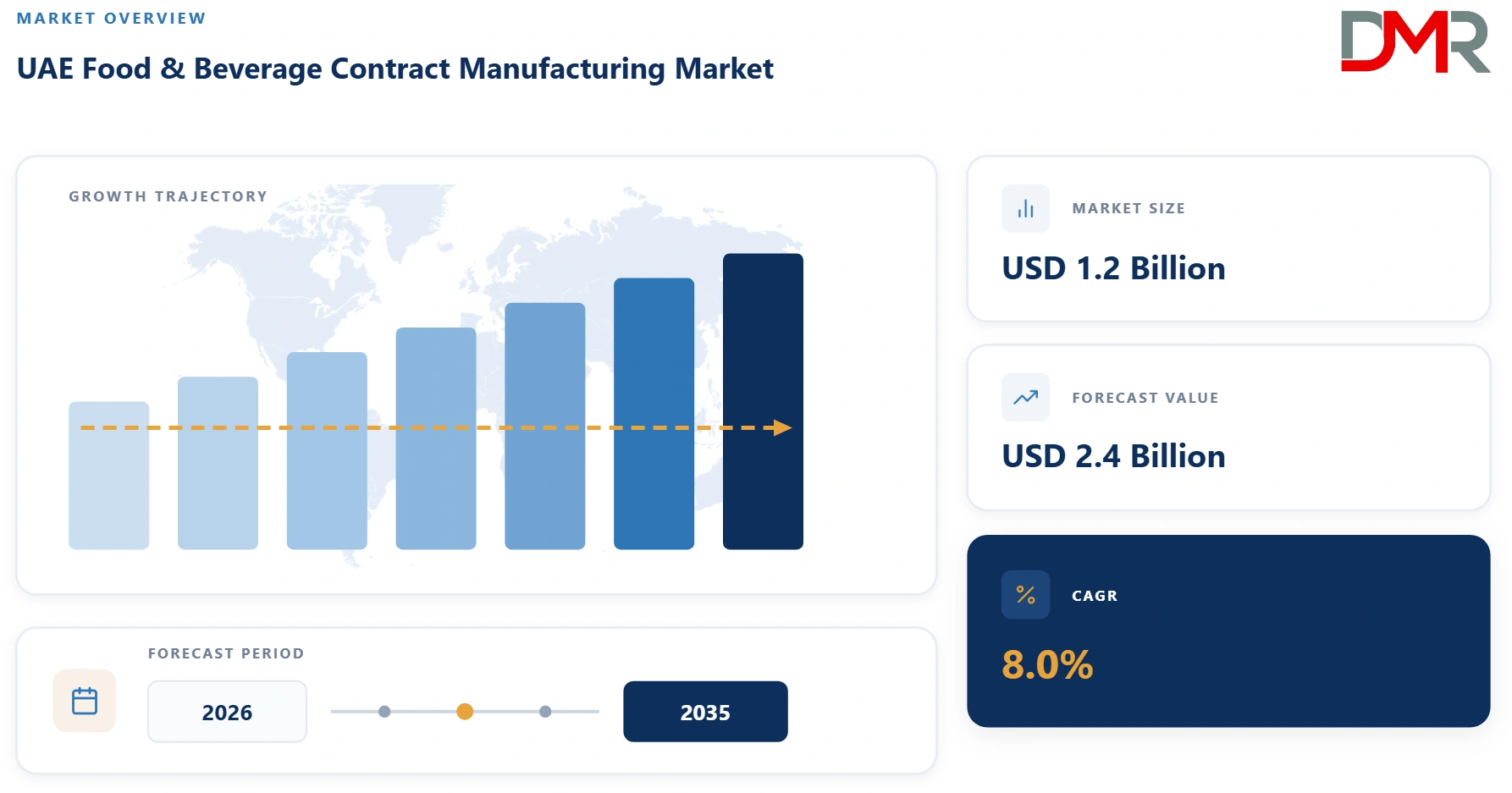
- UAE Food & Beverage Contract Manufacturing Market Size in 2026: USD 1.2 Billion
- UAE Food & Beverage Contract Manufacturing Market Size in 2035: USD 2.4 Billion
- UAE CAGR from 2026 to 2035: 8.0%
- Manufacturing and Processing is the leading Service Type segment in 2026: 52.4%
- Beverages is the leading Food Category segment in 2026: 24.8%
- Large National and Multinational Brands is the leading Client Type segment in 2026: 38.6%
- Kosher Halal Certified is the leading Facility Certification segment in 2026: 46.2%
What is the UAE Food & Beverage Contract Manufacturing Market and its Market Size?
The UAE Food & Beverage Contract Manufacturing Market is projected to reach USD 1.2 billion in 2026 and grow at a compound annual growth rate of 8.0% from there until 2035 to reach a value of USD 2.4 billion.
ℹ
To learn more about this report –
Download Your Free Sample Report Here
The market comprises third-party companies providing product formulation, ingredient sourcing, processing, filling, packaging, labeling, warehousing, and distribution services for food and beverage brands. Demand is expanding as emerging businesses, multinational companies, restaurants, retailers, and private-label operators seek scalable production without investing heavily in dedicated facilities. The UAE’s strategic location, advanced logistics infrastructure, halal manufacturing capabilities, expanding tourism economy, and access to GCC, African, and Asian markets make it an attractive regional contract-manufacturing hub.
Use Cases
- Market Entry for Emerging Brands: Emerging food and beverage brands use contract manufacturers to commercialize products without constructing factories or purchasing expensive processing equipment. Manufacturers assist with recipe development, ingredient procurement, pilot production, regulatory documentation, packaging, and commercial-scale output. This arrangement lowers initial capital requirements, reduces operational risk, shortens product-launch timelines, and enables entrepreneurs to test demand before committing to dedicated capacity.
- Retailer Private-Label Production: Supermarkets, hypermarkets, convenience stores, and e-commerce retailers outsource the production of private-label beverages, snacks, sauces, frozen foods, and prepared meals. Contract manufacturers provide standardized recipes, customized packaging, quality assurance, labeling compliance, and scheduled delivery. Retailers benefit from stronger category control, differentiated product portfolios, competitive pricing, improved margins, and faster responses to changing consumer preferences across the UAE.
- Regional Expansion for International Brands: International food and beverage companies use UAE contract manufacturers to localize recipes, obtain halal certification, reduce import lead times, and supply regional markets efficiently. Local production supports packaging adaptation, Arabic labeling, climate-appropriate formulations, smaller production batches, and compliance with UAE requirements. It also provides access to established distribution networks connecting Gulf Cooperation Council countries, Africa, and South Asia.
Key Takeaways
- Market Size: The UAE Food & Beverage Contract Manufacturing Market is anticipated to be valued at USD 1.2 billion in 2026 and is forecast to reach USD 2.4 billion by 2035, expanding at a CAGR of 8.0%.
- Growth Rate and Outlook: Market expansion is supported by increasing private-label penetration, new food brand formation, localization strategies, tourism-driven consumption, demand for convenience products, halal-certified production, advanced industrial infrastructure, and growing requirements for flexible manufacturing, formulation, packaging, warehousing, and regional distribution services.
- Primary Growth Drivers: Rising capital costs associated with establishing dedicated factories, increasing demand for shorter product-development cycles, expanding supermarket private labels, growth in ready-to-eat foods and functional beverages, and the UAE’s position as a regional logistics and re-export center are accelerating contract-manufacturing adoption.
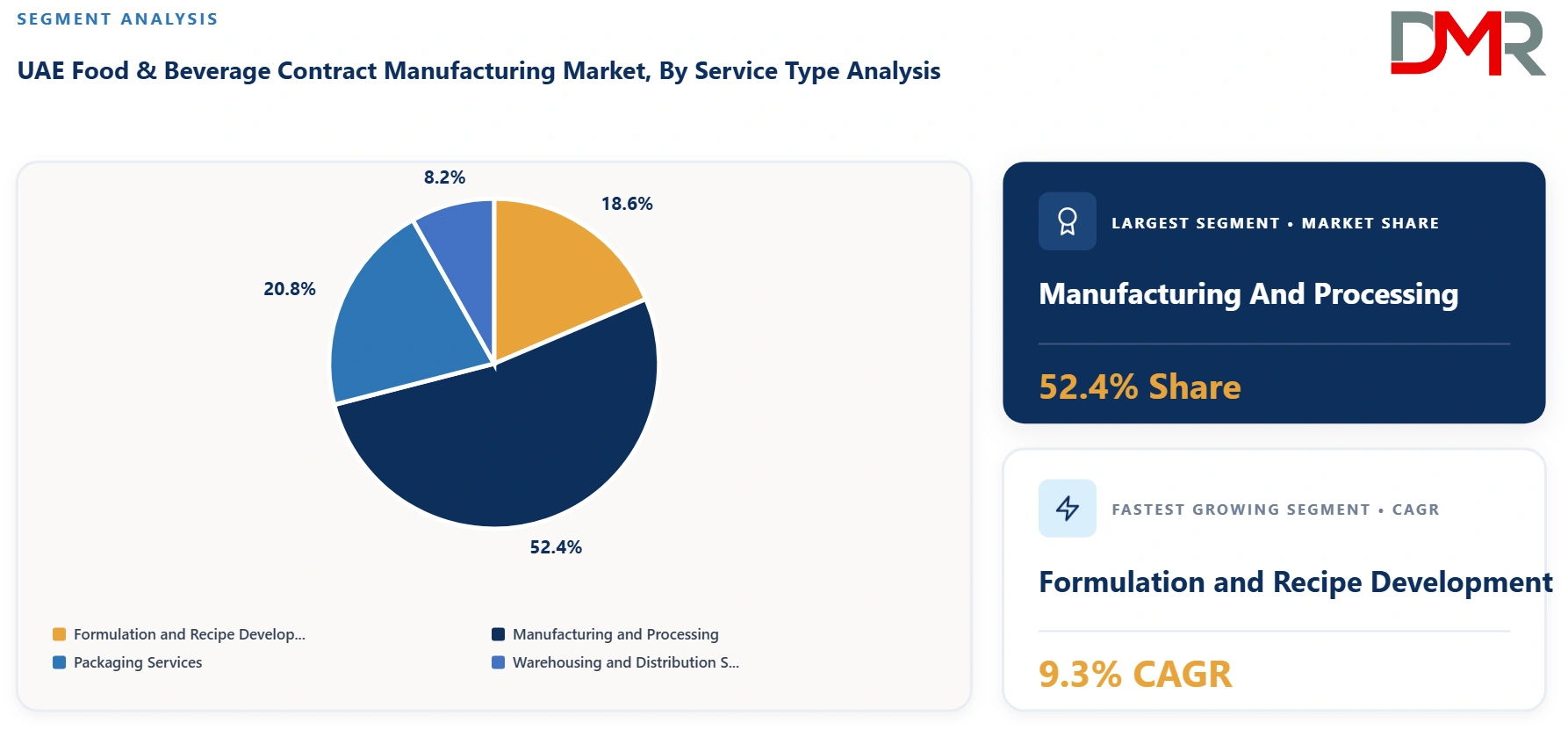
- By Service Type Analysis: Manufacturing and Processing is projected to lead the market with a 52.4% share in 2026, supported by demand for scalable production, specialized machinery, standardized quality systems, and efficient capacity utilization. Formulation and Recipe Development is expected to record the highest CAGR as brands pursue functional, clean-label, culturally adapted, and health-focused products.
- By Food Category Analysis: Beverages is anticipated to dominate with a 24.8% share in 2026 due to strong demand for bottled water, juices, energy drinks, functional beverages, dairy drinks, and low-sugar alternatives. Nutritional and Dietary Supplements is expected to grow fastest, supported by preventive health awareness and demand for personalized wellness products.
- By Client Type Analysis: Large National and Multinational Brands is expected to lead with a 38.6% share in 2026. Emerging and Small Brands is forecast to register the fastest growth as low-volume production, shared infrastructure, pilot batches, and outsourced regulatory support reduce market-entry barriers for start-ups and digital-first brands.
- By Facility Certification Analysis: Kosher Halal Certified facilities are projected to dominate with a 46.2% share in 2026, reflecting the importance of halal compliance across domestic and regional markets. Allergen-Free and Free-From Certified facilities are expected to record the fastest growth as demand rises for gluten-free, dairy-free, nut-free, vegan, and specialized nutrition products.
How AI and GenAI are Transforming the UAE Food & Beverage Contract Manufacturing Market?
Artificial intelligence and generative AI are improving recipe development, production planning, quality assurance, demand forecasting, and equipment maintenance across UAE contract-manufacturing facilities. AI platforms can analyze ingredient functionality, consumer preferences, nutritional targets, and production constraints to accelerate formulation. Computer vision supports contamination detection, portion control, packaging inspection, and label verification. Predictive systems improve capacity utilization and reduce equipment downtime, while generative AI assists with regulatory documentation, supplier evaluation, product concepts, and multilingual packaging content. Digital twins and automated scheduling further enable manufacturers to manage multiple brands, recipes, batch sizes, certifications, and delivery requirements efficiently.
Key Drivers in the UAE Food & Beverage Contract Manufacturing Market
Expanding Private Labels and Brand Outsourcing
UAE retailers, hospitality operators, restaurant groups, and emerging consumer brands increasingly outsource manufacturing to reduce capital expenditure and accelerate product launches. Contract partners offer access to specialized processing lines, procurement networks, product-development laboratories, certifications, and scalable packaging capabilities. Dubai Industrial City attracted more than 25 food and beverage customers leasing 1.7 million square feet during 2024, demonstrating growing demand for localized production infrastructure. Outsourcing is particularly valuable for smaller brands that require pilot quantities and for retailers seeking differentiated products without managing factories, technical teams, food-safety systems, or fluctuating production capacity directly.
Food Security and Local Manufacturing Initiatives
The UAE’s focus on food security is encouraging investment in domestic processing, storage, packaging, and distribution capacity. The country has historically imported nearly 90% of its food, increasing its exposure to supply-chain interruptions, commodity volatility, geopolitical risks, and freight-cost changes. Local contract manufacturing enables imported ingredients to be converted into finished products closer to consumers while supporting inventory resilience and regional exports. Government-backed industrial zones, financing initiatives, modern ports, cold-chain networks, and the Make it in the Emirates strategy are improving the operating environment for manufacturers serving local brands, international companies, foodservice operators, and retail private-label programs.
Restraints in the UAE Food & Beverage Contract Manufacturing Market
Dependence on Imported Ingredients and Packaging Inputs
Although the UAE is expanding local food manufacturing, many ingredients, additives, agricultural commodities, specialty proteins, and packaging materials remain imported. This dependence exposes contract manufacturers to currency movements, international commodity prices, shipping delays, geopolitical disruption, and changing freight costs. Manufacturers handling multiple clients must balance minimum ingredient orders against uncertain production schedules, potentially increasing working-capital requirements and inventory waste. Temperature-sensitive ingredients also require dependable cold-chain handling. Supply interruptions can force reformulation, delay product launches, reduce margins, or create inconsistency between production batches, particularly for small brands lacking purchasing scale or alternative approved suppliers.
Complex Compliance and Cross-Contamination Risks
Contract manufacturers must manage UAE food-registration rules, municipality requirements, halal controls, allergen segregation, nutrition labeling, shelf-life validation, hygiene standards, traceability, and recall procedures across numerous products and clients. Shared production lines increase the possibility of allergen carryover, ingredient substitution, label mismatch, or contamination if cleaning and changeover processes are inadequate. Separate storage and production controls can raise operating costs for organic, kosher, halal, vegan, and free-from products. Differences between UAE and export-market requirements further complicate documentation. Compliance failures can trigger recalls, product rejection, financial liability, reputational damage, and the loss of long-term manufacturing contracts.
Growth Opportunities in the UAE Food & Beverage Contract Manufacturing Market
Functional Foods and Personalized Nutrition
Growing interest in preventive health creates opportunities for contract manufacturers specializing in protein products, fortified beverages, probiotics, supplements, low-sugar foods, sports nutrition, and products designed around specific dietary needs. Brands require technical partners capable of sourcing functional ingredients, validating formulations, controlling dosage, preserving ingredient stability, and supporting permitted health claims. Manufacturers offering small-batch development and flexible packaging can serve fitness companies, healthcare-focused brands, pharmacies, e-commerce businesses, and hospitality operators. Opportunities are especially strong for halal-certified supplements and culturally relevant wellness products developed for consumers across the UAE, Gulf Cooperation Council, Africa, and South Asia.
Export-Oriented Halal Manufacturing Platforms
The UAE’s port infrastructure, air connectivity, economic zones, and proximity to major consumer markets create opportunities for export-focused contract manufacturing. Facilities offering halal certification, multilingual labeling, temperature-controlled storage, and integrated customs and logistics support can serve international brands entering the Middle East. Manufacturers can also help regional brands expand into Africa, Asia, and Europe through localized packaging, recipe adaptation, and export documentation. KEZAD’s food ecosystem provides connectivity to ports, airports, raw-material sources, processing facilities, storage operations, and distribution channels. This integrated environment can reduce lead times and strengthen the UAE’s position as a regional co-manufacturing and re-export center.
Trends in the UAE Food & Beverage Contract Manufacturing Market
Flexible Production and Smaller Batch Sizes
The expansion of digital-first brands, specialty retailers, restaurants, and premium food concepts is increasing demand for shorter production runs and frequent product changes. Contract manufacturers are investing in modular processing equipment, automated changeovers, flexible filling systems, and digitally managed production scheduling to accommodate different recipes, package sizes, and order quantities. Small-batch capabilities allow clients to test consumer response, launch seasonal products, and manage inventory more efficiently. Manufacturers able to scale successful products from pilot batches to national distribution will gain an advantage, particularly in fast-changing categories such as functional drinks, healthy snacks, specialty sauces, supplements, and ready-to-eat meals.
Clean Labels and Sustainable Packaging
Consumers, retailers, and corporate buyers increasingly prefer products containing recognizable ingredients, reduced sugar, fewer artificial additives, and packaging designed to minimize environmental impact. Contract manufacturers are responding through natural preservation techniques, recipe simplification, recyclable materials, lightweight containers, and improved production efficiency. Sustainability requirements are also influencing ingredient sourcing, water consumption, waste management, energy use, and packaging design. Manufacturers capable of documenting environmental performance and supporting client sustainability claims can strengthen their competitive position. However, they must ensure that alternative materials maintain food safety, product stability, barrier performance, shelf life, and compatibility with existing filling and sealing equipment.
Research Scope and Analysis
The UAE Food and Beverage Contract Manufacturing Market is analyzed by service type covering formulation and recipe development, manufacturing and processing, packaging services, warehousing and distribution support, by food category, by client type, and by facility certification, assessing demand patterns, outsourcing strategies, production capabilities, quality compliance, private labels, capacity expansion, innovation, national competitiveness, and competitive positioning.
ℹ
To learn more about this report –
Download Your Free Sample Report Here
By Service Type Analysis
Manufacturing and Processing is projected to hold the highest market share of 52.4% in 2026, supported by demand for scalable production lines, specialized processing equipment, consistent quality, and efficient capacity utilization. Formulation and Recipe Development is expected to record the highest CAGR of approximately 9.3% from 2026 to 2035, as brands prioritize innovation, functional ingredients, and locally adapted recipes.
By Food Category Analysis
Beverages is anticipated to account for the highest market share of 24.8% in 2026, driven by bottled water, juices, functional drinks, dairy beverages, energy products, and low-sugar alternatives. Nutritional and Dietary Supplements is expected to register the highest CAGR of approximately 9.6% from 2026 to 2035, supported by preventive health, fitness participation, and personalized nutrition demand.
By Client Type Analysis
Large National and Multinational Brands is projected to capture the highest market share of 38.6% in 2026 because of substantial production volumes, product localization requirements, and regional distribution strategies. Emerging and Small Brands is expected to achieve the highest CAGR of approximately 9.4% from 2026 to 2035, as flexible manufacturing lowers capital barriers and accelerates commercialization.
By Facility Certification Analysis
Kosher Halal Certified is expected to hold the highest market share of 46.2% in 2026, reflecting mandatory cultural considerations, regional export opportunities, and strong demand for verified halal production. Allergen-Free and Free-From Certified is forecast to record the highest CAGR of approximately 9.2% from 2026 to 2035, driven by specialized diets, allergy awareness, and premium health-oriented products.
The UAE Food & Beverage Contract Manufacturing Market Report is Segmented Based on the Following
By Service Type
- Formulation and Recipe Development
- Manufacturing and Processing
- Packaging Services
- Warehousing and Distribution Support
By Food Category
- Bakery and Snacks
- Beverages
- Dairy and Frozen Foods
- Sauces, Dressings and Condiments
- Nutritional and Dietary Supplements
- Ready-to-Eat and Prepared Meals
- Others
By Client Type
- Emerging and Small Brands
- Mid-Sized Regional Brands
- Large National and Multinational Brands
- Retailer Private Label Programs
By Facility Certification
- Organic-Certified
- Allergen-Free and Free-From Certified
- Kosher and Halal Certified
- Standard Certified
Regulatory Landscape
UAE food and beverage contract manufacturers operate under federal food-safety legislation, emirate-level municipality controls, product-registration requirements, labeling standards, halal rules, and import and export procedures. Facilities must maintain traceability, hygiene programs, hazard-control systems, laboratory testing, shelf-life evidence, allergen declarations, and recall readiness. Regulatory compliance creates opportunities for manufacturers offering certification management and market-entry support to smaller brands. However, handling multiple formulations, suppliers, clients, and export destinations increases documentation and cross-contamination risks. Strong digital records, segregated production, validated cleaning, approved suppliers, and standardized quality systems improve customer confidence. Non-compliance may cause shipment rejection, recalls, penalties, contract loss, or reputational damage across connected regional markets.
Investment and White Space Analysis
Investment opportunities are concentrated in flexible small-batch production, nutritional supplements, functional beverages, allergen-controlled facilities, frozen prepared meals, sustainable packaging, and integrated cold-chain services. Dubai Industrial City attracted more than AED 350 million in food and beverage investment during 2024, while new manufacturing projects in KEZAD demonstrate continued demand for localized capacity. White spaces remain for manufacturers combining formulation laboratories, halal certification, low minimum orders, multilingual packaging, and regional fulfillment in one platform. Investors face risks from imported input costs, capacity underutilization, energy requirements, and intense price competition. Facilities serving several categories and export markets can diversify demand, improve equipment utilization, and capture higher-value development services.
Competitive Landscape
The UAE Food & Beverage Contract Manufacturing Market is moderately fragmented, comprising diversified food groups, beverage producers, specialist processors, private-label suppliers, packaging companies, and logistics providers. Competition centers on production capacity, minimum order quantities, formulation expertise, halal certification, quality systems, packaging flexibility, turnaround time, and regional distribution. Large manufacturers benefit from integrated procurement and established infrastructure, while specialists compete through customization and smaller batches. Capacity expansion in Dubai Industrial City and KEZAD is strengthening local production, encouraging technical partnerships, and increasing competition for retailer, start-up, hospitality, and multinational outsourcing contracts.
Some of the Prominent Players in the UAE Food & Beverage Contract Manufacturing Market Are
- Agthia Group PJSC
- IFFCO Group
- National Food Products Company
- Al Rawabi Dairy Company
- Emirates Food Industries
- Hunter Foods LLC
- Barakat Quality Plus LLC
- International Beverage and Filling Industries
- Gulf Processing Industries LLC
- Global Food Industries LLC
- Al Islami Foods
- Arabian American Technology
- Unikai Foods PJSC
- Mai Dubai LLC
- Masafi LLC
- Dubai Refreshment PJSC
- Al Ain Farms
- Marmum Dairy Farm LLC
- Gulf and Safa Dairies Company LLC
- Emirates Refreshments PJSC
- Al Ghurair Foods
- Grand Mills
- Al Foah Company
- Al Barakah Dates Factory LLC
- Bayara
- BMB Group
- Food Specialities Limited
- Delta Food Industries FZC
- Al Kabeer Group
- Royal Horizon Foodstuff Trading LLC
- Pure Ice Cream Company LLC
- Nutridor Limited
- Silver Line Gate Group
- Wonder Bakery LLC
- Modern Bakery LLC
- Bakemart FZ LLC
- Golden Loaf Establishment
- Al Ameera Food Industries LLC
- Bisconni Middle East Manufacturing
- Barada Baby Food Industries
- Other Key Players
Recent Developments
- February 2026: Barakat Group started construction of an AED 150 million halal-certified baby-food manufacturing facility in KEZAD. The 10,000-square-meter plant is designed to produce 90 million units annually, including fruit, vegetable, meat, fish purées, and selected juice products.
- February 2025: Bisconni Middle East Manufacturing announced an AED 110 million investment in a 37,000-square-meter KEZAD facility for biscuits and confectionery, expanding UAE production capacity and supporting regional supply, private-label opportunities, localization, and export-oriented manufacturing.
- February 2025: Agthia Group partnered with Reliance Consumer Products to introduce Campa Cola in the UAE. The collaboration covered Campa Cola, Campa Lemon, Campa Orange, and Cola Zero, demonstrating opportunities for local manufacturing, distribution partnerships, and international brand localization.
- February 2025: Dubai Industrial City reported attracting more than AED 350 million in food and beverage investment during 2024, including over 25 new customers occupying 1.7 million square feet and projects involving dairy and ice-cream manufacturing capacity.
Report Details
| Report Characteristics |
| Market Size (2026) |
USD 1.2 Bn |
| Forecast Value (2035) |
USD 2.4 Bn |
| CAGR (2026–2035) |
8.0% |
| Historical Data |
2021 – 2025 |
| Forecast Data |
2026 – 2035 |
| Base Year |
2025 |
| Segments Covered |
By Service Type, By Food Category, By Client Type, By Facility Certification |
Frequently Asked Questions
How big is the UAE Food & Beverage Contract Manufacturing Market?
▾ The UAE Food & Beverage Contract Manufacturing Market is estimated at USD 1.2 billion in 2026 and is projected to reach USD 2.4 billion by 2035.
What is the CAGR of the UAE Food & Beverage Contract Manufacturing Market from 2026 to 2035?
▾ The UAE Food & Beverage Contract Manufacturing Market is expected to expand at a compound annual growth rate of 8.0% from 2026 to 2035.
What factors are driving the growth of the UAE Food & Beverage Contract Manufacturing Market?
▾ Growth is driven by private-label expansion, emerging food brands, localization strategies, food-security initiatives, halal manufacturing, tourism, convenience-food consumption, flexible production requirements, and the UAE’s position as a regional logistics and export hub.
What are the major trends in the UAE Food & Beverage Contract Manufacturing Market?
▾ Major trends include small-batch production, functional foods, low-sugar beverages, clean-label recipes, sustainable packaging, AI-enabled quality inspection, automated manufacturing, retailer private labels, allergen-free facilities, and integrated warehousing and distribution services.
Who are the key players in the UAE Food & Beverage Contract Manufacturing Market?
▾ Key players include Agthia Group, IFFCO Group, National Food Products Company, Hunter Foods, Barakat Quality Plus, International Beverage and Filling Industries, Gulf Processing Industries, Global Food Industries, Al Rawabi Dairy, and Emirates Food Industries.
How is the UAE Food & Beverage Contract Manufacturing Market segmented?
▾ The market is segmented by service type, food category, client type, and facility certification. These segments cover formulation, manufacturing, packaging, logistics, major food and beverage categories, different brand sizes, private-label programs, and certified production environments.