UAE Food Ingredients Market Snapshot
- UAE Food Ingredients Market Size in 2026: USD 2.4 Billion
- UAE Food Ingredients Market Size in 2035: USD 4.0 Billion
- UAE CAGR from 2026 to 2035: 5.8%
- Fats and Oils is the leading Type segment in 2026: 21.8%
- Plant Based is the leading Source segment in 2026: 56.2%
- Natural is the leading Nature segment in 2026: 61.5%
- Dry is the leading Form segment in 2026: 58.4%
- Bakery and Confectionery is the leading Application segment in 2026: 24.6%
What is the UAE Food Ingredients Market and its Market Size?
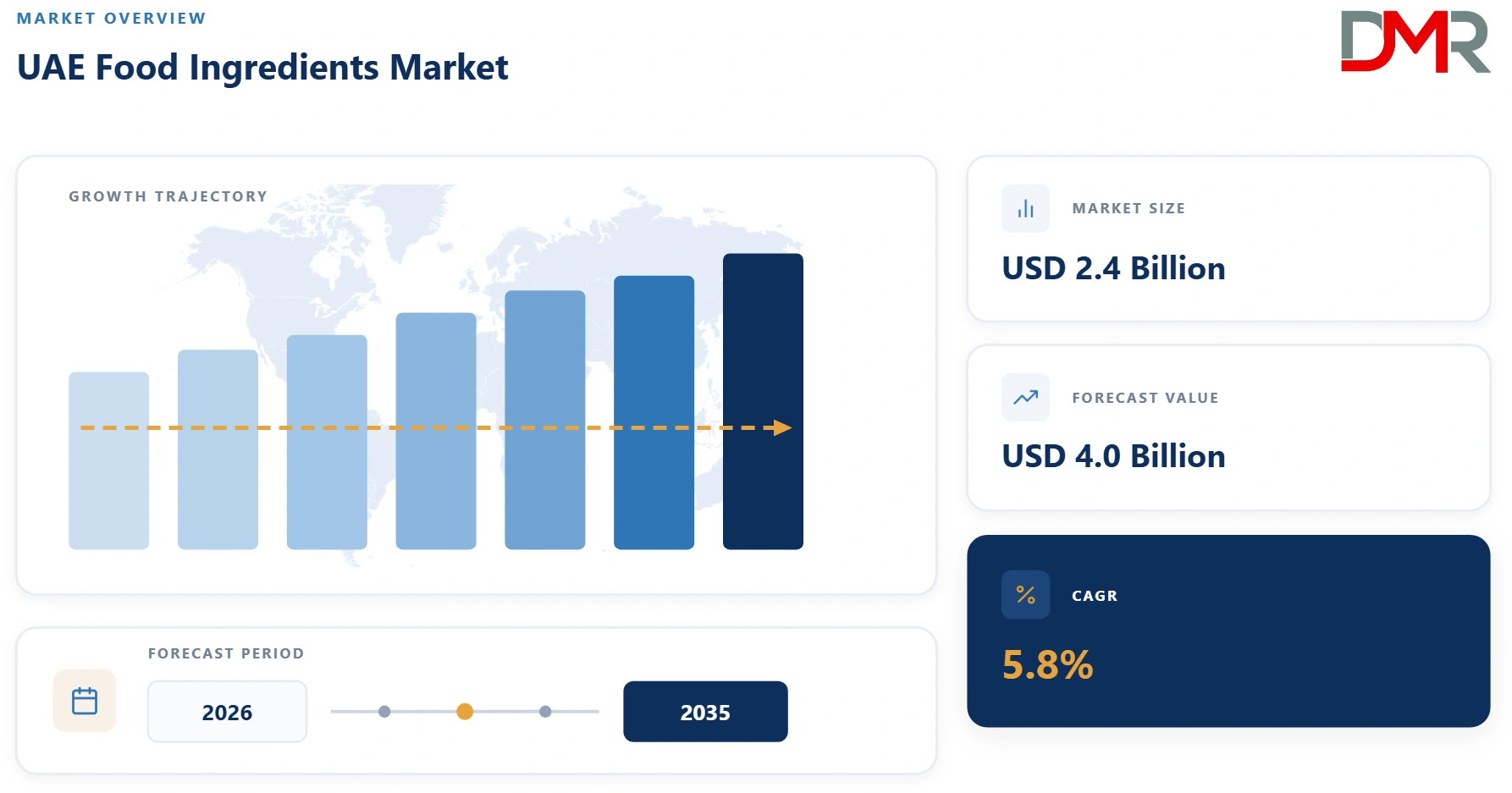
The UAE Food Ingredients Market is projected to reach USD 2.4 billion in 2026 and grow at a compound annual growth rate of 5.8% from there until 2035 to reach a value of USD 4.0 billion.
ℹ
To learn more about this report –
Download Your Free Sample Report Here
The market covers functional, nutritional, sensory, texturizing, preservation, processing, and formulation ingredients supplied to food and beverage manufacturers across the Emirates. Demand is supported by expanding local processing, premium packaged foods, multicultural flavor requirements, hospitality activity, health-focused reformulation, and food security investment. Suppliers increasingly combine imported raw materials with local blending, application support, customization, and distribution capabilities.
Use Cases
- Product Reformulation: Food manufacturers use sweeteners, fibers, proteins, starches, emulsifiers, and natural flavors to reduce sugar, improve nutritional profiles, and meet clean-label expectations without sacrificing taste or texture. Application laboratories help bakery, beverage, dairy, and snack producers optimize ingredient combinations for UAE climatic conditions, halal requirements, manufacturing economics, shelf stability, and diverse consumer preferences across expatriate and Emirati populations.
- Shelf-Life and Stability Enhancement: Preservatives, antioxidants, acidulants, hydrocolloids, stabilizers, and enzymes help processors maintain safety, freshness, consistency, and sensory quality during storage and distribution. These functions are particularly important in the UAE because high temperatures, long imported supply chains, retail display conditions, and foodservice logistics can accelerate deterioration, separation, moisture migration, oxidation, and microbial risks in finished products.
- Functional Nutrition Development: Producers use vitamins, minerals, amino acids, dietary fibers, probiotics, plant proteins, and other bioactive ingredients to formulate fortified beverages, sports nutrition, supplements, infant products, and healthier convenience foods. Growing wellness awareness, active lifestyles, preventive health priorities, and demand for personalized nutrition encourage brands to launch products offering energy, immunity, digestive health, weight management, and healthy aging benefits.
- Localization of Global Products: International and regional manufacturers adapt products for the UAE using date flavors, saffron, cardamom, pistachio, Arabic spice blends, reduced sweetness, and halal-compliant ingredient systems. Localized formulations enable global brands to serve culturally diverse consumers while controlling cost, ensuring regulatory compliance, improving heat stability, and differentiating bakery, confectionery, dairy, beverage, sauce, snack, and ready-meal portfolios.
Key Takeaways
- Market Size: The UAE Food Ingredients Market is anticipated to be valued at USD 2.4 billion in 2026 and is forecast to reach USD 4.0 billion by 2035, expanding at a CAGR of 5.8%.
- Growth Outlook: Market expansion is supported by rising packaged food consumption, domestic manufacturing investment, tourism and hospitality demand, premiumization, multicultural eating habits, clean-label reformulation, functional nutrition, and the UAE’s strategic role as an import, distribution, and re-export center for the wider Gulf region.
- Primary Growth Drivers: Increasing food processing capacity, dependence on imported ingredients, demand for longer shelf life, health-focused product innovation, plant-based alternatives, sugar reduction, halal compliance, rapid foodservice development, and government efforts to improve food security are strengthening ingredient consumption and encouraging localized blending, technical support, and application development.
- By Type Analysis: Fats and Oils is projected to lead the type segment with a 21.8% share in 2026, supported by broad use across bakery, confectionery, dairy, snacks, sauces, convenience foods, and foodservice. Functional and Nutritional Ingredients is expected to record the fastest growth as fortified products, sports nutrition, wellness beverages, and dietary supplements expand.
- By Source Analysis: Plant Based is expected to dominate with a 56.2% share in 2026 because vegetable oils, starches, fibers, natural colors, botanical extracts, plant proteins, gums, and sweeteners serve numerous applications. Microbial Based ingredients are projected to grow fastest, driven by fermentation-derived enzymes, cultures, flavors, vitamins, proteins, and next-generation functional compounds.
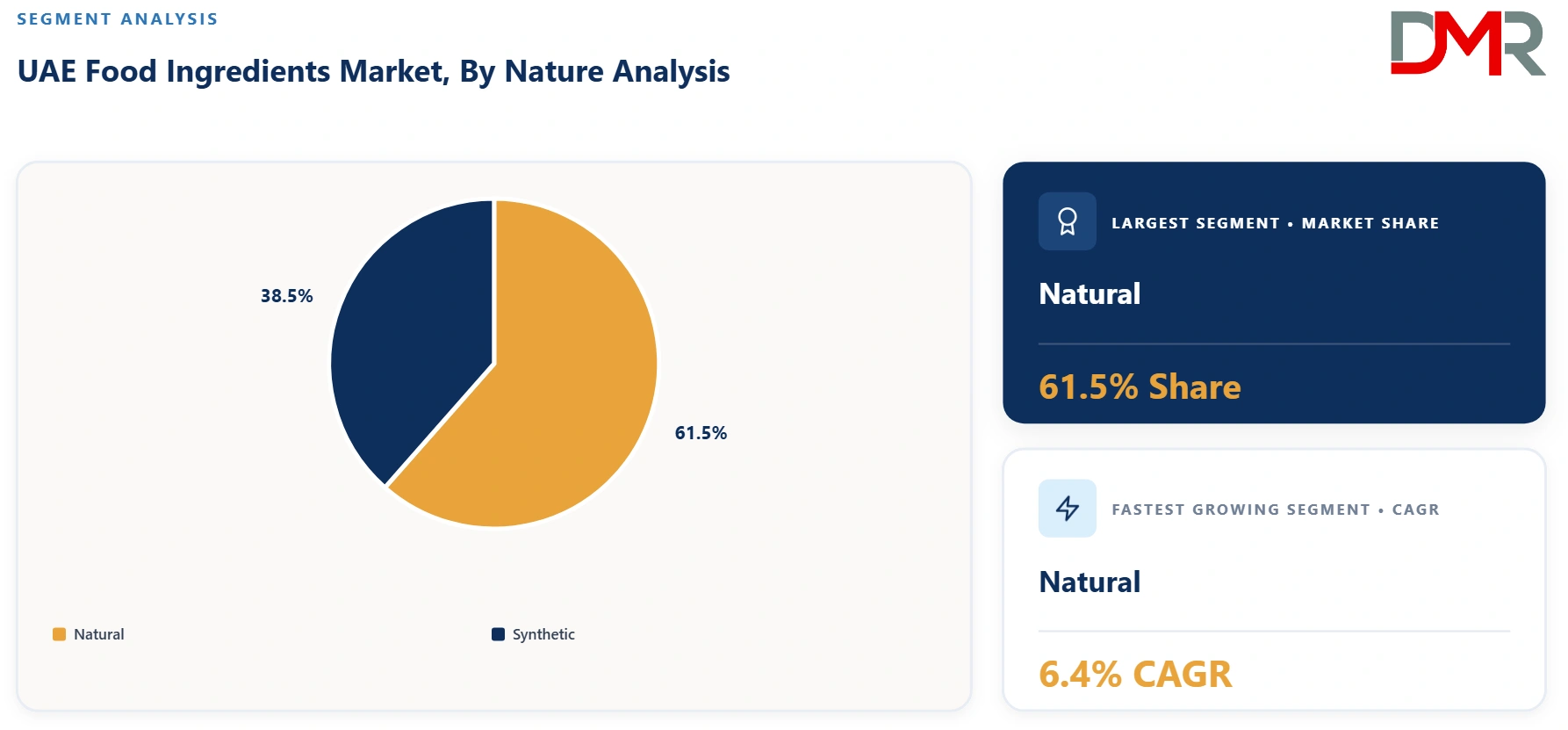
- By Nature Analysis: Natural is anticipated to lead with a 61.5% share in 2026 and record the faster growth through 2035. Consumer preference for recognizable labels, minimally processed foods, botanical flavors, natural colors, plant-derived sweeteners, and preservative alternatives is encouraging manufacturers to replace synthetic systems where performance, availability, regulatory acceptance, and cost permit.
- By Form Analysis: Dry is projected to hold a 58.4% share in 2026 due to storage stability, economical transportation, accurate dosing, and wide use of powders in bakery, beverages, supplements, dairy, and convenience foods. Liquid ingredients are expected to grow fastest because beverage, sauce, dairy, flavor, color, and foodservice applications require rapid dispersion and processing convenience.
- By Application Analysis: Bakery and Confectionery is projected to lead with a 24.6% share in 2026, supported by industrial bakeries, premium desserts, chocolate, snacks, hotel catering, and multicultural consumption. Dietary Supplements and Nutritional Products is expected to achieve the highest CAGR as demand rises for sports nutrition, immunity, healthy aging, weight management, and personalized wellness products.
How AI and Generative AI are Transforming the UAE Food Ingredients Market?
AI and generative AI are accelerating formulation, sensory prediction, quality control, and demand planning across the UAE food ingredients market. Manufacturers can screen ingredient combinations digitally, predict sweetness, texture, stability, and shelf life, and generate recipes tailored to halal, clean-label, nutritional, and cost requirements. Machine vision improves raw material and finished-product inspection, while predictive analytics reduces waste and production downtime. Generative tools also analyze consumer feedback and regional flavor preferences, helping suppliers develop localized concepts faster. Adoption remains dependent on reliable datasets, validation, cybersecurity, skilled personnel, and transparent regulatory documentation.
Key Drivers in the UAE Food Ingredients Market
Expansion of Domestic Food Processing and Food Security Investment
The UAE is strengthening local food production to reduce supply vulnerability and serve domestic and regional demand. The country has more than 570 predominantly small and medium food and beverage processors, creating a broad customer base for oils, starches, flavors, sweeteners, proteins, preservatives, and functional systems. Industrial zones, modern logistics, contract manufacturing, and investment incentives support new processing capacity in bakery, dairy, beverages, snacks, and convenience foods. Local production also requires technical services, customized formulations, and reliable inventories, enabling ingredient distributors and global suppliers to move beyond trading toward blending, application support, and value-added manufacturing.
Multicultural Consumption and Rapid Product Innovation
The UAE’s highly diverse population, strong tourism sector, and internationally oriented foodservice industry create demand for an unusually wide range of tastes, textures, formats, and nutritional claims. Manufacturers require Arabic, South Asian, European, African, and East Asian flavor profiles alongside premium, halal, plant-based, reduced-sugar, and clean-label solutions. Fast product rotation in retail and hospitality encourages shorter development cycles and smaller customized batches. Ingredient companies offering local application laboratories, sensory expertise, regulatory support, and flexible distribution can capture demand from established processors, cloud kitchens, private labels, and emerging wellness brands seeking differentiated products suited to regional preferences and climatic conditions.
Restraints in the UAE Food Ingredients Market
High Import Dependence and Supply-Chain Exposure
Most specialized ingredients and many agricultural raw materials are imported, exposing UAE buyers to freight disruption, currency movements, commodity volatility, supplier concentration, and geopolitical risk. Long lead times can make inventory planning difficult, while heat-sensitive cultures, enzymes, colors, flavors, and nutritional compounds require controlled storage and transportation. Smaller processors may face high minimum-order quantities and limited negotiating power. Building safety stocks improves availability but increases working capital and expiry risk. Suppliers must therefore diversify origins, strengthen cold-chain capabilities, improve forecasting, and develop regional inventories, while manufacturers may reformulate products when specific ingredients become unavailable or commercially unviable.
Regulatory Complexity and Reformulation Costs
Food ingredients must comply with UAE and GCC standards governing permitted additives, maximum use levels, contaminants, labeling, nutrition claims, halal suitability, and product registration. Differences between export-market rules can complicate formulations intended for distribution across the Gulf. Documentation gaps, changing restrictions, or inconsistent ingredient nomenclature may delay approvals and shipments. Replacing an additive requires laboratory trials, sensory testing, stability studies, packaging review, and revised labels, creating costs for smaller manufacturers. Suppliers that cannot provide certificates of analysis, safety data, origin information, halal documentation, and traceability records may lose access despite offering commercially attractive products.
Growth Opportunities in the UAE Food Ingredients Market
Clean-Label and Better-for-You Reformulation
Substantial opportunity exists in natural colors, botanical flavors, plant-based sweeteners, fibers, proteins, fermentation-derived preservatives, and multifunctional texture systems. UAE consumers increasingly examine sugar, fat, sodium, additives, and nutritional value, while brands seek recognizable labels without compromising indulgence or shelf life. Suppliers can create region-specific systems for reduced-sugar beverages, high-protein snacks, fortified bakery, dairy alternatives, and healthier convenience foods. The strongest propositions will combine sensory performance, heat stability, halal compliance, and commercially realistic dosage. Co-development with local processors can shorten launch cycles and create defensible relationships beyond price-based ingredient distribution.
Local Manufacturing, Blending, and Application Centers
The gap between imported bulk materials and application-ready solutions creates white space for local ingredient manufacturing, premixing, blending, repacking, and technical service. Facilities in Dubai, Abu Dhabi, Sharjah, and other industrial hubs can provide shorter lead times, smaller order quantities, customized fortification systems, flavor blends, bakery improvers, beverage compounds, and texturizer solutions. Local application centers can test products under regional production and storage conditions, supporting faster customer approvals. Investments in corn starch, sweeteners, proteins, fermentation, and sustainable oils could also improve resilience and develop the UAE as an export platform serving Saudi Arabia, Oman, Kuwait, Qatar, Bahrain, Africa, and South Asia.
Trends in the UAE Food Ingredients Market
Natural, Plant-Based, and Functional Positioning
Ingredient demand is shifting toward products that combine natural positioning with measurable health or processing benefits. Plant proteins, dietary fibers, natural colors, botanical extracts, low-calorie sweeteners, vitamins, minerals, prebiotics, and functional fats are moving into mainstream beverages, snacks, bakery, dairy alternatives, and supplements. Manufacturers increasingly prefer multifunctional ingredients that improve nutrition, texture, stability, and label simplicity simultaneously. However, natural solutions must withstand high ambient temperatures and extended distribution. Suppliers are responding through encapsulation, fermentation, advanced extraction, and blended systems that deliver consistent performance while meeting halal, allergen, origin, sustainability, and clean-label expectations.
Localization and Premium Sensory Experiences
Food brands are combining international concepts with regional sensory cues such as dates, pistachio, saffron, cardamom, rose, tahini, zaatar, and Arabic coffee. Premium bakery, chocolate, beverages, dairy desserts, sauces, and snacks increasingly use layered flavors, contrasting textures, and visually distinctive natural colors. Limited editions tied to Ramadan, Eid, tourism, and gifting generate additional formulation activity. Ingredient suppliers are developing customized flavor systems, inclusions, fillings, coatings, and texture combinations for these occasions. Success depends on balancing authenticity with scalable production, stable sourcing, affordability, and appeal across the UAE’s diverse consumer base.
Research Scope and Analysis
The UAE food ingredients market covers sweeteners flavors colors preservatives emulsifiers stabilizers hydrocolloids enzymes starches proteins vitamins fibers fats acidulants and functional ingredients, assessed by plant animal microbial and synthetic sources, natural and synthetic nature, dry liquid and paste forms, and bakery beverages dairy snacks convenience foods meat sauces infant nutrition supplements and other applications.
ℹ
To learn more about this report –
Download Your Free Sample Report Here
By Type Analysis
Fats and Oils is expected to dominate the Type segment with 21.8% of market revenue in 2026 due to extensive use across processed foods and foodservice.
Functional and Nutritional Ingredients is projected to record the highest CAGR of approximately 7.3% during 2026–2035, above the overall market CAGR of 5.8%, supported by fortification, sports nutrition, wellness beverages, and preventive health demand.
By Source Analysis
Plant Based is projected to lead the Source segment with a 56.2% share in 2026, supported by the broad availability and versatility of oils, starches, fibers, gums, proteins, colors, flavors, and sweeteners.
Microbial Based is anticipated to expand at the highest CAGR of around 7.1%, as fermentation-derived enzymes, cultures, vitamins, proteins, and flavors gain commercial adoption.
By Nature Analysis
Natural ingredients are expected to dominate the Nature segment with a 61.5% share in 2026, reflecting demand for recognizable labels, plant-derived inputs, natural sensory solutions, and perceived health benefits.
Natural ingredients are also forecast to post the highest CAGR of approximately 6.4%, as manufacturers progressively reformulate synthetic colors, flavors, sweeteners, and preservation systems.
By Form Analysis
Dry ingredients are projected to lead the Form segment with a 58.4% share in 2026 because powders offer storage stability, transportation efficiency, accurate dosing, and broad formulation compatibility.
Liquid ingredients are expected to register the highest CAGR of nearly 6.3%, driven by beverages, sauces, dairy products, liquid flavors, colors, sweetener syrups, and processing convenience.
By Application Analysis
Bakery and Confectionery is anticipated to dominate the Application segment with a 24.6% share in 2026, supported by industrial bakeries, premium confectionery, hospitality, gifting, desserts, and multicultural consumption.
Dietary Supplements and Nutritional Products is projected to grow at the highest CAGR of around 7.5%, due to rising demand for sports nutrition, immunity, healthy aging, and personalized wellness.
The UAE Food Ingredients Market Report is Segmented Based on the Following
By Type
- Sweeteners
- Flavors and Flavor Enhancers
- Food Colors
- Preservatives
- Emulsifiers
- Stabilizers
- Hydrocolloids and Thickeners
- Food Enzymes
- Starches
- Proteins and Amino Acids
- Vitamins and Minerals
- Dietary Fibers
- Fats and Oils
- Acidulants and pH Control Agents
- Functional and Nutritional Ingredients
- Others
By Source
- Plant Based
- Animal Based
- Microbial Based
- Synthetic
By Nature
By Form
- Dry
- Liquid
- Paste or Semi-Solid
By Application
- Bakery and Confectionery
- Beverages
- Dairy and Dairy Alternatives
- Snacks and Savory Products
- Convenience and Processed Foods
- Meat, Poultry and Seafood
- Sauces, Dressings and Condiments
- Infant Nutrition
- Dietary Supplements and Nutritional Products
- Others
Regulatory Landscape
The UAE food ingredients regulatory landscape combines federal legislation, emirate-level registration processes, Gulf standards, Codex principles, halal requirements, and technical rules for additives, contaminants, labeling, and claims. Permitted additives must satisfy approved uses and maximum levels, while suppliers require traceable specifications, certificates of analysis, origin documentation, and appropriate halal evidence. Authorities can restrict particular substances, creating reformulation and inventory risks. Strong compliance capabilities provide an opportunity for suppliers to differentiate through regulatory support and application guidance. Market impact includes longer commercialization timelines, greater testing expenditure, and preference for established distributors able to manage registration, Arabic labeling, customs clearance, quality documentation, and regulatory updates.
Export-Import Analysis
Imports remain central because the UAE has limited domestic agricultural output and depends on overseas supplies of oils, starches, proteins, dairy derivatives, cocoa products, flavors, enzymes, cultures, vitamins, colors, gums, and specialty additives. Dubai and Abu Dhabi ports support distribution throughout the Emirates and re-exports across the GCC, Africa, and South Asia. This hub role creates opportunities for bonded inventories, regional warehouses, blending, repacking, and technical distribution. Risks include freight volatility, port disruption, origin concentration, temperature exposure, and documentation failures. Expanding domestic processing and ingredient manufacturing can reduce selected dependencies, although imported raw materials will continue underpinning market availability and price formation.
Competitive Landscape
The UAE food ingredients market is fragmented across global ingredient producers, regional manufacturers, specialized distributors, and local food groups. International companies compete through broad portfolios, research capabilities, application laboratories, quality consistency, and multinational customer relationships. Regional participants differentiate through local inventories, smaller order quantities, halal-compliant sourcing, regulatory knowledge, and rapid technical support. Competition is shifting from commodity supply toward customized blends, reformulation services, clean-label systems, and functional nutrition. Partnerships with distributors and processors remain important because product registration, logistics, credit terms, and customer proximity strongly influence supplier selection.
Some of the Prominent Players in the UAE Food Ingredients Market Are
- Cargill Incorporated
- Archer Daniels Midland Company
- Kerry Group plc
- International Flavors and Fragrances Inc.
- dsm-firmenich
- Givaudan SA
- Symrise AG
- Ingredion Incorporated
- Tate & Lyle PLC
- BASF SE
- Corbion NV
- Novonesis
- Ajinomoto Co., Inc.
- Roquette Frères
- Kemin Industries, Inc.
- Sensient Technologies Corporation
- Olam Food Ingredients
- AAK AB
- Bunge Global SA
- Louis Dreyfus Company
- Lesaffre
- Puratos Group
- Palsgaard A/S
- Döhler Group
- Brenntag SE
- Azelis Group
- IMCD Group
- Barentz International
- Food Specialities Limited
- REDA Food Ingredients
- Al Ghurair Foods LLC
- IFFCO Group
- Agthia Group PJSC
- Savola Group
- Al Khaleej Sugar Co. LLC
- Tamfood Ingredients
- Al Maya Distribution
- Bidfood Middle East
- Truebell Marketing and Trading LLC
- Univar Solutions Inc.
- Other Key Players
Recent Developments
- November 2025: Al Ghurair Foods introduced its first industrial food ingredients portfolio at Gulfood Manufacturing 2025, including sweeteners, starches, and maltodextrin. The company also announced that its UAE corn starch manufacturing plant was targeted for completion during the first quarter of 2026.
- October 2025: Tamfood Ingredients, part of Tajchem, expanded its partnership with Denico Food Ingredients in the UAE, strengthening localized services, technical support, and access to specialized ingredient solutions for regional food and beverage manufacturers.
- June 2025: USDA’s Food Processing Ingredients Annual reported that the UAE food processing sector comprised more than 570 predominantly small and medium processors, with rising domestic demand sustaining opportunities for local and international ingredient suppliers.
- November 2025: Gulfood Manufacturing brought more than 2,500 exhibitors and over 45,000 professionals to Dubai, providing ingredient companies with a major platform for functional ingredients, flavors, enzymes, stabilizers, sweeteners, clean-label systems, and processing solutions.
Report Details
| Report Characteristics |
| Market Size (2026) |
USD 2.4 Bn |
| Forecast Value (2035) |
USD 4.0 Bn |
| CAGR (2026–2035) |
5.8% |
| Historical Data |
2021 – 2025 |
| Forecast Data |
2026 – 2035 |
| Base Year |
2025 |
| Segments Covered |
By Type, By Source, By Nature, By Form, By Application |
Frequently Asked Questions
How big is the UAE Food Ingredients Market?
▾ The UAE Food Ingredients Market is estimated at USD 2.4 billion in 2026 and is projected to reach USD 4.0 billion by 2035.
What is the CAGR of the UAE Food Ingredients Market from 2026 to 2035?
▾ The UAE Food Ingredients Market is expected to expand at a compound annual growth rate of approximately 5.8% during 2026–2035.
What factors are driving the growth of the UAE Food Ingredients Market?
▾ Growth is driven by local food processing investment, packaged food consumption, tourism, foodservice expansion, multicultural demand, health-focused reformulation, food security programs, and demand for clean-label, functional, and halal-compliant ingredients.
What are the major trends in the UAE Food Ingredients Market?
▾ Major trends include natural ingredients, plant-based formulations, sugar reduction, functional nutrition, fermentation-derived ingredients, localized Arabic flavors, premium sensory experiences, application-specific blends, and AI-assisted product development.
Who are the key players in the UAE Food Ingredients Market?
▾ Key players include Cargill, ADM, Kerry Group, IFF, dsm-firmenich, Givaudan, Symrise, Ingredion, Tate & Lyle, Corbion, Novonesis, Al Ghurair Foods, IFFCO Group, Agthia Group, and regional ingredient distributors.
How is the UAE Food Ingredients Market segmented?
▾ The market is segmented by Type, Source, Nature, Form, and Application, covering sensory, processing, nutritional, preservation, and functional ingredients supplied in dry, liquid, and semi-solid formats to major food and beverage industries.