UAE Food Packaging Market Snapshot
- UAE Food Packaging Market Size in 2026: USD 3.2 Billion
- UAE Food Packaging Market Size in 2035: USD 5.3 Billion
- UAE CAGR from 2026 to 2035: 5.8%
- Plastics is the leading material segment in 2026: 54.8%
- Flexible is the leading type segment in 2026: 48.6%
- Bakery and Confectionery is the leading application segment in 2026: 24.7%
- Paper and Paper-Based is the fastest-growing material segment during 2026–2035: 7.4%
- Meat, Poultry, and Seafood is the fastest-growing application segment during 2026–2035: 6.7%
What is the UAE Food Packaging Market and its Market Size?
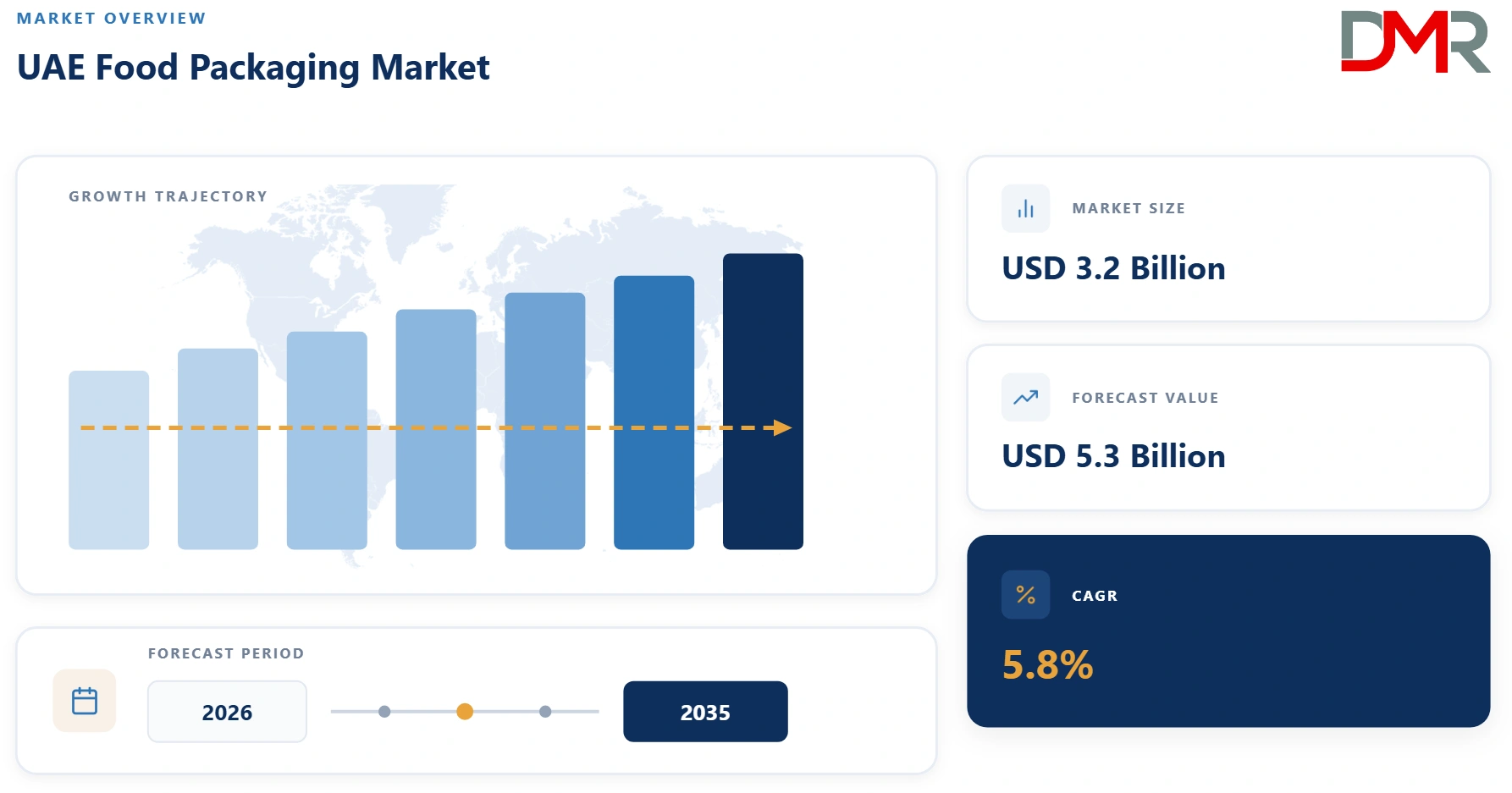
The UAE Food Packaging Market is projected to reach USD 3.2 billion in 2026 and grow at a compound annual growth rate of 5.8% until 2035 to reach a value of USD 5.3 billion.
ℹ
To learn more about this report –
Download Your Free Sample Report Here
Food packaging includes containers, films, pouches, trays, cartons, cans, bottles, wraps, and protective formats used to preserve, transport, display, and distribute food products. UAE demand is supported by packaged-food consumption, tourism, food imports, quick-service restaurants, online grocery platforms, and food delivery. Sustainability regulations are encouraging manufacturers to develop recyclable, reusable, paper-based, lightweight, and mono-material packaging while maintaining food safety, shelf life, barrier performance, and convenience.
Use Cases
- Fresh Produce Protection: Food packaging protects imported and locally produced fruits and vegetables against moisture loss, contamination, bruising, and temperature variations. Ventilated trays, films, cartons, and modified-atmosphere solutions help retailers extend shelf life and reduce wastage. Transparent packaging improves product visibility, while recyclable paperboard and lightweight plastic formats support supermarkets, wholesalers, foodservice distributors, and online grocery platforms operating across the UAE’s demanding climate conditions.
- Meat and Seafood Preservation: Vacuum packs, barrier films, rigid trays, absorbent pads, and modified-atmosphere systems preserve meat, poultry, and seafood during processing, transportation, retail display, and home delivery. These solutions control oxygen and moisture exposure, prevent leakage, reduce microbial risks, and maintain freshness. High-performance packaging is especially important within the UAE because substantial food volumes travel through extended refrigerated import and distribution networks.
- Bakery and Foodservice Packaging: Flexible bags, paperboard boxes, clamshell containers, wraps, and portion packs support bakeries, confectionery producers, restaurants, hotels, cloud kitchens, and takeaway operators. Packaging maintains texture, aroma, hygiene, and visual appeal while enabling branding and convenient handling. Growing delivery demand is encouraging tamper-evident closures, grease-resistant paper, heat-retaining containers, resealable formats, and recyclable alternatives designed for individual portions and family-sized orders.
Key Takeaways
- Market Size: The UAE Food Packaging Market is anticipated to be valued at USD 3.2 billion in 2026 and is forecast to reach USD 5.3 billion by 2035, expanding at a CAGR of 5.8%.
- Growth Outlook: Market expansion is supported by packaged-food consumption, food imports, population growth, tourism, food delivery, modern retail development, premiumization, and increasing demand for convenient, durable, tamper-evident, sustainable, and temperature-resistant packaging.
- Primary Growth Drivers: The growing food-processing industry, expanding quick-service restaurant network, rising supermarket penetration, e-commerce grocery deliveries, demand for extended product shelf life, and regulations restricting selected single-use plastic products are reshaping packaging demand.
- By Material Analysis: Plastics is projected to lead the material segment with a 54.8% share in 2026, supported by its affordability, moisture resistance, durability, light weight, flexibility, and strong barrier properties. Paper and paper-based packaging is expected to register the fastest CAGR as foodservice operators and retailers shift toward recyclable alternatives.
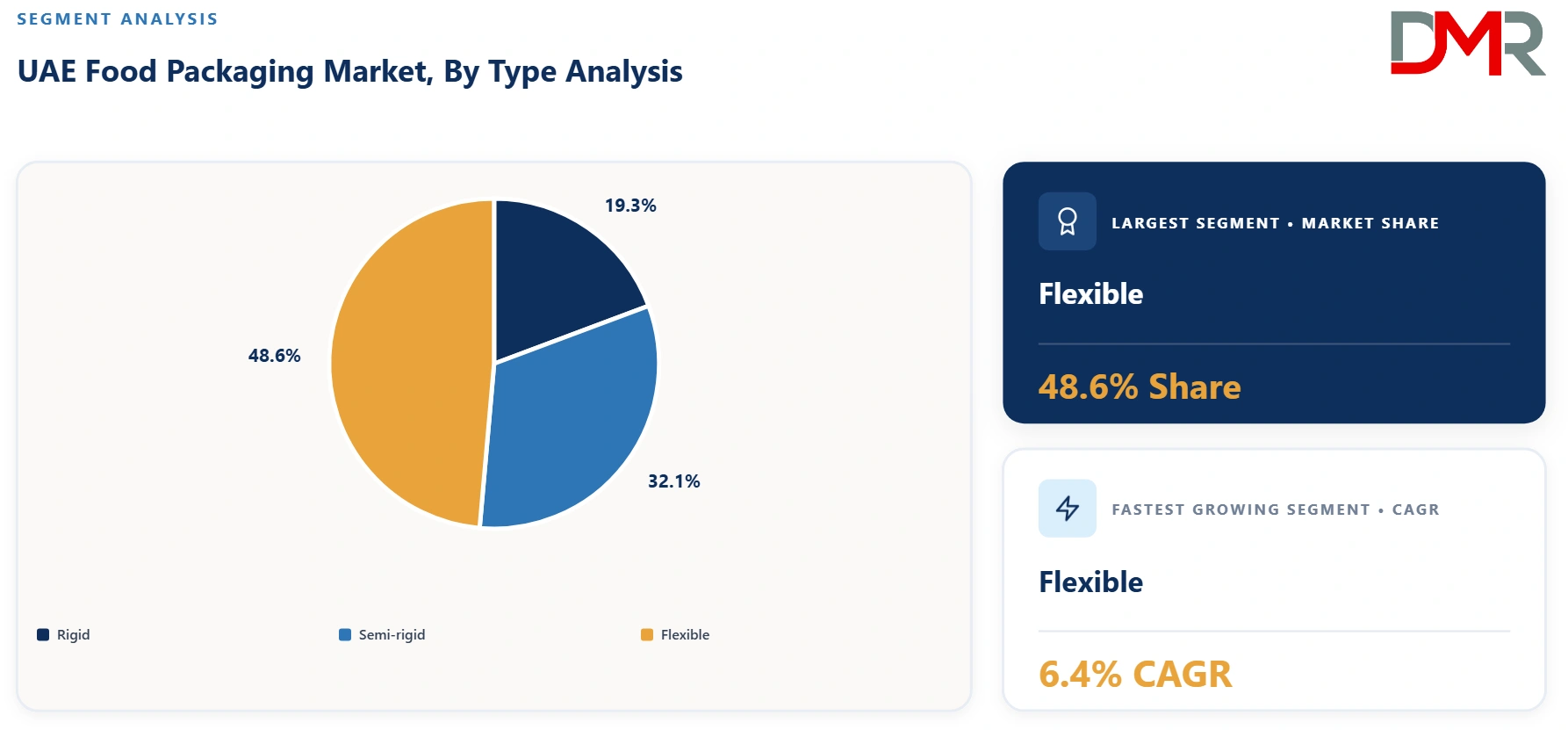
- By Type Analysis: Flexible packaging is anticipated to dominate with a 48.6% share in 2026. Its leadership is supported by lower material consumption, transportation efficiency, strong printability, resealable features, portion control, and suitability for bakery products, confectionery, frozen foods, sauces, snacks, and dairy applications.
- By Application Analysis: Bakery and Confectionery is expected to lead with a 24.7% share in 2026, driven by a substantial expatriate population, tourism, café culture, gifting demand, and widespread availability of packaged bread, cakes, biscuits, chocolates, dates, and premium confectionery. Meat, poultry, and seafood are forecast to achieve the fastest growth.
How AI and GenAI are Transforming the UAE Food Packaging Market?
Artificial intelligence is improving packaging design, inspection, production planning, and supply-chain efficiency across the UAE. Machine-vision systems identify printing errors, weak seals, contamination, and dimensional defects on high-speed lines. Predictive maintenance reduces machinery downtime, while AI-based demand forecasting helps converters optimize resin, paperboard, film, and inventory requirements. Generative AI accelerates package artwork, structural concepts, multilingual labeling, and customized marketing designs. Intelligent sorting systems can improve material recovery, while digital twins help manufacturers evaluate lightweight formats and production changes before commercial deployment, reducing material waste, development expenses, and time to market.
Key Drivers in the UAE Food Packaging Market
Expanding Packaged-Food Consumption and Foodservice Activity
Retail sales of packaged food in the UAE reached USD 7.68 billion in 2025 and are forecast to grow at 5.4% annually through 2030. Staple foods generated USD 2.7 billion, while dairy products contributed USD 2.3 billion in 2025. This expanding consumption increases demand for pouches, trays, cartons, cups, films, and containers across retail and foodservice channels. Rising household incomes, multinational food brands, convenience-oriented lifestyles, and growing online grocery adoption are increasing the number of packaged items sold through supermarkets, convenience stores, restaurants, and delivery platforms.
Tourism and Hospitality Sector Expansion
Dubai welcomed 15.70 million international visitors between January and October 2025, representing 5% year-on-year growth, following a record 18.72 million visitors in 2024. High visitor volumes support hotels, restaurants, cafés, catering businesses, entertainment venues, and quick-service outlets, creating sustained demand for portion packs, takeaway containers, bakery boxes, cups, lids, foodservice films, and premium presentation packaging. Growing airline catering, events, exhibitions, and luxury hospitality further stimulate specialized packaging requirements. Suppliers benefit from demand for hygienic, leak-resistant, tamper-evident, heat-retaining, visually attractive, and increasingly sustainable packaging suitable for high-volume commercial food operations.
Restraints in the UAE Food Packaging Market
Volatility in Raw Material and Import Costs
Packaging manufacturers remain exposed to fluctuations in polyethylene, polypropylene, aluminum, paper pulp, glass inputs, inks, adhesives, and energy prices. Although the UAE has access to domestic petrochemical feedstocks, many specialized films, coatings, machinery components, and paper grades are imported. Freight disruptions and currency movements can increase production costs and complicate procurement planning. Food producers and restaurant operators frequently resist price increases, creating margin pressure for converters. Smaller suppliers face greater challenges because they purchase limited material volumes and possess weaker negotiating power. Maintaining safety, barrier performance, and regulatory compliance while controlling prices restricts rapid adoption of advanced sustainable materials.
Recycling Limitations and Performance Trade-offs
The transition toward circular packaging is constrained by inconsistent collection, sorting, washing, and food-grade recycling capabilities. Multilayer films deliver excellent moisture, oxygen, grease, and aroma protection but can be difficult to recycle through conventional systems. Paper-based formats may require coatings that complicate recovery, while compostable materials need dedicated processing conditions. Alternative packaging can also provide lower heat resistance, shorter shelf life, or higher unit costs than established plastic formats. Manufacturers must therefore balance recyclability with food safety, climatic conditions, transportation requirements, and consumer convenience. Unclear disposal behavior can further reduce the practical environmental benefits of redesigned packaging.
Growth Opportunities in the UAE Food Packaging Market
Recyclable Paper and Mono-Material Packaging
Restrictions on selected single-use products are creating opportunities for recyclable paperboard, molded fiber, bagasse, aluminum, reusable containers, and mono-material plastic structures. Packaging suppliers can develop grease-resistant food boxes, fiber trays, recyclable pouches, paper lids, and lightweight rigid containers adapted to local foodservice requirements. Brands increasingly require solutions that reduce material use while retaining moisture, oxygen, and temperature performance. Local production of compliant alternatives can shorten lead times and reduce import dependence. Companies providing environmental testing, life-cycle assessment, certification, recycled-content verification, and recycling-compatible designs can secure partnerships with retailers, hotels, restaurant chains, food processors, and government-linked organizations.
Smart and Active Packaging Solutions
High-value fresh foods, imported meat, seafood, dairy products, and premium confectionery create opportunities for intelligent and active packaging. Time-temperature indicators, freshness sensors, antimicrobial films, oxygen absorbers, QR codes, and near-field communication labels can enhance traceability and quality monitoring. Connected packaging allows consumers to verify origin, ingredients, halal certification, authenticity, storage instructions, and recycling guidance. Producers can use serialized codes for inventory visibility, recall management, and customer engagement. As UAE retailers digitalize their supply chains, packaging companies combining physical protection with real-time data, product authentication, and interactive brand communication can capture premium-margin applications.
Trends in the UAE Food Packaging Market
Shift Away from Selected Single-Use Plastics
Dubai’s final phase of restrictions on specified single-use plastic products became effective on January 1, 2026, covering items including plastic cups, lids, plates, cutlery, and food containers. This transition is accelerating the adoption of paper, molded fiber, bagasse, aluminum, reusable plastics, and other compliant substitutes. Foodservice companies are redesigning packaging portfolios, consolidating suppliers, and requesting documentation on material composition and recyclability. Converters are investing in barrier coatings and fiber-forming capabilities to address performance gaps. The regulation is expected to reshape foodservice packaging more rapidly than packaging used for factory-sealed retail food.
Lightweight Flexible and Convenience-Oriented Formats
Flexible pouches, lidding films, sachets, flow wraps, vacuum bags, and stand-up packs are gaining adoption because they consume less material and provide attractive shelf presentation. Resealable zippers, easy-open features, spouts, portion packs, and microwave-compatible structures respond to convenience-focused households and delivery channels. Suppliers are also replacing difficult-to-recycle multilayer laminates with polyethylene- or polypropylene-based mono-material structures. Digital printing supports short production runs, multilingual artwork, seasonal packaging, and brand personalization. However, converters must ensure that lightweight structures withstand high temperatures, extended transportation, and repeated handling without compromising sealing strength, food safety, or product shelf life.
Research Scope and Analysis
UAE food packaging market research covers materials including plastics paper and paper based glass metals and others, packaging types including rigid semi rigid and flexible, applications covering fruits and vegetables bakery and confectionery dairy products meat poultry and seafood sauces dressings and condiments and others, revenue trends segment shares competitive positioning growth drivers restraints opportunities forecasts.
ℹ
To learn more about this report –
Download Your Free Sample Report Here
By Material Analysis
Plastics is projected to dominate the material segment with a 54.8% share in 2026, supported by low cost, durability, moisture resistance, and broad application compatibility. Paper and paper-based packaging is expected to register the fastest CAGR of approximately 7.4%, as regulations and corporate sustainability commitments accelerate demand for recyclable and fiber-based formats.
By Type Analysis
Flexible packaging is expected to lead the type segment with a 48.6% share in 2026, owing to its lightweight construction, strong barrier performance, reduced transportation cost, and suitability for portioned products. Flexible packaging is also projected to record the fastest CAGR of approximately 6.4%, supported by growth in pouches, films, wraps, resealable packs, and mono-material structures.
By Application Analysis
Bakery and Confectionery is anticipated to dominate the application segment with a 24.7% share in 2026, driven by packaged bread, desserts, dates, chocolates, biscuits, and premium gifting products. Meat Poultry and Seafood is projected to register the fastest CAGR of approximately 6.7%, supported by food imports, cold-chain expansion, retail modernization, and demand for vacuum and modified-atmosphere packaging.
The UAE Food Packaging Market Report is Segmented Based on the following:
By Material
- Plastics
- Paper and Paper-Based
- Glass
- Metals
- Others
By Type
- Rigid
- Semi-rigid
- Flexible
By Application
- Fruits and Vegetables
- Bakery and Confectionery
- Dairy Products
- Meat, Poultry, and Seafood
- Sauces, Dressings and Condiments
- Others
Regulatory Landscape
The UAE food packaging regulatory landscape emphasizes food-contact safety, product labeling, material conformity, waste reduction, and restrictions on selected disposable products. Dubai’s phased single-use products framework began with plastic bags and expanded to additional plastic foodservice items, encouraging substitution with reusable and lower-impact alternatives. Regulations create opportunities for paperboard, molded fiber, bagasse, aluminum, and compliant reusable products but increase testing, redesign, certification, and sourcing expenses. Suppliers must monitor differences in implementation across emirates and verify migration, hygiene, labeling, and disposal claims. Companies providing documented compliance, traceable materials, recyclable designs, and reliable performance can strengthen relationships with multinational food brands, retailers, hotels, and restaurant chains.
Technology Analysis
Food packaging technology in the UAE is shifting toward high-barrier mono-material films, modified-atmosphere packaging, vacuum systems, aseptic formats, active packaging, digital printing, and connected labels. Automation improves forming, filling, sealing, inspection, coding, and palletizing while lowering contamination risks and labor dependency. Digital printing enables short runs, personalized branding, seasonal designs, and bilingual information without substantial plate costs. Smart labels and QR codes support traceability, authenticity, temperature monitoring, and consumer engagement. However, investment costs, technical skills, food-contact approval, cybersecurity, and compatibility with recycling infrastructure remain challenges. Suppliers integrating performance, sustainability, data visibility, and scalable production can capture premium opportunities across fresh food, dairy, meat, and foodservice applications.
Competitive Landscape
The UAE Food Packaging Market combines domestic manufacturers, regional converters, multinational packaging companies, raw-material suppliers, and specialized distributors. Hotpack Global, Falcon Pack, Al Bayader International, Huhtamaki, Arabian Packaging, and Arabian Flexible Packaging maintain significant regional visibility. Competition centers on pricing, food-contact compliance, printing quality, delivery speed, sustainable materials, customization, barrier performance, and production scale. Large players are investing in recyclable structures, automation, geographic expansion, and capacity consolidation, while smaller converters compete through short production runs, responsive customer service, and customized foodservice packaging.
Some of the Prominent Players in the UAE Food Packaging Market Are
- Hotpack Global
- Falcon Pack
- Al Bayader International
- Arabian Packaging
- Arabian Flexible Packaging
- Huhtamaki
- Tetra Pak
- SIG Group
- Amcor
- Mondi
- Sealed Air Corporation
- Berry Global
- Sonoco Products Company
- Crown Holdings
- Ball Corporation
- CANPACK
- Napco National
- Emirates National Factory for Plastic Industries
- Taghleef Industries
- Integrated Plastics Packaging
- Amber Packaging Industries
- Al Ghurair Printing and Publishing
- Gulf East Paper and Plastic Industries
- Queenex Corrugated Carton Factory
- Universal Carton Industries
- Ras Al Khaimah Packaging
- Multipack Industries
- Future Pack
- Gulf Packaging Industries
- Precision Plastic Products Company
- Cosmoplast
- Harwal Group
- Unipack Containers and Carton Products
- Rotopak
- Printopack
- Swiss Pac UAE
- Corys Packaging
- Gulf Carton Factory
- Al Jawda Plastic Industries
- Al Areen Packaging Industries
- Other Key Players
Recent Developments
- May 2026: Gulf Islamic Investments completed a minority investment in UAE-based Hotpack Global Holding. The investment is intended to support international expansion, manufacturing development, and the company’s position in food packaging and related disposable products.
- August 2025: Napco National, through its Dubai-based subsidiary Napco Investment, acquired Arabian Flexible Packaging. The transaction expanded Napco’s UAE manufacturing presence and strengthened its rotogravure printing and flexible-substrate capabilities across polypropylene, polyester, nylon, polyethylene, aluminum foil, and paper.
- May 2024: Huhtamaki announced the consolidation of its three flexible-packaging manufacturing sites in the UAE. The company retained its Jebel Ali facility and expanded its Ras Al Khaimah operation to improve production efficiency and regional market coverage.
- December 2025: Dubai Municipality confirmed that the final phase of Dubai’s single-use plastic restrictions would become effective from January 1, 2026. The covered categories include selected cups, lids, plates, cutlery, food containers, and tableware, accelerating demand for alternative packaging materials.
Report Details
| Report Characteristics |
| Market Size (2026) |
USD 3.2 Bn |
| Forecast Value (2035) |
USD 5.3 Bn |
| CAGR (2026–2035) |
5.8% |
| Historical Data |
2021 – 2025 |
| Forecast Data |
2026 – 2035 |
| Base Year |
2025 |
| Segments Covered |
By Material, By Type, By Application |
Frequently Asked Questions
How big is the UAE Food Packaging Market?
▾ The UAE Food Packaging Market is expected to reach USD 3.2 billion in 2026 and is projected to attain USD 5.3 billion by 2035.
What is the CAGR of the UAE Food Packaging Market from 2026 to 2035?
▾ The UAE Food Packaging Market is expected to expand at a compound annual growth rate of 5.8% between 2026 and 2035.
What factors are driving the growth of the UAE Food Packaging Market?
▾ Growth is driven by packaged-food consumption, tourism, food imports, food delivery, organized retail, hospitality expansion, shelf-life requirements, sustainability regulations, and demand for convenient packaging.
What are the major trends in the UAE Food Packaging Market?
▾ Major trends include recyclable paper packaging, mono-material films, lightweight formats, molded-fiber containers, digital printing, smart labels, active packaging, tamper-evident designs, and reduced use of selected single-use plastics.
Which material segment dominates the UAE Food Packaging Market?
▾ Plastics is projected to dominate with a 54.8% share in 2026, supported by affordability, durability, light weight, moisture resistance, and extensive application suitability.
Which application segment holds the largest market share?
▾ Bakery and Confectionery is expected to lead with a 24.7% share in 2026, supported by packaged bakery products, premium confectionery, dates, tourism, cafés, and gifting demand.
Who are the key players in the UAE Food Packaging Market?
▾ Key players include Hotpack Global, Falcon Pack, Al Bayader International, Arabian Packaging, Huhtamaki, Tetra Pak, SIG, Amcor, Mondi, Arabian Flexible Packaging, and Napco National.
How is the UAE Food Packaging Market segmented?
▾ The market is segmented by material into plastics, paper and paper based, glass, metals, and others, by type into rigid, semi-rigid, and flexible, and by application into major food categories.