Market Snapshot
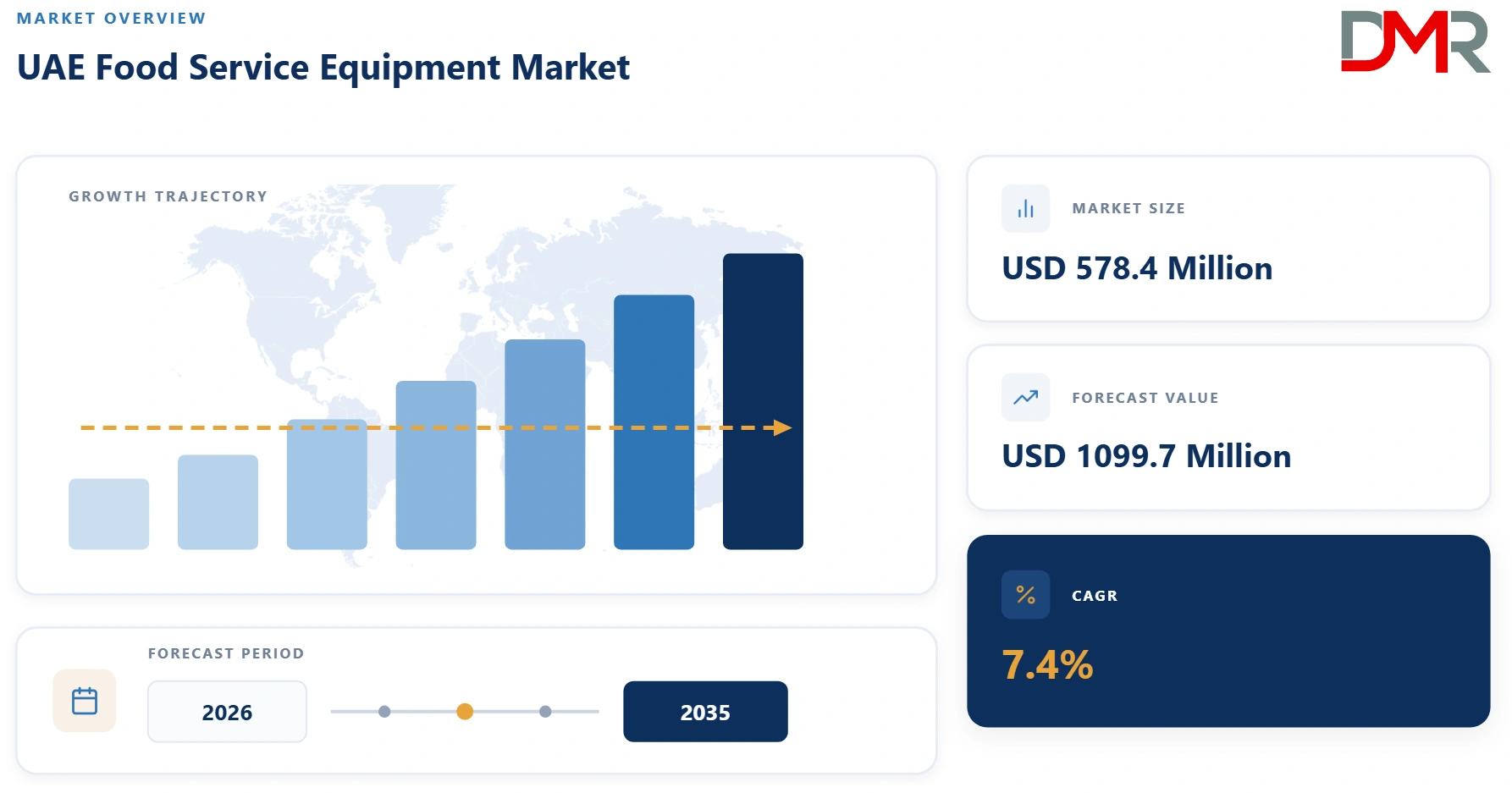
- Market Size (2026): USD 578.4 Mn
- Forecast Value (2035): USD 1099.7 Mn
- CAGR (2026-2035): 7.4%
- Leading Equipment Type (2026): Cooking Equipment, approximately 31.8%
- Leading End User (2026): Full Service Restaurants, around 28.4%
- Key Players: The Middleby Corporation, Electrolux Professional Group, RATIONAL AG and others
What is UAE Food Service Equipment Market and its Market Size?
The UAE Food Service Equipment Market size is estimated to reach USD 578.4 Mn in 2026 and is further anticipated to reach USD 1099.7 Mn by 2035, at a CAGR of 7.4%. Food Service equipment covers the commercial machinery and systems used to cook, chill, prepare, wash, hold, dispense and serve food and beverages in professional kitchens. The scope includes equipment purchased for restaurants, hotels, resorts, catering operations, cafes, bakeries, cloud kitchens and institutional kitchens.
ℹ
To learn more about this report –
Download Your Free Sample Report Here
The sizing represents equipment demand generated inside the United Arab Emirates, not the worldwide revenue of manufacturers or distributors headquartered in the country. It includes new installations, replacement purchases and major equipment upgrades, while excluding consumer kitchen appliances, tableware, disposable Food Service items and building construction work. Turnkey kitchen projects are captured to the extent that their value relates to equipment supply rather than civil works.
Demand is concentrated in Dubai and Abu Dhabi because these emirates carry the largest clusters of hotels, restaurants, malls, tourism assets and institutional kitchens. Sharjah and the Northern Emirates contribute through restaurant expansion, catering facilities, central kitchens, manufacturing and distribution activity. Buyers increasingly evaluate lifecycle electricity consumption, water use, ventilation load, service coverage, spare parts availability and equipment footprint alongside the initial purchase price.
Structural change is being driven by combi ovens, induction systems, connected refrigeration and automated warewashing. High temperatures keep refrigeration performance important, while suppliers combining installation and after-sales service are gaining an advantage over transaction-only sellers.
Use Cases
- Luxury Hotel Production Kitchens: Hotel engineering and culinary teams deploy high-capacity cooking, refrigeration, warewashing and banquet holding systems to support multiple outlets and event kitchens. Integrated equipment layouts reduce movement, improve service consistency and allow central production to support restaurants, room service and banqueting from a coordinated back-of-house operation.
- Quick Service Restaurant Networks: QSR operators standardize fryers, griddles, holding cabinets, beverage dispensers and compact preparation equipment across multiple outlets. Repeatable equipment packages shorten store commissioning, simplify staff training and make maintenance inventories easier to manage when brands expand across malls, transport hubs and residential catchments.
- Cloud and Delivery Kitchens: Delivery-focused operators deploy modular cooking lines, cold storage and space-efficient preparation equipment where throughput per square meter matters more than dining capacity. Flexible equipment layouts allow multiple virtual brands to share infrastructure, helping operators add menus or adjust production volumes without rebuilding an entire kitchen.
- Institutional Catering Facilities: Hospitals, schools, staff canteens and large labor accommodations use batch cooking, food holding, dishwashing and temperature-controlled storage systems to serve predictable meal volumes. Equipment selection prioritizes hygiene, durability, portion consistency and service continuity because kitchen downtime can disrupt feeding schedules across large user populations.
Key Takeaways
- Market Size & Share: Refrigeration Equipment is expected to represent approximately 24.6% of 2026 revenue, reflecting the UAE climate and the need for reliable cold-chain control inside professional kitchens.
- Equipment Type Analysis: Cooking Equipment is projected to hold around 31.8% of 2026 market share, supported by frequent restaurant openings, replacement of thermal equipment and demand for multifunction cooking platforms.
- Demand Concentration: Hotels and Resorts are expected to account for close to 22.7% of 2026 revenue, with large properties purchasing diversified equipment packages for restaurants, banquets, pastry, room service and staff kitchens.
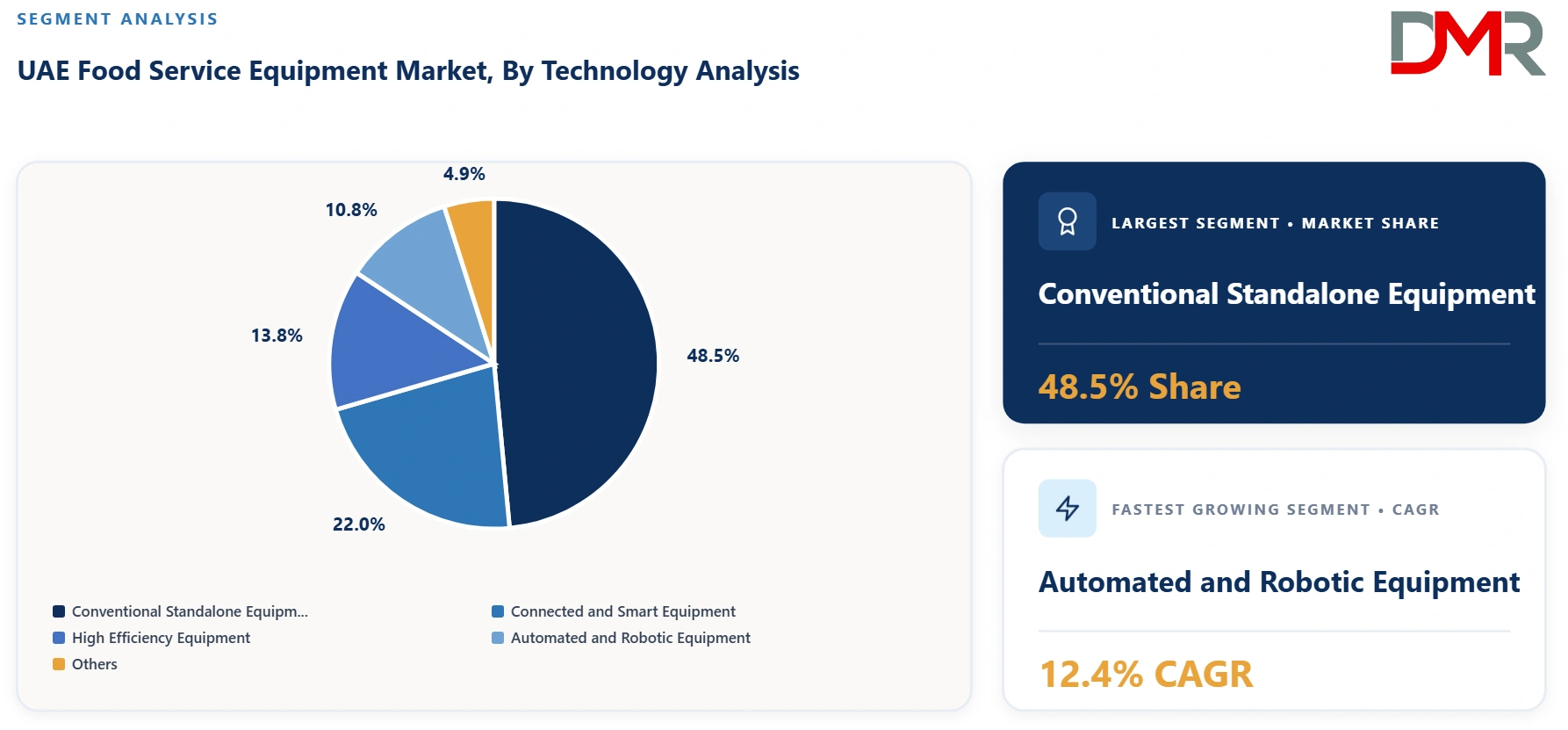
- Technology Shift: Automated and Robotic Equipment is forecast to expand at a CAGR of 12.4% from 2026-2035 as operators seek higher throughput with fewer repetitive manual tasks.
- Channel Evolution: Online and E-Commerce sales are projected to grow at a CAGR of 11.1% from 2026-2035, especially for standardized replacement items and smaller commercial appliances.
- Power Transition: Electric equipment is expected to capture approximately 55.6% of 2026 demand as induction, electric ovens and connected appliances gain preference in new projects and retrofit kitchens.
How AI/Gen AI is Transforming the UAE Food Service Equipment Market?
AI adoption in professional kitchens is practical rather than purely generative. Connected ovens, refrigeration systems and warewashers collect operating data for predictive maintenance and energy optimization. Computer vision can monitor cooking consistency and tray loading, while demand forecasting can align equipment use with expected meal volumes.
Generative AI has a growing role around equipment rather than inside the hardware. LLM-based tools can organize manuals and service histories, while digital twins can test kitchen workflows before fit-out. The commercial value comes from reducing downtime and simplifying service work across multi-site estates.
- Predictive Maintenance: Machine learning models use temperature, cycle, vibration and error-code data to flag equipment that may require service before a breakdown interrupts kitchen operations.
- Energy Optimization: AI scheduling can coordinate ovens, refrigeration defrost cycles and warewashing loads around peak demand, helping large kitchens reduce avoidable electricity consumption.
- Digital Kitchen Design: Digital twins and generative design tools can compare layouts, workflow paths and equipment combinations before procurement, reducing redesign risk in space-constrained projects.
- Service Knowledge Support: LLM document processing can search manuals, parts catalogs and service records so technicians identify likely faults and required components more quickly.
Key Drivers in the UAE Food Service Equipment Market
Growth is being supported by two structural forces: continued expansion of hospitality and Food Service capacity, and a replacement cycle that favors efficient multifunction equipment. Both mechanisms increase equipment value per kitchen rather than relying only on outlet count.
Hospitality, Tourism and Restaurant Capacity Expansion
Full Service Restaurants are expected to represent approximately 28.4% of 2026 market revenue, making new restaurant and hotel capacity a direct equipment demand engine. Dubai and Abu Dhabi continue to add dining concepts across hotels, malls, mixed-use districts and tourism destinations. Each opening requires a combination of cooking, refrigeration, preparation, warewashing and holding systems, while premium properties often specify higher-capacity or specialized equipment. The driver extends beyond initial fit-out because hospitality groups periodically refurbish kitchens to match new concepts, menu changes and productivity targets. Suppliers with turnkey design and commissioning capability therefore benefit from both new-build and renovation pipelines.
Efficiency and Replacement Economics in Commercial Kitchens
Electric equipment is projected to account for around 55.6% of 2026 demand as operators focus on controllability, ventilation requirements and lifecycle operating cost. High electricity use, labor constraints and limited kitchen footprints make older single-function equipment harder to justify when newer ovens, induction systems and connected refrigeration can deliver more output from less space. Replacement spending is also supported by the need to reduce unplanned downtime in high-volume kitchens. Operators increasingly evaluate energy consumption, water use, cleaning cycles and serviceability at procurement stage, shifting purchasing toward equipment that can demonstrate measurable operating savings over a multi-year life.
Restraints in the UAE Food Service Equipment Market
Market expansion is constrained by high upfront investment and by a supply structure that remains dependent on imported brands, components and specialist service capabilities. These factors affect smaller operators more strongly than large hospitality groups.
High Capital Cost and Uneven Payback for Advanced Equipment
Automated and Robotic Equipment represents only around 8.1% of 2026 technology demand despite its strong growth outlook. The gap reflects the capital burden of robotics, smart controls, premium combi ovens and high-efficiency refrigeration, especially for independent restaurants with limited financing capacity. Savings from labor, utilities and waste can be attractive, but payback depends on utilization, menu stability and maintenance discipline. A small operator may therefore choose a lower-cost conventional unit even when a connected alternative has better lifecycle economics. This slows technology substitution and keeps price competition intense in the mid-market.
Import Exposure, Service Complexity and Spare Parts Risk
Distributors and Dealers are expected to hold close to 42.6% of 2026 sales because the UAE relies heavily on channel partners to stock imported equipment, manage warranty support and source replacement components. That model creates exposure to freight costs, currency movements, lead-time variability and manufacturer-specific parts availability. A delayed control board, compressor or heating component can keep a commercial unit offline even when the core equipment remains usable. Buyers therefore favor suppliers with local inventories and technical teams, but maintaining those capabilities raises channel costs and can widen the price gap between supported premium brands and lower-cost imports.
Growth Opportunities in the UAE Food Service Equipment Market
White space is strongest where operators need compact capacity, recurring service support and digitally enabled equipment rather than simply more floor space. Cloud kitchens and lifecycle service models are especially attractive.
Cloud Kitchens and Compact Multi-Brand Production
Cloud Kitchens account for roughly 6.4% of 2026 end-user demand but are forecast to expand at a CAGR of 10.2% from 2026-2035. Their equipment needs differ from conventional restaurants because production density, ventilation, rapid menu switching and delivery throughput matter more than front-of-house presentation. Suppliers can address this segment with modular cook lines, countertop automation, compact refrigeration, holding systems and lease-friendly equipment packages. Multi-brand kitchens also value rapid repairs because one failed appliance can affect several virtual concepts at the same site.
Equipment-as-a-Service and Digital After-Sales Support
Connected and Smart Equipment is expected to represent approximately 21.4% of 2026 technology demand, creating a base for subscription maintenance, remote diagnostics and performance monitoring. Distributors can bundle preventive service, spare parts, software updates and energy reporting into multi-year contracts. This can reduce initial capital pressure while creating recurring supplier revenue, especially for hotel groups, QSR networks and institutional operators managing similar equipment across multiple sites.
Trends in the UAE Food Service Equipment Market
Purchasing behavior is shifting toward multifunction equipment, connected serviceability and electrification. These trends alter kitchen design choices even when total Food Service floor area changes only modestly.
Multifunction Cooking and Space Compression
Cooking Equipment is anticipated to hold approximately 31.8% of 2026 equipment-type revenue, but the mix within the category is moving toward programmable ovens, combi systems, induction units and compact appliances that can perform several functions. High occupancy costs limit back-of-house expansion, so multifunction equipment can replace several dedicated appliances with fewer units and fewer cleaning points. This trend favors manufacturers that combine cooking intelligence, automatic cleaning and repeatable recipe control with strong local training support.
Electrification, Connectivity and Data-Based Maintenance
High Efficiency Equipment is projected to account for close to 17.8% of 2026 technology demand as owners look beyond purchase price toward utility use and equipment uptime. Electric and connected systems can provide precise control, remote fault alerts and usage data that support preventive maintenance. The value is especially relevant for refrigeration and high-load cooking, where long operating hours magnify energy and maintenance costs. Procurement teams increasingly ask for energy specifications, service response commitments and digital monitoring capability.
Research Scope and Analysis
Segment performance is assessed across equipment type, end user, technology, sales channel and power source. Each axis identifies where 2026 revenue is concentrated and which sub-segment is moving fastest through 2035, linking the result to procurement economics, operating conditions and changing kitchen formats.
ℹ
To learn more about this report –
Download Your Free Sample Report Here
By Equipment Type
Cooking Equipment is projected to hold the largest equipment-type share in 2026 at approximately 31.8%, reflecting the fact that every restaurant, hotel kitchen and catering facility requires a core thermal line and that ovens, fryers, ranges and grills carry meaningful unit values. Menu diversification also encourages buyers to add specialized or multifunction thermal equipment during refurbishments. Growth, however, is concentrated in Refrigeration Equipment, which is forecast to expand at a CAGR of 8.6% from 2026-2035. Hot ambient conditions, tighter temperature control expectations and the expansion of delivery-oriented formats increase the need for reach-ins, cold rooms, blast chillers and under-counter refrigeration. Connected temperature monitoring and higher-efficiency compressors further support replacement demand where operators seek lower operating cost and improved food safety assurance.
By End User
Full Service Restaurants are expected to lead end-user demand in 2026 with around 28.4% of revenue because the UAE has a dense mix of independent dining concepts, international brands and restaurants embedded in hotels and malls. These venues typically buy broader equipment packages than beverage-led outlets and refresh kitchens when concepts or menus change. The steeper trajectory sits with Cloud Kitchens, expanding at a CAGR of 10.2% from 2026-2035 as delivery economics encourage centralized production and multi-brand operations. Their growth pulls demand toward compact ovens, modular cook lines, holding cabinets and dense refrigeration configurations. Faster commissioning and flexible layouts are important because cloud-kitchen operators may add or remove brands without changing the entire facility.
By Technology
Conventional Standalone Equipment is projected to retain the largest technology share in 2026 at close to 48.5%, supported by a large installed base, straightforward maintenance and lower acquisition cost for independent operators. Standardized mechanical or digitally controlled units remain attractive where buyers prioritize reliability over integration. Growth, however, is concentrated in Automated and Robotic Equipment, forecast to rise at a CAGR of 12.4% from 2026-2035. Labor productivity pressure, recipe consistency and high throughput are encouraging selective automation in frying, beverage preparation, warewashing and food handling. Adoption will be strongest where repetitive processes justify the capital cost, while remote diagnostics and software-based control make advanced equipment easier to manage across multi-site restaurant and hotel portfolios.
By Sales Channel
Distributors and Dealers are expected to account for approximately 42.6% of 2026 sales because local channel partners bridge international brands with UAE buyers through specification, stocking, installation, warranty support and parts availability. Their role is especially important when a project combines equipment from several manufacturers and requires coordinated commissioning. The fastest growth is expected in Online and E-Commerce, with a CAGR of 11.1% from 2026-2035. Digital purchasing is becoming more practical for standardized appliances, replacement units, accessories and smaller food-preparation equipment where technical specification is clear. Large projects will remain consultative, but online catalogues, transparent pricing and rapid delivery can take a larger share of repeat purchases by restaurants, cafes and small catering operators.
By Power Source
Electric equipment is set to represent the largest power-source share in 2026 at nearly 55.6%, supported by broad availability across ovens, induction systems, refrigeration, warewashing, beverage equipment and countertop appliances. Electric systems are also easier to integrate with connected controls and can simplify kitchen layouts where gas infrastructure or extraction constraints are limiting. Electric is additionally forecast to be the fastest-growing power source, expanding at a CAGR of 8.3% from 2026-2035 as induction and high-efficiency electric cooking gain acceptance. Gas will remain important for selected high-heat applications and existing kitchens, but new projects increasingly compare total ventilation, safety, control and maintenance requirements rather than fuel cost alone when choosing the thermal platform.
The UAE Food Service Equipment Market Report is Segmented Based on the Following
By Equipment Type
- Cooking Equipment
- Refrigeration Equipment
- Warewashing Equipment
- Food Preparation Equipment
- Beverage Equipment
- Holding and Serving Equipment
- Others
By End User
- Full Service Restaurants
- Hotels and Resorts
- Quick Service Restaurants
- Cafes and Bakeries
- Catering Services
- Cloud Kitchens
- Institutional Food Service
By Technology
- Conventional Standalone Equipment
- Connected and Smart Equipment
- High Efficiency Equipment
- Automated and Robotic Equipment
- Others
By Sales Channel
- Distributors and Dealers
- Direct Sales
- Project and System Integrators
- Online and E-Commerce
- Others
By Power Source
- Electric
- Gas
- Hybrid
- Alternative and Other Sources
Competitive Landscape
Competition combines international manufacturers with UAE-based distributors, fabricators and turnkey kitchen specialists. Global suppliers compete on thermal performance, refrigeration efficiency, automation, durability and software features, while local firms differentiate through design support, stock availability, fabrication, installation and service response. Channel capability matters because hotel and restaurant projects frequently require multiple equipment brands to be integrated into one kitchen. Large hospitality groups favor standardized global platforms, while independent restaurants often rely on local dealers. Strong strategies combine imported equipment with local parts inventories, preventive maintenance and operator training.
Some of the Prominent Players in the UAE Food Service Equipment Market Are
- The Middleby Corporation
- Electrolux Professional Group
- RATIONAL AG
- HOSHIZAKI Corporation
- Illinois Tool Works Inc.
- Marmon Food Service Technologies
- MEIKO Maschinenbau GmbH & Co. KG
- MKN Maschinenfabrik Kurt Neubauer GmbH & Co. KG
- UNOX S.p.A.
- Alto-Shaam, Inc.
- True Manufacturing Co., Inc.
- Turbo Air Inc.
- Duke Manufacturing
- Fagor Professional
- Franke Group
- La Marzocco International LLC
- Nuova Simonelli S.p.A.
- Winterhalter Gastronom GmbH
- Liebherr-Hausgeräte GmbH
- Sirman S.p.A.
- Paramount Group
- TSSC Kitchen & Laundry Equipment Trading LLC
- Al Laith Kitchen Equipment
- Al Diwan Kitchen Equipment
- Excel Kitchen LLC
- Kitchen Warehouse Trading LLC
- Al Taqah Kitchens & Consultancy
- Bari Kitchen Equipment Trading LLC
- Al Awdah Kitchen Equipments
- Al Tamam Group
- FMD International
- Bait Al Diafa Trading
- R M Kitchen Equipment Factory LLC
- Catania Ref & Kitchen Equipment Ind. LLC
- Ampex Engineering Services LLC
- Fiamma Kitchens and Steel Installations
- Al Quresh Kitchen Equipments
- Al Waha Kitchen Equipment LLC
- Amco Kitchen Equipment Trading LLC
- Alkhayam Kitchen Equipments
- Other Key Players
Recent Developments
- In January 2026, Electrolux Professional completed an acquisition in commercial cooking and continued preparing new food-equipment platforms for broader international rollout, strengthening the product pipeline available to sales organizations and distributors serving markets including the UAE.
- In November 2025, Electrolux Professional presented a strategic roadmap centered on higher-margin innovation and introduced a new modular cooking line, reinforcing competition in programmable electric cooking systems relevant to premium UAE hospitality and institutional kitchens.
- In September 2025, Electrolux Professional announced operating and production efficiency measures intended to improve competitiveness while continuing investment in food equipment innovation, a move that can influence product availability and channel economics across its international markets including the UAE.
- In November 2024, GulfHost in Dubai brought more than 350 exhibitors from over 35 countries together around commercial kitchen, refrigeration, warewashing, automation and energy-saving solutions, giving UAE buyers direct access to a wider equipment and supplier base.
- In October 2024, Evoca Group announced a new representative office in Dubai, expanding its local presence for professional coffee and vending equipment and improving commercial support for hospitality and beverage operators across the UAE and wider region.
- In January 2024, Paramount Group opened a new corporate headquarters and sales center in Sharjah as part of a major investment program, expanding local capacity for Food Service equipment sales, manufacturing, storage and customer support.
| Report Characteristics |
| Market Size (2026) |
USD 578.4 Mn |
| Forecast Value (2035) |
USD 1099.7 Mn |
| CAGR (2026-2035) |
7.4% |
| Historical Data |
2021 - 2025 |
| Forecast Data |
2026 - 2035 |
| Base Year |
2025 |
| Segments Covered |
By Equipment Type, By End User, By Technology, By Sales Channel and By Power Source |
| Regional Coverage |
The UAE |
Frequently Asked Questions
How big is the UAE Food Service Equipment Market?
▾ The UAE Food Service Equipment Market is estimated at USD 578.4 Mn in 2026. Demand covers cooking, refrigeration, warewashing, preparation, beverage, holding and serving equipment purchased for restaurants, hotels, catering operations, cafes, cloud kitchens and institutional Food Service facilities across the Emirates.
What is the growth rate of the UAE Food Service Equipment Market?
▾ The industry is forecast to expand at a CAGR of 7.4% from 2026-2035. Growth is supported by hospitality capacity, restaurant openings, kitchen refurbishment, energy-efficient replacement equipment, connected service models and more compact production formats such as QSR and cloud kitchens.
What is driving demand in the UAE Food Service Equipment Market?
▾ Demand is being driven by hospitality and restaurant expansion together with the need to replace older equipment with higher-productivity systems. Full Service Restaurants are expected to account for approximately 28.4% of 2026 revenue, illustrating the importance of dining outlets to national equipment purchasing.
Who are the key players in the UAE Food Service Equipment Market?
▾ Key participants include The Middleby Corporation, Electrolux Professional Group, RATIONAL AG, HOSHIZAKI Corporation, Paramount Group, TSSC Kitchen & Laundry Equipment Trading LLC and Al Laith Kitchen Equipment. Competition depends on brand performance, local availability, installation capability, parts support and maintenance response.
Which equipment type has the largest share in the UAE Food Service Equipment Market?
▾ Cooking Equipment is expected to hold the leading 2026 share at approximately 31.8%. Restaurants, hotels and catering facilities require ovens, ranges, fryers, grills and other thermal systems as core production assets, while multifunction equipment is increasing value per installed kitchen.
Which end-user segment is growing fastest?
▾ Cloud Kitchens are forecast to grow at a CAGR of 10.2% from 2026-2035. Their expansion supports demand for compact cooking lines, dense refrigeration, holding equipment and modular preparation systems that can support several delivery brands from one production location.
How is technology changing the UAE Food Service Equipment Market?
▾ Connected monitoring, automated cleaning, programmable cooking, predictive maintenance and digital service tools are reshaping equipment selection. Automated and Robotic Equipment is forecast to grow at a CAGR of 12.4% from 2026-2035 as operators seek better throughput, repeatability and labor productivity across professional kitchens.