Market Snapshot
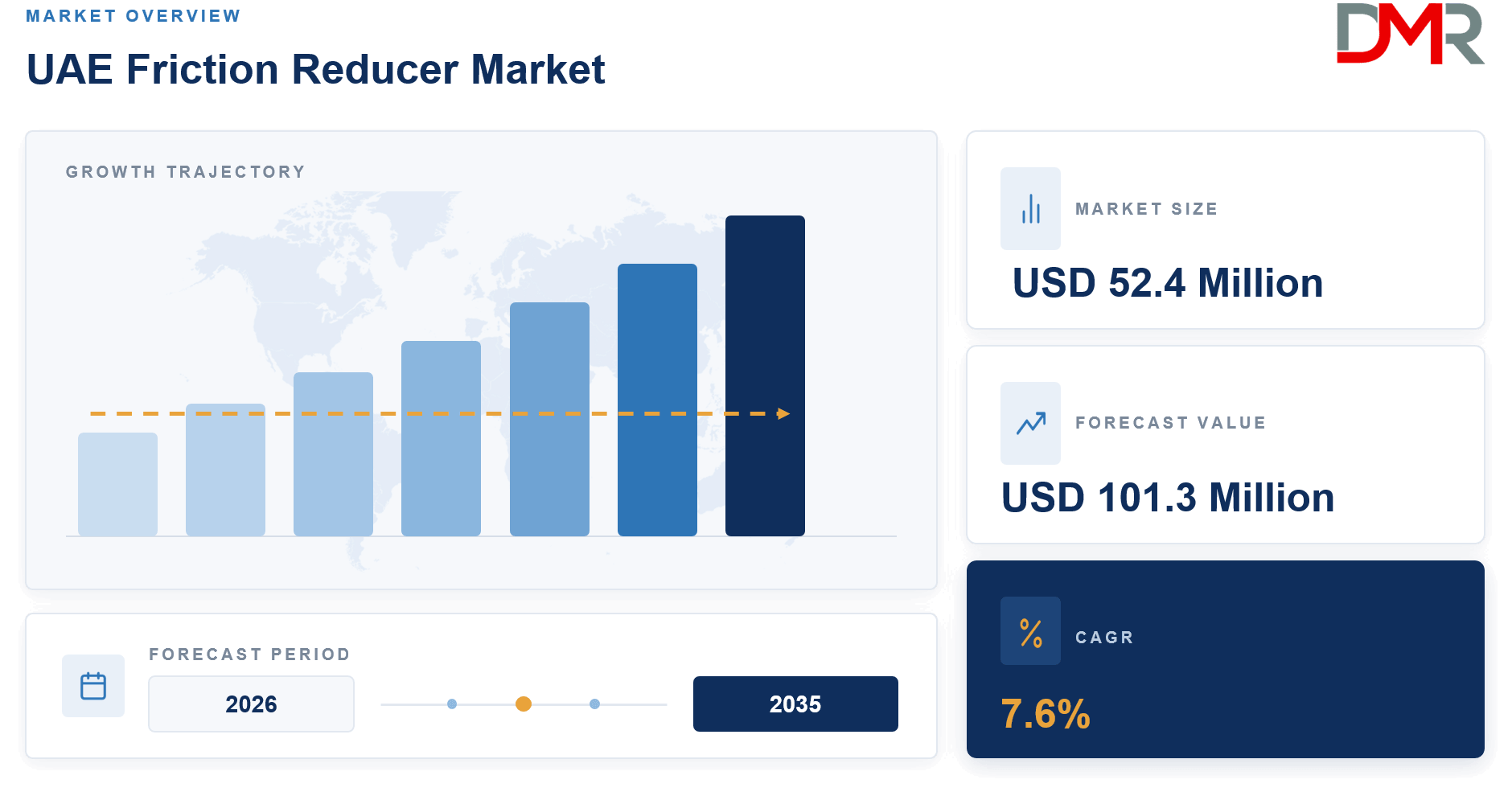
- Market Size (2026): USD 52.4 Mn
- Forecast Value (2035): USD 101.3 Mn
- CAGR (2026-2035): 7.6%
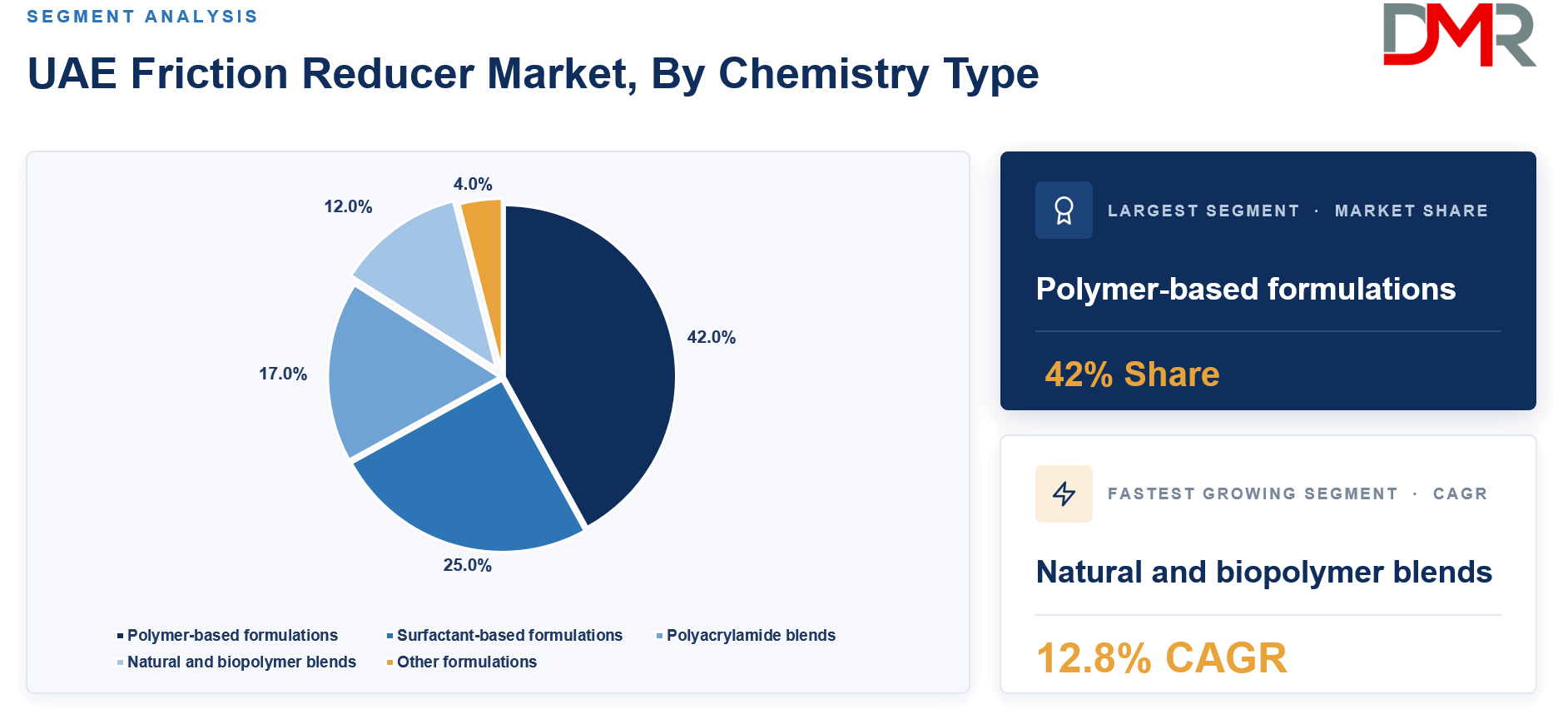
- Leading Chemistry Type (2026): Polymer-based formulations, approximately 42%
- Leading Application (2026): Hydraulic fracturing, around 48%
- Key Players: SLB, Halliburton, Baker Hughes and others
What is UAE Friction Reducer Market and its Market Size?
The UAE Friction Reducer Market size is estimated to reach USD 52.4 Mn in 2026 and is further anticipated to reach USD 101.3 Mn by 2035, at a CAGR of 7.6%.
ℹ
To learn more about this report –
Download Your Free Sample Report Here
The market covers chemical additives used to lower hydraulic resistance in oilfield fluid systems, particularly where operators need to move stimulation, drilling, completion or treatment fluids through surface lines, tubulars and wellbores at controlled pressure. Friction reducers can modify fluid flow behaviour, allowing pumping systems to operate more efficiently and helping service companies maintain targeted treatment rates.
Demand in the UAE is tied closely to upstream activity, well intervention, stimulation programs and the expansion of integrated drilling services. Buyers include national oil and gas operators, drilling contractors, stimulation service providers, drilling-fluid specialists and chemical distributors. Product selection depends on fluid chemistry, salinity, temperature, formation conditions, pumping profile, compatibility requirements and the operator's treatment objective.
The commercial structure is also changing as procurement increasingly favors reliable local supply, technical support and predictable chemical availability. UAE industrial policy encourages in-country manufacturing and local value creation across drilling and production chemicals, while service companies are being pushed to demonstrate measurable field performance rather than simply supplying commodity additives. This supports opportunities for formulators that can combine product consistency with application engineering and responsive field service.
Use Cases
- Hydraulic Fracturing Service Teams: Stimulation contractors use friction reducers to control pressure losses while pumping large fluid volumes into selected well sections. The objective is to sustain treatment rates, manage surface pressure and support efficient placement of treatment fluids under demanding operating conditions.
- Drilling Contractors: Drilling teams apply friction-reducing chemistry where long well sections and complex trajectories increase hydraulic resistance. The treatment can support smoother fluid circulation and help maintain drilling parameters when friction, torque and pressure management become operational constraints.
- Offshore Operators: Offshore production teams require compact chemical programs that can be handled safely around constrained logistics and storage conditions. Friction-reducing additives can support stimulation or well-treatment programs where pumping efficiency and compatibility with existing fluid systems influence intervention economics.
- Chemical Distributors: UAE distributors serve operators and oilfield service companies by maintaining local inventory, handling technical documentation and coordinating delivery to field locations. Their value increases when customers require rapid replenishment, formulation matching and application support rather than a one-time commodity purchase.
Key Takeaways
- Market Size & Share: The UAE market is estimated at USD 52.4 Mn in 2026 and is projected to reach USD 101.3 Mn by 2035.
- Chemistry Type Analysis: Polymer-based formulations are expected to account for approximately 42% of 2026 demand because they offer established friction reduction across major fluid programs.
- Demand Concentration: Onshore oil and gas applications are projected to represent roughly 63% of 2026 revenue, reflecting the scale of UAE drilling and well-development activity.
- Fluid-System Shift: Brine and high-salinity systems are forecast to expand at a 11.2% CAGR from 2026 to 2035 as formulators address challenging water quality and field-fluid conditions.
- Deployment Model: Bulk field dosing is expected to hold close to 39% of 2026 deployment revenue, supported by recurring requirements across larger treatment programs.
- Buyer Priorities: Local availability, formulation compatibility and field technical support are becoming stronger purchasing criteria as UAE procurement emphasizes supply resilience and domestic value creation.
How AI/Gen AI is Transforming the UAE Friction Reducer Market?
AI is influencing the market mainly through operational optimization rather than autonomous chemistry design. Service providers can use machine learning to compare pumping pressure, fluid properties, water quality, treatment concentration and well conditions, helping engineers identify dosing patterns that reduce hydraulic losses without unnecessarily increasing chemical consumption.
Generative AI can also improve the information layer around chemical programs. Large language models can organize technical documents, summarize field reports, compare treatment histories and prepare draft chemical compatibility records for engineering review. The strongest commercial impact comes when these tools are connected to validated operational data and used as decision support rather than as a substitute for laboratory testing or field engineering.
- Predictive Dosing: Machine learning models can estimate friction behaviour from historical treatment and pumping data.
- LLM Document Processing: Generative AI can structure safety data, product specifications, treatment records and customer requirements for faster review.
- Digital Twins: Well and fluid-system models can simulate pressure behaviour before a treatment program is executed.
- Optimization Scheduling: Reinforcement learning can help service teams coordinate chemical delivery, pumping windows and inventory requirements.
Key Drivers in the UAE Friction Reducer Market
Demand is shaped by operating economics and by the increasing need to manage complex well conditions with predictable fluid performance.
- Growing Stimulation and Well Activity: UAE operators are developing conventional and unconventional resources while expanding drilling and integrated well services. This creates recurring requirements for chemical systems that can maintain pumping efficiency across long well sections and treatment stages. Hydraulic fracturing is expected to hold approximately 48% of 2026 application demand, making stimulation performance a major commercial anchor. The mechanism is direct: when fluid resistance rises, available pumping capacity is consumed by pressure loss; a suitable friction reducer can lower that loss and allow the treatment design to operate closer to its intended rate. Suppliers that validate performance across UAE water qualities and temperature conditions can therefore capture repeat orders.
- Pressure on Well Economics: Operators are increasingly evaluating chemical programs through total treatment economics rather than unit price alone. A formulation that reduces hydraulic resistance, improves pumping efficiency or reduces the need for corrective intervention can justify a higher product value when the field outcome is measurable. Onshore oil and gas is projected to represent around 63% of 2026 end-use demand, providing a broad installed base for repeat treatment programs. The resulting demand favours suppliers that can provide consistent concentration control, compatibility testing, field troubleshooting and dependable replenishment, especially where drilling and stimulation schedules leave little tolerance for chemical shortages or reformulation delays.
Restraints in the UAE Friction Reducer Market
Demand is shaped by operating economics and by the increasing need to manage complex well conditions with predictable fluid performance.
- Formulation Compatibility and Water Quality: Friction reducers do not perform uniformly across every fluid system. Salinity, hardness, temperature, shear exposure, additives and formation chemistry can change polymer hydration and flow response. This increases laboratory qualification requirements and can slow product substitution when an operator has already validated a chemistry. Brine and high-salinity systems are expected to be one of the faster-growing pockets, with a projected 11.2% CAGR from 2026 to 2035, but that growth also raises formulation complexity. Suppliers without local testing capability may face longer qualification cycles, higher technical-service costs and greater risk of field underperformance.
- Procurement Concentration and Service Risk: Large upstream buyers can concentrate purchasing through framework contracts and integrated service arrangements, placing pressure on smaller chemical formulators and distributors. ADNOC has used longer-term procurement structures and in-country value requirements to strengthen supply reliability and local manufacturing, which can improve market access for qualified domestic suppliers but also raises the bar for compliance and delivery capability. The effect is a market where product price alone is rarely sufficient: documentation, stock availability, formulation consistency, technical support and local operating capability can determine whether a supplier reaches recurring field demand.
Growth Opportunities in the UAE Friction Reducer Market
Demand is shaped by operating economics and by the increasing need to manage complex well conditions with predictable fluid performance.
- Localized High-Salinity Formulations: A clear white-space opportunity lies in formulations designed around UAE-specific water quality and treatment conditions. Suppliers can differentiate through products validated for high salinity, hardness, elevated temperature and mixed additive packages rather than selling a generic friction reducer. Brine and high-salinity systems represent approximately 13% of 2026 fluid-system demand, leaving room for specialized chemistry to grow faster than the overall category. The commercial opportunity is strongest for manufacturers that pair formulation development with rapid laboratory screening, field trials and documented compatibility with common drilling and stimulation fluids.
- Integrated Chemical Programs: Another opportunity is to bundle friction reduction with broader stimulation and drilling-fluid services. Operators and service contractors can reduce vendor complexity when one supplier provides formulation support, inventory planning, treatment monitoring and troubleshooting. Continuous injection is projected to expand at a 10.6% CAGR through 2035, indicating room for service models that link chemical supply with dosage management. UAE distributors and oilfield service companies are well positioned to build these programs because local presence can shorten response times and allow suppliers to collect operating feedback that improves subsequent formulations and replenishment planning.
Trends in the UAE Friction Reducer Market
Demand is shaped by operating economics and by the increasing need to manage complex well conditions with predictable fluid performance.
- Performance-Based Chemical Selection: Purchasing is shifting from a simple product specification toward demonstrated performance under defined operating conditions. Buyers increasingly compare pressure response, fluid compatibility, treatment concentration, handling requirements and field reliability. This encourages suppliers to maintain application data and develop standardized qualification protocols. Polymer-based formulations remain the leading chemistry type at approximately 42% of 2026 demand, but growth is spreading into specialized blends that address more difficult water and temperature conditions. The trend supports premium positioning for products that solve a defined operating problem rather than competing only on delivered price.
- Local Inventory and Manufacturing: UAE procurement is placing greater emphasis on domestic value creation, supply resilience and shorter replenishment cycles. This is encouraging chemical manufacturers and distributors to establish local stock, blending capability, technical laboratories and stronger customer-service coverage. The trend is commercially important because friction reducers are often purchased within time-sensitive well programs where a delayed chemical delivery can disrupt an entire treatment sequence. Suppliers that combine local inventory with formulation flexibility can therefore compete against larger international vendors even when they lack the same global manufacturing footprint.
Research Scope and Analysis
Segment performance is assessed across five axes: chemistry type, application, fluid system, end use and deployment model. Each axis identifies the sub-segment carrying the largest share of 2026 revenue and the one expanding fastest through 2035, with the commercial reason behind each position.
ℹ
To learn more about this report –
Download Your Free Sample Report Here
By Chemistry Type
Polymer-based formulations are projected to hold the largest chemistry share in 2026, accounting for approximately 42% of revenue because established polymer systems offer predictable drag reduction across a broad range of oilfield fluid programs. Their adoption is supported by operator familiarity, established treatment protocols and service-company experience. Growth, however, is concentrated in natural and biopolymer blends, expanding at a CAGR of 12.8% between 2026 and 2035 as formulators respond to environmental expectations and seek chemistry options that can meet performance requirements with improved handling and degradation characteristics.
By Application
Hydraulic fracturing is expected to carry the largest application share in 2026, at around 48%, because high-rate fluid pumping creates a direct need to manage frictional pressure losses. Service companies can use friction reducers to preserve pumping efficiency while maintaining treatment design. The steeper trajectory sits with acid stimulation, expanding at a CAGR of 10.9% through 2035 as operators apply more targeted intervention programs to mature and complex wells. Suppliers that can maintain performance in acidic and chemically active environments can therefore address a higher-value niche within the wider stimulation market.
By Fluid System
Water-based fluids are projected to dominate by fluid system in 2026, representing close to 56% of revenue because they are widely used across drilling, stimulation and completion programs and offer a large base for friction-control chemistry. Their established operating profile supports repeat procurement. Growth, however, is concentrated in brine and high-salinity systems, expanding at a CAGR of 11.2% between 2026 and 2035 as operators and service companies require formulations that retain activity in difficult water chemistries and variable field conditions.
By End Use
Onshore oil and gas is projected to hold the largest end-use share in 2026, accounting for approximately 63% of revenue because the UAE's extensive onshore drilling and production base creates recurring demand for fluid-treatment chemicals. The installed operational base also supports standardized purchasing and service routines. Growth, however, is concentrated in gas development, expanding at a CAGR of 11.5% from 2026 to 2035 as gas-focused drilling and well-treatment programs increase the need for fluid systems that maintain hydraulic performance across demanding well geometries.
By Deployment
Bulk field dosing is projected to lead deployment in 2026, with a share of roughly 39%, because larger treatment programs often require predictable chemical volumes delivered directly to field operations. The model is supported by established logistics and purchasing practices. The faster trajectory sits with continuous injection, expanding at a CAGR of 10.6% through 2035 as operators seek tighter control over dosage and fluid performance. Automated or semi-automated injection can reduce manual intervention and support more consistent treatment when well conditions change during operations.
The UAE Friction Reducer Market Report is Segmented Based on the Following
By Chemistry Type
- Polymer-based formulations
- Surfactant-based formulations
- Polyacrylamide blends
- Natural and biopolymer blends
- Other formulations
By Application
- Hydraulic fracturing
- Drilling fluid circulation
- Acid stimulation
- Well cleanout and completion
- Other applications
By Fluid System
- Water-based fluids
- Slickwater systems
- Brine and high-salinity systems
- Synthetic-based fluids
- Other fluid systems
By End Use
- Onshore oil and gas
- Offshore oil and gas
- Gas development
- Enhanced recovery and mature-field work
- Other end uses
By Deployment
- Bulk field dosing
- Continuous injection
- Batch treatment
- Pre-blended chemical programs
- Specialty treatment packages
Regulatory Landscape
UAE demand is influenced by ADNOC procurement requirements, industrial localization policies, chemical handling rules and the technical qualification practices applied by oilfield service companies. The market is shifting toward suppliers that can provide documented product specifications, safety documentation, traceable batches and local support while meeting in-country value expectations. The commercial opening is strongest for manufacturers that can blend or stock qualified formulations locally and support customer trials without long import lead times. The main brake is qualification: chemical substitutions can require laboratory checks and field validation before deployment, particularly where formulation changes could affect fluid compatibility or treatment performance. This favors suppliers with technical laboratories, application engineers and established service relationships across Abu Dhabi's upstream ecosystem.
Pricing Analysis
Friction reducer pricing in the UAE is shaped by polymer or surfactant chemistry, concentration, treatment volume, water quality requirements, packaging, logistics and the level of field support included with the chemical program. Standard formulations compete on delivered cost, while specialized products can command stronger value when they solve high-salinity, temperature or compatibility constraints. Local inventory can also reduce the indirect cost of urgent replenishment and help distributors protect customer relationships. The main commercial risk is raw-material volatility combined with framework procurement that places pressure on unit prices. Suppliers therefore need to manage formulation economics carefully while demonstrating the operational value of lower pressure losses, steadier pumping and fewer treatment interruptions.
Competitive Landscape
The competitive landscape combines diversified oilfield service companies, specialty chemical manufacturers, drilling-fluid suppliers and UAE-based distributors. Competition is based on formulation performance, compatibility testing, field validation, technical support, inventory availability and the ability to integrate chemical supply with broader stimulation or drilling services. International suppliers bring broad portfolios and field experience, while UAE-based companies can differentiate through local stock, customer access and faster response. Procurement concentration also favors vendors that can meet documentation and in-country value requirements at scale.
Some of the Prominent Players in the UAE Friction Reducer Market Are
- SLB
- Halliburton
- Baker Hughes
- ChampionX
- Innospec
- Clariant
- BASF
- Dow
- Solvay
- Arkema
- LANXESS
- Ecolab
- Kurita Water Industries
- Kemira
- Veolia Water Technologies
- SUEZ
- Solenis
- Buckman
- Dorf Ketal
- Weatherford
- NOV
- CES Energy Solutions
- Flotek Industries
- Lubrizol
- Nouryon
- SNF
- ADNOC Drilling
- Al Mansoori Specialized Engineering
- Al Ghaith Industries
- IDC Group
- IDC Chem
- Gulfchem Solutions
- REDA Chemicals
- Best Pick General Trading
- Gulf Automation Services & Oilfield Supplies
- Al Ghaith Oilfield Supplies & Services
- Dutco Tennant
- Anglo Gulf FZE
- Crikem
- Fouz Chemical Company
- Other Key Players
Recent Developments
- In May 2026, TA'ZIZ announced long-term agreements across its chemicals portfolio covering offtake, feedstock and sales. The development strengthens the UAE's integrated chemicals ecosystem and can improve the broader domestic supply environment for industrial and oilfield chemical value chains.
- In November 2025, TA'ZIZ announced a major EPC award for a PVC complex at Ruwais. The project reinforces the UAE's move toward larger domestic chemical production and strengthens the industrial base available to downstream chemical users.
- In May 2025, ADNOC announced contracts worth AED543 million for locally made industrial products, including drilling and production chemicals. The awards reinforce local sourcing and create opportunities for UAE-based chemical manufacturers and suppliers.
- In May 2025, ADNOC signed an agreement with Tubacex to localize oilfield technology and establish an R&D technical center in Abu Dhabi. The move strengthens the local oilfield technology ecosystem and supports a broader shift toward domestic technical capability.
Report Details
| Report Characteristics |
| Market Size (2026) |
USD 52.4 Mn |
| Forecast Value (2035) |
USD 101.3 Mn |
| CAGR (2026-2035) |
7.6% |
| Historical Data |
2021 - 2025 |
| Forecast Data |
2026 - 2035 |
| Base Year |
2025 |
| Segments Covered |
By Chemistry Type, By Application, By Fluid System, By End Use, and By Deployment |
| Regional Coverage |
The UAE |
Frequently Asked Questions
How big is the UAE Friction Reducer Market?
▾ The UAE Friction Reducer Market is estimated at USD 52.4 Mn in 2026. The estimate covers demand within the UAE for friction-reducing chemical formulations used in drilling, stimulation, completion and related oilfield fluid programs, rather than worldwide revenue of companies headquartered in the country.
What is the growth rate of the UAE Friction Reducer Market?
▾ The market is projected to expand at a CAGR of 7.6% from 2026 to 2035, reaching USD 101.3 Mn by 2035. Growth is supported by drilling and stimulation activity, greater attention to pumping efficiency, localized chemical supply and demand for formulations suited to complex fluid conditions.
What is driving demand in the UAE Friction Reducer Market?
▾ Demand is primarily driven by upstream drilling, well stimulation and the need to manage hydraulic resistance in fluid systems. Local procurement initiatives also support domestic chemical manufacturing and distribution, improving supply resilience for operators and oilfield service companies that require reliable treatment chemicals.
Which chemistry type leads the UAE Friction Reducer Market?
▾ Polymer-based formulations are expected to lead in 2026, with approximately 42% of market revenue. Their position reflects established use, broad applicability and the familiarity of drilling and stimulation teams with polymer-based friction-control chemistry.
Which application holds the largest share?
▾ Hydraulic fracturing is projected to represent around 48% of 2026 application demand. High-rate pumping creates a direct requirement for friction control, making these formulations valuable for managing pressure losses and supporting the intended treatment rate.
Which fluid system is growing fastest?
▾ Brine and high-salinity systems are forecast to grow at a CAGR of 11.2% between 2026 and 2035. Suppliers are responding with formulations designed to retain friction-reduction performance under higher salinity, hardness and variable water-quality conditions.
Who are the key players in the UAE Friction Reducer Market?
▾ Key players include SLB, Halliburton, Baker Hughes, ChampionX, Innospec, Clariant and UAE-based suppliers such as IDC Chem, Gulfchem Solutions and Al Ghaith Industries. Competition centers on formulation performance, technical service, local availability and procurement qualification.