UAE Gold Jewelry Market Snapshot
- UAE Gold Jewelry Market Size in 2026: USD 6.4 Billion
- UAE Gold Jewelry Market Size in 2035: USD 12.8 Billion
- UAE CAGR from 2026 to 2035: 8.1%
- Necklaces and Pendants is the leading product type segment in 2026: 29.8%
- 22 Karat is the leading purity segment in 2026: 44.6%
- Plain Gold Jewelry is the leading category segment in 2026: 63.1%
- Women is the leading end user segment in 2026: 71.4%
- Gold Souks and Independent Jewelers is the leading distribution channel segment in 2026: 41.9%
What is the UAE Gold Jewelry and its Market Size?
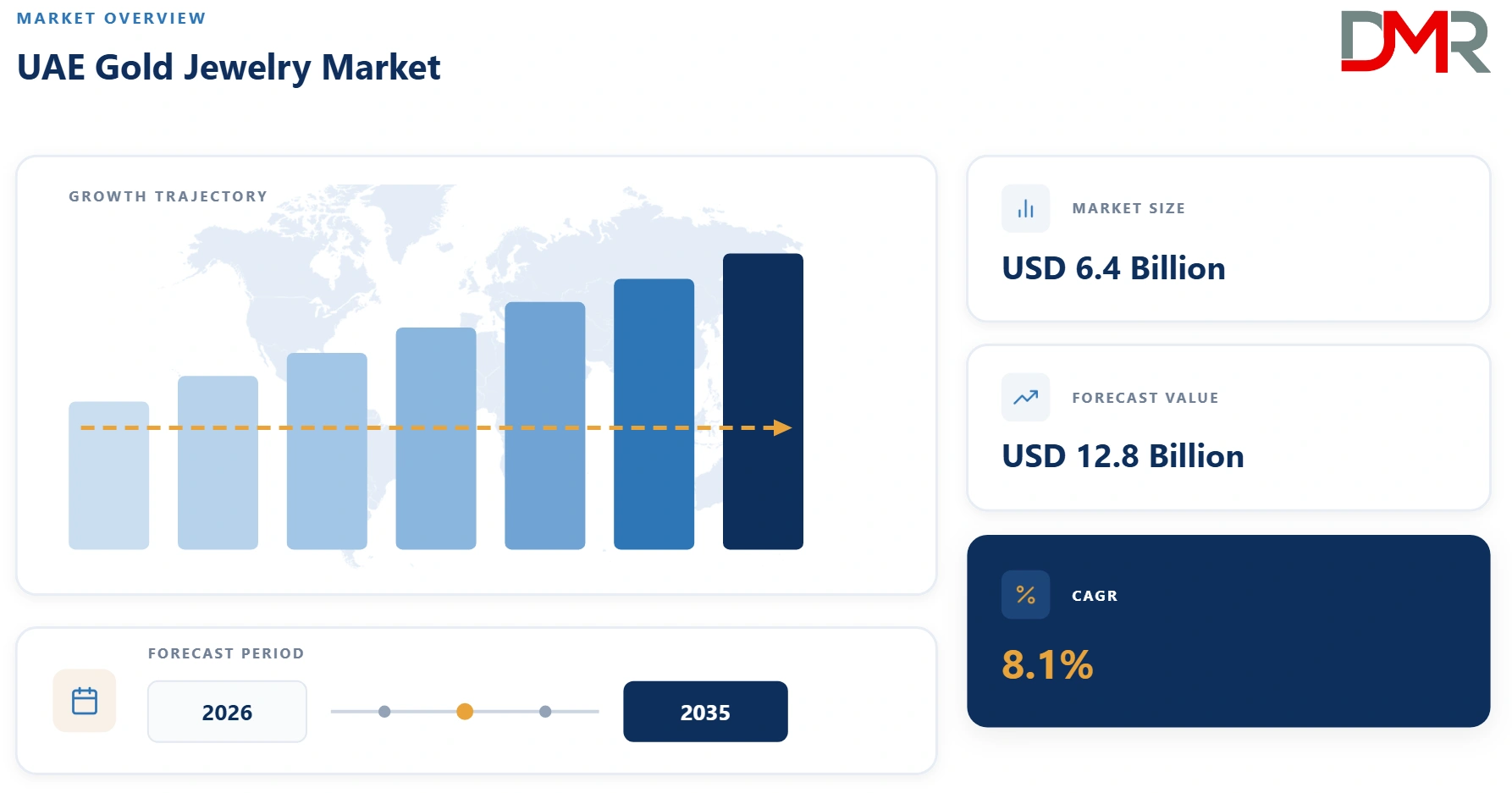
The UAE Gold Jewelry Market is projected to be valued at USD 6.4 Billion in 2026 and is projected to reach USD 12.8 Billion by 2035, expanding at a CAGR of 8.1% during the forecast period.
ℹ
To learn more about this report –
Download Your Free Sample Report Here
Growth is being propelled by the UAE's enduring position as a UAE gold trading and re-export hub, sustained tourist-driven demand centered on Dubai's gold souks, rising disposable incomes among resident and expatriate populations, and the cultural centrality of gold in wedding and gifting occasions across South Asian, Arab, and broader expatriate communities. The expansion of branded retail chains alongside traditional souk jewelers, growing consumer appetite for lightweight and studded designs, and the government's continued positioning of Dubai as the "City of Gold" through duty-free policies and destination shopping festivals are reshaping the market from a purely transactional bullion-adjacent trade into a design-led, brand-conscious retail category. Investment is accelerating as retailers digitize inventory, expand omnichannel purchasing, and introduce hallmarking and traceability standards that strengthen buyer confidence in both domestic and tourist segments.
Use Cases
- Bridal and Wedding Jewelry Sets: Households across South Asian, Emirati, and broader Arab communities purchase large, purity-certified gold sets for weddings, sustaining consistent baseline demand independent of short-term gold price fluctuations.
- Tourist and Duty-Free Gold Purchases: International visitors, particularly from South Asia, Europe, and the CIS region, purchase gold jewelry in Dubai and Abu Dhabi to take advantage of competitive making charges, purity assurance, and duty-free re-export allowances.
- Investment-Linked Gifting for Festivals and Milestones: Residents purchase gold jewelry and coins during festivals such as Diwali, Eid, and during childbirth or graduation milestones, treating jewelry as both adornment and a store of value.
- Lightweight Daily-Wear and Studded Fashion Jewelry: Younger, working professional consumers increasingly purchase lightweight 18 karat and diamond-studded gold pieces for everyday wear, distinct from heavier traditional 22 karat investment-oriented jewelry.
Key Takeaways
- Market Size: The UAE Gold Jewelry Market is anticipated to be valued at USD 6.4 Billion in 2026 and is forecast to reach USD 12.8 Billion by 2035, expanding at a CAGR of 8.1%.
- Growth Outlook: Market expansion is sustained by tourism-linked purchasing, resilient cultural demand for bridal and festival gold, and retailers' expansion into lightweight, studded, and design-differentiated product lines that broaden the category beyond traditional investment buying.
- Primary Growth Drivers: Dubai's positioning as a UAE gold trading and tourism hub, rising expatriate and resident disposable incomes, growing participation of women in independent jewelry purchasing decisions, and continued expansion of hallmarking and purity-certification standards are strengthening consumer confidence and transaction volumes.
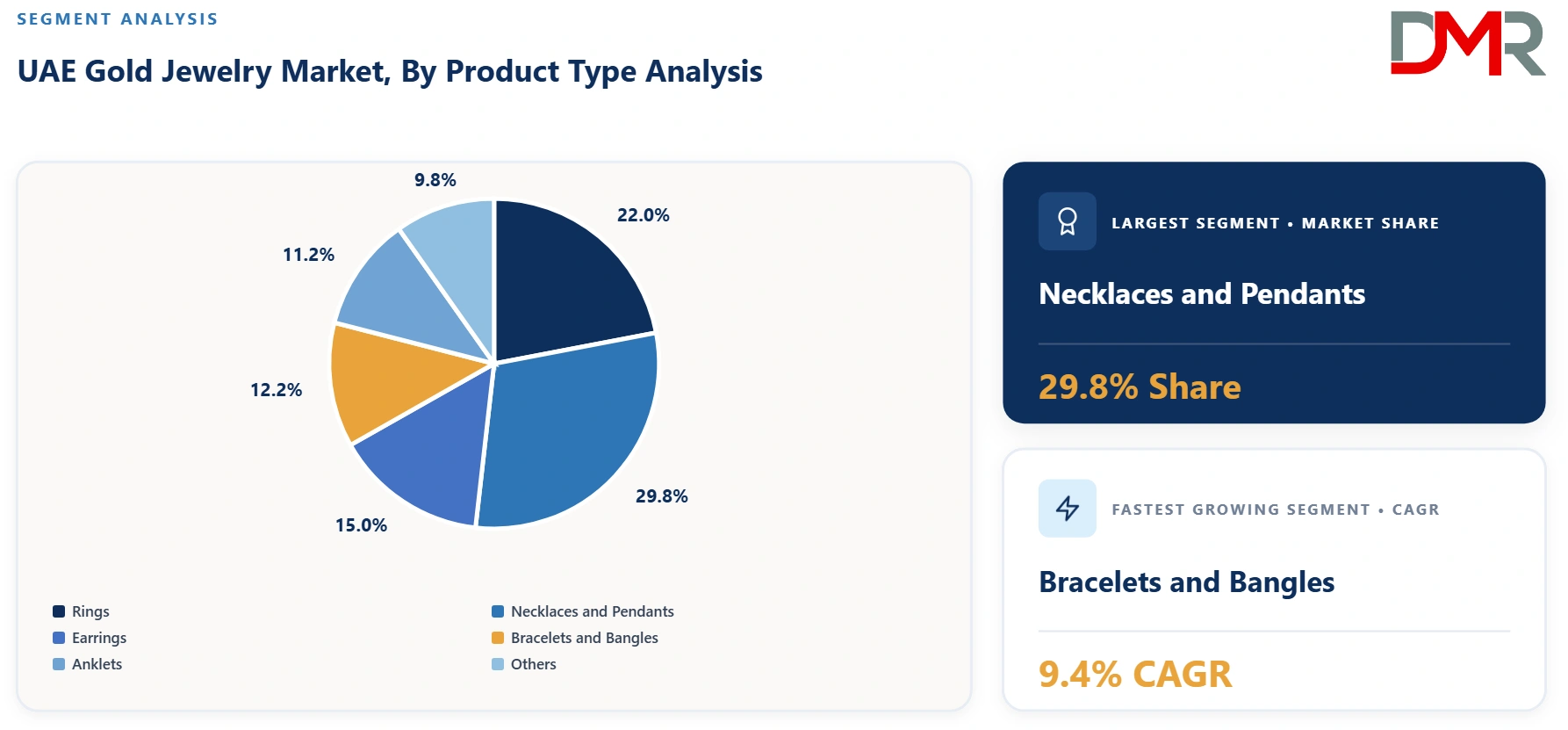
- By Product Type Analysis: Necklaces and Pendants is projected to lead the product segment with a 29.8% share in 2026, reflecting their central role in bridal and gifting purchases. Bracelets and Bangles is the fastest-growing product segment at 9.4% CAGR, driven by rising demand for stackable and everyday-wear designs.
- By Purity Analysis: 22 Karat is expected to dominate with a 44.6% share in 2026, remaining the preferred purity for traditional and investment-oriented jewelry. 18 Karat is projected to exhibit the highest CAGR at 10.2%, as demand grows for lighter, more durable pieces suited to daily wear and studded designs.
- By Category Analysis: Plain Gold Jewelry is poised to lead with a 63.1% share in 2026, reflecting continued preference for purity-led, resale-friendly pieces. Studded/Gemstone-Embedded Jewelry is the fastest-growing category at 11.6% CAGR, driven by rising fashion-led and bridal demand for diamond and colored-stone combinations.
- By End User Analysis: Women are expected to command a 71.4% share in 2026, underpinned by bridal sets, daily-wear pieces, and gifting occasions. Men's Jewelry is the fastest-growing end user segment at 9.8% CAGR, supported by rising demand for gold chains, rings, and bracelets among younger male consumers.
- By Distribution Channel Analysis: Gold Souks and Independent Jewelers are projected to lead with a 41.9% share in 2026, reflecting deep-rooted consumer trust and competitive making charges. Online Retail is the fastest-growing distribution channel at 15.3% CAGR, driven by growing comfort with high-value digital purchases backed by certification and insured delivery.
Key Drivers in the UAE Gold Jewelry Market
Dubai's Established Role as a UAE Gold Trading and Tourism Hub
The UAE's decades-long positioning as a duty-free gold trading center continues to drive growth in the Gold Jewelry Market. Competitive making charges, purity assurance through the Dubai Multi Commodities Centre and municipal hallmarking systems, and the concentration of retail density in areas such as the Gold Souk and Gold Souk Extension attract both resident and tourist buyers. Annual shopping festivals and promotional campaigns tied to gold pricing further stimulate seasonal purchasing spikes. As international travel to the UAE continues to recover and diversify across source markets, tourist-linked gold purchasing is expected to remain a structurally important demand driver.
Rising Female Workforce Participation and Independent Purchasing Power
Growing female workforce participation and independent income among resident and expatriate women are broadening the base of gold jewelry buyers beyond traditional household or occasion-linked purchasing. Consumers increasingly purchase gold jewelry for personal adornment and self-investment rather than exclusively for weddings or gifting. Retailers are responding with lighter, design-forward, and studded collections targeted at working professionals. This shift is expanding purchase frequency and average transaction values across urban centers, particularly Dubai and Abu Dhabi.
Restraints in the UAE Gold Jewelry Market
Gold Price Volatility and Its Effect on Purchase Timing
Fluctuations in international gold prices represent a significant restraint on the UAE Gold Jewelry Market, particularly for investment-weighted 22 and 24 karat purchases. Sharp price increases can delay discretionary purchases or shift consumer preference toward lighter-weight and studded pieces where making charges represent a larger share of value relative to gold content. Retailers must manage inventory and pricing strategies carefully during periods of heightened volatility, and price uncertainty can lengthen purchase decision cycles, particularly for large bridal sets.
Growth Opportunities in the UAE Gold Jewelry Market
Lightweight and Digitally-Enabled Bridal Collections
Rising demand for lighter, more wearable bridal and occasion jewelry presents a meaningful opportunity for retailers able to combine traditional design cues with modern craftsmanship techniques that reduce overall gold weight without compromising visual impact. Retailers offering virtual try-on tools, augmented-reality catalogs, and digitally configurable bridal sets can capture younger, digitally native consumers while maintaining the emotional and cultural significance associated with traditional gold jewelry purchases.
Certified Pre-Owned and Buyback-Linked Retail Models
Growing consumer interest in transparent buyback and exchange programs presents an opportunity for retailers to strengthen customer loyalty and repeat purchasing. Structured buyback models, combined with purity certification and transparent making-charge disclosure, can reduce purchase hesitancy tied to gold's dual role as adornment and investment, supporting longer-term customer relationships and higher lifetime transaction value.
Trends in the UAE Gold Jewelry Market
Expansion of Branded Retail Chains Alongside Traditional Souks
Branded regional and international jewelry chains are steadily expanding their UAE retail footprint alongside long-established independent souk jewelers. Branded retailers differentiate through consistent design language, standardized purity certification, loyalty programs, and omnichannel purchasing experiences, while souk jewelers continue to compete on price transparency, negotiation flexibility, and deep-rooted community trust. This dual-structure retail landscape is expected to persist, with consumers frequently moving between both formats depending on occasion and purchase type.
Growing Integration of Hallmarking, Traceability, and Digital Certification
Increasing consumer and regulatory emphasis on purity assurance and ethical sourcing is driving wider adoption of hallmarking, digital certification, and blockchain-linked traceability tools across the UAE gold jewelry trade. Retailers are increasingly providing digital certificates alongside physical hallmarks to strengthen buyer confidence, particularly for online and tourist transactions where post-purchase verification options may otherwise be limited.
Research Scope and Analysis
The UAE Gold Jewelry Market is segmented by product type, purity, category, end user, and distribution channel, covering rings, necklaces, earrings, bracelets, bangles, anklets, plain and studded jewelry, women's, men's, and children's jewelry, and souk, branded, department store, and online retail channels.
ℹ
To learn more about this report –
Download Your Free Sample Report Here
By Product Type Analysis
Necklaces and Pendants are projected to dominate the UAE Gold Jewelry Market with approximately 29.8% share in 2026, reflecting their prominence in bridal sets and gifting occasions across resident and tourist buyer segments. Bracelets and Bangles are expected to register the highest CAGR of 9.4% during 2026-2035, supported by growing demand for stackable, everyday-wear pieces among younger consumers and rising participation of men in bracelet and chain purchases.
By Purity Analysis
22 Karat jewelry is anticipated to dominate the UAE Gold Jewelry Market by purity, accounting for approximately 44.6% share in 2026, remaining the preferred standard for traditional, bridal, and investment-oriented purchases. 18 Karat jewelry is projected to register the highest CAGR of 10.2% between 2026 and 2035, as demand grows for lighter, more durable pieces better suited to daily wear and combination with diamonds and gemstones.
By Category Analysis
Plain Gold Jewelry is projected to dominate the UAE Gold Jewelry Market with an estimated 63.1% share in 2026, supported by its resale liquidity, cultural familiarity, and straightforward purity-based valuation. Studded/Gemstone-Embedded Jewelry is expected to register the fastest CAGR of 11.6% through 2035, driven by rising bridal and fashion-led demand for diamond and colored-stone combination pieces among younger, design-conscious buyers.
By End User Analysis
Women are expected to lead the UAE Gold Jewelry Market by end user, accounting for approximately 71.4% share in 2026, supported by bridal sets, daily-wear collections, and gifting occasions spanning multiple cultural communities. Men's Jewelry is projected to achieve the fastest CAGR of 9.8% during 2026-2035, driven by rising demand for gold chains, rings, and bracelets, particularly among younger male consumers influenced by regional and UAE fashion trends.
By Distribution Channel Analysis
Gold Souks and Independent Jewelers are projected to dominate the UAE Gold Jewelry Market with approximately 41.9% share in 2026, reflecting deep-rooted consumer trust, competitive making charges, and negotiation flexibility. Online Retail is expected to register the highest CAGR of 15.3% through 2035, driven by growing consumer comfort with high-value digital purchases supported by purity certification, insured delivery, and virtual try-on tools.
The UAE Gold Jewelry Market Report is segmented based on the following:
By Product Type
- Rings
- Necklaces and Pendants
- Earrings
- Bracelets and Bangles
- Anklets
- Others
By Purity
- 24 Karat
- 22 Karat
- 18 Karat
- Others
By Category
- Plain Gold Jewelry
- Studded/Gemstone-Embedded Jewelry
By End User
By Distribution Channel
- Gold Souks and Independent Jewelers
- Branded Retail Chains
- Department and Specialty Stores
- Online Retail
Technology Analysis
Technology adoption is increasingly shaping the UAE Gold Jewelry Market as retailers integrate digital certification, RFID-based inventory tracking, augmented-reality try-on tools, and e-commerce platforms supporting high-value, insured jewelry transactions. Growing use of CAD-based design and precision casting is enabling retailers to offer lighter, more intricate pieces at competitive making charges. Opportunities are expanding for retailers investing in blockchain-linked traceability, virtual bridal consultation tools, and omnichannel inventory integration across souk and branded retail formats. However, technology investment must be balanced against the traditionally relationship-driven, in-person nature of high-value gold purchasing in the region.
Investment and White Space Analysis
Investment opportunities in the UAE Gold Jewelry Market are expanding alongside continued tourism recovery, rising resident disposable incomes, and diversification of the retail base across Dubai, Abu Dhabi, and the northern emirates. Significant white space exists in lightweight bridal collections, men's jewelry lines, certified buyback programs, and digitally-enabled online retail supported by insured logistics. Retailers with strong hallmarking, traceability, and design differentiation are positioned to capture premium segments, while gold price volatility and intense competition among souk jewelers continue to pressure making-charge margins for undifferentiated players.
Competitive Landscape
The UAE Gold Jewelry Market is fragmented and highly competitive, comprising long-established independent souk jewelers, regional branded retail chains, and international luxury jewelry houses. Competition centers on purity assurance, making-charge transparency, design differentiation, and omnichannel purchasing experience. Independent souk jewelers benefit from deep community trust, price negotiation flexibility, and decades of accumulated goodwill, while branded chains leverage standardized quality, loyalty programs, and broader marketing reach. Companies increasingly differentiate through lightweight collection launches, digital certification, buyback programs, and expanded men's and studded jewelry lines.
Some of the prominent players in the UAE Gold Jewelry Market are:
- Damas Jewellery
- Malabar Gold & Diamonds
- Joyalukkas Jewellery
- Pure Gold Jewellers
- Kalyan Jewellers
- Tanishq
- Liali Jewellery
- Jawhara Jewellery
- Taiba Jewellery
- Salem Al Shueibi Jewellery
- Cara Jewellers
- Kanz Jewels
- Sky Jewellery
- Bafleh Jewellery
- Mahallati Jewellery
- La Marquise Jewellery
- Sona Gold & Diamonds
- Meena Jewellers
- Al Romaizan Gold & Jewellery
- Al Zain Jewellery
- Samra Jewellery
- Dhamani Jewels
- Amwaj Jewellery
- Gafla Jewellery
- Mouawad
- L’azurde Company for Jewelry
- FK Jewellery
- Siroya Jewellers
- Mahesh Notandass Fine Jewellery
- Al Manara International Jewellery
- Tiffany & Co.
- Cartier
- Bvlgari
- Van Cleef & Arpels
- Chopard
- Graff
- Harry Winston
- Damiani
- Senco Gold & Diamonds
- Rivoli Group
- Other Key Players
Recent Developments
- May 2025: Malabar Gold & Diamonds strengthened its presence in the UAE by expanding its retail network and introducing new gold jewelry collections targeting bridal, festive, and everyday jewelry demand.
- April 2025: Joyalukkas expanded its UAE retail and product initiatives, emphasizing traditional and contemporary gold jewelry collections while strengthening engagement with resident, expatriate, and tourist customers.
- February 2025: Kalyan Jewellers continued expanding its operations in the UAE, strengthening its showroom network and localized jewelry portfolio to capture growing demand for bridal and occasion-based gold jewelry.
- January 2025: Tanishq strengthened its UAE presence through retail expansion and broader gold jewelry offerings, targeting Indian expatriates and other consumer groups seeking branded, certified, contemporary, and traditional jewelry.
Report Details
| Report Characteristics |
| Market Size (2026) |
USD 6.4 Bn |
| Forecast Value (2035) |
USD 12.8 Bn |
| CAGR (2026–2035) |
8.1% |
| Historical Data |
2021 – 2025 |
| Forecast Data |
2026 – 2035 |
| Base Year |
2025 |
| Segments Covered |
By Product Type, By Purity, By Category, By End User, By Distribution Channel |
| Country Coverage |
UAE |
Frequently Asked Questions
How big is the UAE Gold Jewelry Market?
▾ The UAE Gold Jewelry Market is valued at USD 6.4 Billion in 2026 and is projected to reach USD 12.8 Billion by 2035, reflecting sustained demand for bridal, gifting, and everyday-wear gold jewelry across resident and tourist buyer segments.
What is the CAGR of the UAE Gold Jewelry Market from 2026 to 2035?
▾ The market is projected to expand at a compound annual growth rate (CAGR) of 8.1% between 2026 and 2035, supported by tourism-linked purchasing, rising disposable incomes, and growth in lightweight and studded jewelry demand.
What factors are driving the growth of the UAE Gold Jewelry Market?
▾ Growth is driven by Dubai's established role as a UAE gold trading and tourism hub, rising female workforce participation and independent purchasing power, and expanding hallmarking and purity-certification standards that strengthen buyer confidence.
What are the major trends in the UAE Gold Jewelry Market?
▾ Major trends include the continued expansion of branded retail chains alongside traditional gold souks, growing integration of digital certification and traceability tools, and rising demand for lightweight, studded, and men's jewelry collections.
Who are the key players in the UAE Gold Jewelry Market?
▾ Key market participants include Malabar Gold and Diamonds, Joyalukkas, Damas Jewellery, Kalyan Jewellers, Pure Gold Jewellers, and Rivoli Group, among other regional and international jewelry retailers.
How is the UAE Gold Jewelry Market segmented?
▾ The market is segmented by product type, purity, category, end user, and distribution channel, with demand analysis concentrated across Dubai, Abu Dhabi, and the remaining northern emirates.