UAE Medical AI Market Snapshot
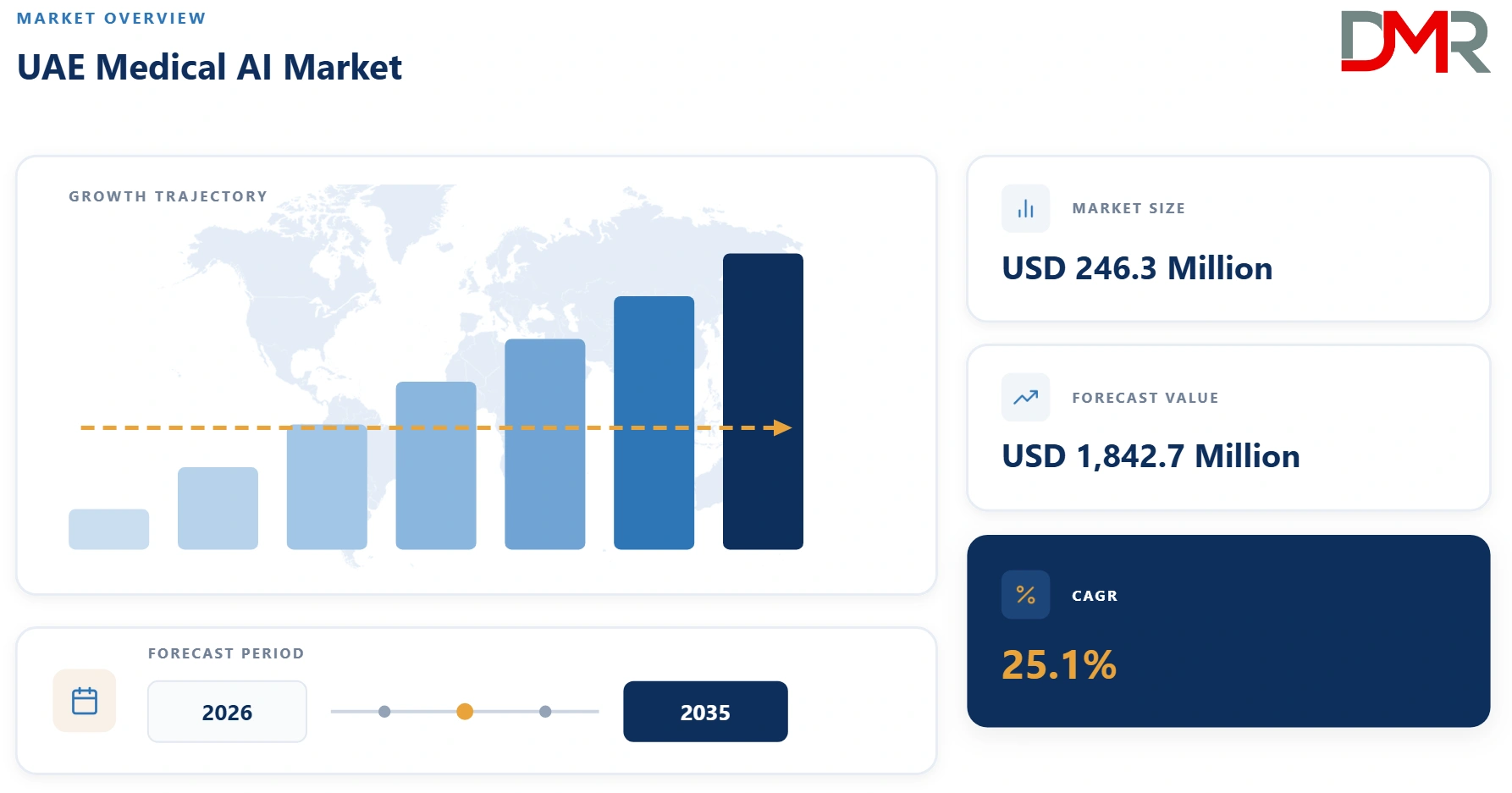
- UAE Medical AI Market Size in 2026: USD 246.3 Million
- UAE Medical AI Market Size in 2035: USD 1,842.7 Million
- UAE CAGR from 2026 to 2035: 25.1%
- Software/Platforms is the leading component segment in 2026: 48.7%
- Machine Learning and Deep Learning is the leading technology segment in 2026: 38.2%
- Medical Imaging and Diagnostics is the leading application segment in 2026: 27.9%
- Hospitals and Clinics is the leading end user segment in 2026: 44.6%
What is the UAE Medical AI Market and its Market Size?
The UAE Medical AI Market is projected to be valued at USD 246.3 Million in 2026 and is projected to reach USD 1,842.7 Million by 2035, expanding at a CAGR of 25.1% during the forecast period.
ℹ
To learn more about this report –
Download Your Free Sample Report Here
Growth is being propelled by sustained government investment in national AI and digital health strategies, rising adoption of AI-assisted diagnostic imaging and clinical decision support tools among leading public and private hospital networks, and growing pharmaceutical and biotech interest in AI-accelerated drug discovery pipelines supported by the UAE's expanding life sciences and biotechnology infrastructure. The maturing of UAE-based and regional health data governance frameworks, growing clinician confidence in AI-assisted diagnostic and administrative tools following successful pilot deployments, and the entry of both global health-tech vendors and homegrown AI health platforms into the market are reshaping medical AI adoption from isolated pilot projects into structured, health-system-wide deployment strategies. Investment is accelerating as hospital networks integrate AI tools directly into electronic health record and hospital information systems while regulators formalize approval pathways for AI-based medical devices and clinical software.
Use Cases
- AI-Assisted Radiology and Diagnostic Imaging: Hospitals and diagnostic imaging centers deploy AI-based image analysis tools to support radiologists in detecting abnormalities across X-ray, CT, MRI, and mammography scans, improving diagnostic speed and consistency while managing rising imaging volumes.
- Clinical Decision Support for Chronic Disease Management: Healthcare providers integrate AI-driven clinical decision support tools into electronic health record systems to flag high-risk patients, recommend evidence-based treatment pathways, and support management of chronic conditions such as diabetes and cardiovascular disease, both of which carry high regional prevalence.
- AI-Powered Virtual Health Assistants and Patient Triage: Public and private health providers deploy Arabic and English-language AI chatbots and virtual assistants to support patient triage, appointment scheduling, and preliminary symptom assessment, reducing administrative burden on clinical staff.
- AI-Accelerated Drug Discovery and Biotech Research: Pharmaceutical and biotech companies operating within UAE life sciences free zones utilize AI-driven molecular modeling and drug discovery platforms to accelerate early-stage research, supported by growing regional investment in biotechnology infrastructure.
Key Takeaways
- Market Size: The UAE Medical AI Market is anticipated to be valued at USD 246.3 Million in 2026 and is forecast to reach USD 1,842.7 Million by 2035, expanding at a CAGR of 25.1%.
- Growth Outlook: Market expansion is sustained by national digital health strategy investment, rising hospital adoption of AI-assisted diagnostic and clinical decision support tools, and growing pharmaceutical and biotech interest in AI-accelerated research and development.
- Primary Growth Drivers: Sustained government investment in AI and digital health infrastructure, rising diagnostic imaging volumes outpacing radiologist supply, growing clinician confidence following successful pilot deployments, and formalization of regulatory approval pathways for AI-based medical devices are accelerating adoption.
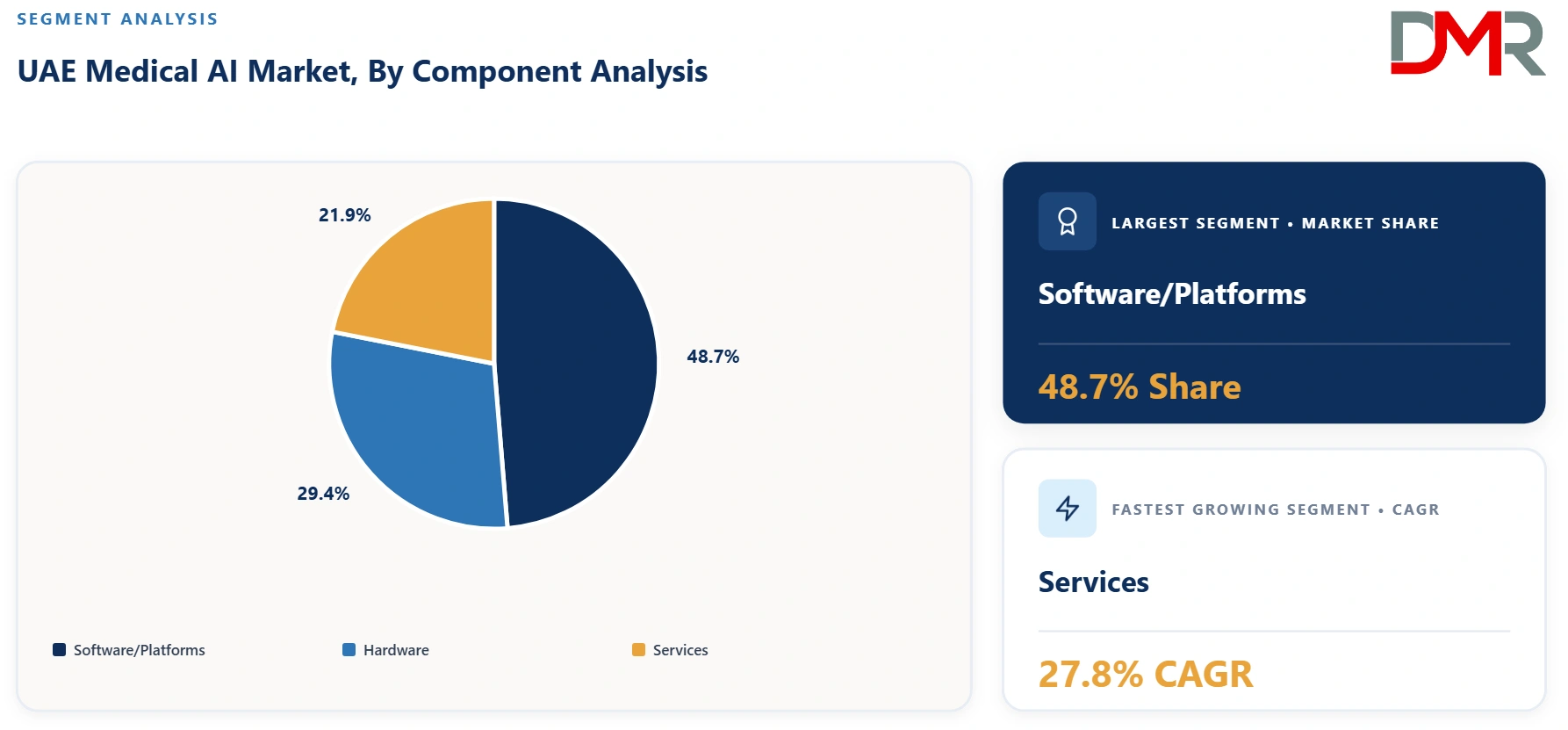
- By Component Analysis: Software/Platforms is projected to lead the component segment with a 48.7% share in 2026, reflecting sustained investment in AI diagnostic, clinical decision support, and administrative automation platforms. Services is the fastest-growing component segment at 27.8% CAGR, driven by rising demand for implementation, integration, and model validation support alongside software deployment.
- By Technology Analysis: Machine Learning and Deep Learning is expected to dominate with a 38.2% share in 2026, supported by its central role in diagnostic imaging and predictive clinical analytics. Natural Language Processing is the fastest-growing technology segment at 28.9% CAGR, driven by expanding Arabic-language clinical documentation and virtual assistant applications.
- By Application Analysis: Medical Imaging and Diagnostics is poised to lead with a 27.9% share in 2026, reflecting mature commercial availability of AI-assisted radiology tools. Drug Discovery and Development is the fastest-growing application segment at 29.4% CAGR, driven by expanding biotech investment and AI-accelerated research pipelines.
- By End User Analysis: Hospitals and Clinics are projected to dominate with a 44.6% share in 2026, reflecting their position as the primary point of AI-assisted diagnostic and clinical workflow deployment. Pharmaceutical and Biotech Companies is the fastest-growing end user segment at 28.3% CAGR, fuelled by rising AI adoption across drug discovery and clinical trial optimization functions.
Key Drivers in the UAE Medical AI Market
Sustained Government Investment in National AI and Digital Health Strategy
The UAE government's sustained prioritization of artificial intelligence as a national economic and healthcare transformation pillar is a central driver of growth in the Medical AI Market. Federal and emirate-level digital health strategies encourage public and private hospital networks to integrate AI diagnostic and clinical decision support tools as part of broader healthcare digitization mandates. Government-backed health data platforms and unified electronic health record initiatives are also creating the underlying data infrastructure necessary for scaled AI deployment, reinforcing sustained public and private sector investment in medical AI capability.
Rising Diagnostic Imaging Volumes Outpacing Radiologist Supply
Growing imaging volumes driven by population growth, rising chronic disease prevalence, and expanding health insurance coverage are creating capacity pressure on the UAE's radiologist workforce. AI-assisted diagnostic imaging tools help address this gap by supporting faster triage, prioritization of high-risk cases, and consistency in image interpretation, allowing radiologists to manage higher case volumes without proportional increases in staffing. This structural imaging capacity gap is expected to sustain strong demand for AI diagnostic imaging solutions across both public and private healthcare providers.
Restraints in the UAE Medical AI Market
Regulatory Approval Complexity for AI-Based Medical Devices and Clinical Software
Navigating regulatory approval pathways for AI-based diagnostic and clinical decision support tools represents a significant restraint on the UAE Medical AI Market. As an emerging regulatory category, AI-based medical software often requires evaluation against evolving local and international standards for clinical validation, algorithmic transparency, and ongoing performance monitoring following deployment. This regulatory complexity can lengthen approval timelines, increase compliance costs for vendors, and create uncertainty for hospital networks evaluating long-term AI tool procurement decisions, particularly for higher-risk clinical applications.
Growth Opportunities in the UAE Medical AI Market
Arabic-Language Clinical AI and Virtual Health Assistant Platforms
Growing demand for Arabic-language clinical documentation, patient communication, and virtual health assistant tools presents a significant opportunity for AI vendors capable of delivering natural language processing solutions tailored to regional dialects and clinical terminology. Vendors with strong Arabic-language natural language processing capability can differentiate from global platforms primarily built around English-language clinical data, capturing preferential positioning among public health authorities and government-linked hospital networks.
AI-Enabled Preventive and Population Health Management
Rising government and payer interest in preventive care and population health management presents an opportunity for AI vendors offering predictive risk stratification, chronic disease early-detection, and population-level health analytics platforms. As the UAE continues expanding mandatory health insurance coverage and preventive screening programs, AI tools capable of identifying at-risk populations and supporting proactive intervention are well positioned to capture government and payer-funded deployment contracts.
Trends in the UAE Medical AI Market
Integration of AI Tools Directly into Hospital Information and EHR Systems
UAE hospital networks are increasingly moving away from standalone AI diagnostic tools toward AI capabilities embedded directly within core hospital information systems and electronic health record platforms. This integration trend allows AI-generated insights, alerts, and recommendations to appear directly within clinicians' existing workflow rather than requiring separate software interfaces, improving adoption rates and reducing clinician workflow disruption. Vendors offering seamless EHR and hospital information system integration capability are increasingly favored over standalone point-solution providers.
Growing Public-Private Collaboration on AI Health Data Infrastructure
UAE health authorities are increasingly partnering with private technology companies and healthcare providers to build shared, governed health data infrastructure supporting AI model training and validation while maintaining strict data privacy and sovereignty requirements. These collaborative data infrastructure initiatives are expected to accelerate development of UAE-specific, population-relevant AI models, reducing reliance on AI tools trained primarily on non-regional patient data and strengthening the clinical relevance and regulatory acceptance of deployed AI systems.
Research Scope and Analysis
The UAE Medical AI Market is segmented by component, technology, application, and end user, covering software platforms, hardware, services, machine learning, natural language processing, computer vision, medical imaging, clinical decision support, virtual assistants, drug discovery, and hospital, diagnostic center, pharmaceutical, and payer end users.
ℹ
To learn more about this report –
Download Your Free Sample Report Here
By Component Analysis
Software/Platforms is projected to dominate the UAE Medical AI Market with approximately 48.7% share in 2026, reflecting sustained investment in AI diagnostic, clinical decision support, and administrative workflow automation platforms across public and private healthcare providers. Services is expected to register the highest CAGR of 27.8% during 2026-2035, driven by growing demand for implementation, system integration, clinical validation, and ongoing model performance monitoring support.
By Technology Analysis
Machine Learning and Deep Learning is anticipated to dominate the UAE Medical AI Market by technology, accounting for approximately 38.2% share in 2026, supported by its foundational role in diagnostic imaging analysis and predictive clinical analytics applications. Natural Language Processing is projected to register the highest CAGR of 28.9% between 2026 and 2035, driven by expanding demand for Arabic-language clinical documentation automation and virtual health assistant applications.
By Application Analysis
Medical Imaging and Diagnostics is projected to lead the UAE Medical AI Market with an estimated 27.9% share in 2026, reflecting the relatively mature commercial availability and clinical validation of AI-assisted radiology and diagnostic imaging tools. Drug Discovery and Development is expected to register the fastest CAGR of 29.4% through 2035, driven by expanding biotech sector investment and growing adoption of AI-accelerated molecular research and clinical trial optimization platforms.
By End User Analysis
Hospitals and Clinics are projected to dominate the UAE Medical AI Market with approximately 44.6% share in 2026, reflecting their position as the primary deployment site for AI-assisted diagnostic imaging, clinical decision support, and administrative automation tools. Pharmaceutical and Biotech Companies are expected to register the fastest CAGR of 28.3% through 2035, fuelled by rising adoption of AI tools across drug discovery, clinical trial design, and research and development functions.
The UAE Medical AI Market Report is segmented based on the following:
By Component
- Software/Platforms
- Medical Imaging and Diagnostic AI
- Clinical Decision Support Systems
- Predictive Analytics Platforms
- Virtual Assistants and AI Chatbots
- Precision Medicine Platforms
- Healthcare Workflow Automation
- Others
- Hardware
- AI-Enabled Medical Imaging Systems
- Robotic Surgical Systems
- Wearable Medical Devices
- Smart Patient Monitoring Devices
- Edge AI Devices and Processors
- AI-Enabled Diagnostic Equipment
- Others
- Services
- Implementation and Integration
- Consulting Services
- Training and Support
- Maintenance and Upgrades
- Data Management and Analytics
- Managed AI Services
By Technology
- Machine Learning and Deep Learning
- Natural Language Processing
- Computer Vision
- Robotic Process Automation
- Others
By Application
- Medical Imaging and Diagnostics
- Clinical Decision Support
- Virtual Health Assistants and Chatbots
- Drug Discovery and Development
- Administrative and Workflow Automation
- Remote Patient Monitoring
- Others
By End User
- Hospitals and Clinics
- Diagnostic and Imaging Centers
- Pharmaceutical and Biotech Companies
- Payers and Insurance Providers
- Government Health Authorities
Technology Analysis
Technology development is central to the trajectory of the UAE Medical AI Market as vendors invest in multimodal AI models combining imaging, clinical text, and structured health record data to improve diagnostic accuracy and clinical relevance. Growing use of federated learning and privacy-preserving AI training techniques is enabling model development across multiple hospital networks without centralizing sensitive patient data, addressing data sovereignty and privacy requirements. Opportunities are expanding for vendors developing region-specific AI models trained on UAE and broader GCC patient population data, as well as explainable AI tools that support clinician trust and regulatory transparency requirements. However, ensuring robust clinical validation, managing algorithmic bias risk, and maintaining ongoing model performance monitoring post-deployment remain critical technical and governance requirements for sustained adoption.
Investment and White Space Analysis
Investment opportunities in the UAE Medical AI Market are expanding alongside sustained government digital health investment, growing hospital network AI adoption, and increasing pharmaceutical and biotech interest in AI-accelerated research. Significant white space exists in Arabic-language clinical natural language processing, population health and preventive care analytics, AI-enabled remote patient monitoring, and regulatory-compliant AI model validation services. Vendors with strong regional clinical data partnerships, EHR integration capability, and demonstrated regulatory approval track records are positioned to capture premium, longer-duration health-system contracts. However, regulatory approval complexity, data governance requirements, and the need for sustained clinical validation investment can constrain near-term scalability for smaller or newly entering AI health-tech vendors.
Competitive Landscape
The UAE Medical AI Market is fragmented and increasingly competitive, comprising global health-tech AI vendors, regional homegrown medical AI startups, diversified technology companies expanding into healthcare AI, and hospital-affiliated innovation units developing proprietary AI tools. Competition centers on clinical validation strength, regulatory approval status, EHR and hospital information system integration capability, and Arabic-language natural language processing expertise. Global vendors benefit from mature, internationally validated AI platforms and broader research and development resources, while regional players compete on data localization, government relationships, and tailored regional clinical relevance. Companies increasingly differentiate through integrated deployment partnerships with major hospital networks and health authorities rather than standalone software sales.
Some of the prominent players in the UAE Medical AI Market are:
- M42
- PureHealth
- Burjeel Holdings
- Presight AI
- Core42
- Altibbi
- Okadoc
- Nabta Health
- Valeo Health
- Avey
- Klaim
- Alma Health
- Siemens Healthineers
- GE HealthCare
- Philips Healthcare
- Microsoft
- Google Health
- Amazon Web Services
- NVIDIA
- IBM
- Oracle Health
- Roche
- Medtronic
- Intuitive Surgical
- Elekta
- Aidoc
- Viz.ai
- Qure.ai
- Lunit
- Annalise.ai
- RapidAI
- PathAI
- Paige
- Tempus AI
- Hippocratic AI
- SOPHiA Genetics
- Biofourmis
- Infermedica
- Sectra
- Agfa HealthCare
- Other Key Players
Recent Developments
- In June 2026, Abu Dhabi Biobank and BioTwin partnered to deploy AI-based Human Virtual Twin technology for early disease detection, longitudinal health monitoring, personalized prevention, and precision healthcare across Abu Dhabi.
- In June 2026, M42’s National Reference Laboratory collaborated with Qritive to introduce AI-powered prostate cancer diagnostics in Abu Dhabi, supporting faster, more consistent pathology assessments and addressing rising diagnostic workloads.
- In April 2025, Dubai Health Authority integrated AI into the NABIDH health-information exchange through its Privacy Intelligence initiative, strengthening patient-data security, access monitoring, and privacy-risk detection across Dubai’s healthcare network.
- In April 2025, Burjeel Holdings partnered with Hippocratic AI to introduce safety-focused generative AI healthcare agents across its UAE and Oman facilities, supporting patient engagement and clinical administrative workflows.
Report Details
| Report Characteristics |
| Market Size (2026) |
USD 246.3 Mn |
| Forecast Value (2035) |
USD 1,842.7 Mn |
| CAGR (2026–2035) |
25.1% |
| Historical Data |
2021 – 2025 |
| Forecast Data |
2026 – 2035 |
| Base Year |
2025 |
| Segments Covered |
By Component, By Technology, By Application, By End User |
| Country Coverage |
UAE |
Frequently Asked Questions
How big is the UAE Medical AI Market?
▾ The UAE Medical AI Market is projected to be valued at USD 246.3 Million in 2026 and is projected to reach USD 1,842.7 Million by 2035, reflecting rapid adoption of AI-assisted diagnostic, clinical decision support, and drug discovery tools across public and private healthcare providers.
What is the CAGR of the UAE Medical AI Market from 2026 to 2035?
▾ The market is projected to expand at a compound annual growth rate (CAGR) of 25.1% between 2026 and 2035, supported by sustained government digital health investment, rising diagnostic imaging demand, and growing pharmaceutical and biotech AI adoption.
What factors are driving the growth of the UAE Medical AI Market?
▾ Growth is driven by sustained government investment in national AI and digital health infrastructure, rising diagnostic imaging volumes outpacing radiologist supply, growing clinician confidence following successful pilot deployments, and formalization of regulatory approval pathways for AI-based medical devices and software.
What are the major trends in the UAE Medical AI Market?
▾ Major trends include growing integration of AI tools directly into hospital information and EHR systems, expanding public-private collaboration on governed health data infrastructure, and rising investment in Arabic-language clinical AI and virtual health assistant platforms.
Who are the key players in the UAE Medical AI Market?
▾ Key market participants include G42 Healthcare, M42, Microsoft Healthcare AI, Siemens Healthineers, and GE Healthcare, among other global and regional medical AI technology providers.
How is the UAE Medical AI Market segmented?
▾ The market is segmented by component, technology, application, and end user, with demand analysis concentrated across Dubai, Abu Dhabi, and the remaining northern emirates.