Market Snapshot
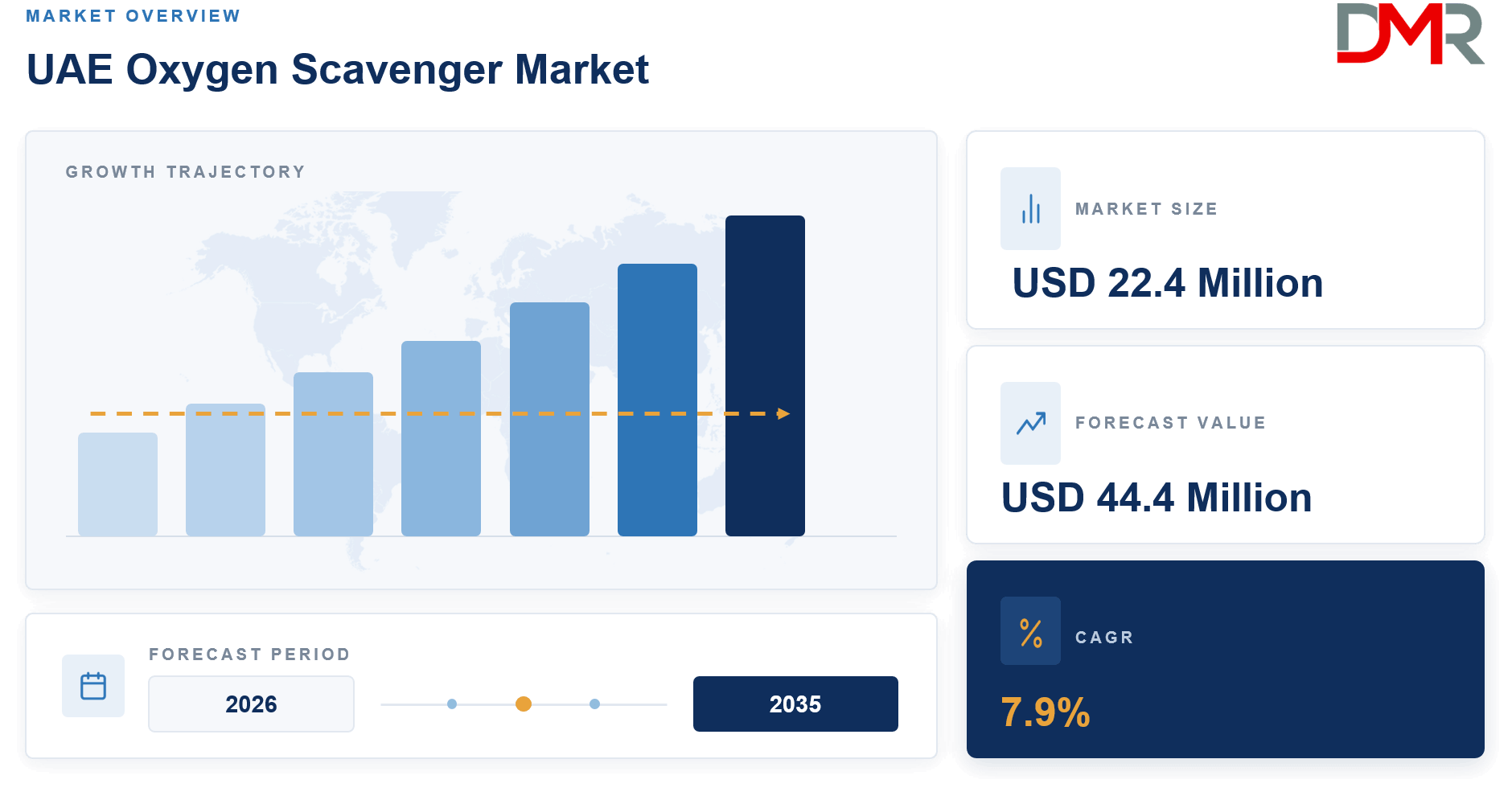
- Market Size (2026): USD 22.4 Mn
- Forecast Value (2035): USD 44.4 Mn
- CAGR (2026-2035): 7.9%
- Leading Chemistry (2026): Sodium sulfite, around 34%
- Leading Application (2026): Boiler feedwater, close to 46%
- Key Players: Ecolab, Clariant, Metito and other regional suppliers
What is UAE Oxygen Scavenger Market and its Market Size?
The UAE Oxygen Scavenger Market size is estimated to reach USD 22.4 Mn in 2026 and is further anticipated to reach USD 44.4 Mn by 2035, at a CAGR of 7.9%.
ℹ
To learn more about this report –
Download Your Free Sample Report Here
The market covers chemical products formulated to remove dissolved oxygen from water, hydrotest fluids, oilfield fluids and selected enclosed process systems where oxygen can accelerate corrosion or degrade product quality. The commercial boundary includes oxygen scavenger formulations sold for industrial use, including sulfite, bisulfite, DEHA and carbohydrazide based chemistries, together with formulated blends and technical dosing support when bundled with the chemical programme. It excludes mechanical deaeration equipment, oxygen removal membranes and consumer oxygen absorber sachets unless the chemistry is sold as part of an industrial treatment programme.
Demand is anchored by steam generation and boiler feedwater treatment, where residual oxygen can create localized pitting in carbon steel and copper bearing equipment. Oil and gas operators also use scavenging chemistry in water injection, hydrotest and preservation applications where dissolved oxygen control supports asset integrity. Buyers typically include utilities managers, water treatment engineers, refinery operators, production chemical teams and maintenance departments that balance chemical dosage against corrosion risk, operating conditions and compliance requirements.
UAE demand has a distinctive mix of large energy assets, desalination linked infrastructure, district cooling, hospitality facilities, manufacturing plants and marine operations. The hot climate and high dependence on engineered water systems increase the value of preventive treatment, while centralized procurement and technical service contracts favor suppliers that can combine chemistry, monitoring, dosing support and inventory reliability. The market therefore competes on treatment performance and lifecycle cost rather than on chemical price alone.
Use Cases
- Utility Boiler Protection: Power and industrial utility teams dose oxygen scavengers into boiler feedwater to reduce dissolved oxygen before it reaches heat transfer surfaces. The objective is to limit pitting, stabilize iron transport and reduce avoidable tube maintenance while maintaining dependable steam generation.
- Refinery and Petrochemical Water Injection: Oil and gas production teams use scavenging chemistry in water handling and injection systems where oxygen ingress can increase corrosion risk. Treatment is adjusted to water chemistry, residence time and injection conditions, helping operators protect metallic infrastructure and maintain injection reliability.
- Pipeline and Hydrotest Preservation: Pipeline contractors and asset owners apply multifunctional preservation fluids during hydrotesting or temporary shutdowns. Oxygen scavengers can be combined with corrosion inhibitors and biocides, reducing the number of chemical handling steps and limiting corrosion during idle periods.
- Industrial Steam Systems: Food, beverage, hospitality and manufacturing facilities with packaged boilers use formulated scavengers to control residual oxygen after deaeration. The treatment supports longer equipment life and more predictable maintenance, particularly where compact boiler rooms operate under variable steam demand.
Key Takeaways
- Market Size & Share: UAE demand is estimated at USD 22.4 Mn in 2026, with the market expected to reach USD 44.4 Mn by 2035.
- Chemistry Analysis: Sodium sulfite is projected to hold approximately 34% of 2026 revenue, supported by established boiler treatment practice and broad availability.
- Demand Concentration: Boiler feedwater is expected to represent close to 46% of 2026 application demand because steam systems require continuous oxygen control.
- End Use Analysis: Oil and gas is set to account for roughly 35% of 2026 demand, reflecting the UAE's large hydrocarbon production and processing base.
- Growth Direction: DEHA is projected to expand at a CAGR of 10.4% from 2026 to 2035 as buyers seek alternatives where volatile amines and sulfite chemistry create operational constraints.
- Channel Shift: Direct supply is expected to retain just over 52% of 2026 distribution value, while technical specialty distributors gain ground where smaller plants need local inventory and dosing support.
How AI/Gen AI is Transforming the UAE Oxygen Scavenger Market?
AI adoption in oxygen scavenger programmes is primarily an operational improvement rather than a product replacement. Treatment systems can combine dissolved oxygen sensors, feedwater quality data, boiler load, condensate return conditions and chemical dosing records to identify abnormal oxygen ingress and dosage drift. Machine learning models can then support predictive maintenance by flagging patterns associated with corrosion risk, deaerator performance deterioration or changes in system demand.
Generative AI is becoming more useful around documentation and technical service. LLM document processing can organize laboratory reports, chemical safety documentation, operating logs and service notes, while digital twins can model water chemistry and asset conditions before engineers change a treatment programme. The main value is faster decision support and more consistent field service, with human engineers retaining responsibility for chemical selection and process safety.
- Predictive Dosing: Models correlate oxygen readings and boiler load with chemical demand.
- LLM Documentation: Automated extraction of treatment records speeds technical reporting and compliance review.
- Digital Twins: Virtual boiler and water system models help test changes in dosing strategy before implementation.
- Anomaly Detection: Algorithms identify unusual oxygen ingress, condensate contamination or dosing pump behavior.
Key Drivers in the UAE Oxygen Scavenger Market
Demand is shaped by the need to protect high-value water and steam assets while operators seek tighter control of chemical consumption. Two forces are particularly relevant in the UAE because they combine large installed systems with demanding operating environments.
- Steam System Integrity: Boiler feedwater remains the largest application, expected to represent close to 46% of 2026 application demand. Oxygen creates localized corrosion even when bulk water chemistry appears controlled, so operators use chemical scavenging as a final protection layer after mechanical deaeration. Larger utility and process boilers also create recurring consumption because treatment is linked to continuous steam production. Suppliers that pair oxygen scavengers with corrosion control, monitoring and dosing equipment can capture more value than commodity chemical sellers, particularly where maintenance teams measure treatment through reduced tube failures, stable condensate quality and predictable inspection intervals.
- Energy and Hydrocarbon Asset Density: Oil and gas is expected to account for roughly 35% of 2026 end use demand, reflecting extensive production, refining, petrochemical and water handling infrastructure. Oxygen control supports water injection, pipeline preservation and selected production chemical programmes where corrosion exposure increases when oxygen enters fluids. The opportunity extends beyond individual chemical sales because operators often prefer treatment packages that combine oxygen scavenging with corrosion inhibition, biocide control and technical monitoring. This favors suppliers with field service capabilities and local inventory, especially for facilities where chemical availability can affect production continuity.
Restraints in the UAE Oxygen Scavenger Market
Market expansion is constrained by chemistry selection requirements, operating discipline and substitution from mechanical oxygen removal. Buyers do not simply maximize scavenger dosage because excess chemical can affect water chemistry, downstream processes and cost.
- Mechanical Deaeration and Process Optimization: Industrial operators increasingly improve upstream oxygen removal through deaerators, feedwater conditioning and condensate management before relying on chemical scavenging. This does not eliminate chemical demand, but it can lower dosage intensity and shift purchasing toward higher-performance formulations. Suppliers therefore need to demonstrate treatment economics rather than sell on active ingredient concentration alone. The restraint is strongest in large, well-engineered steam systems where instrumentation provides tighter control and operating teams can correct oxygen ingress at its source.
- Chemistry and Handling Constraints: Oxygen scavengers differ materially in reaction rate, temperature response, residual behavior and compatibility with boiler chemistry. Sulfite based products remain economical, while alternative organic chemistries can be preferred in systems with tighter steam purity or specific regulatory requirements. Storage, transport, dosing accuracy and worker handling also influence procurement. These factors can slow switching between suppliers because operators require validation, water chemistry testing and field confidence before changing a treatment programme, particularly in high-value energy and petrochemical facilities.
Growth Opportunities in the UAE Oxygen Scavenger Market
White space is concentrated in higher-value formulations and service models rather than simple commodity volume. Suppliers can expand by targeting customers that need measurable corrosion control with fewer chemical handling steps.
- Multifunctional Preservation Chemistry: Hydrotest and pipeline preservation creates room for combined oxygen scavenger, biocide and corrosion inhibitor formulations. Such products can simplify chemical logistics and reduce the number of injection points. The opportunity is relevant to contractors, pipeline operators and offshore service teams that manage temporary fluid conditions and need reliable preservation without building a complex chemical programme for short-duration work.
- Digital Boiler Treatment Contracts: Smaller industrial and commercial boiler operators often lack dedicated water chemistry teams. Suppliers can package oxygen scavengers with remote monitoring, dosing optimization, testing and scheduled replenishment. This creates recurring service revenue while reducing the buyer's dependence on manual sampling. Local distributors with technical staff can compete effectively because response time and inventory availability matter when plants operate continuously.
Trends in the UAE Oxygen Scavenger Market
Current market movement is centered on treatment precision, formulation flexibility and supplier accountability. Buyers are increasingly evaluating the complete operating programme rather than treating oxygen scavenger chemistry as an isolated consumable.
- Lower Dosage Formulations: Suppliers are developing chemistry packages designed to achieve oxygen control with more predictable residual behavior. This supports tighter chemical management and reduces the risk of overfeeding, particularly in automated boiler systems.
- Multifunctional Products: Oilfield and pipeline applications increasingly favor blends that address oxygen alongside corrosion, microbiological activity or preservation requirements. Clariant's SCAVTREAT and PRESERVAN portfolios illustrate this broader move toward multifunctional treatment chemistry.
- Local Inventory and Technical Support: UAE buyers place value on rapid delivery, site testing and formulation adjustment. Local stock points and regional technical teams can therefore become a stronger competitive differentiator than small differences in chemical unit price.
- Monitoring Linked to Chemistry: Sensors, automated dosing and remote service are becoming more closely connected with chemical contracts. This encourages suppliers to sell treatment performance and operational outcomes rather than only drums or bulk chemical volumes.
Research Scope and Analysis
Segment performance is assessed across five axes: chemistry, form, application, end use industry and distribution channel. Each axis identifies where 2026 revenue is concentrated and which sub-segment is expanding fastest through 2035, with the operating reason behind each position.
ℹ
To learn more about this report –
Download Your Free Sample Report Here
By Chemistry
Sodium sulfite is projected to hold the largest chemistry share in 2026, accounting for around 34% of revenue, because it is familiar to boiler operators, widely available and suited to many low and medium pressure systems. Growth, however, is concentrated in DEHA, expanding at a CAGR of 10.4% between 2026 and 2035 as selected users seek organic oxygen scavenging options with different residual and steam-system characteristics. Ammonium bisulfite remains important in oilfield and water injection applications, while carbohydrazide serves systems requiring stronger oxygen control and passivation characteristics. Other chemistries retain specialist demand where water quality, temperature or downstream process constraints make standard sulfite treatment less suitable.
By Form
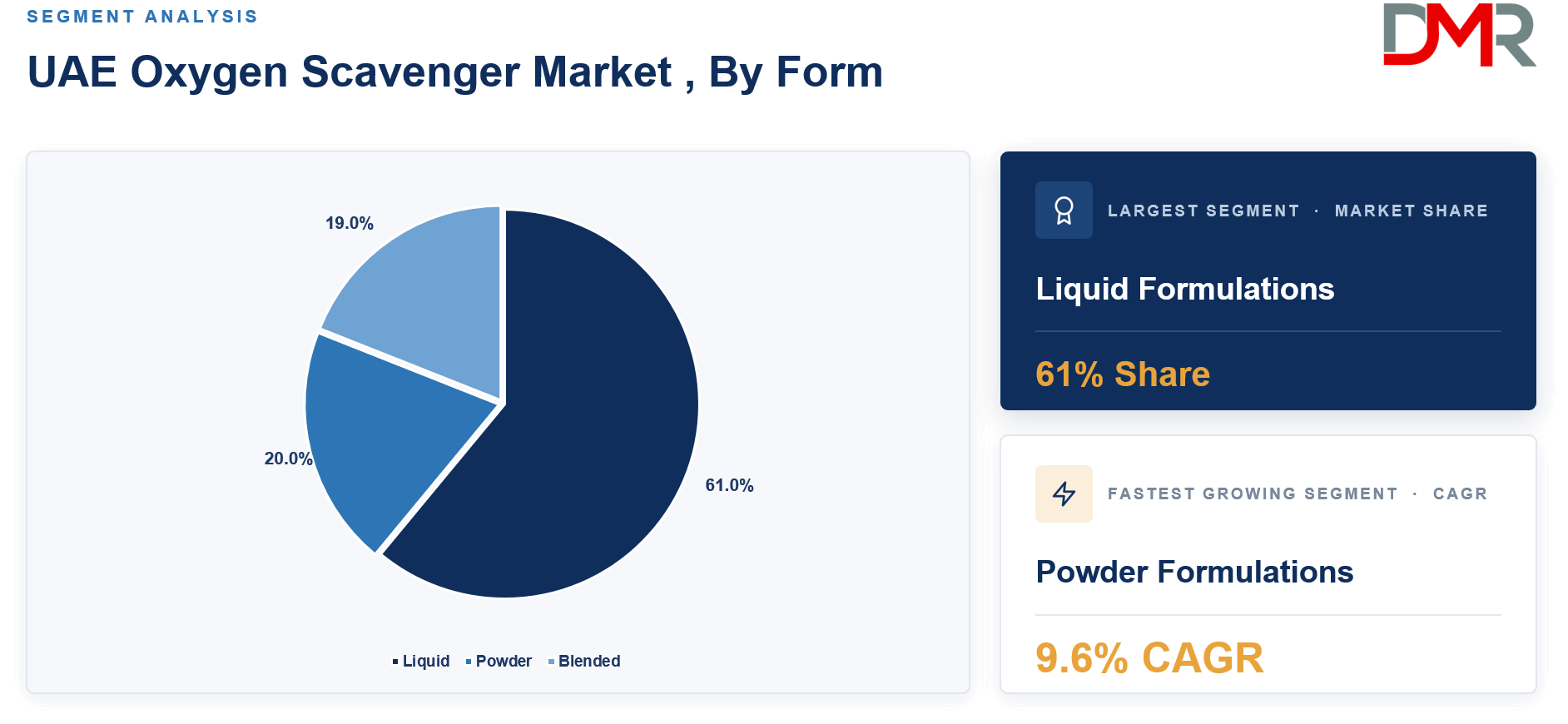
Liquid formulations are expected to lead the UAE market in 2026 with close to 61% of revenue because they can be metered directly through dosing systems and are convenient for continuous boiler and industrial treatment programmes. Growth, however, is concentrated in powder formulations, which are projected to expand at a CAGR of 9.6% through 2035 as distributors and smaller industrial users seek longer storage flexibility and easier shipment of concentrated chemistry. Blended products occupy the remaining demand where buyers value combined corrosion, oxygen and deposit control. Liquid chemistry should remain dominant in automated facilities, while powder and dry products gain share in decentralized operations and selected oilfield applications.
By Application
Boiler feedwater is projected to command the largest application share in 2026, representing close to 46% of revenue because steam generation creates continuous exposure to dissolved oxygen and recurring treatment demand. The steeper trajectory sits with hydrotest and pipeline preservation, expanding at a CAGR of 10.2% from 2026 to 2035 as pipeline integrity programmes and temporary preservation needs encourage multifunctional chemical packages. Oilfield water injection remains a substantial application where oxygen control supports corrosion management and injection performance. Closed loop industrial water and packaging or process protection are smaller niches, with demand shaped by specific equipment designs and product protection requirements rather than broad continuous consumption.
By End Use Industry
Oil and gas is expected to remain the largest end use industry in 2026, accounting for roughly 35% of UAE revenue because production, refining, petrochemical and water injection assets create multiple points where oxygen control supports integrity. Growth, however, is concentrated in chemical and petrochemical operations, which are forecast to expand at a CAGR of 9.8% through 2035 as process plants modernize utility systems and increase attention to reliability and water reuse. Power generation remains a major recurring buyer because boiler chemistry is essential to steam system performance. Food and beverage, manufacturing and marine facilities form a diverse secondary base where smaller boilers and process systems generate steady replacement demand.
By Distribution Channel
Direct supply is projected to account for just over 52% of 2026 distribution value because large utilities, refineries and industrial plants prefer technical agreements with chemical producers or integrated treatment providers. Growth, however, is concentrated in specialty distributors, expanding at a CAGR of 9.3% through 2035 as smaller industrial buyers need local stock, flexible order quantities and application support. General chemical trading and online procurement remain relevant for standardized products, but they are less suited to complex boiler and oilfield programmes. Distribution competition will therefore depend on inventory reliability, formulation advice and the ability to respond quickly to field chemistry problems.
The UAE Oxygen Scavenger Market Report is Segmented Based on the Following
By Chemistry
- Sodium Sulfite
- Ammonium Bisulfite
- DEHA
- Carbohydrazide
- Other Chemistries
By Form
By Application
- Boiler Feedwater
- Oilfield Water Injection
- Hydrotest and Pipeline Preservation
- Closed Loop Industrial Water
- Packaging and Process Protection
By End Use Industry
- Oil and Gas
- Power Generation
- Chemical and Petrochemical
- Food and Beverage
- Manufacturing
- Marine
By Distribution Channel
- Direct Supply
- Specialty Distributors
- General Chemical Trading and Online Procurement
Pricing Analysis
Pricing in the UAE oxygen scavenger market is increasingly determined by active chemistry, concentration, dosing performance, delivery format and technical service rather than a single commodity benchmark. Standard sulfite products remain price sensitive, while DEHA, carbohydrazide and multifunctional blends command stronger value where formulation performance reduces corrosion risk or simplifies treatment. The commercial opening is largest in service contracts that combine chemical supply with testing, dosing optimization and inventory management, especially for smaller plants. The brake is buyer qualification: high-value steam and oilfield assets require chemistry validation, so a lower quoted chemical price does not automatically win a contract. This structure supports steady market growth while preserving room for premium formulations and technical distributors.
Export/Import Analysis
The UAE market combines local formulation and distribution with imported specialty chemicals and active ingredients. International producers can reach customers through regional subsidiaries, free-zone stock points and specialist chemical traders, while domestic formulators compete by blending and packaging treatment programmes closer to the end user. The commercial opening lies in shortening replenishment cycles and reducing dependence on long lead times for specialized grades, particularly for oilfield and industrial shutdown work. The main brake is supply-chain volatility for imported intermediates and the qualification burden attached to changing treatment chemistry in critical assets. This favors suppliers that maintain local inventory, provide consistent documentation and can offer technically validated substitutes when a specific imported grade becomes constrained.
Competitive Landscape
The competitive structure combines large water technology and oilfield service companies with UAE based formulators, chemical traders and specialist boiler treatment suppliers. Competition is based on chemistry breadth, field engineering, local inventory, technical response, formulation customization and the ability to integrate oxygen control with corrosion, scale and biocide programmes. Large providers benefit from multinational procurement and monitoring platforms, while regional specialists can respond faster to smaller orders and application-specific requirements. The market is therefore moderately fragmented at the product level, but customer relationships can be concentrated around major industrial accounts and long-duration treatment contracts.
Some of the Prominent Players in the UAE Oxygen Scavenger Market Are
- Ecolab (Nalco Water)
- Clariant
- BASF
- Dow
- Solvay
- Kurita Water Industries
- Kemira
- Veolia Water Technologies
- SUEZ
- Metito
- REDA Chemicals
- Al-Jazira Water Treatment Chemicals
- EMVEES Water Treatment
- Fouz Chemical Company
- Sheran Chemicals
- Anglo Gulf FZE
- Crikem
- Innotech Water Treatment & Purification Chemicals Trading
- Hydroguard Enviro Solutions
- Cauldron
- Dutco Tennant
- Gulfstar Group
- Abu Dhabi Chemicals
- Orange Chemicals FZ LLC
- Hazchem
- Dubi Chem
- Blue Line Industries
- Nirvana Water
- Innova Priority Solutions
- International Industrial Chemical Trading
- Baker Hughes
- SLB
- Halliburton
- ChampionX
- Innospec
- Dorf Ketal
- Solenis
- Buckman
- Arkema
- LANXESS
- Other Key Players
Recent Developments
- In July 2026, Clariant updated its SCAVTREAT product information, highlighting oxygen scavenging alongside sulfide and iron sulfide control and reinforcing the move toward multifunctional production chemical programmes.
- In February 2026, Clariant updated its PRESERVAN hydrotest technology information, including multifunctional formulations that can combine oxygen scavenging with biocide and corrosion inhibitor functions for pipeline and process preservation.
- In April 2026, Abu Dhabi Chemicals promoted oxygen scavengers within its UAE water treatment portfolio for boilers, desalination related systems and oilfield water applications, highlighting the role of local technical supply and rapid delivery.
Report Details
| Report Characteristics |
| Market Size (2026) |
USD 22.4 Mn |
| Forecast Value (2035) |
USD 44.4 Mn |
| CAGR (2026-2035) |
7.9% |
| Historical Data |
2021 - 2025 |
| Forecast Data |
2026 - 2035 |
| Base Year |
2025 |
| Segments Covered |
By Chemistry, By Form, By Application, By End Use Industry, By Distribution Channel |
| Regional Coverage |
The UAE |
Frequently Asked Questions
How big is the UAE Oxygen Scavenger Market?
▾ The UAE Oxygen Scavenger Market is estimated at USD 22.4 Mn in 2026. Demand is supported by boiler feedwater treatment, oilfield water injection, pipeline preservation and industrial steam systems. The market boundary covers industrial oxygen scavenger chemistry and formulated treatment products supplied within the UAE, while excluding mechanical deaeration equipment and other non-chemical oxygen removal technologies.
What is the growth rate of the UAE Oxygen Scavenger Market?
▾ The market is forecast to grow at a CAGR of 7.9% from 2026 to 2035, reaching USD 44.4 Mn by 2035. Growth is supported by recurring boiler treatment demand, oilfield integrity requirements and greater adoption of multifunctional formulations. Demand growth is expected to remain steady rather than explosive because established chemical programmes and mechanical deaeration already cover much of the installed base.
What is driving demand in the UAE Oxygen Scavenger Market?
▾ Demand is driven primarily by the need to control oxygen related corrosion in steam generation and hydrocarbon infrastructure. Boiler feedwater is expected to represent close to 46% of 2026 application demand, reflecting recurring chemical consumption in industrial and utility steam systems. Oilfield water handling, hydrotest preservation and process utilities add further demand across the country's energy and industrial base.
Who are the key players in the UAE Oxygen Scavenger Market?
▾ Key suppliers and market participants include Ecolab through Nalco Water, Clariant, Metito, REDA Chemicals, Sheran Chemicals, EMVEES Water Treatment and Anglo Gulf, alongside broader chemical and oilfield service providers. Competition centers on formulation range, technical support, local stock, dosing expertise and the ability to integrate oxygen scavenging with wider corrosion and water treatment programmes.
Which chemistry leads the UAE Oxygen Scavenger Market?
▾ Sodium sulfite is expected to lead the chemistry segment in 2026, holding around 34% of revenue. Its position reflects established boiler treatment practice, availability and suitability across a broad range of low and medium pressure applications. Alternative chemistries such as DEHA and carbohydrazide gain relevance where operating conditions, steam purity requirements or corrosion control objectives justify a more specialized treatment approach.
Which application has the highest growth potential?
▾ Hydrotest and pipeline preservation is projected to be the fastest-growing application, with a CAGR of 10.2% from 2026 to 2035. Growth is supported by demand for multifunctional preservation fluids that can address oxygen, microbiological activity and corrosion through a coordinated treatment programme. This application also benefits suppliers that can provide technical support and rapid delivery around project schedules and maintenance windows.
What is the outlook for the UAE Oxygen Scavenger Market through 2035?
▾ The UAE Oxygen Scavenger Market is expected to reach USD 44.4 Mn by 2035 as industrial steam systems, energy infrastructure and specialized preservation applications sustain recurring chemical demand. The market should favor suppliers with local inventory, validated formulations, monitoring capabilities and technical service. Growth will increasingly come from higher-value blends and service-led programmes rather than from simple increases in commodity chemical volume.