Market Snapshot
- Market Size (2026): USD 0.9 Bn
- Forecast Value (2035): USD 3.8 Bn
- CAGR (2026-2035): 17.3%
- Leading Offering (2026): Software, around 46%
- Leading Deployment (2026): Cloud, close to 58%
- Key Players: UiPath Inc., Microsoft Corporation, Automation Anywhere, Inc., and others
What is UAE Robotic Process Automation Market and its Market Size?
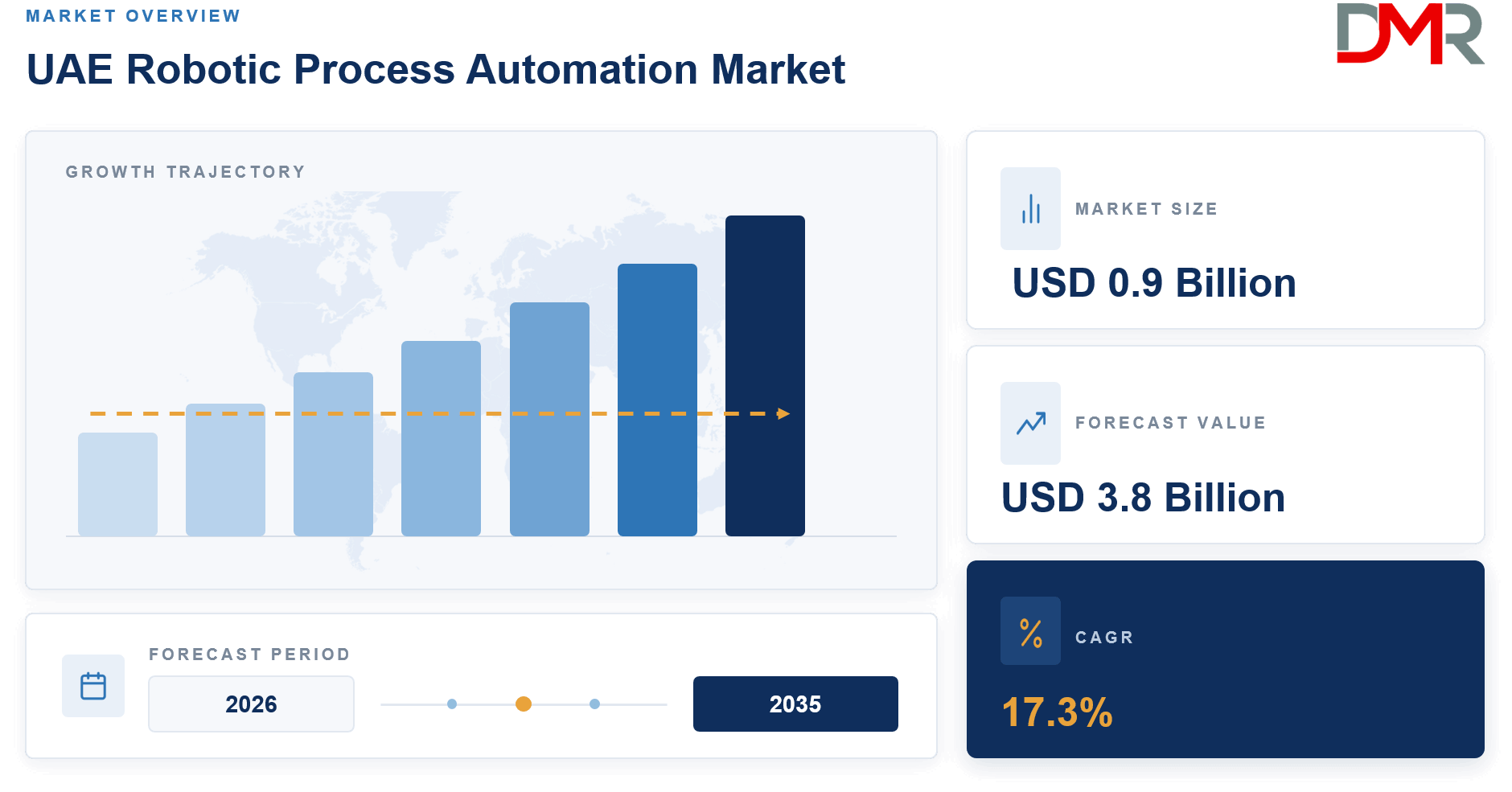
The UAE Robotic Process Automation Market size is estimated to reach USD 0.9 Bn in 2026 and is further anticipated to reach USD 3.8 Bn by 2035, at a CAGR of 17.3%.
ℹ
To learn more about this report –
Download Your Free Sample Report Here
Robotic process automation in the UAE covers software platforms, orchestration tools, intelligent document processing, implementation services and managed capabilities used to execute repeatable digital work across enterprise applications. Demand in these figures is confined to automation spending inside the UAE, not the worldwide revenue of suppliers headquartered or incorporated in the country. Buyers typically deploy bots to move data between systems, validate records, trigger workflow steps, prepare documents and manage exception queues.
The commercial boundary increasingly extends beyond desktop bots. Enterprise programmes now combine API integration, process mining, workflow orchestration, optical character recognition, machine learning and generative AI with traditional rule-based automation. This shifts purchasing toward governed platforms that can manage identities, audit trails, reusable components and human approvals, especially where customer data or regulated transactions are involved.
Government entities, banks, insurers, telecom operators, retailers, healthcare providers and large diversified groups are the principal buyers. National digital-service programmes, cloud investment and pressure to reduce administrative handling create a large pipeline of processes, while the transition from pilots to enterprise-wide automation is changing how vendors package software, services and local data-residency options.
Use Cases
- Government Service Delivery: Public entities deploy automation teams to route applications, validate supporting records, update multiple government systems and trigger routine approvals. The result is fewer manual handoffs, more consistent processing and staff capacity shifting toward exceptions, policy cases and citizen-facing work that requires judgment.
- BFSI Operations: Banks and insurers use automation across account servicing, KYC support, reconciliations, claims administration and compliance reporting. Bots handle repetitive cross-system steps, while controlled exception paths preserve review requirements, reducing queue pressure and improving traceability for internal audit and regulatory oversight.
- Telecom and Shared Services: Large operators and corporate service centres deploy RPA to manage order updates, billing adjustments, supplier records and employee administration. Central automation teams standardise reusable components, allowing repeated processes to be changed once and distributed across business units with less local rework.
- Healthcare Administration: Providers and payer-facing teams automate appointment updates, eligibility checks, claims preparation and document routing. Administrative work moves faster between clinical and enterprise systems, helping operations teams concentrate on incomplete records and cases where human verification remains necessary.
Key Takeaways
- Market Size & Growth: Revenue is estimated at USD 0.9 Bn in 2026 and is forecast to reach USD 3.8 Bn by 2035.
- Offering Analysis: Software is expected to account for approximately 46% of 2026 demand, while Services is forecast to grow at 24.1% CAGR.
- Demand Concentration: BFSI is set to represent around 27% of 2026 spending, while Government and Public Sector is projected to expand at 26.4% CAGR.
- Deployment Shift: Cloud is projected to hold close to 58% of 2026 revenue, supported by scalable platform delivery and faster software updates.
- Technology Direction: Agentic Automation is expected to record a CAGR of 27.9% through 2035 as buyers automate more exception-heavy work.
How AI/Gen AI is Transforming the UAE Robotic Process Automation Market?
AI is changing RPA from a primarily deterministic automation layer into a system that can interpret unstructured inputs, classify intent and recommend the next action. In the UAE, this matters because many enterprise and government workflows combine Arabic and English documents, multiple applications and approval rules that generate exceptions. Intelligent document processing, machine learning classification and computer vision therefore complement bots rather than simply replacing them.
Gen AI adds a second shift by improving how automation systems understand text and coordinate multi-step work. LLM document processing can extract meaning from correspondence and contracts, while agentic workflows can plan actions across approved tools. Human approval remains important for high-impact decisions, and governed orchestration, identity controls and audit logs become more valuable as automation reaches regulated processes.
- LLM Document Processing: Models classify, summarise and extract structured fields before automation routes the result.
- Computer Vision: Visual models interpret screen elements and scanned content where older integrations are unavailable.
- Agentic Orchestration: AI agents select approved tools and sequence actions, with policy rules controlling execution.
- Process Intelligence: AI-assisted mining identifies bottlenecks and prioritises workflows with stronger automation potential.
Key Drivers in the UAE Robotic Process Automation Market
Demand is being shaped by public-sector digitisation and enterprise pressure to scale productivity without adding administrative layers.
- Government Digital Process Redesign: Government programmes are moving beyond digitising forms toward automating complete service journeys. This creates a large addressable workflow base for orchestration, document processing and attended or unattended automation. Government and Public Sector is forecast to expand at 26.4% CAGR from 2026 to 2035, above the market rate, because agencies are connecting more services, applying AI to routine decisions and investing in secure digital infrastructure. The mechanism is straightforward: once data sources and identity layers are connected, repeated back-office steps become easier to standardise, measure and automate.
- Enterprise Demand for Scalable Operating Efficiency: Banks, telecom groups and diversified companies face high transaction volumes across legacy and modern applications. Software is expected to account for approximately 46% of 2026 demand because platform licences, orchestration and reusable automation components are central to scaling beyond individual bots. Buyers are using automation to reduce rekeying, shorten queue times and improve auditability. As programmes mature, central control rooms and reusable libraries lower the cost of expanding automation across finance, procurement, customer operations and shared services.
Restraints in the UAE Robotic Process Automation Market
Growth remains strong, but implementation economics and governance can slow the conversion of automation ideas into production deployments.
- Fragmented Legacy Systems and Process Variability: RPA works best when processes are sufficiently stable, yet many organisations operate mixed ERP, CRM and sector-specific applications with local exceptions. Back-Office Process Automation is projected to hold around 34% of 2026 application demand because repetitive work remains plentiful, but scaling beyond these workflows requires process redesign, API availability and stronger data quality. Poorly documented rules can turn a promising pilot into a maintenance-heavy programme, raising service costs and delaying enterprise-wide rollout.
- Data Governance and Skills Constraints: Regulated buyers must balance automation speed with access controls, data residency, audit requirements and human accountability. Cloud is set to represent close to 58% of 2026 revenue, yet some workloads cannot move without governance reviews and integration planning. Demand for local expertise in process discovery, automation architecture, AI controls and change management also raises dependence on specialised services. These constraints do not remove demand, but they lengthen procurement and production timelines.
Growth Opportunities in the UAE Robotic Process Automation Market
The strongest white space sits where automation platforms can combine local deployment options with industry-specific workflow expertise.
- Managed Automation for Mid-Sized Enterprises: Services is forecast to grow at 24.1% CAGR through 2035 as organisations without large internal centres of excellence seek packaged discovery, implementation and ongoing bot management. Local providers can build recurring revenue by offering sector templates for finance, HR, procurement and customer operations. A managed model reduces the need for buyers to recruit every technical role internally and creates a path from a limited process portfolio to broader automation programmes.
- Regulated Agentic Workflows: Agentic Automation is projected to expand at 27.9% CAGR, creating room for platforms that combine LLM reasoning with strict permissions, approval checkpoints and audit evidence. Banks, public entities and healthcare organisations are attractive targets because they have large knowledge-heavy workflows but cannot permit uncontrolled actions. Vendors that package trusted connectors, policy engines and Arabic-English document capabilities can address this gap with higher-value deployments.
Trends in the UAE Robotic Process Automation Market
Buyer behaviour is shifting from isolated bot counts toward automation portfolios measured by process coverage, resilience and business outcomes.
- Cloud Platforms and Hybrid Control Models: Cloud delivery is expected to hold approximately 58% of 2026 spending, while Hybrid deployment is forecast to grow at 22.4% CAGR. Enterprises want central updates and elastic capacity but still retain selected applications or sensitive workloads in controlled environments. This is encouraging vendors and integrators to offer architecture that separates orchestration from execution and supports both modern APIs and older enterprise applications.
- From Rules to Intelligent Exception Handling: Rule-Based RPA is set to represent around 44% of 2026 technology demand, reflecting the large installed base of structured processes. The faster trajectory sits with AI-enabled and agentic tools, especially where documents, correspondence and incomplete data create exceptions. Intelligent Document Processing is forecast to grow at 26.8% CAGR, signalling that buyers increasingly value automation systems able to prepare inputs before deterministic workflows take over.
Research Scope and Analysis
Segment performance is assessed across five axes: offering, deployment, technology, application and end use industry. Each axis identifies the sub-segment carrying the largest share of 2026 revenue and the one expanding fastest through 2035, showing where current demand is concentrated and where commercial momentum is moving.
ℹ
To learn more about this report –
Download Your Free Sample Report Here
By Offering
Software is projected to hold the highest revenue position within offering in 2026, representing approximately 46% of demand, because platform licences, orchestration tools and reusable automation components form the recurring technology layer for enterprise programmes. Growth, however, is concentrated in Services, expanding at a CAGR of 24.1% between 2026 and 2035 as buyers need implementation, redesign, integration and change-management support as deployments move across departments. This split reflects a market moving from isolated task automation toward broader orchestration, governance and measurable process outcomes.
By Deployment
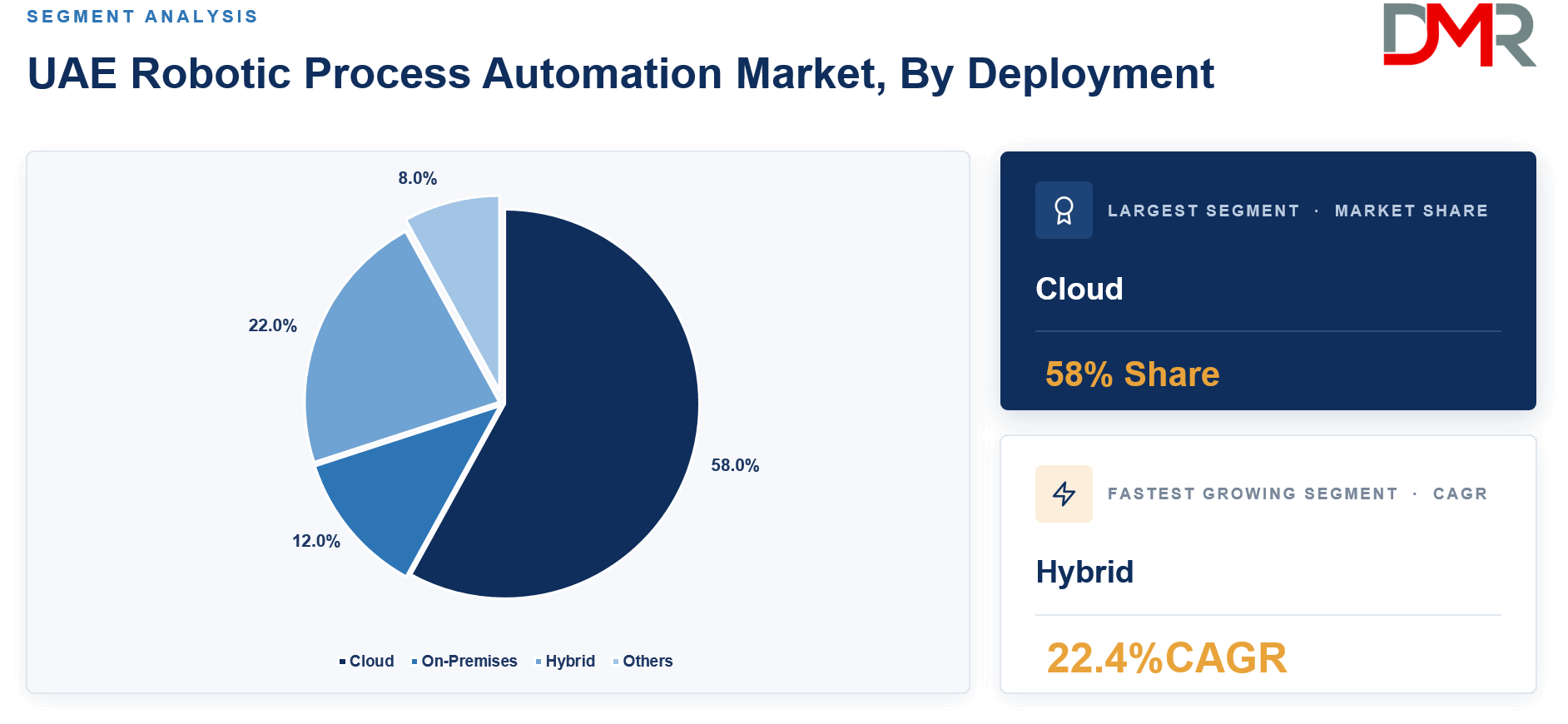
Cloud is projected to hold the highest revenue position within deployment in 2026, representing approximately 58% of demand, because UAE buyers increasingly prefer elastic capacity, faster upgrades and central administration without maintaining large automation infrastructure. Growth, however, is concentrated in Hybrid, expanding at a CAGR of 22.4% between 2026 and 2035 as regulated institutions keep selected workloads and data controls close to internal environments while extending automation to cloud services. This split reflects a market moving from isolated task automation toward broader orchestration, governance and measurable process outcomes.
By Technology
Rule-Based RPA is projected to hold the highest revenue position within technology in 2026, representing approximately 44% of demand, because many production processes remain structured, repetitive and governed by explicit business rules, making deterministic bots easier to validate. Growth, however, is concentrated in Agentic Automation, expanding at a CAGR of 27.9% between 2026 and 2035 as LLM planning, tool use and human approval layers allow automation to handle exceptions and multi-step work that earlier bots escalated. This split reflects a market moving from isolated task automation toward broader orchestration, governance and measurable process outcomes.
By Application
Back-Office Process Automation is projected to hold the highest revenue position within application in 2026, representing approximately 34% of demand, because finance operations, reconciliations, onboarding checks and data transfers still offer high-volume work with repeatable inputs. Growth, however, is concentrated in Customer Service Automation, expanding at a CAGR of 25.1% between 2026 and 2035 as service teams are combining workflow engines with conversational interfaces to reduce response queues and coordinate actions across systems. This split reflects a market moving from isolated task automation toward broader orchestration, governance and measurable process outcomes.
By End Use Industry
BFSI is projected to hold the highest revenue position within end use industry in 2026, representing approximately 27% of demand, because banks and insurers operate document-heavy, regulated processes where accuracy, audit trails and turnaround time directly affect operating cost. Growth, however, is concentrated in Government and Public Sector, expanding at a CAGR of 26.4% between 2026 and 2035 as national digital-service programmes are widening the number of workflows suitable for automation and increasing demand for secure orchestration. This split reflects a market moving from isolated task automation toward broader orchestration, governance and measurable process outcomes.
The UAE Robotic Process Automation Market Report is Segmented Based on the Following
By Offering
- Software
- Services
- Platform and Managed Automation
- Others
By Deployment
- Cloud
- On-Premises
- Hybrid
- Others
By Technology
- Rule-Based RPA
- AI-Enabled RPA
- Agentic Automation
- Intelligent Document Processing
By Application
- Back-Office Process Automation
- Finance and Accounting
- Customer Service Automation
- Compliance and Risk Automation
- Human Resources Automation
By End Use Industry
- BFSI
- Government and Public Sector
- Telecom and IT
- Retail and E-commerce
- Healthcare
- Others
Competitive Landscape
Competition combines large enterprise software suppliers, RPA specialists, AI automation vendors, systems integrators and UAE-based digital-service providers. Platform breadth, local cloud options, Arabic and English document capabilities, integration depth and governance increasingly determine vendor selection. Global software firms compete through installed enterprise relationships and bundled ecosystems, while specialists compete on process discovery, bot development, orchestration and industry templates. Local partners remain important because many projects require process redesign, implementation support and knowledge of sector-specific compliance expectations. The market is therefore moderately fragmented at the delivery layer, even where a smaller group of platforms shapes core technology choices.
Some of the Prominent Players in the UAE Robotic Process Automation Market Are
- Microsoft Corporation
- UiPath Inc.
- IBM Corporation
- SAP SE
- Oracle Corporation
- Automation Anywhere, Inc.
- Salesforce, Inc.
- ServiceNow, Inc.
- Pegasystems Inc.
- NICE Ltd.
- SS&C Blue Prism
- WorkFusion, Inc.
- Kofax LLC
- Appian Corporation
- Nintex UK Ltd.
- AntWorks Pte. Ltd.
- ElectroNeek Robotics, Inc.
- Kryon Systems Ltd.
- Laiye Technology
- Fortra, LLC
- Celonis SE
- AutomationEdge Technologies Pvt. Ltd.
- Cyclone Robotics
- HCLTech
- Tata Consultancy Services
- Infosys Limited
- Wipro Limited
- Tech Mahindra Limited
- e& enterprise
- G42
- Core42
- Presight AI Holding PLC
- Injazat Data Systems
- du
- Emirates NBD
- First Abu Dhabi Bank
- Mashreqbank PSC
- Moro Hub
- Alpha Data Processing Services LLC
- Gulf Business Machines LLC
- Other Key Players
Recent Developments
- In July 2026, Abu Dhabi Government announced a Microsoft 365 Copilot rollout covering 35,000 civil servants across 27 entities, increasing demand for governed AI-enabled productivity and creating adjacent opportunities for workflow automation around enterprise applications.
- In September 2025, Abu Dhabi advanced its Digital Strategy 2025-2027 toward AI-native government operations, strengthening the pipeline for automation, data integration and intelligent service orchestration across public entities.
Report Details
| Report Characteristics |
| Market Size (2026) |
USD 0.9 Bn |
| Forecast Value (2035) |
USD 3.8 Bn |
| CAGR (2026-2035) |
17.3% |
| Historical Data |
2021 - 2025 |
| Forecast Data |
2026 - 2035 |
| Base Year |
2025 |
| Segments Covered |
By Offering, By Deployment, By Technology, By Application, and By End Use Industry |
| Regional Coverage |
The UAE |
Frequently Asked Questions
How big is the UAE Robotic Process Automation Market?
▾ The UAE Robotic Process Automation Market is estimated to reach USD 0.9 Bn in 2026. The estimate covers spending on automation software, related platforms, intelligent automation capabilities and implementation or managed services deployed for business and government processes within the UAE. It measures domestic demand rather than the worldwide revenue generated by suppliers that happen to operate from the country.
What is the growth rate of the UAE Robotic Process Automation Market?
▾ The market is projected to grow at a CAGR of 17.3% from 2026 to 2035. Expansion is supported by government service automation, cloud adoption, enterprise productivity programmes and wider use of AI for document-heavy and exception-driven workflows. The fastest areas are expected to include agentic automation, regulated intelligent workflows and implementation services for organisations scaling beyond pilot projects.
What is driving demand in the UAE Robotic Process Automation Market?
▾ Demand is being driven mainly by digital government programmes and the need for enterprises to process high transaction volumes with stronger consistency and auditability. Government and Public Sector is forecast to grow at 26.4% CAGR, reflecting expanding service digitisation and workflow integration. Banks, telecom operators and large corporate groups also continue to automate repetitive tasks across fragmented enterprise systems.
Which offering holds the largest share in the UAE Robotic Process Automation Market?
▾ Software is expected to lead the offering mix in 2026, accounting for approximately 46% of demand. Enterprises require platform licences, orchestration, bot management and reusable automation components before they can scale process portfolios. Services are growing faster at a CAGR of 24.1%, as buyers seek local implementation expertise, process redesign, integration and managed automation support.
Which deployment model is most widely used in the UAE Robotic Process Automation Market?
▾ Cloud is projected to hold close to 58% of 2026 market demand. The model supports faster updates, central administration and scalable automation capacity. Hybrid environments remain important for organisations that must retain selected applications or sensitive workloads within controlled infrastructure while still using cloud-based orchestration, analytics and broader enterprise automation services.
Who are the key players in the UAE Robotic Process Automation Market?
▾ Key participants include UiPath Inc., Microsoft Corporation, IBM Corporation, Automation Anywhere, Inc., SS&C Blue Prism, SAP SE and e& enterprise. Competition also involves UAE technology providers, systems integrators and managed-service partners that support implementation, governance and industry-specific process redesign. Selection increasingly depends on integration depth, local delivery capability, security controls and AI-enabled automation features.
What is the forecast outlook for the UAE Robotic Process Automation Market?
▾ The UAE Robotic Process Automation Market is expected to reach USD 3.8 Bn by 2035. Future growth will depend on how quickly organisations convert pilot bots into governed automation portfolios and integrate AI with existing workflow systems. Agentic automation, intelligent document processing, managed services and public-sector digital transformation are expected to remain important expansion areas during the forecast period.