Market Snapshot
- Market Size (2026): USD 145.0 Mn
- Forecast Value (2035): USD 285.1 Mn
- CAGR (2026-2035): 7.8%
- Leading Pump Type (2026): Submersible Sewage Pumps, approximately 44%
- Leading Installation (2026): Permanent Installations, around 62%
- Leading Power Rating (2026): 5 to 20 kW, close to 34%
- Leading Application (2026): Municipal Sewage, nearly 46%
- Key Players: Grundfos, Xylem, and KSB, among others
What is UAE Sewer Pumps Market and its Market Size?
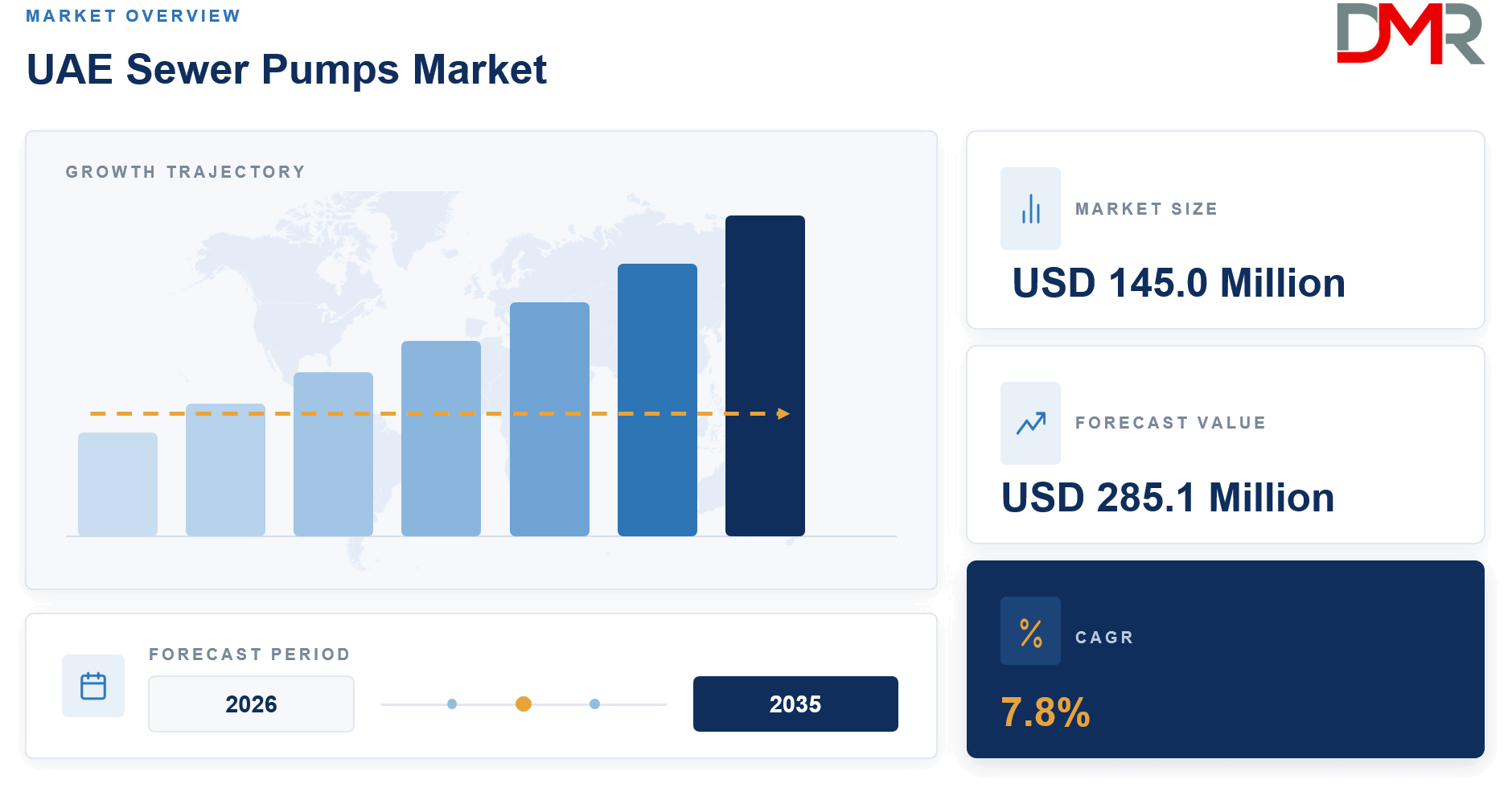
The UAE Sewer Pumps Market size is estimated to reach USD 145.0 Mn in 2026 and is further anticipated to reach USD 285.1 Mn by 2035, at a CAGR of 7.8%.
ℹ
To learn more about this report –
Download Your Free Sample Report Here
This market covers pumps and pump assemblies designed to move raw sewage, wastewater containing suspended solids, sludge-laden liquids, and effluent through collection systems, lift stations, building drainage systems, and treatment infrastructure within the United Arab Emirates. The scope centers on pump equipment and closely integrated pumping packages rather than the value of complete wastewater treatment plants.
Submersible units form the practical core of many installations because they can operate directly inside wet wells and handle variable liquid levels without a separate dry-pit arrangement. Vortex, channel, semi-open, and cutter impellers are selected according to solids loading, fiber content, required head, flow duty, and clogging risk. Motor protection, mechanical seals, guide rails, level controls, check valves, and variable frequency drives determine how reliably the package performs.
Demand comes from water utilities, municipalities, MEP contractors, building owners, industrial operators, and facilities management providers. Procurement decisions increasingly weigh total energy use, maintenance access, spare-parts availability, solids passage, corrosion resistance, noise, and remote monitoring. Projects serving dense residential districts, commercial complexes, hospitality assets, industrial zones, and public infrastructure create different duty profiles.
Structural change is being shaped by sewer network expansion, rehabilitation of pumping assets, digital monitoring, energy-efficiency requirements, and large infrastructure programs that alter where pumping remains necessary. Some deep gravity systems reduce the number of conventional pumping stations, while new lift points, rehabilitation work, storm resilience measures, and decentralized building systems preserve demand for specialized sewer pumps.
Use Cases
- Municipal Lift Stations: Water utilities deploy high-duty sewage pumps in wet wells where gravity flow cannot maintain hydraulic continuity, moving solids-bearing wastewater toward trunk sewers or treatment assets. Proper solids passage and duty redundancy reduce blockage exposure and help maintain service during peak inflow.
- Residential Basement Drainage: Property developers and building operators use compact sewage pumps below sewer elevation, particularly where underground bathrooms, utility rooms, or parking areas create low-level discharge points. Automatic level controls reduce manual intervention and limit the risk of wastewater accumulation.
- Hospitality Facilities: Hotel engineering teams select corrosion-resistant pumping equipment for kitchens, laundry areas, staff facilities, and guest wastewater systems where variable occupancy changes inflow patterns. Duty and standby arrangements improve continuity while easier access to wear components lowers maintenance disruption.
- Industrial Effluent Transfer: Plant maintenance teams use solids-tolerant pumps for process wastewater containing fibers, suspended matter, or abrasive particles. Equipment is selected around fluid characteristics and duty cycles so production areas can transfer wastewater without relying on repeated manual clearing.
Key Takeaways
- Market Size & Share: UAE sewer pumps demand is estimated at USD 145.0 Mn in 2026 and is projected to reach USD 285.1 Mn by 2035.
- Pump Type Analysis: Submersible Sewage Pumps are expected to account for approximately 44% of 2026 demand, while Grinder Pumps expand at a 10.6% CAGR through 2035.
- Installation Analysis: Permanent Installations are projected to hold around 62% of 2026 revenue, reflecting the installed base of municipal and building wet wells.
- Application Analysis: Municipal Sewage is expected to represent close to 46% of 2026 demand, while Industrial Wastewater records a 10.8% CAGR.
- Power Rating Analysis: The 5 to 20 kW class is set to represent nearly 34% of 2026 demand, supported by broad building and utility duty requirements.
- Demand Concentration: Water Utilities are projected to hold about 48% of 2026 end-user demand, keeping public infrastructure procurement central to the market.
- Technology Shift: Facilities are moving toward condition monitoring, variable speed control, and remote alarms as pump downtime becomes more costly across dense urban assets.
How AI/Gen AI is Transforming the UAE Sewer Pumps Market?
AI adoption in sewer pumping is primarily operational rather than product-led. Utilities and large facilities can combine motor current, vibration, temperature, pressure, flow, wet-well level, and alarm histories to identify patterns that precede clogging, seal degradation, cavitation, or motor overload. Machine-learning anomaly detection can then rank assets by failure probability and guide maintenance teams toward the pumps most likely to require attention.
Generative AI adds value around engineering records and operational knowledge. LLM document processing can extract pump curves, service histories, inspection notes, and maintenance instructions into searchable work orders, while digital twins can compare expected hydraulic behavior with live operating conditions. The result is a more data-driven maintenance workflow, especially where municipalities manage many remote stations and need consistent decisions across dispersed assets.
- Predictive Maintenance: Time-series models flag abnormal vibration, temperature, current, and run-time patterns before failure becomes visible.
- LLM Document Processing: Language models organize maintenance logs, equipment manuals, inspection reports, and procurement records into searchable operational knowledge.
- Digital Twins: Virtual pump and wet-well models test hydraulic conditions, duty cycles, and control settings before field changes are implemented.
- Intelligent Scheduling: Reinforcement learning can optimize duty and standby sequencing around inflow, energy tariffs, tank levels, and equipment health.
Key Drivers in the UAE Sewer Pumps Market
Demand is being shaped by infrastructure renewal and the operational need to keep wastewater assets reliable under changing urban loads.
- Wastewater Network Expansion and Rehabilitation: Urban development creates new collection points while older assets require replacement, rehabilitation, and higher operating reliability. Dubai's sewerage investment pipeline includes deep tunnel and link-sewer development, while projects in other emirates are adding treatment and collection capacity. For pump suppliers, this creates demand not only for new sewage pumps but also for replacement units, guide systems, control panels, valves, and service contracts. Municipal and contractor procurement therefore remains a major demand channel, particularly where pumping cannot be eliminated by gravity. The market is projected to expand at a 7.8% CAGR through 2035 as infrastructure requirements translate into recurring equipment and maintenance spending.
- Higher Reliability and Energy Management Requirements: Sewer pumps operate in environments where clogging, corrosion, seal wear, and irregular inflow can produce costly service interruptions. Buyers are consequently shifting attention from initial purchase price toward solids passage, motor efficiency, redundancy, variable speed operation, and condition monitoring. Larger facilities also have stronger incentives to reduce unnecessary starts and optimize pump sequencing because electricity is a recurring operating cost. This favors suppliers able to combine hydraulic equipment with controls, sensors, service support, and spare parts. The effect is strongest in municipal and commercial assets with high duty cycles, where a small reliability improvement can reduce emergency callouts and unplanned shutdowns.
Restraints in the UAE Sewer Pumps Market
Market growth faces practical limits from project design choices, procurement economics, and the demanding operating environment.
- Gravity Sewerage Can Reduce Pumping Requirements: Deep gravity tunnel systems can replace numerous conventional pumping stations where terrain and network geometry permit. Dubai's strategic sewerage program is designed to shift a substantial portion of wastewater conveyance toward gravity, which can reduce the long-term requirement for some conventional lift-station pumps. This does not eliminate the market because buildings, local collection points, treatment facilities, and specialized assets still need pumping, but it changes the mix toward higher-duty, specialized equipment and replacement opportunities. Suppliers dependent on standard station volumes therefore face a structural ceiling as network architecture evolves.
- Harsh Duty Conditions and Procurement Pressure: Sewage contains fibers, grit, fats, oils, and solids that accelerate wear and increase the consequences of poor sizing. Buyers must balance motor rating, impeller design, corrosion protection, solids passage, redundancy, and service access against project budgets. Imported equipment can also face longer lead times for specialized parts, while lower-cost alternatives intensify price competition in smaller building applications. These factors can extend purchasing cycles and favor established suppliers with local stock, technical support, and proven references, limiting rapid penetration by new entrants even when their equipment has competitive specifications.
Growth Opportunities in the UAE Sewer Pumps Market
White space is emerging where buyers need higher uptime, compact pumping packages, and better control of dispersed wastewater assets.
- Smart Retrofit Packages for Existing Stations: Aging wet wells can be upgraded with variable frequency drives, level sensors, remote alarms, energy monitoring, and condition-based maintenance without rebuilding the full civil structure. This creates an attractive retrofit proposition for utilities and building operators that need measurable reliability improvements while keeping capital expenditure below a full station replacement. Suppliers that package pumps with controls, commissioning, and lifecycle service can capture more value than vendors competing only on pump price.
- Packaged Lift Stations for New Developments: Residential, hospitality, logistics, and mixed-use projects increasingly require compact wastewater lifting where site levels, phasing, or local network conditions make gravity connections impractical. Factory-assembled wet wells, pump sets, controls, valves, and alarms can shorten installation work and reduce interface risk for MEP contractors. The packaged segment is projected to record a 10.2% CAGR through 2035, reflecting the value of faster deployment and standardized commissioning.
Trends in the UAE Sewer Pumps Market
Purchasing behavior is moving toward integrated equipment and service models rather than standalone pump transactions.
- Condition Monitoring Is Becoming a Specification Item: Buyers increasingly request remote alarms, run-time tracking, vibration sensing, and fault histories alongside pump equipment. This trend shifts competition toward suppliers that can integrate sensors and controls into existing building management or utility SCADA environments.
- Energy Efficiency Is Moving Into Lifecycle Evaluation: Pump curves, motor efficiency, variable speed operation, and duty sequencing are being assessed against lifetime operating cost. Suppliers are therefore competing on hydraulic efficiency and controllability as well as purchase price, especially for continuously operated municipal assets.
Research Scope and Analysis
Segment performance is assessed across pump type, installation, power rating, application, and end user. Each axis identifies where 2026 revenue is concentrated and which sub-segment is positioned for faster expansion through 2035, providing a practical view of procurement structure and demand movement.
ℹ
To learn more about this report –
Download Your Free Sample Report Here
By Pump Type
Submersible Sewage Pumps are projected to hold the largest pump type share in 2026, accounting for approximately 44% of revenue because wet-well deployment, compact footprints, and solids-handling capability fit a wide range of municipal, commercial, and residential duties. Their ability to operate below liquid level also simplifies many retrofit and lift-station arrangements. Growth, however, is concentrated in Grinder Pumps, advancing at a CAGR of 10.6% between 2026 and 2035 as decentralized wastewater points, smaller discharge lines, and applications with higher clogging exposure increase the value of maceration before transfer. Cutter configurations also benefit where fibrous waste creates recurring blockage risk, but grinder systems have a broader opportunity in compact building and packaged station applications.
By Installation
Permanent Installations are expected to represent around 62% of 2026 installation demand because municipal wet wells, fixed building sumps, and treatment infrastructure require equipment designed for continuous service and predictable access arrangements. Fixed guide-rail systems also simplify removal for scheduled maintenance. The steeper trajectory sits with Packaged Lift Stations, expanding at a CAGR of 10.2% through 2035 as developers and MEP contractors favor factory-assembled systems that reduce civil interfaces, commissioning time, and procurement complexity. Packaged designs are particularly suitable for phased developments and locations where a permanent civil station must be delivered quickly, creating a stronger growth profile than portable or conventional standalone installations.
By Power Rating
The 5 to 20 kW class is projected to account for close to 34% of 2026 revenue, reflecting its broad fit across building sewage systems, smaller municipal stations, commercial properties, and light industrial facilities. This range balances flow capacity with manageable electrical infrastructure and replacement cost. Growth, however, is concentrated in pumps above 75 kW, which are advancing at a CAGR of 10.4% through 2035 as large treatment assets, deep conveyance systems, and higher-capacity stations require greater hydraulic duty and redundancy. Higher power projects also support premium monitoring, variable speed control, and engineered installation packages, increasing average equipment value and service potential compared with smaller standardized units.
By Application
Municipal Sewage is expected to hold nearly 46% of 2026 application revenue because public collection networks, lift stations, and treatment infrastructure represent the largest concentration of recurring sewage pumping duties. Utility procurement also creates replacement demand when installed equipment reaches service limits or hydraulic requirements change. Industrial Wastewater has the faster trajectory, growing at a CAGR of 10.8% through 2035 as manufacturing, food processing, utilities, and industrial estates place greater emphasis on reliable effluent transfer and solids management. Industrial fluids can require specialized impellers, materials, seals, and controls, raising the value of application engineering and lifecycle service beyond the standard building pump transaction.
By End User
Water Utilities are projected to command about 48% of 2026 end-user demand because municipal wastewater collection and treatment systems operate extensive pump fleets and require planned replacement, redundancy, and rehabilitation. Their procurement scale also supports framework agreements and long-term service relationships. Facilities Management is expanding faster, at a CAGR of 10.0% through 2035, as large property portfolios centralize maintenance decisions and seek fewer emergency interventions across basements, commercial complexes, hotels, and mixed-use assets. Integrated monitoring and service contracts can make pump lifecycle costs more predictable, encouraging facilities managers to shift from reactive replacement toward scheduled maintenance and condition-based interventions.
The UAE Sewer Pumps Market Report is Segmented Based on the Following
By Pump Type
- Submersible Sewage Pumps
- Dry-Pit Sewage Pumps
- Grinder Pumps
- Cutter Pumps
- Non-Clog Centrifugal Pumps
- Others
By Installation
- Permanent Installations
- Portable Installations
- Packaged Lift Stations
- Skid-Mounted Systems
- Others
By Power Rating
- Up to 5 kW
- 5 to 20 kW
- 20 to 75 kW
- Above 75 kW
- Others
By Application
- Municipal Sewage
- Residential Wastewater
- Commercial Buildings
- Industrial Wastewater
- Hospitality Facilities
- Others
By End User
- Water Utilities
- MEP Contractors
- Building Owners
- Industrial Operators
- Facilities Management
- Others
Competitive Landscape
Competition is fragmented across multinational pump manufacturers, specialist sewage pump suppliers, UAE distributors, and engineering firms that package equipment with controls and service. Large brands compete on hydraulic efficiency, solids handling, reliability, and installed references, while local suppliers compete through availability, technical selection, commissioning, and response time. The market favors vendors that can satisfy municipal specifications while also supporting MEP contractors and facilities operators with parts and field service.
Some of the Prominent Players in the UAE Sewer Pumps Market Are
- Grundfos
- Xylem
- Sulzer
- KSB
- Wilo
- Ebara
- Tsurumi Pump
- Pedrollo
- Flowserve
- Torishima
- Kubota
- HOMA Pumpen
- Zenit
- Caprari
- Faggiolati Pumps
- Hidrostal
- LEO Group
- Lubi Industries
- Mody Pumps
- Texmo Pumps
- Tapflo
- DAB Pumps
- Calpeda
- Saer Elettropompe
- Qifeng Pump
- ARJ Water Technology
- Rajab Trading Company
- M.A.H.Y. Khoory & Co.
- Mohammed Tayyeb Khoory & Sons
- TechnoServe Group
- Standard Technical Supply
- Dynamic Solution Electromechanical
- Rover Industry
- AMET
- Cosmo Pumps General Trading
- Orax Roots
- Prakash Pump
- Safe Technical Trading of Mechanical Equipment
- Excellent Projects Development Establishment
- FAMCO
- Other Key Players
Recent Developments
- In June 2026, Tamas Projects secured an engineering, procurement and construction contract to rehabilitate Abu Dhabi's Step Terminal Pumping Station PS01, extending asset life and strengthening wastewater transmission reliability.
- In January 2026, Ras Al Khaimah entered a long-term sewage treatment agreement for a new wastewater treatment plant designed for 60,000 cubic metres per day, creating additional demand for collection, transfer, and treatment pumping equipment.
- In February 2026, the Dubai Strategic Sewerage Tunnel Phase 2 Links procurement advanced with a revised bid timetable, keeping major tunnel, link-sewer, and pumping infrastructure packages active in the emirate's wastewater investment cycle.
Report Details
| Report Characteristics |
| Market Size (2026) |
USD 145.0 Mn |
| Forecast Value (2035) |
USD 285.1 Mn |
| CAGR (2026-2035) |
7.8% |
| Historical Data |
2021 - 2025 |
| Forecast Data |
2026 - 2035 |
| Base Year |
2025 |
| Segments Covered |
By Pump Type, By Installation, By Power Rating, By Application and By End User |
| Regional Coverage |
UAE |
Frequently Asked Questions
How big is the UAE Sewer Pumps Market?
▾ The UAE Sewer Pumps Market is estimated at USD 145.0 Mn in 2026. The estimate covers sewage pump equipment and closely integrated pumping packages used inside the United Arab Emirates across municipal, residential, commercial, industrial, hospitality, and facilities management applications.
What is the growth rate of the UAE Sewer Pumps Market?
▾ The market is projected to grow at a CAGR of 7.8% from 2026 to 2035, reaching USD 285.1 Mn by 2035. Growth reflects wastewater infrastructure renewal, packaged lift-station demand, higher reliability requirements, and increasing use of monitoring and energy-management controls.
What is driving demand in the UAE Sewer Pumps Market?
▾ Demand is being driven most strongly by wastewater network expansion and rehabilitation. Municipal collection assets, treatment infrastructure, building drainage systems, and industrial wastewater applications require reliable solids-handling equipment, while rehabilitation creates recurring replacement and service opportunities across installed pump fleets.
Who are the key players in the UAE Sewer Pumps Market?
▾ Key participants include Grundfos, Xylem, KSB, Wilo, Ebara, Tsurumi Pump, Pedrollo, Sulzer, ARJ Water Technology, and Rajab Trading Company. Competition is shaped by hydraulic performance, solids handling, local availability, technical support, spare parts, and the ability to deliver complete pumping packages.
Which pump type holds the largest share in the UAE Sewer Pumps Market?
▾ Submersible Sewage Pumps are projected to account for approximately 44% of 2026 pump type demand. Their position reflects broad use in wet wells, compact station designs, building drainage systems, and municipal applications where direct immersion simplifies installation and supports reliable solids handling.
Which application is growing fastest in the UAE Sewer Pumps Market?
▾ Industrial Wastewater is forecast to expand at a CAGR of 10.8% from 2026 to 2035. Industrial operators increasingly require dependable effluent transfer for fluids containing suspended solids, fibers, or abrasive matter, supporting demand for specialized impellers, materials, seals, controls, and service programs.
What role will smart controls play in the UAE Sewer Pumps Market?
▾ Smart controls will improve visibility into pump health, energy use, wet-well levels, and operating cycles. Condition monitoring, remote alarms, predictive maintenance models, and variable speed control can reduce avoidable failures and help utilities and facilities teams prioritize maintenance based on asset condition rather than fixed schedules.