Market Snapshot
- Market Size (2026): USD 186.4 Mn
- Forecast Value (2035): USD 357.4 Mn
- CAGR (2026-2035): 7.5%
- Leading Type (2026): Anionic Surfactants, around 43%
- Leading Source (2026): Synthetic Surfactants, close to 82%
- Key Players: Union Chemicals Factory LLC, BASF SE, AquaChemie DMCC and others
What is UAE Surfactant Market and its Market Size?
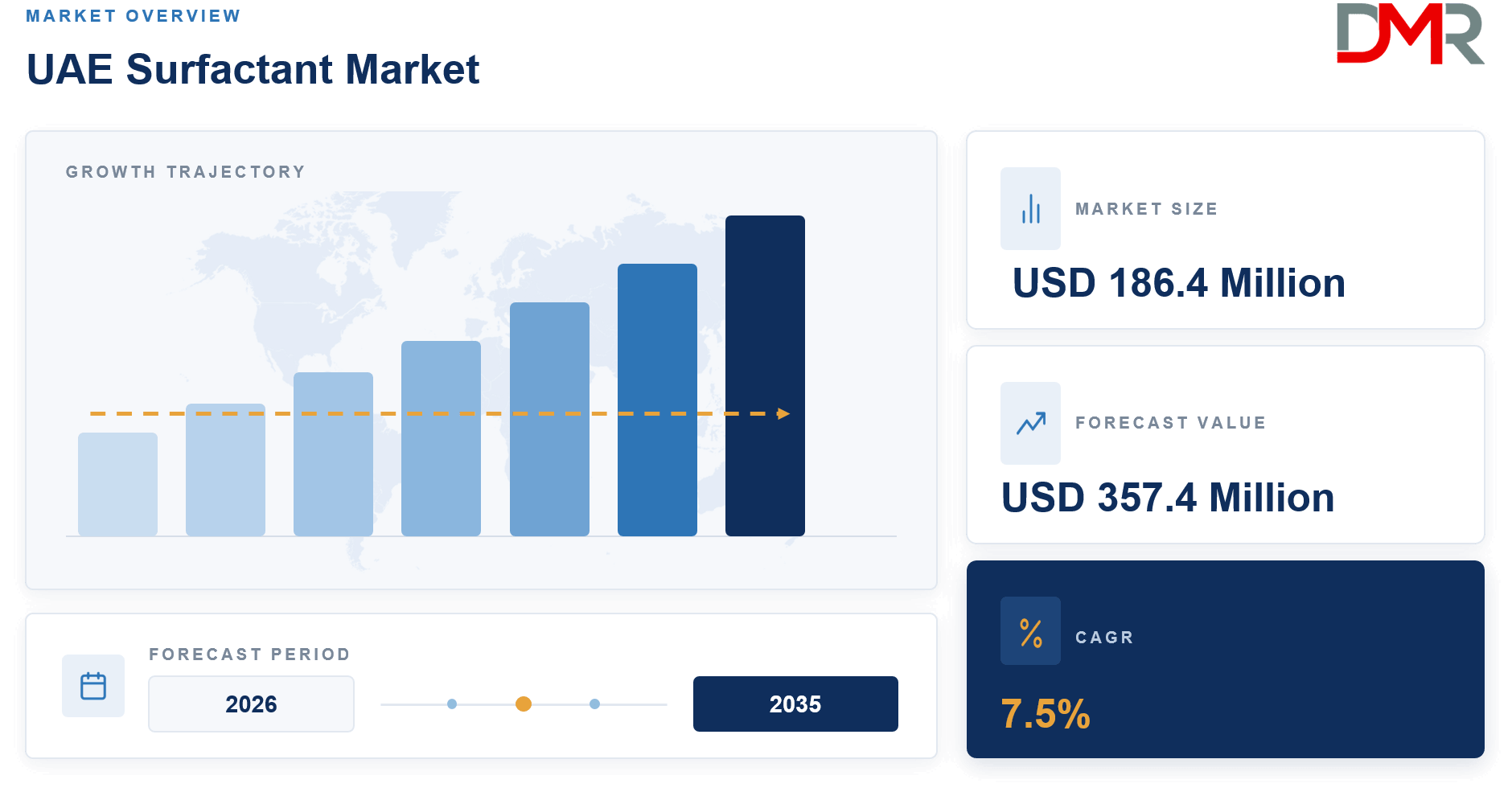
The UAE Surfactant Market size is estimated to reach USD 186.4 Mn in 2026 and is further anticipated to reach USD 357.4 Mn by 2035, at a CAGR of 7.5%.
ℹ
To learn more about this report –
Download Your Free Sample Report Here
The market covers surface-active chemicals supplied to formulators and industrial users in the United Arab Emirates, including anionic, non-ionic, cationic and amphoteric chemistries as well as selected bio-based products. Demand is tied to the ability of these ingredients to control wetting, detergency, foaming, emulsification, dispersion and interfacial behavior in finished formulations. The scope includes locally manufactured material, imported products, specialty blends and distributor-supplied grades sold into domestic industrial and consumer applications.
Home care is the largest demand pool because laundry detergents, dishwashing liquids, hard-surface cleaners and other cleaning formulations consume surfactants at scale. Personal care adds a higher-value layer through shampoos, body washes, facial cleansers and specialty formulations, where mildness, sensory profile, compatibility and formulation stability can command more technical attention. Industrial cleaning and oilfield chemicals provide additional demand with different performance requirements and buying criteria.
UAE demand is also being shaped by localization of chemical production, strong logistics infrastructure and the country's role as a regional distribution point. Buyers increasingly balance delivered cost against technical consistency, supply continuity and environmental characteristics. This supports a gradual shift toward specialty and bio-based grades while keeping established synthetic surfactants central to high-volume detergent and cleaning formulations. UAE procurement also reflects the country's role as a gateway for regional manufacturing and distribution. Large formulators can source commodity surfactants through established import channels, while smaller producers often rely on distributors that consolidate products from several manufacturers. This creates a layered market in which scale, local stock and technical responsiveness matter alongside chemical performance. Local manufacturing is particularly relevant where products require blending, sulphonation or application-specific adjustment, because domestic capability can reduce replenishment time and improve responsiveness to customer trials. At the same time, international suppliers remain important for specialty grades that require proprietary chemistry, global quality systems or a broader portfolio. The resulting competitive structure gives buyers more sourcing choices, but it also makes supplier qualification, documentation and technical support increasingly important in purchasing decisions. For buyers, this means the market is not defined only by product availability. Specification control, batch consistency, packaging formats, documentation, minimum order quantities and technical response times can determine supplier selection. These factors are especially important for personal care and industrial customers where a formulation change can require additional testing before commercial release. This favors suppliers that can combine dependable chemistry with responsive local service.
Use Cases
- Household Cleaning Formulation: Detergent manufacturers use anionic and non-ionic surfactants to build cleaning, wetting and foaming performance in laundry, dishwashing and multipurpose products. Procurement teams focus on active content, formulation compatibility and reliable delivery because small changes in raw material quality can affect viscosity, foam profile and finished-product consistency.
- Personal Care Production: Cosmetic and personal care formulators select amphoteric, non-ionic and mild anionic systems for shampoos, body washes, facial cleansers and grooming products. R&D teams use surfactant blends to balance cleansing with skin and hair feel, while sourcing teams increasingly evaluate biodegradability and renewable feedstock credentials.
- Oilfield Chemical Treatment: Oil and gas service companies deploy specialty surfactants in drilling, stimulation, production and well-treatment formulations where wetting, dispersion or interfacial control affects field performance. Technical buyers prioritize temperature tolerance, brine compatibility and predictable behavior under demanding operating conditions rather than commodity price alone.
- Institutional and Hospitality Cleaning: Hotels, hospitals, commercial kitchens and facility-management contractors purchase formulated cleaners through chemical suppliers and contract manufacturers. Their buyers need dependable cleaning performance across large sites, consistent dilution behavior and supply continuity, making concentrated formulations and technical distributor support important commercial factors.
Key Takeaways
- Market Size & Share: The market is estimated at USD 186.4 Mn in 2026 and is projected to reach USD 357.4 Mn by 2035.
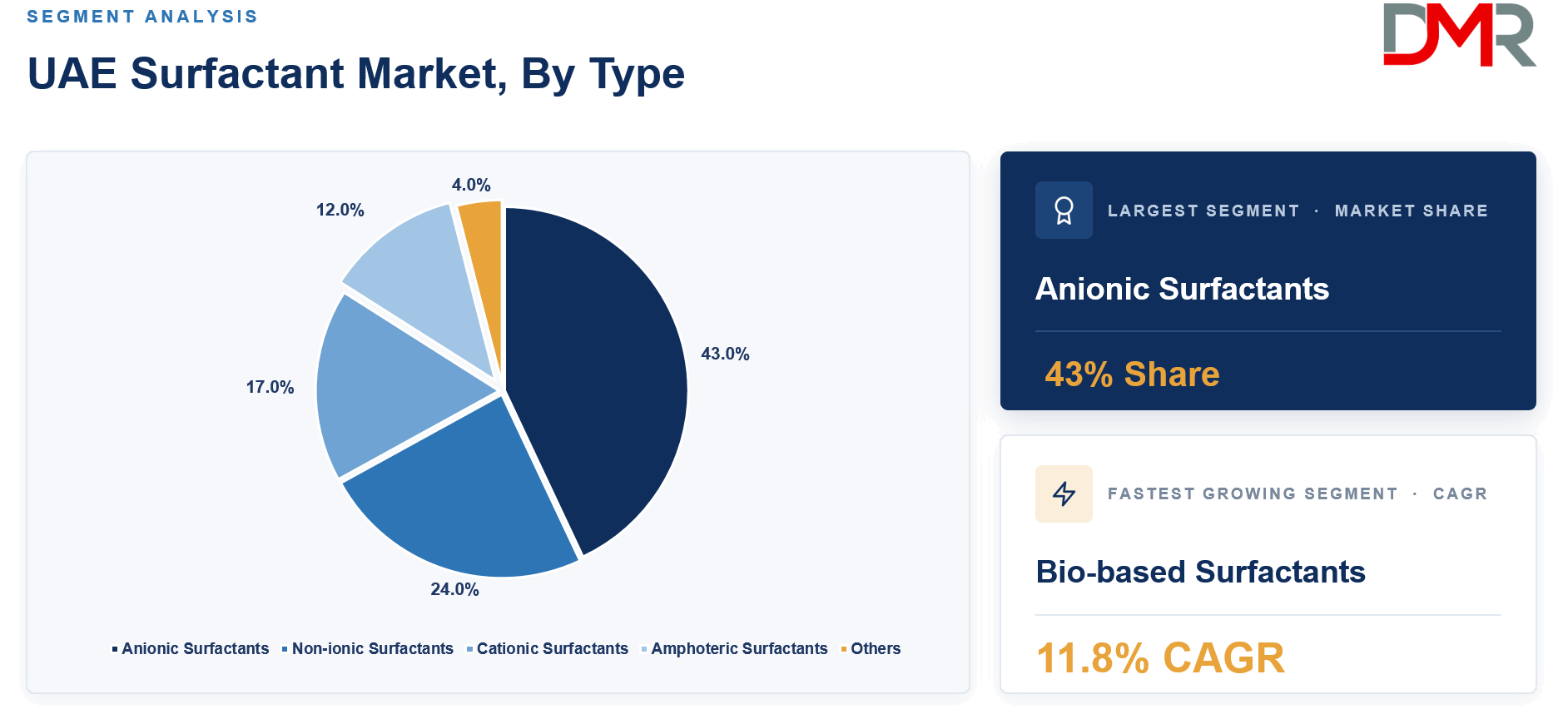
- Type Analysis: Anionic surfactants are expected to account for around 43% of 2026 demand, supported by detergent and cleaning applications.
- Demand Concentration: Demand is concentrated across Dubai, Abu Dhabi and Sharjah, with Dubai serving as the main commercial and distribution hub.
- Source Analysis: Synthetic surfactants are projected to hold close to 82% of 2026 revenue, while bio-based alternatives expand more quickly.
- Application Analysis: Household detergents are expected to hold about 31% of 2026 demand, while personal care posts the strongest application growth at 11.7% CAGR.
- Channel Analysis: Direct sales are set to represent roughly 46% of 2026 revenue because large formulators prefer technical supply agreements and predictable replenishment.
How AI/Gen AI is Transforming the UAE Surfactant Market?
Artificial intelligence is entering the UAE surfactant value chain mainly through formulation development, quality monitoring, demand planning and technical service rather than through direct replacement of chemical expertise. Formulators can combine historical batch information, raw material attributes and performance tests to identify promising surfactant combinations before running a full laboratory program. This reduces trial volume and helps teams investigate viscosity, foam, detergency and stability trade-offs more systematically.
For distributors and manufacturers, machine learning can improve inventory planning by linking customer orders, lead times, seasonality and production constraints. Gen AI can also accelerate technical documentation, product comparison and customer-response workflows, provided generated content is checked against approved specifications and safety documentation.
- Formulation Optimization: Machine learning models rank candidate surfactant blends against target cleaning, foaming and mildness attributes.
- Quality Analytics: Anomaly detection flags unusual batch measurements and supports earlier investigation of raw material or process variation.
- Demand Forecasting: Predictive models combine customer ordering patterns with seasonal home care, hospitality and industrial demand to improve replenishment.
- Technical Documentation: Gen AI assists with structured product comparisons, formulation notes and regulatory document retrieval while final approval remains with qualified technical teams.
Key Drivers in the UAE Surfactant Market
Two demand forces are particularly influential because they connect different buyer groups and purchasing decisions.
- Expansion of Cleaning and Personal Care Consumption: Household detergents are expected to account for around 31% of 2026 application demand, creating a stable volume base for anionic and non-ionic surfactants. UAE hospitality, facility management and consumer care channels add recurring demand for cleaning formulations, while personal care manufacturers require more differentiated blends. The mechanism is direct: greater formulation output raises consumption of active ingredients, but buyers increasingly seek higher active concentration and formulation efficiency. This supports both established commodity grades and specialty systems that improve performance at lower use levels.
- Localization and Specialty Chemical Capability: The UAE is building more local chemical manufacturing and blending capacity, which reduces dependence on long import cycles for selected specialty products. Oilfield and industrial customers are particularly sensitive to lead times because treatment programs can be linked to project schedules and production requirements. As local technical supply expands, customers can move from purely transactional imports toward application-specific formulations, trials and shorter replenishment cycles. This strengthens the addressable market for specialty surfactants and supports the expected 7.5% market CAGR through 2035.
Restraints in the UAE Surfactant Market
Market expansion is constrained by input volatility, qualification requirements and the uneven economics of sustainable substitution.
- Feedstock and Freight Exposure: Many surfactant chemistries remain linked to petrochemical, oleochemical and ethoxylation feedstocks whose prices can move independently of downstream detergent pricing. Imported specialty grades add freight, storage and working-capital exposure. Distributors can mitigate some risk through local inventory, but smaller buyers may still face price resets when raw material or logistics costs change. This makes long-term supply agreements attractive for large formulators while leaving commodity buyers more exposed to spot-market conditions.
- Qualification and Reformulation Friction: Replacing a conventional surfactant with a bio-based or newer specialty grade is not a simple procurement change. Formulators must verify foam, viscosity, stability, preservative interaction, skin feel, biodegradability claims and finished-product performance. In industrial applications, compatibility with salts, solvents, hydrocarbons and process equipment can also require testing. These technical switching costs slow adoption of alternatives even when sustainability objectives are strong, keeping established synthetic products important to the UAE market.
Growth Opportunities in the UAE Surfactant Market
Commercial white space is developing where local supply, specialty formulation and sustainability requirements overlap.
- Bio-based Blends for Premium Consumer Products: Bio-based surfactants are expected to grow at 11.8% CAGR from 2026 to 2035, above the headline market rate. The opportunity is strongest in premium personal care, concentrated home care and products positioned around renewable or biodegradable ingredients. Suppliers that can provide consistent performance, documentation and compatibility with existing manufacturing lines can reduce the formulation burden for local brands. The opportunity is not limited to fully bio-based systems; hybrid blends can provide a practical transition path while preserving cost and performance.
- Local Specialty Supply for Oilfield and Industrial Formulation: Oilfield service companies, coatings formulators and industrial chemical blenders offer a route beyond high-volume detergents. Local production and technical blending can shorten response times and support customized surfactant packages for specific operating conditions. The commercial opening is especially relevant for buyers that need smaller batches, rapid formulation changes or application testing. Suppliers that combine inventory, blending and technical support can compete on total delivered value rather than commodity unit price.
Trends in the UAE Surfactant Market
Buyer behavior is shifting toward performance, traceability and supply resilience rather than simple unit-cost comparison.
- Movement Toward Mild and Bio-based Chemistry: Personal care formulators are increasing attention on mild surfactant systems, renewable feedstocks and biodegradable profiles. This trend favors non-ionic, amphoteric and bio-based technologies where they can meet performance requirements without forcing major process changes. The fastest growth is therefore concentrated in differentiated grades rather than the largest commodity categories. Suppliers with application laboratories and formulation support have an advantage because customers want evidence of performance before changing established recipes.
- More Localized and Multi-channel Procurement: UAE buyers increasingly combine direct manufacturer relationships with specialty distributors and local inventory. Direct sales are expected to represent roughly 46% of 2026 revenue, but distributors remain important for fragmented formulators and smaller industrial users. Digital procurement is also gaining relevance for repeat chemical purchases, documentation access and quotation workflows. This creates a hybrid channel structure in which technical relationships remain human-led while ordering and information exchange become more digital.
Research Scope and Analysis
Segment performance is assessed across five axes: type, source, application, end use industry and distribution channel. Each axis identifies where 2026 revenue is concentrated and which sub-segment is expanding fastest through 2035, with the commercial reason behind each position.
ℹ
To learn more about this report –
Download Your Free Sample Report Here
By Type
Anionic Surfactants are projected to hold the largest type share in 2026, accounting for around 43% of revenue, because detergents and industrial cleaners depend on their established detergency and cost-performance profile. Existing formulation infrastructure also reduces switching friction. Growth, however, is concentrated in Bio-based Surfactants, expanding at a CAGR of 11.8% between 2026 and 2035 as premium personal care, concentrated cleaning products and sustainability-oriented formulations increase demand for renewable feedstock options. Suppliers that can match the performance of established systems while providing credible environmental documentation are positioned to capture this shift.
By Source
Synthetic Surfactants are expected to retain the largest source share in 2026, close to 82%, because high-volume detergent and cleaning formulations remain optimized around established petrochemical and oleochemical supply chains. Their predictable performance and broad availability support procurement continuity. The steeper trajectory sits with Bio-based Surfactants, growing at a CAGR of 11.8% through 2035 as formulators respond to biodegradability goals, premium positioning and renewable-content preferences. Growth will favor suppliers able to deliver consistent active content and formulation compatibility rather than simply marketing a natural origin.
By Application
Household Detergents are expected to account for about 31% of 2026 application demand, supported by recurring consumption of laundry, dishwashing and surface-cleaning formulations across residential and commercial channels. The category also benefits from mature manufacturing infrastructure and established surfactant recipes. Growth, however, is concentrated in Personal Care, expanding at a CAGR of 11.7% between 2026 and 2035 as premium grooming, facial cleansing and hair care formulations place greater emphasis on mildness, sensory performance and differentiated ingredient systems.
By End Use Industry
Home Care is projected to lead the end use industry mix in 2026 with approximately 32% of revenue, reflecting the breadth and repeat purchase frequency of detergents and household cleaners. Large-volume products continue to anchor consumption. Growth, however, is concentrated in Personal Care, expanding at a CAGR of 11.6% through 2035 as local and regional brands broaden premium hair, skin and body formulations. The shift increases demand for mild surfactants, amphoteric systems and specialty blends with tighter performance specifications.
By Distribution Channel
Direct Sales are projected to hold roughly 46% of 2026 distribution revenue because large formulators prefer negotiated specifications, supply agreements and technical support directly from manufacturers or primary suppliers. This channel also supports better planning for recurring industrial demand. Growth, however, is concentrated in Specialty Distributors, expanding at a CAGR of 10.6% through 2035 as smaller formulators and industrial users seek local inventory, multi-product sourcing and formulation assistance. Distributors that combine logistics with technical support can capture customers that do not have the scale to manage multiple direct supplier relationships.
The UAE Surfactant Market Report is Segmented Based on the Following
By Type
- Anionic Surfactants
- Non-ionic Surfactants
- Cationic Surfactants
- Amphoteric Surfactants
- Others
By Source
- Synthetic Surfactants
- Bio-based Surfactants
By Application
- Household Detergents
- Personal Care
- Industrial & Institutional Cleaning
- Oilfield Chemicals
- Food Processing
- Agrochemicals
- Others
By End Use Industry
- Home Care
- Personal Care
- Oil & Gas
- Hospitality & Institutional Services
- Construction & Infrastructure
- Food & Beverage
- Other Industries
By Distribution Channel
- Direct Sales
- Specialty Distributors
- Chemical Traders
- Digital Procurement
- Other Channels
Pricing Analysis
Pricing in the UAE surfactant market is shaped by feedstock exposure, active content, import logistics, packaging, order volume and the degree of technical customization. Commodity anionic grades tend to be more price-sensitive because buyers can compare multiple sources, while specialty blends can command stronger value when they solve formulation or field-performance constraints. Current market development is increasing the relevance of local production and blending, which can reduce freight exposure and improve responsiveness for selected applications. The commercial opening lies in hybrid contracts that combine volume commitments with technical service and inventory support. The principal brake remains raw material volatility, which can compress distributor margins or trigger reformulation when customers cannot pass cost changes through to finished products.
Investment and White Space Analysis
Investment is increasingly directed toward chemical localization, specialty blending and supply-chain resilience rather than simple capacity for undifferentiated imported products. UAE industrial policy and new chemical projects create a stronger base for downstream formulation, while existing logistics infrastructure allows suppliers to serve neighboring GCC markets from local inventory positions. White space is strongest in bio-based surfactants, specialty oilfield formulations, premium personal care ingredients and technical distribution services that connect product selection with formulation support. The opportunity is reinforced by the projected 11.8% CAGR for bio-based surfactants through 2035. Risks include qualification costs, uncertain customer switching behavior and the need to secure reliable renewable feedstocks at competitive delivered prices.
Competitive Landscape
Competition is fragmented across local manufacturers, multinational chemical producers, specialty ingredient companies and distributors. Commodity products compete primarily on delivered cost, active content, consistency and supply reliability, while specialty products compete through formulation expertise, documentation and technical support. Local players benefit from shorter lead times and customer proximity, whereas multinational suppliers bring broader portfolios and established technology platforms. The market is therefore moving toward a two-speed structure: scale-oriented suppliers defend high-volume detergent grades, while specialist providers target personal care, industrial cleaning and oilfield applications where technical differentiation can protect margins.
Some of the Prominent Players in the UAE Surfactant Market Are,
- Union Chemicals Factory LLC
- Ittihad International Chemicals Trading LLC
- Ansol Gulf
- AquaChemie DMCC
- Trion Surfactants LLC
- Reda Industrial Materials LLC
- Galaxy International FZC
- Genome Specialities FZC
- Trimix LLC
- Petrozo Energy FZE
- DANA Lubricants Factory LLC
- Transiso Chem UAE
- Chembridges Group
- Kapco Chemicals LLC
- BASF SE
- Dow Inc.
- Evonik Industries AG
- Clariant AG
- Nouryon
- Croda International Plc
- Solvay SA
- Ashland Inc.
- Stepan Company
- Innospec Inc.
- Kao Corporation
- Indorama Ventures
- Sasol Limited
- Lubrizol Corporation
- Galaxy Surfactants Ltd.
- Godrej Industries Limited
- Aarti Surfactants Limited
- Kuala Lumpur Kepong Berhad
- Emery Oleochemicals
- Lion Corporation
- ADEKA Corporation
- Colonial Chemical Inc.
- EOC Group
- Oxiteno S.A.
- Syensqo
- Huntsman Corporation
- Other Key Players
Recent Developments
- In May 2026, TA'ZIZ and Alpha Dhabi Holding announced a strategic collaboration aimed at developing up to 14 industrial chemicals in Abu Dhabi's Al Ruwais Industrial City. The planned capacity would strengthen local chemical supply chains and expand downstream feedstock availability relevant to multiple formulation industries.
- In May 2025, AquaChemie announced the acquisition of an Abu Dhabi specialty chemical manufacturing business, adding a local sulphonation platform that includes surfactants among its product capabilities. The move supports localization and shorter supply routes for industrial chemical customers.
- In May 2025, AquaChemie presented the Abu Dhabi manufacturing expansion during the Make it in the Emirates platform, linking specialty chemical production with the UAE's industrial localization agenda. The development strengthens the case for locally formulated products and technical supply services.
- In 2025, Ansol Gulf continued to operate its Jebel Ali sulphonation and bulk storage infrastructure, combining LABSA production with storage and specialty surfactant blending capabilities. This model supports regional detergent and industrial customers through local inventory and formulation flexibility.
Report Details
| Report Characteristics |
| Market Size (2026) |
USD 186.4 Mn |
| Forecast Value (2035) |
USD 357.4 Mn |
| CAGR (2026-2035) |
7.5% |
| Historical Data |
2021 - 2025 |
| Forecast Data |
2026 - 2035 |
| Base Year |
2025 |
| Segments Covered |
By Type, By Source, By Application, By End Use Industry and By Distribution Channel |
| Regional Coverage |
The UAE |
Frequently Asked Questions
How big is the UAE Surfactant Market?
▾ The UAE Surfactant Market is estimated to reach USD 186.4 Mn in 2026 and is projected to reach USD 357.4 Mn by 2035. The market includes surfactant demand across household detergents, personal care, industrial cleaning, oilfield chemicals, food processing and other formulation industries.
What is the growth rate of the UAE Surfactant Market?
▾ The UAE Surfactant Market is expected to expand at a CAGR of 7.5% from 2026 to 2035. Growth is supported by recurring cleaning demand, personal care formulation activity, industrial chemical localization and increasing interest in specialty and bio-based surfactant systems.
What is driving demand in the UAE Surfactant Market?
▾ Demand is driven by home care and institutional cleaning volumes, personal care formulation growth, oilfield chemical requirements and the UAE's expanding chemical manufacturing and distribution capabilities. Localized specialty production can also reduce lead times for customers that require tailored formulations or smaller production batches.
Who are the key players in the UAE Surfactant Market?
▾ Key participants include Union Chemicals Factory LLC, Ittihad International Chemicals Trading LLC, Ansol Gulf, AquaChemie DMCC, BASF SE, Dow Inc., Evonik Industries AG and Croda International Plc. The market also includes specialty suppliers and distributors serving specific application groups.
Which type leads the UAE Surfactant Market?
▾ Anionic Surfactants are expected to lead by type in 2026 with around 43% of demand. Their position reflects extensive use in laundry detergents, dishwashing products, industrial cleaners and other formulations where detergency, foaming and cost performance are established purchasing criteria.
Which source segment is growing fastest in the UAE Surfactant Market?
▾ Bio-based Surfactants are projected to be the fastest-growing source segment, expanding at a CAGR of 11.8% from 2026 to 2035. Growth is supported by sustainability goals, premium personal care products and concentrated cleaning formulations seeking renewable or biodegradable ingredient profiles.
Which application has the largest share in the UAE Surfactant Market?
▾ Household Detergents are projected to hold the largest application share in 2026 at about 31%. The category benefits from recurring laundry, dishwashing and surface-cleaning consumption across residential, hospitality and commercial channels, supported by established local formulation and distribution networks.