Market Snapshot
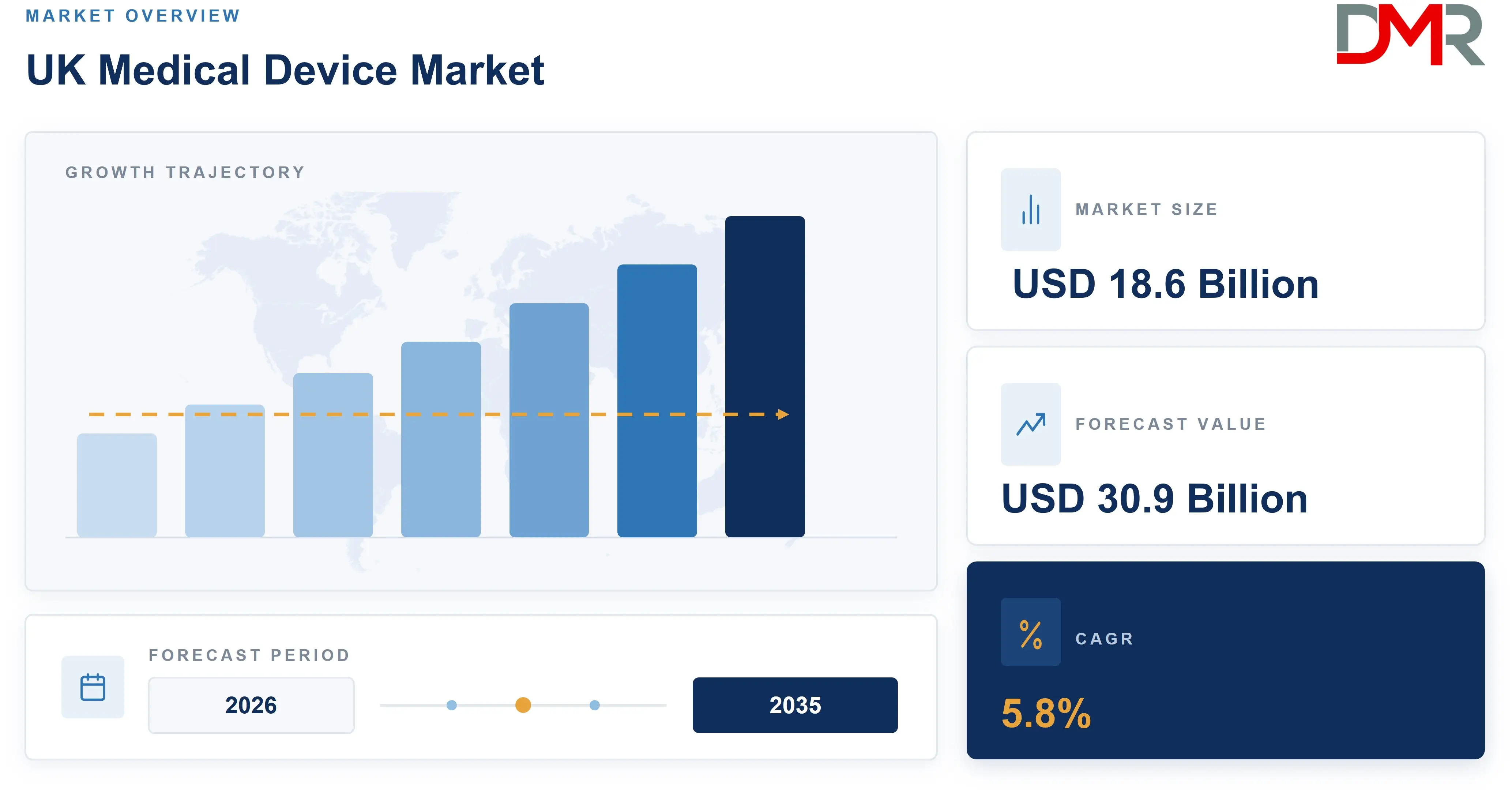
- Market Size (2026): USD 18.6 Bn
- Forecast Value (2035): USD 30.9 Bn
- CAGR (2026-2035): 5.8%
- Leading Product (2026): Medical consumables, around 27%
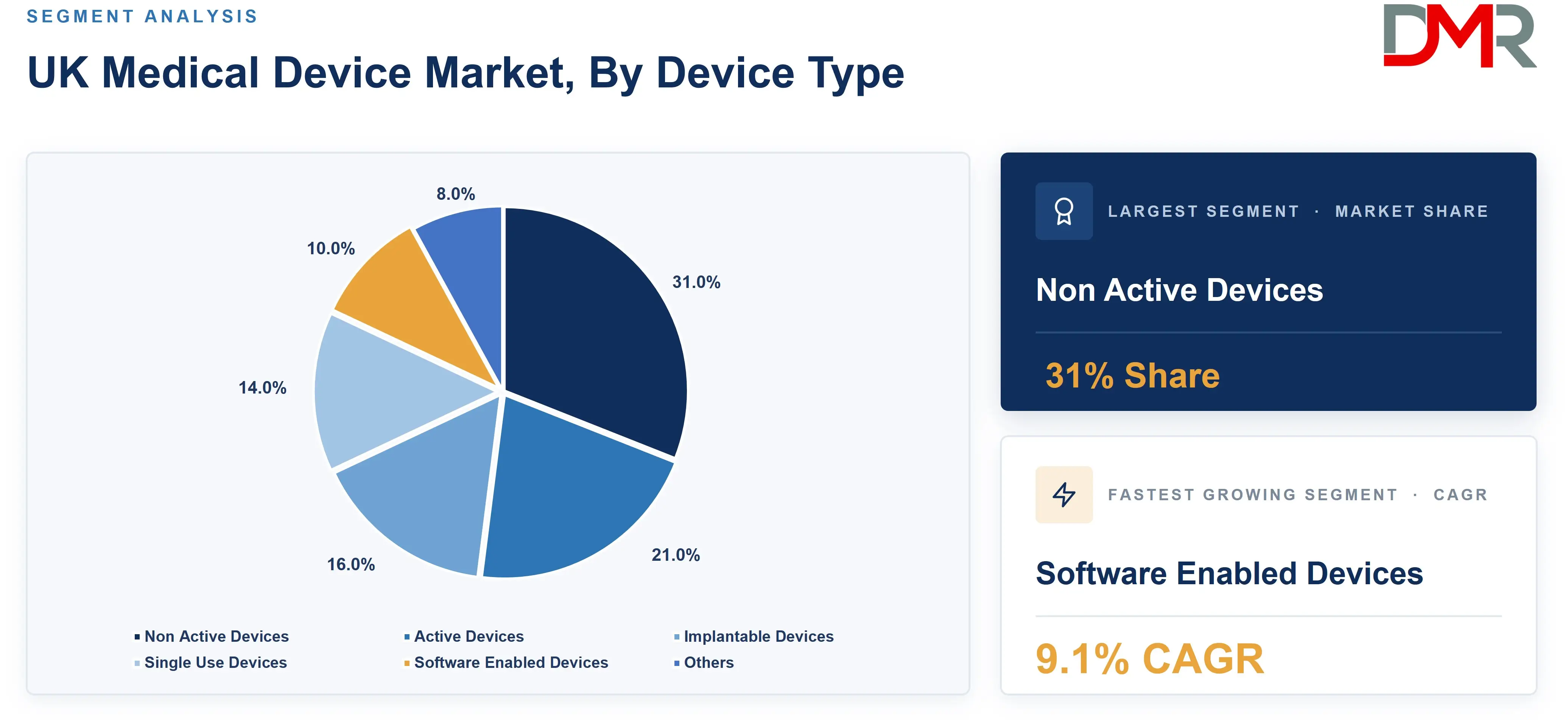
- Leading Device Type (2026): Non active devices, close to 31%
- Key Players: Smith+Nephew, Convatec, Siemens Healthineers and others
What is UK Medical Device Market and its Market Size?
The UK Medical Device Market size is estimated to reach USD 18.6 Bn in 2026 and is further anticipated to reach USD 30.9 Bn by 2035, at a CAGR of 5.8%.
ℹ
To learn more about this report –
Download Your Free Sample Report Here
The market covers devices supplied for diagnosis, monitoring, prevention, treatment, rehabilitation and patient support across the UK healthcare system. It includes capital equipment such as imaging systems, operating room equipment and patient monitors, as well as recurring products including wound care, syringes, catheters, diagnostic kits and other consumables. Software enabled devices are included where the software forms part of the medical device proposition rather than functioning solely as administrative healthcare software.
Demand is shaped by NHS hospital activity, private healthcare, community services, diagnostic capacity and home based care. Hospitals remain the most influential purchasing environment because high value equipment, implants and procedure related products require clinical evaluation, procurement review, service support and evidence of economic value. Manufacturers therefore compete on clinical performance, lifecycle cost, interoperability, reliability and the ability to support procurement requirements rather than on unit price alone.
Structural change is coming from ageing patient populations, pressure to increase diagnostic throughput, expansion of minimally invasive procedures and tighter scrutiny of healthcare expenditure. At the same time, the UK regulatory framework is being rebuilt around stronger post market surveillance and new pre market requirements. This creates additional compliance work but also gives established manufacturers an opportunity to differentiate through traceability, evidence generation and product quality. In June 2025, new post market surveillance requirements began applying to devices placed on the Great Britain market, increasing expectations for active safety monitoring.
Use Cases
- NHS Acute Hospitals: Hospital procurement teams deploy imaging, operating room, monitoring and surgical equipment to increase throughput while maintaining clinical quality. Standardised equipment fleets can simplify staff training, maintenance and spare parts management, particularly where several hospitals share procurement frameworks.
- Private Hospitals: Clinical directors use advanced surgical, diagnostic and therapeutic devices to expand elective capacity and differentiate specialist services. Purchasing decisions increasingly consider procedure time, clinician usability, patient recovery and total service cost rather than acquisition price alone.
- Community and Primary Care: Community providers use compact diagnostic and monitoring equipment closer to patients, reducing unnecessary hospital visits and supporting earlier intervention. Portable devices are particularly useful where clinical teams serve dispersed populations and require equipment that can move between care settings.
- Home Healthcare: Home care providers and patients use connected monitoring, infusion, respiratory and diabetes devices to shift suitable care away from acute facilities. This model changes the buyer relationship because device design must account for patient usability, remote support, data connectivity and adherence outside controlled clinical environments.
Key Takeaways
- Market Size & Share: The market is estimated at USD 18.6 Bn in 2026, with consumables expected to hold approximately 27% of revenue.
- Product Analysis: Diagnostic imaging and consumables form major revenue pools, while connected monitoring devices are among the faster expanding product groups.
- Demand Concentration: England represents the dominant demand base because of its population scale and concentration of NHS procurement, specialist hospitals and life sciences infrastructure.
- Regulatory Shift: Great Britain's post market surveillance regime took effect in June 2025, increasing manufacturer obligations for incident tracking, trend identification and corrective action.
- Procurement Change: NHS buyers are placing more weight on productivity, patient outcomes, staff experience, environmental impact and supply resilience alongside purchase price.
- Innovation Direction: Robotics, connected monitoring, advanced imaging and software enabled devices are attracting demand as providers seek higher diagnostic and procedural productivity.
How AI/Gen AI is Transforming the UK Medical Device Market?
AI is moving from an experimental feature to an embedded capability in selected UK medical devices, particularly diagnostic imaging, patient monitoring and workflow intensive equipment. Computer vision can assist image interpretation and quality control, while machine learning models can identify patterns in physiological data and help clinicians prioritise patients. These applications can increase the value of installed equipment without requiring a complete replacement cycle.
Generative AI has a narrower but growing role. It can support regulatory documentation, device service records and clinical workflow summaries when deployed with appropriate controls. Digital twins can model equipment performance and simulate procedure environments, while reinforcement learning can support scheduling and resource optimisation around high utilisation assets.
- Imaging Assistance: Computer vision supports image reconstruction, anomaly detection and workflow prioritisation.
- Connected Monitoring: Machine learning analyses streams from monitors and connected devices to flag changes requiring attention.
- Regulatory Documentation: LLM based document processing can organise technical files, complaint records and post market surveillance evidence under human review.
- Equipment Optimisation: Digital twins and predictive analytics help manufacturers and hospitals assess maintenance, utilisation and lifecycle performance.
Key Drivers in the UK Medical Device Market
Two demand forces have the strongest influence on near term device purchasing: rising healthcare activity combined with capacity constraints, and the need to shift care toward more productive and less invasive models.
- Diagnostic and Procedural Capacity Pressure: NHS providers face persistent pressure to deliver more diagnostic and elective care with constrained clinical resources. This supports investment in imaging, monitoring, surgical equipment and procedure specific consumables because manufacturers can link equipment productivity to throughput. The effect is strongest where devices reduce procedure time, increase utilisation or support earlier diagnosis. Product categories tied to recurring procedures also benefit from replacement and replenishment demand. Medical consumables are expected to account for approximately 27% of market revenue in 2026, giving this segment a large recurring base from which incremental procedural activity can translate into sales.
- Shift Toward Distributed Care: Healthcare delivery is moving suitable monitoring and treatment closer to patients through community, ambulatory and home settings. This expands demand for portable, connected and simpler devices that can be used outside specialist hospitals. The commercial mechanism is different from capital equipment replacement because manufacturers can access new buyers, usage models and recurring service relationships. Non active devices are projected to represent close to 31% of 2026 revenue, but the strongest incremental opportunity is in devices that combine clinical functionality with connectivity, remote monitoring or simplified operation.
Restraints in the UK Medical Device Market
Growth is constrained by regulatory complexity, procurement discipline and the high cost of introducing new equipment into clinical workflows.
- Regulatory Transition and Compliance Cost: Great Britain is progressing through staged reform of its medical device framework. The post market surveillance rules that took effect in June 2025 require stronger monitoring, reporting and corrective action processes, while further pre market reforms are being developed. Manufacturers must therefore maintain evidence and traceability across products already in use while preparing for additional requirements. Smaller firms can face a disproportionate burden because regulatory teams and quality systems are less developed. The result is a longer commercial preparation cycle for novel products and a stronger competitive advantage for companies with mature compliance infrastructure.
- NHS Procurement and Budget Constraints: Public buyers evaluate devices against clinical outcomes, total cost, service requirements and supply resilience rather than simply purchasing the newest technology. Capital equipment can also require installation, staff training, maintenance contracts and infrastructure changes. These factors slow replacement cycles and can favour established vendors with installed bases. Manufacturers introducing premium technologies must therefore demonstrate measurable operational value. Value based procurement guidance issued in 2026 further reinforces assessment of productivity, patient outcomes, staff experience, environmental considerations and supply chain resilience.
Growth Opportunities in the UK Medical Device Market
White space is strongest where manufacturers can connect clinical performance with measurable system savings. Connected patient monitoring, minimally invasive surgical equipment, advanced diagnostics and home care devices can address both capacity pressure and the shift toward distributed care.
- Connected Home Monitoring: Devices for respiratory care, cardiac monitoring, diabetes management and post discharge observation can extend clinical capacity without replicating hospital infrastructure at home. The opportunity is strongest when device data integrates into existing clinical workflows.
- Robotic and Image Guided Procedures: Hospitals seeking shorter stays and consistent procedural performance can support adoption of robotic and image guided systems where clinical evidence and utilisation justify the capital commitment.
- Local Manufacturing and Supply Resilience: UK manufacturers can gain share in selected consumables, diagnostics and specialist devices by offering shorter supply routes, traceability and resilient service arrangements to NHS and private buyers.
Trends in the UK Medical Device Market
The market is shifting toward devices that generate more measurable value over their lifecycle. Procurement teams increasingly ask manufacturers to demonstrate productivity, patient outcomes, staff safety, environmental performance and supply continuity. This changes competitive positioning from a product specification comparison toward a broader value assessment.
- Connected Devices: Connectivity is becoming a differentiator in monitoring and selected therapeutic products because manufacturers can support remote follow up, maintenance and usage analytics.
- Minimally Invasive Care: Procedure volumes are supporting demand for devices that reduce tissue disruption, shorten recovery and improve operating room utilisation.
- Traceability: Regulatory requirements are increasing the importance of incident records, unique product identification and post market data management.
- Value Based Procurement: NHS purchasing is moving beyond acquisition price toward total system value, creating opportunities for vendors able to quantify operational and clinical benefits.
Research Scope and Analysis
Segment performance is assessed across product, device type, application, end user and distribution channel. Each axis identifies where 2026 revenue is concentrated and which sub-segment is expanding faster through 2035, linking commercial position to clinical demand, procurement behaviour and technology adoption.
ℹ
To learn more about this report –
Download Your Free Sample Report Here
By Product
Medical consumables are projected to hold the largest product share in 2026, accounting for around 27% of revenue, supported by recurring procedure volumes and replacement demand across hospitals and community care. Growth, however, is concentrated in software enabled and connected monitoring devices, expanding at a CAGR of 8.7% between 2026 and 2035 as providers adopt remote observation, interoperability and data supported clinical workflows. Diagnostic imaging remains another major revenue pool because replacement of ageing systems and capacity expansion require substantial capital expenditure, while therapeutic and surgical devices benefit from elective procedure activity and specialist care.
By Device Type
Non active devices are expected to account for close to 31% of 2026 revenue because they span a broad base of implants, instruments, dressings and other products with established clinical use. The steeper trajectory sits with software enabled devices, expanding at a CAGR of 9.1% as connected monitoring and device intelligence become more practical and buyers seek measurable workflow improvements. Active devices retain a substantial installed base in imaging, monitoring and therapy, while single use products continue to benefit from infection control requirements and procedure intensity.
By Application
General diagnostics is projected to lead application demand with approximately 24% of 2026 revenue because testing and diagnostic procedures underpin a wide range of NHS and private care pathways. Growth, however, is concentrated in diabetes care, expanding at a CAGR of 8.5% as continuous monitoring, connected devices and home based management broaden the addressable user base. Cardiology and oncology remain high value applications because of equipment intensity and complex treatment pathways, while orthopedics benefits from elective surgery and an ageing patient population.
By End User
Hospitals are set to represent around 56% of 2026 revenue, reflecting their concentration of capital equipment, specialist procedures, implants and high volume consumables. Growth, however, is concentrated in home healthcare, expanding at a CAGR of 8.9% as remote monitoring and decentralised treatment shift selected services away from acute settings. Clinics and diagnostic centres continue to purchase equipment that improves throughput, while ambulatory care gains relevance where procedures can be delivered outside large hospitals.
By Distribution Channel
Direct manufacturer and NHS framework procurement is expected to hold approximately 48% of 2026 revenue because complex devices require clinical support, service agreements, training and structured procurement. The steeper trajectory sits with specialist distributors, expanding at a CAGR of 7.6% as smaller manufacturers and overseas suppliers use established channels to reach fragmented private, community and specialist buyers. Distributor value is strongest where regulatory representation, inventory management and after sales support are difficult for a manufacturer to establish independently.
The UK Medical Device Market Report is Segmented Based on the Following
By Product
- Diagnostic Imaging
- Surgical Devices
- Therapeutic Devices
- Patient Monitoring
- In Vitro Diagnostics
- Medical Consumables
- Others
By Device Type
- Active Devices
- Non Active Devices
- Implantable Devices
- Single Use Devices
- Software Enabled Devices
- Others
By Application
- Cardiology
- Orthopedics
- Oncology
- Diabetes Care
- General Diagnostics
- Other Applications
By End User
- Hospitals
- Clinics
- Diagnostic Centers
- Ambulatory Care
- Home Healthcare
- Others
By Distribution Channel
- Direct Manufacturer Sales
- NHS Procurement and Frameworks
- Specialist Distributors
- Medical Equipment Dealers
- Online and Digital Channels
- Others
Regulatory Landscape
The UK regulatory environment is undergoing a staged redesign led by the MHRA, with Great Britain operating under the UK Medical Devices Regulations while Northern Ireland follows its applicable arrangements. Post market surveillance rules became effective in June 2025, strengthening incident reporting, trend monitoring and corrective action expectations. In 2026, draft pre market reforms proposed international reliance routes, unique device identification and closer alignment with international practice. The commercial opening is clearest for manufacturers able to maintain high quality technical files, traceability and lifecycle evidence while entering the market through proportionate routes. The brake is regulatory uncertainty during transition, which can raise compliance costs and delay launches. Overall, the framework favours suppliers with mature quality systems and could improve market access for selected innovative devices.
Investment and White Space Analysis
Investment opportunities are strongest in UK device categories that address NHS capacity constraints without requiring a complete redesign of care delivery. Connected monitoring, advanced diagnostics, minimally invasive equipment and home care devices can serve growing demand while supporting more distributed healthcare. The commercial opening is particularly attractive for companies combining a physical device with analytics, service support or recurring revenue. Local manufacturing and specialist contract production also offer scope where supply resilience is increasingly considered in procurement. The principal risk is adoption friction: hospitals need evidence, training, integration and budget approval before capital intensive technologies can scale. The market therefore rewards investments that pair technical differentiation with clear health economic evidence and dependable UK service coverage.
Competitive Landscape
Competition in the UK is fragmented across multinational manufacturers, specialist medtech firms, diagnostics companies, device innovators and distributors. Large suppliers benefit from installed bases, procurement relationships and service infrastructure, while specialist companies compete through clinical differentiation and faster product development. Domestic manufacturers hold particular strength in wound care, surgical technology, monitoring and specialist devices. Competitive advantage increasingly depends on regulatory readiness, clinical evidence, interoperability, service coverage and the ability to quantify total value for NHS and private buyers.
Some of the Prominent Players in the UK Medical Device Market Are
- Smith+Nephew
- Convatec Group
- Renishaw
- CMR Surgical
- OrganOx
- Medovate
- Creo Medical
- Intelligent Ultrasound
- Micrima
- Owlstone Medical
- Quanta Dialysis Technologies
- Inspiration Healthcare Group
- Salts Healthcare
- Vernacare
- Surgical Innovations Group
- Genedrive
- SureScreen Diagnostics
- Adaptix
- Biocomposites
- Tristel
- Siemens Healthineers
- GE HealthCare
- Philips
- Medtronic
- Johnson & Johnson MedTech
- Abbott
- Stryker
- Boston Scientific
- BD
- Baxter
- Edwards Lifesciences
- Zimmer Biomet
- Intuitive Surgical
- Roche Diagnostics
- Thermo Fisher Scientific
- Danaher
- Fresenius Medical Care
- Olympus
- Terumo
- Getinge
- Other Key Players
Recent Developments
- In June 2026, the Department of Health and Social Care published national value based procurement guidance for medical technology, giving NHS buyers a structured approach to assessing productivity, patient outcomes, staff experience, environmental impact and supply resilience.
- In May 2026, the MHRA published draft pre market requirements for medical devices and in vitro diagnostics, including proposals for international reliance, unique device identification and stronger traceability, signalling the next stage of UK regulatory reform.
- In February 2026, the MHRA opened a consultation on indefinite recognition of certain CE marked medical devices in Great Britain, addressing transitional arrangements and potential alignment with European regulatory timelines.
- In July 2025, the MHRA published its response on future routes to market, including proposals intended to reduce duplicated regulatory work and improve access to selected innovative devices while retaining patient safety requirements.
- In June 2025, new post market surveillance requirements took effect across Great Britain, requiring manufacturers to strengthen safety monitoring, incident reporting and corrective action for devices placed on the market.
- In January 2025, the MHRA issued guidance to help manufacturers prepare for the incoming post market surveillance framework, highlighting enhanced data collection, reporting timelines and risk mitigation obligations.
Report Details
| Report Characteristics |
| Market Size (2026) |
USD 18.6 Bn |
| Forecast Value (2035) |
USD 30.9 Bn |
| CAGR (2026-2035) |
5.8% |
| Historical Data |
2021 - 2025 |
| Forecast Data |
2026 - 2035 |
| Base Year |
2025 |
| Segments Covered |
By Product, By Device Type, By Application, By End User, By Distribution Channel |
| Regional Coverage |
The UK |
Frequently Asked Questions
How big is the UK Medical Device Market?
▾ The UK Medical Device Market is estimated to reach USD 18.6 Bn in 2026. Demand is supported by NHS and private healthcare activity across diagnostics, surgery, monitoring, therapeutic care, implants and recurring consumables, with procurement increasingly focused on clinical and operational value.
What is the growth rate of the UK Medical Device Market?
▾ The UK Medical Device Market is expected to grow at a CAGR of 5.8% during 2026-2035, reaching USD 30.9 Bn by 2035. Growth is supported by diagnostic capacity needs, procedure volumes, connected monitoring and the expansion of care outside acute hospitals.
What is driving demand in the UK Medical Device Market?
▾ Demand is being driven by pressure to expand healthcare capacity while improving productivity and patient outcomes. NHS procurement is increasingly evaluating wider value, including efficiency, clinical outcomes, staff safety, environmental effects and supply resilience. These criteria support devices that can produce measurable lifecycle benefits.
Who are the key players in the UK Medical Device Market?
▾ Key players include Smith+Nephew, Convatec Group, Siemens Healthineers, GE HealthCare, Philips, Medtronic and Johnson & Johnson MedTech. Specialist UK companies such as CMR Surgical and Renishaw also contribute to the competitive landscape through surgical technology, engineering and device innovation.
Which product segment leads the UK Medical Device Market?
▾ Medical consumables are projected to lead by product, accounting for around 27% of 2026 revenue. Their position reflects recurring demand across procedures, wound care, infection control, diagnostics and other high volume clinical activities where replacement and replenishment are continuous.
Which end user is expected to dominate the UK Medical Device Market?
▾ Hospitals are expected to remain the leading end user, representing around 56% of 2026 revenue. Their share reflects concentration of advanced imaging, surgical equipment, implants, monitoring systems and procedure related consumables, although home healthcare is expected to expand faster as selected services move closer to patients.
What is the outlook for connected medical devices in the UK?
▾ Connected devices are expected to gain share as healthcare providers seek remote monitoring, better asset visibility and data supported care. Adoption will depend on interoperability, cybersecurity, clinical validation and workflow integration, but these devices can support distributed care while creating recurring service and analytics opportunities.