Market Snapshot
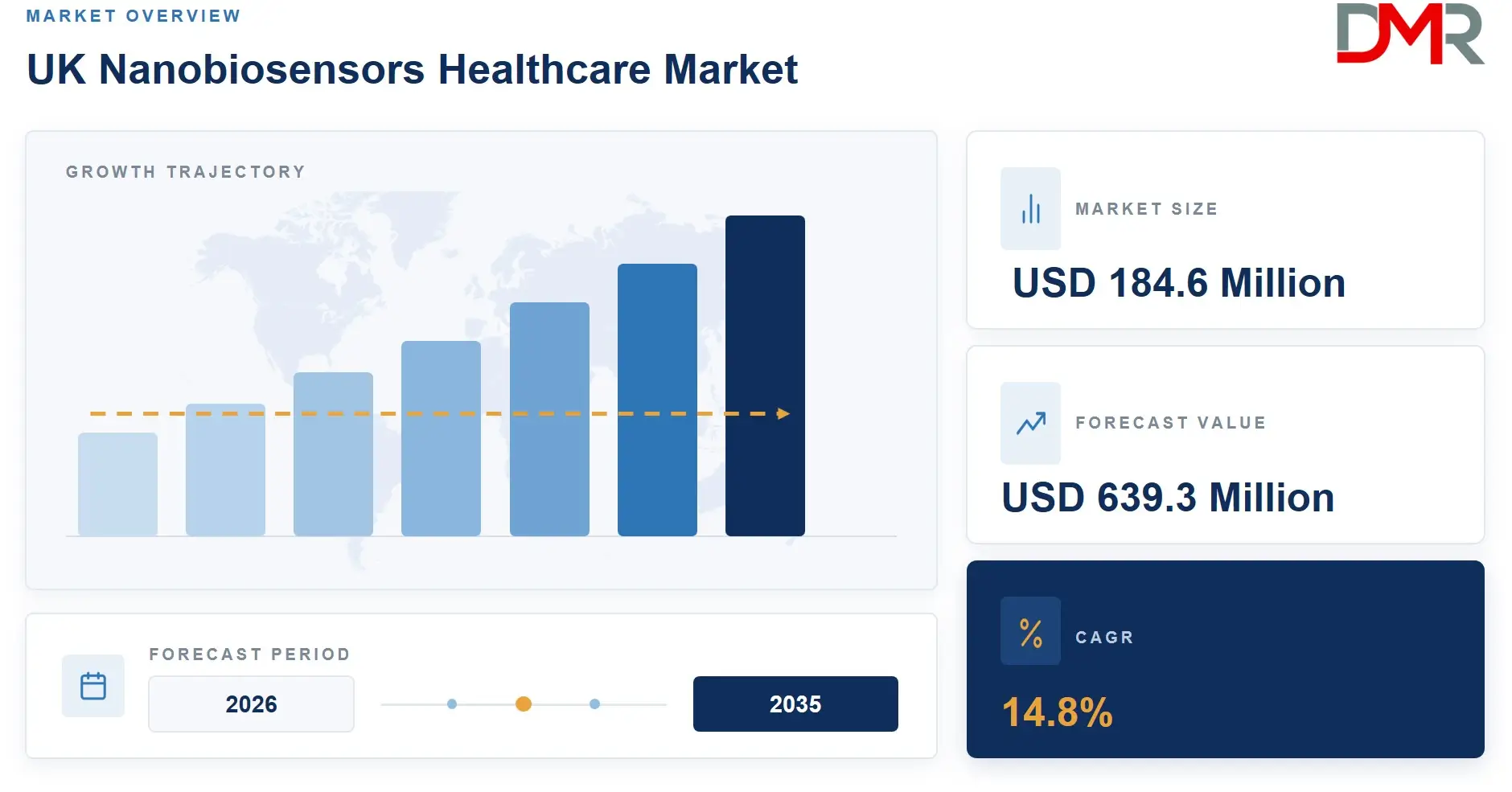
- Market Size (2026): USD 184.6 Mn
- Forecast Value (2035): USD 639.3 Mn
- CAGR (2026-2035): 14.8%
- Leading Product Type (2026): Point of Care Nanobiosensors, around 34%
- Leading Technology (2026): Electrochemical Nanobiosensors, close to 38%
- Key Players: Oxford Nanopore Technologies, Siemens Healthineers, Abbott and others
What is UK Nanobiosensors Healthcare Market and its Market Size?
The UK Nanobiosensors Healthcare Market size is estimated to reach USD 184.6 Mn in 2026 and is further anticipated to reach USD 639.3 Mn by 2035, at a CAGR of 14.8%.
Nanobiosensors are compact diagnostic or monitoring devices that use nanoscale materials, structures or signal amplification to identify biological molecules. In healthcare, they can detect proteins, nucleic acids, metabolites, cells and other clinically relevant markers from small samples. The addressable market includes sensor consumables, reader instruments, integrated systems and associated analytical software used by NHS organisations, private providers, laboratories, research hospitals and life science teams.
ℹ
To learn more about this report –
Download Your Free Sample Report Here
The figures cover demand inside the UK, not the worldwide revenue of businesses headquartered in the country. The sector sits at the junction of in vitro diagnostics, digital health and advanced materials. Its commercial value arises when analytical sensitivity can be converted into a reproducible workflow, a valid clinical claim and an economically workable route through procurement.
Near patient testing is becoming the key route to scale. Community diagnostics, pharmacy services, decentralised trials and home monitoring favour compact assays with short turnaround times. At the same time, laboratory users are seeking multiplexed panels that conserve scarce sample volumes. This creates room for nanomaterial enabled platforms, while raising the bar for quality control, data governance and evidence generation.
Use Cases
- Community Diagnostics: NHS community diagnostic centres deploy rapid biomarker systems to triage patients with suspected infection, cardiac symptoms or chronic disease. A smaller sample and faster result can direct referral decisions earlier, helping sites manage diagnostic queues without transferring every patient to an acute laboratory.
- Home Chronic Care: Integrated care teams use connected wearable or handheld sensors for patients requiring repeated monitoring of glucose, inflammation or treatment response. Clinicians can review changing results remotely, identify deterioration between appointments and target in person reviews where they are most needed.
- Hospital Oncology Pathways: Pathology and oncology teams evaluate high sensitivity assays for circulating markers when biopsy material is limited. The technology supports serial measurements during treatment, which can give multidisciplinary teams an additional signal for treatment planning alongside established imaging and laboratory tests.
- Clinical Research Laboratories: Academic medical centres and contract research groups use multiplex nanobiosensor assays in translational studies. Researchers can screen small cohorts for molecular signatures with less reagent use, then prioritise the most promising markers for validation in larger clinical programmes.
Key Takeaways
- Market Size & Growth: Domestic demand is forecast to rise from USD 184.6 Mn in 2026 to USD 639.3 Mn by 2035.
- Product Type Analysis: Point of care nanobiosensors are set to represent roughly 34% of 2026 revenue.
- Demand Concentration: The UK is estimated to account for about 8.7% of European healthcare nanobiosensor demand in 2026.
- Technology Analysis: Electrochemical platforms are projected to hold nearly 38% of the 2026 technology mix.
- Fastest Technology: Field effect transistor nanobiosensors are expected to expand at a CAGR of 21.6% through 2035.
- Application Momentum: Infectious disease testing is projected to account for around 29% of 2026 application revenue.
How AI/Gen AI is Transforming the UK Nanobiosensors Healthcare Market?
Artificial intelligence strengthens nanobiosensor value when it converts variable raw sensor signals into clinically usable information. Machine learning can correct drift, distinguish weak signal patterns from noise and combine sensor outputs with contextual patient data. In the UK, this is particularly relevant for distributed testing, where a device must perform reliably across different operators and care settings.
Generative AI has a more operational role than a diagnostic role. It can assist assay documentation, draft validation protocols, organise technical evidence and help researchers explore candidate nanomaterial configurations. Any model supporting a clinical decision remains subject to governance, validation and oversight. The commercial benefit comes from reducing development iteration and improving workflow consistency, rather than replacing clinicians.
- Signal Classification: Computer vision and classification models identify meaningful electrochemical or optical patterns.
- Assay Design: Generative design tools examine material and surface chemistry combinations before laboratory screening.
- Quality Monitoring: Anomaly detection flags calibration drift and batch variation across connected instruments.
- Clinical Documentation: LLM document processing structures validation records, incident narratives and technical files.
Key Drivers in the UK Nanobiosensors Healthcare Market
Demand is being shaped by pressure to make diagnostic pathways faster and more distributed.
- Expansion of Decentralised Diagnostic Capacity: Point of care delivery is projected to hold around 34% of product revenue in 2026 because NHS and private providers increasingly need actionable results closer to the patient. Nanobiosensor formats reduce sample handling and can fit pharmacy, community and outpatient environments. Their value is not simply speed: an earlier result can avoid repeat attendance, support triage and make scarce laboratory capacity available for complex testing. Procurement interest is strongest where the device connects to an established pathway and has clear training, quality assurance and data-transfer arrangements.
- Need for Earlier Molecular Detection: Infectious disease testing is expected to account for approximately 29% of 2026 application demand as providers seek tests that identify disease signals before symptoms become severe. Nanoscale interfaces can raise sensitivity and support multi-marker approaches from small volumes. Cancer, cardiovascular and metabolic care also benefit from repeated measurement, particularly where conventional testing is episodic. These clinical needs sustain investment in platforms capable of delivering measurable improvement in turnaround, accessibility or sample economy.
Restraints in the UK Nanobiosensors Healthcare Market
Promising analytical performance does not automatically translate into adoption at scale.
- Clinical Validation and Regulatory Burden: Field effect transistor devices may grow at a CAGR of 21.6%, but their technical promise still requires substantial evidence across sample types, operators and patient populations. Developers must demonstrate accuracy, reproducibility, usability and clinical relevance, then maintain documentation through evolving UK medical device requirements. Smaller innovators can find these studies expensive and slow. A platform that performs well in a controlled research setting may face materially different conditions in routine care, delaying market access and limiting the number of reimbursable use cases.
- Manufacturing Reproducibility at Nanoscale: Lab based nanobiosensors are projected to retain close to 24% of 2026 product revenue partly because centralised sites can control workflow and quality. Moving to disposable point of care formats introduces variation in nanomaterial deposition, surface functionalisation, storage and batch calibration. Small shifts can affect analytical output. Suppliers must therefore invest in scalable quality systems and stable supply chains before they can compete on price, creating a difficult capital requirement for early stage businesses.
Growth Opportunities in the UK Nanobiosensors Healthcare Market
The most viable white space lies in focused deployments where the buyer can measure workflow as well as analytical value.
- Multiplex Respiratory and Antimicrobial Testing: Infectious disease testing represents around 29% of 2026 application demand, yet many frontline pathways still depend on separate tests or laboratory referral. Multiplex nanobiosensors can address this gap by distinguishing clinically similar conditions and supporting antimicrobial stewardship. The opportunity is strongest for suppliers that pair assay panels with interoperable reporting, external quality assessment and practical training. Revenue can extend beyond hardware into recurring cartridges, service contracts and pathway analytics.
- Remote Monitoring for High Risk Cohorts: Wearable nanobiosensors are forecast to grow at a CAGR of 20.9% as integrated care systems seek earlier warning of deterioration. Cardiometabolic, renal and oncology cohorts offer a defined buyer group with repeat measurement needs. Winning solutions will need to show adherence, equitable access, secure data handling and a clear escalation protocol. A device that merely generates additional data will struggle; one that helps teams decide when to intervene has a stronger economic proposition.
Trends in the UK Nanobiosensors Healthcare Market
Technology development is moving toward simpler user experiences and more specific, integrated assays.
- Transition from Single Analyte to Multiplex Platforms: Electrochemical nanobiosensors are expected to hold roughly 38% of 2026 technology revenue because they offer a practical route to compact and relatively low power testing. Suppliers are increasingly designing arrays that test several biomarkers from one sample rather than competing on a single highly sensitive signal. This supports clinical stratification and can reduce the need for serial draws. The trend also raises requirements for calibration, data interpretation and clinical validation of each combined marker panel.
- Connected Reader and Consumable Models: Disposable cartridge systems are projected to account for close to 33% of 2026 component revenue. Suppliers are linking these consumables to connected readers that manage calibration, operator prompts and secure result transfer. The model offers recurring revenue and can make distributed quality assurance more manageable. Buyers, however, are more cautious about vendor lock in, lifecycle costs and integration with existing laboratory information systems, pushing vendors toward open interfaces and transparent service terms.
Research Scope and Analysis
The UK Nanobiosensors Healthcare Market is analysed across product type, technology, application, and component segments, identifying current revenue leaders, emerging high-growth categories, clinical adoption patterns, diagnostic demand, connected monitoring opportunities, and the technology advances shaping domestic healthcare deployment.
ℹ
To learn more about this report –
Download Your Free Sample Report Here
By Product Type
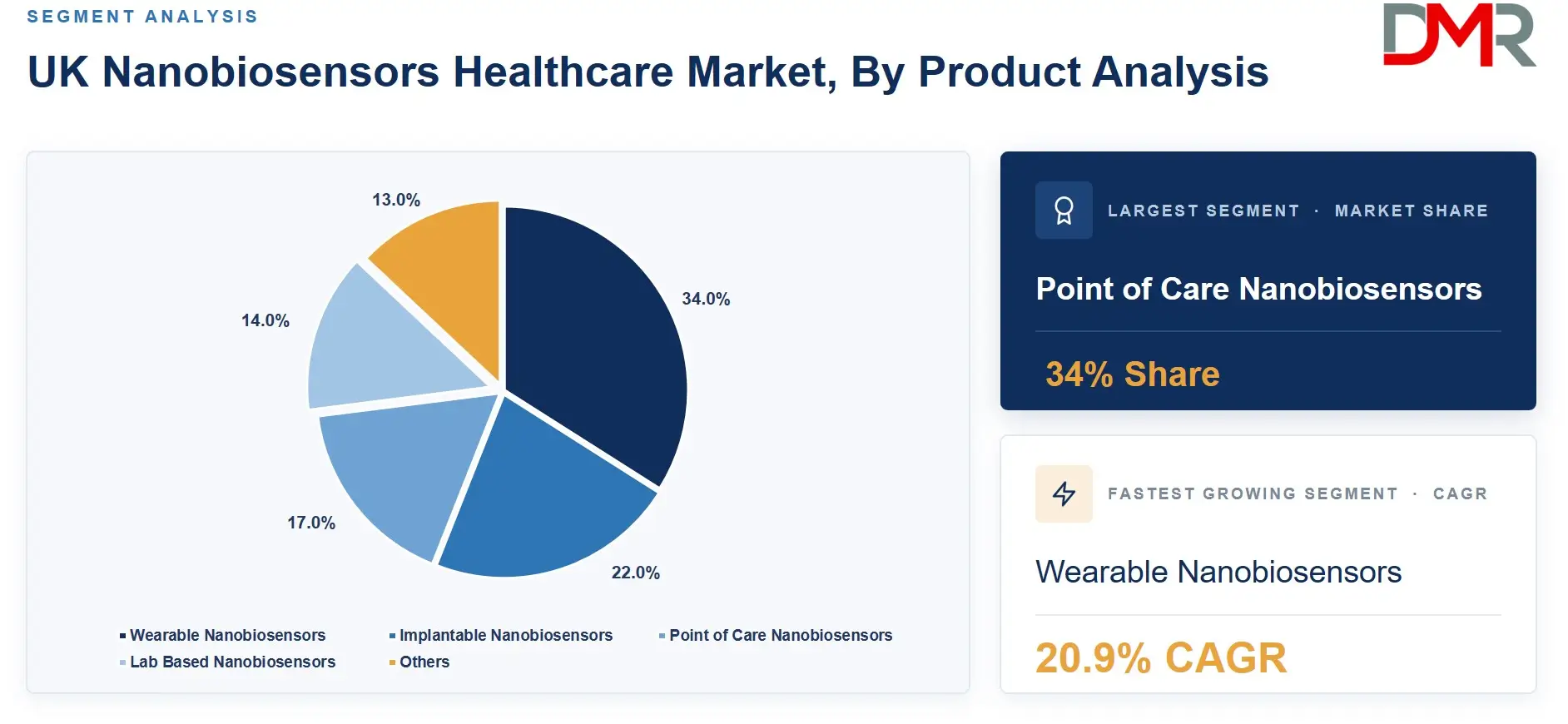
Point of care nanobiosensors are projected to lead the product mix in 2026, accounting for around 34% of revenue, because their compact format fits outpatient, pharmacy and community testing pathways where turnaround time changes triage decisions. They also create a direct route to cartridge recurring revenue. Growth, however, is concentrated in wearable nanobiosensors, expanding at a CAGR of 20.9% between 2026 and 2035 as remote monitoring programmes move from pilots toward defined cohorts with measurable escalation needs. Adoption will depend on skin compatibility, battery life, data quality and a clinician workflow that prevents unattended alerts from becoming an administrative burden.
By Technology
Electrochemical nanobiosensors are expected to hold the largest technology share in 2026, at close to 38%, due to their fit with low power readers, mature electrode manufacturing and quantitative assay workflows. Their established chemistry base gives developers a more practical path from prototype to cartridge. The steeper trajectory sits with field effect transistor nanobiosensors, growing at a CAGR of 21.6% through 2035 as semiconductor fabrication methods and miniaturised multiplex arrays improve. Their commercial progress will depend on reducing signal instability in real biological samples and demonstrating repeatable performance outside specialist laboratories.
By Application
Infectious disease testing is set to represent around 29% of 2026 application revenue because time sensitive triage, outbreak response and antimicrobial stewardship create a clear need for rapid molecular and antigen detection. Demand is reinforced where a result can influence a same visit prescribing or referral decision. Growth, however, is concentrated in oncology monitoring, expanding at a CAGR of 20.3% between 2026 and 2035 as liquid biomarker research, treatment surveillance and smaller sample workflows advance. Broad adoption still rests on demonstrating that a sensor result improves outcomes or avoids a cost elsewhere in the cancer pathway.
By Component
Sensor chips and electrodes are projected to lead component spending in 2026, holding nearly 36% of revenue, as every deployed platform requires a functional sensing surface and performance depends directly on material quality. The component remains difficult to substitute even when software services expand. Growth, however, is concentrated in data analytics and software, rising at a CAGR of 20.7% through 2035 as connected devices generate longitudinal results that need quality checks, visualisation and clinical interpretation support. Vendors that make this layer interoperable can capture value without forcing providers to replace their core records systems.
The UK Nanobiosensors Healthcare Market Report is Segmented Based on the Following
By Product Type
- Wearable Nanobiosensors
- Implantable Nanobiosensors
- Point of Care Nanobiosensors
- Lab Based Nanobiosensors
- Others
By Technology
- Electrochemical Nanobiosensors
- Optical Nanobiosensors
- Piezoelectric Nanobiosensors
- Field Effect Transistor Nanobiosensors
- Others
By Application
- Infectious Disease Testing
- Oncology Monitoring
- Cardiovascular Monitoring
- Diabetes Management
- Drug Discovery and Research
- Others
By Component
- Sensor Chips and Electrodes
- Nanomaterials and Biorecognition Elements
- Reader Instruments
- Disposable Cartridges
- Data Analytics and Software
- Others
Competitive Landscape
Competition combines established diagnostics groups, semiconductor and instrumentation suppliers, specialist sensor developers, university spinouts and clinical research partners. Scale matters in manufacturing, quality systems, channel access and evidence generation. Smaller companies compete through a distinctive assay, material platform or disease focus, but need co-development, distribution or laboratory partners to reach routine care. Product differentiation is moving beyond analytical sensitivity toward sample preparation, cartridge cost, result interpretation and interoperability. In the UK, commercial success is closely tied to a credible clinical pathway and a procurement case that demonstrates savings or capacity gain. Partnerships with NHS trusts, academic centres and contract manufacturers are therefore a central route to market.
Some of the Prominent Players in the UK Nanobiosensors Healthcare Market Are
- Oxford Nanopore Technologies
- Siemens Healthineers
- Abbott
- Roche Diagnostics
- Thermo Fisher Scientific
- bioMerieux
- BD
- Danaher
- Honeywell
- TE Connectivity
- Renishaw
- Smith+Nephew
- EKF Diagnostics
- Abingdon Health
- Sphere Fluidics
- Cambridge Sensotec
- Delta Diagnostics
- iotaSciences
- QuantuMDx Group
- Sense Biodetection
- Linear Diagnostics
- Lambda Diagnostics
- Microsaic Systems
- Porvair Sciences
- GeneFirst
- Pro-Lab Diagnostics
- Randox Laboratories
- Tristel
- Hologic
- Qiagen
- Sysmex UK
- Revvity
- Bio-Rad Laboratories
- Agilent Technologies
- Bruker
- Merck KGaA
- Sartorius
- Illumina
- Promega
- Meridian Bioscience
- Other Key Players
Recent Developments
- In February 2026, Oxford Nanopore Technologies expanded its clinical workflow support for rapid sequencing applications, strengthening the domestic ecosystem for compact molecular analysis and adjacent sensor enabled diagnostic pathways.
- In November 2025, Abingdon Health reported further progress in its lateral flow and contract development activities, supporting UK capacity for decentralised diagnostic product development and scale up.
- In September 2025, Siemens Healthineers continued UK digital diagnostics collaborations focused on workflow connectivity, reinforcing demand for instruments that can securely move results into care systems.
- In October 2024, Sense Biodetection advanced commercial activity for its instrument free molecular testing approach, highlighting continued interest in low complexity diagnostics designed for distributed care environments.
Report Details
| Report Characteristics |
| Market Size (2026) |
USD 184.6 Mn |
| Forecast Value (2035) |
USD 639.3 Mn |
| CAGR (2026-2035) |
14.8% |
| Historical Data |
2021 - 2025 |
| Forecast Data |
2026 - 2035 |
| Base Year |
2025 |
| Segments Covered |
By Product Type, By Technology, By Application and By Component |
| Regional Coverage |
The UK |
Frequently Asked Questions
How big is the UK Nanobiosensors Healthcare Market?
▾ The UK Nanobiosensors Healthcare Market is estimated at USD 184.6 Mn in 2026. This value covers demand for nanomaterial enabled healthcare sensing products, associated readers, consumables and software used in diagnostic, monitoring and research workflows within the domestic market.
What is the growth rate of the UK Nanobiosensors Healthcare Market?
▾ The market is forecast to grow at a CAGR of 14.8% from 2026 to 2035. Growth is supported by decentralised testing, demand for sensitive molecular analysis, connected care models and continuing efforts to improve diagnostic productivity.
What is driving demand in the UK Nanobiosensors Healthcare Market?
▾ Demand is led by the need for faster testing closer to patients and earlier detection of clinically meaningful biomarkers. Point of care nanobiosensors are expected to represent around 34% of 2026 product revenue because their format can support triage and community pathways.
Which product type leads the UK Nanobiosensors Healthcare Market?
▾ Point of care nanobiosensors are projected to lead the product mix, holding roughly 34% in 2026. Their appeal is tied to short turnaround time, compact deployment and the opportunity to connect testing directly to outpatient, pharmacy and community clinical decisions.
Which technology is growing fastest in the UK Nanobiosensors Healthcare Market?
▾ Field effect transistor nanobiosensors are expected to record the highest technology CAGR of 21.6% between 2026 and 2035. The segment benefits from semiconductor miniaturisation and the prospect of dense multiplex arrays, although routine clinical validation remains essential.
Which application has the largest share in the UK Nanobiosensors Healthcare Market?
▾ Infectious disease testing is forecast to account for approximately 29% of 2026 application revenue. The segment benefits from demand for quick triage, efficient prescribing decisions and testing formats that can operate outside central laboratories without lengthy transport delays.
Who are the key players in the UK Nanobiosensors Healthcare Market?
▾ Key participants include Oxford Nanopore Technologies, Siemens Healthineers, Abbott, Roche Diagnostics, EKF Diagnostics, Abingdon Health and Randox Laboratories. The UK Nanobiosensors Healthcare Market also includes specialist developers, clinical partners and component suppliers supporting assay development and deployment.