What is the OEM Patient Monitoring and Vital Sign OEM Module Market Size?
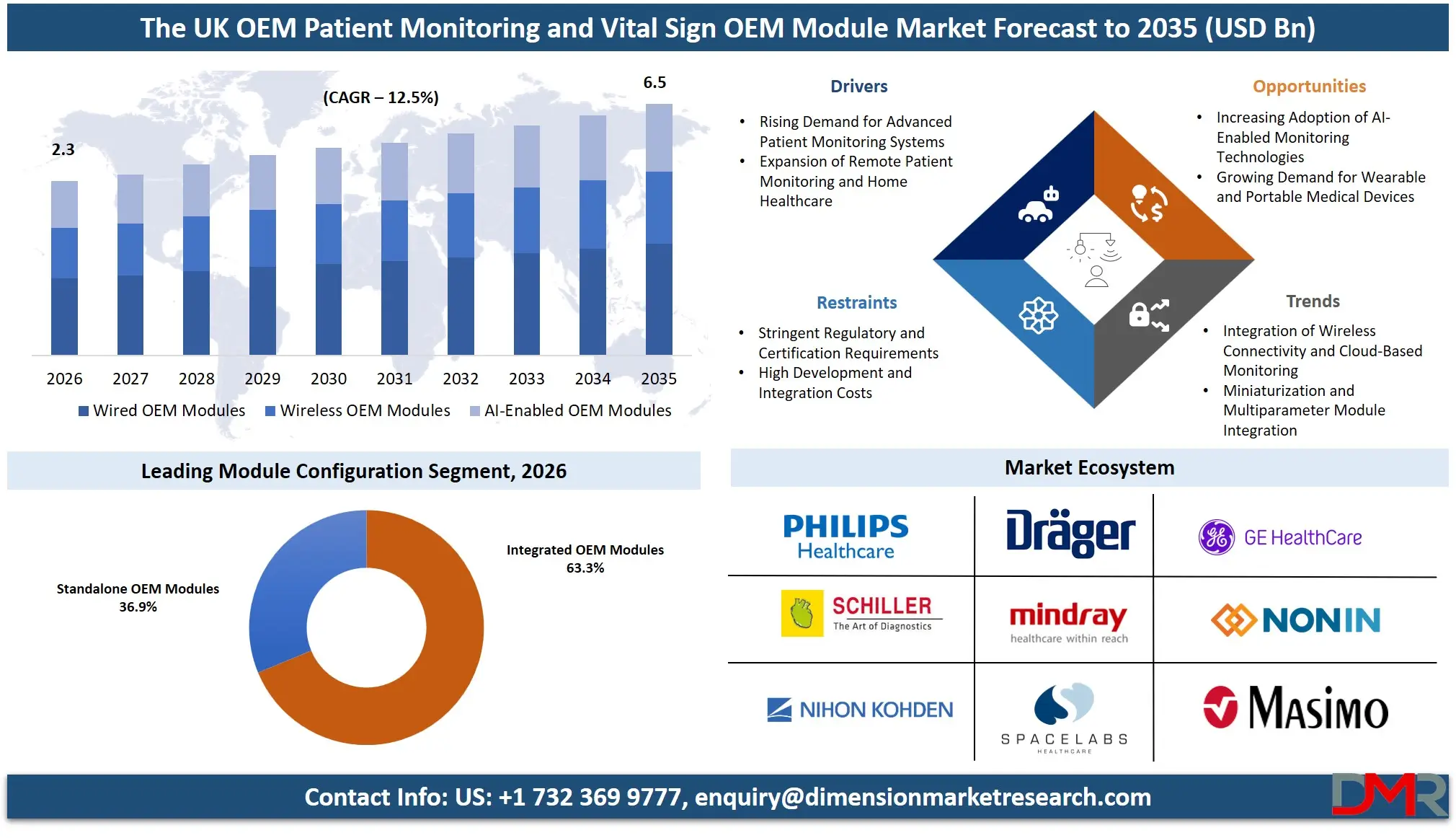
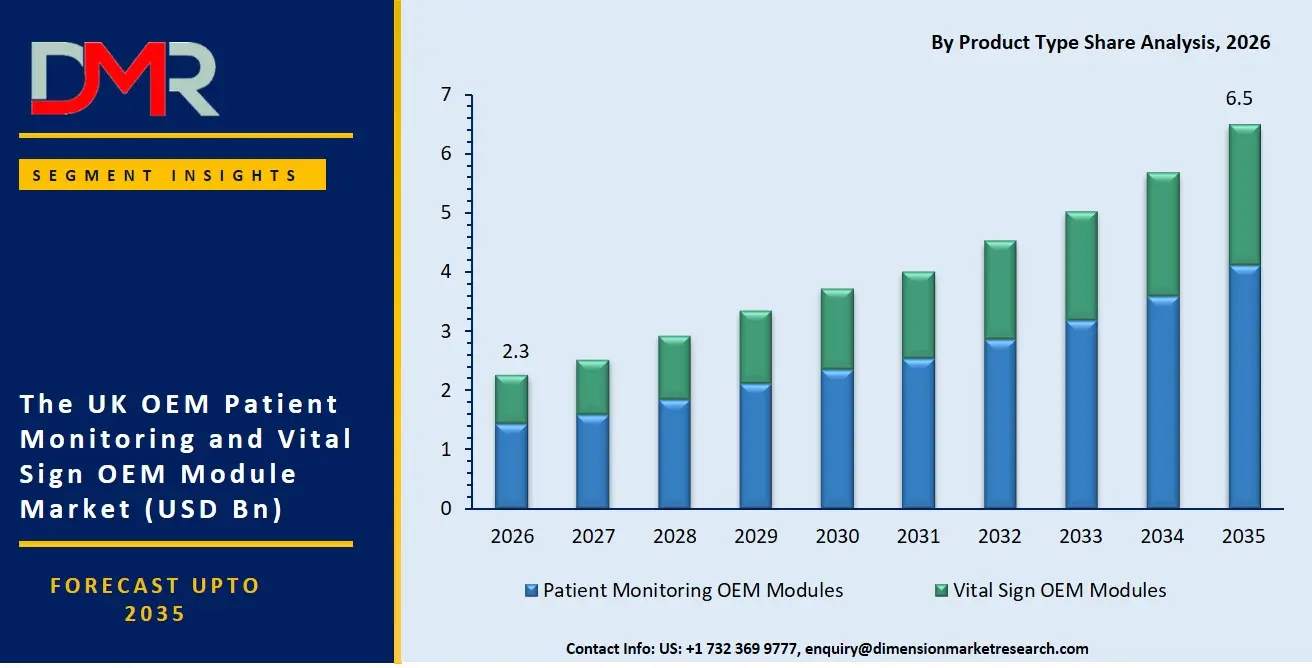
The UK OEM Patient Monitoring and Vital Sign Module Market is expected to reach a value of USD 2.3 billion in 2026, and it is further anticipated to reach USD 6.5 billion by 2035, growing at a CAGR of 12.5% during the forecast period.
ℹ
To learn more about this report –
Download Your Free Sample Report Here
The OEM module market in the UK has witnessed impressive growth, driven by the nation's strategic focus on enhancing healthcare infrastructure and the rapid adoption of modular, scalable patient monitoring solutions. This market consists of multiparameter and single-parameter monitoring modules, as well as core vital sign modules such as ECG, SpO₂, and blood pressure, which serve as the foundational building blocks for comprehensive patient monitoring systems. The surge in demand for remote patient monitoring, the increasing complexity of managing chronic diseases, and the NHS's focus on reducing hospital admissions have necessitated the integration of advanced OEM modules into next-generation medical devices. Original equipment manufacturers and specialist technology providers are the major drivers in this industry, with wireless and AI-enabled modules emerging as dominant growth areas due to their ability to enable predictive analytics and seamless data integration.
Key Takeaways
- Market Size & Forecast: The UK market for OEM patient monitoring and vital sign modules is set to attain a value of USD 2.3 billion by 2026, expanding dramatically to USD 6.5 billion by 2035, a trajectory fueled by a structural shift towards preventative care models and the continuous upgrading of NHS medical device fleets with cutting-edge, interoperable technology.
- Growth Rate & Outlook: It is predicted that the market will register a robust CAGR of 12.5%, attributed to key growth factors such as the widespread adoption of wireless connectivity in medical devices, a strong national telehealth agenda, and the expanding integration of artificial intelligence for clinical decision support tools within OEM modules.
- Primary Growth Drivers: Important growth drivers include the NHS's long-term plan to build a digitally-enabled health service, the escalating demand for early warning scoring systems (EWS) powered by multiparameter modules, and a concentrated effort by UK-based medical device OEMs to engineer energy-efficient, miniaturised modules for the burgeoning home healthcare market.
- Key Market Trends: The market trends are mainly related to the shift from standalone modules to integrated, application-specific platforms; the use of AI to embed real-time diagnostic analytics directly into vital sign modules; and a heightened interest in non-invasive hemodynamic and neurological monitoring modules for critical care settings, with a strong emphasis on cybersecurity and UK-specific data compliance (NHS DTAC).
- By Product Type Analysis: The UK market is propelled by the dominance of vital sign OEM modules, which form the indispensable building blocks of all monitoring systems. The ECG and SpO₂ module segments are particularly robust, reflecting their universal application in critical care and the growing prevalence of cardiovascular and respiratory diseases, with significant commercial backing from established sensor technology providers.
- By Technology Analysis: The OEM patient monitoring module market in the UK is projected to be dominated by wireless OEM modules, as they form the core enabler of flexible care models, allowing seamless patient mobility within wards and directly facilitating the architecture of remote patient monitoring and virtual ward programs across the UK.
What is the OEM Patient Monitoring and Vital Sign Modules?
OEM patient monitoring and vital sign modules are specialised, ready-to-integrate hardware and software sub-systems that medical device manufacturers use to build complete patient monitors. Unlike developing custom components from scratch, OEM modules provide a fast-track route for manufacturers. This is achieved through two primary approaches: a modular hardware approach involving the selection of specific vital sign modules like ECG and SpO₂ boards that connect via standard interfaces, and a software-driven approach where AI-enabled modules provide processed, clinical decision-support data rather than just raw signals. Considering the UK's rigorous regulatory landscape (MHRA) and the NHS's emphasis on interoperability, OEM modules require market-leading accuracy and compliance, making post-market surveillance and continuous improvement essential.
Use Cases
- Virtual Ward Deployment: Home healthcare equipment manufacturers utilise compact, wireless multiparameter monitoring modules to create patient-worn kits that allow the NHS to monitor chronically ill patients remotely, reducing bed occupancy and enabling early discharge.
- Outpatient Cardiac Diagnostics: Medical device OEMs integrate advanced, AI-enabled ECG and respiration rate modules into lightweight Holter and event monitors, providing specialist cardiology clinics with high-fidelity diagnostic data for detecting arrhythmias over extended periods.
- Emergency Triage in A&E: Hospital equipment developers adopt integrated, rapid-response vital sign modules (NIBP, SpO₂, temperature) in wall-mounted and mobile triage trolleys, enabling clinical staff to instantly calculate NEWS2 scores upon patient arrival.
- In-Home Sleep Apnea Testing: Respiratory device manufacturers integrate high-resolution SpO₂ and capnography (EtCO₂) modules into portable sleep monitors, facilitating the NHS's shift towards diagnosing sleep-disordered breathing outside of the hospital sleep lab.
How AI is Transforming the OEM Patient Monitoring and Vital Sign OEM Module Market?
The impact of AI on the UK OEM module market encompasses the engineering of predictive clinical analytics directly into embedded hardware and the optimisation of sensor noise reduction. Concerning module intelligence, AI-driven software development kits (SDKs) are now paired with OEM hardware, allowing medical device manufacturers to develop modules that can predict patient deterioration from subtle changes in multiple vital signs, reducing alarm fatigue by differentiating true clinical crises from motion artefacts.
Furthermore, the role of AI in diagnostic accuracy and personalisation is transformative. AI algorithms embedded within OEM SpO₂ and ECG modules continuously adapt to a patient's unique physiological baseline, maintaining accuracy across diverse UK demographics. AI-driven edge computing within the module itself processes complex biosignals like arrhythmia detection from a single-lead ECG on the device without latency, ensuring critical alerts are generated instantly even without a network connection, a vital feature for UK paramedic services and air ambulances.
Market Dynamics
Key Drivers in the UK OEM Patient Monitoring and Vital Sign OEM Module Market
Rising Demand for Advanced Patient Monitoring Systems
The increasing prevalence of chronic diseases, an aging population, and rising hospital admissions are driving demand for advanced patient monitoring systems across the UK. Healthcare providers are investing in modern bedside monitors, portable devices, and multiparameter monitoring equipment to improve clinical outcomes and patient safety. OEM manufacturers require high-performance monitoring modules that shorten product development cycles while ensuring regulatory compliance and reliable performance. Continuous modernization of NHS facilities and growing adoption of digital healthcare infrastructure further accelerate the integration of sophisticated OEM patient monitoring modules into next-generation medical devices, supporting sustained market expansion across the country.
Expansion of Remote Patient Monitoring and Home Healthcare
The rapid adoption of remote patient monitoring and home healthcare services is significantly increasing demand for compact, energy-efficient OEM monitoring modules. Healthcare providers are expanding virtual care programs to manage chronic conditions, reduce hospital readmissions, and improve patient convenience. Medical device manufacturers are developing portable and wearable monitoring equipment equipped with ECG, SpO₂, blood pressure, and respiratory monitoring capabilities. Growing acceptance of telehealth, combined with government initiatives supporting community-based healthcare delivery, is encouraging OEMs to integrate advanced monitoring technologies into connected medical devices that deliver accurate, real-time physiological data outside traditional clinical environments.
Restraints in the UK OEM Patient Monitoring and Vital Sign OEM Module Market
Stringent Regulatory and Certification Requirements
OEM patient monitoring modules must comply with strict UK medical device regulations, quality standards, and safety certifications before commercialization. Manufacturers are required to conduct extensive testing, clinical validation, cybersecurity assessments, and technical documentation to demonstrate product safety and effectiveness. Regulatory updates and evolving compliance requirements increase development costs and extend product approval timelines. Small and medium-sized OEM suppliers often face resource constraints when meeting these complex standards, limiting market entry and slowing innovation. Maintaining continuous compliance while introducing advanced monitoring technologies remains a significant operational challenge across the UK medical device industry.
High Development and Integration Costs
Developing sophisticated OEM monitoring modules requires substantial investment in research, software development, sensor technologies, and validation processes. Manufacturers must ensure compatibility with multiple medical devices while maintaining accuracy, reliability, and long-term performance. Integration of advanced wireless connectivity, AI capabilities, and cybersecurity features further increases engineering complexity and production costs. Smaller manufacturers may struggle to compete with established suppliers possessing stronger financial resources and technical expertise. These high development expenses, combined with pressure to maintain competitive pricing, can restrict innovation and reduce profitability throughout the UK OEM patient monitoring module market.
Growth Opportunities in the UK OEM Patient Monitoring and Vital Sign OEM Module Market
Increasing Adoption of AI-Enabled Monitoring Technologies
Artificial intelligence presents significant growth opportunities for OEM module manufacturers by enabling predictive analytics, early disease detection, and automated clinical decision support. AI-powered monitoring modules can identify abnormal physiological patterns, reduce false alarms, and improve patient monitoring efficiency in hospitals and home healthcare environments. Medical device manufacturers are increasingly integrating intelligent algorithms into patient monitoring systems to enhance diagnostic accuracy and workflow efficiency. As healthcare providers continue investing in digital transformation and connected care, demand for AI-enabled OEM monitoring modules is expected to expand significantly across the UK healthcare ecosystem.
Growing Demand for Wearable and Portable Medical Devices
The increasing popularity of wearable and portable healthcare devices creates strong opportunities for OEM module suppliers. Patients and healthcare providers seek compact monitoring solutions that enable continuous measurement of vital signs while improving mobility and convenience. Manufacturers are designing lightweight, low-power OEM modules capable of supporting wearable ECG monitors, portable pulse oximeters, remote blood pressure devices, and home monitoring systems. Advances in sensor miniaturization, wireless communication, and battery efficiency further accelerate product innovation. Expanding preventive healthcare initiatives and remote disease management programs continue to strengthen long-term market growth opportunities.
Trends in the UK OEM Patient Monitoring and Vital Sign OEM Module Market
Integration of Wireless Connectivity and Cloud-Based Monitoring
Wireless communication and cloud-based healthcare platforms are becoming standard features in next-generation OEM patient monitoring modules. Manufacturers increasingly integrate Bluetooth, Wi-Fi, and cloud connectivity to enable secure transmission of patient data between monitoring devices and healthcare providers. These connected solutions improve remote monitoring, facilitate electronic health record integration, and support real-time clinical decision-making. Growing investment in digital healthcare infrastructure and interoperability standards encourages broader deployment of cloud-enabled monitoring technologies. This trend is improving healthcare efficiency while supporting continuous patient care across hospitals, outpatient facilities, and home healthcare settings.
Miniaturization and Multiparameter Module Integration
Manufacturers are increasingly focusing on developing compact OEM modules capable of simultaneously monitoring multiple physiological parameters within a single integrated platform. Advances in semiconductor technology, sensor design, and embedded electronics enable smaller, lighter, and more energy-efficient monitoring solutions without compromising clinical accuracy. Miniaturized multiparameter modules simplify medical device design, reduce manufacturing costs, and improve portability for wearable and handheld healthcare equipment. This trend supports growing demand for space-efficient patient monitoring systems while enabling medical device manufacturers to deliver innovative products that meet evolving clinical and home healthcare requirements across the UK.
Research Scope and Analysis
The UK OEM Patient Monitoring and Vital Sign Module Market is segmented by product type into patient monitoring and vital sign OEM modules; by technology, module configuration, monitoring type, distribution channel, and end user, covering medical device manufacturers, hospitals, ambulatory surgical centers, home healthcare equipment manufacturers, and research institutions.
ℹ
To learn more about this report –
Download Your Free Sample Report Here
By Product Type Analysis
Patient Monitoring OEM Modules is poised to dominate the UK market due to their widespread integration into multiparameter patient monitors used across hospitals, intensive care units, emergency departments, and surgical facilities.
ℹ
To learn more about this report –
Download Your Free Sample Report Here
Medical device manufacturers increasingly prefer modular monitoring solutions that combine ECG, SpO₂, blood pressure, respiration, and temperature measurements into a compact platform, reducing development time and regulatory complexity. The growing demand for advanced bedside monitoring systems, coupled with rising adoption of connected healthcare technologies, supports sustained demand for these modules. Their flexibility, scalability, compatibility with multiple medical devices, and ability to deliver comprehensive real-time patient monitoring make them the leading product category.
By Technology Analysis
Wired OEM Modules is projected to dominate the technology segment because they provide highly reliable, uninterrupted data transmission essential for critical care environments. Hospitals and OEM manufacturers continue to prioritize wired solutions for bedside monitors, operating rooms, and intensive care units where signal stability, low latency, and regulatory compliance are paramount. These modules are easier to integrate with existing hospital infrastructure and require minimal cybersecurity management compared to wireless systems. Their proven clinical performance, compatibility with established monitoring equipment, and lower implementation costs make wired OEM modules the preferred choice for high-acuity healthcare settings across the UK healthcare system.
By Module Configuration Analysis
Integrated OEM Modules is expected to hold the largest market share because they combine multiple monitoring functions into a single compact platform, enabling manufacturers to reduce device size, simplify engineering, and accelerate product development. These modules lower production costs while ensuring seamless interoperability between monitoring parameters such as ECG, SpO₂, blood pressure, and temperature. UK medical device manufacturers increasingly favor integrated solutions to improve product reliability, streamline regulatory approvals, and enhance clinical performance. Their ability to support advanced patient monitoring systems with fewer hardware components, reduced maintenance requirements, and simplified installation reinforces their dominance across modern healthcare equipment manufacturing.
By Monitoring Type Analysis
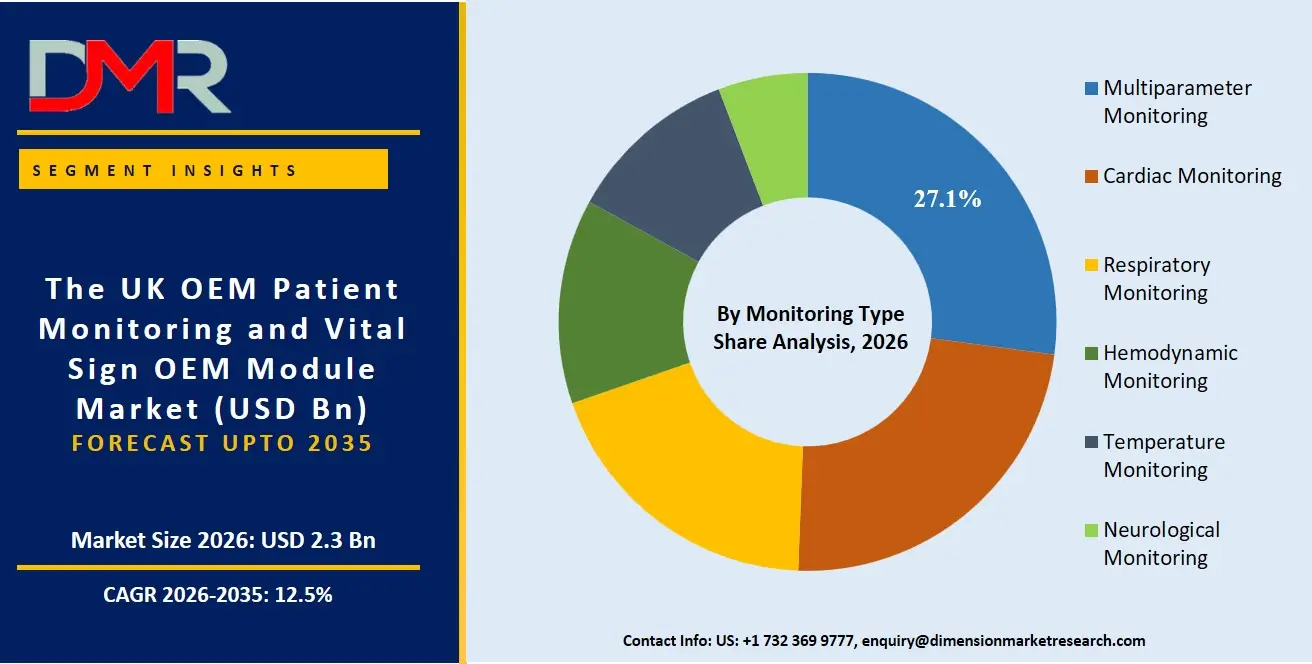
Multiparameter Monitoring is projected to dominates this segment because healthcare providers increasingly require comprehensive real-time assessment of multiple physiological parameters using a single monitoring platform. Modern patient monitors simultaneously track ECG, SpO₂, blood pressure, respiration, temperature, and other vital signs, improving clinical efficiency and supporting faster medical decision-making. Hospitals, emergency departments, and intensive care units rely heavily on multiparameter monitoring to manage critically ill patients while reducing equipment complexity. The growing adoption of advanced monitoring technologies, integrated healthcare systems, and connected medical devices continues to strengthen demand for multiparameter OEM modules across the UK healthcare sector.
By Distribution Channel Analysis
Direct Sales through OEM contracts is poised to dominate the distribution channel because OEM modules are highly specialized components requiring close collaboration between module suppliers and medical device manufacturers. Long-term contractual relationships support customized product development, technical integration, regulatory documentation, quality assurance, and post-sales engineering support. Direct procurement also ensures reliable supply chains, product traceability, and compliance with stringent UK and international medical device standards. Since OEM modules are rarely sold through conventional commercial channels, manufacturers prefer direct engagement with component suppliers to optimize product performance, accelerate development timelines, and maintain long-term strategic partnerships.
By End User Analysis
Medical Device Manufacturers (OEMs) is expected to dominate the end-user segment because they are the primary purchasers and integrators of patient monitoring and vital sign modules into finished medical equipment. OEMs require certified, high-performance modules that reduce engineering complexity, shorten product development cycles, and support compliance with stringent medical device regulations. Increasing demand for portable monitors, bedside systems, wearable devices, and remote patient monitoring solutions has further accelerated procurement of advanced OEM modules. Continuous innovation in monitoring technologies, combined with growing investments in digital healthcare and connected medical devices, ensures OEM manufacturers remain the largest consumers within the UK market.
The UK OEM Patient Monitoring and Vital Sign OEM Module Market Report is segmented on the basis of the following:
By Product Type
- Patient Monitoring OEM Modules
- Multiparameter Monitoring Modules
- Single-Parameter Monitoring Modules
- Vital Sign OEM Modules
- ECG Modules
- SpO₂ Modules
- Blood Pressure (NIBP) Modules
- Temperature Modules
- Respiration Rate Modules
- Capnography (EtCO₂) Modules
By Technology
- Wired OEM Modules
- Wireless OEM Modules
- AI-Enabled OEM Modules
By Module Configuration
- Integrated OEM Modules
- Standalone OEM Modules
By Monitoring Type
- Multiparameter Monitoring
- Cardiac Monitoring
- Respiratory Monitoring
- Hemodynamic Monitoring
- Temperature Monitoring
- Neurological Monitoring
By Distribution Channel
- Direct Sales (OEM Contracts)
- Authorized Distributors
- Value-Added Resellers (VARs)
By End User
- Medical Device Manufacturers (OEMs)
- Hospitals & Healthcare Providers
- Ambulatory Surgical Centers (ASCs)
- Home Healthcare Equipment Manufacturers
- Research & Academic Institutions
Competitive Landscape
The nature of competition in the UK OEM patient monitoring and vital sign module market has become intensely dynamic, defined by a diverse range of global sensor technology giants, specialist signal processing firms, and innovative UK-based design houses all competing to become the embedded heart of the next generation of NHS medical devices. Strategic alliances with major UK medical device OEMs and teaching hospitals are crucial, as they provide direct insight into NHS clinical workflow needs and provide validation of novel sensor fusion platforms. The trend of consolidation is accelerating, as large semiconductor companies acquire niche UK AI algorithm developers and module designers to secure a position in the regulated medical technology stack. IP differentiators, such as proprietary motion-tolerant SpO₂ algorithms, ultra-low-power AI inference chips, and pre-validated NHS DTAC-compliant software stacks, are playing a significantly more critical role than the commoditised hardware sensor itself.
Some of the prominent players in the UK OEM Patient Monitoring and Vital Sign OEM Module Market are:
- Philips Healthcare
- GE HealthCare
- Nihon Kohden Corporation
- Schiller AG
- Dräger
- Mindray Medical International Limited
- Masimo Corporation
- Nonin Medical, Inc.
- OSI Systems, Inc. (Spacelabs Healthcare)
- Infineon Technologies AG
- Analog Devices, Inc.
- Texas Instruments Incorporated
- ams-OSRAM AG
- TE Connectivity Ltd.
- Mediana Co., Ltd.
- Bionet Co., Ltd.
- Edan Instruments, Inc.
- Contec Medical Systems Co., Ltd.
- Shenzhen Comen Medical Instruments Co., Ltd.
- OEM Technology Solutions Ltd.
- Other Key Players
Recent Developments
- June 2026: The Medicines and Healthcare products Regulatory Agency (MHRA), in partnership with NHS England (London) and the London Health Innovation Networks, launched the London Region I AI Regulatory Sandbox to accelerate the safe evaluation and adoption of AI-enabled medical devices, including patient monitoring technologies, within NHS clinical settings.
- June 2026: Manchester University NHS Foundation Trust announced the Greater Manchester Wearables and Remote Monitoring Innovation Cluster (GM-WIC), a multi-million-pound initiative bringing together NHS organizations, universities, and industry partners to accelerate the development and deployment of wearable patient monitoring and remote healthcare technologies across the UK.
- February 2026: NHS England introduced the national Virtual Wards data standard, establishing standardized data collection and interoperability requirements for remote patient monitoring and hospital-at-home services, supporting wider deployment of connected patient monitoring devices across NHS organizations.
Report Details
| Report Characteristics |
| Market Size (2026) |
USD 2.3 Bn |
| Forecast Value (2035) |
USD 6.5 Bn |
| CAGR (2026–2035) |
12.5% |
| Historical Data |
2021 – 2025 |
| Forecast Data |
2027 – 2035 |
| Base Year |
2025 |
| Estimate Year |
2026 |
| Segments Covered |
By Product Type, By Technology, By Module Configuration, By Monitoring Type, By Distribution Channel, and By End User |
| Country Coverage |
The UK |
Frequently Asked Questions
How big is the UK OEM Patient Monitoring and Vital Sign Module Market?
▾ The UK OEM Patient Monitoring and Vital Sign Module market is poised to be valued at USD 2.3 billion in 2026 and is projected to reach USD 6.5 billion by 2035, driven by the universal need for modular, interoperable monitoring cores to digitise an evolving NHS and support an aging population with complex care needs.
What is the CAGR of the UK OEM Patient Monitoring and Vital Sign Module Market from 2026 to 2035?
▾ The market is expected to grow at a CAGR of 12.5% from 2026 to 2035, reflecting the accelerating design cycle of medical devices and the nation's unique healthcare policy framework mandating the rapid scaling of virtual care and remote patient monitoring services.
What factors are driving the growth of the UK OEM Patient Monitoring and Vital Sign Module Market?
▾ Key drivers include the NHS’s formal expansion of virtual wards and out-of-hospital care models, the imperative for seamless device interoperability (HL7/FHIR) within NHS digital ecosystems, and a deep ecosystem of UK-based design excellence in creating ultra-low-power wireless and AI-driven sensor technologies.
What are the major trends in the UK OEM Patient Monitoring and Vital Sign Module Market?
▾ Major trends include the design of miniature, patient-compliant modules for the "Hospital at Home" pathway, the rise of hyper-specialised AI-powered single-parameter modules (like EtCO2), and a strong focus on building NHS DTAC-compliant security and clinical safety directly into the module’s firmware.
Who are the key players in the UK OEM Patient Monitoring and Vital Sign Module Market?
▾ Key players in the UK OEM Patient Monitoring and Vital Sign Module Market include GE HealthCare, Medtronic, Philips, Masimo, Analog Devices, and Texas Instruments, alongside specialist UK design firms, driving innovation through sensor fusion, embedded AI algorithms, and large-scale OEM commercialisation activities.
How is the UK OEM Patient Monitoring and Vital Sign Module Market segmented?
▾ The market is segmented by Product Type, Technology, Module Configuration, Monitoring Type, Distribution Channel, and End User.