Market Snapshot
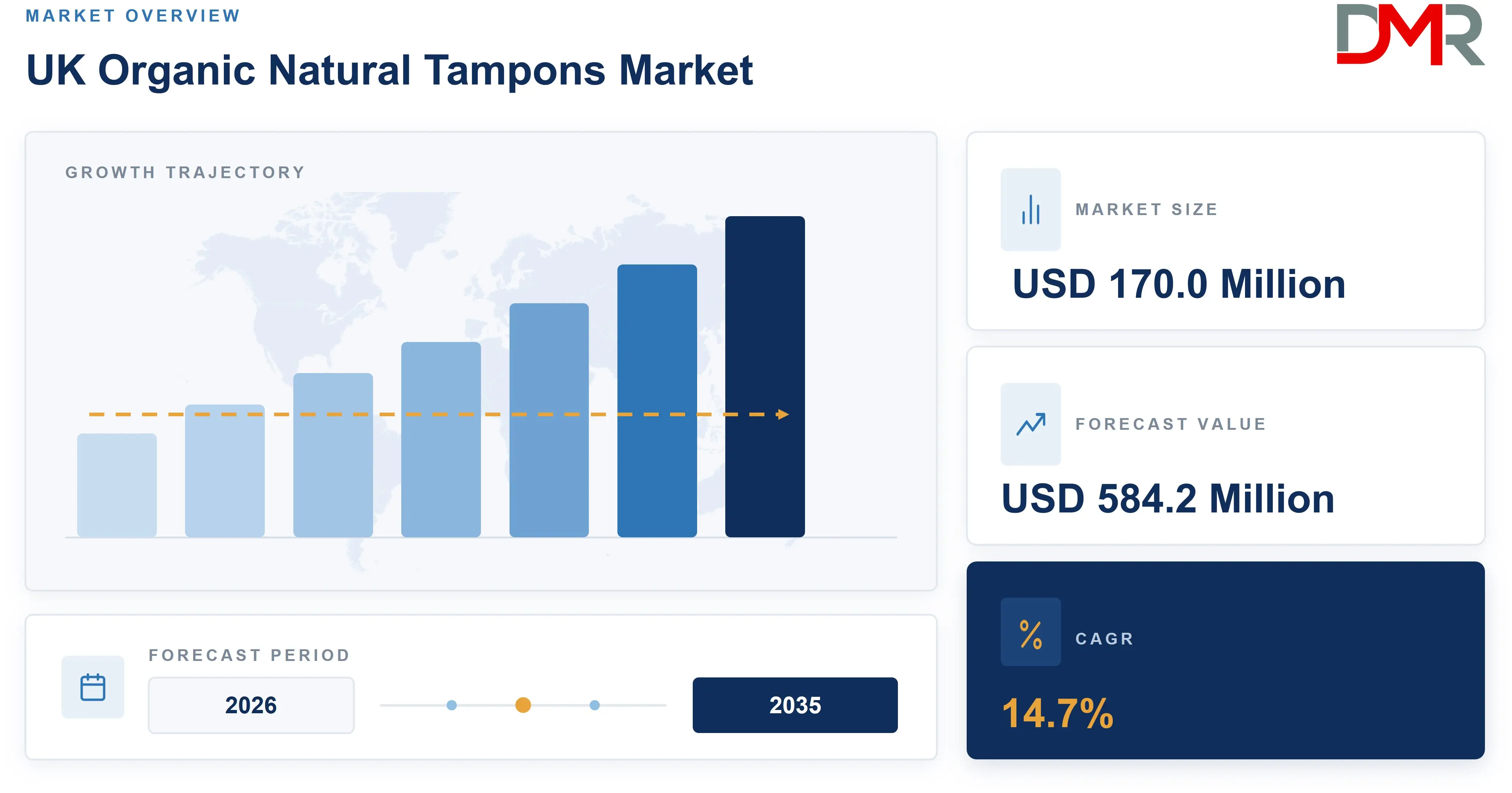
- Market Size (2026): USD 170.0 Mn
- Forecast Value (2035): USD 584.2 Mn
- CAGR (2026-2035): 14.7%
- Leading Product Type (2026): Applicator Tampons, approximately 46%
- Leading Material (2026): Organic Cotton, around 58%
- Key Players: Natracare, TOTM, and DAME, among others
What is UK Organic Natural Tampons Market and its Market Size?
The UK Organic Natural Tampons Market size is estimated to reach USD 170.0 Mn in 2026 and is further anticipated to reach USD 584.2 Mn by 2035, at a CAGR of 14.7%. The figures capture retail demand for organic and natural tampons consumed inside the United Kingdom; they do not represent the worldwide turnover of companies headquartered in Britain, several of which sell substantially larger volumes outside the UK than within it. The scope excludes menstrual cups, reusable pads and period underwear, which sit in adjacent but structurally different product categories.
ℹ
To learn more about this report –
Download Your Free Sample Report Here
An organic or natural tampon is built around a core of certified organic cotton, free of the viscose rayon blends, synthetic fragrance and chlorine-processed fibres used in mainstream products. Many are paired with cardboard or compostable applicators, plastic-free wrapping and packaging carrying a recognised organic mark, most commonly a Global Organic Textile Standard or Soil Association certification. The category sits at the premium end of feminine hygiene, priced above conventional cotton-viscose tampons to reflect certified raw material sourcing and smaller production runs.
Buyers span health-conscious shoppers seeking to reduce exposure to synthetic materials, sustainability-driven consumers replacing single-use plastic with compostable formats, and individuals managing sensitivities that make certified organic cotton a practical rather than purely ethical choice. Purchasing runs across supermarket aisles, pharmacies, health food retailers and a growing base of subscription services that deliver fixed monthly quantities matched to a buyer's cycle.
What is changing structurally is distribution reach. The category has moved from a narrow set of independent health stores into mainstream supermarket shelf space and private label ranges, while the removal of value-added tax on period products and tightening plastics packaging rules have both narrowed the price gap with conventional brands and pushed manufacturers toward compostable applicator formats.
Use Cases
- Independent Health Food Retail Restocking: independent organic grocers restock organic tampon multi-packs alongside weekly organic food shops, reinforcing habitual purchase for loyal customers who already buy certified organic groceries and toiletries under one roof.
- Corporate Workplace Wellbeing Programmes: employers in professional services and technology stock organic tampons in office washrooms as part of wellbeing and inclusion policy, introducing the category to staff who might not otherwise seek it out and building passive brand familiarity.
- University and Student Union Provision: student unions distribute organic tampons through free period product schemes funded under government period poverty initiatives, exposing first-time student buyers to organic brands before independent purchasing habits are set.
- Subscription Curation for Postnatal Care: postnatal subscription services bundle organic tampons with other sensitive-skin personal care items for new mothers managing postpartum bleeding, a moment when ingredient transparency and comfort weigh heavily on product choice.
Key Takeaways
- Market Size & Share: organic and natural tampons are projected to generate USD 170.0 Mn in UK revenue in 2026, expanding to USD 584.2 Mn by 2035.
- Material Analysis: organic cotton formulations are expected to account for around 58% of 2026 revenue, ahead of bamboo and blended fibre alternatives.
- Demand Concentration: online and direct-to-consumer subscription channels are projected to represent close to 28% of 2026 sales, concentrating growth among digitally engaged, repeat buyers.
- Regulatory Tailwind: removal of value-added tax on period products has narrowed the retail price gap between organic and conventional tampons to approximately 18%, easing a longstanding barrier to trial.
- Certification Shift: products carrying Global Organic Textile Standard certification are expected to hold around 41% of 2026 revenue as retailers standardise on recognised organic labelling.
How AI/Gen AI is Transforming the UK Organic Natural Tampons Market?
Artificial intelligence has a narrower role in this category than in higher-technology consumer segments, and the honest picture is operational rather than transformative. Manufacturing lines are low-complexity relative to electronics or pharmaceuticals, so the clearest gains sit in quality control, inventory planning and the customer relationship rather than in the product itself.
On the production floor, computer vision inspection catches core-density and packaging defects earlier than manual sampling, reducing recall risk on a product with strict absorbency tolerances. On the commercial side, subscription-led brands use forecasting models to predict individual reorder timing from historical cycle data, cutting both stockouts and wasted inventory, while smaller specialists lean on generative tools mainly for regulatory-compliant labelling copy and customer support rather than product design.
- Automated Defect Detection: vision systems inspect organic cotton cores and compostable applicators on the line, flagging density or seal faults before packaging.
- Demand Forecasting for Subscription Commerce: machine learning models predict individual reorder windows from cycle history, smoothing production runs and cutting waste.
- Digital Twins for Compostable Packaging Lines: manufacturers model new plastic-free wrapping formats virtually before committing to physical retooling.
- Chatbot-Led Cycle Support: D2C brands deploy conversational tools to handle sizing, absorbency and subscription queries at scale.
Key Drivers in the UK Organic Natural Tampons Market
Two forces, one regulatory and one behavioural, are pulling demand into the category from different directions.
- VAT Removal and Plastics Packaging Rules: the abolition of value-added tax on period products removed a fixed cost layer that previously fell hardest on premium-priced organic lines, narrowing the retail gap with conventional tampons to approximately 18%. At the same time, extended producer responsibility rules and a plastics packaging tax raise the compliance cost of conventional plastic applicators and wrapping, giving compostable, organic-aligned formats a relative cost advantage they did not previously hold. Retailers responding to both changes have widened organic shelf allocation rather than treating it as a token specialist line, which has itself expanded the addressable buying occasion beyond health-food stores into weekly grocery shopping.
- Health and Ingredient-Transparency Consciousness: growing public scrutiny of synthetic fibres, fragrance additives and rare but serious risks such as toxic shock syndrome has pushed a segment of buyers to treat ingredient sourcing as a purchase criterion rather than a preference. Social platforms and menstrual health content have normalised label-reading behaviour that previously applied mainly to food and skincare, carrying it into feminine hygiene. This has been reinforced by clinicians and school health programmes increasingly mentioning certified organic options when discussing menstrual product choice, which lends the category a credibility that pure marketing could not achieve on its own.
Restraints in the UK Organic Natural Tampons Market
Two structural brakes keep the category from converting broad awareness into proportionate share.
- Persistent Price Premium: even after VAT removal narrowed the gap to around 18%, organic tampons still carry a meaningful premium over private label conventional products, and that gap widens further against discount-retailer own brands. For budget-constrained households, the premium remains a genuine barrier rather than a marketing perception, and it is the main reason organic penetration has not scaled at the pace of organic food or skincare, categories with lower absolute price differentials.
- Limited Discount-Channel Distribution: value and discount grocers, which account for a meaningful share of UK grocery spend, rarely stock organic tampon ranges, concentrating supply in premium and mid-market retail. This confines organic exposure to shoppers who already frequent higher-margin retail formats, slowing the category's reach into price-sensitive demographics and leaving penetration skewed toward affluent, urban buying patterns rather than broad-based national adoption.
Growth Opportunities in the UK Organic Natural Tampons Market
The clearest white space sits outside the retail shelf, in procurement channels and subscription relationships rather than in new geography.
- Public Procurement and Period Poverty Schemes: NHS trusts, schools and local authorities running free period product provision represent a channel where organic suppliers have limited current presence relative to conventional mass-market bidders. Winning even a modest share of public tenders would introduce organic products to first-time users at scale, at a moment when purchasing decisions are made centrally rather than by individual price-sensitive shoppers, creating a credible on-ramp into future private purchasing.
- Subscription Bundle Deepening: direct-to-consumer subscription relationships currently centre on tampons alone, leaving room to bundle adjacent sensitive-skin personal care items and increase basket value per subscriber without acquiring new customers. Brands that deepen the subscription relationship this way improve retention economics and reduce dependence on retail listing fees, which is where much of the category's margin currently leaks.
Trends in the UK Organic Natural Tampons Market
Two shifts are reshaping how the category is made and sold, distinct from the drivers pulling underlying demand.
- Compostable and Bio-Based Applicator Innovation: manufacturers are moving beyond cardboard toward corn-starch and other bio-based composite applicators that biodegrade faster while matching the handling feel of plastic, a technical bar earlier plant-based attempts struggled to clear. This format shift is being adopted first by specialist brands and is now filtering into private label development as retailers seek differentiated organic ranges.
- Supermarket Private Label Entry: major grocers are launching their own organic cotton tampon lines rather than relying solely on branded specialists, a shift that increases category visibility on shelf but compresses branded specialists' pricing power. This mirrors the pattern seen earlier in organic food, where private label eventually captured a large share of category volume once retailers judged demand durable enough to invest in their own ranges.
Research Scope and Analysis
Segment performance is assessed across five axes: product format, material, distribution channel, certification standard and absorbency type. Each axis identifies the sub-segment carrying the largest share of 2026 revenue and the one expanding fastest through 2035, with the commercial reason behind each position.
ℹ
To learn more about this report –
Download Your Free Sample Report Here
By Product
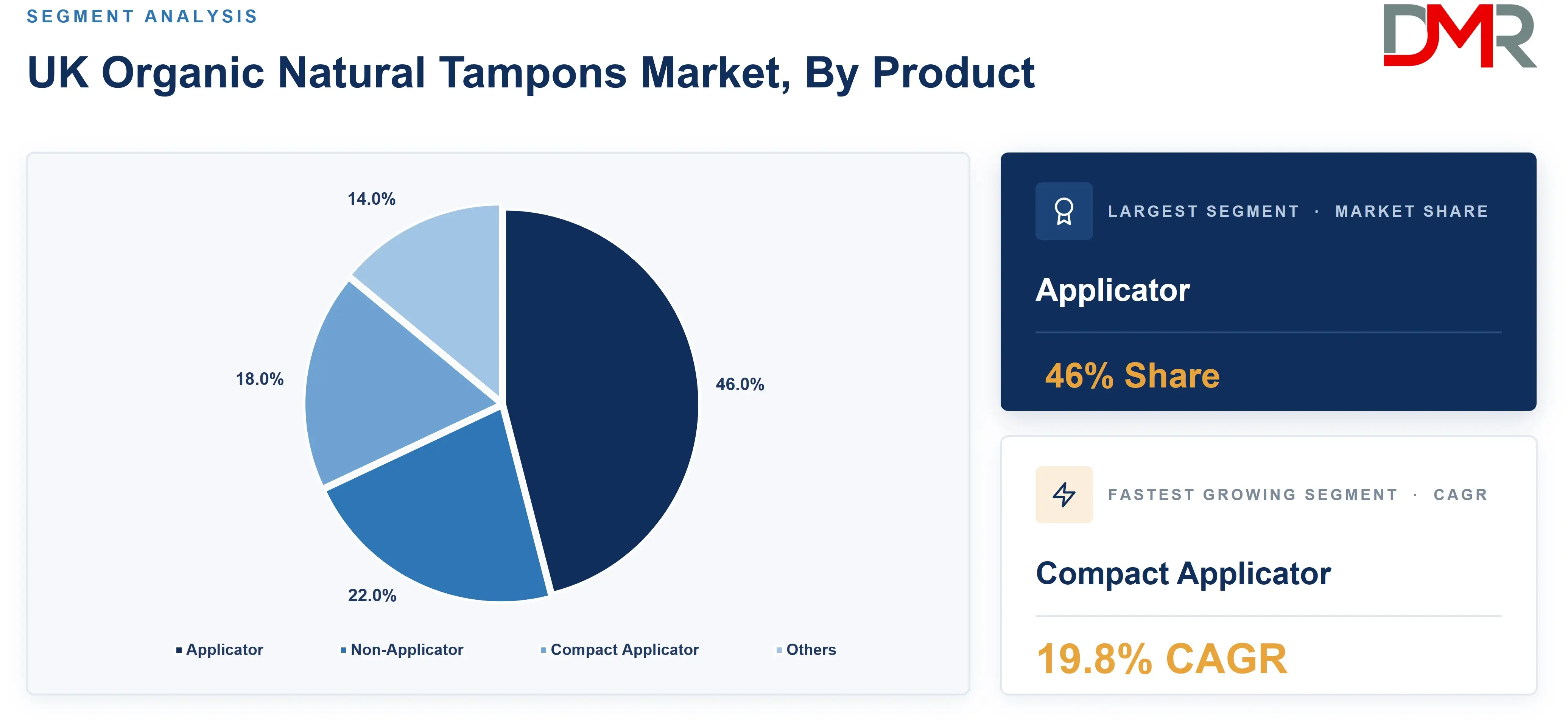
Applicator tampons are projected to hold the largest share by product format in 2026, accounting for close to 46% of revenue, reflecting long-standing consumer familiarity and ease of insertion that new entrants have not displaced. Non-applicator formats trail behind but retain a loyal base among sustainability-motivated buyers who prioritise minimal packaging over convenience. Growth, however, is concentrated in compact and travel applicators, expanding at a CAGR of 19.8% between 2026 and 2035 as brands package smaller, discreet applicator formats aimed at on-the-go and subscription unboxing occasions, a format largely absent from the category five years ago.
By Material
Organic cotton is projected to hold the largest share by material in 2026, accounting for around 58% of revenue, since it is the reference material against which the category is defined and the one carrying the broadest certification recognition among UK shoppers. Cotton-bamboo blends hold a secondary position on cost grounds. The steeper trajectory sits with biodegradable composite materials, growing at a CAGR of 24.3% between 2026 and 2035, pulled by manufacturers seeking a genuine plastic-free claim across the entire product rather than the core alone, a differentiator increasingly demanded by retail buyers.
By Distribution Channel
Supermarkets and grocery retail are projected to hold the largest share by channel in 2026, accounting for approximately 39% of revenue, as organic ranges have moved from a specialist-only listing into mainstream weekly shopping baskets. Pharmacies retain a meaningful secondary role. Growth, however, is concentrated in online and direct-to-consumer subscription channels, expanding at a CAGR of 22.6% between 2026 and 2035, as recurring delivery models improve retention economics for brands that cannot match supermarket shelf presence.
By Certification & Standard
Global Organic Textile Standard certified products are projected to hold the largest share by standard in 2026, accounting for close to 41% of revenue, since it is the certification UK retailers most consistently require before granting shelf space. Soil Association certification holds a strong secondary position domestically. Growth, however, is concentrated in products carrying compostable packaging certification, expanding at a CAGR of 20.9% between 2026 and 2035, pulled by extended producer responsibility rules that reward verifiable end-of-life claims rather than raw material sourcing alone.
By Absorbency Type
Regular absorbency is projected to hold the largest share by type in 2026, accounting for around 44% of revenue, reflecting typical flow distribution across the buying population and its position as the default multi-pack size stocked by retailers. Super absorbency holds a solid secondary position. Growth, however, is concentrated in light and mini absorbency formats, expanding at a CAGR of 18.4% between 2026 and 2035, driven by younger, first-time users entering the category through school and student provision schemes that typically start buyers on lighter formats.
The UK Organic Natural Tampons Market Report is Segmented Based on the Following
By Product
- Applicator
- Non-Applicator
- Compact Applicator
- Others
By Material
- Organic Cotton
- Cotton-Bamboo Blend
- Bamboo Fibre
- Biodegradable Composite
- Others
By Distribution Channel
- Supermarkets & Grocery Retail
- Online/D2C & Subscription
- Pharmacies & Drugstores
- Health & Wellness Specialty Stores
- Others
By Certification & Standard
- GOTS Certified
- Soil Association Certified
- Compostable Packaging Certified
- Non-Certified Natural Claims
- Others
By Absorbency Type
- Regular
- Super
- Light/Mini
- Super Plus
- Others
Regulatory Landscape
UK period products have carried a zero rate of value-added tax since January 2021, a change that structurally favours premium organic lines more than conventional ones because it removes a proportionally larger tax burden from a higher retail price. Extended producer responsibility obligations and the plastics packaging tax are now shifting cost incentives toward compostable applicators and wrapping, an area where organic brands already had a design head start. The commercial opening is for suppliers that can demonstrate verifiable end-of-life claims to retailers writing sustainability criteria into supplier contracts. The main risk is that certification and compliance documentation costs fall disproportionately on smaller specialists relative to diversified majors, a pressure that is gradually pushing consolidation and private label entry across the category.
Pricing Analysis
Retail pricing for organic tampons sits well above conventional cotton-viscose products, though the gap has narrowed to around 18% since VAT removal, and it is narrowing further as supermarket private label ranges undercut branded specialists. What is shifting now is the emergence of a mid-tier price point between premium specialist brands and value private label, aimed at converting curious mainstream shoppers who have not previously paid a full premium. The commercial opening sits in subscription pricing, where recurring delivery discounts can offset per-unit cost without retailers discounting shelf price. The risk is margin compression for smaller brands unable to match private label cost structures, which could push some toward channel exclusivity or acquisition by larger hygiene manufacturers seeking ready-made organic credibility.
Competitive Landscape
The market remains moderately fragmented, with specialist organic brands competing alongside diversified hygiene majors that have added organic lines and grocery retailers building private label ranges. Competition is fought primarily on certification credibility, shelf placement and, increasingly, subscription retention rather than on price alone, since price-led competition tends to favour private label over branded specialists. Manufacturing scale advantages sit with the diversified majors and contract manufacturers, while specialist brands compete on formulation transparency, packaging innovation and direct consumer relationships built through subscription commerce and social content. Retail listing decisions remain the single most consequential competitive lever in the category, determining which brands reach mainstream shoppers versus those confined to specialist and online channels.
Some of the Prominent Players in the UK Organic Natural Tampons Market Are
- Procter & Gamble Co.
- Edgewell Personal Care Co.
- Kimberly-Clark Corporation
- Essity AB
- Unicharm Corporation
- Ontex Group NV
- Attindas Hygiene Partners
- Drylock Technologies NV
- Fippi S.p.A.
- McBride plc
- Natracare (Bodywise Ltd)
- TOTM
- DAME
- Grace & Green
- Freda
- Here We Flo
- Lil-Lets
- Organyc (Corman S.p.A.)
- Cora
- Rael Inc.
- This Is L.
- The Honey Pot Company
- Blume
- Boots UK Ltd
- Superdrug Stores plc
- Holland & Barrett
- Waitrose & Partners
- Tesco plc
- Sainsbury's
- Morrisons plc
- Co-op Group (Food)
- ASDA Stores Ltd
- Ocado Retail
- Amazon UK Services Ltd
- Cult Beauty Ltd
- LookFantastic (THG plc)
- Naturisimo
- Planet Organic
- Whole Foods Market UK
- Marks & Spencer plc
- Other Key Players
Recent Developments
- In February 2026, Holland & Barrett widened its organic period care aisle across UK stores to include a broader range of compostable-applicator tampon brands, giving smaller specialists shelf access previously limited to online sales.
- In January 2026, Tesco extended its own-label organic cotton tampon range to additional UK stores after a regional trial, intensifying private label competition for branded specialists.
- In October 2025, TOTM introduced a compostable applicator format across its core UK tampon range, replacing cardboard with a faster-degrading bio-based material.
- In June 2025, DAME announced an expanded UK retail partnership bringing its plastic-free feminine hygiene range into additional supermarket chains beyond its established online and Boots listings.
- In March 2025, Natracare confirmed continued Soil Association certification across its full UK organic cotton tampon range following a scheduled recertification audit.
Report Details
| Report Characteristics |
| Market Size (2026) |
USD 170.0 Mn |
| Forecast Value (2035) |
USD 584.2 Mn |
| CAGR (2026-2035) |
14.7% |
| Historical Data |
2021 - 2025 |
| Forecast Data |
2026 - 2035 |
| Base Year |
2025 |
| Segments Covered |
By Product, By Material, By Distribution Channel, By Certification & Standard, By Absorbency Type |
| Regional Coverage |
The UK |
Frequently Asked Questions
How big is the UK Organic Natural Tampons Market?
▾ The UK Organic Natural Tampons Market is estimated at USD 170.0 Mn in 2026. Demand has moved beyond specialist health retailers into mainstream supermarket aisles, supported by removal of value-added tax on period products and rising retailer investment in certified organic ranges across pharmacy, grocery and online channels.
What is the growth rate of the UK Organic Natural Tampons Market?
▾ The market is projected to expand at a CAGR of 14.7% between 2026 and 2035, reaching USD 584.2 Mn by the end of the forecast period. Growth is led by online subscription commerce and material innovation in compostable, biodegradable applicator formats gaining retailer and consumer acceptance.
What is driving demand in the UK Organic Natural Tampons Market?
▾ Demand is driven primarily by the removal of value-added tax on period products, which has narrowed the price gap with conventional tampons to approximately 18%, alongside rising consumer scrutiny of synthetic fibres and fragrance additives. Plastics packaging regulation is simultaneously pushing manufacturers toward compostable formats, reinforcing the category's core sustainability positioning.
Who are the key players in the UK Organic Natural Tampons Market?
▾ Key players include Natracare, TOTM, DAME, Grace & Green, Freda and Organyc, alongside diversified hygiene majors such as Procter & Gamble and Essity that have extended organic lines into UK retail. Grocery retailers including Tesco and Waitrose have also entered with private label organic ranges.
Which product type leads the UK Organic Natural Tampons Market?
▾ Applicator tampons lead the market, accounting for close to 46% of 2026 revenue, reflecting established consumer familiarity and ease of use. Compact and travel applicator formats are growing fastest, at a CAGR of 19.8%, as brands target discreet, on-the-go packaging for subscription and travel occasions.
Which material segment is expected to grow fastest through 2035?
▾ Biodegradable composite materials are expected to grow fastest, at a CAGR of 24.3% between 2026 and 2035, as manufacturers pursue fully plastic-free product claims. Organic cotton remains the largest material by 2026 revenue share, holding around 58% on the strength of established certification recognition.
How has UK regulation shaped the UK Organic Natural Tampons Market?
▾ Regulation has materially reshaped the UK Organic Natural Tampons Market: removal of value-added tax on period products narrowed the organic price premium, while extended producer responsibility and plastics packaging rules have accelerated the shift toward compostable applicators, favouring brands already built around organic, plastic-free design principles.