UK Viral Vectors and Plasmid DNA Manufacturing Market Snapshot
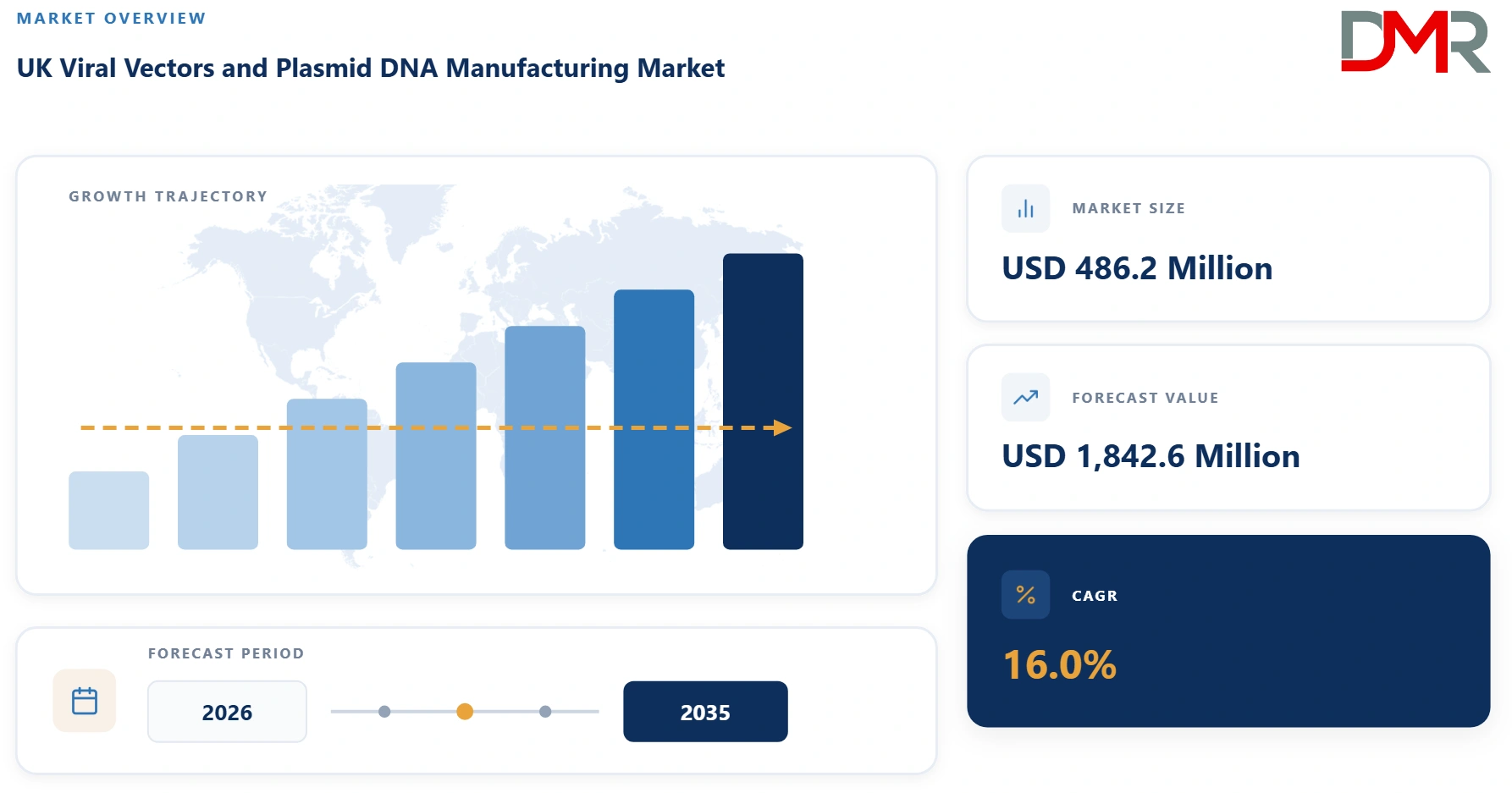
- UK Viral Vectors and Plasmid DNA Manufacturing Market Size in 2026: USD 486.2 Million
- UK Viral Vectors and Plasmid DNA Manufacturing Market Size in 2035: USD 1,842.6 Million
- UK CAGR from 2026 to 2035: 16.0%
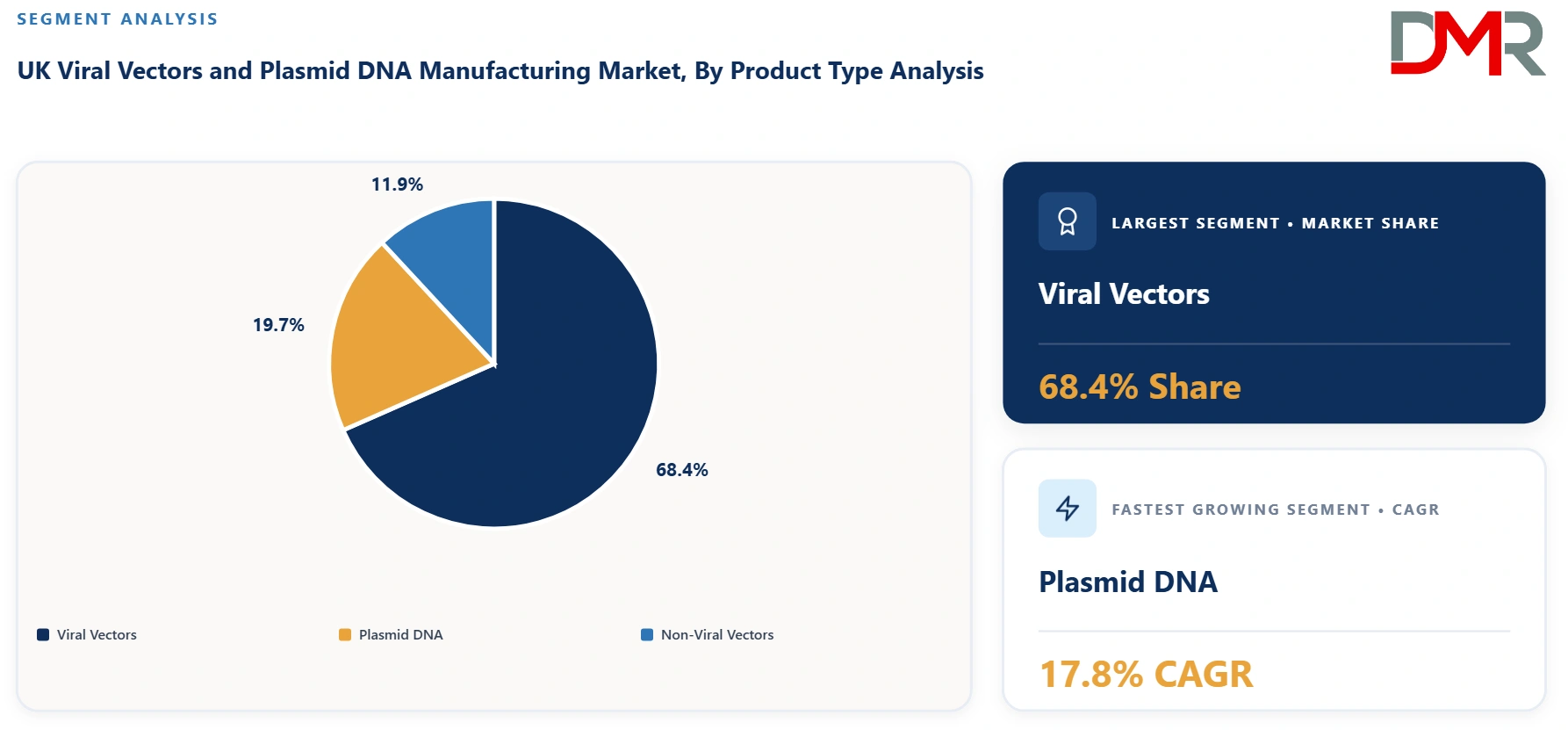
- Viral Vectors is the leading product type segment in 2026: 68.4%
- Adeno-Associated Virus (AAV) is the leading vector type segment in 2026: 38.7%
- Upstream Manufacturing is the leading workflow segment in 2026: 56.9%
- Gene Therapy is the leading application segment in 2026: 52.3%
- Contract Development and Manufacturing Organizations (CDMOs) is the leading end user segment in 2026: 46.8%
What is the UK Viral Vectors and Plasmid DNA Manufacturing Market and its Market Size?
The UK Viral Vectors and Plasmid DNA Manufacturing Market is projected to be valued at USD 486.2 Million in 2026 and is projected to reach USD 1,842.6 Million by 2035, expanding at a CAGR of 16.0% during the forecast period.
ℹ
To learn more about this report –
Download Your Free Sample Report Here
Growth is being propelled by the UK's position as a leading European hub for advanced therapy medicinal product development, sustained government investment in cell and gene therapy manufacturing infrastructure through bodies such as the Cell and Gene Therapy Catapult, and rapidly expanding clinical pipeline activity across gene therapy, CAR-T cell therapy, and viral vector-based vaccine platforms requiring specialized manufacturing capacity. The maturing of scalable, GMP-compliant viral vector and plasmid DNA production technologies capable of meeting the exacting quality and regulatory standards required for advanced therapy products, growing UK-based contract development and manufacturing organization capacity expansion serving both domestic and international biopharmaceutical clients, and continued strength of the UK's academic and research base in gene and cell therapy science are reshaping the market from a historically research-oriented, small-batch production category into an increasingly commercial-scale, internationally significant manufacturing industry. Investment is accelerating as UK-based manufacturers expand capacity to serve growing global demand for viral vector and plasmid DNA production supporting an expanding late-stage and commercial advanced therapy pipeline.
Use Cases
- AAV Vector Manufacturing for Gene Therapy Clinical and Commercial Supply: Gene therapy developers and CDMOs manufacture adeno-associated virus vectors under GMP conditions to support clinical trial and, increasingly, commercial supply for gene therapies targeting rare genetic diseases, ophthalmological conditions, and other indications with growing regulatory approval activity.
- Lentiviral Vector Production for CAR-T and Cell Therapy Applications: Cell therapy manufacturers and CDMOs produce lentiviral vectors used to genetically modify patient-derived or donor immune cells for CAR-T and other engineered cell therapy products, supporting both clinical development and commercial cell therapy manufacturing.
- Plasmid DNA Manufacturing as Critical Raw Material Input: Specialized plasmid DNA manufacturers produce GMP-grade plasmid DNA serving as an essential raw material input for both viral vector production and direct DNA-based therapeutic and vaccine applications, representing a critical upstream link in the advanced therapy manufacturing supply chain.
- Contract Manufacturing Capacity for International Biopharmaceutical Clients: UK-based CDMOs provide viral vector and plasmid DNA contract manufacturing services to international biopharmaceutical and biotechnology companies lacking in-house manufacturing capability, leveraging the UK's regulatory expertise and manufacturing infrastructure to serve global advanced therapy developers.
Key Takeaways
- Market Size: The UK Viral Vectors and Plasmid DNA Manufacturing Market is anticipated to be valued at USD 486.2 Million in 2026 and is forecast to reach USD 1,842.6 Million by 2035, expanding at a CAGR of 16.0%.
- Growth Outlook: Market expansion is sustained by the UK's position as a leading European advanced therapy hub, sustained government investment in cell and gene therapy manufacturing infrastructure, and rapidly expanding clinical pipeline activity requiring specialized viral vector and plasmid DNA manufacturing capacity.
- Primary Growth Drivers: Government investment in cell and gene therapy manufacturing infrastructure, rapidly expanding global gene and cell therapy clinical pipeline, growing UK CDMO capacity serving international biopharmaceutical clients, and the UK's strong academic and research base in advanced therapy science are accelerating market growth.
- By Product Type Analysis: Viral Vectors is projected to lead the product type segment with a 68.4% share in 2026, reflecting their essential role across gene and cell therapy manufacturing. Plasmid DNA is the fastest-growing product type segment at 17.8% CAGR, driven by rising demand for this critical upstream raw material input as viral vector production volumes expand.
- By Vector Type Analysis: Adeno-Associated Virus (AAV) is expected to dominate with a 38.7% share in 2026, supported by its widespread use in in vivo gene therapy applications. Lentivirus is the fastest-growing vector type segment at 17.2% CAGR, driven by expanding CAR-T and broader engineered cell therapy manufacturing demand.
- By Workflow Analysis: Upstream Manufacturing is poised to lead with a 56.9% share in 2026, reflecting the technically complex and capacity-constrained nature of cell culture and vector production processes. Downstream Manufacturing is the fastest-growing workflow segment at 16.8% CAGR, driven by growing investment in purification and formulation capacity supporting commercial-scale production.
- By Application Analysis: Gene Therapy is expected to command a 52.3% share in 2026, underpinned by the UK's substantial gene therapy clinical pipeline and growing commercial product approvals. Vaccine Development is the fastest-growing application segment at 16.4% CAGR, driven by continued viral vector platform investment following pandemic-era vaccine development experience.
- By End User Analysis: Contract Development and Manufacturing Organizations (CDMOs) are projected to dominate with a 46.8% share in 2026, reflecting the capital-intensive nature of viral vector manufacturing favoring outsourced production models. Pharmaceutical and Biotechnology Companies is the fastest-growing end user segment at 16.9% CAGR, driven by growing in-house manufacturing investment among well-capitalized advanced therapy developers.
Key Drivers in the UK Viral Vectors and Plasmid DNA Manufacturing Market
Government Investment in Cell and Gene Therapy Manufacturing Infrastructure
The UK government, through bodies including the Cell and Gene Therapy Catapult and broader life sciences sector investment initiatives, has provided substantial and sustained support for developing domestic advanced therapy manufacturing infrastructure and capability. This coordinated public sector investment, combined with supportive regulatory engagement from the Medicines and Healthcare products Regulatory Agency, has helped position the UK as an attractive location for both domestic and international viral vector and plasmid DNA manufacturing investment, reducing the capital and regulatory risk associated with establishing advanced therapy manufacturing capacity in the country.
Rapidly Expanding Global Gene and Cell Therapy Clinical Pipeline
The substantial and continuing growth in gene therapy and engineered cell therapy clinical trial activity globally, addressing an expanding range of genetic diseases, oncology indications, and other therapeutic areas, is driving sustained demand for viral vector and plasmid DNA manufacturing capacity. As more advanced therapy candidates progress from early clinical development toward late-stage trials and commercial approval, manufacturing capacity requirements increase substantially, both in terms of production volume and the need for commercial-scale, fully validated GMP manufacturing processes, sustaining strong demand growth for UK-based manufacturing capacity serving this expanding global pipeline.
Restraints in the UK Viral Vectors and Plasmid DNA Manufacturing Market
Manufacturing Complexity and Capacity Constraints Limiting Scalability
The inherent technical complexity of viral vector and plasmid DNA manufacturing, requiring specialized cell culture, purification, and quality control processes that are difficult to rapidly scale compared to more conventional pharmaceutical manufacturing, represents a significant restraint on the UK Viral Vectors and Plasmid DNA Manufacturing Market. Manufacturing capacity expansion requires substantial capital investment, specialized technical expertise, and extended timelines for facility qualification and regulatory approval, creating persistent capacity constraints that can limit the pace at which UK manufacturers can respond to growing global demand for advanced therapy manufacturing services.
Growth Opportunities in the UK Viral Vectors and Plasmid DNA Manufacturing Market
Process Intensification and Yield Improvement Technology for Commercial-Scale Production
Growing need to reduce the cost of goods and improve production yields for viral vector and plasmid DNA manufacturing, particularly as advanced therapy products move toward broader commercial adoption requiring more cost-effective manufacturing economics, presents a substantial opportunity for companies developing process intensification technologies. Companies capable of demonstrating meaningfully improved production yields and reduced manufacturing costs can capture significant market share as advanced therapy developers increasingly prioritize manufacturing partners capable of supporting commercially viable production economics.
Platform Technology Development for Multi-Product Manufacturing Flexibility
Growing demand for flexible manufacturing platforms capable of efficiently producing multiple different viral vector or plasmid DNA products within shared facility infrastructure presents an opportunity for UK CDMOs and technology developers to differentiate through platform flexibility rather than single-product manufacturing specialization. Companies developing modular, rapidly reconfigurable manufacturing platforms can better serve the diverse and evolving needs of biopharmaceutical clients across multiple therapeutic programs, improving facility utilization and capturing broader client relationships.
Trends in the UK Viral Vectors and Plasmid DNA Manufacturing Market
Continued Expansion of UK CDMO Capacity Serving International Clients
UK-based contract development and manufacturing organizations continue to expand viral vector and plasmid DNA production capacity specifically to serve international biopharmaceutical and biotechnology company clients, leveraging the UK's regulatory expertise, manufacturing infrastructure, and life sciences talent base to compete for global advanced therapy manufacturing contracts. This trend reflects the UK's strategic positioning as a manufacturing partner not only for domestic biopharmaceutical development but for the broader international gene and cell therapy industry.
Growing Investment in Analytical and Quality Control Technology
UK viral vector and plasmid DNA manufacturers are increasingly investing in advanced analytical and quality control technology capable of providing the rigorous characterization and release testing required for increasingly complex advanced therapy products. This trend reflects both evolving regulatory expectations for advanced therapy product characterization and manufacturers' own quality assurance priorities as production volumes scale toward commercial supply requirements.
Research Scope and Analysis
The UK Viral Vectors and Plasmid DNA Manufacturing Market is segmented by product type, vector type, workflow, application, and end user, covering viral vectors, plasmid DNA, AAV, lentivirus, adenovirus, upstream and downstream manufacturing, and gene therapy, cell therapy, and vaccine applications.
ℹ
To learn more about this report –
Download Your Free Sample Report Here
By Product Type Analysis
Viral Vectors is projected to dominate the UK Viral Vectors and Plasmid DNA Manufacturing Market with approximately 68.4% share in 2026, reflecting their essential and irreplaceable role as delivery vehicles across gene therapy, cell therapy, and viral vector-based vaccine manufacturing. Plasmid DNA is expected to register the highest CAGR of 17.8% during 2026-2035, driven by rising demand for this critical upstream raw material input as viral vector production volumes expand across an increasingly commercial-scale advanced therapy industry.
By Vector Type Analysis
Adeno-Associated Virus (AAV) is anticipated to dominate the UK Viral Vectors and Plasmid DNA Manufacturing Market by vector type, accounting for approximately 38.7% share in 2026, supported by its widespread use in in vivo gene therapy applications addressing rare genetic diseases and other indications with substantial clinical and commercial activity. Lentivirus is projected to register the highest CAGR of 17.2% between 2026 and 2035, driven by expanding CAR-T cell therapy and broader engineered cell therapy manufacturing demand requiring lentiviral vector-based genetic modification.
By Workflow Analysis
Upstream Manufacturing is projected to lead the UK Viral Vectors and Plasmid DNA Manufacturing Market with an estimated 56.9% share in 2026, reflecting the technically complex and often capacity-constrained nature of cell culture, transfection, and vector production processes central to viral vector manufacturing. Downstream Manufacturing is expected to register the fastest CAGR of 16.8% through 2035, driven by growing investment in purification, formulation, and fill-finish capacity supporting the transition from clinical to commercial-scale production.
By Application Analysis
Gene Therapy is expected to lead the UK Viral Vectors and Plasmid DNA Manufacturing Market by application, accounting for approximately 52.3% share in 2026, underpinned by the UK's substantial gene therapy clinical pipeline and growing number of commercial product approvals addressing rare genetic diseases. Vaccine Development is projected to achieve the fastest CAGR of 16.4% during 2026-2035, driven by continued investment in viral vector-based vaccine platforms following substantial pandemic-era vaccine development experience and infrastructure investment.
By End User Analysis
Contract Development and Manufacturing Organizations (CDMOs) are projected to dominate the UK Viral Vectors and Plasmid DNA Manufacturing Market with approximately 46.8% share in 2026, reflecting the capital-intensive and technically complex nature of viral vector manufacturing that favors outsourced production models for many biopharmaceutical developers. Pharmaceutical and Biotechnology Companies are expected to register the fastest CAGR of 16.9% through 2035, driven by growing in-house manufacturing investment among well-capitalized advanced therapy developers seeking greater supply chain control.
The UK Viral Vectors and Plasmid DNA Manufacturing Market Report is segmented based on the following:
By Product Type
- Viral Vectors
- Plasmid DNA
- Non-Viral Vectors
By Vector Type
- Adeno-Associated Virus (AAV)
- Lentivirus
- Adenovirus
- Retrovirus
- Others
By Workflow
- Upstream Manufacturing
- Downstream Manufacturing
By Application
- Gene Therapy
- Cell Therapy
- Vaccine Development
- Others
By End User
- Pharmaceutical and Biotechnology Companies
- Contract Development and Manufacturing Organizations (CDMOs)
- Academic and Research Institutes
Technology Analysis
Technology development is central to the trajectory of the UK Viral Vectors and Plasmid DNA Manufacturing Market as companies invest in suspension cell culture technology, single-use bioreactor systems, and advanced chromatography-based purification methods aimed at improving production yields and reducing manufacturing costs. Growing use of continuous manufacturing and process analytical technology is supporting real-time quality monitoring and more consistent production outcomes across increasingly commercial-scale operations. Opportunities are expanding for companies developing next-generation vector design technology improving transduction efficiency and reducing required vector doses, as well as digital manufacturing execution systems supporting the extensive documentation and traceability requirements for advanced therapy product manufacturing. However, achieving cost-competitive, large-scale commercial manufacturing while maintaining the rigorous quality standards required for advanced therapy products remains an ongoing technical and capital investment challenge across the industry.
Investment and White Space Analysis
Investment opportunities in the UK Viral Vectors and Plasmid DNA Manufacturing Market are expanding alongside the UK's position as a leading European advanced therapy hub, sustained government infrastructure investment, and rapidly expanding global gene and cell therapy clinical pipeline. Significant white space exists in process intensification and yield improvement technology, flexible multi-product manufacturing platforms, and advanced analytical and quality control technology supporting commercial-scale production. Companies with strong technical manufacturing capability, established regulatory expertise, and international client relationships are positioned to capture premium, longer-duration manufacturing contracts. However, manufacturing complexity and capacity constraints limiting scalability, along with the substantial capital investment required for facility expansion and qualification, can constrain near-term growth pace for smaller or newly entering manufacturers.
Competitive Landscape
The UK Viral Vectors and Plasmid DNA Manufacturing Market is moderately consolidated and increasingly competitive, comprising large global CDMOs with UK manufacturing operations, specialized UK-based viral vector and plasmid DNA manufacturers, and academic and research institute-affiliated manufacturing facilities. Competition centers on manufacturing capacity and scalability, regulatory expertise and track record, technical capability across diverse vector types and applications, and established relationships with both domestic and international biopharmaceutical clients. Large global CDMOs benefit from substantial capital resources and broad manufacturing network capability, while specialized UK-based manufacturers compete on deep technical expertise and closer, more collaborative client relationships. Companies increasingly differentiate through process intensification capability, platform flexibility, and quality and regulatory track record rather than manufacturing capacity alone.
Some of the prominent players in the UK Viral Vectors and Plasmid DNA Manufacturing Market are:
- Oxford Biomedica plc
- Thermo Fisher Scientific Inc.
- Lonza Group AG
- Merck KGaA
- FUJIFILM Diosynth Biotechnologies
- Charles River Laboratories International, Inc.
- Catalent, Inc.
- AGC Biologics
- Aldevron LLC
- WuXi Advanced Therapies
- GenScript ProBio
- Takara Bio Inc.
- Sartorius AG
- Miltenyi Biotec
- VGXI, Inc.
- Genezen Laboratories, Inc.
- Batavia Biosciences B.V.
- FinVector Oy
- PlasmidFactory GmbH
- Kaneka Eurogentec S.A.
- BioNTech IMFS GmbH
- uniQure N.V.
- REGENXBIO Inc.
- Forge Biologics
- Andelyn Biosciences
- Yposkesi
- IDT Biologika GmbH
- Virovek, Inc.
- Waisman Biomanufacturing
- Cell and Gene Therapy Catapult
- Revvity, Inc.
- Polyplus
- SIRION Biotech GmbH
- VectorBuilder Inc.
- Touchlight
- eXmoor Pharma
- 3PBIOVIAN
- ProBio
- Resilience
- BioMarin Pharmaceutical Inc.
- Other Key Players
Recent Developments
- August 2026: 4basebio and Genezen signed a strategic collaboration to provide 4basebio’s cell-free hpDNA technology as starting material for next-generation viral vector development and clinical manufacturing programs.
- July 2026: Touchlight announced its dbDNA manufacturing technology supported first UK patient dosing in the NEOVACC Phase I personalised lung cancer vaccine trial, demonstrating clinical application of scalable cell-free DNA production.
- April 2026: Oxford Biomedica (OXB) launched a fast-track AAV and lentiviral vector development and manufacturing service, potentially shortening timelines to GMP manufacturing by up to nine months.
Report Details
| Report Characteristics |
| Market Size (2026) |
USD 486.2 Mn |
| Forecast Value (2035) |
USD 1,842.6 Mn |
| CAGR (2026–2035) |
16.0% |
| Historical Data |
2021 – 2025 |
| Forecast Data |
2026 – 2035 |
| Base Year |
2025 |
| Segments Covered |
By Product Type, By Vector Type, By Workflow, By Application, and By End User |
| Country Coverage |
The UK |
Frequently Asked Questions
How big is the UK Viral Vectors and Plasmid DNA Manufacturing Market?
▾ The UK Viral Vectors and Plasmid DNA Manufacturing Market is poised to be valued at USD 486.2 Million in 2026 and is projected to reach USD 1,842.6 Million by 2035, reflecting the UK's position as a leading European advanced therapy manufacturing hub and rapidly expanding global gene and cell therapy clinical pipeline.
What is the CAGR of the UK Viral Vectors and Plasmid DNA Manufacturing Market from 2026 to 2035?
▾ The market is projected to expand at a compound annual growth rate (CAGR) of 16.0% between 2026 and 2035, supported by sustained government infrastructure investment, rapidly expanding clinical pipeline activity, and growing UK CDMO capacity serving international clients.
What factors are driving the growth of the UK Viral Vectors and Plasmid DNA Manufacturing Market?
▾ Growth is driven by government investment in cell and gene therapy manufacturing infrastructure, rapidly expanding global gene and cell therapy clinical pipeline, growing UK CDMO capacity serving international biopharmaceutical clients, and the UK's strong academic and research base in advanced therapy science.
What are the major trends in the UK Viral Vectors and Plasmid DNA Manufacturing Market?
▾ Major trends include continued expansion of UK CDMO capacity serving international clients, growing investment in analytical and quality control technology, and rising focus on process intensification and yield improvement for commercial-scale production.
Who are the key players in the UK Viral Vectors and Plasmid DNA Manufacturing Market?
▾ Key market participants include Oxford Biomedica, Cobra Biologics (Charles River Laboratories), Catalent Biologics UK, FUJIFILM Diosynth Biotechnologies UK, and Lonza UK Operations, among other global and specialized UK-based advanced therapy manufacturers.
How is the UK Viral Vectors and Plasmid DNA Manufacturing Market segmented?
▾ The market is segmented by product type, vector type, workflow, application, and end user, with demand analysis concentrated across Oxford, Cambridge, and the broader Golden Triangle life sciences cluster.