What is the Underground Construction Chemical Market Size?
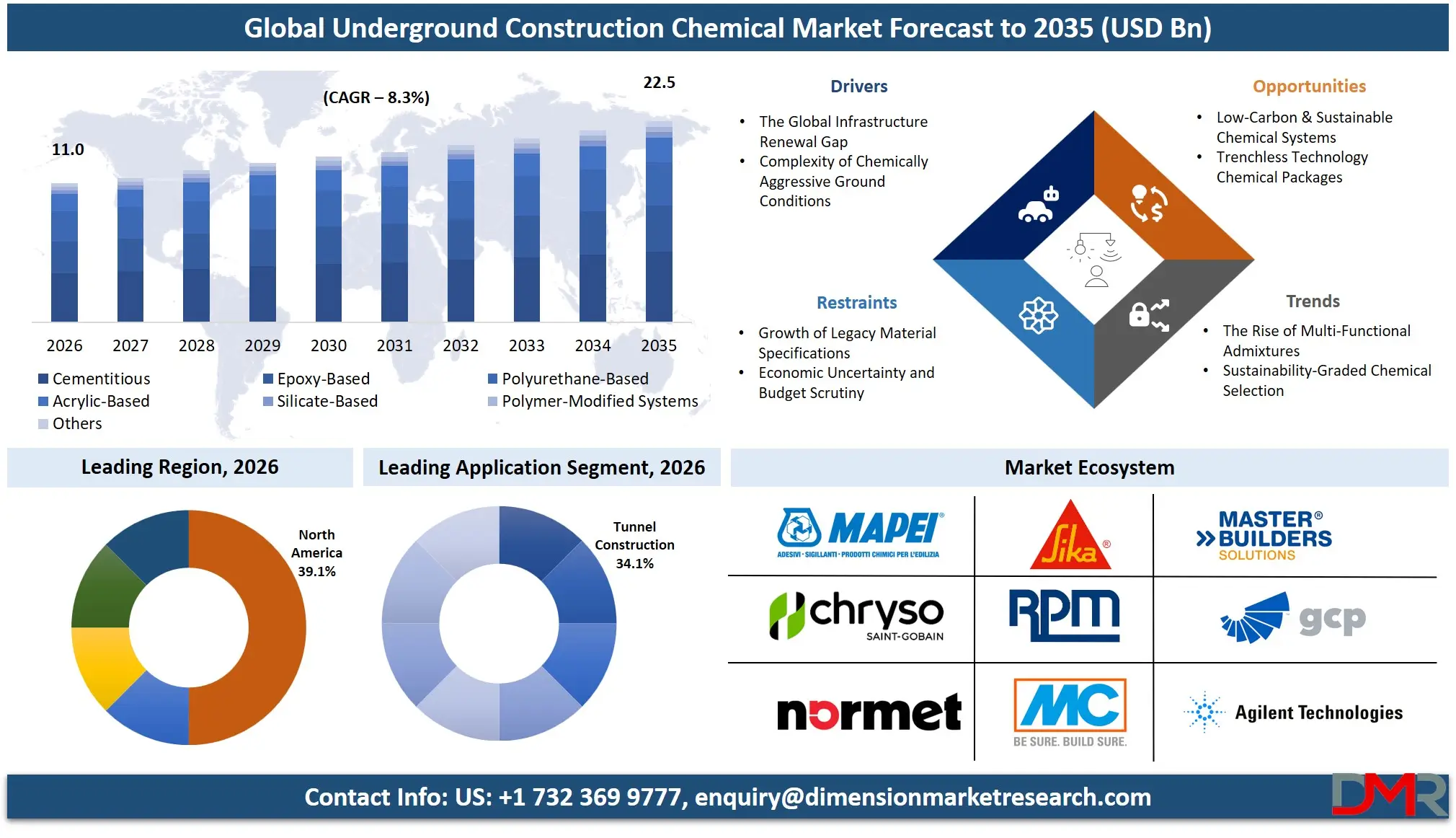
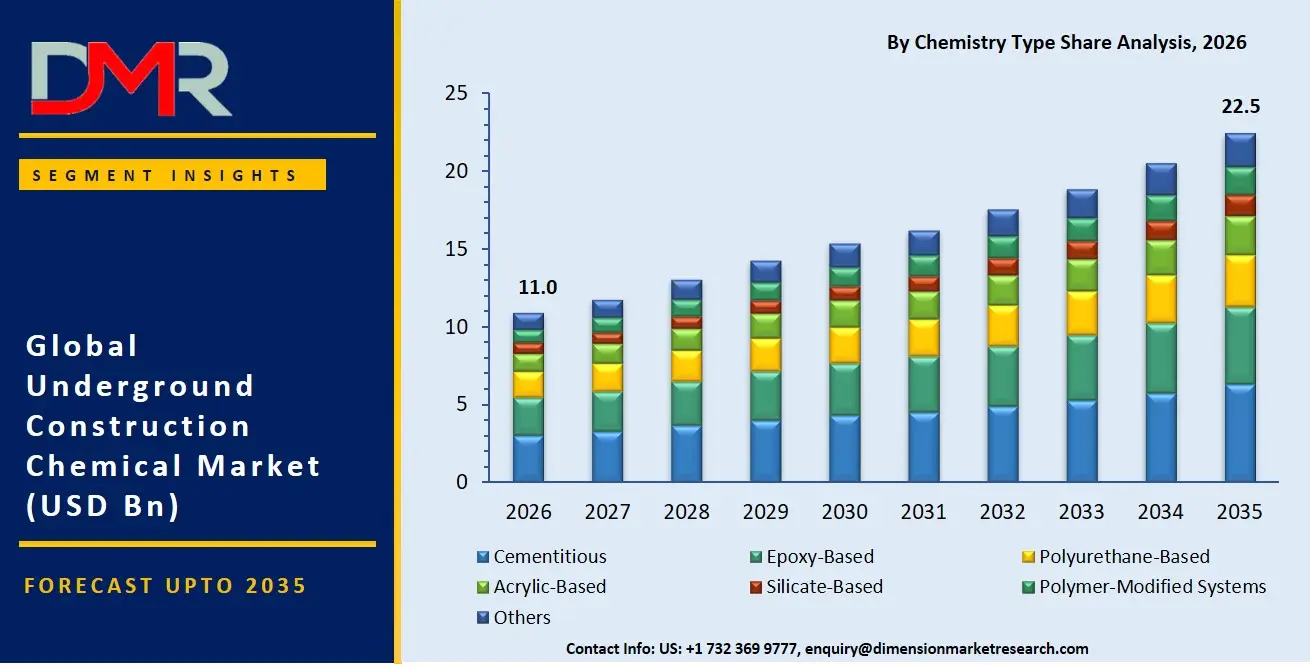
The Global Underground Construction Chemical Market is expected to reach a value of USD 11.0 billion in 2026, and it is further anticipated to reach USD 22.5 billion by 2035, growing at a CAGR of 8.3% during the forecast period.
ℹ
To learn more about this report –
Download Your Free Sample Report Here
With increased urbanization, population density and the global drive to expand infrastructure underground, the underground construction chemical market has been steadily expanding. Specialty chemical solutions such as concrete admixtures, waterproofing, grouts, shotcrete accelerators, adhesives, protective coatings, repair materials and ground stabilization chemicals make up this market.
These products are crucial for maintaining the structural strength, water tightness and durability of tunnels, metros, mines, and utility corridors. The market for high-performance, long-lasting and resistant materials is growing and creating the need for specialist construction chemical formulations. As in the past, the primary sectors of use are transportation and energy & utilities, with cementitious and polyurethane-based systems being the most common because they are reliable and suitable for use in severe subsurface environments.
ℹ
To learn more about this report –
Download Your Free Sample Report Here
The US Underground Construction Chemical Market
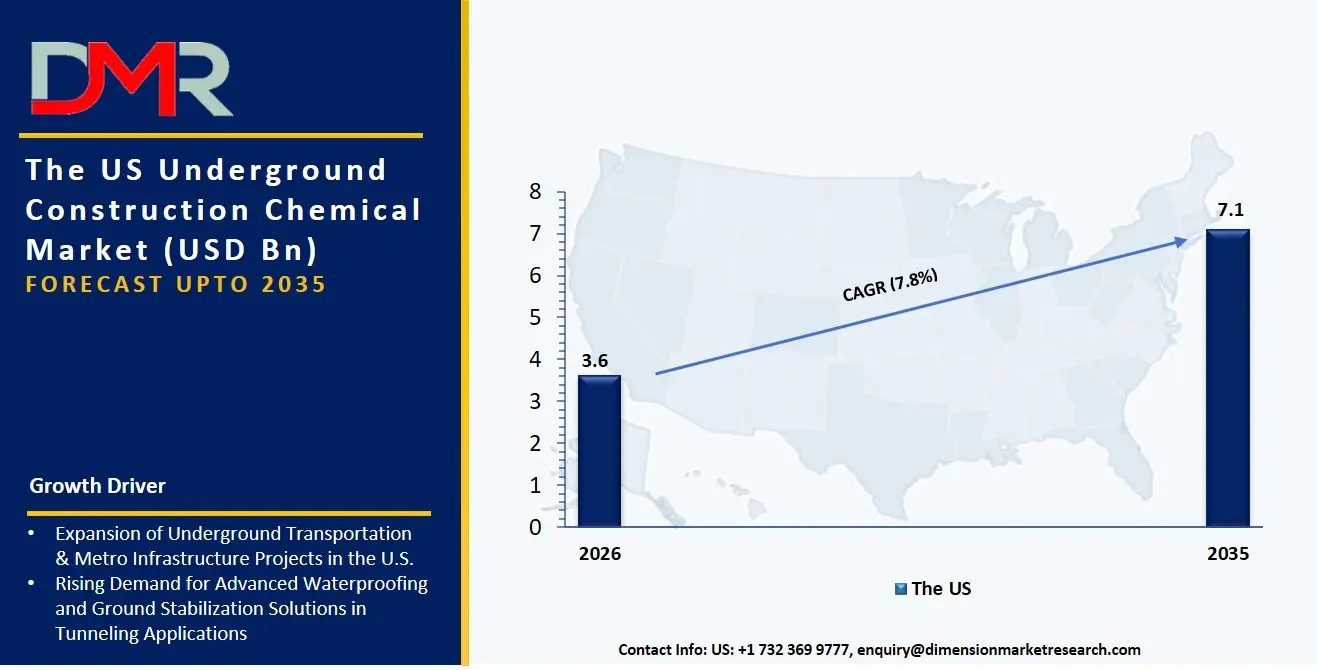
The US Underground Construction Chemical Market is projected to reach USD 3.6 billion in 2026 at a compound annual growth rate of 7.8% over its forecast period, culminating in a value of USD 7.1 billion by 2035. Under active programs of aging infrastructure renewal, such as tunnel rehabilitation, the largest and most developed market in North America for underground construction chemicals is the U.S. market, which is being fueled by urban metro system expansion in cities such as New York, Los Angeles and Chicago. The market has been characterized as one with a high demand for repair & rehabilitation chemicals, where infrastructure owners want to prolong the life of legacy tunnels and sewer without excavation. Besides, the implementation of stringent environmental regulations is producing a similar need for low-VOC & eco-friendly grouts and waterproofing membranes in sensitive underground water table environments.
ℹ
To learn more about this report –
Download Your Free Sample Report Here
The Europe Underground Construction Chemical Market
The Europe Underground Construction Chemical Market is estimated to be valued at USD 3.2 billion in 2026 and is further anticipated to reach USD 6.4 billion by 2035 at a CAGR of 8.0%. The need for crystalline waterproofing and silicate based ground stabilization chemicals is significantly affected by the European market and the regulatory framework, such as the EU Taxonomy for sustainable activities and the strict groundwater protection directives. Rapid setting and high early strength of shotcrete accelerators are also being observed in the region, where Alpine base tunnels (such as Brenner Base Tunnel, Mont Cenis) and urban metro extensions in Germany and France demand high early strength for ground support and quick setting. Moreover, programs to promote the principles of circular economy are pushing service providers to develop systems that can be polymer modified with a lower carbon footprint to line underground utility corridors.
The Japan Underground Construction Chemical Market
The Japan Underground Construction Chemical Market is projected to be valued at USD 0.9 billion in 2026. It is further expected to witness robust growth, holding USD 1.8 billion in 2035 at a CAGR of 7.9% (inferred). Japan is an exception, facing a national need for upgrading of water and sewage tunnels due to the vulnerability of the nation's aging networks and to a lack of manpower for maintaining them. A significant portion of spending is on epoxy grouts and polyurethane sealants as municipalities use trenchless methods, such as pipe jacking and microtunneling, to rehabilitate leaky sewer and drainage systems. The demand for anti-corrosion coatings to prevent corrosion of underground storage tanks and foundation structures in Japan's highly corrosive and saline groundwater conditions is also very high.
Key Takeaways
- Market Size & Forecast: The Global Underground Construction Chemical market is projected to reach USD 11.0 billion in 2026, expanding to USD 22.5 billion by 2035, propelled by the twin trends of the renovation of aging underground infrastructure and the emergence of new mega-tunnels across the globe.
- Growth Rate & Outlook: Global market growth is forecast to occur at a CAGR of 8.3% based on the crucial demand for water proofing tunnels against water seepage and increasing difficulty in handling aggressive chemical soils in cities.
- Primary Growth Drivers: Main drivers include the switch from traditional open-cut methods of tunneling to trenchless construction which calls for unique grouts, the demand for high performance shotcretes to speed up construction and the inclusion of repair chemicals to prevent failures.
- Key Market Trends: Prominent trends include the adoption of eco-friendly crystalline waterproofing, the usage of polyurethane-based grouts for active crack filling and the adoption of polymer-modified cementitious materials for transport tunnels.
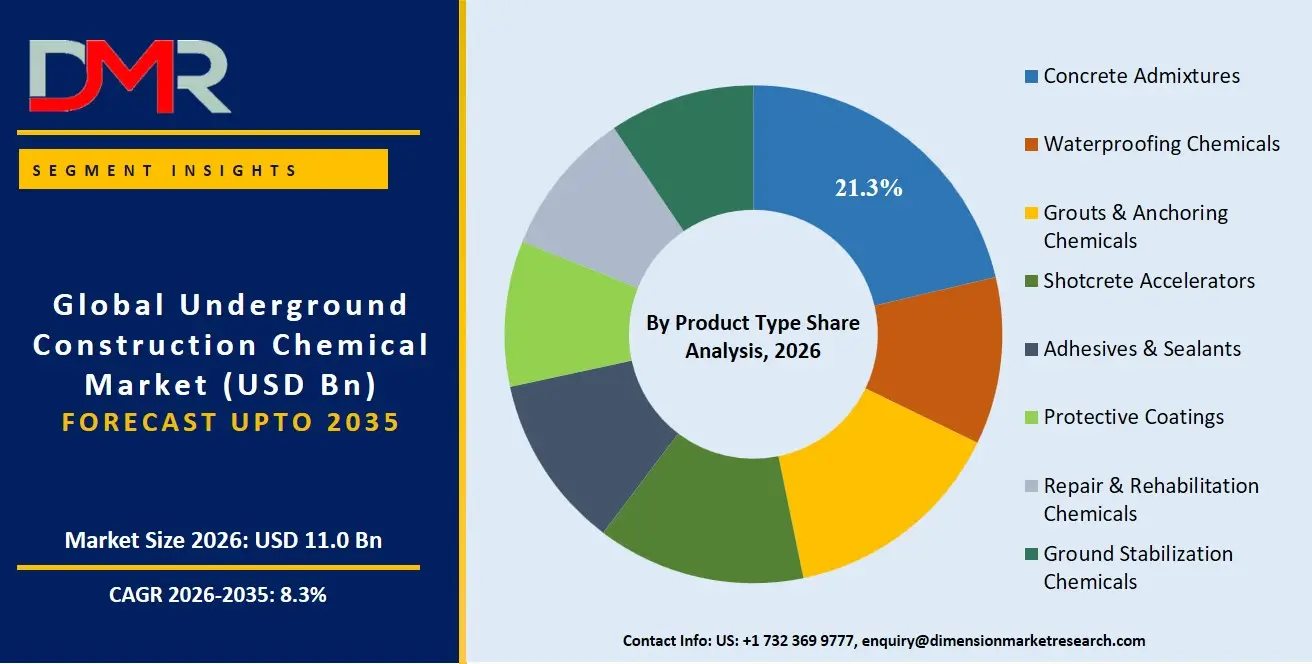
- By Product Analysis: The underground construction concrete additives segment is dominated by concrete additives as they help enhance the strength, durability, workability, and setting capacity of concrete used in underground constructions. Their heavy application in tunnels, mining, hydropower plants, along with high-performance concrete, drives their market dominance.
- By Chemistry Analysis: The cementitious systems segment is dominant due to their durable, economical, and flexible use in applications such as tunneling, waterproofing, and underground stabilization. Their compressive strength and water resistance, along with wide usage in infrastructure projects, continues to drive their market dominance globally.
- Regional Leadership: The North American region is set to dominate the market with 39.1% of the market share by 2026 owing to a huge amount of aged underground infrastructure that requires upgrading and technological advancement.
What is the Underground Construction Chemical?
Underground Construction Chemicals include various chemical formulations such as admixtures, grouts, coatings, and sealants that are used by constructors, engineers, and infrastructure owners to guarantee safety, stability, and water resistance of subsurface structures. In contrast to other construction chemicals, underground construction chemicals help solve a number of issues related to subsurface environment, which includes high hydrostatic pressure, ground deformation, chemical reactions between soil and structure materials, and poor accessibility for repair purposes. This includes admixtures for concretes (accelerators and superplasticizers) used to improve shotcrete performance for tunnel lining purposes, chemicals preventing water penetration, and grouts and anchoring materials filling voids in rock and stabilizing ground. As 80 percent of all new urban transit projects utilize TBMs, specific chemicals are required to make problematic geology workable.
Use Cases
- TBM Tunneling for Metro Lines: The shotcrete accelerators and polymer-based system is used by metro railways to stabilize the tunnel wall immediately behind the TBM shield, assuring safe working conditions in an effort to keep the tunnel above from subsiding in urban centers.
- Rehabilitation of Sewer Main in Aging Cities: The cities utilize polyurethane grouting and epoxy resins through robotic systems to repair damaged brickwork or concrete sewer lines to stop any infiltration/exfiltration process.
- Hydropower Tunnels Waterproofing: In order to retain water in hydropower tunnels and penstocks, the crystalline waterproofing technique or polyurethane sealants are used.
- Stabilization of Ground for Mining Operations: Major global mining companies have been using cementitious and silicate grouting techniques to pre-grout fractured zones prior to any shaft/decline excavation.
How AI is Transforming the Underground Construction Chemical Market
AI is shaping the underground construction chemical market through the optimization of material formulation and predictive maintenance of underground constructions. As part of concrete admixtures, AI-based dosage optimizers can autonomously determine the optimum amount of superplasticizer and accelerators through real-time data provided by the Tunnel Boring Machine (TBM) including temperature, geological composition, and advance speed, thereby minimizing waste and variation in setting times. In the case of sewer and drainage chemicals, AI-based inspection technology enables infrastructure owners to accurately estimate the need for chemical maintenance through crack and water penetration patterns captured in CCTV videos to suggest the most suitable repair and rehabilitation chemicals that will augment FinOps techniques in public asset management.
Quality assurance and project planning are also pivoting towards AI solutions. Regarding ground stabilization chemicals, intelligent injection monitoring solutions are being applied to continuously monitor the amount of grout taken and the pressure exerted while pinpointing any voids and incomplete fillings in order to ensure compliance with structural codes throughout the project cycle. Furthermore, generative AI assistants have been assisting tunnel construction planning by simulating the performance of chemical grout curtains in different hydrogeological settings to visualize the water cut-off effect of such chemicals.
Market Dynamics
Key Drivers in the Global Underground Construction Chemical Market
The Global Infrastructure Renewal Gap
Even today governments around the world are struggling to deal with the management of aging tunnels, sewer pipes and metros that were constructed 50-100 years ago, many of which are at or close to their design life. The demand for repair & rehabilitation chemicals is growing at a rate greater than the ability to create new infrastructure, resulting in a structural renewal gap. This is leading to a trend for public works agencies to contract out rehabilitation solutions in chemicals instead of replacing them. These chemicals provide necessary functions, such as crack injection, structural lining and corrosion protection, for tunnels during operation. In these chemicals, agencies can expect to reduce the rate of deterioration of their assets and to avoid catastrophic failure related to the presence of decaying subsurface conditions.
Complexity of Chemically Aggressive Ground Conditions
Sulfate soils, acidic ground waters or salinity are not uncommon in the underground projects and will severely affect ordinary concrete and steel. However, it's a complex task to design for such environments. Anti-corrosion coatings, epoxy based grouts and polymer modified systems with design life of 100 years need to be specified by engineers to stand up to particular chemical attacks. This complexity can lead to degradation, safety issues and unplanned maintenance before the chemicals are properly formulated by an expert. This means that there is a growing demand for protective coatings and ground stabilization chemicals that can help contractors to carry on working in such aggressive environment.
Restraints in the Global Underground Construction Chemical Market
Growth of Legacy Material Specifications
Even in most infrastructure projects, traditional material specifications are in use, which have been established over the course of decades and are highly localised in terms of procurement. Such old specifications are a huge barrier to innovation with new formulations of chemicals providing improved durability and construction speed. The process of long-term testing and regulatory approval is expensive and risky for qualifying new cementitious grouts or waterproofing systems based on acrylic. Owners fear premature failure, warranty issues, and unanticipated compatibility problems in the transition. As a result, there is a tendency to postpone infrastructure modernization by technical inertia and retard the adoption of advanced construction chemicals.
Economic Uncertainty and Budget Scrutiny
Instability in economies and in funding streams from public sources has led infrastructure owners to be less likely to invest in premium chemical solutions. Although durability and lifecycle cost are strategic considerations, procurement executives are facing the pressure to keep the initial investment minimised. It is more likely to be examined whether the higher initial cost of epoxy grouts or polyurethane sealants outweighs the benefits over traditional cementitious grouts or sealants. The projects have moved on to the use of lower-cost standard chemical admixtures that provide immediate budget compliance but not long-term durability. More likely to be delayed until a clear 30-year cost-benefit advantage has been shown will be long-life, high-performance chemical solutions.
Growth Opportunities in the Global Underground Construction Chemical Market
Low-Carbon & Sustainable Chemical Systems
An important growth opportunity is helping the infrastructure owners achieve low CO2 cementitious grouts, bio-based polyurethane sealants, and recycled polymer-modified systems for underground construction. Environmental Product Declarations are now being demanded by a number of public agencies in all construction chemicals used in government-funded tunnels and metro lines. Developing these advanced formulations requires special expertise in alternative binders, carbon capture technologies, and lifecycle assessment. Contractors can access high-value public projects with the help of chemical manufacturers to meet green building certifications and net zero infrastructure commitments.
Trenchless Technology Chemical Packages
Technological advances in both trenchless methods and chemical expertise are fueling a rise in professional chemical services, as municipalities switch to pipe jacking, microtunneling, and Cured-in-Place Pipe (CIPP) to save on the disruption of the surface. These have to be specific chemicals, soil conditioners and annular space grouts other than the conventional open-cut chemicals. Wastewater and water utility owners need chemical partners who can not only understand chemistry, but the application in particular. Chemical service companies can supplement design expertise by tailoring the specific chemical package to the pipe materials, ground conditions and stresses.
Trends in the Global Underground Construction Chemical Market
The Rise of Multi-Functional Admixtures
Multi-functional admixtures are gaining more popularity in underground construction besides using single use admixtures. Superplasticizers, accelerators and water reductants are all in one product, not in separate components which are added to the concrete in the field on a piece-by-piece, as-needed basis, are the type of admixtures contractors want. With these integrated formulations, logistics becomes easier, batching errors are diminished and the quality of the shotcrete is increased. In response, the chemical industry is offering polymer chemistry, rheology, and on-line optimization of product dosages.
Sustainability-Graded Chemical Selection
Environmental sustainability is also becoming a major factor in chemical selection as infrastructure owners are being called upon to deliver ESG goals and reduce embedded carbon in large-scale projects. Today, specifiers are interested in ground stabilization and waterproofing strategies that would benefit the performance and cost of projects while also reducing environmental impacts. This has brought about a need for Green Chemical consulting services. Chemical manufacturers help owners choose low-lead accelerators, sealants made with recycled content, and solvent-free coatings to maximize the total amount of chemistry used, right-size injection volumes, and minimize wasted chemistry due to over-application.
Research Scope and Analysis
The Global Underground Construction Chemical Market Report is segmented by product type, chemistry type, construction method, application, and end use. Key segments include concrete admixtures, waterproofing chemicals, cementitious systems, TBM construction, tunnel infrastructure, mining applications, transportation infrastructure, utilities, commercial, residential, and industrial development sectors globally.
ℹ
To learn more about this report –
Download Your Free Sample Report Here
By Product Type Analysis
Concrete admixture is the leading category in terms of product types as its importance cannot be overlooked when considering its significance in increasing workability, durability, setting time, and strength of underground concrete structures. Plasticizers and superplasticizers play an important role in underground structures as they provide greater flowability of underground concrete structures and reduce the quantity of water. Accelerator is the most commonly used type of concrete admixture in shotcrete, as it helps in fast setting time. High infrastructure developments like metro tunnels, hydroelectric caves, and other underground transit passages largely depend on concrete admixtures. High-performance concrete is increasingly being preferred in TBM and drill-and-blast construction works.
By Chemistry Type Analysis
Cementitious systems lead the pack in the chemistry type category due to their affordability, durability, and flexibility in underground construction applications. Grouts, water-proofing products, repair mortars, and shotcrete mixes made up of cement are widely used in tunnel lining projects, mining stabilizations, and underground utilities. They are favored in concrete-related applications and can be easily handled at the work site. In addition, they exhibit high compressive strength and water repellence properties, which are important when it comes to deep excavations and tunnels. With growing investments in underground metros, sewers, and hydro tunnels, cement-based underground construction chemicals have maintained their dominance.
By Construction Method Analysis
Construction using Tunnel Boring Machine (TBM) technology leads the way in this category due to its wide use in metros, railways, utility corridors, and water tunnels in the contemporary era. TBM construction needs complex construction chemicals like lubricants, grout, waterproofing materials, and shotcreting accelerators. Unlike traditional tunneling technologies, TBM construction ensures accuracy and is environmentally friendly, especially in densely populated cities. Rapid urbanization and implementation of smart cities programs in nations like China, India, and Japan has increased the demand for TBM technology. An increase in underground projects in terms of transport and utilities all around the globe has played an important role in establishing the supremacy of TBM construction.
By Application Analysis
The tunnel construction is the anticipated to be the dominant segment in terms of application due to the high consumption of construction chemicals in underground tunnels. Heavy investments in metros, roads, railway tracks, hydropower plants, and cross-country infrastructure developments will drive demand for waterproofing chemicals, grouts, accelerators for shotcrete, and repair chemicals. The tunnel environment demands advanced chemical products to cope with high water pressure, geological hazards, corrosion, and strain on structures. The governments around the world are increasingly focusing on developing underground transportation networks to mitigate traffic issues in cities. Moreover, the rise in usage of long-distance underground utility and transportation tunnels will continue driving the chemical usage in tunnel construction applications.
By End Use Analysis
The transportation sector is the poised to be the leader among end-use industries because of heavy investments worldwide in underground metros, tunnels, highways, and urban transportation infrastructure. There are huge demands for construction chemicals in underground transportation infrastructure development for purposes of waterproofing, reinforcement, stabilization through shotcrete, and improving the durability of concrete. Population and urban transportation growth have led governments to focus on the development of underground transport corridors and intelligent transportation systems. Major countries like China, India, the US, and those in Europe are investing heavily in metro and tunnel systems. The long lifespan of infrastructure development projects and strict safety requirements are other factors increasing chemical usage in the transportation infrastructure industry.
The Global Underground Construction Chemical Market Report is segmented on the basis of the following:
By Product Type
- Concrete Admixtures
- Plasticizers & Superplasticizers
- Accelerators
- Retarders
- Air-Entraining Agents
- Waterproofing Chemicals
- Crystalline Waterproofing
- Membrane-Based Waterproofing
- Bituminous Waterproofing
- Grouts & Anchoring Chemicals
- Cementitious Grouts
- Epoxy Grouts
- Polyurethane Grouts
- Shotcrete Accelerators
- Adhesives & Sealants
- Epoxy Adhesives
- Polyurethane Sealants
- Silicone Sealants
- Protective Coatings
- Epoxy Coatings
- Polyurethane Coatings
- Anti-Corrosion Coatings
- Repair & Rehabilitation Chemicals
- Ground Stabilization Chemicals
By Chemistry Type
- Cementitious
- Epoxy-Based
- Polyurethane-Based
- Acrylic-Based
- Silicate-Based
- Polymer-Modified Systems
- Others
By Construction Method
- Tunnel Boring Machine (TBM)
- Drill & Blast
- Cut-and-Cover
- Microtunneling
- Pipe Jacking
By Application
- Tunnel Construction
- Underground Metro & Rail Systems
- Mining Infrastructure
- Underground Utility Corridors
- Hydropower & Water Tunnels
- Underground Storage Facilities
- Sewer & Drainage Systems
- Basement & Foundation Structures
By End Use
- Transportation Infrastructure
- Energy & Utilities
- Mining
- Commercial Infrastructure
- Residential Infrastructure
- Industrial Infrastructure
Regional Analysis
Leading Region by Market Share
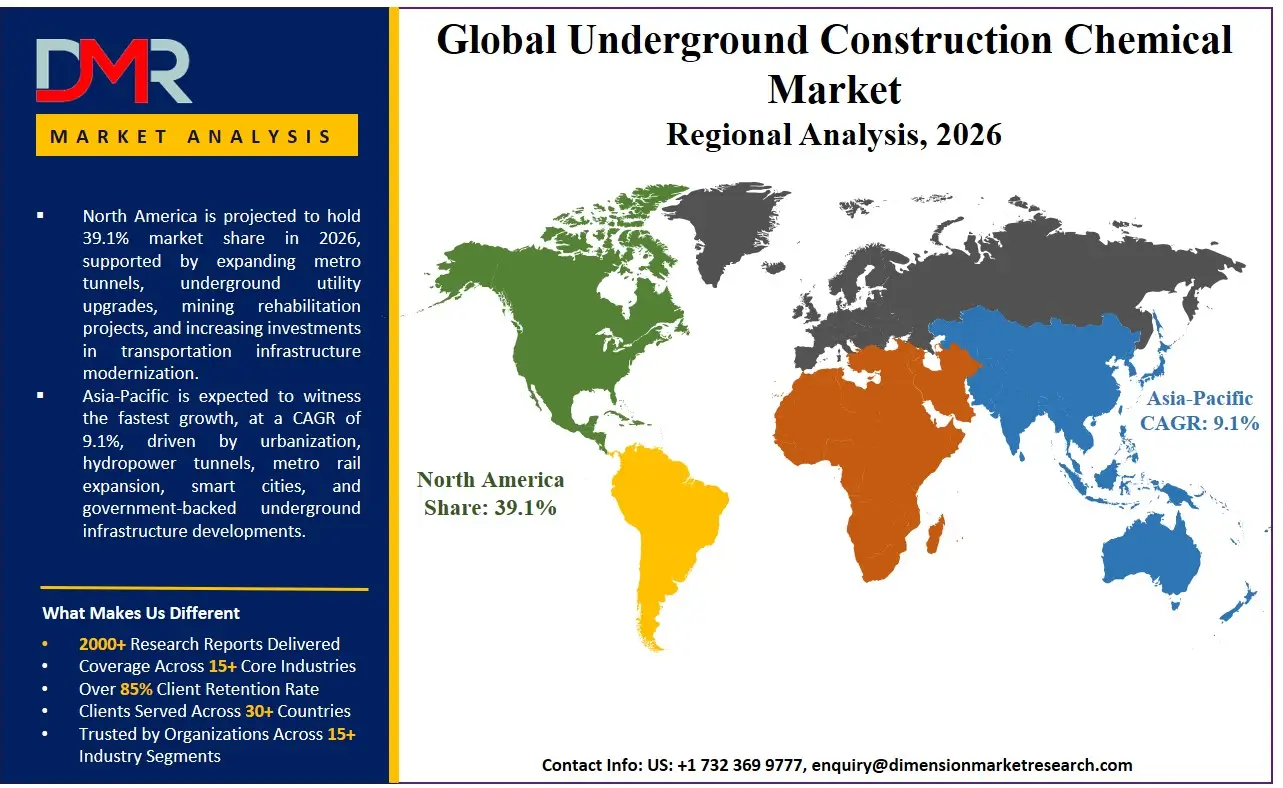
North America is poised to dominate the global underground construction chemical market, holding 39.1% of the market share by the end of 2026. As the dominant nation within North America, the United States claims the largest market share due to the unique presence of aging underground transportation systems coupled with aggressive programs to rehabilitate by the states' departments of transportation and municipalities. The country already has an existing community of applicators of chemicals, engineering firms, as well as abundant geotechnical and structural engineers. The investment in seismic retrofitting in underground transport networks, as well as the general renovation of CSO tunnels, adds up to the constant demand for repair and rehabilitation chemicals and grouts, alongside protective coatings. In addition, an encouraging outlook on the country's federal infrastructure spending programs (IIJA) continues to finance upcoming underground projects requiring specialized chemical application services.
ℹ
To learn more about this report –
Download Your Free Sample Report Here
Fastest-Growing Regional Market
It is projected that the Asia-Pacific market will record the fastest growth in the underground construction chemicals market due to government-backed extensive subway railways and hydropower projects in India, China, Japan, and Southeast Asia. The rapid economic development, emergence of megacities, and dynamic expansion of transport infrastructure networks has made it necessary for the traditional contractors and public entities to resort to modern chemical solutions in order to accelerate the tunneling process. There is an acute shortage of expertise in using such chemicals in certain regions in the region, making it imperative for the international underground construction chemical suppliers to offer their services for filling the gap.
By Region
North America
Europe
- Germany
- The U.K.
- France
- Italy
- Russia
- Spain
- Benelux
- Nordic
- Rest of Europe
Asia-Pacific
- China
- Japan
- South Korea
- India
- ANZ
- ASEAN
- Rest of Asia-Pacific
Latin America
- Brazil
- Mexico
- Argentina
- Colombia
- Rest of Latin America
Middle East & Africa
- Saudi Arabia
- UAE
- South Africa
- Israel
- Egypt
- Rest of MEA
Competitive Landscape
The competitive environment of the global underground construction chemical market is highly dynamic, with a heterogeneous array of multinational specialty chemical producers (e.g., Sika, BASF, GCP Applied Technologies), diversified construction material conglomerates (e.g., RPM International, MAPEI), and regional/niché providers focusing on specific chemistries like polyurethanes or epoxies. The key to success is profound strategic collaboration with major tunneling contractors and engineering firms, because this will open necessary specification inclusion and early access to new project opportunities. The movement towards product system consolidation is rapidly progressing, with traditional cement companies acquiring polyurethane and epoxy grout specialists to stay relevant. Proprietary intellectual property, including low-odor acrylate grouts and alkali-free shotcrete accelerators, is becoming a more important basis of competitive differentiation than just bulk commodity pricing.
Some of the prominent players in the Global Underground Construction Chemical Market are:
- Sika AG
- BASF SE
- MAPEI S.p.A.
- Fosroc International
- Normet Group
- Master Builders Solutions
- MC-Bauchemie
- GCP Applied Technologies
- Chryso Group
- Euclid Chemical Company
- RPM International Inc.
- Saint-Gobain
- Henkel AG & Co. KGaA
- Dow Inc.
- Denka Company Limited
- KÖSTER Bauchemie AG
- Beijing Oriental Yuhong Waterproof Technology
- Condat Group
- WEBAC Chemie GmbH
- TPH Bausysteme GmbH
- Other Key Players
Recent Developments
- January 2026: Sika announced a major expansion of its underground construction chemical technical center in Switzerland, a research initiative to assist clients in tunnel construction and mining infrastructure to develop next-generation alkali-free shotcrete accelerators with enhanced early strength and reduced rebound.
- November 2025: BASF strengthened its collaboration with leading TBM manufacturers and introduced a specific product line of polyurethane-based grouts and tail sealants aimed to support metro clients in sealing annular gaps behind segmental linings, keeping compliance with strict groundwater protection regulations.
- October 2025: GCP Applied Technologies acquired a European ground stabilization chemical firm to further its cementitious grouts and silicate-based systems for sovereign infrastructure facilities, supporting the complicated requirements of government and hydropower sector clients in water-sensitive geological zones.
Report Details
| Report Characteristics |
| Market Size (2026) |
USD 11.0 Bn |
| Forecast Value (2035) |
USD 22.5 Bn |
| CAGR (2026–2035) |
8.3% |
| The US Market Size (2026) |
USD 3.6 Bn |
| Historical Data |
2021 – 2025 |
| Forecast Data |
2027 – 2035 |
| Base Year |
2025 |
| Estimate Year |
2026 |
| Segments Covered |
By Product Type, By Chemistry Type, By Construction Method, By Application, and By End Use |
| Regional Coverage |
North America – The US and Canada; Europe – Germany, The UK, France, Russia, Spain, Italy, Benelux, Nordic, & Rest of Europe; Asia-Pacific – China, Japan, South Korea, India, ANZ, ASEAN, Rest of APAC; Latin America – Brazil, Mexico, Argentina, Colombia, Rest of Latin America; Middle East & Africa – Saudi Arabia, UAE, South Africa, Turkey, Egypt, Israel, & Rest of MEA |
Frequently Asked Questions
How big is the Global Underground Construction Chemical Market?
▾ The Global Underground Construction Chemical market is poised to be valued at USD 11.0 billion in 2026 and is projected to reach USD 22.5 billion by 2035, driven by the universal need for specialized durability and waterproofing solutions in tunnels, metros, and subsurface infrastructure.
What is the CAGR of the Global Underground Construction Chemical Market from 2026 to 2035?
▾ The market is expected to grow at a CAGR of 8.3% from 2026 to 2035, reflecting the accelerating complexity of underground environments and the persistent need to extend the service life of aging subsurface assets.
What factors are driving the growth of the Global Underground Construction Chemical Market?
▾ Key drivers include the global infrastructure renewal gap (aging tunnels, sewers, and metros), the imperative to waterproof against rising groundwater tables, the management complexity of chemically aggressive ground conditions, and the surge in demand for repair & rehabilitation chemicals amid stricter environmental and safety regulations.
Which region held the largest share of the Underground Construction Chemical Market in 2026?
▾ North America, specifically the United States, held 39.1% of the market share in 2026, driven by a mature aging infrastructure portfolio and aggressive public investment in repair & rehabilitation chemicals for transit tunnels and sewer systems.
Which region is expected to grow the fastest in the Underground Construction Chemical Market?
▾ The Asia-Pacific region is expected to grow the fastest, fueled by rapid metro rail and hydropower tunnel construction in India, China, and Japan, where shotcrete accelerators and polyurethane grouts are critical for rapid advance rates in challenging geologies.
What are the major trends in the Global Underground Construction Chemical Market?
▾ Major trends include the integration of multi-functional admixtures, the rise of sustainability-graded chemical selection (low-carbon grouts, bio-based sealants), the demand for trenchless technology chemical packages, and the focus on repair & rehabilitation within aging sewer and drainage systems.
Who are the key players in the Global Underground Construction Chemical Market?
▾ Key players include global specialty chemical leaders like Sika AG, BASF SE, GCP Applied Technologies, MAPEI S.p.A., RPM International, Normet OY, Fosroc, and Denka Company Limited.
How is the Global Underground Construction Chemical Market segmented?
▾ The market is segmented by Product Type, Chemistry Type (Cementitious, Epoxy, Polyurethane, Acrylic, Silicate, Polymer-Modified), Construction Method (TBM, Drill & Blast, Cut-and-Cover, Microtunneling, Pipe Jacking), Application (Tunnels, Metro & Rail, Mining, Utility Corridors, Hydropower, Sewers, Basements), and End Use (Transportation, Energy & Utilities, Mining, Commercial, Residential, Industrial).