United Kingdom Cold Chain Logistics Market Snapshot
- United Kingdom Cold Chain Logistics Market Size in 2026: USD 9.7 Billion
- United Kingdom Cold Chain Logistics Market Size in 2035: USD 13.9 Billion
- United Kingdom CAGR from 2026 to 2035: 4.1%
- Refrigerated Warehouse is the leading Service Type segment in 2026: 52.0%
- Meat is the leading Application segment in 2026: 27.8%
- Frozen is the leading Temperature Type segment in 2026: 55.8%
- Gel Packs is the leading Technology segment in 2026: 31.5%
What is the United Kingdom Cold Chain Logistics Market and its Market Size?
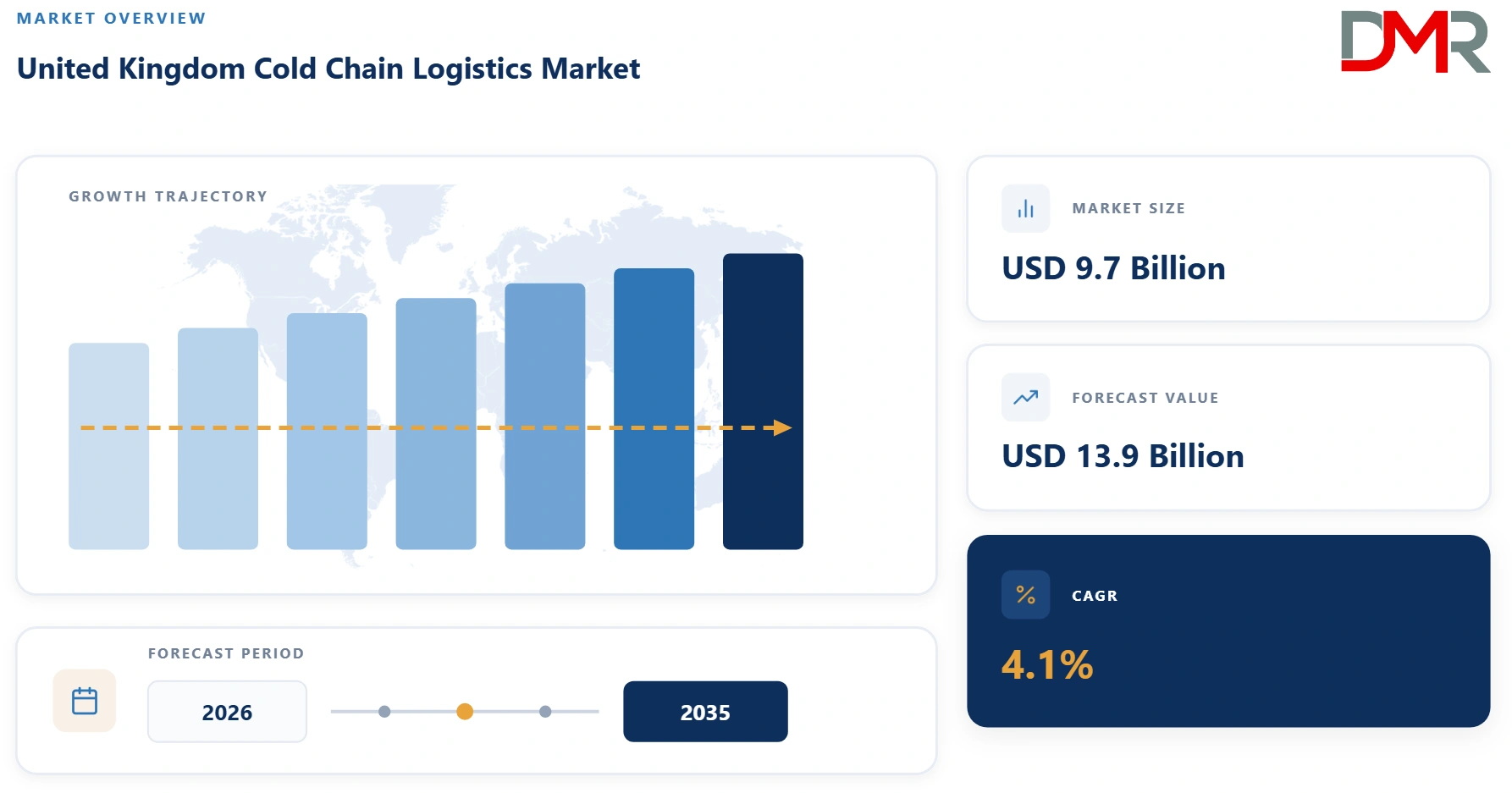
The United Kingdom Cold Chain Logistics Market is projected to reach USD 9.7 billion in 2026 and grow at a compound annual growth rate of 4.1% until 2035 to reach a value of USD 13.9 billion.
ℹ
To learn more about this report –
Download Your Free Sample Report Here
Cold chain logistics encompasses temperature-controlled warehousing, transportation, packaging, monitoring, and handling solutions used to preserve perishable and temperature-sensitive products. In the United Kingdom, the industry supports meat, seafood, dairy products, fruits, vegetables, alternative proteins, pharmaceuticals, retail, and foodservice supply chains. Growth is supported by grocery retailing, food imports, online delivery, automation, stricter food-safety requirements, and expanding demand for traceable chilled and frozen distribution.
Use Cases
- Frozen-food warehousing and distribution: Cold chain providers store frozen meat, seafood, prepared meals, bakery products, and desserts under controlled conditions before distributing them to supermarkets, wholesalers, restaurants, and foodservice companies. Automated storage systems, inventory management platforms, blast-freezing facilities, and refrigerated vehicles help operators preserve product quality, maintain stock rotation, reduce spoilage, and fulfil time-sensitive orders across the United Kingdom.
- Chilled fresh-food supply chains: Farmers, processors, importers, and retailers use chilled logistics for fruits, vegetables, dairy products, fresh meat, seafood, and ready-to-eat foods. Temperature-controlled consolidation centres allow different products to be combined into retail-ready deliveries. Continuous temperature monitoring, rapid cross-docking, route planning, and insulated packaging help preserve freshness, extend shelf life, comply with food-safety standards, and reduce waste.
- Alternative-protein distribution: Manufacturers of plant-based meat, dairy alternatives, fermentation-derived proteins, and other novel foods require controlled temperatures to protect texture, flavour, nutritional value, and microbiological safety. Cold chain providers offer chilled and frozen storage, insulated packaging, last-mile delivery, inventory visibility, and quality documentation. These services support distribution through supermarkets, foodservice operators, direct-to-consumer platforms, specialist retailers, and product-development facilities.
Key Takeaways
- Market Size: The United Kingdom Cold Chain Logistics Market is anticipated to be valued at USD 9.7 billion in 2026 and is forecast to reach USD 13.9 billion by 2035, expanding at a CAGR of 4.1%.
- Growth Rate and Outlook: Market expansion is supported by demand for frozen and chilled food, food-import dependence, supermarket distribution, online grocery orders, meal-delivery services, temperature-monitoring requirements, automated cold-storage investment, alternative proteins, and the need to reduce spoilage across increasingly complex supply chains.
- Primary Growth Drivers: Increasing consumption of perishable foods, expanding retail and foodservice networks, growing demand for next-day distribution, stringent food-safety requirements, investment in automated warehouses, rising energy-efficiency initiatives, and greater demand for real-time shipment visibility are encouraging logistics providers to expand temperature-controlled capacity.
- By Service Type Analysis: Refrigerated Warehouse is projected to lead with 52.0% of market revenue in 2026. The segment benefits from the United Kingdom’s imported-food requirements, supermarket inventory systems, frozen-food consumption, seasonal stock management, and increasing investment in automated high-bay facilities. Refrigerated Transportation is expected to record the highest CAGR of approximately 4.4% through 2035.
- By Application Analysis: Meat is anticipated to dominate with a 27.8% share in 2026, supported by strict temperature requirements across processing, storage, wholesale, retail, and foodservice distribution. Alternative Protein is expected to record the highest CAGR of approximately 5.3%, driven by product innovation and expanding chilled and frozen plant-based food portfolios.
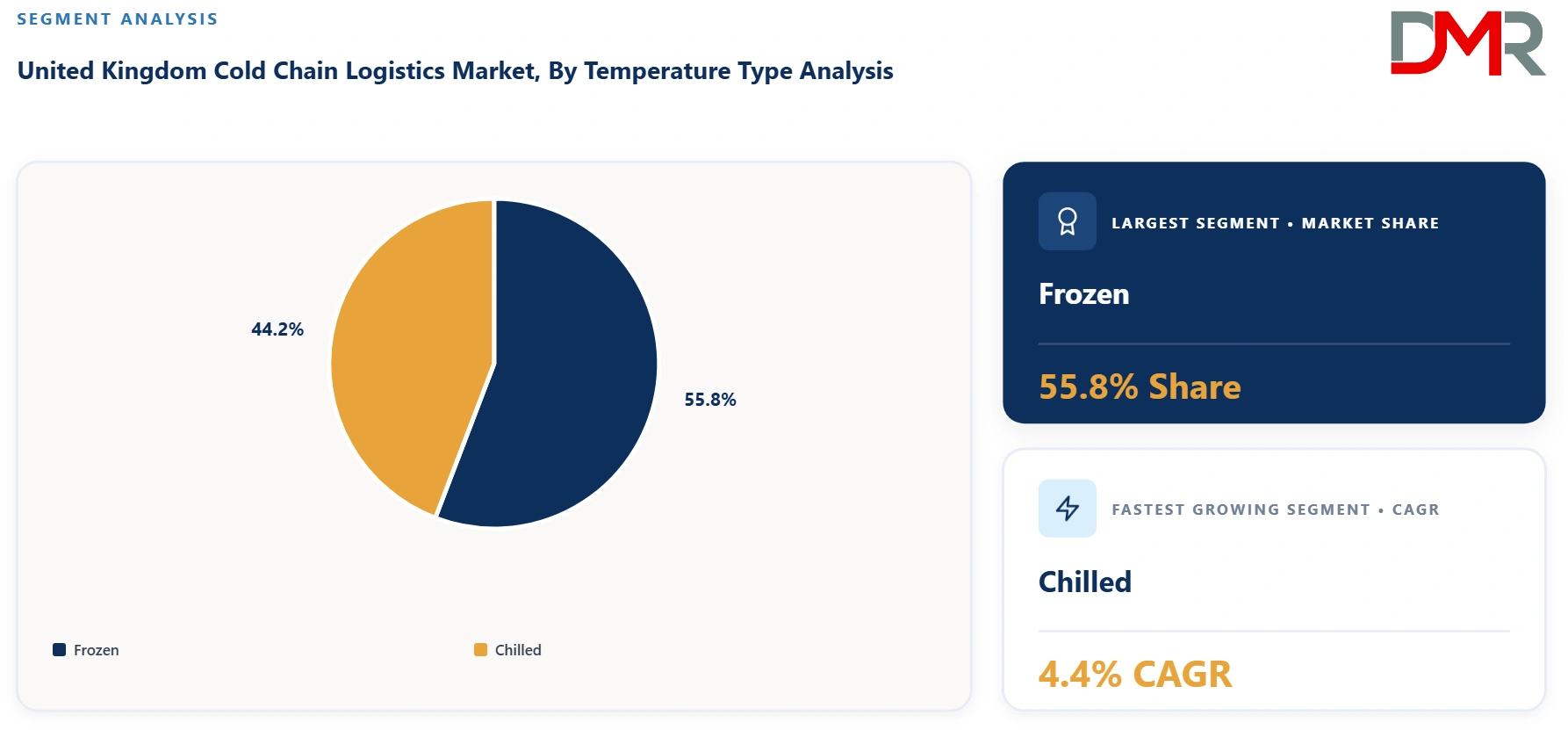
- By Temperature Type Analysis: Frozen is projected to lead with 55.8% of market revenue in 2026 due to demand for frozen meat, seafood, prepared foods, desserts, vegetables, and bakery products. Chilled is expected to expand at the highest CAGR of approximately 4.4%, supported by fresh-food retailing and short-shelf-life distribution.
- By Technology Analysis: Gel Packs are anticipated to account for 31.5% of the market in 2026, supported by their affordability, reusability, handling convenience, and suitability for short-distance deliveries. Liquid Nitrogen is expected to register the highest CAGR of approximately 5.0%, driven by rapid freezing and specialised ultra-cold applications.
How AI and Generative AI are Transforming the United Kingdom Cold Chain Logistics Market?
Artificial intelligence is improving demand forecasting, route optimisation, energy management, inventory allocation, and equipment maintenance across UK cold chains. Machine-learning systems analyse weather, traffic, order histories, temperature readings, and equipment data to predict demand and prevent spoilage. Computer vision supports pallet inspection and automated warehouse operations, while digital twins model facility performance. Generative AI assists operators with shipment documentation, maintenance guidance, compliance reporting, and customer communication. Adoption remains dependent on reliable sensor data, system integration, cybersecurity, workforce skills, and cooperation among producers, logistics companies, and retailers.
Key Drivers in the United Kingdom Cold Chain Logistics Market
Expanding Demand for Temperature-Controlled Food Distribution
Growth in frozen foods, chilled convenience products, dairy, meat, seafood, fresh produce, and home-delivered groceries is increasing demand for temperature-controlled logistics. The Cold Chain Federation represents approximately 270 members operating more than 450 specialist storage facilities and over 40,000 refrigerated vehicles and trailers. This extensive infrastructure demonstrates the cold chain’s importance to national food distribution. Retailers require frequent, accurately timed deliveries, while manufacturers need storage flexibility and dependable access to supermarkets, wholesalers, foodservice businesses, and ports. Growing product diversity is also encouraging multi-temperature warehouses, consolidated transportation, cross-docking, and specialised packaging services.
Investment in Automation, Visibility, and Supply-Chain Resilience
Cold chain operators are investing in automated storage and retrieval systems, warehouse-management software, temperature sensors, telematics, route optimisation, and energy-management platforms. These technologies increase pallet density, reduce manual handling in low-temperature environments, and provide traceability from warehouses to delivery destinations. The country’s dependence on imported chilled and frozen food also creates demand for larger safety stocks and efficient port-connected infrastructure. Operators increasingly require real-time alerts for temperature deviations, refrigeration failures, delays, and power disruptions. Modern facilities with renewable energy, efficient insulation, automated cranes, and predictive maintenance are therefore becoming strategically important for continuity and cost control.
Restraints in the United Kingdom Cold Chain Logistics Market
High Energy, Construction, and Operating Costs
Cold warehouses require continuous electricity for refrigeration, ventilation, lighting, monitoring, and automated handling systems. Refrigerated transportation also faces fuel, equipment, maintenance, insurance, and driver expenses. Energy-price volatility can materially affect operating margins, particularly for independent providers working under long-term customer contracts. Constructing modern cold-storage facilities requires specialised insulation, refrigeration systems, fire protection, backup power, automation, and compliance infrastructure, resulting in substantial capital requirements. Grid-connection delays can further postpone new projects and renewable-energy installations. These cost pressures may encourage consolidation, raise customer prices, delay capacity additions, and limit the ability of smaller companies to adopt energy-efficient technologies.
Infrastructure Vulnerability and Workforce Constraints
The cold chain depends on uninterrupted electricity, secure digital systems, road access, qualified refrigeration engineers, warehouse employees, and heavy-goods vehicle drivers. Extreme heat, flooding, cyberattacks, port delays, equipment failures, and electricity interruptions can compromise stored products and disrupt supermarket deliveries. Cold stores may operate at temperatures down to minus 25 degrees Celsius, while some specialised products require considerably colder environments. An ageing facility base can struggle during unusually hot conditions, increasing refrigeration loads and maintenance requirements. Labour shortages and the demanding nature of work in refrigerated environments also increase recruitment, training, retention, and automation pressures.
Growth Opportunities in the United Kingdom Cold Chain Logistics Market
Automated and Energy-Efficient Cold-Storage Development
High-bay automated warehouses offer opportunities to increase storage density, improve order accuracy, reduce land use, and limit employee exposure to freezing environments. Operators can combine automated cranes, intelligent monorails, warehouse-management systems, predictive maintenance, rooftop solar generation, heat recovery, and natural refrigerants to reduce energy intensity. Regional gaps in modern storage capacity create opportunities around ports, manufacturing clusters, supermarket distribution corridors, and underserved areas. New facilities can also generate additional revenue through blast freezing, tempering, repacking, labelling, customs support, order picking, and import-export services. Developers providing flexible multi-temperature space can serve a wider range of food manufacturers and retailers.
Alternative Proteins and Specialised Last-Mile Services
The expanding availability of plant-based meat, dairy alternatives, fermented foods, and other novel protein products creates opportunities for specialised chilled and frozen logistics. Many alternative-protein products require stable temperatures to maintain texture, taste, appearance, and shelf life. Logistics providers can offer smaller shipment sizes, flexible storage, direct-to-consumer fulfilment, insulated packaging, returns management, and real-time condition monitoring for emerging brands. Similar capabilities can serve meal-kit companies, premium food sellers, independent retailers, restaurants, and online grocery platforms. Providers that integrate warehousing, packaging, inventory management, transport, and delivery confirmation can capture demand from businesses seeking scalable distribution without building dedicated cold-chain infrastructure.
Trends in the United Kingdom Cold Chain Logistics Market
Adoption of Natural Refrigerants and Lower-Carbon Operations
Cold chain companies are adopting ammonia, carbon dioxide, energy-efficient compressors, improved insulation, solar power, electric vehicles, and intelligent energy-management systems to reduce emissions and operating costs. UK restrictions on certain high-global-warming-potential fluorinated gases are increasing pressure to modernise refrigeration equipment and evaluate lower-impact alternatives. Customers are also requesting emissions information from logistics partners as they work toward supply-chain sustainability targets. However, equipment costs, technical complexity, safety considerations, and shortages of appropriately trained engineers can slow adoption. Operators capable of combining refrigeration upgrades with automation and renewable energy can improve regulatory readiness and strengthen long-term cost competitiveness.
Expansion of Real-Time Monitoring and Data-Led Logistics
Internet-connected temperature sensors, telematics, cloud-based control towers, and electronic proof-of-delivery systems are becoming increasingly important. These technologies allow operators and customers to monitor cargo temperature, humidity, vehicle location, door openings, fuel use, and refrigeration-unit performance. Automated alerts help teams intervene before a temperature deviation causes product loss. Data platforms also improve route planning, capacity allocation, inventory rotation, regulatory reporting, and customer communication. Demand is shifting from basic transportation toward integrated services that provide condition visibility and performance analytics. Cybersecurity, data standardisation, interoperability, and supplier participation remain essential challenges as operators connect warehouses, vehicles, packaging systems, retailers, and manufacturing sites.
Research Scope and Analysis
The United Kingdom cold chain logistics market is analysed by service type covering refrigerated warehouse and refrigerated transportation, by application covering seafood, meat, fruit and vegetable, dairy products, alternative protein and others, by temperature type covering frozen and chilled, by technology covering dry ice, gel packs, eutectic plates, liquid nitrogen and quilts across the forecast period.
ℹ
To learn more about this report –
Download Your Free Sample Report Here
By Service Type Analysis
Refrigerated Warehouse is projected to hold the highest market share of 52.0% in 2026, supported by frozen-food inventories, imports, retail consolidation, and growing automated storage capacity. Refrigerated Transportation is expected to record the highest CAGR of approximately 4.4% through 2035, driven by frequent supermarket replenishment, fresh-food distribution, online grocery delivery, and growing demand for shipment visibility.
By Application Analysis
Meat is anticipated to account for the highest market share of 27.8% in 2026, owing to strict handling requirements throughout processing, storage, retail, and foodservice distribution. Alternative Protein is projected to register the highest CAGR of approximately 5.3% through 2035, supported by plant-based product development, supermarket availability, foodservice adoption, and specialised chilled and frozen distribution requirements.
By Temperature Type Analysis
Frozen is expected to dominate with a 55.8% share in 2026, supported by demand for frozen meat, seafood, vegetables, desserts, bakery products, and prepared meals. Chilled is projected to record the highest CAGR of approximately 4.4% through 2035, driven by fresh produce, dairy products, short-shelf-life foods, premium convenience meals, and temperature-sensitive last-mile deliveries.
By Technology Analysis
Gel Packs are projected to lead with a 31.5% share in 2026 due to their affordability, portability, reusability, and suitability for short-duration distribution. Liquid Nitrogen is expected to achieve the highest CAGR of approximately 5.0% through 2035, supported by rapid freezing, specialist food-processing requirements, ultra-low-temperature applications, and growing demand for high-performance temperature-control solutions.
The United Kingdom Cold Chain Logistics Market Report is Segmented Based on the Following
By Service Type
- Refrigerated Warehouse
- Refrigerated Transportation
By Application
- Seafood
- Meat
- Fruit and Vegetable
- Dairy Products
- Alternative Protein
- Others
By Temperature Type
By Technology
- Dry Ice
- Gel Packs
- Eutectic Plates
- Liquid Nitrogen
- Quilts
Regulatory Landscape
The United Kingdom cold chain operates under food hygiene, product safety, transport, environmental, refrigerant, customs, and workplace regulations. Operators must maintain appropriate temperatures, document controls, prevent contamination, and demonstrate traceability across storage and transportation. Rules governing fluorinated greenhouse gases are influencing refrigeration-equipment selection, servicing, leak checking, and technician qualifications. Border procedures following the United Kingdom’s departure from the European Union also affect imported food documentation and inspection requirements. Regulatory compliance creates opportunities for monitoring platforms, validated packaging, low-global-warming-potential refrigerants, and specialised advisory services. However, equipment replacement costs, administrative complexity, changing import controls, and differences between domestic and European requirements can increase operational risks and delay cross-border shipments.
Technology Analysis
Automation, sensors, artificial intelligence, telematics, robotics, and cloud platforms are reshaping UK cold chain operations. Automated storage and retrieval systems increase pallet density and reduce labour requirements inside frozen warehouses. Internet-connected sensors provide continuous condition monitoring, while predictive analytics identify potential equipment failures and optimise refrigeration loads. Route-planning software reduces delivery time, fuel consumption, and empty mileage. Digital twins can test changes to warehouse layouts and energy systems before investment. Opportunities are emerging for interoperable control towers connecting manufacturers, logistics providers, retailers, and packaging suppliers. Major risks include cyberattacks, poor data quality, system-integration costs, dependence on connectivity, and limited digital capabilities among smaller supply-chain participants.
Competitive Landscape
The United Kingdom Cold Chain Logistics Market includes international logistics groups, automated cold-storage specialists, national food-distribution companies, regional refrigerated carriers, and packaging-technology providers. Competition is based on warehouse capacity, geographic coverage, temperature range, delivery reliability, energy efficiency, digital visibility, regulatory compliance, and value-added services. Leading operators are expanding automated pallet capacity and integrated warehousing-transportation networks. Smaller providers compete through regional expertise, flexible service, specialist products, and customer relationships. High construction and energy costs encourage partnerships, long-term contracts, acquisitions, and consolidation, while sustainability and real-time monitoring increasingly influence customer selection.
Some of the Prominent Players in the United Kingdom Cold Chain Logistics Market Are
- Lineage Logistics
- Americold Logistics
- NewCold
- Magnavale
- Culina Group
- Culina Logistics
- Fowler Welch
- CML Fulfilment and Logistics
- Reed Boardall
- DFDS
- GXO Logistics
- DHL Supply Chain
- Kuehne and Nagel
- DSV
- CEVA Logistics
- Maersk Logistics
- UPS Healthcare
- FedEx Logistics
- Wincanton
- Turners Soham
- Buffaload Logistics
- FreshLinc
- Nagel Langdons
- Oakland International
- ACS and T Logistics
- Rick Bestwick
- McCulla Ireland
- Hannon Transport
- Pulleyn Transport
- Moran Logistics
- NFT Distribution
- Knowles Transport
- Yearsley Logistics
- Norish
- Gist Limited
- HSF Logistics
- Eurofresh Logistics
- Peter Green Chilled
- Cold Move
- R Swain and Sons
- Other Key Players
Recent Developments
- In April 2026, Magnavale appointed Swisslog as the automation partner for its Bristol cold-storage facility. The development is planned to provide 90,000 fully automated frozen pallet positions near the M4 and M5 motorway junction, addressing capacity requirements across Southwest England and South Wales.
- In October 2025, Magnavale commenced construction of its Bristol automated frozen cold store. The strategically located facility will offer storage, blast freezing, packing, labelling, and import-export support, strengthening integrated food logistics services in an underserved regional market.
- In June 2025, NewCold officially launched its Corby 3 expansion, adding more than 33,000 pallet positions and increasing capacity across its three UK facilities to more than 185,000 pallet positions. The project strengthened automated storage capacity for the frozen-food industry.
Report Details
| Report Characteristics |
| Market Size (2026) |
USD 9.7 Bn |
| Forecast Value (2035) |
USD 13.9 Bn |
| CAGR (2026–2035) |
4.1% |
| Historical Data |
2021 – 2025 |
| Forecast Data |
2026 – 2035 |
| Base Year |
2025 |
| Segments Covered |
By Service Type, By Application, By Temperature Type, By Technology |
Frequently Asked Questions
How big is the United Kingdom Cold Chain Logistics Market?
▾ The United Kingdom Cold Chain Logistics Market is projected to be valued at USD 9.7 billion in 2026 and reach USD 13.9 billion by 2035.
What is the CAGR of the United Kingdom Cold Chain Logistics Market from 2026 to 2035?
▾ The market is expected to expand at a compound annual growth rate of 4.1% from 2026 to 2035.
What factors are driving the growth of the United Kingdom Cold Chain Logistics Market?
▾ Growth is driven by frozen and chilled food consumption, supermarket distribution, food imports, online grocery delivery, warehouse automation, traceability requirements, alternative proteins, and investment in energy-efficient temperature-controlled infrastructure.
What are the major trends in the United Kingdom Cold Chain Logistics Market?
▾ Major trends include automated high-bay warehouses, natural refrigerants, real-time temperature monitoring, AI-based forecasting, predictive maintenance, electric refrigerated vehicles, renewable energy, and integrated warehousing and transportation services.
Who are the key players in the United Kingdom Cold Chain Logistics Market?
▾ Key players include Lineage Logistics, Americold Logistics, NewCold, Magnavale, Culina Group, Fowler Welch, Reed Boardall, DFDS, GXO Logistics, DHL Supply Chain, Kuehne and Nagel, DSV, and Wincanton.
How is the United Kingdom Cold Chain Logistics Market segmented?
▾ The market is segmented by Service Type into Refrigerated Warehouse and Refrigerated Transportation, by Application, by Temperature Type into Frozen and Chilled, and by Technology into Dry Ice, Gel Packs, Eutectic Plates, Liquid Nitrogen, and Quilts.