United Kingdom Food Packaging Market Snapshot
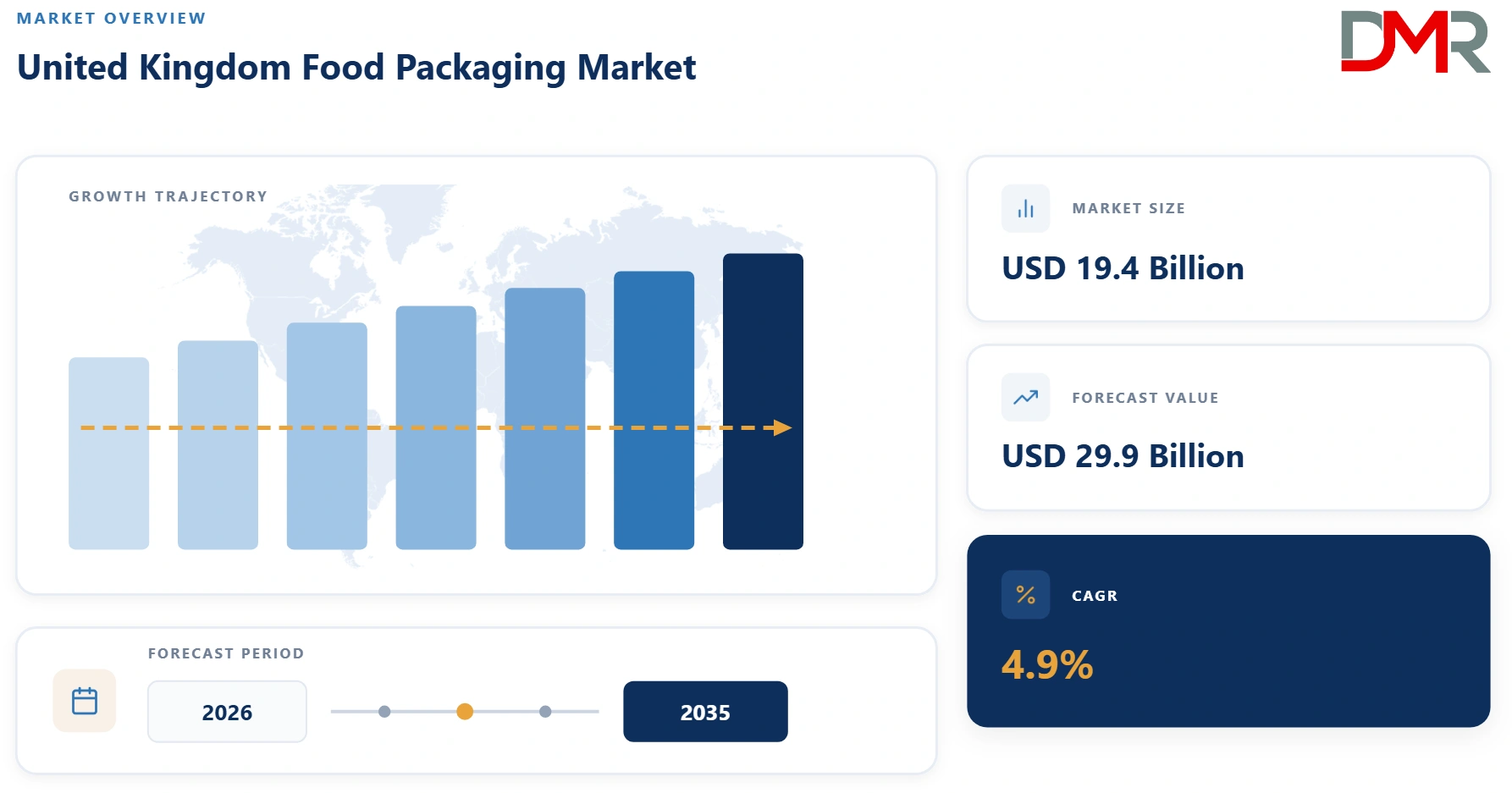
- United Kingdom Food Packaging Market Size in 2026: USD 19.4 Billion
- United Kingdom Food Packaging Market Size in 2035: USD 29.9 Billion
- United Kingdom CAGR from 2026 to 2035: 4.9%
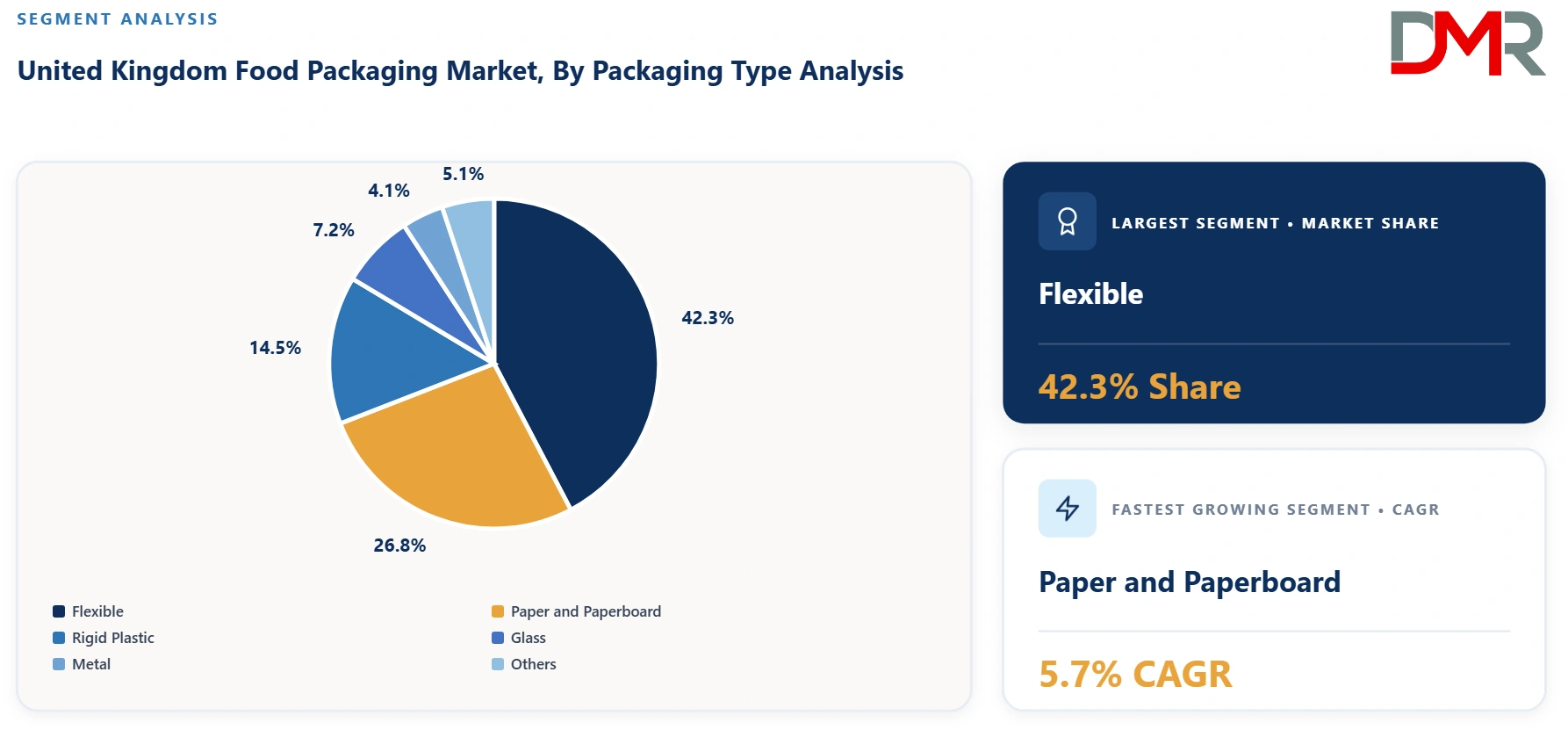
- Flexible is the leading packaging type segment in 2026: 42.3%
- Meat, Fish, and Poultry is the leading application segment in 2026: 24.8%
What is the United Kingdom Food Packaging Market and Its Market Size?
The United Kingdom Food Packaging Market is projected to reach USD 19.4 billion in 2026 and grow at a compound annual growth rate of 4.9% through 2035 to reach USD 29.9 billion.
ℹ
To learn more about this report –
Download Your Free Sample Report Here
The market comprises flexible films, paperboard cartons, rigid plastic containers, glass packaging, metal cans, trays, pouches, wraps, bottles, and other formats used to protect and distribute food products. Growth is supported by convenience-food consumption, grocery retail, online food delivery, sustainability requirements, private-label expansion, and demand for longer shelf life. Manufacturers are developing recyclable mono-materials, fibre-based alternatives, lightweight containers, active barriers, resealable formats, and digitally enabled packaging. However, raw-material volatility, recycling limitations, Extended Producer Responsibility fees, plastic taxation, food-contact compliance, and pressure to reduce unnecessary material create operational challenges for converters and food manufacturers.
Use Cases
- Fresh and Processed Meat Protection: Food packaging provides oxygen, moisture, microbial, and contamination barriers for fresh meat, poultry, fish, and processed products. Vacuum packs, modified-atmosphere trays, skin packaging, absorbent pads, and high-barrier films preserve colour, texture, and freshness. These solutions extend refrigerated shelf life, strengthen cold-chain performance, reduce retail food waste, and provide tamper evidence and product information.
- Convenience and Ready-Meal Packaging: Trays, pouches, lidding films, cartons, and microwave-compatible containers support the expanding consumption of chilled, frozen, prepared, and ready-to-eat meals. Packaging enables portion control, reheating convenience, transport safety, and longer shelf life while offering strong retail visibility. Resealable and compartmentalized designs address smaller households, workplace dining, delivery services, and consumer demand for quick meal preparation.
- Bakery and Confectionery Preservation: Flexible films, flow wraps, cartons, trays, and paper-based formats protect bread, cakes, biscuits, chocolate, pasta, and noodles from moisture, oxygen, breakage, and contamination. High-quality printing supports differentiation, nutritional communication, and seasonal promotions. Recyclable mono-material films and barrier-coated papers are gaining adoption as brands seek to preserve freshness while reducing plastic intensity and improving recyclability.
- Fresh Produce Distribution: Punnets, trays, bags, wraps, corrugated cases, and breathable films protect fruits and vegetables during handling, transportation, retail display, and household storage. Ventilation, moisture control, cushioning, and modified-atmosphere technologies help reduce bruising, dehydration, and premature spoilage. Fibre-based trays, recyclable films, lightweight structures, and returnable transport packaging support sustainability commitments across grocery and fresh-produce supply chains.
Key Takeaways
- Market Size: The United Kingdom Food Packaging Market is anticipated to be valued at USD 19.4 billion in 2026 and is forecast to reach USD 29.9 billion by 2035, expanding at a CAGR of 4.9%.
- Growth Rate and Outlook: Market expansion is supported by convenience-food consumption, online grocery services, food delivery, changing household structures, private-label products, sustainability regulations, premiumization, and rising demand for lightweight, recyclable, resealable, portion-controlled, and shelf-life-extending packaging.
- Primary Growth Drivers: Growth is being driven by demand for packaged foods, strict food-safety requirements, expanding chilled and frozen categories, supermarket innovation, food-waste reduction initiatives, recyclable-material adoption, smart packaging, modified-atmosphere technology, and investment in efficient packaging machinery.
- By Packaging Type Analysis: Flexible packaging is projected to lead with a 42.3% share in 2026, supported by its low weight, material efficiency, printability, barrier performance, and suitability for snacks, bakery goods, meat, frozen foods, sauces, and convenience products. Paper and Paperboard is expected to record the fastest CAGR of approximately 5.7%.
- By Application Analysis: Meat, Fish, and Poultry is expected to dominate with a 24.8% share in 2026, owing to stringent hygiene, shelf-life, cold-chain, and contamination-control requirements. Convenience Foods is forecast to expand at the fastest CAGR of approximately 5.6%, driven by prepared meals, smaller households, and food delivery.
How AI and Generative AI Are Transforming the United Kingdom Food Packaging Market
Artificial intelligence is improving packaging design, production control, quality inspection, and supply-chain planning across the United Kingdom. Computer-vision systems identify printing defects, seal failures, contamination, incorrect labels, and damaged containers at production speed. Predictive analytics reduces machinery downtime, material waste, and energy consumption. Generative AI enables converters to develop optimized pack structures, artwork concepts, and lightweight designs more rapidly. AI-supported demand forecasting improves inventory and procurement decisions, while intelligent sensors provide freshness and temperature insights. These capabilities help manufacturers strengthen food safety, accelerate innovation, manage regulatory documentation, improve recyclability, and personalize packaging for different retailers and consumer groups.
Key Drivers in the United Kingdom Food Packaging Market
Expansion of Convenience Foods and Modern Consumption Patterns
Demand for ready meals, snacks, prepared ingredients, frozen products, meal kits, and food-to-go formats is increasing the requirement for durable and convenient packaging. Smaller households, hybrid working, urban lifestyles, and limited meal-preparation time support demand for portion-controlled, microwaveable, resealable, lightweight, and easy-open packs. Retailers are also expanding private-label chilled and prepared-food ranges, encouraging suppliers to develop differentiated trays, films, pouches, and cartons. Packaging must combine convenience with food safety, barrier performance, attractive presentation, accurate labeling, and reduced environmental impact, creating sustained opportunities for innovative converters and material suppliers.
Sustainability Commitments and Food-Waste Reduction
Government regulation, retailer commitments, and consumer scrutiny are accelerating the transition toward recyclable, reusable, fibre-based, and recycled-content packaging. WRAP reported that UK Plastics Pact initiatives had removed approximately 33 billion problematic plastic items since 2018 and reduced total plastic packaging placed on the market by 7% by 2023–2024. Packaging suppliers are therefore investing in mono-material films, lightweight containers, paper-based barriers, recycled polymers, and design-for-recycling capabilities. These developments support circularity while maintaining shelf life, product protection, print quality, transport efficiency, and compliance with food-contact requirements.
Restraints in the United Kingdom Food Packaging Market
High Compliance and Material Transition Costs
Packaging producers face rising expenses associated with Extended Producer Responsibility, recyclability assessments, data reporting, recycled-content verification, packaging redesign, and food-contact testing. For 2025–2026, UK EPR base fees were set at £423 per tonne for plastic, compared with £196 for paper and card, £192 for glass, and £259 for steel. These costs can affect material selection, product pricing, supplier negotiations, and margins, especially for smaller converters and food manufacturers. Transitioning established packaging lines to alternative substrates may also require machinery upgrades, testing, certification, and supply-chain adjustments.
Performance and Recycling Infrastructure Limitations
Replacing multi-layer plastic structures remains technically difficult where food products require strong oxygen, moisture, grease, aroma, light, or puncture protection. Paper and mono-material alternatives may not always provide equivalent shelf life, sealing performance, processing speed, or temperature resistance. Flexible plastic packaging presents a particular challenge because collection and sorting systems remain less developed than those for bottles, metal, glass, or paper. WRAP reported that flexible plastic represents more than 27% of UK consumer plastic packaging, while only about 7% was being recycled. Weak recovery economics and inconsistent local collection can limit circularity claims.
Growth Opportunities in the United Kingdom Food Packaging Market
Development of Fibre-Based and Mono-Material Packaging
Growing regulatory and retail pressure creates considerable opportunity for recyclable paper, paperboard, moulded fibre, polyethylene, and polypropylene mono-material solutions. Suppliers can replace difficult-to-recycle laminates, black plastic trays, mixed-material packs, and excessive secondary packaging without reducing product protection. Barrier coatings, dispersion technologies, improved sealing layers, and advanced fibre forming are expanding the range of food products suitable for alternative materials. Companies that combine recyclability with grease resistance, moisture control, printability, microwave performance, and compatibility with existing filling lines can secure partnerships across bakery, confectionery, produce, dairy, chilled foods, and convenience meals.
Smart, Active, and Shelf-Life-Extending Solutions
Food waste reduction presents opportunities for modified-atmosphere packaging, antimicrobial films, freshness indicators, oxygen scavengers, moisture absorbers, temperature-monitoring labels, and digitally connected traceability systems. These technologies help retailers and food manufacturers extend usable shelf life, improve stock rotation, identify cold-chain disruptions, and provide clearer information to consumers. QR codes and connected labels can communicate origin, recycling instructions, allergens, authenticity, and preparation guidance without overcrowding printed packaging. Suppliers offering affordable, scalable, and regulation-compliant smart solutions can differentiate their products while helping customers reduce waste, manage recalls, improve transparency, and meet sustainability targets.
Trends in the United Kingdom Food Packaging Market
Shift Toward Recyclable Paper and Reduced-Plastic Structures
Food brands are increasingly adopting paper wraps, fibre trays, paperboard cartons, hybrid structures, and lightweight mono-material films. Innovation is focused on maintaining barrier protection while reducing fossil-plastic content and enabling collection through established recycling streams. Paper solutions are gaining visibility in confectionery, bakery, produce, snacks, cereals, and food-to-go categories. Nevertheless, life-cycle performance, coating composition, food contamination, product damage, and material weight remain important considerations. The strongest solutions balance recyclability, resource efficiency, food preservation, production compatibility, and consumer convenience rather than replacing plastic without evaluating total environmental impact.
Greater Use of Recycled Content and Design for Recycling
Recycled polymers and simplified packaging structures are becoming central to supplier and retailer strategies. The UK Plastics Pact’s 2024–2025 progress report indicated that 71.6% of plastic packaging was reusable or recyclable and average recycled content had reached 28% among reporting members. Brand owners are consequently increasing post-consumer recycled content, removing pigments and incompatible layers, reducing pack weight, and using clearer disposal instructions. Food-grade recycled polymer availability remains a constraint, but investment in closed-loop PET, advanced sorting, washing, decontamination, and traceability is expected to increase usable supply.
Research Scope and Analysis
The research examines United Kingdom food packaging across packaging type and application, packaging type includes flexible, paper and paperboard, rigid plastic, glass, metal, others, application includes bakery confectionery pasta and noodles, dairy products, sauces dressings and condiments, snacks and side dishes, convenience foods, meat fish and poultry, fruits and vegetables, others, with forecasts through 2035 included.
ℹ
To learn more about this report –
Download Your Free Sample Report Here
By Packaging Type Analysis
Flexible packaging is projected to hold the highest share of 42.3% in 2026, owing to its lightweight construction, strong barrier properties, material efficiency, printability, and compatibility with numerous food categories. It is widely used for bakery products, snacks, frozen foods, sauces, cheese, meat, and confectionery. Paper and Paperboard is expected to register the highest CAGR of approximately 5.7%, driven by recyclable and fibre-based alternatives.
By Application Analysis
Meat, Fish, and Poultry is anticipated to account for the highest share of 24.8% in 2026, supported by strict hygiene requirements and extensive use of vacuum packaging, skin packs, modified-atmosphere trays, absorbent materials, and barrier films. Convenience Foods is projected to record the highest CAGR of approximately 5.6%, due to increasing consumption of chilled meals, prepared foods, meal kits, and food-to-go products.
The United Kingdom Food Packaging Market Report Is Segmented Based on the Following
By Packaging Type
- Flexible
- Paper and Paperboard
- Rigid Plastic
- Glass
- Metal
- Others
By Application
- Bakery, Confectionery, Pasta, and Noodles
- Dairy Products
- Sauces, Dressings, and Condiments
- Snacks and Side Dishes
- Convenience Foods
- Meat, Fish, and Poultry
- Fruits and Vegetables
- Others
Regulatory Landscape
The United Kingdom regulatory landscape is reshaping packaging design, reporting, procurement, and end-of-life responsibility. Extended Producer Responsibility requires qualifying organizations to report packaging data and contribute toward household packaging-waste management costs. From April 2026, the Plastic Packaging Tax increases to £228.82 per tonne for applicable plastic packaging containing less than the required recycled-plastic proportion. Food-contact materials must also satisfy safety, migration, hygiene, traceability, and labeling requirements. Modulated EPR fees are expected to reward more recyclable formats and increase costs for difficult-to-recycle structures. These rules create opportunities for recyclable materials, compliance services, recycled polymers, lightweight designs, and packaging-data platforms while raising transition costs and enforcement risks.
Technology Analysis
Technology development focuses on high-barrier mono-material films, recyclable coatings, moulded fibre, modified-atmosphere packaging, active materials, digital printing, robotics, machine vision, and connected labels. Advanced extrusion and coating methods help reduce multi-material laminates while preserving moisture, oxygen, aroma, and grease resistance. Digital printing supports shorter production runs, personalization, rapid artwork changes, and reduced inventory. Sensors and freshness indicators can improve cold-chain visibility and food-waste management, although unit cost and recycling compatibility constrain mass adoption. Artificial intelligence enables defect detection, predictive maintenance, lightweight design, and demand forecasting. Technology providers that combine sustainability, food safety, line efficiency, consumer convenience, and regulatory compliance are positioned to achieve strong commercial adoption.
Competitive Landscape
The United Kingdom Food Packaging Market is fragmented and highly competitive, comprising multinational packaging groups, specialized converters, glass and metal manufacturers, fibre-based packaging suppliers, machinery producers, and regional companies. Competition centers on recyclable materials, barrier performance, lightweighting, recycled content, printing quality, food safety, production efficiency, and customer-specific development. Leading players are expanding through acquisitions, capacity investments, collaborative innovation, and product launches. EPR fees and retailer sustainability commitments are encouraging companies to redesign portfolios around mono-material films, paperboard, moulded fibre, and closed-loop systems while maintaining shelf life and affordability.
Some of the Prominent Players in the United Kingdom Food Packaging Market Are
- Amcor plc
- Mondi plc
- International Paper Company
- DS Smith
- Smurfit Westrock
- Sealed Air Corporation
- Huhtamaki Oyj
- Sonoco Products Company
- Coveris
- Tetra Pak International SA
- Graphic Packaging International
- Berry Global Group
- Constantia Flexibles
- Ardagh Group
- Crown Holdings
- Ball Corporation
- Silgan Holdings
- Greiner Packaging
- ALPLA Group
- AptarGroup
- Pactiv Evergreen
- Klöckner Pentaplast
- Winpak
- UFlex Limited
- SIG Group
- ProAmpac
- Novolex
- Seda International Packaging Group
- Faerch Group
- Wipak Group
- Sirane Group
- Parkside Flexibles
- KM Packaging
- FFP Packaging Solutions
- Clifton Packaging Group
- Sharpak
- Celebration Packaging
- Colpac
- Robinson plc
- Macfarlane Group
- Other Key Players
Recent Developments
- November 2025: Mondi expanded its corrugated and solid-board food-packaging portfolio following its acquisition of Schumacher Packaging assets. The portfolio covers fresh produce, bakery products, beverages, meat, seafood, confectionery, and other food applications.
- September 2025: Coveris introduced MonoFlexBP, a resealable mono-material tray for refrigerated food. The solution replaces difficult-to-recycle mixed-material structures while maintaining shelf life, seal performance, and consumer convenience.
- September 2025: Coveris presented MonoFlexFibre Pure Max, a single-layer paper-based packaging material for cereals, protein bars, chocolate bars, and tablets, designed for recycling through established paper streams.
Report Details
| Report Characteristics |
| Market Size (2026) |
USD 19.4 Bn |
| Forecast Value (2035) |
USD 29.9 Bn |
| CAGR (2026–2035) |
4.9% |
| Historical Data |
2021 – 2025 |
| Forecast Data |
2026 – 2035 |
| Base Year |
2025 |
| Segments Covered |
By Packaging Type, By Application |
Frequently Asked Questions
How big is the United Kingdom Food Packaging Market?
▾ The United Kingdom Food Packaging Market is projected to reach USD 19.4 billion in 2026 and USD 29.9 billion by 2035.
What is the CAGR of the United Kingdom Food Packaging Market from 2026 to 2035?
▾ The market is expected to expand at a compound annual growth rate of 4.9% during the forecast period from 2026 to 2035.
What factors are driving the growth of the United Kingdom Food Packaging Market?
▾ Growth is driven by increasing consumption of convenience foods, food-to-go products, online grocery services, sustainable packaging, private-label foods, modified-atmosphere formats, recyclable materials, and shelf-life-extending technologies.
What are the major trends in the United Kingdom Food Packaging Market?
▾ Major trends include recyclable mono-material packaging, fibre-based alternatives, recycled content, lightweighting, smart labels, active packaging, digital printing, convenient formats, and packaging designed to reduce food waste.
Who are the key players in the United Kingdom Food Packaging Market?
▾ Major players include Amcor, Mondi, International Paper, DS Smith, Smurfit Westrock, Sealed Air, Huhtamaki, Sonoco, Coveris, Tetra Pak, Graphic Packaging International, and Constantia Flexibles.
How is the United Kingdom Food Packaging Market segmented?
▾ The market is segmented by packaging type into Flexible, Paper and Paperboard, Rigid Plastic, Glass, Metal, and Others. By application, it includes Bakery, Dairy Products, Sauces and Condiments, Snacks, Convenience Foods, Meat, Fish and Poultry, Fruits and Vegetables, and Others.