United States Contract Food Manufacturing Market Snapshot
- United States Contract Food Manufacturing Market Size in 2026: USD 68.4 Billion
- United States Contract Food Manufacturing Market Size in 2035: USD 118.9 Billion
- United States CAGR from 2026 to 2035: 6.3%
- Co-Packing/Co-Manufacturing is the leading service type segment in 2026: 47.2%
- Bakery and Snacks is the leading food category segment in 2026: 24.1%
- Emerging and Small Brands is the leading client type segment in 2026: 38.6%
- Standard Certified is the leading facility certification segment in 2026: 52.3%
What is the United States Contract Food Manufacturing Market and its Market Size?
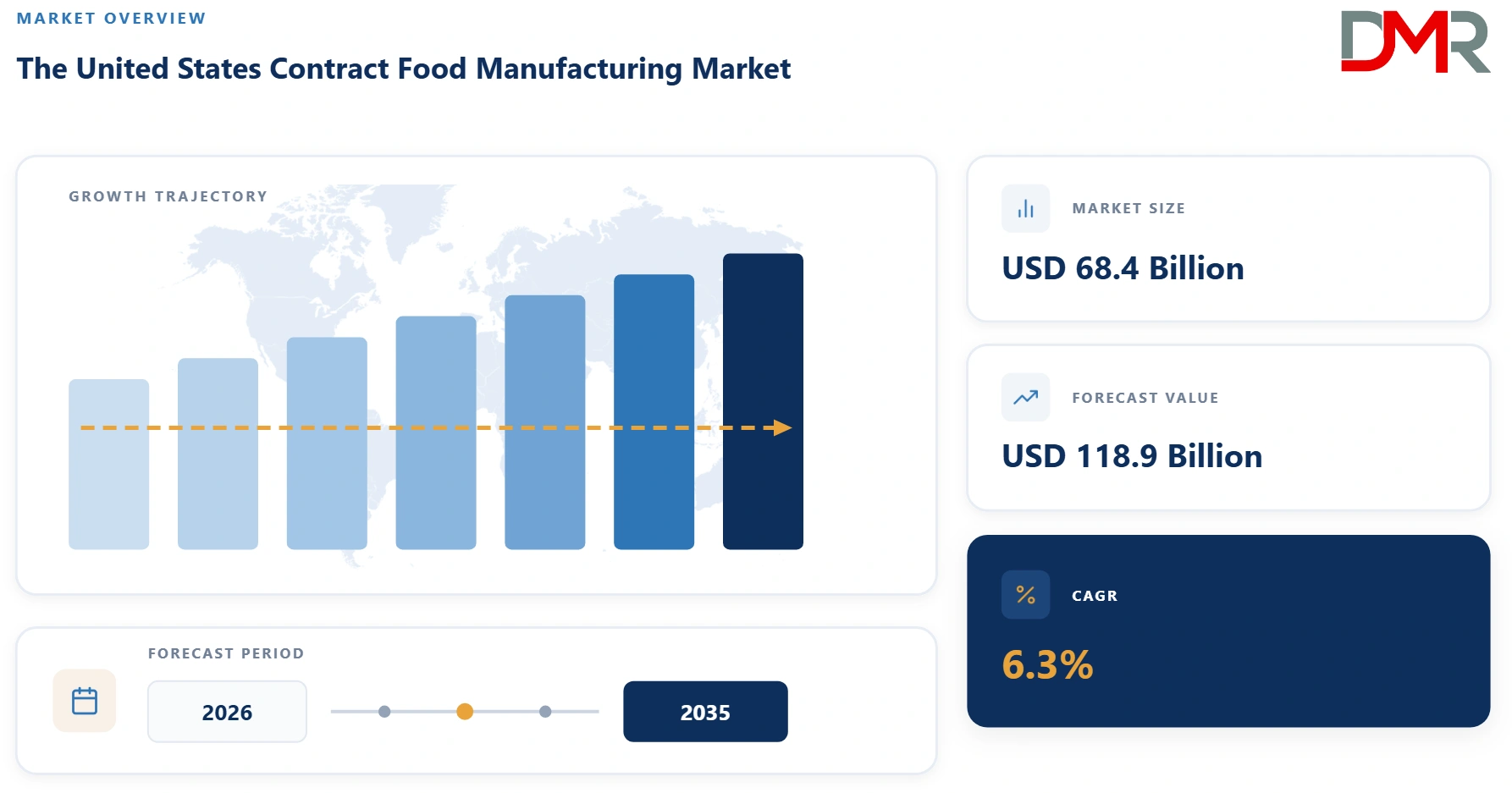
The United States Contract Food Manufacturing Market is projected to be valued at USD 68.4 Billion in 2026 and is projected to reach USD 118.9 Billion by 2035, expanding at a CAGR of 6.3% during the forecast period.
ℹ
To learn more about this report –
Download Your Free Sample Report Here
Growth is being propelled by the proliferation of emerging and challenger food and beverage brands that lack the capital to build proprietary production facilities, the growing willingness of established national brands to outsource overflow production and new product lines to preserve internal capital expenditure, and retailers' expanding private label programs that require flexible, scalable manufacturing partners. The maturing of contract manufacturers into full-service partners offering formulation, regulatory, packaging, and logistics support alongside production capacity, combined with rising consumer demand for clean-label, allergen-free, and functional food products that require specialized facility certifications, is reshaping the market from simple capacity-for-hire arrangements toward strategic, long-term co-manufacturing partnerships. Investment is accelerating as contract manufacturers modernize aging plants, add flexible small-batch lines, and pursue food-safety and specialty certifications that widen the range of clients they can serve.
Use Cases
- New Product Line Launches for Emerging Brands: Direct-to-consumer and emerging food and beverage brands contract co-manufacturers to produce initial and scaling production runs, avoiding the capital investment required to build dedicated facilities before demand is proven.
- Retailer Private Label Expansion: National and regional grocery retailers contract food manufacturers to produce store-brand snacks, beverages, and prepared foods, allowing retailers to expand private label assortments without owning manufacturing infrastructure.
- Overflow and Seasonal Production for Established Brands: Large branded food companies engage contract manufacturers to absorb seasonal demand spikes or new SKU production, preserving internal plant capacity for core, high-volume products.
- Specialty and Allergen-Free Product Manufacturing: Brands developing organic, gluten-free, or allergen-free products contract manufacturers with dedicated certified facilities, avoiding cross-contamination risk and the cost of building separate specialty production lines in-house.
Key Takeaways
- Market Size: The United States Contract Food Manufacturing Market is anticipated to be valued at USD 68.4 Billion in 2026 and is forecast to reach USD 118.9 Billion by 2035, expanding at a CAGR of 6.3%.
- Growth Outlook: Market expansion is sustained by continued proliferation of emerging food and beverage brands, retailers' expanding private label ambitions, and established brands' growing comfort outsourcing production to preserve capital for marketing and innovation.
- Primary Growth Drivers: Rising capital costs of building proprietary manufacturing facilities, growing consumer demand for clean-label and specialty-certified products, retailer private label expansion, and contract manufacturers' increasing ability to offer full-service formulation-to-distribution support are accelerating outsourcing adoption.
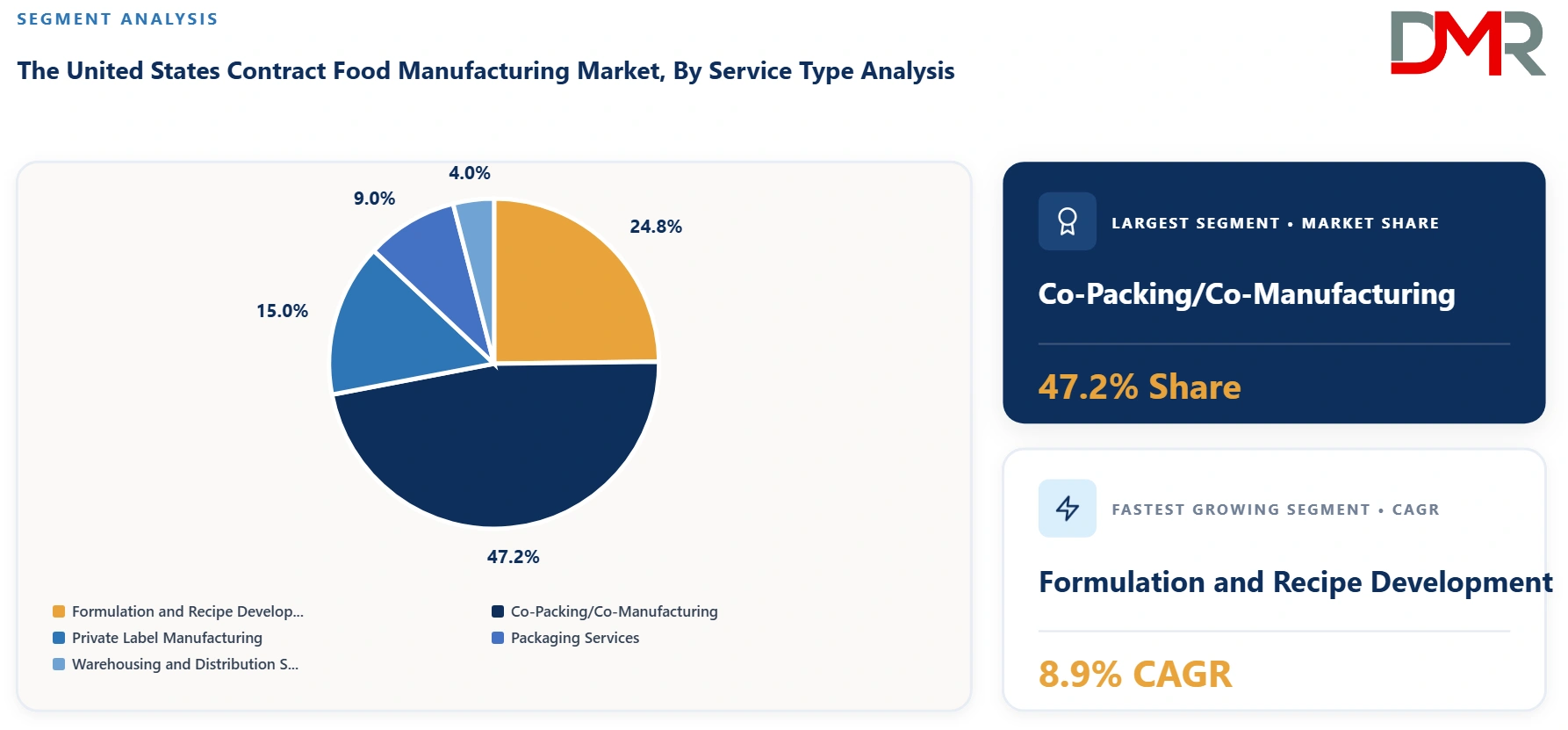
- By Service Type Analysis: Co-Packing/Co-Manufacturing is projected to lead the service segment with a 47.2% share in 2026, reflecting sustained demand for turnkey production capacity across brand sizes. Formulation and Recipe Development is the fastest-growing service segment at 8.9% CAGR, driven by brands seeking end-to-end product development support rather than production alone.
- By Food Category Analysis: Bakery and Snacks is expected to dominate with a 24.1% share in 2026, supported by high SKU turnover and strong private label demand. Nutritional and Dietary Supplements is the fastest-growing food category at 10.4% CAGR, driven by rising consumer interest in functional and fortified food products.
- By Client Type Analysis: Emerging and Small Brands are poised to lead with a 38.6% share in 2026, reflecting the large and growing population of challenger brands reliant on outsourced production. Retailer Private Label Programs is the fastest-growing client type segment at 9.1% CAGR, driven by continued grocery and mass-retail investment in store-brand assortments.
- By Facility Certification Analysis: Standard Certified facilities are expected to command a 52.3% share in 2026, reflecting the broad base of conventional food production demand. Allergen-Free/Free-From Certified is the fastest-growing certification segment at 11.2% CAGR, fuelled by rising demand for allergen-safe and clean-label products.
Key Drivers in the United States Contract Food Manufacturing Market
Rising Capital Costs Discouraging In-House Facility Investment
The escalating cost of building and operating compliant food manufacturing facilities is driving growth in the United States Contract Food Manufacturing Market. Equipment, real estate, food-safety compliance, and skilled labor costs have made proprietary production increasingly capital-intensive, particularly for early-stage and mid-sized brands. Contract manufacturers offering shared infrastructure and flexible production runs allow brands to scale output in line with actual demand rather than committing capital upfront. As emerging brand formation continues across snacking, beverage, and functional food categories, structural reliance on contract manufacturing capacity is expected to persist.
Retailer Private Label Expansion and Margin Pressure
Grocery, mass-merchandise, and club retailers are steadily expanding private label assortments to improve category margins and differentiate their offerings from national brands. This expansion is driving sustained demand for contract manufacturers capable of producing high-quality, competitively priced store-brand products at scale. Retailers increasingly favor manufacturers offering flexible formulation support, rapid new-item development, and consistent food-safety compliance across large production volumes, strengthening long-term supply agreements and recurring revenue for capable contract manufacturing partners.
Restraints in the United States Contract Food Manufacturing Market
Capacity Constraints and Extended Onboarding Timelines
Limited available production capacity at established, reputable contract manufacturers represents an important restraint on the United States Contract Food Manufacturing Market. High-demand facilities, particularly those holding specialty certifications, often carry lengthy onboarding queues, extended lead times, and minimum order volume requirements that can be difficult for early-stage brands to meet. These constraints can delay product launches, limit brand choice among manufacturing partners, and push some brands toward less experienced or lower-capability facilities, creating quality and consistency risks that can affect long-term outsourcing relationships.
Growth Opportunities in the United States Contract Food Manufacturing Market
Full-Service Innovation and Co-Development Partnerships
Contract manufacturers offering integrated formulation, sensory testing, packaging design, and regulatory support alongside production represent an attractive opportunity as brands increasingly seek single-partner relationships rather than fragmented vendor networks. Manufacturers that develop proprietary formulation expertise in high-growth categories such as functional beverages, plant-based foods, and fortified snacks can capture premium contracts and longer engagement terms, differentiating themselves from capacity-only co-packers.
Small-Batch and Flexible-Run Production for Emerging Brands
Growing demand from early-stage and direct-to-consumer brands for smaller, more flexible production runs presents an opportunity for manufacturers willing to lower minimum order thresholds and invest in adaptable, quick-changeover equipment. Manufacturers serving this underserved segment can build long-term relationships with brands as they scale, capturing increasing production volumes as client businesses grow rather than competing solely for established, high-volume accounts.
Trends in the United States Contract Food Manufacturing Market
Consolidation Among Regional Co-Manufacturers
The United States Contract Food Manufacturing Market is experiencing increasing consolidation as private equity-backed platforms acquire regional co-manufacturers to build multi-category, multi-facility production networks. Consolidation allows combined entities to offer broader category capabilities, wider geographic distribution reach, and shared investment in food-safety systems and automation. Smaller independent co-packers face growing competitive pressure to specialize or align with larger platforms to remain viable, gradually reshaping the competitive landscape toward fewer, larger-scale manufacturing groups.
Growing Adoption of Automation and Digital Production Monitoring
Contract manufacturers are increasingly investing in automated packaging lines, robotics, and digital production monitoring systems to improve throughput, reduce labor dependency, and strengthen quality-control consistency across client programs. Real-time production visibility tools are also being extended to brand clients, allowing them to track order status, batch quality data, and inventory levels remotely. Continued automation investment is expected to improve manufacturing margins while supporting the shorter lead times increasingly demanded by brand clients.
Research Scope and Analysis
The United States Contract Food Manufacturing Market is segmented by service type, food category, client type, and facility certification, covering co-packing, formulation development, private label manufacturing, packaging and warehousing support, bakery and snacks, beverages, dairy, supplements, prepared meals, and brand and retailer client segments.
ℹ
To learn more about this report –
Download Your Free Sample Report Here
By Service Type Analysis
Co-Packing/Co-Manufacturing is projected to dominate the United States Contract Food Manufacturing Market with approximately 47.2% share in 2026, reflecting sustained core demand for outsourced production capacity across brand sizes and categories. Formulation and Recipe Development is expected to register the highest CAGR of 8.9% during 2026-2035, as brands increasingly seek manufacturing partners capable of supporting product development from concept through commercial-scale production.
By Food Category Analysis
Bakery and Snacks is anticipated to dominate the United States Contract Food Manufacturing Market by food category, accounting for approximately 24.1% share in 2026, supported by high category fragmentation, frequent new product introductions, and strong private label penetration. Nutritional and Dietary Supplements is projected to register the highest CAGR of 10.4% between 2026 and 2035, driven by rising consumer interest in functional nutrition, protein-fortified foods, and wellness-oriented snacking.
By Client Type Analysis
Emerging and Small Brands are projected to dominate the United States Contract Food Manufacturing Market with an estimated 38.6% share in 2026, reflecting the large and continuously replenished population of challenger brands entering the food and beverage sector. Retailer Private Label Programs are expected to register the fastest CAGR of 9.1% through 2035, as grocery and mass-retail chains continue prioritizing store-brand assortment growth to defend category margins.
By Facility Certification Analysis
Standard Certified facilities are expected to lead the United States Contract Food Manufacturing Market by facility certification, accounting for approximately 52.3% share in 2026, reflecting the broad base of conventional production demand across mainstream food categories. Allergen-Free/Free-From Certified facilities are projected to achieve the fastest CAGR of 11.2% during 2026-2035, driven by rising consumer and regulatory attention to allergen transparency and clean-label manufacturing standards.
The United States Contract Food Manufacturing Market Report is segmented based on the following:
By Service Type
- Formulation and Recipe Development
- Co-Packing/Co-Manufacturing
- Private Label Manufacturing
- Packaging Services
- Warehousing and Distribution Support
By Food Category
- Bakery and Snacks
- Beverages
- Dairy and Frozen Foods
- Sauces, Dressings and Condiments
- Nutritional and Dietary Supplements
- Ready-to-Eat and Prepared Meals
- Others
By Client Type
- Emerging and Small Brands
- Mid-Sized Regional Brands
- Large National and Multinational Brands
- Retailer Private Label Programs
By Facility Certification
- Organic-Certified
- Allergen-Free/Free-From Certified
- Kosher/Halal Certified
- Standard Certified
Technology Analysis
Technology investment is increasingly central to competitiveness in the United States Contract Food Manufacturing Market as manufacturers adopt robotics-assisted packaging, automated batch tracking, and predictive maintenance systems to improve throughput and reduce downtime. Growing use of digital client portals enables brands to monitor order status, quality documentation, and inventory in real time, strengthening transparency across outsourced production relationships. Opportunities are expanding for manufacturers investing in flexible, quick-changeover equipment suited to smaller production runs and in traceability systems supporting allergen and organic certification requirements. However, high automation capital costs and integration complexity across legacy facilities remain adoption barriers for smaller independent co-packers.
Investment and White Space Analysis
Investment opportunities in the United States Contract Food Manufacturing Market are expanding as private equity and strategic acquirers continue consolidating regional co-manufacturing capacity and as emerging brand formation sustains structural outsourcing demand. Significant white space exists in small-batch flexible production, functional and fortified food manufacturing, allergen-free dedicated facilities, and full-service formulation-to-distribution partnerships. Manufacturers specializing in high-growth categories such as plant-based foods, functional beverages, and better-for-you snacking are positioned to capture premium, longer-duration contracts. However, rising labor costs, food-safety compliance burdens, and capacity constraints at top-tier facilities can pressure margins and limit near-term scalability for undercapitalized manufacturers.
Competitive Landscape
The United States Contract Food Manufacturing Market is fragmented and increasingly consolidating, comprising large diversified co-manufacturing platforms, regional and family-owned co-packers, and category-specialist manufacturers. Competition centers on production flexibility, food-safety certification breadth, formulation capability, minimum order volume thresholds, and geographic distribution reach. Large diversified platforms benefit from multi-facility scale, broad category coverage, and established retailer relationships, while regional and specialist manufacturers compete on responsiveness, category expertise, and client relationship depth. Companies increasingly differentiate through investment in automation, specialty certifications, and integrated formulation and packaging services rather than competing on production capacity alone.
Some of the prominent players in the United States Contract Food Manufacturing Market are:
- TreeHouse Foods
- Maker’s Pride
- Schreiber Foods
- Shearer’s Foods
- LiDestri Food and Drink
- Rich Products Corporation
- Monogram Foods
- Seneca Foods Corporation
- Gehl Food & Beverage
- Johanna Foods
- The Fresh Factory
- United Foods International
- Chairmans Foods
- Portland Bottling Company
- Mayer Brothers
- Felbro Food Products
- PacMoore Products
- Request Foods
- Hearthside Food Solutions
- DiscoverFresh Foods
- Century Foods International
- TruFood Manufacturing
- Western Foods
- YouBar
- E.A. Sween Company
- Ready Pac Foods
- Reser’s Fine Foods
- Ventura Foods
- Baldwin Richardson Foods
- Newly Weds Foods
- Golden State Foods
- SK Food Group
- Lassonde Pappas
- Giovanni Food Company
- VitaQuest International
- Assemblers Inc.
- KanPak
- Harvest Food Group
- Blount Fine Foods
- Wornick Foods
- Other Key Players
Recent Developments
- November 2025: TreeHouse Foods entered a definitive agreement to be acquired by Investindustrial in a transaction carrying a total enterprise value of approximately USD 2.9 billion, highlighting consolidation across U.S. private-label and outsourced food manufacturing.
- March 2025: Nonantum Capital Partners acquired MSI Express, strengthening its position in food and beverage co-manufacturing and supporting a scalable manufacturing platform with diversified production capabilities.
- March 2025: TreeHouse Foods emphasized cost optimization, supply-chain efficiency, and portfolio adjustments while continuing to invest selectively in categories with stronger private-label demand.
Report Details
| Report Characteristics |
| Market Size (2026) |
USD 68.4 Bn |
| Forecast Value (2035) |
USD 118.9 Bn |
| CAGR (2026–2035) |
6.3% |
| Historical Data |
2021 – 2025 |
| Forecast Data |
2026 – 2035 |
| Base Year |
2025 |
| Segments Covered |
By Service Type, By Food, By Client Type, By Facility Certification |
| Country Coverage |
The United States |
Frequently Asked Questions
How big is the United States Contract Food Manufacturing Market?
▾ The United States Contract Food Manufacturing Market is valued at USD 68.4 Billion in 2026 and is projected to reach USD 118.9 Billion by 2035, reflecting sustained demand for outsourced production across emerging brands, established food companies, and retailer private label programs.
What is the CAGR of the United States Contract Food Manufacturing Market from 2026 to 2035?
▾ The market is projected to expand at a compound annual growth rate (CAGR) of 6.3% between 2026 and 2035, supported by rising capital costs of in-house production, growing private label expansion, and increasing demand for specialty-certified manufacturing capacity.
What factors are driving the growth of the United States Contract Food Manufacturing Market?
▾ Growth is driven by escalating capital costs of building proprietary manufacturing facilities, expanding retailer private label programs, rising consumer demand for clean-label and allergen-free products, and contract manufacturers' growing ability to offer full-service formulation-to-distribution support.
What are the major trends in the United States Contract Food Manufacturing Market? What are the major trends in the United States Contract Food Manufacturing Market?
▾ Major trends include continued consolidation among regional co-manufacturers, growing adoption of automation and digital production monitoring, and rising demand for small-batch, flexible-run production capacity among emerging brands.
Who are the key players in the United States Contract Food Manufacturing Market?
▾ Key market participants include TreeHouse Foods, Hearthside Food Solutions, Ajinomoto Foods North America, Windsor Foods, and CJ Foods Manufacturing, among other diversified and regional contract manufacturing companies.
How is the United States Contract Food Manufacturing Market segmented?
▾ The market is segmented by service type, food category, client type, and facility certification, with demand analysis concentrated across major U.S. food manufacturing regions including the Midwest, Southeast, and West Coast.