United States Food Ingredients Market Snapshot
- United States Food Ingredients Market Size in 2026: USD 54.7 Billion
- United States Food Ingredients Market Size in 2035: USD 91.6 Billion
- United States CAGR from 2026 to 2035: 5.9%
- Flavors and Fragrances is the leading ingredient type segment in 2026: 21.6%
- Natural is the leading source segment in 2026: 58.4%
- Dry is the leading form segment in 2026: 61.2%
- Bakery and Confectionery is the leading application segment in 2026: 23.9%
- Food and Beverage Manufacturers is the leading end user segment in 2026: 76.8%
What is the United States Food Ingredients Market and its Market Size?
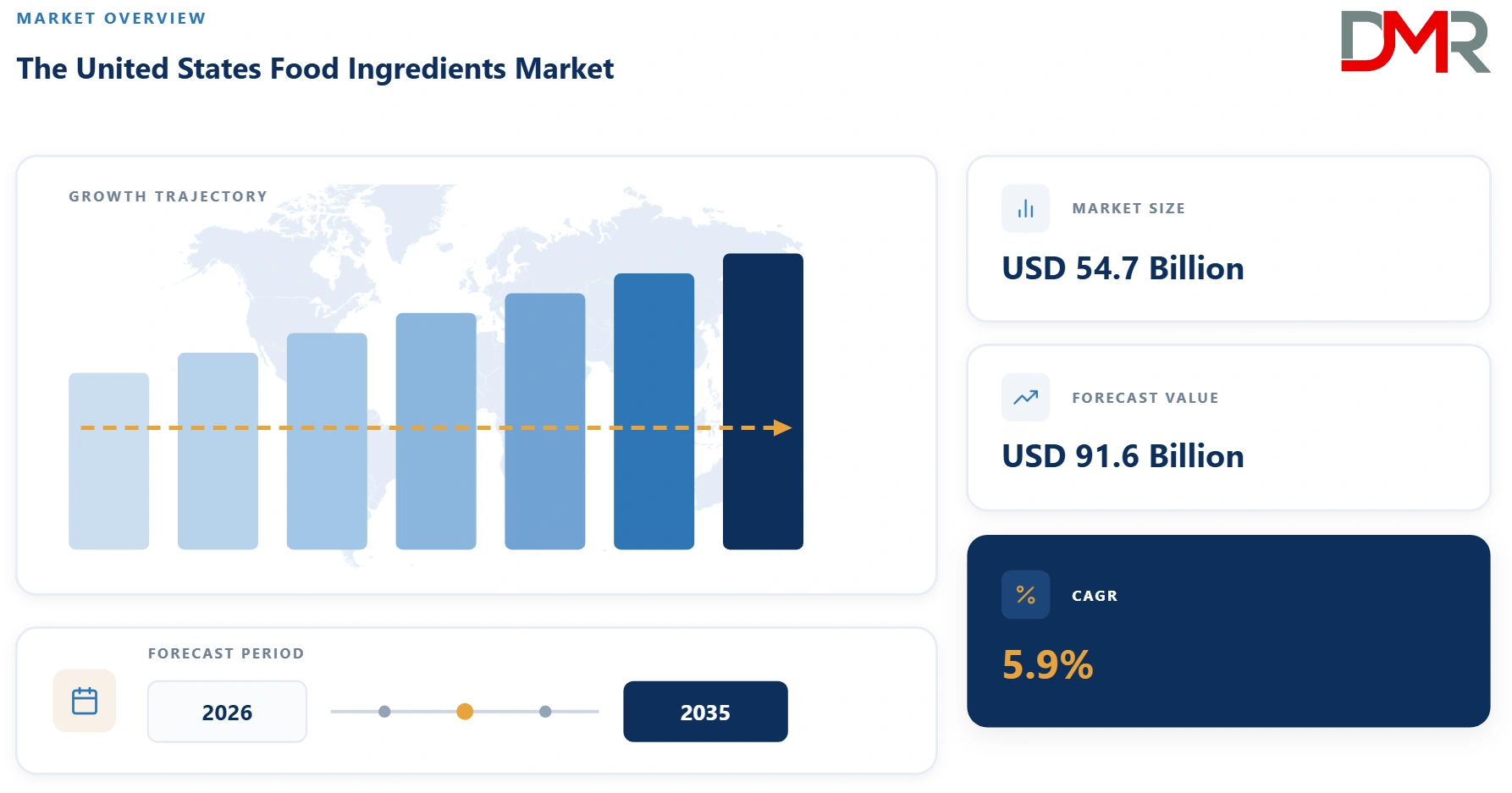
The United States Food Ingredients Market is projected to be valued at USD 54.7 Billion in 2026 and is projected to reach USD 91.6 Billion by 2035, expanding at a CAGR of 5.9% during the forecast period.
ℹ
To learn more about this report –
Download Your Free Sample Report Here
Growth is being propelled by accelerating reformulation activity across the packaged food and beverage industry as manufacturers respond to consumer demand for clean-label, minimally processed, and functional products, the phased removal of synthetic dyes and select additives under evolving state and federal regulatory pressure, and continued innovation in plant-based proteins, natural sweeteners, and functional ingredients targeting gut health, immunity, and protein fortification. The maturing of ingredient suppliers into solution-oriented technical partners offering formulation support, regulatory guidance, and application testing alongside raw ingredient supply, combined with food and beverage manufacturers' growing preference for consolidated, multi-category ingredient sourcing relationships, is reshaping the market from commodity-driven procurement toward collaborative, innovation-linked supplier partnerships. Investment is accelerating as ingredient companies expand natural and clean-label production capacity while navigating volatile agricultural input costs and tightening regulatory scrutiny of synthetic additives.
Use Cases
- Clean-Label Reformulation of Packaged Foods: Packaged food manufacturers replace synthetic colorants, preservatives, and flavor compounds with natural alternatives to meet consumer clean-label expectations and comply with tightening state-level additive restrictions.
- Plant-Based Protein Fortification: Beverage, snack, and prepared food manufacturers incorporate pea, soy, and other plant-derived protein ingredients to meet rising consumer demand for protein-fortified and plant-based product lines.
- Sugar Reduction Through Alternative Sweetener Systems: Beverage and confectionery manufacturers integrate stevia, monk fruit, allulose, and blended sweetener systems to reduce added sugar content while preserving taste and texture in reformulated products.
- Shelf-Life Extension for Convenience and Ready-to-Eat Foods: Manufacturers of prepared meals and convenience foods utilize natural preservative systems, hydrocolloids, and stabilizers to extend shelf life and maintain texture without relying on synthetic preservatives.
Key Takeaways
- Market Size: The United States Food Ingredients Market is anticipated to be valued at USD 54.7 Billion in 2026 and is forecast to reach USD 91.6 Billion by 2035, expanding at a CAGR of 5.9%.
- Growth Outlook: Market expansion is sustained by accelerating clean-label reformulation, regulatory pressure on synthetic additives, and rising manufacturer demand for functional ingredients supporting protein, fiber, and gut-health positioning across packaged food and beverage categories.
- Primary Growth Drivers: Tightening state and federal restrictions on synthetic dyes and additives, growing consumer preference for natural and minimally processed ingredients, expansion of functional and fortified food categories, and manufacturers' increasing reliance on ingredient suppliers for formulation and regulatory expertise are accelerating market growth.
- By Ingredient Type Analysis: Flavors and Fragrances is projected to lead the ingredient segment with a 21.6% share in 2026, reflecting their central role across nearly all food and beverage categories. Proteins is the fastest-growing ingredient type segment at 8.7% CAGR, driven by sustained demand for plant-based and alternative protein fortification.
- By Source Analysis: Natural is expected to dominate with a 58.4% share in 2026, reflecting accelerating reformulation away from synthetic additives. Natural is also the fastest-growing source segment at 7.9% CAGR, as regulatory and consumer pressure continues to favor naturally derived ingredient systems over synthetic alternatives.
- By Form Analysis: Dry ingredients are poised to lead with a 61.2% share in 2026, supported by longer shelf stability and lower transportation costs relative to liquid formats. Liquid is the fastest-growing form segment at 6.8% CAGR, driven by rising demand for ready-to-use flavor and functional ingredient systems in beverage manufacturing.
- By Application Analysis: Bakery and Confectionery is expected to command a 23.9% share in 2026, underpinned by broad ingredient diversity across texture, flavor, and shelf-life requirements. Nutritional and Functional Foods is the fastest-growing application segment at 9.3% CAGR, fuelled by expanding consumer demand for fortified and health-positioned products.
- By End User Analysis: Food and Beverage Manufacturers are projected to dominate the market with approximately 76.8% share in 2026, reflecting their position as the primary purchasers of bulk ingredient volumes. Foodservice and HoReCa is the fastest-growing end user segment at 8.1% CAGR, as restaurant and food service operators increasingly source functional and clean-label ingredients directly for menu reformulation.
Key Drivers in the United States Food Ingredients Market
Regulatory Pressure and Consumer Demand Accelerating Clean-Label Reformulation
Tightening state-level restrictions on synthetic food dyes and select additives, alongside sustained consumer preference for recognizable, minimally processed ingredients, are driving substantial reformulation activity across the United States food and beverage industry. Manufacturers are increasingly replacing synthetic colorants, flavors, and preservatives with natural alternatives to maintain compliance and align with shifting consumer expectations. Ingredient suppliers capable of providing functionally equivalent natural substitutes, along with regulatory and labeling guidance, are capturing expanding reformulation-driven demand. This dynamic is expected to remain a dominant growth driver as additional states consider similar restrictions.
Expansion of Functional and Fortified Food Categories
Rising consumer interest in health-positioned nutrition, including protein fortification, gut-health support, and immunity-linked claims, is expanding demand for functional ingredients such as prebiotic fibers, probiotics, plant proteins, and specialty vitamins and minerals. Food and beverage manufacturers are increasingly incorporating these ingredients into mainstream product lines rather than limiting them to niche health-food categories. Ingredient suppliers with strong technical application support and clinical or scientific substantiation for functional claims are well positioned to capture this expanding, higher-margin segment of the market.
Restraints in the United States Food Ingredients Market
Agricultural Input Cost Volatility and Supply Chain Disruption
Volatility in agricultural commodity prices, weather-related crop disruptions, and global supply chain constraints represent a significant restraint on the United States Food Ingredients Market. Natural ingredient sourcing, in particular, can be more exposed to crop yield variability and geographic concentration of supply than synthetic alternatives, creating pricing unpredictability for manufacturers. These cost pressures can complicate long-term formulation planning, squeeze ingredient supplier margins, and in some cases slow the pace of clean-label reformulation where natural substitutes carry a persistent cost premium relative to synthetic ingredients they replace.
Growth Opportunities in the United States Food Ingredients Market
Precision and Fermentation-Derived Ingredient Innovation
Advances in precision fermentation and biotechnology-derived ingredient production present a significant opportunity for suppliers seeking to offer natural-equivalent flavors, proteins, and functional compounds with greater supply consistency than traditional agricultural sourcing. These technologies can reduce exposure to weather-driven volatility while meeting clean-label and sustainability expectations, positioning early-moving ingredient companies to capture premium contracts with manufacturers seeking both innovation and supply reliability.
Co-Development Partnerships with Emerging and Mid-Sized Brands
Growing demand from emerging and mid-sized food and beverage brands for formulation support, rather than ingredient supply alone, presents an opportunity for ingredient companies to build deeper, technical-service-oriented client relationships. Suppliers offering application labs, pilot-scale testing, and regulatory labeling support can differentiate from commodity ingredient sellers, capturing higher-value, longer-duration contracts as client brands scale from initial launch through national distribution.
Trends in the United States Food Ingredients Market
Consolidation and Vertical Integration Among Ingredient Suppliers
The United States Food Ingredients Market is experiencing continued consolidation as larger ingredient companies acquire specialty natural, functional, and flavor-focused suppliers to broaden category coverage and technical capability. Vertical integration into upstream agricultural sourcing and fermentation-based production is also increasing among larger players, aimed at improving supply chain control and cost predictability. This consolidation trend is gradually concentrating innovation capacity and broad-category technical support among a smaller number of larger, diversified ingredient suppliers.
Rising Adoption of Ingredient Traceability and Sustainability Certification
Food and beverage manufacturers are increasingly requiring ingredient suppliers to provide traceability documentation and sustainability certifications covering sourcing origin, environmental impact, and labor practices. This trend is being driven by both consumer transparency expectations and manufacturers' own corporate sustainability commitments. Ingredient suppliers investing in digital traceability systems and third-party sustainability certification are gaining a competitive advantage in securing long-term supply agreements with major food and beverage manufacturers.
Research Scope and Analysis
The United States Food Ingredients Market is segmented by ingredient type, source, form, application, and end user, covering flavors, sweeteners, emulsifiers, enzymes, proteins, preservatives, colorants, natural and synthetic sourcing, dry and liquid formats, and food and beverage manufacturing, foodservice, and retail end users.
ℹ
To learn more about this report –
Download Your Free Sample Report Here
By Ingredient Type Analysis
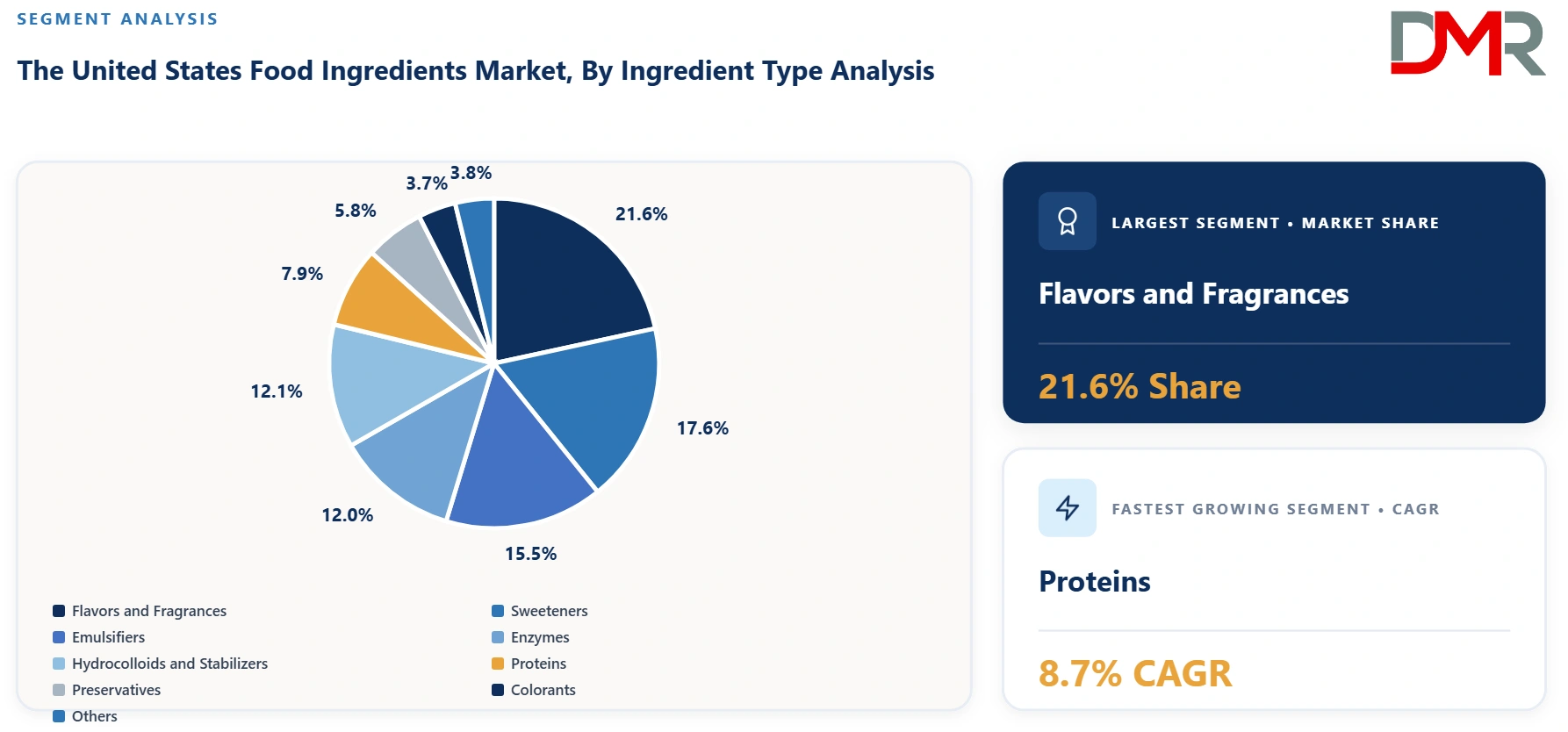
Flavors and Fragrances are projected to dominate the United States Food Ingredients Market, accounting for approximately 21.6% of the market share in 2026. Their leadership is supported by widespread utilization across bakery, confectionery, beverages, dairy, snacks, sauces, and prepared foods to improve taste, aroma, differentiation, and consumer appeal. Continuous product innovation and demand for natural flavor systems further support segment growth. Meanwhile, Proteins are expected to register the highest CAGR of 8.7% during 2026–2035, driven by rising consumption of plant-based proteins, protein-enriched snacks, functional beverages, sports nutrition products, and fortified foods among increasingly health-conscious American consumers.
By Source Analysis
Natural ingredients are anticipated to dominate the United States Food Ingredients Market by source, capturing approximately 58.4% of the market share in 2026. Growth is primarily supported by increasing consumer preference for recognizable, minimally processed, clean-label ingredients and continued reformulation of packaged foods away from artificial colors, flavors, preservatives, and other synthetic additives. Food manufacturers are increasingly incorporating botanical extracts, natural sweeteners, plant-derived colors, and naturally sourced functional ingredients across product portfolios. Natural ingredients are also projected to record the highest CAGR of 7.9% during 2026–2035, supported by clean-label innovation, premiumization, sustainability priorities, and evolving consumer expectations regarding ingredient transparency.
By Form Analysis
Dry ingredients are projected to dominate the United States Food Ingredients Market by form, holding approximately 61.2% of the market share in 2026. Their strong position is attributed to extended shelf life, easier storage, lower transportation costs, convenient handling, dosage accuracy, and suitability across numerous industrial food-processing applications. Powders, granules, and other dry formats are widely utilized in bakery, snacks, nutritional products, seasonings, and prepared foods. Conversely, liquid ingredients are anticipated to register the fastest CAGR of 6.8% through 2035, supported by increasing demand for ready-to-use flavors, sweeteners, emulsions, concentrates, colors, and functional ingredient systems, particularly across beverage and dairy manufacturing.
By Application Analysis
Bakery and Confectionery are expected to lead the United States Food Ingredients Market by application, accounting for approximately 23.9% of the market share in 2026. The segment requires substantial volumes of flavors, sweeteners, emulsifiers, colors, preservatives, proteins, fats, and texturizing ingredients to enhance taste, appearance, texture, freshness, and shelf stability. Continuous launches of premium, clean-label, reduced-sugar, and functional bakery products further strengthen ingredient demand. Nutritional and Functional Foods are projected to achieve the fastest CAGR of 9.3% during 2026–2035, fueled by expanding consumer interest in protein fortification, digestive wellness, immunity support, healthy aging, weight management, and personalized nutrition products.
By End User Analysis
Food and Beverage Manufacturers are projected to dominate the United States Food Ingredients Market by end user, capturing approximately 76.8% of the market share in 2026. Their leadership reflects large-scale procurement of flavors, proteins, sweeteners, preservatives, emulsifiers, colors, and functional ingredients for processed foods and beverages. Growing product reformulation, clean-label positioning, nutritional enhancement, and new product development continue supporting bulk ingredient consumption among manufacturers. Meanwhile, Foodservice and HoReCa are expected to register the fastest CAGR of 8.1% through 2035, supported by restaurant chains and foodservice operators increasingly adopting natural, functional, premium, and clean-label ingredients for menu innovation and differentiated consumer offerings.
The United States Food Ingredients Market Report is segmented based on the following:
By Ingredient Type
- Flavors and Fragrances
- Sweeteners
- Emulsifiers
- Enzymes
- Hydrocolloids and Stabilizers
- Proteins
- Preservatives
- Colorants
- Others
By Source
- Natural
- Synthetic/Artificial
By Form
By Application
- Bakery and Confectionery
- Beverages
- Dairy and Frozen Desserts
- Meat, Poultry and Seafood
- Sauces, Dressings and Condiments
- Snacks and Convenience Foods
- Nutritional and Functional Foods
- Others
By End User
- Food and Beverage Manufacturers
- Foodservice and HoReCa
- Household/Retail
Technology Analysis
Technology investment is increasingly shaping competitiveness in the United States Food Ingredients Market as suppliers adopt precision fermentation, AI-assisted formulation modeling, and advanced encapsulation techniques to improve ingredient stability, functionality, and clean-label compatibility. Growing use of digital application labs and rapid prototyping tools is shortening product development timelines for manufacturer clients. Opportunities are expanding for suppliers investing in fermentation-derived proteins and flavors, natural preservation technologies, and traceability platforms supporting sustainability and regulatory documentation requirements. However, high capital costs for biotechnology-based production and lengthy regulatory approval pathways for novel ingredients remain adoption barriers for smaller suppliers.
Investment and White Space Analysis
Investment opportunities in the United States Food Ingredients Market are expanding alongside accelerating clean-label reformulation, tightening additive regulation, and sustained growth in functional and fortified food categories. Significant white space exists in fermentation-derived natural flavors and proteins, sugar-reduction ingredient systems, allergen-friendly stabilizers, and traceability and sustainability certification services. Ingredient suppliers specializing in high-growth categories such as plant-based proteins, functional beverages, and natural preservation systems are positioned to capture premium, technically differentiated contracts. However, agricultural input volatility, consolidation-driven competitive pressure, and rising compliance costs can constrain margins for undercapitalized or narrowly specialized suppliers.
Competitive Landscape
The United States Food Ingredients Market is moderately consolidated and increasingly competitive, comprising large diversified global ingredient companies, specialty natural and functional ingredient suppliers, and regional flavor and additive houses. Competition centers on natural ingredient innovation, regulatory and labeling expertise, application and technical support capability, and supply chain reliability. Large diversified suppliers benefit from broad category coverage, global sourcing networks, and integrated research capabilities, while specialty suppliers compete on category-specific innovation, faster development cycles, and closer client collaboration. Companies increasingly differentiate through investment in fermentation-based production, sustainability certification, and formulation co-development services rather than ingredient supply alone.
Some of the prominent players in the United States Food Ingredients Market are:
- Archer Daniels Midland Company (ADM)
- Cargill, Incorporated
- Ingredion Incorporated
- International Flavors & Fragrances Inc. (IFF)
- Kerry Group plc
- Tate & Lyle PLC
- Givaudan SA
- dsm-firmenich AG
- Sensient Technologies Corporation
- Corbion N.V.
- Symrise AG
- BASF SE
- Novonesis
- Roquette Frères
- Glanbia plc
- Ajinomoto Co., Inc.
- Balchem Corporation
- Kemin Industries, Inc.
- Jungbunzlauer Suisse AG
- Brenntag SE
- Bunge Global SA
- AAK AB
- MGP Ingredients, Inc.
- Olam Food Ingredients (ofi)
- BENEO GmbH
- Kalsec Inc.
- Florida Food Products
- Prinova Group LLC
- Batory Foods
- Innophos Holdings, Inc.
- CP Kelco
- Palsgaard A/S
- ABF Ingredients
- Biospringer
- Arla Foods Ingredients
- Leprino Foods Company
- Grain Millers, Inc.
- Manildra Group USA
- Synergy Flavors, Inc.
- Kraft Heinz Ingredients
- Other Key Players
Recent Developments
- June 2026: Ingredion announced a recommended all-cash acquisition of Tate & Lyle, creating a larger specialty ingredients platform focused on sweetening, texture, fortification, and healthier food formulations.
- May 2026: IFF agreed to sell its Food Ingredients business to CVC for approximately USD 4.3 billion, representing a significant portfolio restructuring in specialty food ingredients.
- January 2026: ADM announced a USD 26 million investment in its Erlanger, Kentucky facility to expand flavor capabilities and address growing food and beverage reformulation demand.
- October 2025: IFF highlighted its IFF CURE™ reformulation solutions, designed to help food and beverage manufacturers develop healthier products while maintaining taste, functionality, and consumer appeal.
Report Details
| Report Characteristics |
| Market Size (2026) |
USD 54.7 Bn |
| Forecast Value (2035) |
USD 91.6 Bn |
| CAGR (2026–2035) |
5.9% |
| Historical Data |
2021 – 2025 |
| Forecast Data |
2026 – 2035 |
| Base Year |
2025 |
| Segments Covered |
By Ingredient Type, By Source, By Form, By Application, By End User |
| Country Coverage |
The United States |
Frequently Asked Questions
How big is the United States Food Ingredients Market?
▾ The United States Food Ingredients Market is valued at USD 54.7 Billion in 2026 and is projected to reach USD 91.6 Billion by 2035, reflecting sustained demand for natural, functional, and clean-label ingredients across the food and beverage manufacturing industry.
What is the CAGR of the United States Food Ingredients Market from 2026 to 2035?
▾ The market is projected to expand at a compound annual growth rate (CAGR) of 5.9% between 2026 and 2035, supported by tightening additive regulation, accelerating clean-label reformulation, and rising demand for functional and fortified food ingredients.
What factors are driving the growth of the United States Food Ingredients Market?
▾ Growth is driven by tightening state and federal restrictions on synthetic dyes and additives, growing consumer preference for natural and minimally processed ingredients, expansion of functional and fortified food categories, and manufacturers' increasing reliance on ingredient suppliers for formulation and regulatory expertise.
What are the major trends in the United States Food Ingredients Market?
▾ Major trends include continued consolidation and vertical integration among ingredient suppliers, rising adoption of traceability and sustainability certification, and growing investment in precision fermentation and biotechnology-derived ingredient innovation.
Who are the key players in the United States Food Ingredients Market?
▾ Key market participants include Cargill, Archer Daniels Midland, International Flavors and Fragrances, Ingredion, and Kerry Group, among other diversified and specialty ingredient suppliers.
How is the United States Food Ingredients Market segmented?
▾ The market is segmented by ingredient type, source, form, application, and end user, with demand analysis concentrated across major U.S. food and beverage manufacturing regions including the Midwest, Northeast, and West Coast.