United States Food Processing Automation Market Snapshot
- United States Food Processing Automation Market Size in 2026: USD 15.8 Billion
- United States Food Processing Automation Market Size in 2035: USD 31.4 Billion
- United States CAGR from 2026 to 2035: 7.9%
- Hardware is the leading component segment in 2026: 51.6%
- Robotic Process Automation is the leading automation type segment in 2026: 29.3%
- Packaging and Palletizing is the leading application segment in 2026: 26.8%
- Meat, Poultry and Seafood is the leading food category segment in 2026: 24.5%
- Large Enterprises is the leading enterprise size segment in 2026: 66.7%
What is the United States Food Processing Automation Market and its Market Size?
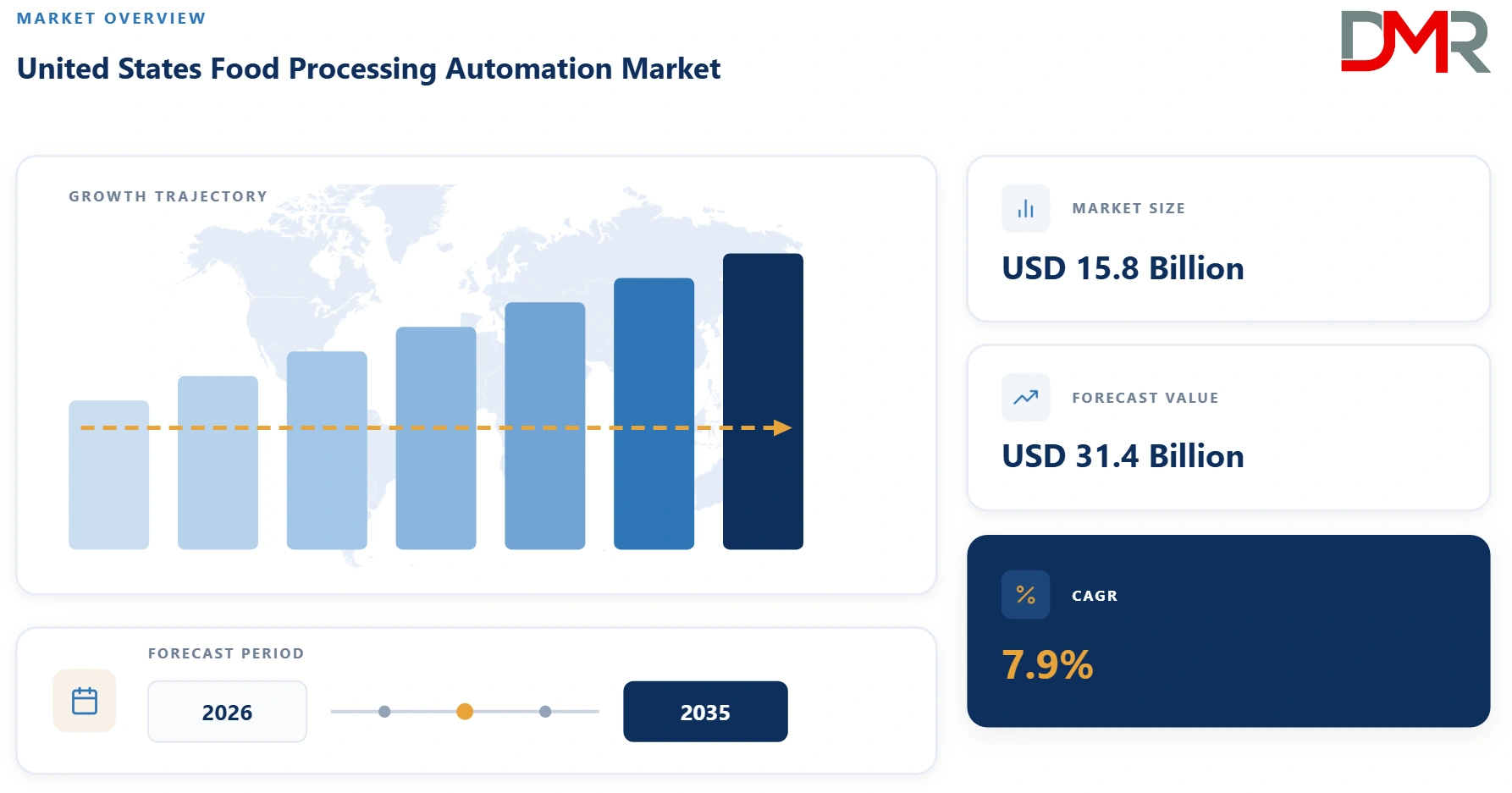
The United States Food Processing Automation Market is projected to be valued at USD 15.8 Billion in 2026 and is projected to reach USD 31.4 Billion by 2035, expanding at a CAGR of 7.9% during the forecast period.
ℹ
To learn more about this report –
Download Your Free Sample Report Here
Growth is being propelled by a persistent and worsening shortage of food manufacturing plant labor, rising wage costs across processing facilities, and mounting regulatory and buyer pressure for consistent, verifiable food safety and quality control outcomes that manual processes struggle to guarantee at scale. The maturing of machine vision, robotics, and sensor technologies capable of handling the variable, delicate, and often unstructured nature of food products, growing food manufacturer investment in integrated plant-wide automation and data systems rather than isolated equipment upgrades, and expanding vendor capability to retrofit automation into legacy processing facilities are reshaping the market from single-purpose equipment purchases into holistic, connected plant modernization programs. Investment is accelerating as processors seek to reduce labor dependency, improve throughput consistency, and strengthen traceability and quality documentation simultaneously through integrated automation and software investment.
Use Cases
- Robotic Palletizing and End-of-Line Packaging: Bakery, snack, and beverage manufacturers deploy robotic palletizing and case-packing systems to handle high-volume, repetitive end-of-line packaging tasks, reducing labor dependency and workplace injury risk associated with repetitive manual lifting.
- Machine Vision-Based Sorting and Quality Inspection: Fruit, vegetable, and protein processors use machine vision systems to automatically sort produce by size, ripeness, and defect status, and to inspect meat and poultry products for contamination or quality deviations at line speed, improving consistency beyond manual visual inspection capability.
- Automated Portioning and Processing for Protein and Prepared Foods: Meat, poultry, and prepared meal manufacturers deploy automated cutting, portioning, and forming equipment to achieve precise, consistent product sizing while reducing yield loss and labor requirements associated with manual portioning.
- Integrated MES and Plant Data Systems for Real-Time Production Visibility: Food manufacturers implement manufacturing execution system software to connect automated equipment across the plant floor, enabling real-time production monitoring, downtime tracking, and quality documentation required for both operational efficiency and regulatory compliance.
Key Takeaways
- Market Size: The United States Food Processing Automation Market is anticipated to be valued at USD 15.8 Billion in 2026 and is forecast to reach USD 31.4 Billion by 2035, expanding at a CAGR of 7.9%.
- Growth Outlook: Market expansion is sustained by persistent plant-level labor shortages, rising wage and workers' compensation costs, and growing food manufacturer investment in integrated automation and data systems to strengthen both throughput and food safety documentation.
- Primary Growth Drivers: Worsening food manufacturing labor availability and rising wage costs, increasing regulatory and retailer buyer pressure for consistent food safety and quality outcomes, maturing machine vision and robotics technology suited to variable food product handling, and growing manufacturer preference for integrated, plant-wide automation systems are accelerating adoption.
- By Component Analysis: Hardware is projected to lead the component segment with a 51.6% share in 2026, reflecting the equipment-intensive nature of physical processing, packaging, and material handling automation. Software is the fastest-growing component segment at 10.6% CAGR, driven by rising demand for MES, SCADA, and plant-wide data integration platforms.
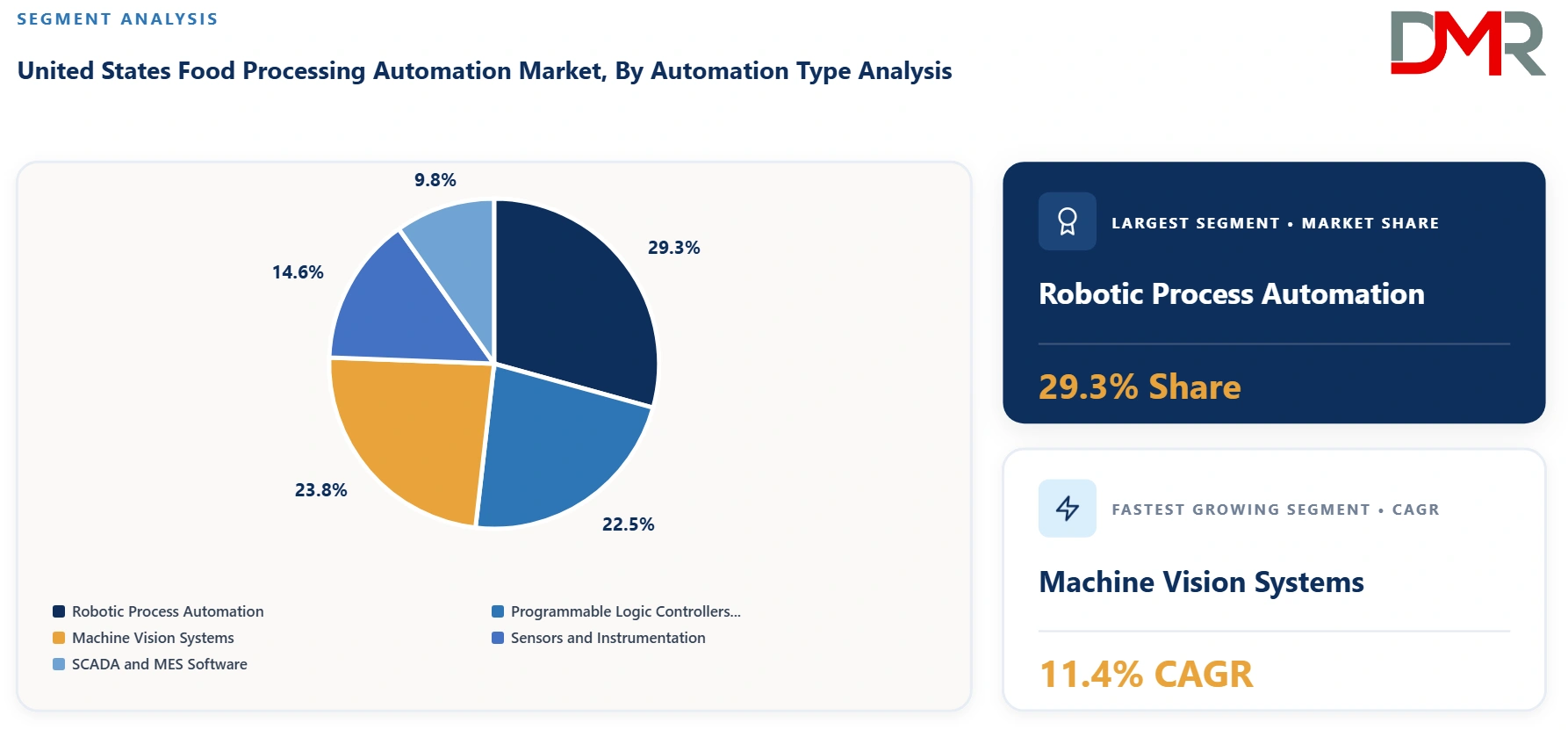
- By Automation Type Analysis: Robotic Process Automation is expected to dominate with a 29.3% share in 2026, supported by broad applicability across packaging, palletizing, and material handling tasks. Machine Vision Systems is the fastest-growing automation type segment at 11.4% CAGR, driven by expanding use in quality inspection and sorting applications across produce and protein categories.
- By Application Analysis: Packaging and Palletizing is poised to lead with a 26.8% share in 2026, reflecting the high-volume, repetitive nature of end-of-line automation opportunities. Quality Control and Inspection is the fastest-growing application segment at 10.9% CAGR, driven by rising food safety documentation requirements and growing machine vision inspection capability.
- By Food Category Analysis: Meat, Poultry and Seafood is expected to command a 24.5% share in 2026, underpinned by labor-intensive processing requirements and strong automation return-on-investment potential in this category. Fruits and Vegetables is the fastest-growing food category segment at 9.8% CAGR, fuelled by expanding adoption of automated sorting, grading, and packing systems.
- By Enterprise Size Analysis: Large Enterprises are projected to dominate with a 66.7% share in 2026, reflecting greater capital availability for plant-wide automation investment. Small and Medium Enterprises is the fastest-growing enterprise size segment at 10.2% CAGR, driven by falling automation equipment costs and growing availability of automation-as-a-service financing models.
Key Drivers in the United States Food Processing Automation Market
Persistent Food Manufacturing Labor Shortages and Rising Wage Costs
Chronic difficulty recruiting and retaining plant-floor labor across the U.S. food manufacturing sector is a central driver of growth in the Food Processing Automation Market. Physically demanding, often cold or repetitive processing and packaging roles face persistent turnover and recruitment challenges, compounded by broader competition for manufacturing labor across other industries. Rising wage costs and workers' compensation expenses further increase the financial case for automating repetitive, injury-prone tasks. As labor availability constraints show limited signs of easing, food manufacturers are increasingly treating automation investment as a structural operational necessity rather than a discretionary efficiency upgrade.
Growing Regulatory and Retailer Pressure for Consistent Food Safety Outcomes
Increasing regulatory scrutiny under food safety modernization requirements, combined with major retailers' growing supplier quality and safety documentation standards, is pushing food manufacturers toward automated processes capable of delivering more consistent, verifiable outcomes than manual operations. Automated inspection, sorting, and processing systems reduce variability associated with human factors such as fatigue and inconsistent judgment, while integrated data systems provide auditable production records supporting both regulatory compliance and buyer quality assurance requirements. This dual pressure from regulators and commercial buyers is reinforcing sustained automation investment across the industry.
Restraints in the United States Food Processing Automation Market
High Upfront Capital Costs and Retrofit Complexity in Legacy Facilities
Significant upfront capital investment required for automation equipment, combined with the complexity of retrofitting automation into older, legacy processing facilities not originally designed for integrated automated systems, represents a meaningful restraint on the United States Food Processing Automation Market. Many existing plants face physical layout constraints, outdated electrical and control infrastructure, and production downtime costs associated with installation that can delay or limit the scope of automation projects, particularly among small and mid-sized processors with more constrained capital budgets.
Growth Opportunities in the United States Food Processing Automation Market
Automation-as-a-Service and Flexible Financing Models
Growing interest among small and mid-sized food processors in accessing automation technology without large upfront capital outlays presents a significant opportunity for equipment vendors and integrators offering subscription-based, leasing, or automation-as-a-service financing models. These flexible commercial arrangements can lower adoption barriers for resource-constrained processors, expanding the addressable market for automation vendors beyond large, well-capitalized enterprises and supporting longer-term, recurring vendor-client relationships.
AI-Enhanced Adaptive Robotics for Variable Food Product Handling
Advances in AI-enhanced robotics capable of adapting to the natural variability of food products, such as irregularly shaped produce or inconsistent protein cuts, present a substantial opportunity for automation vendors to expand beyond rigid, single-purpose equipment into more flexible, broadly applicable systems. Vendors developing adaptive grasping, cutting, and sorting technology suited to food's inherent variability can capture demand from processors previously unable to automate tasks requiring human-like dexterity and judgment.
Trends in the United States Food Processing Automation Market
Convergence of Automation Hardware with Integrated Plant Data Platforms
Food manufacturers are increasingly moving away from isolated, single-purpose automation equipment purchases toward integrated automation and data platform investments that connect robotics, sensors, and control systems into unified plant-wide visibility and analytics systems. This convergence allows manufacturers to move beyond individual task automation toward holistic production optimization, predictive maintenance, and comprehensive quality documentation, increasing the strategic value and stickiness of automation vendor relationships.
Rising Adoption of Collaborative Robots for Flexible, Mixed-Product Lines
Growing adoption of collaborative robots, designed to work safely alongside human workers on shared production lines, is enabling food manufacturers to automate specific tasks within otherwise manual processes without requiring full line redesign. This flexible, incremental automation approach is particularly well suited to processors handling frequent product changeovers or smaller batch sizes, allowing automation investment to scale more gradually and cost-effectively than traditional large-scale, fixed automation systems.
Research Scope and Analysis
The United States Food Processing Automation Market is segmented by component, automation type, application, food category, and enterprise size, covering hardware, software, services, robotics, machine vision, sensors, SCADA/MES systems, packaging, sorting, processing, quality control, and material handling applications across major food categories.
ℹ
To learn more about this report –
Download Your Free Sample Report Here
By Component Analysis
Hardware is projected to dominate the United States Food Processing Automation Market with approximately 51.6% share in 2026, reflecting the equipment-intensive nature of robotics, sensors, and control systems underpinning physical processing and packaging automation. Software is expected to register the highest CAGR of 10.6% during 2026-2035, driven by rising manufacturer investment in manufacturing execution systems, SCADA platforms, and plant-wide data integration tools that connect and optimize automated equipment.
By Automation Type Analysis
Robotic Process Automation is anticipated to dominate the United States Food Processing Automation Market by automation type, accounting for approximately 29.3% share in 2026, supported by broad applicability across packaging, palletizing, and material handling tasks throughout food processing facilities. Machine Vision Systems are projected to register the highest CAGR of 11.4% between 2026 and 2035, driven by expanding use in automated quality inspection, defect detection, and sorting applications across produce, protein, and packaged food categories.
By Application Analysis
Packaging and Palletizing is projected to lead the United States Food Processing Automation Market with an estimated 26.8% share in 2026, reflecting the high-volume, repetitive nature of end-of-line tasks well suited to robotic automation. Quality Control and Inspection is expected to register the fastest CAGR of 10.9% through 2035, driven by rising food safety documentation requirements and growing machine vision capability for automated defect and contamination detection.
By Food Category Analysis
Meat, Poultry and Seafood is expected to lead the United States Food Processing Automation Market by food category, accounting for approximately 24.5% share in 2026, underpinned by labor-intensive cutting, portioning, and packaging requirements that offer strong automation return-on-investment potential. Fruits and Vegetables is projected to achieve the fastest CAGR of 9.8% during 2026-2035, driven by expanding adoption of automated sorting, grading, and packing systems capable of handling produce variability.
By Enterprise Size Analysis
Large Enterprises are projected to dominate the United States Food Processing Automation Market with approximately 66.7% share in 2026, reflecting greater capital availability for large-scale, plant-wide automation investment programs. Small and Medium Enterprises are expected to register the fastest CAGR of 10.2% through 2035, driven by falling automation equipment costs, growing availability of automation-as-a-service financing models, and increasing accessibility of flexible, incremental automation solutions such as collaborative robots.
The United States Food Processing Automation Market Report is segmented based on the following:
By Component
- Hardware
- Software
- Services
By Automation Type
- Robotic Process Automation
- Programmable Logic Controllers and Industrial Control Systems
- Machine Vision Systems
- Sensors and Instrumentation
- SCADA and MES Software
By Application
- Packaging and Palletizing
- Sorting and Grading
- Processing and Portioning
- Quality Control and Inspection
- Material Handling and Warehousing
By Food Category
- Bakery and Confectionery
- Beverages
- Dairy and Frozen Foods
- Meat, Poultry and Seafood
- Fruits and Vegetables
- Others
By Enterprise Size
- Large Enterprises
- Small and Medium Enterprises
Technology Analysis
Technology development is central to the trajectory of the United States Food Processing Automation Market as vendors invest in AI-enhanced adaptive robotics, higher-resolution machine vision systems, and predictive maintenance analytics capable of reducing unplanned downtime across automated production lines. Growing integration of edge computing is enabling faster, more reliable real-time processing decisions directly on the plant floor, reducing latency-related quality and safety risks. Opportunities are expanding for vendors developing flexible, collaborative robotics suited to variable product handling and smaller batch production, as well as retrofit-friendly automation solutions designed for integration into legacy processing facilities without extensive infrastructure overhaul. However, achieving reliable performance handling the natural variability of food products, and ensuring robust food-grade sanitation compatibility for automated equipment, remain persistent technical challenges across the industry.
Investment and White Space Analysis
Investment opportunities in the United States Food Processing Automation Market are expanding alongside persistent labor shortages, rising regulatory and buyer quality expectations, and continued technology maturation in robotics and machine vision suited to food applications. Significant white space exists in automation-as-a-service financing models for small and mid-sized processors, AI-enhanced adaptive robotics for variable product handling, and integrated plant-wide data platforms connecting automation hardware with quality and compliance documentation systems. Vendors with strong retrofit capability, food-grade sanitation-compliant equipment design, and flexible commercial financing models are positioned to capture premium, longer-duration contracts across a broader base of processor sizes. However, high upfront capital costs, retrofit complexity in legacy facilities, and integration challenges across fragmented existing plant systems can constrain adoption pace, particularly among smaller, capital-constrained processors.
Competitive Landscape
The United States Food Processing Automation Market is moderately consolidated and increasingly competitive, comprising large diversified industrial automation companies, specialty food and beverage processing equipment manufacturers, robotics integrators, and software providers offering manufacturing execution and plant data systems. Competition centers on food-grade equipment design and sanitation compliance, integration capability across mixed legacy and modern plant infrastructure, machine vision and AI technology sophistication, and breadth of service and support offered alongside hardware. Large diversified automation companies benefit from broad product portfolios and established food manufacturer relationships, while specialty vendors compete on category-specific expertise and deeper application engineering support. Companies increasingly differentiate through integrated hardware-software platform offerings and flexible financing models rather than equipment sales alone.
Some of the prominent players in the United States Food Processing Automation Market are:
- IBM Corporation
- Oracle Corporation
- Microsoft Corporation
- SAP SE
- Honeywell International Inc.
- Zebra Technologies Corporation
- Avery Dennison Corporation
- Impinj, Inc.
- Cognex Corporation
- Trimble Inc.
- TE Connectivity Ltd.
- Emerson Electric Co.
- Rockwell Automation, Inc.
- Siemens AG
- Schneider Electric SE
- Infor
- TraceGains, Inc.
- FoodLogiQ
- Trustwell
- iFoodDS
- ReposiTrak, Inc.
- Mojix, Inc.
- Wholechain
- ripe.io
- FoodChain ID Group, Inc.
- Provision Analytics
- SafetyChain Software, Inc.
- Trace One
- OPTEL Group
- rfxcel Corporation
- Antares Vision Group
- Kezzler AS
- Wiliot Ltd.
- Scantrust SA
- SATO Holdings Corporation
- Bar Code Integrators, Inc.
- Loftware, Inc.
- Tive, Inc.
- Roambee Corporation
- Overhaul Group, Inc.
- Other Key Players
Recent Developments
- In February 2026, TraceGains and iFoodDS expanded their strategic alliance, integrating TraceGains Supplier Management with iFoodDS Trace Exchange to streamline FSMA 204 traceability data sharing and supplier compliance.
- In January 2026, Avery Dennison highlighted digital identity and smart packaging technologies as tools for improving food traceability, inventory visibility, shelf-life management, and food-waste reduction across the supply chain.
- In November 2025, ReposiTrak expanded its Traceability Network deeper into the food supply chain by adding food manufacturing companies and connecting their ingredient suppliers and customers for traceability data sharing.
Report Details
| Report Characteristics |
| Market Size (2026) |
USD 15.8 Bn |
| Forecast Value (2035) |
USD 31.4 Bn |
| CAGR (2026–2035) |
7.9% |
| Historical Data |
2021 – 2025 |
| Forecast Data |
2026 – 2035 |
| Base Year |
2025 |
| Segments Covered |
By Component, By Automation Type, By Application, By Food Category, and By Enterprise Size |
| Country Coverage |
United States |
Frequently Asked Questions
How big is the United States Food Processing Automation Market?
▾ The United States Food Processing Automation Market is poised to be valued at USD 15.8 Billion in 2026 and is projected to reach USD 31.4 Billion by 2035, reflecting sustained investment in robotics, machine vision, and plant data systems across the food manufacturing industry.
What is the CAGR of the United States Food Processing Automation Market from 2026 to 2035?
▾ The market is projected to expand at a compound annual growth rate (CAGR) of 7.9% between 2026 and 2035, supported by persistent labor shortages, rising wage costs, and growing regulatory and retailer pressure for consistent food safety outcomes.
What factors are driving the growth of the United States Food Processing Automation Market?
▾ Growth is driven by worsening food manufacturing labor availability and rising wage costs, increasing regulatory and retailer buyer pressure for consistent food safety and quality outcomes, maturing machine vision and robotics technology suited to variable food product handling, and growing manufacturer preference for integrated, plant-wide automation systems.
What are the major trends in the United States Food Processing Automation Market?
▾ Major trends include the convergence of automation hardware with integrated plant-wide data platforms, rising adoption of collaborative robots for flexible, mixed-product lines, and growing investment in AI-enhanced adaptive robotics suited to variable food product handling.
Who are the key players in the United States Food Processing Automation Market?
▾ Key market participants include Rockwell Automation, Siemens, ABB, FANUC, and Bühler Group, among other diversified industrial automation companies and specialty food processing equipment manufacturers.
How is the United States Food Processing Automation Market segmented?
▾ The market is segmented by component, automation type, application, food category, and enterprise size, with demand analysis concentrated across major U.S. food manufacturing regions including the Midwest, Southeast, and West Coast.