United States Foodservice Equipment Market Snapshot
- US Foodservice Equipment Market Size in 2026: USD 16.2 Billion
- US Foodservice Equipment Market Size in 2035: USD 24.1 Billion
- US CAGR from 2026 to 2035: 4.5%
- Cooking Equipment is the leading product type segment in 2026: 33.4%
- Full-Service Restaurants is the leading end use segment in 2026: 36.2%
- Dealers and Distributors is the leading sales channel segment in 2026: 61.8%
What is the United States Foodservice Equipment Market and its Market Size?
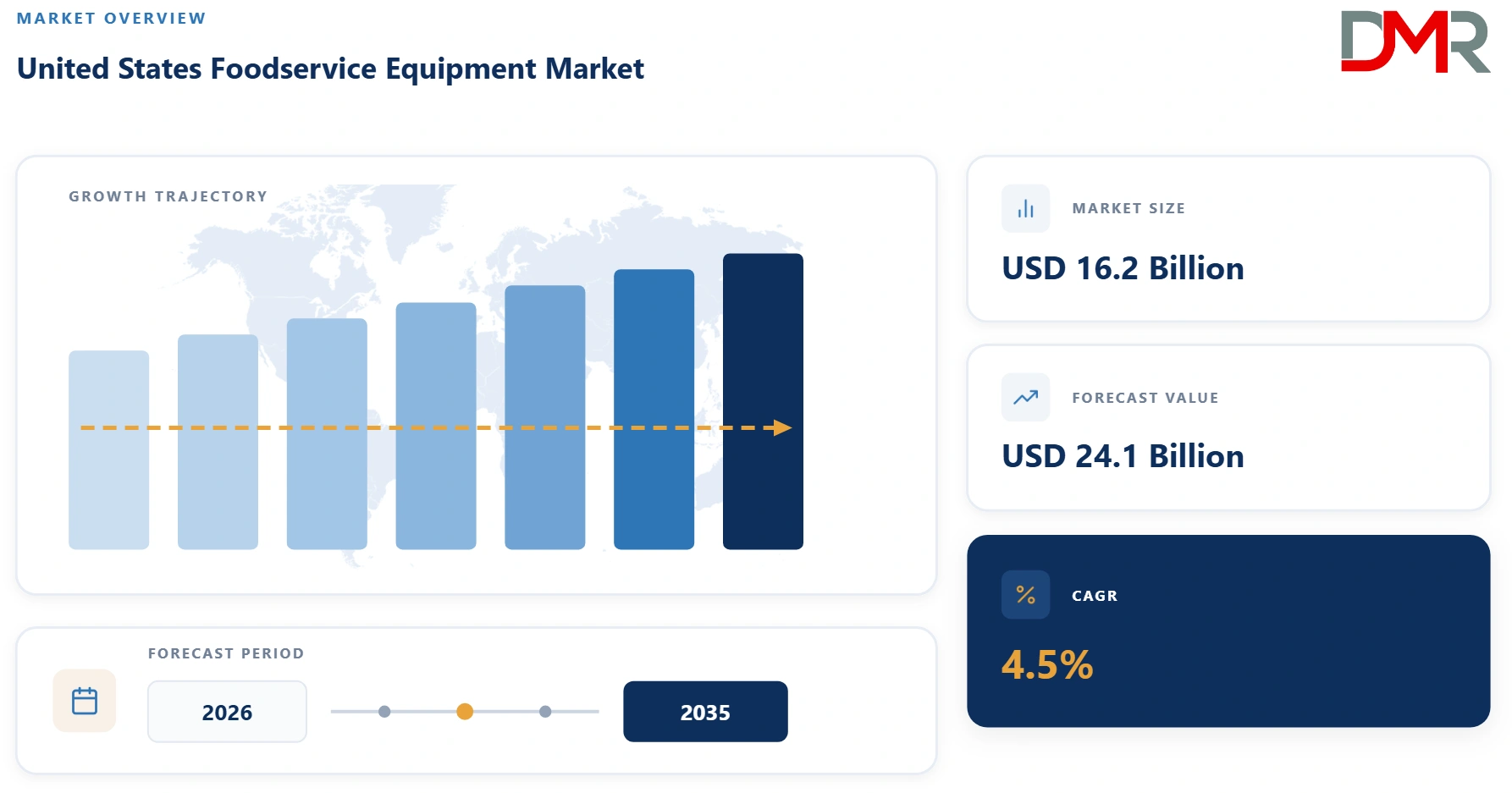
The United States Foodservice Equipment Market is projected to be valued at USD 16.2 billion in 2026 and is projected to reach USD 24.1 billion by 2035, expanding at a CAGR of 4.5% during the forecast period.
ℹ
To learn more about this report –
Download Your Free Sample Report Here
Growth is being propelled by sustained expansion of quick-service and fast-casual restaurant chains, ongoing replacement and upgrade cycles across an aging installed base of commercial kitchen equipment, and rising demand for labor-saving automation amid persistent kitchen staffing constraints. The adoption of energy-efficient and Energy Star-certified equipment, growing integration of IoT-enabled remote monitoring and predictive maintenance capabilities, and expanding investment in standardized, high-throughput kitchen systems designed for multi-unit brand consistency are reshaping procurement decisions. Investment is accelerating as operators shift purchase criteria from simple age-based replacement toward total cost-in-use, energy efficiency, and labor-reduction potential, prompting equipment manufacturers to prioritize automation, connectivity, and multifunctional design across their commercial kitchen portfolios.
Use Cases
- High-Throughput Standardization Across Multi-Unit Restaurant Chains: Quick-service and fast-casual restaurant brands deploy standardized cooking and holding equipment across hundreds of locations to maintain menu consistency, line speed, and brand uniformity during expansion.
- Labor-Reduction Automation in Staffing-Constrained Kitchens: Full-service restaurants and institutional kitchens adopt automated and multifunctional cooking, prep, and warewashing equipment to reduce manual workload, shorten new-hire training time, and maintain throughput during peak service with fewer skilled workers.
- Energy-Efficient Refrigeration and Cooking Equipment Upgrades: Foodservice operators replace aging refrigeration units, ovens, and fryers with Energy Star-certified equipment to lower utility costs and meet corporate sustainability commitments.
- Remote Kitchen Monitoring and Predictive Maintenance: Multi-location restaurant groups and institutional foodservice operators deploy cloud-connected ovens, refrigeration units, and warewashing systems that provide remote diagnostics and usage analytics to reduce downtime and optimize maintenance scheduling.
Key Takeaways
- Market Size: The US Foodservice Equipment Market is anticipated to be valued at USD 16.2 billion in 2026 and is forecast to reach USD 24.1 billion by 2035, expanding at a CAGR of 4.5%.
- Growth Outlook: Market expansion is sustained by continued quick-service and fast-casual restaurant unit growth, the accelerating replacement cycle for aging commercial kitchen equipment, rising automation adoption amid labor constraints, and growing demand for energy-efficient and connected kitchen systems.
- Primary Growth Drivers: A large and expanding base of over one million US commercial foodservice locations, sustained investment in standardized multi-unit kitchen buildouts, federal and utility-driven energy efficiency incentives, and industry consolidation among major equipment manufacturers are accelerating investment across the commercial kitchen equipment supply chain.
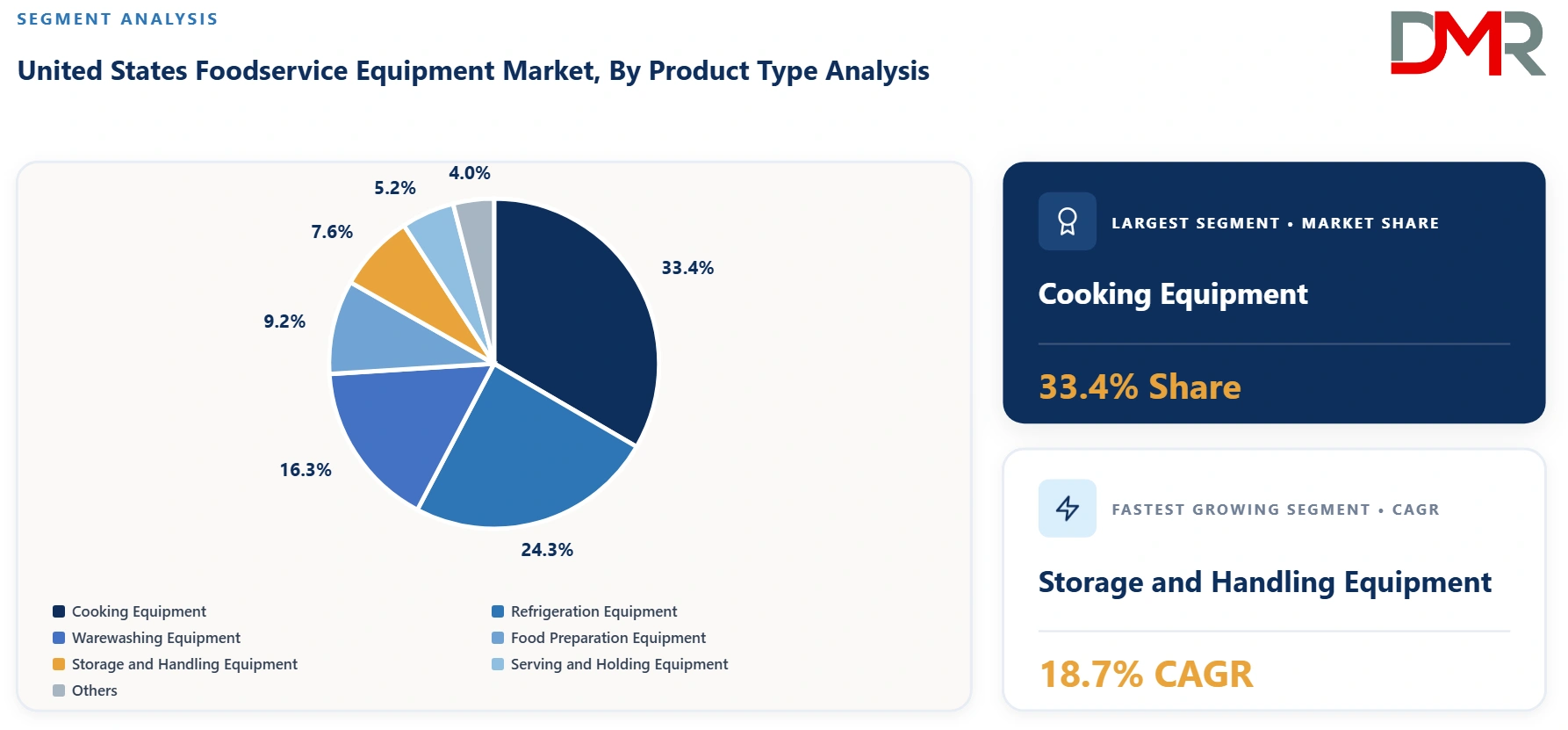
- By Product Type Analysis: Cooking Equipment is projected to lead the segment with a dominant 33.4% share in 2026, reflecting its central role across nearly all commercial kitchen operations, while Refrigeration Equipment is registering the fastest growth as operators prioritize food safety, shelf-life extension, and energy-efficient cold storage upgrades.
- By End Use Analysis: Full-Service Restaurants are anticipated to hold a 36.2% share in 2026, reflecting their broad and diverse equipment needs across complex menus, while Quick Service Restaurants represent the fastest-growing end-use category on the back of continued unit expansion and standardized kitchen buildouts.
- By Sales Channel Analysis: Dealers and Distributors are expected to command a 61.8% share in 2026, underpinned by their role bridging manufacturers and operators with local expertise, installation, and service support, while Online channels are the fastest-growing sales route as digital procurement platforms expand equipment visibility and comparison for buyers.
How AI/Gen AI is Transforming the United States Foodservice Equipment Market?
Artificial intelligence and connected kitchen technologies are reshaping the US foodservice equipment landscape by enabling predictive maintenance, automated cooking precision, and workforce-efficient kitchen operations. AI-driven appliances help ensure precise temperatures, portioning, and timing across cooking equipment, improving food quality, consistency, and safety while reducing reliance on skilled labor for repetitive tasks. Cloud-based remote oven and refrigeration management platforms give multi-location operators centralized visibility into equipment performance, usage patterns, and maintenance needs across their entire footprint, reducing costly downtime and enabling proactive servicing. These technologies also generate operational analytics that help operators optimize workflows, staffing levels, and inventory management, extending the value proposition of foodservice equipment well beyond its core cooking, cooling, or cleaning function.
Key Drivers in the United States Foodservice Equipment Market
Sustained Restaurant Industry Expansion and Replacement Cycle Demand
The US foodservice sector's continued growth, spanning quick-service, fast-casual, full-service, and institutional channels, sustains a large and structurally durable base of demand for commercial kitchen equipment across more than one million organized foodservice establishments nationwide. Beyond new unit buildouts, a substantial share of market demand comes from replacement and upgrade cycles as operators retire aging equipment in favor of models offering improved energy efficiency, automation, and connectivity. This dual demand base, spanning new construction and replacement, provides a resilient foundation for sustained equipment market growth even during periods of moderating new restaurant unit openings.
Automation Adoption Amid Persistent Kitchen Labor Constraints
Ongoing labor availability challenges across the US foodservice industry are accelerating adoption of automated and multifunctional cooking, food preparation, and warewashing equipment that reduces manual workload and shortens training time for new hires. Purchase decisions increasingly hinge on whether equipment can reduce labor intensity while maintaining throughput and menu consistency during tighter service windows, rather than solely being driven by the age of installed units. This evidence-driven shift toward labor-saving automation is generating sustained demand for advanced cooking, warewashing, and food preparation equipment across both large chain operators and independent restaurants.
Restraints in the United States Foodservice Equipment Market
High Upfront Costs and Retrofitting Complexity
The cost of installation, staff training, and potential retrofitting of existing kitchen layouts adds meaningfully to the total investment required for equipment upgrades, particularly for advanced automated or connected systems. Many smaller and independent foodservice operators, facing tighter margins than large chains, opt for lower-cost, less efficient alternatives or delay equipment investments altogether, constraining near-term market growth. Stringent regulatory requirements around food safety standards and emissions compliance further increase costs and complexity for equipment manufacturers and buyers alike.
Growth Opportunities in the United States Foodservice Equipment Market
Expansion of Equipment Leasing and As-a-Service Procurement Models
Equipment leasing and subscription-based procurement models represent a growing opportunity as operators seek to preserve capital while still accessing the latest automation and energy-efficient technology. This shift is particularly relevant for smaller multi-unit operators and franchisees who face capital constraints but still need to remain competitive on kitchen efficiency and labor reduction, creating an emerging revenue channel for equipment manufacturers and distributors beyond traditional outright purchase.
Digital Procurement and Online Equipment Marketplaces
The growth of online B2B equipment marketplaces is creating an opportunity for manufacturers and distributors to reach smaller independent operators and regional chains more efficiently than through traditional dealer networks alone. Buyers increasingly value easier product comparison, broader equipment visibility, and more efficient procurement workflows through digital purchasing platforms, positioning online channels as a structurally faster-growing route to market even as dealers and distributors retain overall channel leadership.
Trends in the United States Foodservice Equipment Market
Industry Consolidation and Portfolio Restructuring Among Major Manufacturers
A defining trend reshaping the competitive landscape is active portfolio restructuring among major US foodservice equipment manufacturers to sharpen focus on core commercial kitchen operations. In 2026, Middleby Corporation completed a sale of a 51% stake in its residential kitchen business to private-equity firm 26North Partners and spun off its commercial food processing division as an independent standalone company, Midera, positioning Middleby entirely around commercial foodservice equipment. Such restructuring reflects a broader industry pattern of equipment manufacturers concentrating capital and management attention on their highest-growth commercial foodservice segments, a dynamic expected to continue shaping competitive positioning and M&A activity through the forecast period.
Rising Adoption of Connected and Multifunctional Kitchen Systems
Operators are increasingly prioritizing multifunctional cooking equipment capable of handling high-volume food preparation across varied menu items, alongside programmable cooking cycles and induction technology that allow precise temperature control and consistency. This trend toward connected, multifunctional systems is reducing the total equipment footprint required in space-constrained commercial kitchens while improving consistency and reducing training burden, a combination increasingly demanded by both large chain operators and independent restaurants.
Research Scope and Analysis
The United States Foodservice Equipment Market is segmented by product type, end use, and sales channel. Product types span cooking, refrigeration, warewashing, food preparation, storage and handling, and serving and holding equipment. End use covers full-service restaurants, quick service restaurants, hotels and hospitality, and institutional and healthcare foodservice. Sales channels include dealers and distributors, direct sales, and online.
ℹ
To learn more about this report –
Download Your Free Sample Report Here
By Product Type Analysis
Cooking Equipment is projected to dominate the US Foodservice Equipment Market, accounting for an estimated 33.4% share in 2026. Ovens, ranges, fryers, and grills sit at the heart of commercial kitchen operations, directly influencing food quality, preparation speed, and operational efficiency across nearly every foodservice format. Refrigeration Equipment is registering the fastest growth in the forecast period, driven by the foodservice industry's need to store perishable goods efficiently, extend shelf life, and maintain food safety compliance, with energy-efficient and smart refrigeration units gaining particular traction.
By End Use Analysis
Full-Service Restaurants is poised to lead the end use segment, holding an estimated 36.2% share in 2026. Their complex menus, competitive pressures, and high equipment turnover drive demand for a broad and diverse range of technologically advanced kitchen equipment. Quick Service Restaurants represent the fastest-growing end-use category, propelled by continued unit expansion, standardized kitchen buildouts across franchise networks, and growing automation adoption to maintain speed of service at scale.
By Sales Channel Analysis
Dealers and Distributors expected to dominate the sales channel segment, accounting for an estimated 61.8% share in 2026. These intermediaries play a critical role bridging equipment manufacturers and foodservice operators, providing vital sales support, local market expertise, and installation and service capabilities that operators rely on for complex kitchen buildouts. Online channels are the fastest-growing sales route as digital B2B procurement platforms expand equipment visibility and enable more efficient product comparison, particularly benefiting smaller independent operators and regional chains.
The United States Foodservice Equipment Market Report is segmented on the basis of the following:
By Product Type
- Cooking Equipment
- Refrigeration Equipment
- Warewashing Equipment
- Food Preparation Equipment
- Storage and Handling Equipment
- Serving and Holding Equipment
- Others
By End Use
- Full-Service Restaurants
- Quick Service Restaurants
- Hotels and Hospitality
- Institutional and Healthcare Foodservice
- Others
By Sales Channel
- Dealers and Distributors
- Direct Sales
- Online
Regulatory Landscape
The regulatory landscape for US foodservice equipment is shaped by federal energy efficiency standards, food safety compliance requirements, and emissions regulations. Energy Star certification requirements and federal efficiency mandates continue to drive adoption of energy-efficient cooking, refrigeration, and warewashing equipment, with a majority of newly established commercial kitchens now utilizing Energy Star-certified equipment to reduce operating costs. Food safety standards set by the FDA Food Code and state and local health departments continue to shape equipment design and materials requirements, particularly for food preparation and storage equipment.
White Space Analysis
The US commercial foodservice equipment and supplies manufacturing industry, as tracked by trade association benchmarks, represents an estimated multi-billion-dollar segment supporting more than one million food-away-from-home locations nationwide. Commercial kitchen penetration across organized US foodservice establishments remains high, with quick service restaurants and full-service restaurants together accounting for the substantial majority of total equipment demand. Refrigeration units represent a significant share of total installed commercial kitchen equipment, reflecting the foodservice industry's sustained emphasis on food safety and perishable goods storage. Equipment leasing models and digital kitchen monitoring adoption are both expanding steadily, reflecting operators' shift toward flexible procurement and connected kitchen management approaches.
Competitive Landscape
The United States Foodservice Equipment Market is competitive, comprising diversified manufacturers, specialized equipment providers, and global companies with extensive distribution networks. The Middleby Corporation and Illinois Tool Works maintain leading positions across commercial cooking, food preparation, refrigeration, and multi-category equipment through broad brand portfolios and sustained acquisition strategies. Ali Group and Dover Corporation compete strongly in refrigeration, warewashing, cooking systems, and integrated kitchen solutions. Other prominent players focus on energy efficiency, automation, connected equipment, durability, and compliance with evolving foodservice standards. Competition is also shaped by product innovation, aftermarket service, dealer relationships, and customization for restaurants, hotels, institutional kitchens, and quick-service chains. Manufacturers increasingly invest in smart technologies and sustainable equipment to address labor shortages, operating costs, and environmental goals.
Some of the prominent players in the United States Foodservice Equipment Market are:
- The Middleby Corporation
- Illinois Tool Works Inc.
- Ali Group
- Dover Corporation
- Hoshizaki Corporation
- Rational AG
- Electrolux Professional AB
- Alto-Shaam, Inc.
- Duke Manufacturing
- Hatco Corporation
- Vollrath Company
- True Manufacturing Co., Inc.
- Traulsen
- Turbo Air Inc.
- Continental Refrigerator
- Beverage-Air Corporation
- Manitowoc Ice
- Scotsman Ice Systems
- Cambro Manufacturing Company
- Robot Coupe USA
- Waring Commercial
- Hamilton Beach Commercial
- Blendtec
- Vitamix Corporation
- Hobart Corporation
- Vulcan Equipment
- Garland Commercial Ranges
- Frymaster
- Pitco Frialator
- Southbend
- Blodgett Oven Company
- Bakers Pride
- Globe Food Equipment Company
- Server Products
- Nemco Food Equipment
- Winholt Equipment Group
- Eagle Group
- AccuTemp Products, Inc.
- Synesso
- Bunn-O-Matic Corporation
- Other Key Players
Recent Developments
- July 2026: The Middleby Corporation completed the spin-off of its food-processing business as Midera Food Processing, positioning Middleby as a pure-play commercial foodservice equipment company focused on automation, connected solutions, and kitchen efficiency.
- June 2026: Hobart, an ITW Food Equipment Group brand, added new protective features to its NoChipMax System for Legacy+ HL600 and HL662 60-quart mixers, improving durability in high-use commercial kitchen environments.
- February 2026: Hoshizaki America introduced its new PR67B-Z 67-inch Pizza Prep Table, which received a 2026 Kitchen Innovations Award for features designed to reduce ingredient waste, improve temperature control, and streamline food preparation.
- November 2025: ITW Food Equipment Group announced its new Total Kitchen Solutions Project & Design Team, effective January 2026, to strengthen support for U.S. foodservice consultants, kitchen designers, and equipment specifiers across regional markets.
Report Details
| Report Characteristics |
| Market Size (2026) |
USD 16.2 Bn |
| Forecast Value (2035) |
USD 24.1 Bn |
| CAGR (2026–2035) |
4.5% |
| Historical Data |
2021 – 2025 |
| Forecast Data |
2026 – 2035 |
| Base Year |
2025 |
| Segments Covered |
By Product Type, By End Use, and By Sales Channel |
| Regional Coverage |
The United States |
Frequently Asked Questions
How big is the United States Foodservice Equipment Market?
▾ The US Foodservice Equipment Market is valued at USD 16.2 billion in 2026 and is projected to reach USD 24.1 billion by 2035, reflecting sustained demand from restaurant expansion, equipment replacement cycles, and automation adoption across US commercial kitchens.
What is the CAGR of the United States Foodservice Equipment Market from 2026 to 2035?
▾ The market is projected to expand at a CAGR of 4.5% between 2026 and 2035, supported by continued quick-service restaurant unit growth, rising automation adoption, and steady replacement-cycle demand across the installed equipment base.
What factors are driving the growth of the United States Foodservice Equipment Market?
▾ Growth is driven by sustained restaurant industry expansion, ongoing replacement of aging kitchen equipment, rising automation adoption amid labor constraints, energy efficiency incentives, and industry consolidation among major equipment manufacturers.
What are the major trends in the United States Foodservice Equipment Market?
▾ Major trends include active portfolio restructuring and consolidation among major manufacturers, rising adoption of connected and multifunctional kitchen systems, growth of equipment leasing and as-a-service procurement models, and expansion of digital B2B procurement channels.
Which product type leads the United States Foodservice Equipment Market in 2026?
▾ Cooking Equipment leads with a 33.4% share in 2026, given its central role across nearly all commercial kitchen operations, while Refrigeration Equipment represents the fastest-growing product category.
Who are the key players in the United States Foodservice Equipment Market?
▾ Key market participants include The Middleby Corporation, Illinois Tool Works, Ali Group, Dover Corporation, Hoshizaki America, Electrolux Professional, RATIONAL, BUNN, Cambro, and The Vollrath Co., among other commercial kitchen equipment manufacturers.
How is the United States Foodservice Equipment Market segmented?
▾ The market is segmented by product type, end use, and sales channel, with regional analysis covering demand patterns across the South, Midwest, Northeast, West, and high-growth Sun Belt metropolitan markets.