Market Overview
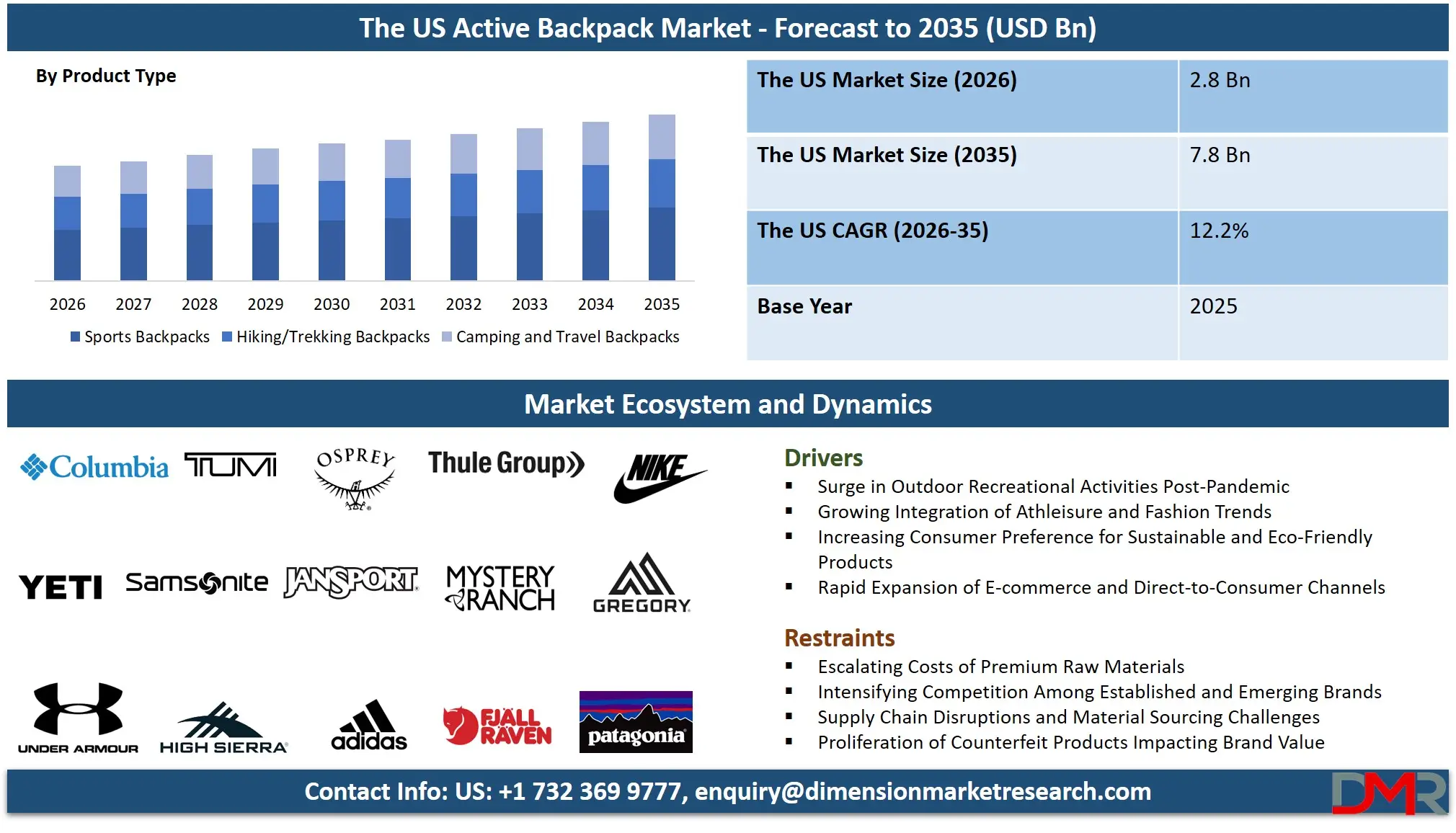
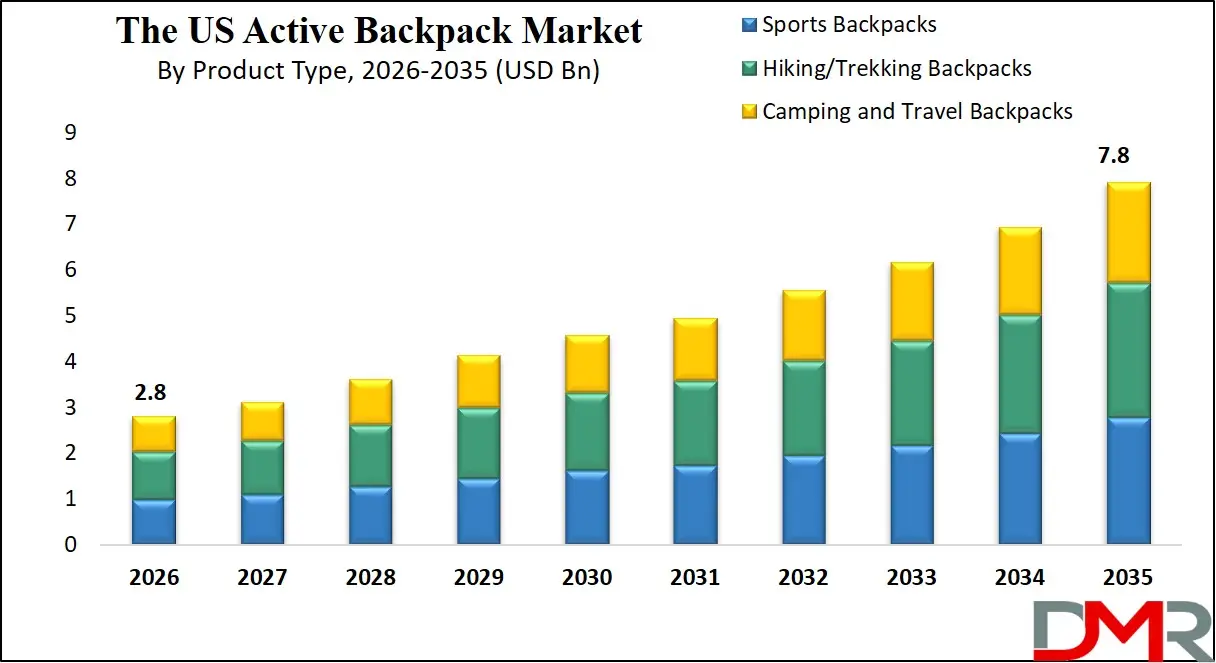
The U.S. active backpack market is anticipated to reach USD 2.8 billion in 2026 and expand at a robust CAGR of 12.2%, ultimately attaining a market value of USD 7.8 billion by 2035.
ℹ
To learn more about this report –
Download Your Free Sample Report Here
This strong growth trajectory is driven by evolving consumer lifestyles, increasing demand for outdoor gear, and the rising adoption of multifunctional carrying solutions across urban and recreational settings. Active backpacks are gaining prominence as essential accessories for fitness enthusiasts, travelers, commuters, and adventure seekers, reflecting their growing integration into everyday mobility and performance-driven activities.
The market is benefiting from rising participation in outdoor recreation, hiking, trekking, and sports activities, alongside the expanding influence of athleisure and wellness-oriented consumer behavior. Additionally, technological advancements in backpack design, including ergonomic support systems, lightweight construction, and durable materials such as ripstop nylon and recycled fabrics, are significantly enhancing product performance and longevity. These innovations are also aligned with the increasing consumer preference for sustainable and eco-friendly products.
Furthermore, the integration of smart features such as USB charging ports, anti-theft compartments, and RFID-blocking pockets is strengthening product differentiation and appealing to tech-savvy users. The shift toward a hybrid work culture and urban commuting has also accelerated demand for versatile backpacks that combine professional aesthetics with functional utility.
ℹ
To learn more about this report –
Download Your Free Sample Report Here
On the distribution side, the rapid expansion of e-commerce platforms, direct-to-consumer channels, and omnichannel retail strategies is improving product accessibility and customer engagement. However, challenges such as supply chain disruptions, fluctuating raw material costs, and evolving trade regulations may influence market dynamics.
Overall, the U.S. active backpack market is positioned for sustained growth, supported by innovation, premiumization trends, and the increasing need for high-performance, adaptable, and sustainable carry solutions.
The US Active Backpack Market: Key Takeaways
- Market Value: The U.S. Active Backpack Market size is estimated to have a value of USD 2.8 billion in 2026 and is expected to reach USD 7.8 billion by the end of 2035.
- By Product Type Segment Analysis: Hiking/Trekking Backpacks is anticipated to dominate this segment in this market as it will hold 37.3% of market share in 2026.
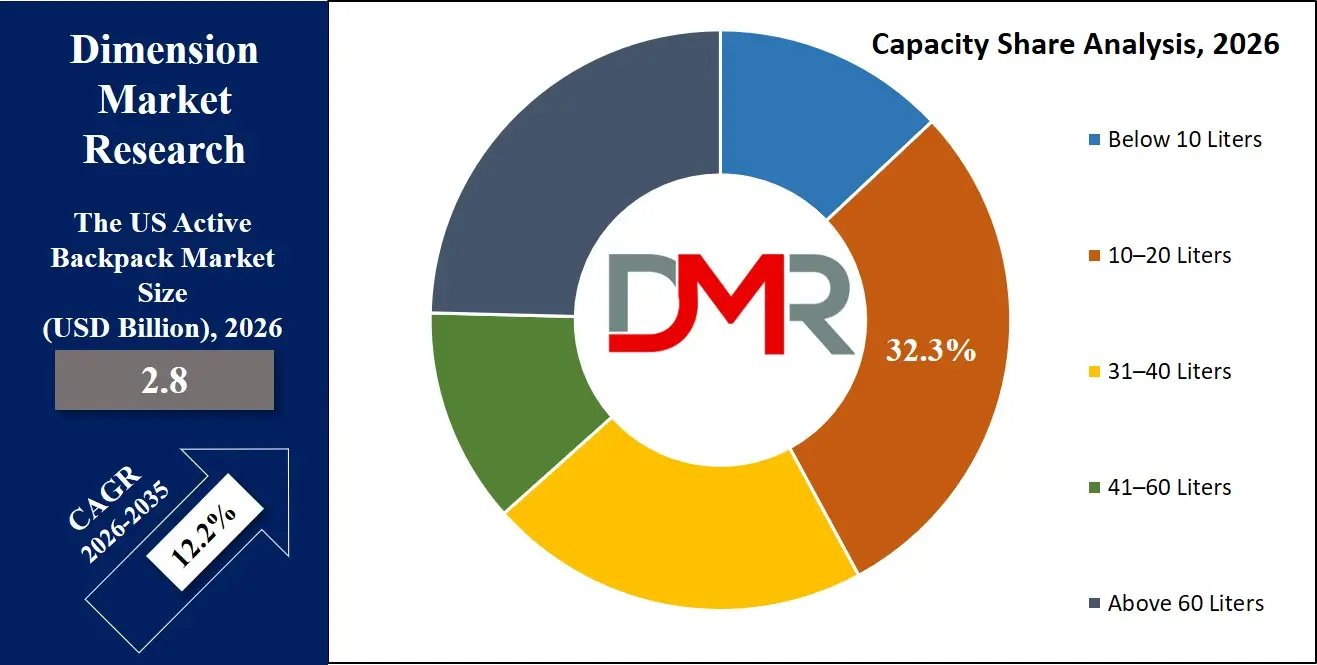
- By Capacity Segment Analysis: The 10–20 liters capacity is projected to dominate the capacity segment in the U.S. Active Backpack Market with the highest market share in 2026.
- By Price Range Segment Analysis: The mid-range ($35–$85) segment is anticipated to dominate the U.S. active backpack market with major market share in 2026.
- By Distribution Channel Segment Analysis: E-commerce Platforms is projected to hold the leading position in the distribution channel segment of this market in 2026.
- Key Players: Some of the major key players in the U.S. Active Backpack Market are The North Face, JanSport, Osprey, Nike, Adidas, Under Armour, Mystery Ranch, Deuter, Gregory Mountain Products, Patagonia, and many others.
- Market Growth Rate: The market is growing at a CAGR of 12.2 percent over the forecasted period.
The US Active Backpack Market: Use Cases
- Daily Commuting: This is about optimizing carrying capacity, ergonomic comfort, and laptop protection because of emerging hybrid work models to offer durable, organized, and style-conscious solutions across urban and suburban environments.
- Outdoor Adventure: Backpacks designed for hiking, trekking, and camping with specialized suspension systems, hydration compatibility, and weather-resistant materials ensure that outdoor enthusiasts are handled most professionally and in compliance with safety requirements.
- Fitness & Sports: Gym and sports backpacks featuring ventilated compartments for athletic gear, shoe storage, and moisture-resistant fabrics play a very critical role in active lifestyle routines.
- Travel & Weekend Getaways: Streamlining packing efficiency, carry-on compliance, and multi-functional organization to facilitate the travel needs of consumers and meet the diversified luggage preferences across different trip durations.
The US Active Backpack Market: Stats & Facts
Outdoor Industry Association (OIA) & Outdoor Foundation
- 175.8 million Americans participated in outdoor recreation in 2023.
- Outdoor participation accounted for 57.3% of the U.S. population (age 6+).
- Outdoor participation grew by 4.1% in 2023.
- 22.2 million more Americans participated in outdoor recreation compared to 2019.
- 7.7 million Americans tried outdoor recreation activities for the first time in 2023.
- Average outings per participant declined to 62.5 annually in 2023.
- Over 50% of U.S. women participated in outdoor recreation activities.
- 80% of outdoor activity categories recorded participation growth in recent years.
U.S. Bureau of Economic Analysis (BEA) / Department of Commerce
- Outdoor recreation generated approximately USD 1.3 trillion in economic output.
- The sector contributed around 2.4% to U.S. GDP.
- Outdoor recreation supports over 5.2 million jobs.
- The sector accounts for approximately 3.2% of total U.S. employment.
- Value-added contribution reached about USD 696.7 billion in GDP terms.
- Earlier estimates placed the contribution at USD 373.7 billion.
- Outdoor recreation historically represented about 2% of GDP.
- The industry has grown faster than the overall U.S. economy in recent periods.
Outdoor Recreation Roundtable
- Outdoor recreation generates about USD 1.3 trillion in annual economic output.
- The sector employs more than 5.2 million people nationwide.
- Contributes approximately 2.4% to the national GDP.
- Accounts for around 3.2% of total U.S. jobs.
Impact of Iran Conflict on the US Active Backpack Market
- Rising Fuel and Logistics Costs: Rising oil prices triggered by geopolitical tensions increase transportation, warehousing, and distribution expenses, directly elevating overall supply chain costs and retail pricing, which may reduce consumer affordability and weaken demand for active backpacks.
- Raw Material Cost Inflation: Higher petrochemical prices significantly impact the cost of synthetic materials such as polyester and nylon, increasing production expenses for manufacturers, compressing profit margins, and limiting flexibility in pricing, innovation, and product development strategies.
- Supply Chain Disruptions: Geopolitical instability can disrupt global shipping routes and trade flows, leading to delays in sourcing raw materials and delivering finished products, ultimately affecting inventory management, production timelines, and operational efficiency across the backpack value chain.
- Decline in Consumer Spending: Economic uncertainty and inflationary pressures reduce discretionary spending, causing consumers to delay or avoid purchases of non-essential items like premium backpacks, thereby impacting sales volumes and slowing overall market growth momentum.
The US Active Backpack Market: Market Dynamic
Driving Factors in the US Active Backpack Market
Outdoor Recreation Boom Post-Pandemic
The U.S. outdoor participation surge underlines renewed interest in national parks and wilderness exploration and makes the technical backpack category one of the mainstays of the outdoor industry. Huge investments in trail infrastructure and outdoor tourism initiatives have been driving growth. In addition, it also comprises lifestyle shifts toward nature-based wellness activities, which also attract both premium and entry-level investments. This helps strengthen the nation's standing as a leading outdoor gear market in North America.
Increasing Athleisure Integration
The U.S. is also developing fashion actively with its participation in trends such as the athleisure movement, increasing the crossover between gym wear and everyday apparel, which in turn is raising demand for more versatile backpack designs. The expansion of streetwear culture, the growth of lifestyle marketing, and the development of better aesthetic features are easing the way to smoother category blending. All these growth drivers increase the fashion relevance of backpacks and ensure the prosperity of the active backpack sector in the evolving consumer goods economy.
Restraints in the US Active Backpack Market
High Raw Material Costs
Premium technical fabrics and sustainable materials require huge capital investment, although consumer willingness to pay is very supportive. Smaller brands can hardly afford recycled certified materials or advanced suspension systems. This may impede market growth and further widen the gap between large corporations and niche players in access to premium materials.
Intense Market Competition
The outdoor industry will face saturation of brands competing for shelf space and consumer attention. While product differentiation is increasingly emphasized, the pace of SKU proliferation outstrips market growth rates. Normally, companies rely on aggressive discounting, greatly reducing profit margins. Getting over this restraint will involve considerable investments in brand storytelling and community-building meant to foster consumer loyalty.
Opportunities in the US Active Backpack Market
Integration of Smart Features
The adoption of technologies such as solar charging panels, GPS tracking, and integrated lighting presents an excellent opportunity for backpack functionality enhancement. Smart compartments and anti-theft features enhance user security, while connected device compatibility improves daily utility. Startups and established firms alike are testing such integrations, which offer an excellent opportunity for technology providers and investors to reach the U.S. active backpack market.
Expansion of Niche Segments
With growing demand for specialized packs for activities like trail running, climbing, and bikepacking, this niche technical segment is developing at a very fast pace. There is also more inflow of investments into lightweight materials and sport-specific designs. Additionally, demographic shifts in the U.S. and changing participation trends will further contribute to this segment and open doors for value-added service providers through innovative solution design.
Trends in the US Active Backpack Market
Digital Transformation of Retail Channels
The active backpack sector in the U.S. is also becoming a hub of digital transformation due to the initiatives laid down by major brands for integrating technology across all sales channels. Companies are leveraging technologies such as AR/VR, AI-powered fit recommendations, and social commerce for virtual try-ons, predictive inventory, and extended brand visibility. For example, AR-enabled mobile apps provide timely insights into product specifications, hence reducing any purchase hesitancy. AI enhances data accuracy in complex inventory management processes, building trust among online shoppers.
Sustainability Driving Material Innovation
This rapid consumer awareness has produced high demand in the U.S. for the sector to implement eco-friendly materials and supply chain transparency. Outdoor brands such as Patagonia and The North Face have partnered with recycled fabric suppliers to try to meet today's demanding expectations around environmental responsibility. The number of Bluesign-approved fabrics has been on the rise; there is an increasing level of circular economy models, including the implementation of repair and take-back programs. As sustainability is increasingly integral to purchasing decisions, this trend is producing real investment in the responsible sourcing of materials, but also increasingly in carbon-neutral manufacturing processes that then tie the operation together in one seamless sustainability story for brands and consumers alike.
The US Active Backpack Market: Research Scope and Analysis
By Product Type Analysis
Hiking/Trekking Backpacks is projected to dominate the product type segment in this market as it will hold 37.3% of market share in 2026. The dominance of hiking packs in the product type segment of the U.S. Active Backpack Market is owing to increased outdoor recreation participation and national park visitation in the country. Consumers in the U.S. are hugely investing in outdoor experiences; hence, advanced backpack solutions are being used to smooth wilderness excursions, ranging from internal frame systems and ventilated back panels to hydration reservoir compatibility. The U.S. demographic shift toward wellness tourism underlines the emphasis on integrating technical features for the safe enjoyment of nature. It therefore raises demand for load-lifting hip belts, adjustable torso lengths, and trekking pole attachments that help in carrying heavy gear with real-time comfort and weight distribution critical to maintaining user satisfaction in this highly competitive market. Such huge trail usage numbers spur demand for high-class suspension technologies, including heat-moldable hip belts and aluminum stays.
It will help in the complete interconnectivity of the user and environment within an outdoor adventure, thus making its future in the market indispensable. Weather resistance, impact protection, and organizational features completely depend on this basic specialized construction for gathering and securing gear within their compartments. Growth in the social media influencer category also adds to the contribution of visually distinctive designs that optimize the processes of brand discovery. Government-backed outdoor recreation initiatives advocate the use of the latest available ergonomic technologies to reduce user fatigue, thus supporting the market of hiking packs. Hence, hiking/trekking backpacks remain an integral factor as they provide the actual functional skeleton for modern outdoor adventure participation in the U.S.
By Capacity Analysis
The 10–20 liter capacity range is anticipated to dominate the share in the capacity segment of the active backpack market in the U.S., owing to the strategic versatility of this size for both day hikes and urban commuting. The U.S. has vast expanses of varied terrain with a trail network connecting important recreational regions for easier carrying of gear to destinations such as the Appalachian Trail, the Rocky Mountains, and the Pacific Crest Trail. This capacity offers flexibility and utility that no other size range can provide. Overnight trips and extended day use, being very essential, do happen with outdoor recreation and also in travel and work scenarios. There is an unparalleled growth in the number of hybrid usage models, as with a growing demand for do-it-all packs, manifold times the same consumer would want to expect versatility across activities.
ℹ
To learn more about this report –
Download Your Free Sample Report Here
The material technology investments involve the expansion of lightweight yet durable fabrics, adding load management features across this sweet spot capacity, and furthering carrying comfort. This development also aligns with the carry-on size compliance for air travel in positioning 10-20L packs as ideal for weekend travel. The proximity of urban centers to trailheads further cements their position as the main capacity range for active consumers. Among many factors, versatility comes forward. Compared with either smaller or larger packs, it has 10-20L at lesser compromises for varied uses, thus making it perfectly fit for multi-purpose ownership. The increased use of compression systems and organization features, like admin panels and stretch mesh pockets, improves the user experience-cum-situation more in enhancing capacity dominance.
By Price Range Analysis
The price range segment in the U.S. Active Backpack Market is projected to be dominated by mid-range ($35–$85) products, having become balanced in affordability, quality, and feature sets. Due to the increased adoption of outdoor activities by mainstream consumers in the U.S., mid-range backpacks offer optimal infrastructure support for reliable performance. This is also aligned with the consumer expectation toward a reasonable investment for occasional-to-regular use. Mid-range solutions make the quality accessible to enable better purchasing decisions and broader participation among the different consumer segments along the activity spectrum. This becomes even more important in a geographically spread-out country like the U.S., where retail access needs to be seamlessly priced. Moreover, mid-range pricing reduces barriers associated with premium sticker shock, such as purchase hesitation and extended replacement cycles. The value appeal attracts consumers of all demographics, especially younger millennials and Gen Z, who are a growth segment in the U.S. economy.
Not to say that the capability for decent features and durability of the mid-range products stands in their favor, too. Reliable materials, adequate suspension, and organizational features integrated with these backpacks further enable consumers in varied usage relevant to accommodating daily transitions. This dream is partly driven by initiatives from major retailers aimed at improving private label offerings and partnering with mid-tier brands. This will enable them to support dynamic market demands and ensure price accessibility, hence remaining the dominant price range within the active backpack market.
By Distribution Channel Analysis
The e-commerce platforms segment is poised to dominate the U.S. active backpack market due to several reasons, such as vast product selection, convenience, and advanced digital marketing capabilities. Online retailers are at the forefront of assortment optimization, driven by their capacity to showcase extensive inventory without physical constraints. The U.S. retail landscape places a strong emphasis on the development of omnichannel presence, a factor that pure-play e-commerce and brick-and-click retailers are eyeing with great interest. These platforms could be offering very extensive product comparison, for which they need advanced recommendation engines to track preferences in real-time, enable intelligent cross-selling, and improve category discovery. Online retailers also boast scale for the adoption of innovative technologies like AR try-on and user-generated content reviews, paving the way to enhance conversion and complete transparency in operations. The reason online retailers can offer competitive pricing and detailed product information is that they have an overall operational scale.
E-commerce platforms have benefited from such market trends fueled by consumer preference for contactless transactions, examples of which are the programs under various shipping innovations to provide different types of delivery speeds and return conveniences to extend the purchasing functionalities of their platforms. In summary, this dominant position has also been enabled by driving the wheel of U.S. consumer goods e-commerce. At the forefront in the implementation of state-of-the-art digital retail best practices, leading online retailers continue to help set new thresholds in terms of assortment depth and consumer experience across categories, therefore continuing their top market performance.
The US Active Backpack Market Report is segmented on the basis of the following:
By Product Type
- Sports Backpacks
- Hiking/Trekking Backpacks
- Camping and Travel Backpacks
By Capacity
- Below 10 Liters
- 10–20 Liters
- 31–40 Liters
- 41–60 Liters
- Above 60 Liters
By Price Range
- Budget (Below <$35)
- Mid-range ($35–$85)
- Premium ($85–$145)
- Luxury (Above >$145)
By Distribution Channel
- E-commerce Platforms
- Specialty Outdoor Retail Stores
- Multi-brand Sports & Lifestyle Store
- Hypermarkets & Supermarkets
- Brand Exclusive Stores
Impact of Artificial Intelligence in the US Active Backpack Market
- AI-Driven Product Design Optimization: Artificial intelligence enables advanced design simulations and predictive modeling, helping manufacturers develop ergonomically optimized backpacks with improved weight distribution, durability, and user comfort, while accelerating product development cycles and reducing prototyping costs.
- Personalization and Customization Capabilities: AI-powered analytics allow brands to offer personalized backpack configurations based on user preferences, body metrics, and usage patterns, enhancing customer satisfaction through tailored designs, modular features, and improved fit systems aligned with individual needs.
- Demand Forecasting and Inventory Management: AI enhances supply chain efficiency by enabling accurate demand forecasting, real-time inventory tracking, and automated replenishment systems, reducing stockouts and overproduction while improving operational agility across retail and e-commerce distribution channels.
- Smart Backpacks and Connected Features: Integration of AI in smart backpacks supports features such as location tracking, usage monitoring, anti-theft alerts, and energy optimization for built-in devices, increasing product value and appeal among tech-savvy and urban consumers.
The US Active Backpack Market: Competitive Landscape
The competitive landscape is fueled by participation, both domestic and international, in the U.S. Active Backpack Market, with dissimilar capabilities across design, materials, and distribution. Major companies, therefore, strategize to develop advanced technologies such as sustainable fabrics, ergonomic suspension, and smart features to enhance backpack performance and improve competitiveness. The leading players are The North Face, JanSport, and Osprey in technical outdoor gear, while in lifestyle and sports segments, the leading players include Nike, Adidas, and Under Armour. These companies leverage U.S. consumer trends by aligning their offerings with preferences meant to attract loyalty and improve market share. It addresses both rising outdoor and urban sectors, where these focus more on niche capabilities: ultralight construction and hydration compatibility, while direct-to-consumer brands have emerged, providing customizable options in size and color configuration.
ℹ
To learn more about this report –
Download Your Free Sample Report Here
Mergers and partnerships are common strategies that allow companies to expand design portfolios and retail reach. For instance, material science companies partnering with gear brands enhance performance-driven innovation and sustainability credentials. While the leading companies are competitive, innovation in the fields of modular design, sustainable manufacturing, and predictive analytics separates the leaders. These opportunities are likely to come along with an intense competitive landscape for both established players and new entrants, with strong consumer demand for technical and lifestyle versatility.
Some of the prominent players in the US Active Backpack Market are:
- VF Corporation
- Osprey Packs, Inc.
- Deuter Sport GmbH
- Samsonite International S.A. (Gregory Mountain Products)
- Nike, Inc.
- Adidas AG
- Patagonia, Inc.
- Columbia Sportswear Company
- Mammut Sports Group AG
- Black Diamond Equipment, Ltd.
- Mystery Ranch (part of Yeti Holdings)
- Arc'teryx (ANTA Sports Products Limited)
- Thule Group
- Lowe Alpine
- Jack Wolfskin
- Quechua (Decathlon S.A.)
- Herschel Supply Co.
- Fjällräven (Fenix Outdoor AB)
- Karrimor (Frasers Group)
- Other Key Players
Recent Developments in the US Active Backpack Market
- March 2026: VF Corporation, Samsonite, and Osprey Packs accelerated investments in sustainable materials, smart features, and modular backpack designs to meet rising demand for eco-friendly and multifunctional gear.
- November 2025: VF Corporation completed the divestment of its Dickies brand to strengthen focus on core outdoor and active lifestyle segments, including backpacks, through brands like The North Face and JanSport.
- September 2025: Nike, Adidas, and Under Armour expanded omnichannel retail strategies through new stores and enhanced e-commerce platforms to improve customer engagement.
- June 2025: Patagonia and The North Face increased collaborations with recycled material suppliers to develop eco-friendly backpacks, supporting circular economy initiatives.
- March 2025: Herschel Supply Company and Tumi accelerated investments in direct-to-consumer channels, enhancing personalized shopping experiences and digital engagement.
- January 2025: Samsonite and Thule Group adopted artificial intelligence for product design optimization, demand forecasting, and customization.
- July 2024: VF Corporation divested its Supreme brand to streamline its portfolio and reallocate resources toward high-growth outdoor and backpack segments.
Report Details
| Report Characteristics |
| Market Size (2026) |
USD 2.8 Bn |
| Forecast Value (2035) |
USD 7.8 Bn |
| CAGR (2026–2035) |
12.2% |
| Historical Data |
2021 – 2025 |
| Forecast Data |
2027 – 2035 |
| Base Year |
2025 |
| Estimate Year |
2026 |
| Report Coverage |
Market Revenue Estimation, Market Dynamics, Competitive Landscape, Growth Factors and etc. |
| Segments Covered |
By Product Type (Sports Backpacks, Hiking/Trekking Backpacks, Camping and Travel Backpacks), By Capacity (Below 10 Liters, 10–20 Liters, 31–40 Liters, 41–60 Liters, Above 60 Liters), By Price Range (Budget [Below <$35], Mid-range [$35–$85], Premium [$85–$145], Luxury [Above >$145]), and By Distribution Channel (E-commerce Platforms, Specialty Outdoor Retail Stores, Multi-brand Sports & Lifestyle Store, Hypermarkets & Supermarkets, Brand Exclusive Stores) |
| Country Coverage |
The US |
| Prominent Players |
VF Corporation, Osprey Packs, JanSport, The North Face, Deuter, Gregory Mountain Products, High Sierra, Tumi, L.L.Bean, Patagonia, Columbia Sportswear, Nike, Adidas, Under Armour, Samsonite, Herschel Supply Company, Thule Group, YETI Holdings, Mystery Ranch, Fjällräven, and Other Key Players |
| Purchase Options |
We have three licenses to opt for: Single User License (Limited to 1 user), Multi-User License (Up to 5 Users) and Corporate Use License (Unlimited User) along with free report customization equivalent to 0 analyst working days, 3 analysts working days and 5 analysts working days respectively. |
Frequently Asked Questions
How big is the U.S. Active Backpack Market?
▾ The U.S. Active Backpack Market size is estimated to have a value of USD 2.8 billion in 2026 and is expected to reach USD 7.8 billion by the end of 2035.
Who are the key players in the U.S. Active Backpack Market?
▾ Some of the major key players in the U.S. Active Backpack Market are The North Face, JanSport, Osprey, Nike, Adidas, Under Armour, Mystery Ranch, Deuter, Gregory Mountain Products, Patagonia, and many others.
What is the growth rate in the U.S. Active Backpack Market?
▾ The market is growing at a CAGR of 12.2 percent over the forecasted period.