Market Overview
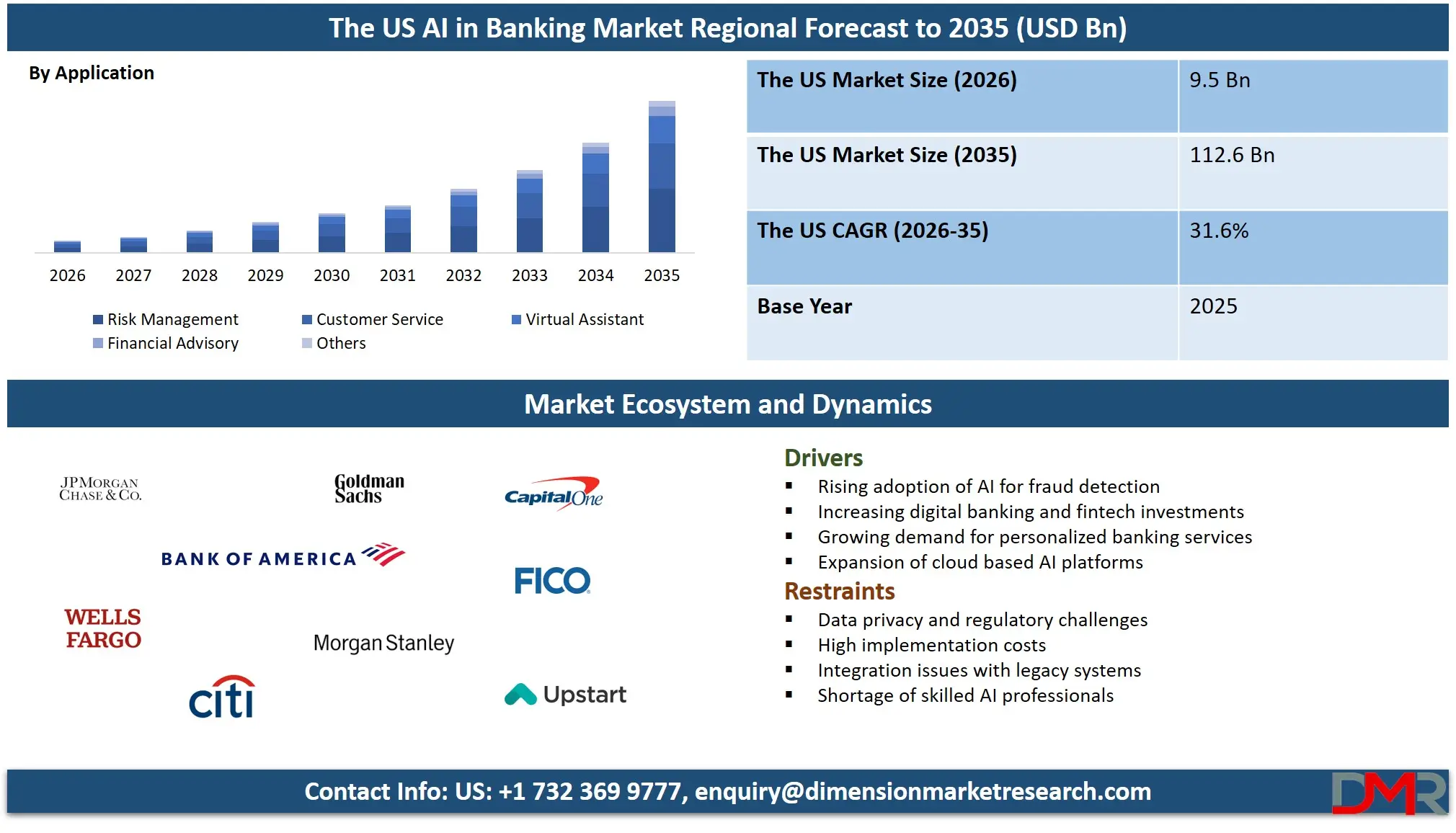
The US AI in Banking Market is estimated to reach USD 9.5 billion in 2026 and is expected to expand significantly to USD 112.6 billion by 2035, registering a CAGR of 31.6% during the forecast period. The market growth is driven by rising adoption of machine learning, predictive analytics, fraud detection systems, intelligent automation, and AI driven financial services across digital banking platforms.
ℹ
To learn more about this report –
Download Your Free Sample Report Here
Artificial Intelligence in banking refers to the use of advanced technologies such as machine learning, natural language processing, predictive analytics, and intelligent automation to enhance financial services, operational efficiency, and customer engagement within banking institutions. AI systems analyze large volumes of financial data to identify patterns, detect fraudulent transactions, improve credit risk assessment, and personalize banking experiences. Banks increasingly deploy AI powered chatbots, virtual assistants, automated compliance monitoring, and algorithm driven investment tools to streamline processes and reduce operational costs. By integrating intelligent data processing and real time analytics, AI enables financial institutions to strengthen cybersecurity, improve decision making, and deliver faster and more accurate banking services across digital platforms.
The US AI in Banking Market represents the growing adoption of artificial intelligence solutions across commercial banks, digital banks, and financial technology providers in the United States. Financial institutions in the country are actively investing in AI driven banking platforms to enhance customer service, automate loan underwriting, optimize wealth management, and improve transaction monitoring. The presence of a highly developed financial ecosystem, strong fintech innovation, and widespread digital banking adoption supports the integration of intelligent technologies within core banking operations. AI powered fraud detection systems, robotic process automation in back office functions, and intelligent document processing are becoming essential tools for modern banking infrastructure.
ℹ
To learn more about this report –
Download Your Free Sample Report Here
The expansion of the US AI in Banking Market is also driven by increasing demand for data driven decision making and advanced financial analytics. Banks are leveraging deep learning models, behavioral analytics, and predictive risk management tools to enhance regulatory compliance and improve financial forecasting. Additionally, the rise of cloud based banking platforms, open banking frameworks, and digital payment ecosystems is creating opportunities for AI based solutions to transform traditional banking models. As financial institutions continue to focus on improving operational agility, cybersecurity resilience, and customer centric banking services, the adoption of artificial intelligence technologies across the US banking sector is expected to grow significantly.
The US AI in Banking Market: Key Takeaways
- Rapid Market Expansion: The market is projected to grow from USD 9.5 billion in 2026 to USD 112.6 billion by 2035, reflecting strong adoption of AI technologies across banking operations.
- High Growth Rate: The market is expected to register a CAGR of 31.6% from 2026 to 2035, driven by increasing use of machine learning, predictive analytics, and intelligent automation in banking.
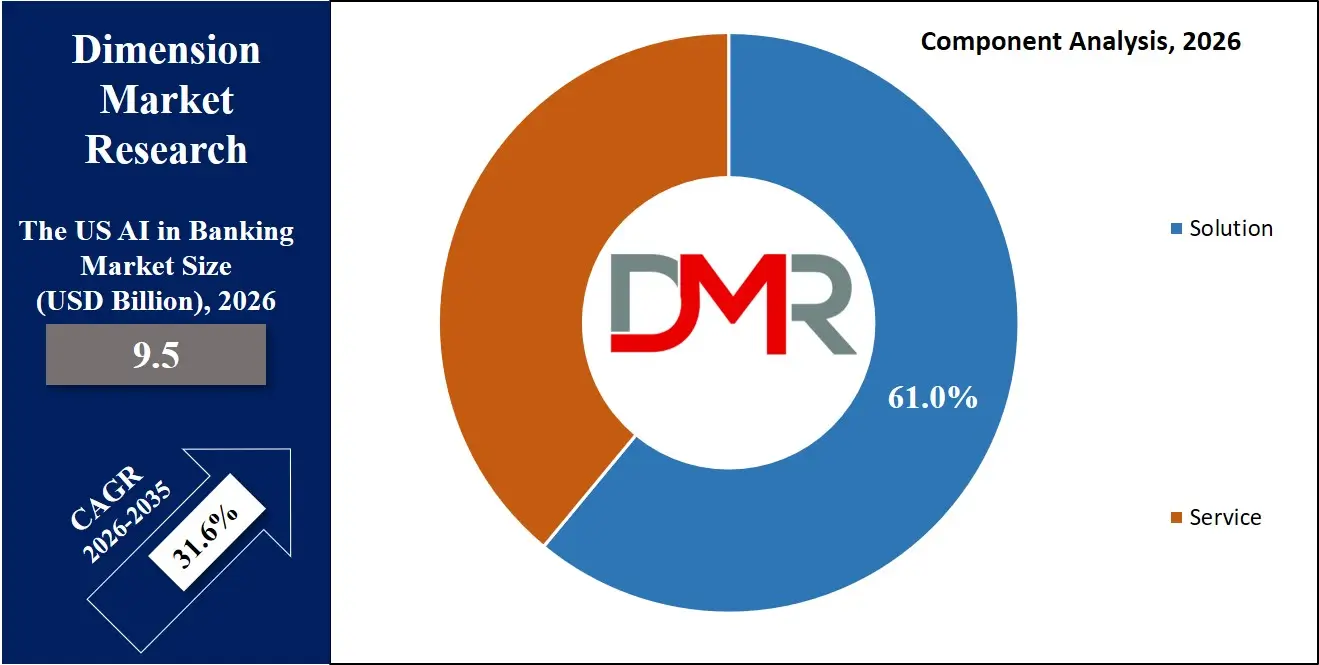
- Dominance of AI Solutions: Solution components are anticipated to lead the segment with 61.0% market share in 2026, supported by rising deployment of fraud detection, risk analytics, and AI banking platforms.
- Natural Language Processing Leadership: Natural language processing technologies are projected to hold 44.0% of the technology segment in 2026, due to growing use of chatbots and conversational banking tools.
- Large Enterprise Adoption: Large enterprises are expected to capture 73.0% of the market share in 2026, reflecting strong investments by major banks in AI driven digital banking solutions.
The US AI in Banking Market: Use Cases
- Fraud Detection and Risk Analytics: AI helps US banks detect fraudulent transactions using machine learning and predictive analytics. Advanced data analytics tools monitor transaction patterns in real time, improving risk management, anti-money laundering compliance, and financial security across digital banking platforms.
- AI Powered Chatbots and Virtual Banking Assistants: Banks deploy AI chatbots and virtual assistants to provide instant customer support and personalized banking services. Natural language processing enables automated responses for account queries, payments, and financial guidance, improving digital customer experience and operational efficiency.
- Credit Scoring and Loan Underwriting: AI driven credit analytics helps banks evaluate borrower profiles using behavioral data and predictive models. Automated loan underwriting improves credit risk assessment, speeds up lending decisions, and supports data driven financial services across retail and commercial banking.
- Personalized Financial Services and Wealth Management: Artificial intelligence enables banks to offer personalized financial recommendations using customer data analytics. AI based investment advisory tools and robo advisory platforms help optimize portfolio management, enhance customer engagement, and improve digital wealth management solutions.
The US AI in Banking Market: Stats & Facts
- Federal Deposit Insurance Corporation (FDIC)
- In 2023, 96% of U.S. households had a bank account, indicating widespread participation in the formal banking system.
- About 4.2% of U.S. households, representing roughly 5.6 million households, were unbanked in 2023.
- The underbanked population accounted for 14.2% of U.S. households in 2023, representing nearly 19 million households.
- Around 48.3% of banked households used mobile banking as their primary method to access their bank accounts in 2023.
- Approximately 49.7% of U.S. households used nonbank online payment services in 2023.
- About 76.4% of households owned a credit card in 2023.
- Around 15.7% of U.S. households had no access to mainstream credit in 2023.
- Approximately 3.9% of U.S. households used Buy Now Pay Later services within the previous 12 months in 2023.
- Around 4.8% of U.S. households owned or used cryptocurrency in 2023.
- About 66.2% of unbanked households relied primarily on cash for financial transactions in 2023.
- Approximately 33.8% of unbanked households used prepaid cards or online payment services in 2023.
- The use of prepaid cards declined to 5.9% of U.S. households in 2023.
- Around 8.0% of households used nonbank money orders in 2023.
- Approximately 2.7% of households used nonbank check cashing services in 2023.
- About 6.6% of households used nonbank money transfer services in 2023.
The US AI in Banking Market: Market Dynamic
Driving Factors in the US AI in Banking Market
Increasing Adoption of Intelligent Fraud Detection and Risk Analytics
The rapid growth of digital banking and online financial transactions in the United States has significantly increased the need for advanced fraud detection systems. Banks are deploying artificial intelligence, machine learning algorithms, and predictive analytics to monitor transaction behavior and identify anomalies in real time. AI powered financial analytics platforms support anti-money laundering monitoring, credit risk modeling, and regulatory compliance management. These intelligent systems help financial institutions strengthen cybersecurity infrastructure, reduce operational risk, and improve accuracy in fraud prevention across digital payment ecosystems.
Rising Investment in Digital Banking and Fintech Innovation
The expansion of fintech innovation and digital financial services is accelerating the adoption of AI driven banking solutions across the US banking sector. Financial institutions are investing in cloud based banking platforms, intelligent automation, and data driven decision systems to modernize core banking operations. Technologies such as natural language processing, robotic process automation, and AI powered chatbots are improving customer engagement and operational efficiency. The growing integration of advanced analytics and automated financial services is enabling banks to enhance digital customer experience and streamline complex banking workflows.
Restraints in the US AI in Banking Market
Data Privacy and Regulatory Compliance Challenges
Strict financial regulations and data privacy requirements remain a major restraint for the adoption of artificial intelligence in banking. Banks must comply with complex regulatory frameworks related to data protection, consumer privacy, and financial transparency. AI systems rely on large volumes of customer data for predictive analytics and behavioral modeling, which increases concerns regarding data security and ethical AI deployment. Ensuring compliance with regulatory standards while maintaining transparency in algorithm based decision making creates operational challenges for financial institutions.
High Implementation Costs and Technology Integration Issues
Implementing advanced AI infrastructure requires significant investment in data management systems, cloud computing platforms, and specialized analytics tools. Many banks also face challenges integrating artificial intelligence solutions with legacy banking systems and traditional financial software. The complexity of deploying machine learning models, maintaining cybersecurity protocols, and training skilled professionals increases operational costs. These technological and financial barriers can slow the pace of AI adoption among smaller financial institutions and regional banks.
Opportunities in the US AI in Banking Market
Growth of AI Powered Personalized Banking Services
The increasing demand for personalized financial services presents a major opportunity for AI adoption in the US banking market. Artificial intelligence enables banks to analyze customer behavior, spending patterns, and financial preferences using advanced data analytics. This allows financial institutions to deliver customized product recommendations, targeted financial planning solutions, and intelligent wealth management services. AI driven customer insights help banks improve client engagement, enhance digital banking experiences, and develop more personalized financial products.
Expansion of AI Driven Credit Analytics and Lending Platforms
AI technologies are transforming credit assessment and lending operations by enabling more accurate credit scoring and automated loan evaluation. Machine learning models analyze alternative financial data, transaction history, and behavioral patterns to improve credit risk analysis. This enables banks to expand access to credit, accelerate loan approval processes, and reduce default risk. AI powered lending platforms and automated underwriting systems are creating new opportunities for financial institutions to improve efficiency in retail and commercial lending.
Trends in the US AI in Banking Market
Integration of Generative AI and Advanced Data Intelligence
A key trend shaping the US AI in Banking Market is the integration of generative AI and advanced data intelligence platforms. Financial institutions are leveraging large language models, AI powered knowledge systems, and intelligent data processing tools to automate financial documentation, customer communication, and financial reporting. These technologies enable banks to enhance operational productivity, improve customer interaction across digital channels, and support data driven financial insights.
Increasing Adoption of Cloud Based AI Banking Platforms
The migration toward cloud based infrastructure is accelerating the deployment of AI driven banking solutions across the United States. Banks are integrating cloud computing, big data analytics, and intelligent automation to enhance scalability and operational flexibility. Cloud enabled AI platforms allow financial institutions to process large volumes of financial data, support real time analytics, and deploy advanced banking applications more efficiently. This trend is transforming traditional banking models and enabling faster innovation in digital financial services.
The US AI in Banking Market: Research Scope and Analysis
By Component Analysis
Solution type components are expected to dominate the component type segment in the US AI in Banking Market, accounting for approximately 61.0% of the market share in 2026. The strong adoption of AI based solutions across banking institutions is primarily driven by the increasing need for advanced data analytics, fraud detection platforms, credit risk modeling systems, and automated financial decision tools. Banks in the United States are integrating machine learning algorithms, predictive analytics software, and intelligent automation platforms to improve operational efficiency and enhance digital banking services. These solutions help financial institutions analyze large volumes of transaction data, detect anomalies, strengthen cybersecurity infrastructure, and optimize customer engagement strategies. In addition, AI driven chatbots, virtual banking assistants, and personalized financial recommendation engines are widely deployed to improve customer experience and streamline routine banking operations. As banks continue to modernize their core banking systems and adopt digital transformation strategies, the demand for scalable AI software platforms and advanced analytics solutions is expected to remain high across the US banking ecosystem.
ℹ
To learn more about this report –
Download Your Free Sample Report Here
Service components also play an important role in supporting the implementation and long term performance of AI technologies within banking institutions. These services include consulting, system integration, deployment support, and ongoing maintenance of artificial intelligence platforms used in financial operations. Many banks rely on specialized service providers to design customized AI models, integrate intelligent solutions with legacy banking infrastructure, and ensure regulatory compliance across data driven financial systems. Professional services help financial institutions identify suitable AI use cases, develop data management frameworks, and implement advanced analytics capabilities. In addition, managed services provide continuous monitoring, system optimization, and cybersecurity management for AI based banking applications. As artificial intelligence solutions become more complex and data intensive, the demand for technical expertise, training programs, and operational support services is increasing across the US banking sector. These services enable banks to maximize the value of AI investments while ensuring secure and efficient deployment of intelligent financial technologies.
By Technology Analysis
Natural language processing technologies are expected to maintain a dominant position in the technology type segment of the US AI in Banking Market, accounting for around 44.0% of the total market share in 2026. The growing use of conversational banking platforms and intelligent communication systems is a key factor supporting this expansion. Banks across the United States are increasingly integrating NLP based solutions to improve digital customer engagement and automate interactions across multiple banking channels. These technologies enable financial institutions to process and interpret human language from emails, voice commands, customer queries, and financial documents. AI driven chatbots and virtual banking assistants powered by natural language processing help banks deliver faster responses, manage customer inquiries, and provide personalized financial guidance. In addition, NLP applications are widely used in automated document processing, sentiment analysis, compliance monitoring, and financial reporting, allowing banks to extract valuable insights from large volumes of unstructured financial data and enhance operational productivity.
Machine learning and deep learning technologies represent another critical subsegment within the technology landscape of the US AI in Banking Market. These advanced analytical models are widely used to identify complex data patterns and generate predictive insights that support financial decision making. Banks apply machine learning algorithms for credit scoring, transaction monitoring, fraud detection, and risk management. Deep learning techniques further enhance these capabilities by analyzing high dimensional financial datasets and improving the accuracy of predictive models. Financial institutions are increasingly utilizing these technologies to strengthen portfolio management, automate loan underwriting processes, and detect abnormal financial activities across digital payment systems. The ability of machine learning and deep learning platforms to continuously learn from new data allows banks to improve forecasting accuracy, enhance operational efficiency, and develop more advanced data driven banking strategies.
By Enterprise Size Analysis
Large enterprises are expected to maintain a dominant position in the enterprise type segment of the US AI in Banking Market, accounting for around 73.0% of the total market share in 2026. Major banks and large financial institutions have strong financial capabilities and advanced digital infrastructure that allow them to invest heavily in artificial intelligence technologies. These organizations are actively deploying AI driven platforms for fraud detection, predictive risk analytics, automated compliance monitoring, and intelligent customer service solutions. Large banking institutions also generate vast volumes of financial and customer data, which can be effectively analyzed using machine learning models and advanced analytics systems. This enables them to improve financial forecasting, strengthen cybersecurity frameworks, and optimize operational processes. Additionally, large enterprises often collaborate with fintech companies and technology providers to integrate AI powered solutions into their core banking platforms, accelerating innovation in digital financial services.
Small and medium sized enterprises within the banking and financial services ecosystem are gradually increasing their adoption of artificial intelligence technologies as digital transformation initiatives expand across the industry. Many regional banks, community banks, and smaller financial institutions are leveraging cloud based AI platforms and software as a service solutions to access advanced analytics tools without making large infrastructure investments. These institutions are implementing AI applications for automated customer support, credit risk assessment, transaction monitoring, and personalized financial product recommendations. The availability of scalable AI solutions and managed services is enabling SMEs to improve operational efficiency, enhance customer engagement, and compete more effectively with larger financial institutions in the evolving digital banking environment.
By Application Analysis
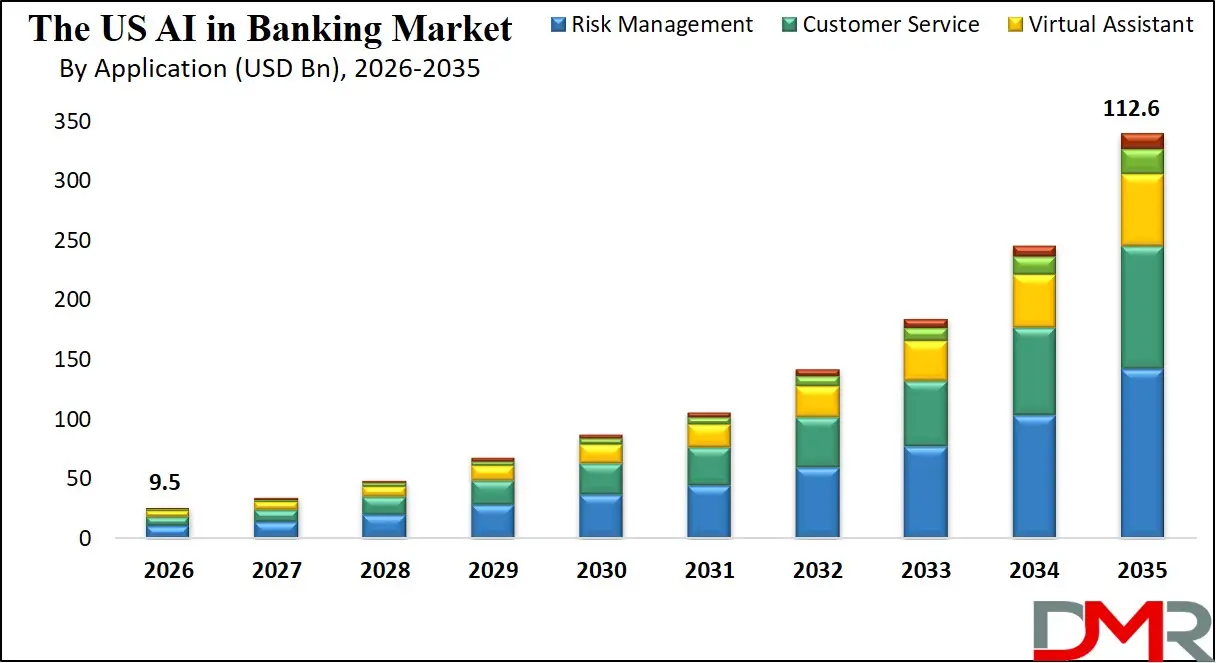
Risk management applications are expected to hold a leading position in the application type segment of the US AI in Banking Market, capturing around 42.0% of the total market share in 2026. Financial institutions in the United States are increasingly relying on artificial intelligence to strengthen risk monitoring, detect financial irregularities, and support data driven decision making. AI powered risk management systems analyze large volumes of transactional and customer data to identify potential threats, abnormal financial patterns, and operational risks. Machine learning algorithms enable banks to improve credit risk evaluation, enhance fraud detection capabilities, and strengthen anti-money laundering monitoring. These intelligent analytics platforms also assist banks in regulatory compliance by automating risk reporting and improving transparency in financial operations. As digital payments and online banking services continue to expand, the role of AI based risk management solutions is becoming essential for maintaining financial stability and protecting sensitive financial information.
Customer service applications represent another significant subsegment within the application landscape of the US AI in Banking Market. Banks are increasingly using artificial intelligence to improve customer interaction, deliver personalized banking experiences, and streamline service delivery across digital channels. AI driven chatbots, virtual assistants, and conversational banking platforms help financial institutions respond to customer queries, provide account related information, and support digital transactions in real time. Natural language processing technologies allow these systems to understand customer requests and deliver accurate responses through mobile banking applications, websites, and voice based interfaces. By automating routine service tasks and providing instant support, AI powered customer service tools help banks reduce operational workload, enhance customer satisfaction, and improve engagement across digital banking platforms.
The US AI in Banking Market Report is segmented on the basis of the following:
By Component
By Technology
- Natural Language Processing (NLP)
- Machine Learning & Deep Learning
- Computer Vision
- Others
By Enterprise Size
By Application
- Risk Management
- Customer Service
- Virtual Assistant
- Financial Advisory
- Others
The US AI in Banking Market: Competitive Landscape
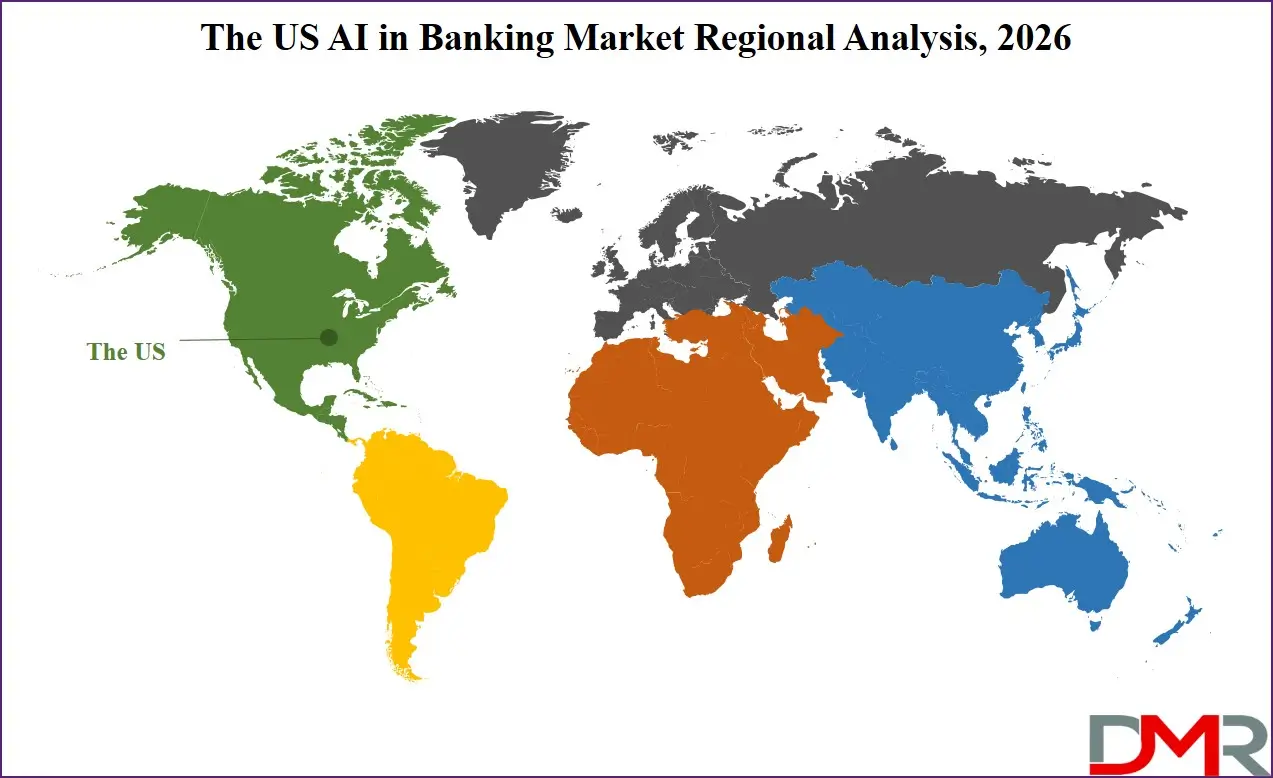
The US AI in Banking Market is characterized by an increasingly competitive landscape driven by rapid technological innovation, strategic partnerships, and continuous investment in advanced analytics platforms. Financial institutions are actively integrating artificial intelligence capabilities into core banking systems to improve fraud detection, credit risk assessment, and digital customer engagement.
ℹ
To learn more about this report –
Download Your Free Sample Report Here
Competition in the market is shaped by the growing demand for machine learning based financial solutions, intelligent automation tools, and cloud enabled banking platforms. Market participants are focusing on developing scalable AI frameworks, enhancing data management capabilities, and strengthening cybersecurity features to meet evolving regulatory requirements. In addition, collaboration between financial service providers and fintech innovators is accelerating the deployment of AI driven banking applications across digital payment systems, lending platforms, and personalized financial services.
Some of the prominent players in the US AI in Banking Market are:
- JPMorgan Chase
- Bank of America
- Wells Fargo
- Citigroup
- Goldman Sachs
- Morgan Stanley
- Capital One
- FICO
- Upstart Holdings
- Zest AI
- nCino
- DataRobot
- Palantir Technologies
- Verint Systems
- Pagaya Technologies
- SoFi Technologies
- Abrigo
- Intuit
- Visa
- Mastercard
- Other Key Players
Recent Developments in the US AI in Banking Market
- March 2026: FICO launched an advanced AI powered fraud detection and financial risk analytics platform designed for banking institutions to strengthen transaction monitoring and credit risk assessment. The platform integrates machine learning models and behavioral analytics to help banks improve fraud prevention, regulatory compliance, and real time financial decision making across digital banking systems.
- February 2026: Visa completed the acquisition of Featurespace, a company specializing in artificial intelligence based fraud detection solutions. The acquisition aims to strengthen Visa’s real time payment security and AI powered transaction monitoring capabilities within the global banking and digital payments ecosystem.
- January 2026: IBM introduced an AI driven conversational banking solution based on its Watson technology to support intelligent customer service automation. The platform uses natural language processing and advanced analytics to enable virtual banking assistants, automated query resolution, and personalized financial recommendations across mobile and online banking platforms.
Report Details
| Report Characteristics |
| Market Size (2026) |
USD 9.5 Bn |
| Forecast Value (2035) |
USD 112.6 Bn |
| CAGR (2026–2035) |
31.6% |
| Historical Data |
2021 – 2025 |
| Forecast Data |
2027 – 2035 |
| Base Year |
2025 |
| Estimate Year |
2026 |
| Report Coverage |
Market Revenue Estimation, Market Dynamics, Competitive Landscape, Growth Factors and etc. |
| Segments Covered |
By Component (Solution, Service), By Technology (Natural Language Processing (NLP), Machine Learning & Deep Learning, Computer Vision, Others), By Enterprise Size (Large Enterprise, SMEs), By Application (Risk Management, Customer Service, Virtual Assistant, Financial Advisory, Others). |
| Country Coverage |
The US |
| Prominent Players |
JPMorgan Chase, Bank of America, Wells Fargo, Citigroup, Goldman Sachs, Morgan Stanley, Capital One, FICO, Upstart Holdings, Zest AI, nCino, DataRobot, Palantir Technologies, Verint Systems, Pagaya Technologies, SoFi Technologies, Abrigo, Intuit, Visa, Mastercard, and Other Key Players |
| Purchase Options |
We have three licenses to opt for: Single User License (Limited to 1 user), Multi-User License (Up to 5 Users) and Corporate Use License (Unlimited User) along with free report customization equivalent to 0 analyst working days, 3 analysts working days and 5 analysts working days respectively. |
Frequently Asked Questions
How big is the US AI in Banking Market?
▾ The US AI in Banking Market size is estimated to have a value of USD 9.5 billion in 2026 and is expected to reach USD 112.6 billion by the end of 2035.
What is the growth rate in the US AI in Banking Market in 2026?
▾ The market is growing at a CAGR of 31.6% over the forecasted period of 2026.
Who are the key players in the US AI in Banking Market?
▾ Some of the major key players in the US AI in Banking Market are JPMorgan Chase, Bank of America, Wells Fargo, Citigroup, Goldman Sachs, Morgan Stanley, Capital One, FICO, Upstart Holdings, Zest AI, nCino, and many others.