Market Overview
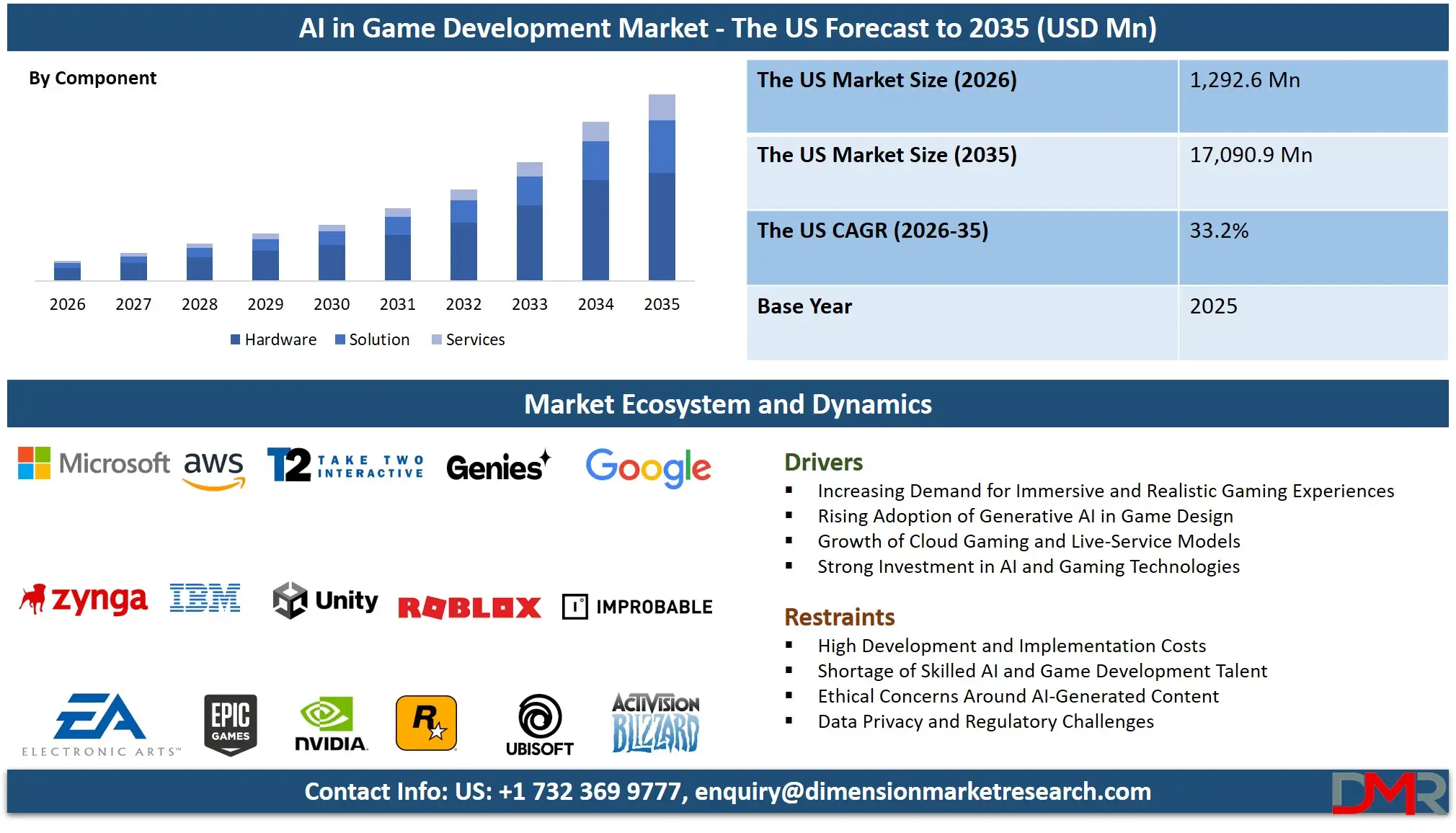
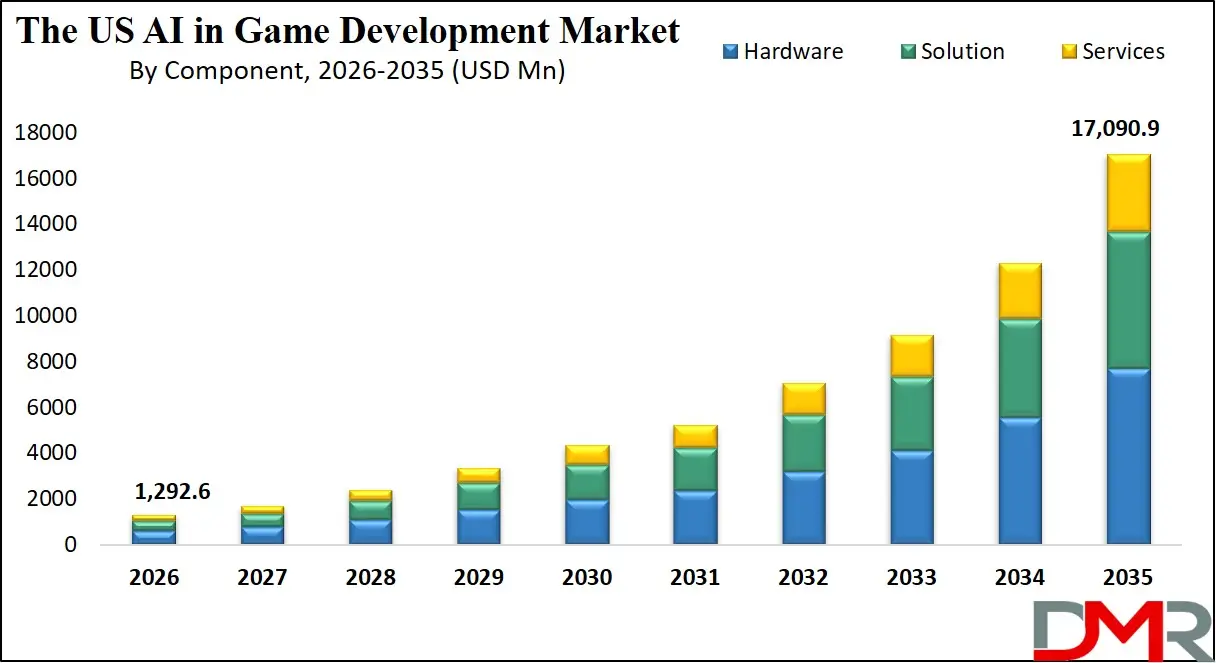
US AI in game development market size is expected to reach a value of USD 1,292.6 million in 2026, and it is further anticipated to reach a market value of USD 17,090.9 million by 2035 at a CAGR of 33.2%.
ℹ
To learn more about this report –
Download Your Free Sample Report Here
The U.S. AI in game development market represents one of the fastest-evolving segments within the broader entertainment technology landscape, driven by exponential advancements in machine learning, generative AI, and real-time rendering capabilities. Major technology hubs such as Silicon Valley, Seattle, Austin, and Los Angeles serve as epicenters for AI-driven game development innovation, supported by a mature gaming industry and substantial venture capital investment.
AI integration in game development is increasingly becoming a cornerstone of modern game production, fueled by rising consumer expectations for immersive experiences, intelligent behaviors, and dynamic storytelling. Game developers are leveraging AI to streamline production pipelines, reduce development timelines, and create more responsive and personalized gaming experiences. The growing adoption of AI-powered tools across indie studios and AAA developers alike is democratizing access to sophisticated development capabilities.
The market has undergone a significant transformation due to advancements in deep learning, natural language processing, and computer vision. Technologies such as neural networks, reinforcement learning, and generative adversarial networks (GANs) are being widely deployed to enhance procedural content generation, enable intelligent non-player characters (NPCs), and optimize quality assurance processes. Additionally, cloud-based AI services are enabling scalable and cost-effective implementation of advanced game development features.
The proliferation of gaming platforms, including mobile, PC, console, and emerging AR/VR and cloud streaming services, continues to be a primary catalyst for AI adoption. Major game publishers such as Electronic Arts, Activision Blizzard, Take-Two Interactive, and Epic Games are driving significant investment in AI research and development. The shift toward live-service games and persistent online worlds has further amplified the need for AI-driven content updates, player behavior analysis, and real-time personalization.
ℹ
To learn more about this report –
Download Your Free Sample Report Here
Sustainability and operational efficiency are also gaining traction, with game developers investing in AI tools that reduce manual labor, minimize production costs, and optimize resource allocation. The increasing availability of AI-as-a-service platforms is enabling smaller studios to compete with larger players by accessing sophisticated development tools without substantial upfront investment.
Despite strong growth, the market faces challenges such as talent shortages in AI and machine learning specialties, ethical considerations surrounding generative AI and intellectual property, and integration complexities with existing development workflows. Overall, the U.S. AI in game development market is characterized by rapid technological innovation, evolving creative applications, and robust investment from both established players and emerging startups.
The US AI in Game Development Market: Key Takeaways
- Market Growth Insights: The market is anticipated to reach USD 1,292.6 million in 2026 and is projected to expand to around USD 17,090.9 million by 2035, registering a CAGR of 33.2% during the forecast period.
- By Component Insights: Solutions, including AI-powered software platforms, engines, and developer toolkits, represent the leading segment, supported by the increasing availability of specialized AI tools for animation, dialogue generation, and world-building.
- By Game Genre Insights: Action and adventure games currently hold the largest share, driven by the genre's need for sophisticated NPC behaviors, dynamic difficulty adjustment, and complex procedural environments.
- By Platform Insights: The mobile gaming segment leads in AI adoption due to its massive user base, while console and PC platforms are experiencing rapid growth in advanced AI applications for high-fidelity experiences.
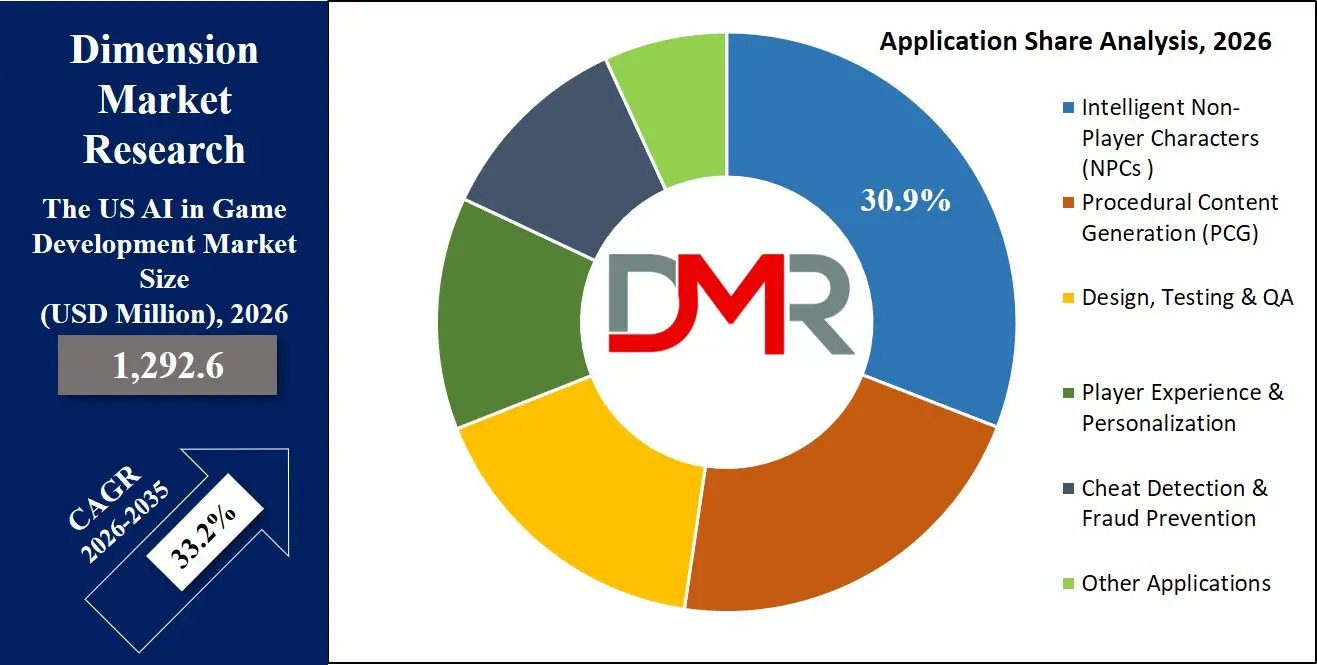
- By Application Insights: Intelligent NPCs and procedural content generation (PCG) account for the majority of market share, reflecting the growing focus on creating immersive, replayable, and dynamically responsive game worlds.
- Key Players Insights: Major market participants include Unity Technologies, Epic Games, NVIDIA Corporation, Microsoft Corporation (Xbox), Sony Interactive Entertainment, Electronic Arts, and other key players.
Impact of Iran Conflict on the US AI in Game Development Market
- Supply Chain Disruption: Escalating Iran conflict threatens semiconductor supply chains, as proximity to the Strait of Hormuz risks disrupting chip shipments, potentially delaying hardware availability essential for AI-driven game development and advanced gaming systems.
- Talent & Visa Restrictions: Heightened geopolitical tensions may prompt stricter U.S. immigration policies, restricting the inflow of international AI and engineering talent critical for game development studios seeking to maintain a competitive advantage.
- Investment Volatility: Regional conflict introduces macroeconomic uncertainty, potentially causing venture capital firms to become risk-averse, tightening funding for speculative AI gaming startups and consequently slowing innovation in emerging technologies.
- Cyber Threat Escalation: State-sponsored cyber warfare threats from Iran increase vulnerability of U.S. digital infrastructure, forcing game studios to divert substantial resources from AI innovation toward comprehensive cybersecurity defense measures.
The US AI in Game Development Market: Use Cases
- Intelligent Non-Player Characters (NPCs) and Dynamic Behavior Systems: AI-powered NPCs represent one of the most transformative use cases in the U.S. game development market. Developers are increasingly adopting reinforcement learning, behavior trees, and natural language processing to create characters that exhibit realistic decision-making, adaptive combat strategies, and context-aware dialogue. These intelligent systems enable more immersive storytelling and emergent gameplay experiences that respond dynamically to player actions.
- Procedural Content Generation for Scalable World-Building: Procedural content generation has emerged as a critical application, enabling developers to create vast, diverse game environments with reduced manual effort. AI algorithms generate landscapes, levels, quests, and item variations that ensure unique player experiences while optimizing development resources. This capability is particularly valuable for open-world games, roguelikes, and live-service titles requiring continuous content updates.
- Automated Design, Testing, and Quality Assurance: AI-driven testing and QA solutions are revolutionizing game development workflows by automating bug detection, playtesting, and balance analysis. Machine learning models simulate thousands of gameplay scenarios, identifying edge cases and performance issues that would require extensive manual testing. This application significantly reduces development cycles, improves product quality, and enables more efficient resource allocation across production teams.
- Player Experience Optimization and Personalization: AI-powered analytics platforms are enabling developers to deliver personalized gaming experiences through dynamic difficulty adjustment, tailored content recommendations, and adaptive monetization strategies. Real-time player behavior analysis allows for targeted engagement mechanics, personalized tutorials, and customized in-game events that enhance player retention and satisfaction across diverse audience segments.
The US AI in Game Development Market: Stats & Facts
Entertainment Software Association (ESA)
- Over 205.1 million Americans play video games, representing about 64% of the population.
- Around 190.6 million Americans play games weekly, highlighting consistent engagement levels.
- Approximately 65% of Americans (over 210 million people) identify as gamers, showing sustained growth.
- About 60% of U.S. adults play video games every week, indicating strong adult participation.
- The average age of a U.S. gamer is 36 years, reflecting a mature user base.
- Nearly 28% of players are aged 50 or older, demonstrating cross-generational adoption.
- Around 82% of parents who play games do so with their children, highlighting social engagement.
- Approximately 89% of players have played games online, supporting demand for AI-driven multiplayer systems.
- About 55% of players play with others weekly, emphasizing interactive gaming ecosystems.
- Around 81% of U.S. adults believe video games provide stress relief, reinforcing engagement drivers.
- The U.S. video game industry supports around 350,000 jobs, including indirect employment.
- The industry contributes approximately USD 101 billion to the U.S. economy, reflecting its economic significance.
- The average salary in the U.S. video game industry is around USD 168,000, indicating high-value technical roles.
U.S. Gaming Industry Economic & Business Data
- U.S. video game industry revenue reached approximately USD 106 billion in 2023, making it one of the largest globally.
- Consumer spending on video games totaled about USD 59.3 billion, reflecting strong market demand.
- The game development segment was valued at approximately USD 2.8 billion, reflecting production scale.
- The industry generated over USD 35 billion in labor income, showing strong wage contribution.
- There are over 2,000 game development establishments in the U.S.
- Game development companies employ approximately 36,000 workers directly.
- Total employment across the broader gaming ecosystem exceeds 100,000 professionals.
- California ranks as the leading U.S. state for gaming industry output and employment.
The US AI in Game Development Market: Market Dynamic
Driving Factors in the United States AI in Game Development Market
Accelerating Demand for Immersive and Dynamic Gaming Experiences
The rapid evolution of player expectations is significantly driving AI adoption across the U.S. game development market. Modern gamers increasingly demand sophisticated NPC behaviors, dynamic storytelling, and personalized gameplay experiences that respond meaningfully to individual actions. A growing base of experienced players, high engagement across multiple platforms, and the rise of content creator culture are accelerating expectations for more complex and reactive game worlds. Game publishers are responding by investing heavily in AI systems that enable emergent gameplay, adaptive difficulty, and procedurally generated content. Additionally, the shift toward live-service models and persistent online worlds is further intensifying the need for AI-driven content updates and real-time player engagement systems, requiring scalable, intelligent, and continuously evolving development pipelines to meet modern gaming standards.
Advancements in Generative AI and Machine Learning Technologies
Breakthroughs in generative AI, large language models, and neural networks are fundamentally transforming game development capabilities in the United States. Generative AI tools are enabling rapid creation of assets including character models, textures, animations, voice dialogue, and musical scores, dramatically reducing production timelines and costs. Large language models are revolutionizing NPC dialogue systems, allowing for dynamic, context-aware conversations that were previously impossible to author manually. Reinforcement learning techniques are producing more sophisticated AI opponents and companion characters that adapt to player skill levels and playstyles. These technological advancements are encouraging the adoption of AI across all phases of game development, from pre-production concepting to live operations, creating a more integrated and technologically advanced development environment across the industry.
Restraints in the United States AI in Game Development Market
Talent Shortages and Skills Gap
A significant shortage of professionals with expertise in both game development and artificial intelligence remains a critical challenge in the U.S. market. The demand for AI engineers, machine learning specialists, and technical artists who understand game engine integration continues to outpace supply, creating hiring challenges for studios of all sizes. Additionally, the complexity of implementing cutting-edge AI systems requires specialized knowledge that is not yet widely available in the traditional game development workforce. Small and mid-sized studios face particular difficulty in recruiting and retaining AI talent, limiting their ability to compete with larger publishers. Balancing the need for specialized AI expertise with traditional development skills is increasingly difficult, especially as the technology evolves rapidly. Studios must invest heavily in training programs, university partnerships, and competitive compensation packages to build and maintain AI-capable development teams in a dynamic and talent-constrained market environment.
Intellectual Property and Ethical Considerations
The use of generative AI in game development raises complex intellectual property and ethical considerations that present ongoing challenges for the industry. Questions surrounding ownership of AI-generated assets, training data provenance, and potential copyright infringement have created legal uncertainty for studios implementing generative AI tools. Additionally, concerns about displacement of creative roles and the ethical implications of AI-generated content are prompting careful consideration of implementation strategies. Game publishers and developers must navigate these complexities while maintaining creative integrity and respecting the contributions of human artists, writers, and designers. These considerations require thoughtful governance frameworks, transparent disclosure practices, and ongoing dialogue with creative communities, adding layers of complexity to AI adoption strategies.
Opportunities in the United States AI in Game Development Market
AI-Powered Personalization and Player Engagement Platforms
The development of AI-powered personalization systems presents significant growth opportunities in the U.S. game development market. These technologies enable dynamic difficulty adjustment, individualized content recommendations, and adaptive monetization strategies that optimize player engagement and retention. For live-service games and free-to-play titles, AI-driven personalization can substantially improve lifetime value and reduce player churn. Machine learning models that analyze player behavior patterns allow developers to deliver tailored experiences that maintain engagement across diverse player segments. Supportive analytics platforms and increasing availability of player data are expected to accelerate adoption, enabling developers to create more responsive and compelling experiences that adapt to individual playstyles and preferences.
Cross-Platform Development and Cloud AI Integration
The proliferation of gaming platforms and cloud-based AI services is creating substantial opportunities for innovation in game development workflows. Cloud AI platforms enable developers to access sophisticated machine learning capabilities without significant on-premise infrastructure investment, democratizing access to advanced tools across studios of all sizes. Cross-platform development requirements are driving demand for AI systems that can optimize experiences across mobile, PC, console, and emerging AR/VR platforms simultaneously. Additionally, cloud streaming services are creating new opportunities for AI-driven features that leverage server-side processing power for enhanced NPC behaviors, real-time content generation, and advanced analytics. These developments not only reduce technical barriers to AI adoption but also enable new categories of gameplay experiences that were previously impossible within hardware constraints.
Trends in the United States AI in Game Development Market
Generative AI Integration Across Production Pipelines
Generative artificial intelligence is fundamentally transforming game development workflows across the United States. AI-powered tools for asset creation, including character generation, environment synthesis, and audio production, are enabling studios to produce higher-quality content with reduced manual effort. Text-to-3D models, AI-assisted animation, and automated voice generation are becoming standard components of modern development pipelines. These technologies help address production bottlenecks and enable faster iteration cycles, particularly in high-demand periods such as pre-launch content creation and live-service update schedules. Real-time AI inference capabilities enable dynamic content generation during gameplay, opening new creative possibilities. As generative AI tools mature, they are becoming essential components of modern game development strategies, driving innovation and improving overall production efficiency across the market.
AI-Driven Quality Assurance and Automated Testing
The rise of AI-powered testing and quality assurance solutions is reshaping game development practices in the U.S. Machine learning models that simulate player behavior, identify edge cases, and automate regression testing are significantly reducing QA timelines and improving product quality. These systems can execute thousands of playtesting hours in the time required for manual testing, identifying bugs, balance issues, and performance bottlenecks with unprecedented efficiency. AI-driven QA is particularly valuable for complex open-world games and multiplayer titles where the number of possible player interactions creates testing challenges beyond human capacity. Development studios are increasingly investing in AI testing platforms to streamline certification processes, reduce post-launch support requirements, and improve overall release quality, making QA automation a critical component of competitive development operations.
The US AI in Game Development Market: Research Scope and Analysis
By Component Analysis
Solutions are expected to dominate the U.S. AI in game development market due to the widespread availability of specialized AI software platforms, developer toolkits, and game engine integrations. The United States has fostered a robust ecosystem of AI solution providers, with companies such as Unity Technologies and Epic Games embedding AI capabilities directly into their core engines. These solutions offer developers seamless access to AI functionality for animation, dialogue generation, world-building, and quality assurance without requiring specialized machine learning expertise.
Software-as-a-service AI platforms are increasingly enabling studios to access sophisticated capabilities through subscription models, reducing upfront investment barriers. Hardware components, including specialized AI accelerators and GPUs from NVIDIA and AMD, continue to play a critical supporting role, particularly for high-fidelity console and PC development requiring intensive neural network processing. Services, including consulting, implementation support, and custom AI model development, represent a growing segment as studios seek expertise in integrating AI into existing workflows. While solution adoption remains highest, the demand for professional services is expanding rapidly as AI capabilities become more complex and studio requirements become more specialized. The integration of AI across hardware, software, and service layers ensures a comprehensive and adaptable technology ecosystem supporting game development in the U.S.
By Game Genre Analysis
Action and adventure games are anticipated to dominate the U.S. AI in game development market due to the genre's extensive requirements for sophisticated NPC behaviors, dynamic combat systems, and complex environmental interactions. These games demand AI systems capable of managing large numbers of simultaneously active characters, implementing adaptive difficulty, and generating responsive enemy behaviors that maintain engagement across extended play sessions. Major franchises in this category have invested heavily in proprietary AI systems that set industry standards for character intelligence and reactivity.
Role-playing games (RPGs) represent another significant segment, leveraging AI for procedural quest generation, dynamic dialogue systems, and adaptive storytelling that responds to player choices. Shooter games (FPS/TPS) utilize AI for enemy tactics, squad behaviors, and aim assist systems that balance accessibility with challenge. Simulation and strategy games employ AI for complex resource management, opponent decision-making, and realistic physics-based interactions. Sports and racing games utilize AI for opponent behaviors, team management systems, and realistic physics simulations. The diversity of genre-specific AI applications highlights the versatility of AI technologies and their critical role in delivering genre-appropriate experiences across the market.
By Platform Analysis
Mobile gaming is projected to lead the U.S. AI in game development market due to its massive user base, diverse audience demographics, and the operational demands of free-to-play and live-service business models. AI applications in mobile gaming span personalized monetization optimization, dynamic difficulty adjustment, and efficient content delivery across millions of daily active users. Mobile developers leverage AI to optimize performance across thousands of device configurations while maintaining engaging experiences that drive retention.
PC and console platforms represent substantial market segments, with developers implementing advanced AI features that leverage higher computational resources for sophisticated NPC behaviors, real-time procedural generation, and enhanced graphical fidelity. These platforms benefit from dedicated hardware acceleration capabilities that enable more complex AI implementations. AR/VR platforms are emerging as growth segments, with AI playing a critical role in hand tracking, spatial understanding, and immersive interaction systems. Cloud and streaming gaming platforms are increasingly leveraging server-side AI processing to deliver experiences that transcend local hardware limitations. The platform diversity in the U.S. market reflects the varied requirements of different gaming contexts and the adaptability of AI technologies across all delivery channels.
By Application Analysis
Intelligent NPCs and procedural content generation are poised to dominate the U.S. AI in game development market, representing the most mature and widely implemented AI applications across the industry. Intelligent NPCs encompass behavior systems, dialogue generation, and adaptive enemy AI that respond dynamically to player actions. These systems are fundamental to creating immersive, believable game worlds that maintain engagement across diverse player interactions. Procedural content generation enables developers to create vast environments, varied quest structures, and unique item combinations with reduced manual authoring effort, addressing the scalability demands of open-world and live-service games.
ℹ
To learn more about this report –
Download Your Free Sample Report Here
Design, testing, and QA applications represent rapidly growing segments as studios seek efficiency gains in development workflows. AI-driven testing systems automate bug detection, balance analysis, and playtesting simulation, significantly reducing QA timelines. Player experience and personalization applications leverage machine learning for dynamic difficulty adjustment, engagement optimization, and retention-focused feature delivery. Cheat detection and fraud prevention applications are essential for maintaining competitive integrity in online multiplayer games. Other applications, including AI-assisted art production, voice synthesis, and localization, continue to expand as technology capabilities mature. The breadth of AI applications underscores the technology's transformative impact across all phases of game development and live operations.
The US AI in Game Development Market Report is segmented on the basis of the following:
By Component
- Hardware
- Solution
- Services
By Game Genre
- Action and Adventure
- Role-Playing Games (RPGs)
- Shooter (FPS/TPS)
- Simulation and Strategy
- Sports and Racing
- Other Games
By Platform
- Mobile
- PC
- Console
- AR/VR
- Cloud and Streaming Gaming
By Application
- Intelligent Non-Player Characters (NPCs)
- Procedural Content Generation (PCG)
- Design, Testing & QA
- Player Experience & Personalization
- Cheat Detection & Fraud Prevention
- Other Applications
The US AI in Game Development Market: Competitive Landscape
The United States AI in game development market features intense competition between established technology platforms, major game publishers, and specialized AI startups, all vying for dominance in a sector experiencing rapid technological transformation and substantial investment.
Technology platform companies such as Unity Technologies and Epic Games hold a significant position, embedding AI capabilities directly into their widely adopted game engines and providing the foundational tools used by the majority of game developers. NVIDIA Corporation, through its hardware and AI software stacks, plays a critical enabling role across the ecosystem.
ℹ
To learn more about this report –
Download Your Free Sample Report Here
Major game publishers including Electronic Arts, Activision Blizzard, Take-Two Interactive, and Sony Interactive Entertainment are developing proprietary AI systems while leveraging third-party solutions, maintaining competitive advantages through specialized applications tailored to their flagship franchises.
The market is also characterized by a vibrant ecosystem of AI-focused startups and specialized tool providers. Companies such as Inworld AI, Promethean AI, and Modulate.ai are developing targeted solutions for NPC dialogue, asset creation, and voice moderation, respectively, creating a diverse competitive landscape.
Platform holders including Microsoft (Xbox), Sony, and Valve are incorporating AI capabilities into their development platforms and distribution services, further expanding the competitive environment. The convergence of AI, cloud computing, and gaming continues to create new opportunities and competitive dynamics across the market.
Some of the prominent players in the US AI in Game Development Market are:
- Epic Games
- Unity Technologies
- Electronic Arts (EA)
- Activision Blizzard
- Take-Two Interactive
- Roblox Corporation
- NVIDIA
- Microsoft (Xbox Game Studios)
- Google (DeepMind / Google AI)
- Amazon (AWS Game Tech)
- IBM
- Genies
- Zynga
- Ubisoft San Francisco
- Rockstar Games
- Riot Games
- Valve Corporation
- Meta Platforms (Reality Labs)
- Discord
- Improbable
- Other Key Players
Recent Developments in the US AI in Game Development Market
- February 2026: Electronic Arts announced a strategic partnership with a leading AI research laboratory to develop proprietary machine learning systems for player behavior analysis and dynamic difficulty optimization across its sports and racing franchises.
- January 2026: Epic Games released significant updates to its MetaHuman technology, incorporating generative AI features that reduce character creation timelines by over 70% for developers utilizing Unreal Engine.
- December 2025: The Game Developers Conference (GDC) in San Francisco featured AI as the central theme, with dedicated sessions on generative AI workflows, AI-assisted testing, and ethical implementation frameworks, with participation from Unity, Epic, and major publishers.
- November 2025: Microsoft announced expanded AI capabilities within its Xbox development ecosystem, including new tools for AI-driven quality assurance and automated playtesting integrated into the ID@Xbox program.
- October 2025: Inworld AI secured USD 150 million in Series C funding to scale its AI character engine platform, reflecting continued investor confidence in specialized AI solutions for game development.
- September 2025: Sony Interactive Entertainment established a dedicated AI research division focused on developing proprietary machine learning systems for PlayStation Studios development workflows and platform features.
- September 2025: Promethean AI launched enhanced features for its AI-assisted environment design platform, enabling faster creation of complex game levels with reduced manual authoring requirements.
Report Details
| Report Characteristics |
| Market Size (2026) |
USD 1,292.6 Mn |
| Forecast Value (2035) |
USD 17,090.9 Mn |
| CAGR (2026–2035) |
33.2% |
| Historical Data |
2021 – 2025 |
| Forecast Data |
2027 – 2035 |
| Base Year |
2025 |
| Estimate Year |
2026 |
| Report Coverage |
Market Revenue Estimation, Market Dynamics, Competitive Landscape, Growth Factors and etc. |
| Segments Covered |
By Component (Hardware, Solution, and Services), By Game Genre (Action and Adventure, Role-playing games (RPGs), Shooter(FPS/TPS), Simulation and Strategy, Sports and Racing, and Other Games), By Platform (Mobile, PC, Console, AR/VR, and Cloud and Streaming Gaming), and By Application (Intelligent Non-Player Characters (NPCs), Procedural Content Generation (PCG), Design, Testing & QA, Player Experience & Personalization, Cheat Detection & Fraud Prevention, and Other Application) |
| Country Coverage |
The US |
| Prominent Players |
Epic Games, Unity Technologies, Electronic Arts (EA), Activision Blizzard, Take-Two Interactive, Roblox Corporation, NVIDIA, Microsoft (Xbox Game Studios), Google (DeepMind / Google AI), Amazon (AWS Game Tech), IBM, Genies, Zynga, Ubisoft San Francisco, Rockstar Games, Riot Games, Valve Corporation, Meta Platforms (Reality Labs), Discord, Improbable, and Other Key Players |
| Purchase Options |
We have three licenses to opt for: Single User License (Limited to 1 user), Multi-User License (Up to 5 Users) and Corporate Use License (Unlimited User) along with free report customization equivalent to 0 analyst working days, 3 analysts working days and 5 analysts working days respectively. |
Frequently Asked Questions
How big is the United States AI in Game Development Market?
▾ The United States AI in Game Development Market size is estimated to have a value of USD 1,292.6 million in 2026 and is expected to reach USD 17,090.9 million by the end of 2035.
Who are the key players in the United States AI in Game Development Market?
▾ Some of the major key players in the United States AI in Game Development Market are Unity Technologies, Epic Games, NVIDIA Corporation, Microsoft Corporation (Xbox), Sony Interactive Entertainment, Electronic Arts, and many others.
What is the growth rate in the United States AI in Game Development Market?
▾ The market is growing at a CAGR of 33.2 percent over the forecasted period.