Market Overview
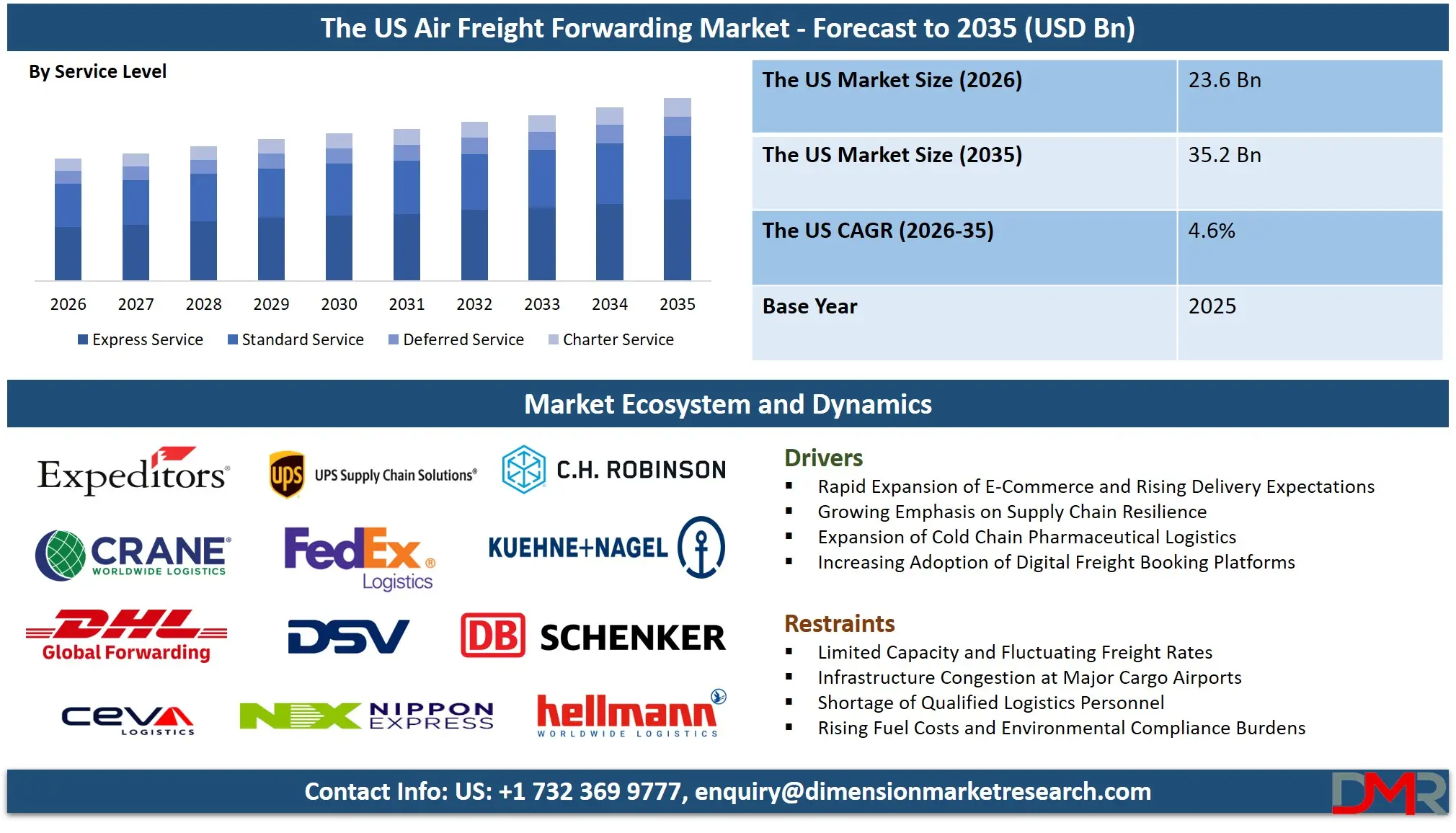
The US Air Freight Forwarding Market is projected to reach USD 23.6 billion in 2026 and is expected to grow at a CAGR of 4.6% from 2026 to 2035, reaching approximately USD 35.2 billion by 2035. The market growth is driven by the increasing globalization of supply chains, rising demand for time-sensitive logistics solutions, and expanding cross-border e-commerce activities across the United States. Additionally, advancements in digital freight platforms, real-time tracking technologies, artificial intelligence, and automated warehouse management systems are accelerating the efficiency of air freight operations in both domestic and international trade lanes. These innovations are helping forwarders optimize route planning, reduce transit times, and support the growing complexity of modern supply chain requirements.
ℹ
To learn more about this report –
Download Your Free Sample Report Here
The American logistics landscape presents unique characteristics that amplify air freight forwarding adoption. The world's largest consumer market with over 330 million residents demanding rapid delivery of goods; a business ecosystem that increasingly relies on just-in-time inventory practices and supply chain resilience; and a logistics industry undergoing its most significant digital transformation since containerization, with established freight forwarders and innovative digital disruptors competing fiercely on technological differentiation.
Regulatory momentum has reached an inflection point. The Federal Aviation Administration Reauthorization Act, updated in 2024, represents the most consequential air cargo legislation in decades, requiring enhanced security protocols, streamlined customs procedures, and modernized cargo screening infrastructure at major US gateways. This legislation establishes a non-negotiable operational floor, compelling every freight forwarder operating in America to integrate advanced tracking, security, and compliance capabilities as standard practice. Simultaneously, the Infrastructure Investment and Jobs Act channels unprecedented federal funding into airport infrastructure modernization, accelerating the expansion of cargo handling facilities and cold chain capabilities that will enable the next generation of time-critical and temperature-sensitive freight forwarding.
ℹ
To learn more about this report –
Download Your Free Sample Report Here
The competitive landscape reflects this dynamism. Traditional freight forwarding giants, including Kuehne + Nagel, DHL Supply Chain, DB Schenker, DSV, and Expeditors International, compete alongside logistics technology platforms like Flexport, Transfix, and Uber Freight, while domestic innovators like Flytrex and Zipline push the boundaries of drone delivery applications. Airlines themselves are increasingly investing in dedicated cargo capacity, with Delta Cargo, United Cargo, and American Airlines Cargo representing strategic fleet modernization and digital booking platform investments.
The US Air Freight Forwarding Market: Key Takeaways
- Sustained Growth Trajectory: The US market is projected to surge from USD 23.6 billion in 2026 to USD 35.2 billion by 2035, driven by a potent mix of e-commerce expansion, pharmaceutical cold chain requirements, and rapid technological modernization of traditional forwarding operations.
- E-Commerce-Led Volume Acceleration: Cross-border online retail, most notably the continued growth of global marketplace platforms and direct-to-consumer international shipping, is the single most powerful force driving air freight demand across all cargo categories, from general merchandise to high-value specialty goods.
- The Perishables and Pharmaceutical Frontier: Beyond general cargo, the massive US healthcare and food export sectors represent a high-growth opportunity. Shippers are rapidly adopting specialized air freight solutions not just for speed, but for tangible product integrity through temperature-controlled supply chains, real-time condition monitoring, and regulatory compliance assurance.
- AI-Powered Supply Chain Visibility: The market is shifting from reactive tracking to predictive logistics. US companies are leading the development of AI that anticipates delays, optimizes routing, and automates exception handling by analyzing weather patterns, historical performance data, and real-time global events.
- Infrastructure Integration with Digital Platforms: Government funding from the Infrastructure Investment and Jobs Act is accelerating the deployment of digital infrastructure at major cargo airports. This integration with smart port technologies allows forwarders to achieve "touchless" processing, addressing bottlenecks like customs clearance and cargo transfer delays.
Impact of the Iran conflict on the US Air Freight Forwarding Market
- Exposed Critical Route Vulnerabilities: The conflict highlighted the US reliance on Middle Eastern airspace and regional hubs (specifically Dubai and Doha) for connecting traffic. This will drive up insurance premiums for overflying carriers and accelerate efforts to develop alternative routing strategies through European and Asian gateways.
- Accelerated Cargo Security Innovation: Battlefield validation of AI-powered threat detection and advanced screening technologies will directly accelerate the development of commercial applications, particularly for high-risk special cargo categories including dangerous goods and high-value shipments.
- Increased Competition for Logistics Talent: A surge in US defense spending on air mobility, supply chain resilience, and logistics automation will create a war for the same limited pool of experienced logistics professionals, customs specialists, and supply chain technology developers needed to manage complex international freight operations.
- Shift in National Infrastructure Priorities: While not halting commercial aviation progress, increased federal focus and funding on defense transportation networks could represent an opportunity cost, potentially slowing investment in complementary areas like inland freight distribution centers and multimodal connectivity.
The US Air Freight Forwarding Market: Use Cases
- Pharmaceutical Cold Chain Logistics: With biologics and temperature-sensitive medications representing critical healthcare exports, specialized air freight solutions are now engineered to maintain strict temperature ranges from origin to destination, utilizing active containers, real-time temperature monitoring, and redundant cooling systems to protect vaccine and biologic shipments.
- E-Commerce Cross-Border Fulfillment: In dense US urban centers and gateway cities, advanced consolidation platforms combine shipments from multiple merchants into optimized air freight containers, providing consolidated forwarding solutions and enabling express delivery timelines for international consumer goods.
- Automotive Just-in-Time Parts Distribution: Leveraging dedicated charter capabilities, automotive manufacturers rely on air freight forwarders to transport critical production components and emergency repair parts, addressing supply chain disruptions that sea freight alone cannot resolve, with integrated customs brokerage ensuring expedited clearance.
- Perishable Food Export Coordination on Temperature-Sensitive Routes: Cold chain monitoring and specialized packaging solutions are evolving into comprehensive perishables logistics platforms that use real-time condition sensors and priority boarding arrangements to transport fresh seafood, premium produce, and specialty foods from US producers to international markets.
- Healthcare Emergency Response and Time-Critical Shipments: Hospital networks and medical device manufacturers are integrating air freight data with hospital inventory management platforms. This allows for automated replenishment triggering emergency charter deployments when critical medical supplies, surgical equipment, or replacement devices are needed for life-saving procedures.
The US Air Freight Forwarding Market: Stats & Facts
Bureau of Transportation Statistics (BTS) – United States
- US airlines carried approximately 17.2 billion revenue ton-miles of freight in 2022.
- Air freight accounts for over 35% of the total value of US international trade.
- More than USD 6 trillion worth of goods are shipped by air annually worldwide.
- Express shipments account for nearly 25% of all air freight revenue in the US market.
- In 2023, the FAA reported over 45 million tons of cargo handled at US airports.
- By 2029, digital air freight booking platforms are projected to handle over 30% of forwarder transactions.
- International air freight shipments from the US exceeded 25 million metric tons in 2022.
- Around 60% of all air freight by value consists of high-tech electronics and pharmaceuticals.
International Air Transport Association (IATA) – Global Industry
- Air cargo generates approximately 35% of airline revenue from international operations.
- Time-sensitive special cargo, including pharmaceuticals and perishables, grew by 15% annually pre-pandemic.
- Digitalization in air freight could unlock USD 4.9 billion in value through efficiency gains.
- E-commerce-related air freight volumes increased by over 20% year-over-year since 2020.
- Temperature-controlled air freight shipments require compliance with IATA CEIV Pharma certification standards.
- By 2025, over 60% of air freight forwarders plan to invest significantly in digital and automation technologies.
United States Department of Commerce – International Trade Administration
- The US exported over USD 160 billion in goods via air freight annually.
- Top air freight export categories include machinery, electronics, pharmaceuticals, and optical instruments.
- The first Trans-Pacific air freight liberalization agreements aimed to expand cargo rights between the US and Asian markets.
The US Customs and Border Protection (CBP)
- Automated commercial environment (ACE) systems process over 30 million air cargo entries annually.
- Advance cargo information requirements now mandate electronic data submission up to four hours prior to arrival for international shipments.
The US Air Freight Forwarding Market: Market Dynamic
Driving Factors in the US Air Freight Forwarding Market
Rapid Expansion of E-Commerce and Rising Delivery Expectations
A major growth driver in the US air freight forwarding market is the sustained expansion of cross-border e-commerce, combined with increasing consumer expectations for faster delivery timelines. Delivery windows of 2–3 days for international shipments are becoming standard, significantly boosting reliance on air freight services. Additionally, global e-commerce platforms influence logistics performance by setting strict delivery benchmarks that directly impact seller ratings and purchasing behavior. In response, freight forwarders are enhancing their capabilities through integrated e-commerce solutions, including shipment consolidation and streamlined customs clearance, to efficiently manage rising parcel volumes.
Growing Emphasis on Supply Chain Resilience
Air freight is increasingly being used as a strategic tool for mitigating supply chain risks in the United States. What was once reserved for urgent shipments is now routinely used by manufacturers and retailers to maintain inventory flow amid disruptions in ocean freight and global trade uncertainties. Lessons learned from pandemic-related disruptions have strengthened corporate focus on reliability, leading to greater willingness to invest in premium air freight services. This shift is accelerating the adoption of dedicated capacity solutions, real-time tracking technologies, and faster customs processing, enabling more resilient and responsive supply chains.
Restraints in the US Air Freight Forwarding Market
Limited Capacity and Fluctuating Freight Rates
Despite improvements in digital booking and visibility, the availability of air cargo capacity remains inherently limited, especially during peak seasons. This imbalance leads to significant rate fluctuations and booking uncertainties. As a result, businesses, particularly small and medium-sized exporters, face challenges in securing consistent shipping capacity. The issue is more pronounced for shipments to secondary destinations or during off-peak trade cycles, where limited flight frequency and higher costs can impact logistics planning and reliability.
Infrastructure Bottlenecks and Workforce Shortages
The growth in air cargo volumes is placing increasing pressure on airport infrastructure and ground operations across the US Even minor disruptions at major cargo hubs such as John F. Kennedy International Airport, Los Angeles International Airport, and O'Hare International Airport can lead to delays across the supply chain. Labor shortages in warehousing, customs brokerage, and cargo handling further contribute to inefficiencies, resulting in shipment backlogs and increased costs. Additionally, variations in operational procedures, working hours, and processing systems across different airports add complexity, requiring forwarders to adapt to location-specific requirements and increasing the need for buffer inventory.
Opportunities in the US Air Freight Forwarding Market
Expansion of Pharmaceutical and Cold Chain Logistics
The US pharmaceutical and biotechnology sector presents a significant growth opportunity for air freight forwarders. Strict regulatory requirements and the increasing demand for temperature-sensitive products, including biologics and specialty drugs, are driving the need for advanced cold chain logistics solutions. With pharmaceutical exports exceeding USD 50 billion annually, ensuring product integrity through temperature-controlled transportation has become critical. The emergence of advanced therapies, such as cell and gene treatments requiring ultra-low temperature handling, further elevates the importance of specialized logistics capabilities. Failure to maintain compliance can result in substantial financial losses, making reliable cold chain solutions a key competitive differentiator.
Adoption of AI-Driven Predictive Logistics
The integration of artificial intelligence into logistics operations is transforming the air freight forwarding landscape in the US Advanced platforms now leverage real-time data, weather analytics, and disruption monitoring to anticipate delays and optimize routing decisions proactively. These systems enable forwarders to move beyond basic shipment tracking toward predictive supply chain management. By identifying potential disruptions in advance, companies can take corrective actions such as rerouting shipments or adjusting schedules, improving overall efficiency and customer satisfaction. Enhanced visibility platforms are also enabling more accurate delivery time predictions and proactive exception handling.
Trends in the US Air Freight Forwarding Market
Shift Toward Digital Freight Platforms
The industry is undergoing a significant transition from manual booking processes to digital platforms that allow real-time rate comparison, booking, and shipment management. Modern freight forwarding solutions integrate pricing, capacity availability, and documentation into centralized digital systems, enabling faster and more transparent operations. This shift toward digitalization enhances operational efficiency, reduces administrative overhead, and improves customer experience through instant quoting and streamlined workflows.
Rising Adoption of Sustainable Aviation Fuel and Green Logistics
Sustainability is becoming a key focus area in the US air freight forwarding market, with increasing adoption of sustainable aviation fuel (SAF) and environmentally friendly logistics practices. Companies are incorporating carbon reduction strategies, including optimized routing and emission-offset programs, to meet corporate sustainability goals and regulatory expectations. Industry initiatives aligned with net-zero emission targets are accelerating the transition toward greener logistics solutions. Major cargo hubs are also investing in eco-friendly infrastructure and energy-efficient operations, supporting the broader shift toward sustainable air freight.
The US Air Freight Forwarding Market: Research Scope and Analysis
By Cargo Type Analysis
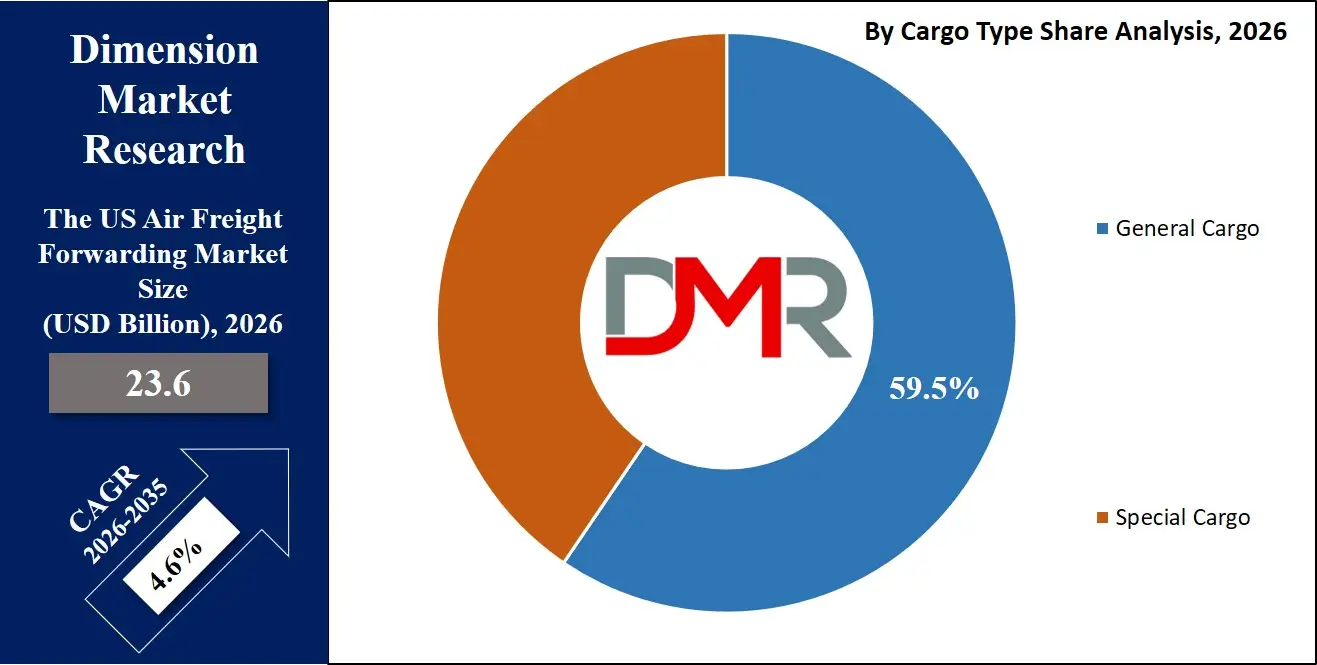
In the United States air freight forwarding market, general cargo is currently projected to dominate shipment volumes. Among these, consumer goods and manufactured products are the most significant categories due to the sheer volume of retail merchandise, automotive parts, and industrial components moving through air trade lanes. As e-commerce and just-in-time manufacturing practices drive demand for faster delivery, general cargo remains the foundation of air freight operations.
ℹ
To learn more about this report –
Download Your Free Sample Report Here
However, the fastest-growing segment is special cargo. These shipments require specialized handling, temperature control, or security protocols that differentiate them from standard freight. Forwarders are developing dedicated special cargo divisions as a requirement for serving high-value industries such as healthcare and life sciences. Beyond pharmaceutical cold chain requirements, next-generation special cargo capabilities are evolving to include active monitoring of shock, light exposure, and humidity using Internet of Things sensors, which can provide end-to-end condition data for sensitive electronics, fine art, and aerospace components.
Perishable cargo, including fresh food and cut flowers, is also widely handled and increasingly requires cold chain integration from origin to destination. These shipments help support US agricultural exports and specialty food trade.
Another important cargo category is dangerous goods, which includes batteries, chemicals, and aerosols. These shipments require strict regulatory compliance, specialized training, and certified packaging to ensure safe transportation. Advanced handling protocols such as segregation requirements and emergency response capabilities are gaining importance in chemical and industrial manufacturing segments, improving safety and regulatory adherence. Overall, service innovation in air freight forwarding is increasingly focused on combining speed, special handling capabilities, and end-to-end visibility.
By Destination Analysis
The destination landscape of air freight forwarding in the United States is built primarily on international movements, with cross-border shipments representing the majority of air freight value and revenue in most forwarding operations. International air freight connects US exporters with global markets and brings imported goods to American consumers and businesses, forming the foundation of globalized supply chains.
A key emerging trend is the development of dedicated Asia-Pacific trade lanes, an advanced route structure connecting US gateways with high-growth manufacturing and consumer markets. Unlike traditional multi-stop itineraries, dedicated transpacific services offer direct flights, optimized capacity, and reduced transit times, improving reliability for time-sensitive shipments such as electronics and e-commerce parcels. This additional route specialization improves the competitiveness of US forwarders serving Asian trade partners.
The next major destination category is domestic air freight, particularly time-definite services within the continental United States. Domestic air freight combines trucking networks with regional aircraft capacity to serve overnight and second-day delivery requirements. Leading carriers such as FedEx, UPS, and regional cargo airlines are investing heavily in hub infrastructure and sortation technology to process this growing volume. The industry's competitive focus is increasingly shifting from pure speed to reliability and visibility.
One emerging approach is Amazon Air's integrated network strategy, which synchronizes air freight capacity with fulfillment center operations to enable predictable two-day delivery nationwide. In contrast, traditional forwarders prefer multimodal integration strategies, using air for long-haul moves combined with truck networks for final delivery.
Another important destination trend is the expansion of Latin American and European trade lanes, including dedicated freighter services to major commercial hubs. As near-shoring trends evolve, US forwarders are increasingly developing specialized services for Mexico, Brazil, and European Union partners. Additionally, block space agreements allow forwarders to secure consistent capacity on high-demand international routes.
By Customer Type Analysis
In the US air freight forwarding market, business-to-business (B2B) customers represent the largest segment by revenue and volume. This dominance is largely driven by manufacturing supply chains, wholesale distribution, and industrial procurement requirements. The widespread reliance on air freight for production components, spare parts, and finished goods has accelerated the integration of forwarders into enterprise resource planning systems across mainstream industry sectors.
However, business-to-consumer (B2C) shipments are emerging as the fastest-growing segment for air freight forwarding. E-commerce retailers and direct-to-consumer brands face significant customer expectations for rapid international delivery, including returns processing and tracking visibility. As a result, forwarders are increasingly investing in B2C-optimized solutions to support merchant requirements and improve end-consumer experience. Compliance with marketplace platform delivery standards and improved customer satisfaction ratings are also key drivers of B2C service adoption.
The rapid growth of cross-border online retail has significantly increased the volume of individual parcel shipments moving through air freight networks. E-commerce parcels frequently require consolidated processing, simplified customs documentation, and last-mile integration with local postal or courier partners. To address these requirements, forwarders are deploying technologies such as multi-carrier booking platforms, consolidated shipment visibility tools, and automated customs clearance systems.
Another important segment driving service innovation is the small and medium enterprise (SME) market. SMEs increasingly require air freight solutions that offer enterprise-level capabilities without minimum volume commitments. Digital forwarders such as Flexport and traditional players with SME-focused divisions are integrating scalable service platforms directly into small business operations.
Consequently, SMEs are increasingly serving as innovation testbeds for next-generation forwarding technologies such as instant quoting, automated export documentation, and simplified hazardous materials shipping capabilities.
By Service Level Analysis
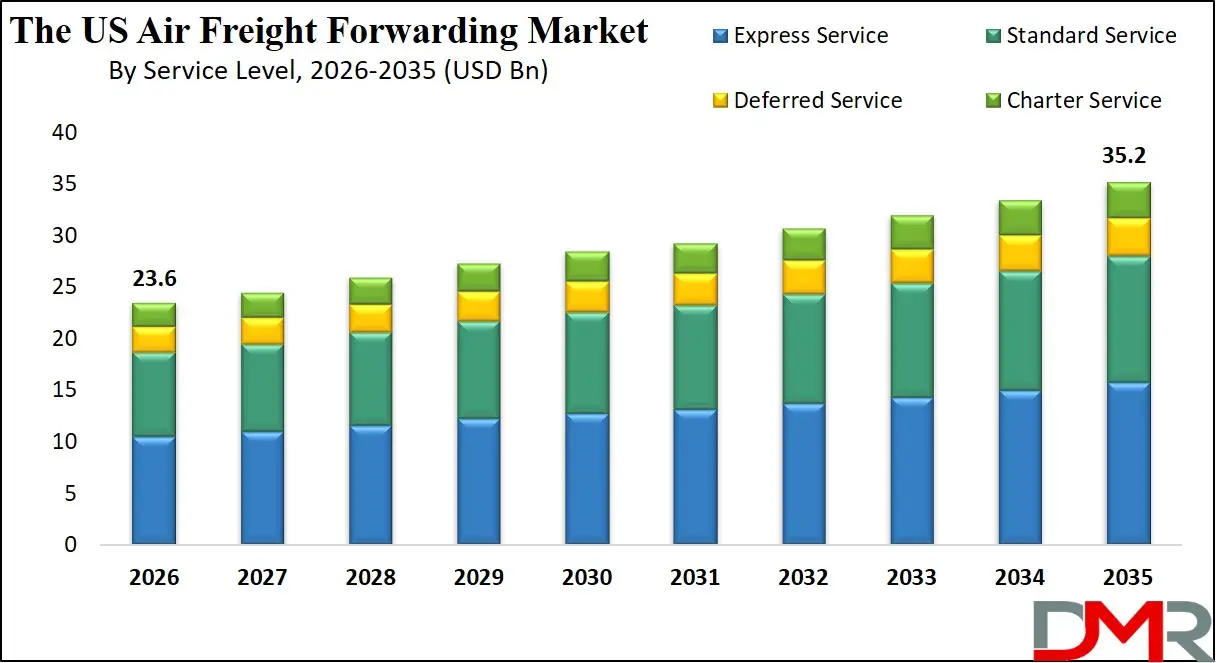
Service level segmentation plays a crucial role in shaping the air freight forwarding market in the United States. Most shipments currently move under standard service, where forwarders consolidate general cargo on scheduled flights with transit times typically ranging from 3-7 days for international moves. Standard service levels include basic freight transportation with terminal handling and origin-destination drayage.
Premium standard services are evolving into deferred service capabilities, where shippers can access reduced rates in exchange for flexibility in routing or transit timing. Examples include consolidated ocean-air programs or routings that utilize secondary gateways with lower handling costs. These service levels allow importers and exporters to balance cost and speed for non-urgent shipments, reducing logistics expenses while maintaining predictable delivery windows. Shippers are increasingly willing to accept longer transit times for appropriate rate incentives, particularly for high-volume, low-urgency cargo categories.
Express service, also known as time-definite or priority service, commands premium pricing and requires dedicated capacity arrangements. Notable examples include DHL's Time Definite products and FedEx International Priority, which offer guaranteed delivery windows with proactive exception management. Express service levels are essential for emergency shipments, critical production parts, and time-sensitive documents where delay is unacceptable.
Meanwhile, charter service is typically reserved for peak season overflow, outsized cargo, or specialized project requirements. Companies such as Air Charter Service and Chapman Freeborn specialize in arranging dedicated aircraft for full-plane shipments. Despite premium pricing, charter service remains essential for specific use cases including automotive production launches, humanitarian relief, and oversize industrial equipment.
By Core Service Offering Analysis
In the United States air freight forwarding market, the freight transportation core service overwhelmingly dominates revenue. Most modern forwarding engagements require reliable airlift capacity, including buy decisions among commercial airline cargo divisions, dedicated freighter operators, and integrated express carriers. Because of this complexity, transportation arrangements must typically be managed by experienced forwarders with established carrier relationships rather than arranged directly by shippers.
Forwarders integrate transportation purchasing directly into their value propositions to ensure capacity availability, competitive pricing, and reliable service delivery. Additionally, liability considerations and service level agreements make professional transportation management the preferred approach for both B2B and B2C shippers. As supply chains evolve into digitally connected networks, many transportation decisions are embedded within the forwarder's core technology and carrier contracting expertise. This deep integration makes it extremely difficult to replicate the same purchasing power and operational flexibility through self-managed arrangements.
Nevertheless, warehousing and distribution still plays an important role, particularly within the special cargo and e-commerce fulfillment sectors. Forwarders often operate bonded warehousing at major gateways to facilitate consolidation, deconsolidation, and cross-dock operations. Major providers such as Kuehne+Nagel and DSV offer integrated warehousing solutions as part of end-to-end supply chain services.
Customs brokerage serves owners of international shipments requiring regulatory compliance and duty processing. However, these solutions are generally integrated with transportation services rather than standalone offerings. For example, services such as Expeditors' customs brokerage platform offer import and export clearance capabilities, but typically complement core freight forwarding activities. For value-added logistics services, the market increasingly demands supply chain consulting, order management, and visibility platform integration as differentiators.
By End-User Industry Analysis
In the US air freight forwarding market, the high-tech and electronics industry represents a primary end-user segment for expedited transportation services. Major electronics manufacturers define supply chain specifications and collaborate closely with freight forwarders to integrate air freight into global production networks. Forwarders such as DHL and Kuehne+Nagel play a critical role in developing specialized handling protocols, security procedures, and visibility platforms for semiconductor, device, and component shipments.
Electronics purchasing decisions are heavily influenced by product value density, time-to-market requirements, and security considerations. Achieving rapid transit from Asian manufacturing to US consumption points is an important competitive factor for electronics brands, encouraging them to adopt increasingly sophisticated air forwarding solutions.
The second major end-user group consists of healthcare and life sciences companies, including pharmaceutical manufacturers, medical device companies, and biotechnology researchers. Unlike general cargo shippers, healthcare approaches logistics from a regulatory compliance and patient safety perspective. They evaluate forwarders based on cold chain certification (IATA CEIV Pharma), temperature excursion prevention, and serialized tracking capabilities. As a result, healthcare shippers often actively audit and qualify forwarders through formal supplier approval programs.
The retail and e-commerce sector utilizes air freight forwarding extensively for seasonal inventory, fashion merchandise, and direct-to-consumer fulfillment. Although automotive, aerospace and defense, and industrial manufacturing also utilize air freight services, their shipment profiles differ significantly from high-tech and healthcare applications. Automotive shipments such as emergency parts and aerospace logistics like AOG (Aircraft on Ground) services operate under time-critical frameworks with specialized handling requirements.
Despite smaller individual shipment volumes, these industries influence forwarding innovation by introducing advanced requirements such as counter-to-counter handling, military air clearance protocols, and supplier consignment inventory programs, which are increasingly being adapted for broader commercial applications.
The US Air Freight Forwarding Market Report is segmented on the basis of the following:
By Cargo Type
- General Cargo
- Special Cargo
By Destination
By Customer Type
- Business-to-Business (B2B)
- Business-to-Consumer (B2C)
By Service Level
- Standard Service
- Express Service
- Deferred Service
- Charter Service
By Core Service Offering
- Freight Transportation
- Warehousing & Distribution
- Customs Brokerage
- Freight Consolidation
- Value-Added Logistics Services
By End-Use Industry
- Healthcare
- Food & Beverage
- High-Tech & Electronics
- Automotive
- Retail & E-commerce
- Aerospace & Defense
- Agriculture
- Industrial Manufacturing
Impact of Artificial Intelligence in the US Air Freight Forwarding Market
- Deep Learning for Demand Forecasting: AI, particularly machine learning algorithms, is used to predict shipping demand patterns, enabling forwarders to optimize capacity purchasing, reduce waste, and improve rate competitiveness across thousands of trade lanes.
- Predictive Route Optimization: AI algorithms analyze weather patterns, geopolitical events, and historical performance data to predict disruptions and recommend optimal routing, enabling proactive contingency planning.
- Intelligent Exception Management: AI is the "control tower" that monitors millions of shipment data points in real-time, automatically identifying exceptions and initiating corrective actions without human intervention.
- Edge AI for Warehouse Automation: High-performance robotics systems from companies like Boston Dynamics and Locus Robotics perform real-time sortation and movement decisions, allowing forwarders to process freight faster and with greater accuracy.
- Fleet Learning (The Digital Twin Model): Forwarders use anonymized operational data from their entire network to continuously train and improve their central logistics models. When one shipment encounters a novel delay scenario, the learning can be applied network-wide to prevent similar issues.
- Customer Experience & Personalization: AI analyzes shipper behavior, preferences, and historical patterns to personalize service recommendations, automate routine inquiries, and provide proactive status updates tailored to individual customer requirements.
The US Air Freight Forwarding Market: Competitive Landscape
The U.S. air freight forwarding market is a highly dynamic and moderately consolidated competitive landscape characterized by the presence of global logistics multinationals, express carrier-integrated forwarders, digital freight platforms, and specialized niche service providers. Leading global forwarders such as Kuehne + Nagel, DHL Supply Chain, DB Schenker, DSV, and Expeditors International maintain strong market positions by supplying integrated, end-to-end logistics solutions to major U.S. importers and exporters, including Fortune 500 manufacturers and international retailers operating in the United States. Alongside these forwarders, express carrier-integrated logistics providers are becoming increasingly influential in shaping service expectations. Companies such as FedEx, UPS, and Amazon Logistics provide the time-definite delivery networks and e-commerce fulfillment capabilities that power modern retail and direct-to-consumer supply chains.
ℹ
To learn more about this report –
Download Your Free Sample Report Here
In addition, digital freight platforms such as Flexport, Transfix, and Uber Freight play a key role in developing technology-forward booking and visibility solutions. The United States also hosts leading logistics technology innovators including project44 and FourKites, which are focused on improving supply chain visibility while reducing integration complexity. At the same time, airlines like Delta Cargo, United Cargo, and American Airlines Cargo are pursuing vertical integration strategies through digital booking portals and dedicated cargo fleet investments, strengthening their competitive position in the air freight value chain.
Some of the prominent players in the US Air Freight Forwarding Market are:
- Expeditors International of Washington
- UPS Supply Chain Solutions
- C.H. Robinson
- Crane Worldwide Logistics
- FedEx Logistics
- Kuehne + Nagel
- DHL Global Forwarding
- DSV A/S
- DB Schenker
- CEVA Logistics
- Nippon Express
- Hellmann Worldwide Logistics
- GEODIS
- Maersk Logistics
- Kerry Logistics
- Kintetsu World Express
- Yusen Logistics
- Purolator International
- Total Quality Logistics
- Radiant Logistics
- Other Key Players
Recent Developments in the US Air Freight Forwarding Market
- February 2026: FedEx Logistics accelerated the deployment of AI-enabled tools across its logistics operations to enhance shipment visibility, automate customs processes, and improve efficiency in international air freight forwarding.
- September 2025: DSV A/S confirmed its acquisition of DB Schenker in a deal valued at over USD 12 billion, a move set to significantly expand its global air freight forwarding capacity and strengthen its position in the U.S. market.
- July 2025: Maersk Logistics continued strengthening its integrated logistics strategy by expanding air cargo capacity through its Maersk Air Cargo division, focusing on improved reliability and flexibility across key Europe–Asia trade lanes.
- May 2025: DHL announced the merger of its UK parcel operations with Evri to enhance international delivery capacity, leveraging its global forwarding network to strengthen cross-border logistics capabilities.
- April 2025: Nippon Express expanded its U.S. logistics footprint by strengthening specialized air freight services for automotive and high-tech sectors requiring time-sensitive and high-value cargo handling.
- January 2025: CEVA Logistics expanded its global service capabilities by establishing dedicated China-focused logistics support teams in international markets to assist clients navigating shifting global trade patterns.
Report Details
| Report Characteristics |
| Market Size (2026) |
USD 23.6 Bn |
| Forecast Value (2035) |
USD 35.2 Bn |
| CAGR (2026–2035) |
4.6% |
| Historical Data |
2021 – 2025 |
| Forecast Data |
2027 – 2035 |
| Base Year |
2025 |
| Estimate Year |
2026 |
| Report Coverage |
Market Revenue Estimation, Market Dynamics, Competitive Landscape, Growth Factors and etc. |
| Segments Covered |
By Cargo Type (General Cargo and Special Cargo), By Destination (Domestic and International), By Customer Type (Business-to-Business (B2B) and Business-to-Consumer (B2C)), By Service Level (Standard Service, Express Service, Deferred Service, Charter Service), By Core Service Offering (Freight Transportation, Warehousing & Distribution, Customs Brokerage, Freight Consolidation, and Value-Added Logistics Services), By End-Use Industry (Healthcare, Food & Beverage, High-Tech & Electronics, Automotive, Retail & E-commerce, Aerospace & Defense, Agriculture, and Industrial Manufacturing) |
| Country Coverage |
The US |
| Prominent Players |
Expeditors International of Washington, UPS Supply Chain Solutions, C.H. Robinson, Crane Worldwide Logistics, FedEx Logistics, Kuehne + Nagel, DHL Global Forwarding, DSV A/S, DB Schenker, CEVA Logistics, Nippon Express, Hellmann Worldwide Logistics, GEODIS, Maersk Logistics, Kerry Logistics, Kintetsu World Express, Yusen Logistics, Purolator International, Total Quality Logistics, Radiant Logistics, and Other Key Players |
| Purchase Options |
We have three licenses to opt for: Single User License (Limited to 1 user), Multi-User License (Up to 5 Users) and Corporate Use License (Unlimited User) along with free report customization equivalent to 0 analyst working days, 3 analysts working days and 5 analysts working days respectively. |
Frequently Asked Questions
How big is the US Air Freight Forwarding Market?
▾ The US Air Freight Forwarding Market is valued at USD 23.6 billion in 2026 and is projected to reach USD 35.2 billion by the end of 2035.
What is the growth rate for the US Air Freight Forwarding Market?
▾ The market is growing at a robust compound annual growth rate (CAGR) of 4.6% over the forecast period of 2026 to 2035.
Who are the key players in the US Air Freight Forwarding Market?
▾ Some of the major key players in the US Air Freight Forwarding Market are Expeditors International of Washington, UPS Supply Chain Solutions, C.H. Robinson, Crane Worldwide Logistics, FedEx Logistics, Kuehne + Nagel, DHL Global Forwarding, and many others.