US Battery Manufacturing Robotics Market Snapshot
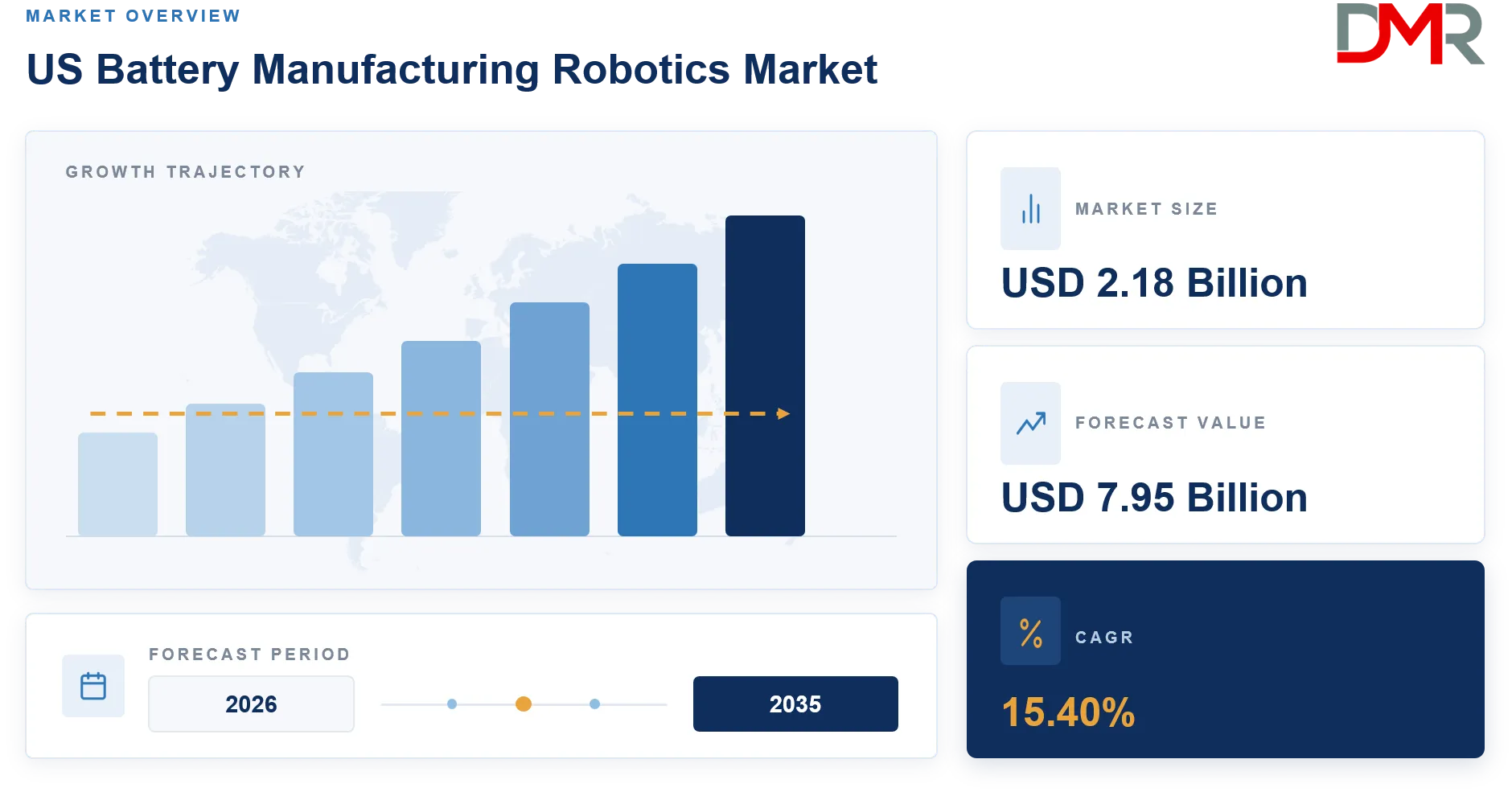
- Market Value: US Battery Manufacturing Robotics market is valued at USD 2.18 billion in 2026 and is projected to reach USD 7.95 billion by 2035.
- CAGR: US Battery Manufacturing Robotics market is expected to grow at a CAGR of 15.4% from 2026 to 2035.
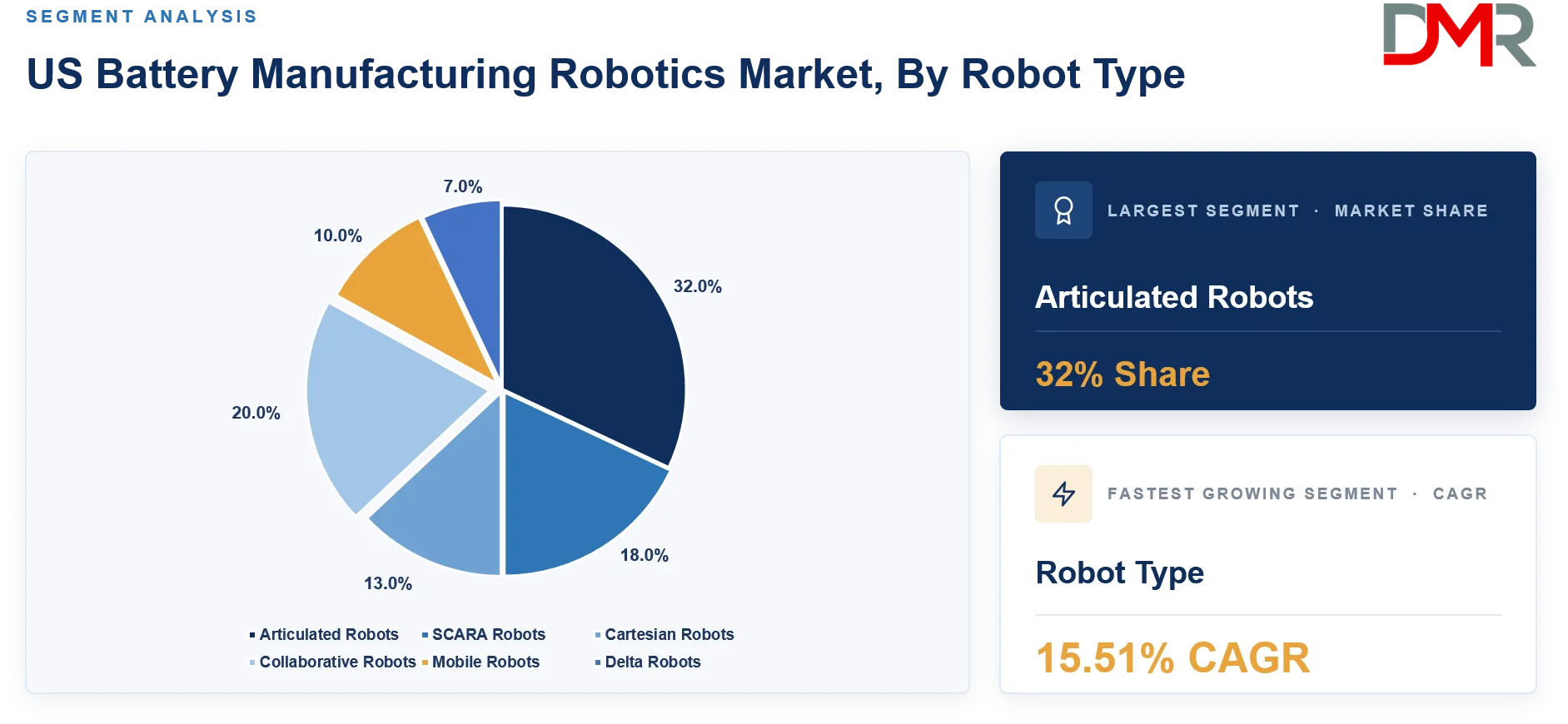
- By Robot Type Segment Analysis: Articulated robots led the robot type segment with a 32.0% share in 2026.
- By Battery Manufacturing Process Segment Analysis: Module pack assembly robots led the battery manufacturing process segment with a 24.0% share in 2026.
- By End User Industry Segment Analysis: Automotive OEM battery plants held a 38.0% share in 2026.
- By Technology Integration Segment Analysis: IoT connected robots accounted for a 22.0% share in 2026.
- Major Players: ABB, FANUC, KUKA, Yaskawa Electric, Universal Robots and Others.
What is the US Battery Manufacturing Robotics Market and its Market Size?
The US Battery Manufacturing Robotics Market size is projected to be valued at USD 2.18 billion in 2026 and is expected to reach USD 7.95 billion by 2035, expanding at a CAGR of 15.4% during the forecast period. The market covers robotic systems, motion platforms, controls, machine vision, autonomous material handling, inspection equipment, and integrated automation deployed across electrode processing, battery cell assembly, module and pack assembly, formation and aging, testing, sealing, packaging, and intralogistics.
ℹ
To learn more about this report –
Download Your Free Sample Report Here
Growth is connected to the expansion and modernization of domestic battery manufacturing. Battery plants require high throughput while controlling contamination, dimensional tolerances, welding quality, adhesive dispensing, cell handling, electrical testing, and worker exposure to repetitive or hazardous processes. These operating requirements create demand for articulated robots, SCARA systems, Cartesian robots, collaborative robots, mobile robots, machine vision, digital twins, and connected production platforms. The International Federation of Robotics reported that US industrial robot installations increased 11% in 2025 to about 38,000 units, while automotive remained the country's largest robot adopting industry with approximately 13,500 installations.
Battery investment is also creating a larger addressable automation base. The US Department of Energy has operated a USD 3 billion Battery Manufacturing and Recycling Grants program and, in August 2026, announced USD 500 million for seven selected critical minerals, battery manufacturing, and recycling projects. These programs support new plants and processing capacity that can require robotics, programmable automation, quality control, traceability, and advanced material handling.
Use Cases
- Battery Module and Pack Assembly: Robots position cells, modules, busbars, frames, cooling plates, covers, and structural components during battery pack production. Integrated fastening, adhesive dispensing, thermal interface material application, and handling improve repeatability while allowing manufacturers to maintain tight cycle times across high volume EV battery lines.
- Precision Welding and Sealing: Articulated and Cartesian robots support laser welding, spot welding, ultrasonic joining, sealant application, and enclosure sealing. Battery manufacturers use automated motion and vision guidance to control weld position, seam consistency, heat input, and enclosure integrity, which are important for electrical performance and battery safety.
- Automated Material Transport: Autonomous mobile robots and robotic transfer systems move cells, trays, modules, containers, and work in progress between production stations. Connected transport systems help battery factories reduce manual forklift movement, coordinate production flow, track materials, and adapt routes when line configurations or production schedules change.
- Inspection and Metrology: Vision equipped robots perform dimensional measurement, surface inspection, connector verification, weld assessment, alignment checks, and barcode or serial number reading. These systems allow manufacturers to link quality results with individual cells and modules, improving traceability and helping identify process drift before defects reach later production stages.
- Formation, Testing and End of Line Handling: Automated systems load batteries into formation and aging equipment, connect test interfaces, transfer units through controlled processes, and route finished modules or packs according to test results. Robotics reduces repetitive handling while supporting consistent testing workflows and higher production throughput.
How AI and Gen AI are Transforming the US Battery Manufacturing Robotics Market?
Artificial intelligence is moving battery robotics beyond fixed motion programs toward production systems that can interpret sensor, vision, maintenance, and process data. AI supported vision can improve part localization, weld inspection, surface defect recognition, and component verification, while machine learning can identify process deviations that are difficult to capture with static thresholds. Battery manufacturing is well suited to these tools because each cell, module, and pack generates production data that can be connected with robot motion, torque, temperature, inspection, and test records. The result is a stronger link between automation and quality control rather than robotics operating as an isolated mechanical layer.
Generative and physical AI technologies are also influencing robot programming, simulation, commissioning, and fleet orchestration. KUKA introduced its Automation Management Platform in 2026 to connect robots, fleets, work cells, digital twins, software tools, and AI driven automation within a common environment. NVIDIA has also reported collaborations with industrial robotics companies including ABB, FANUC, KUKA, Universal Robots, and Yaskawa to develop production scale physical AI. For battery manufacturers, these developments can shorten engineering cycles, improve virtual validation, support predictive adjustments, and make automated cells easier to reconfigure when pack architectures or manufacturing sequences change.
Key Drivers in the US Battery Manufacturing Robotics Market
Expansion of Domestic Battery Manufacturing Capacity
New US battery plants are creating direct demand for robotic assembly, inspection, transport, welding, dispensing, and testing systems. Large plants need automation that can sustain high output while maintaining repeatable quality across thousands of cells and modules. DOE backed projects illustrate the scale of the manufacturing buildout. The BlueOval SK project covers three battery plants designed for more than 120 GWh of annual production, while the StarPlus Energy project in Indiana is designed for about 67 GWh at full capacity. Each new gigawatt hour facility expands opportunities for robot suppliers, integrators, motion control vendors, and digital manufacturing platforms.
Quality, Throughput and Traceability Requirements
Battery manufacturing combines high production volumes with strict requirements for alignment, joining, contamination control, electrical integrity, sealing, and traceability. A defect in a weld, connector, thermal interface, or enclosure can affect downstream yield and product reliability. Robotics allows manufacturers to standardize motion, collect process data, integrate machine vision, and execute repetitive operations with consistent cycle times. ABB, for example, markets battery assembly automation for gluing, thermal interface application, flow drill screwing, and battery charging, showing how robotics is increasingly integrated with process specific tooling rather than used only for basic pick and place operations.
Restraints in the US Battery Manufacturing Robotics Market
High Integration Cost and Complex Commissioning
Robotic battery production lines require more than robot hardware. Manufacturers must combine end effectors, conveyors, safety systems, PLCs, machine vision, traceability software, testing equipment, network infrastructure, and manufacturing execution systems. Engineering and commissioning expenses can therefore become significant, particularly for new battery producers with limited automation experience. Changes in cell geometry or pack design may also require tooling and programming modifications. These costs can extend return on investment periods for smaller plants and encourage phased deployment rather than full line automation.
Rapid Changes in Battery Architecture
Battery formats, cell chemistries, pack structures, and assembly methods continue to evolve. Manufacturers may use cylindrical, prismatic, pouch, cell to pack, structural pack, lithium iron phosphate, nickel rich lithium ion, sodium ion, or other configurations. Automation designed around one format may need mechanical and software changes when production strategy shifts. Buyers therefore place greater value on modular tooling, flexible fixtures, vision guided motion, simulation, and reprogrammable cells. Vendors unable to support rapid product changeovers face greater resistance in capital intensive battery projects.
Growth Opportunities in the US Battery Manufacturing Robotics Market
Flexible and Reconfigurable Robotic Cells
Flexible automation offers a major opportunity as battery producers seek to reduce the risk of locking factories into one product architecture. Collaborative robots, modular articulated robot cells, mobile robots, adaptive grippers, vision systems, and software defined workstations can allow manufacturers to modify operations without replacing complete production lines. Flexible cells are particularly useful for pilot manufacturing, lower volume battery variants, pack finishing, inspection, rework, and end of line processes where product mixes can change more frequently than core high volume cell manufacturing.
Digital Twins and Virtual Commissioning
Battery factories contain tightly linked processes where changes to one station can affect line throughput. Digital twins allow integrators and manufacturers to test robot paths, process logic, cycle times, equipment interfaces, and control strategies before physical commissioning. Siemens describes the use of an automation twin for testing plant programs and supporting virtual commissioning, helping identify programming or specification issues before deployment. As US gigafactories become larger and more software intensive, digital engineering can reduce launch risk and increase demand for robotics platforms that connect simulation with operational production data.
Trends in the US Battery Manufacturing Robotics Market
Connected Robotics and Production Data Integration
IoT connected robots accounted for 22.0% of the market in 2026, reflecting growing demand for equipment that communicates with manufacturing execution systems, quality databases, maintenance platforms, and plant controls. Connected robot cells can report cycle time, motor condition, alarms, tool status, process parameters, and inspection results. Battery producers can use this information to improve overall equipment effectiveness, trace defects to individual production stages, schedule maintenance, and compare performance across lines or facilities.
Shift Toward Software Defined Automation
Robot suppliers are adding orchestration, digital twin, simulation, machine learning, and fleet management capabilities around traditional robot hardware. In March 2026, FANUC America announced a USD 90 million investment in an 840,000 square foot Michigan facility intended to create capacity for future US robot manufacturing expansion, with the company specifically identifying physical AI, virtual commissioning, and digital twin technologies among areas of growing demand. This shift suggests that competitive differentiation will increasingly depend on software, interoperability, lifecycle services, and data capabilities alongside mechanical performance.
Research Scope and Analysis
The US Battery Manufacturing Robotics Market is segmented based on Robot Type, Battery Manufacturing Process, End User Industry, Application Function, Technology Integration, Deployment Model, Payload Capacity, and Power Source. The study analyzes the adoption of robotic equipment across cell, module, pack, inspection, handling, testing, and connected production environments and evaluates how each segment contributes to market size, share, demand, growth, and long term automation investment.
ℹ
To learn more about this report –
Download Your Free Sample Report Here
By Robot Type
Articulated robots dominated the US Battery Manufacturing Robotics market with a 32.0% share in 2026. Their six axis movement, broad working envelope, payload range, mature control ecosystem, and compatibility with multiple end effectors make them suitable for pack assembly, cell and module handling, fastening, dispensing, welding, sealing, palletizing, and machine tending. A single articulated robot platform can be configured for multiple operations, making it attractive for manufacturers that want common hardware across production cells. Large robot suppliers also provide simulation, safety, vision, offline programming, and service capabilities that reduce integration risk for automotive scale plants. Articulated systems are expected to remain central to high volume battery lines while collaborative and mobile robots gain share in flexible operations.
By Battery Manufacturing Process
Module pack assembly robots led the battery manufacturing process segment with a 24.0% share in 2026. Pack assembly brings together cell placement, module positioning, thermal materials, busbars, electrical connections, frames, cooling components, housings, adhesives, fasteners, covers, and final inspection. This combination creates multiple opportunities for robotic handling and process integration within the same line. ABB specifically provides robotic battery assembly solutions for operations such as gluing, thermal interface material application, fastening, and manufacturing stage charging. As vehicle platforms adopt larger and more structurally integrated packs, robot accuracy and coordinated process control become increasingly important for maintaining takt time and dimensional consistency.
By End User Industry
Automotive OEM battery plants accounted for 38.0% of the market in 2026. Automotive manufacturers operate at production volumes that justify extensive investment in assembly automation, industrial robots, autonomous transport, inspection, welding, testing, and digital manufacturing systems. The segment also benefits from decades of automotive robotics expertise already present among suppliers such as ABB, FANUC, KUKA, Yaskawa, Comau, Rockwell Automation, Siemens, and Mitsubishi Electric. IFR data reinforces the importance of automotive automation, with approximately 13,500 industrial robots installed by the US automotive industry in 2025.
By Technology Integration
IoT connected robots represented 22.0% of the market in 2026. Connected automation allows battery manufacturers to move from isolated robot cells toward production systems where equipment status, process measurements, maintenance information, inspection data, and traceability records are available across plant networks. The model is especially valuable in battery production because manufacturers need to correlate process history with individual cells, modules, and packs. Continued adoption of industrial Ethernet, edge computing, manufacturing execution systems, digital twins, and predictive maintenance is expected to expand connected robotics throughout the forecast period.
The US Battery Manufacturing Robotics Market Report is Segmented on the Basis of the Following:
By Robot Type
- Articulated Robots
- SCARA Robots
- Cartesian Robots
- Collaborative Robots
- Mobile Robots
- Delta Robots
By Battery Manufacturing Process
- Electrode Manufacturing Robots
- Cell Assembly Robots
- Module Pack Assembly Robots
- Formation Aging Automation Robots
- Material Handling Robots
- Quality Inspection Robots
By End User Industry
- Automotive OEM Battery Plants
- Dedicated Battery Manufacturers
- Consumer Electronics Battery Makers
- Grid Storage System Providers
- Industrial Battery Manufacturers
- Aerospace Battery Producers
By Application Function
- Precision Assembly Robots
- Material Transport Robots
- Welding Sealing Robots
- Testing Metrology Robots
- Palletizing Packaging Robots
- Vision Inspection Robots
By Technology Integration
- AI Machine Learning Robots
- IoT Connected Robots
- Digital Twin Enabled Robots
- Advanced Vision System Robots
- Precision Motion Control Robots
- Human Machine Interface Robots
By Deployment Model
- On Premise Robot Systems
- Cloud Connected Robot Systems
- Hybrid Deployment Robots
- Standalone Workstation Robots
- Integrated Production Line Robots
- Flexible Cell Robot Systems
By Payload Capacity
- Light Payload Robots
- Medium Payload Robots
- Heavy Payload Robots
- Ultra Heavy Payload Robots
By Power Source
- Lithium Ion Powered Robots
- Lead Acid Powered Robots
- Nickel Metal Hydride Robots
- Sodium Ion Powered Robots
Competitive Landscape
The US Battery Manufacturing Robotics market combines global industrial robot manufacturers, automation platform providers, specialist battery equipment companies, and regional system integrators. ABB, FANUC, KUKA, Yaskawa Electric, Mitsubishi Electric, Comau, Stäubli, Epson Robots, and Universal Robots compete through robot performance, payload coverage, precision, reliability, programming tools, vision integration, safety, and service networks. Rockwell Automation and Siemens strengthen the software and factory architecture layer through controls, industrial connectivity, simulation, digital twins, production management, and plant integration.
Battery focused engineering and integration companies such as Manz USA, Eclipse Automation, Eagle Manufacturing Systems, Glide Line, South Shore Controls, and other specialists compete through process expertise and turnkey production cells. Competition is shifting from stand alone robot hardware toward complete automation ecosystems that combine robots, autonomous transport, machine vision, edge connectivity, manufacturing data, virtual commissioning, predictive maintenance, and lifecycle services. FANUC's planned USD 90 million Michigan expansion and ABB's continued investment in US manufacturing and research capabilities illustrate how major suppliers are increasing domestic capacity while software defined automation becomes a larger source of differentiation.
Some of the prominent players in the US Battery Manufacturing Robotics Industry are:
- ABB
- FANUC
- KUKA
- Yaskawa Electric
- Universal Robots
- Rockwell Automation
- Siemens
- Mitsubishi Electric
- Comau
- Stäubli
- Epson Robots
- Honeywell
- Manz USA
- Eagle Manufacturing Systems
- Glide Line
- Eclipse Automation
- Dinnar Automatic Intelligence
- EnerLink Systems
- South Shore Controls
- Semco Infratech
- Others
Technology Analysis
The US Battery Manufacturing Robotics market is shifting from conventional fixed automation toward connected, vision guided, and software defined robotic systems designed for high precision battery production. Articulated robots remain important for welding, sealing, material handling, and module pack assembly, while SCARA, Cartesian, collaborative, and mobile robots are gaining use in inspection, transport, dispensing, and flexible assembly cells. IoT connected robots accounted for 22.0% of the market in 2026, reflecting demand for real time equipment monitoring, traceability, predictive maintenance, and integration with manufacturing execution systems. Advanced vision systems are becoming more critical for cell alignment, surface inspection, weld verification, connector checking, and dimensional measurement. Digital twins and virtual commissioning are also reducing line launch risk by allowing manufacturers to validate robot paths, cycle times, control logic, and workstation interaction before physical installation. Technology competition is increasingly centered on interoperability, precision motion, data integration, machine vision, flexible programming, and faster production changeovers.
Investment and White Space Analysis
Investment opportunities in the US Battery Manufacturing Robotics market are expanding around new battery plants, capacity upgrades, flexible production lines, and domestic supply chain localization. Large scale battery facilities require substantial spending on robotic assembly, automated material movement, vision inspection, welding, testing, traceability, and connected controls, creating opportunities beyond traditional robot hardware. Attractive white space exists in flexible cells that can support multiple battery formats, retrofit automation for existing plants, autonomous intralogistics, battery specific end effectors, digital twin platforms, AI enabled inspection, and predictive maintenance services. Regional opportunities are especially strong in the Midwest and Southeast, where automotive and battery manufacturing investments are creating new demand for integrators and automation suppliers. Smaller dedicated battery producers also represent an underserved segment because they need scalable automation with lower commissioning complexity and faster payback. Vendors that combine robotics, software, engineering, lifecycle support, and battery process knowledge are positioned to capture higher value projects as factories seek fewer integration points and faster production ramp up.
Recent Developments
- March 2026: Eagle ManufacturingSystems launched CONTIGRID™, a fully integrated continuous lead-grid manufacturing platform that automates melting, casting, rolling and coiling for battery producers.
- August 2025: Yaskawa Electric announced an $180M Wisconsin facility to manufacture industrial robots on U.S. soil, accelerating delivery for battery and EV automation customers.
- July 2025: ekvip automation GmbH acquired Manz USA Inc. (North Kingstown, RI), preserving U.S. battery manufacturing automation service and expanding PLC/software support for lithium-ion production lines.
Report Details
| Report Characteristics |
| Market Size (2026) |
USD 2.18 Bn |
| Forecast Value (2035) |
USD 7.95 Bn |
| CAGR (2026–2035) |
15.4% |
| Historical Data |
2021 – 2025 |
| Forecast Data |
2027 – 2035 |
| Base Year |
2025 |
| Estimate Year |
2026 |
| Segments Covered |
By Robot Type (Articulated Robots, SCARA Robots, Cartesian Robots, Collaborative Robots, Mobile Robots, and Delta Robots), By Battery Manufacturing Process (Electrode Manufacturing Robots, Cell Assembly Robots, Module Pack Assembly Robots, Formation Aging Automation Robots, Material Handling Robots, and Quality Inspection Robots), By End-User Industry (Automotive OEM Battery Plants, Dedicated Battery Manufacturers, Consumer Electronics Battery Makers, Grid Storage System Providers, Industrial Battery Manufacturers, and Aerospace Battery Producers), By Application Function (Precision Assembly Robots, Material Transport Robots, Welding Sealing Robots, Testing Metrology Robots, Palletizing Packaging Robots, and Vision Inspection Robots), By Technology Integration (AI Machine Learning Robots, IoT Connected Robots, Digital Twin Enabled Robots, Advanced Vision System Robots, Precision Motion Control Robots, and Human Machine Interface Robots), By Deployment Model (On-Premise Robot Systems, Cloud-Connected Robot Systems, Hybrid Deployment Robots, Standalone Workstation Robots, Integrated Production Line Robots, and Flexible Cell Robot Systems), By Payload Capacity (Light Payload Robots, Medium Payload Robots, Heavy Payload Robots, and Ultra Heavy Payload Robots), By Power Source (Lithium-Ion Powered Robots, Lead-Acid Powered Robots, Nickel-Metal Hydride Robots, and Sodium-Ion Powered Robots) |
| Regional Coverage |
United States |
Frequently Asked Questions
What is the current size of the US Battery Manufacturing Robotics Market?
▾ The US Battery Manufacturing Robotics Market is valued at USD 2.18 billion in 2026 and is forecast to reach USD 7.95 billion by 2035.
What is the growth rate of the US Battery Manufacturing Robotics Market during?
▾ The US Battery Manufacturing Robotics Market is expected to grow at a CAGR of 15.4% during the forecast period 2026-2035.
What factors are driving the growth of the US Battery Manufacturing Robotics Market?
▾ Battery plant expansion, higher production volumes, precision assembly, quality control, and automation drive market growth.
What are the major challenges restraining the US Battery Manufacturing Robotics Market?
▾ High integration costs, complex commissioning, skilled labor gaps, and changing battery designs restrain market expansion.
Which segment holds the largest share of the US Battery Manufacturing Robotics Market?
▾ Articulated robots hold a 32.0% share of the US Battery Manufacturing Robotics Market by robot type segment in 2026.
Who are the leading companies in the US Battery Manufacturing Robotics Market?
▾ ABB, FANUC, KUKA, Yaskawa Electric, Universal Robots, Rockwell Automation, Siemens, Mitsubishi Electric, Comau, Stäubli, Epson Robots, Honeywell, Manz USA, Eagle Manufacturing Systems, Glide-Line, Eclipse Automation, Dinnar Automatic Intelligence, EnerLink Systems, South Shore Controls, and Semco Infratech are prominent companies in the US Battery Manufacturing Robotics Market.
How is AI influencing the US Battery Manufacturing Robotics Market?
▾ AI improves robotic vision, predictive maintenance, quality inspection, process control, and production efficiency in battery plants.
What are the future opportunities and trends in the US Battery Manufacturing Robotics Market?
▾ Digital twins, IoT robots, flexible automation, smart inspection, and new gigafactories create strong future market opportunities.