Market Overview
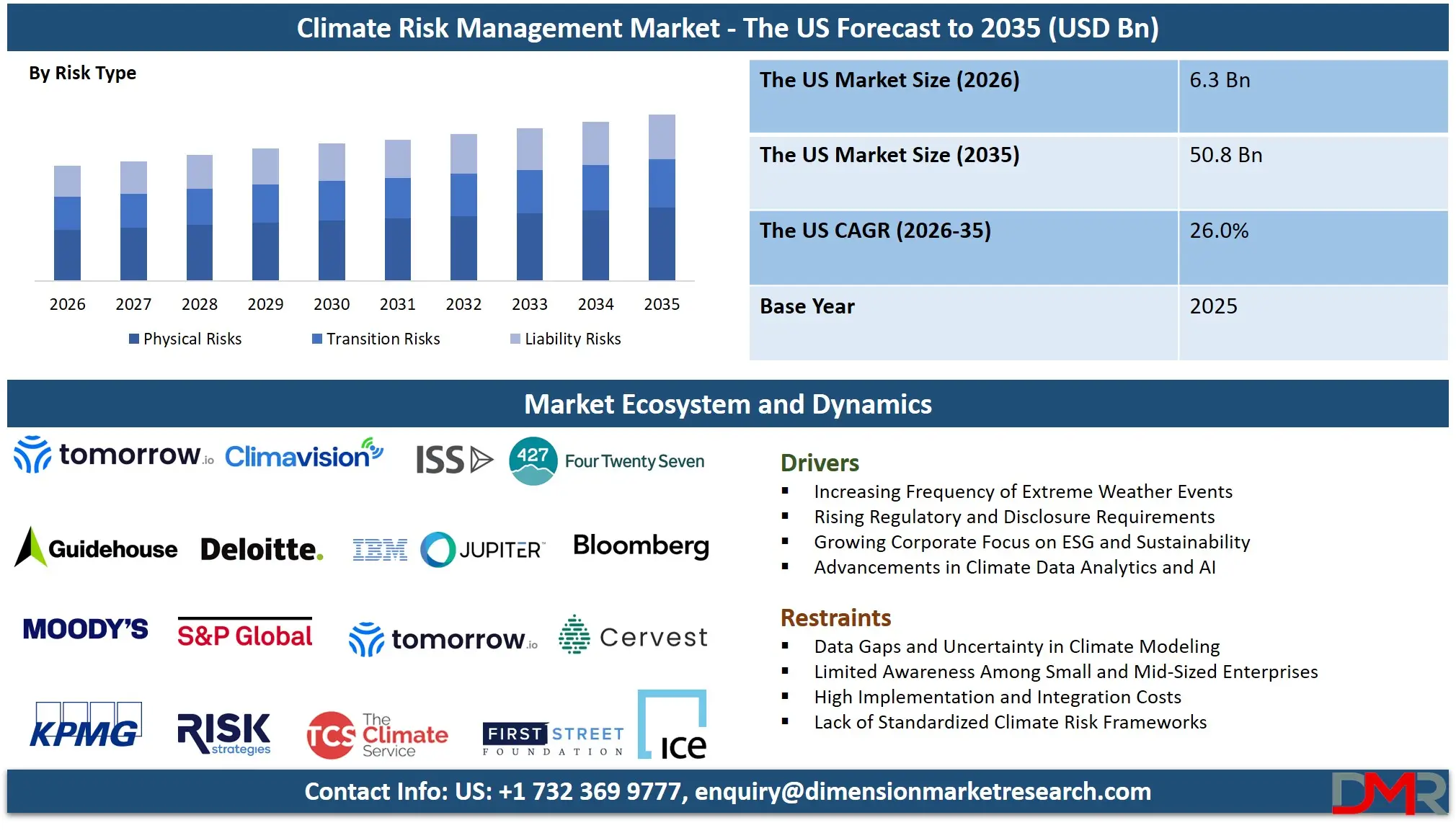
The US Climate Risk Management Market size is expected to be valued at USD 6.3 billion in 2026, which is further projected to reach USD 50.8 billion in 2035 at a CAGR of 26.0% during the forecast period of 2026 to 2035.
ℹ
To learn more about this report –
Download Your Free Sample Report Here
The US Climate Risk Management industry is rapidly growing due to new laws, regulations, and investor pressure to prevent negative impacts related to climate change from affecting businesses. The main drivers of climate risk management are increased environmental regulation and the need for companies to consider ESG (Environmental, Social, and Governance) factors in making business decisions.
ℹ
To learn more about this report –
Download Your Free Sample Report Here
The major sectors in the market, which include insurance, banking, agriculture, and infrastructure, have shown promising growth, driven by innovations in technologies related to artificial intelligence, forecasting, and scenario planning. The market has also been driven by initiatives taken by the government and frameworks developed by agencies like the SEC and FEMA, which have shown positive results in promoting the market.
The US Climate Risk Management Market: Key Takeaways & Influencing Factors
- Market Growth Insights: The Climate Risk Management market in the USA can anticipate reaching USD 6.3 billion by 2026 and expanding to USD 50.8 billion by 2035, with an anticipated CAGR of 26.0% during the forecast period.
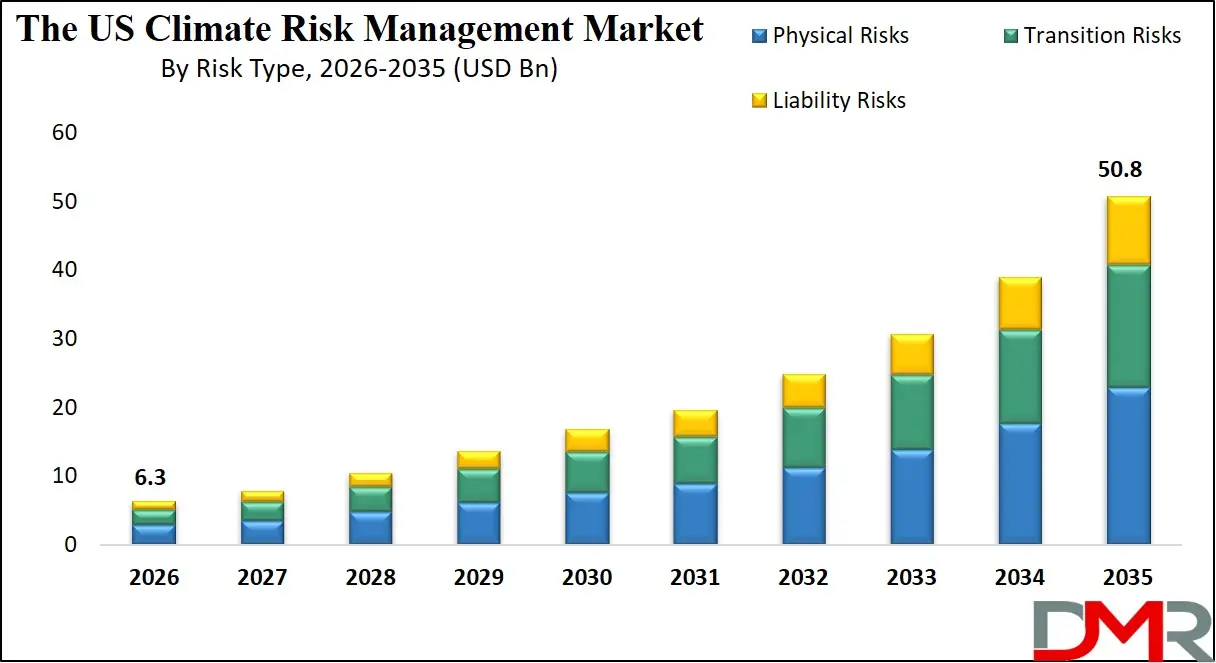
- By Risk Type Insights: The market is dominated by physical risks such as hurricanes, wildfires, and water scarcity. The market is also witnessing the growth of transition risks.
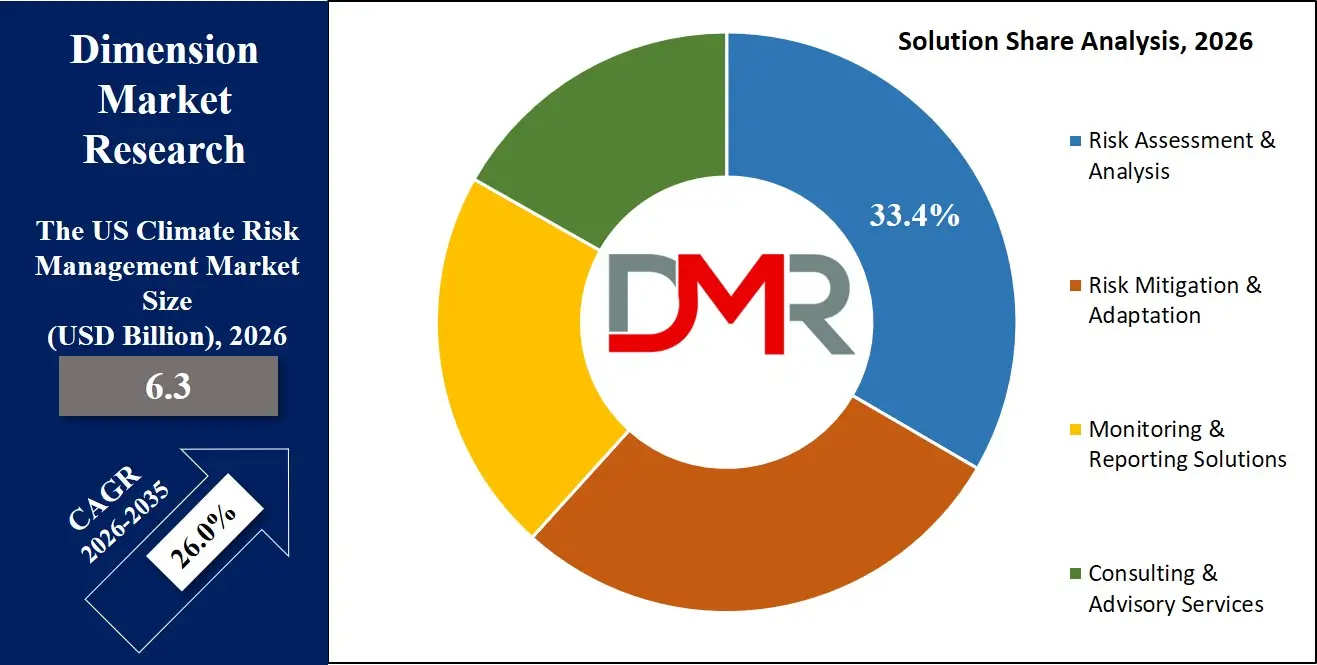
- By Solution Insights: The risk assessment and analysis sector will be the largest portion of the Climate Risk Management market due to the growing need for organizations to prepare themselves for upcoming legislation and access the data necessary to comply with such regulations.
- Key Players Insights: The major players in the market are MSCI, Moody's, S&P Global, Bloomberg, Salesforce (Net Zero Cloud), Palantir, and a robust lineup of US-based climate tech companies such as Jupiter Intelligence, Rhodium Group, and Climate Risk Analytics.
- U.S. Securities and Exchange Commission (SEC): The proposed SEC climate disclosure rules will apply to over 6,000 public companies and will require them to disclose climate-related risks that are reasonably likely to have a material impact on their business.
- National Oceanic and Atmospheric Administration (NOAA): The US went through 28 separate billion-dollar weather and climate disasters in 2023, a record high, which is a clear indicator of the increasing risk landscape and thereby increasing the demand for risk analytics solutions.
- U.S. Government Accountability Office (GAO): Placed climate risk on its "High-Risk List" for the US government in 2024. The government is not well-positioned to manage its fiscal exposure due to climate change, which is a clear indicator of a significant market opportunity for the US government sector.
Impact of the Iran Conflict on the US Climate Risk Management Market
Rising oil prices are a major cause of increasing inflation in the US economy. The conflict is a major cause of increasing oil prices globally and is thereby impacting the US economy. The US government is facing a significant challenge in maintaining low interest rates due to the economic uncertainty and stress faced by the US economy. The conflict is causing an increase in government spending on defense and operations, which is increasing the debt burden of the US government and thereby impacting economic development programs and projects in the US economy.
The US Climate Risk Management Market: Use Cases
- Regulatory Compliance and SEC Disclosure Preparation: The first use case is to prepare for the proposed SEC climate disclosure rules. Publicly traded companies are investing heavily in systems to measure Scope 1, 2, and 3 emissions, perform scenario analysis, and quantify financial impacts.
- Insurance Underwriting and Catastrophe Modeling: The US-based insurance and reinsurance industries are among the largest consumers of climate risk management solutions. Insurance companies use high-resolution physical risk models for wildfires, hurricanes, and flood risks to price risks and make informed decisions about new business opportunities in high-risk areas.
- Real Estate and Infrastructure Portfolio Risk Management: Real estate investment trusts (REITs) and infrastructure asset owners use climate risk platforms to assess the physical vulnerability of their portfolios.
- Investor Engagement and Portfolio Alignment: Large institutional investors like BlackRock and CalPERS use climate risk data to engage with portfolio companies, assess climate risk exposure, and manage their own financial risk. They demand standardized, comparable data to align investments with net-zero goals.
The US Climate Risk Management Market: Market Dynamic
Driving Factors in the US Climate Risk Management Market
Regulatory Changes and Federal Policy
Regulatory acceleration is a key driver for the US-based climate risk management market. The US Securities and Exchange Commission is proposing a climate risk disclosure framework for public companies. This is paving the way for a structured approach to the mandatory reporting of climate risks and opportunities by publicly traded companies. Meanwhile, key US states such as California have mandated very stringent climate risk reporting for companies. This is effectively creating a quasi-national reporting norm for companies to comply with.
Escalating Physical Risk and Economic Losses
The rising incidence of climate-related natural disasters in the US is also a major driver for the US-based climate risk management market. Calamities such as hurricanes, wildfires, floods, and droughts are causing significant economic losses for companies and governments in the US, which us pushing for the growth of this market.
Restraints in the US Climate Risk Management Market
Regulatory Uncertainty and Political Scrutiny
Despite the significant level of regulatory drive for climate risk management solutions, the current level of uncertainty regarding the final form and enforcement of climate risk disclosure regulations is a major restraint for the US climate risk management market. The ongoing political conflict of the US with the Middle East is also one of the reasons why it is getting so much criticism from various environmental and government organizations worldwide.
Data Inconsistency and Modeling Complexity
One of the biggest challenges faced by the US climate risk management market is the inconsistency of data and the inherent complexities of climate modeling. The process of climate risk assessment involves a number of different data inputs, ranging from environmental data to financial data and geospatial data.
Opportunities in the US Climate Risk Management Market
Technology-Driven Risk Analytics Platforms
The increasing need for better and more robust climate risk solutions is a major opportunity for the US climate risk management market. With the increasing demand for better and more robust solutions for climate risk analysis and assessment, technology-driven risk analytics platforms are being developed to automate the process of climate risk assessment and reporting.
Climate Risk Services for the Mid-Market
While the large corporation sector is a key driver for the US climate risk management market, the mid-market is a significant opportunity for the US climate risk management market. Small and medium-sized enterprises are increasingly being subjected to pressure by investors and regulators to disclose climate risk information and greenhouse gas emissions data.
Trends in the US Climate Risk Management Market
Integration with Financial Software and ERP Systems
One of the major trends being seen in the market is the incorporation of climate risk data into the core business processes of enterprises through financial applications and Enterprise Resource Planning tools. Climate risk data is no longer being used only in standalone ESG reports. It is being increasingly used in the core business processes of companies.
Rise of AI and Generative AI for Climate Reporting
Artificial intelligence, including generative AI, is the next big thing being seen in the field of climate risk management and climate change reporting. Advanced AI tools, including generative AI, are being increasingly used to prepare detailed climate change reports with minimal human intervention. It is being increasingly seen as the future of climate change reporting. It can be used in weather forecasting and analyzing weather patterns or for further predictions.
The US Climate Risk Management Market: Research Scope and Analysis
By Risk Type Analysis
The US climate risk management market is segmented into physical risks, transition risks, and liability risks. These three types of risks play different roles in the US climate risk management market. Physical risks account for the largest share of the US climate risk management market. The recent surge in the number of hurricanes, wildfires, floods, and heatwaves is the main reason for the growth of the US climate risk management market. These weather conditions pose a direct threat to businesses in the US. They affect the operations of businesses in the US. As a result, companies in the US are investing heavily in the field of climate risk management.
By Solution Analysis
The Risk Assessment and analysis of poised to dominate this segment as the US climate risk management market is characterized by diverse solutions in the solution landscape, with risk assessment and analysis solutions dominating the market.
ℹ
To learn more about this report –
Download Your Free Sample Report Here
Risk assessment and analysis solutions include advanced climate data solutions, scenario analysis solutions, and financial impact modeling solutions. These solutions allow businesses to measure their exposure to both physical and transition climate-related risks. They also provide actionable insights, which is the backbone of any business strategy.
By Deployment Mode Analysis
Deployment mode is one of the factors that affect the US climate risk management market. Cloud deployment solutions is poised to lead the deployment mode segment. Cloud deployment solutions are the preferred option for businesses in the US climate risk management market. Cloud deployment solutions offer flexibility and the ability to process large amounts of data required to analyze climate and financial data. Cloud deployment solutions allow businesses to integrate data in real-time and can be accessed remotely. They are ideal for large businesses.
By Enterprise Size Analysis
Enterprise size is one of the factors that affect the US climate risk management market. Large enterprises are expected to dominate the US climate risk management market. Large enterprises have the financial capacity to invest in climate risk management. They also have the expertise to understand the importance of climate risk management. Large enterprises in the US climate risk management market are using advanced analytics solutions to analyze climate-related scenarios. They integrate climate risk into the governance structure.
By Industry Vertical Analysis
Industry vertical dynamics also play an important role in shaping the US climate risk management market size, with the financial services and insurance segment is expected to dominating the market. This segment is both the main driver and the main user. It includes insurance companies using sophisticated climate analytics tools for underwriting, risk pricing, and cat modeling, as well as banks using climate risk in portfolio management, stress testing, and investment decisions.
The US Climate Risk Management Market Report is segmented on the basis of the following:
By Risk Type
- Physical Risks
- Transition Risks
- Liability Risks
By Solution
- Risk Assessment & Analysis
- Risk Mitigation & Adaptation
- Monitoring & Reporting Solutions
- Consulting & Advisory Services
By Deployment Mode
By Enterprise Size
- Large Enterprises
- Small & Medium Enterprises (SMEs)
By Industry Vertical
- Financial Services & Insurance
- Energy & Utilities
- Agriculture & Forestry
- Manufacturing & Industrial
- Real Estate & Infrastructure
- Government & Public Sector
Impact of Artificial Intelligence in the US Climate Risk Management Market
Artificial Intelligence is being utilized in developing highly accurate and detailed models of US climate-related risks such as wildfires and hurricanes. It is helping insurers as well as asset owners in assessing risk at the individual asset level. Artificial Intelligence is being utilized in efficiently automating the labor-intensive process of gathering Scope 1, 2, and 3 data from internal sources as well as supplier invoices, thus efficiently reporting these data points in accordance with the expected SEC regulations. Artificial Intelligence is being utilized by asset managers in efficiently aggregate and analyze climate risk across thousands of assets, thus providing a comprehensive view of asset risk against both transition and physical risks.
The US Climate Risk Management Market: Competitive Landscape
The US market of climate risk management is competitive, with well-established IT consulting companies, insurance companies, and special climate analytics firms of the market. Such industry leaders as IBM, Microsoft and Google (AI-guided climate modelling), as well as insurance companies such as Marsh McLennan, Aon, and The Hartford selling parametric and transition risk coverage, are the main players. There are high-resolution physical risk analytics offered by climate risk data specialists like Four Twenty Seven (Moodys), Jupiter Intelligences, and Climate Central.
ℹ
To learn more about this report –
Download Your Free Sample Report Here
The leaders of financial services such as BlackRock, S&P Global, and Bloomberg incorporate climate scoring into investment models. ESG advisory firms, such as ERM or Deloitte, also gain more power in the market. The focal point of competition will revolve around the predictive accuracy, real-time tracking, and adherence to the guidelines of SEC requirements on climate disclosure regulation. It is consolidating with larger companies purchasing smaller startups specializing in analytics to improve their modeling products and create market share in the public and private markets.
Some of the prominent players in the US Climate Risk Management Market are:
- Moody's Corporation
- S&P Global Inc.
- Bloomberg L.P.
- Intercontinental Exchange
- Institutional Shareholder Services
- IBM
- Deloitte
- Guidehouse
- KPMG US
- Risk Strategies
- Jupiter Intelligence
- First Street Foundation
- The Climate Service
- Cervest
- Tomorrow.io
- AccuWeather
- Climavision
- Ceres
- BSR
- Four Twenty Seven
- Other Key Players
Recent Developments in the US Climate Risk Management Market
- In March 2026, MSCI Inc. announced a new AI-powered tool to help asset managers assess climate transition risks in their portfolios, specifically aligned with the US SEC's proposed disclosure requirements.
- In February 2026, Salesforce announced a major update to its Net Zero Cloud, adding new features for physical risk assessment and scenario analysis aimed at large US enterprises.
- In February 2026, Jupiter Intelligence secured USD 75 million in a Series D funding round to expand its climate risk analytics platform for the insurance and real estate sectors.
- In January 2026, Moody's acquired a leading US-based provider of wildfire and flood risk data to enhance its suite of physical risk solutions.
Report Details
| Report Characteristics |
| Market Size (2026) |
USD 6.3 Bn |
| Forecast Value (2035) |
USD 50.8 Bn |
| CAGR (2026–2035) |
26.0% |
| Historical Data |
2021 – 2025 |
| Forecast Data |
2027 – 2035 |
| Base Year |
2025 |
| Estimate Year |
2026 |
| Report Coverage |
Market Revenue Estimation, Market Dynamics, Competitive Landscape, Growth Factors and etc. |
| Segments Covered |
By Risk Type (Physical Risks, Transition Risks, and Liability Risks), By Solution (Risk Assessment & Analysis, Risk Mitigation & Adaptation, Monitoring & Reporting Solutions, and Consulting & Advisory Services), By Deployment Mode (Cloud-based and On-premises), By Enterprise Size (Large Enterprises, and Small & Medium Enterprises (SMEs)), and By Industry Vertical (Financial Services & Insurance, Energy & Utilities, Agriculture & Forestry, Manufacturing & Industrial, Real Estate & Infrastructure, and Government & Public Sector) |
| Country Coverage |
The US |
| Prominent Players |
Moody’s Corporation, S&P Global Inc., Bloomberg L.P., Intercontinental Exchange, Institutional Shareholder Services, IBM, Deloitte, Guidehouse, KPMG US, Risk Strategies, Jupiter Intelligence, First Street Foundation, The Climate Service, Cervest, Tomorrow.io, AccuWeather, Climavision, Ceres, BSR, Four Twenty Seven, and Other Key Players |
| Purchase Options |
We have three licenses to opt for: Single User License (Limited to 1 user), Multi-User License (Up to 5 Users) and Corporate Use License (Unlimited User) along with free report customization equivalent to 0 analyst working days, 3 analysts working days and 5 analysts working days respectively. |
Frequently Asked Questions
How big is the US Climate Risk Management Market?
▾ The US Climate Risk Management Market size is estimated to have a value of USD 6.3 billion in 2026 and is expected to reach USD 50.8 billion by the end of 2035.
Who are the key players in the US Climate Risk Management Market?
▾ Some of the major key players in the US Climate Risk Management Market are MSCI, Moody's, S&P Global, Bloomberg, Salesforce, Palantir, and many others.
What is the growth rate in the US Climate Risk Management Market?
▾ The market is growing at a CAGR of 26.0 percent over the forecasted period.