Market Overview
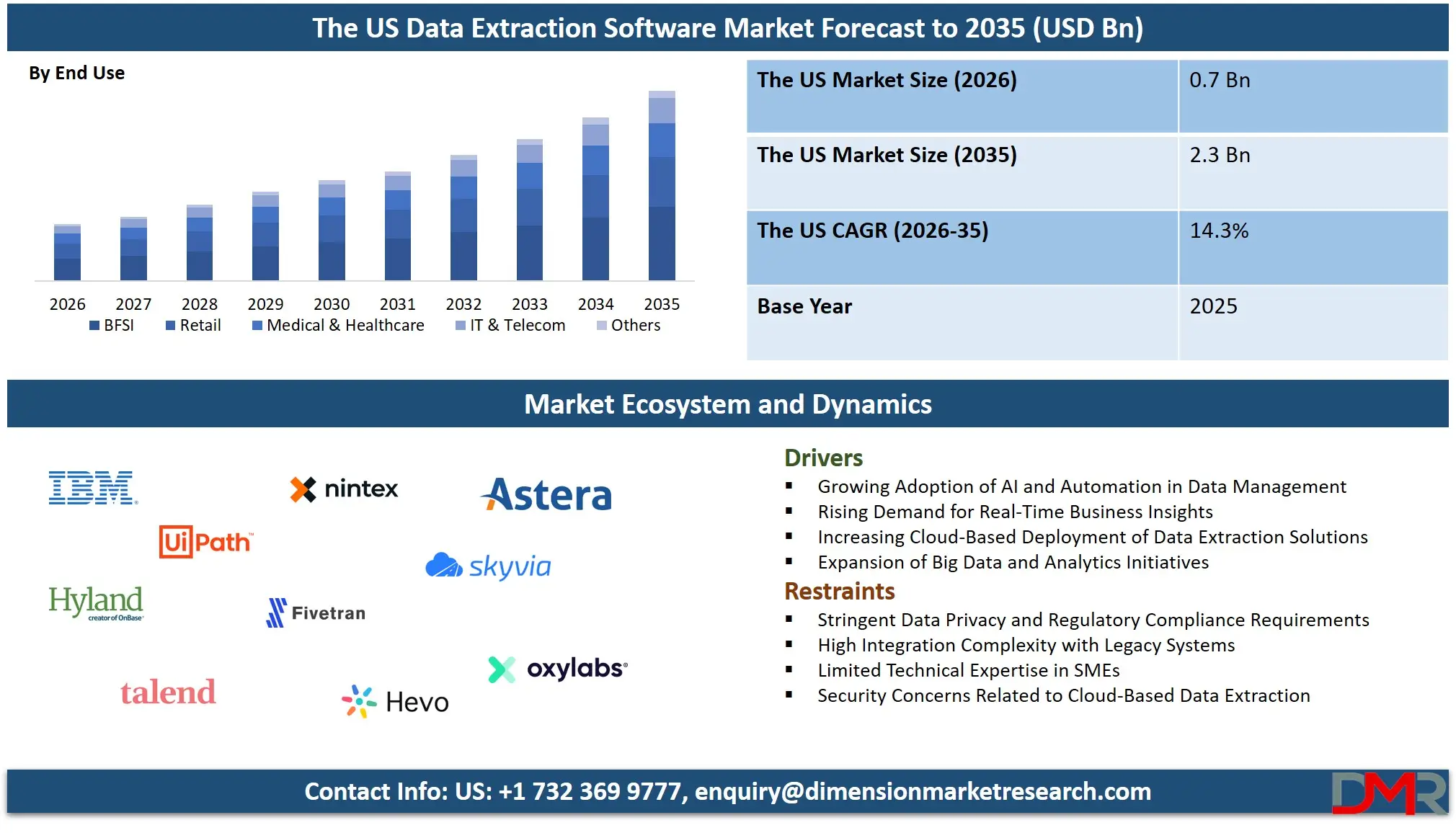
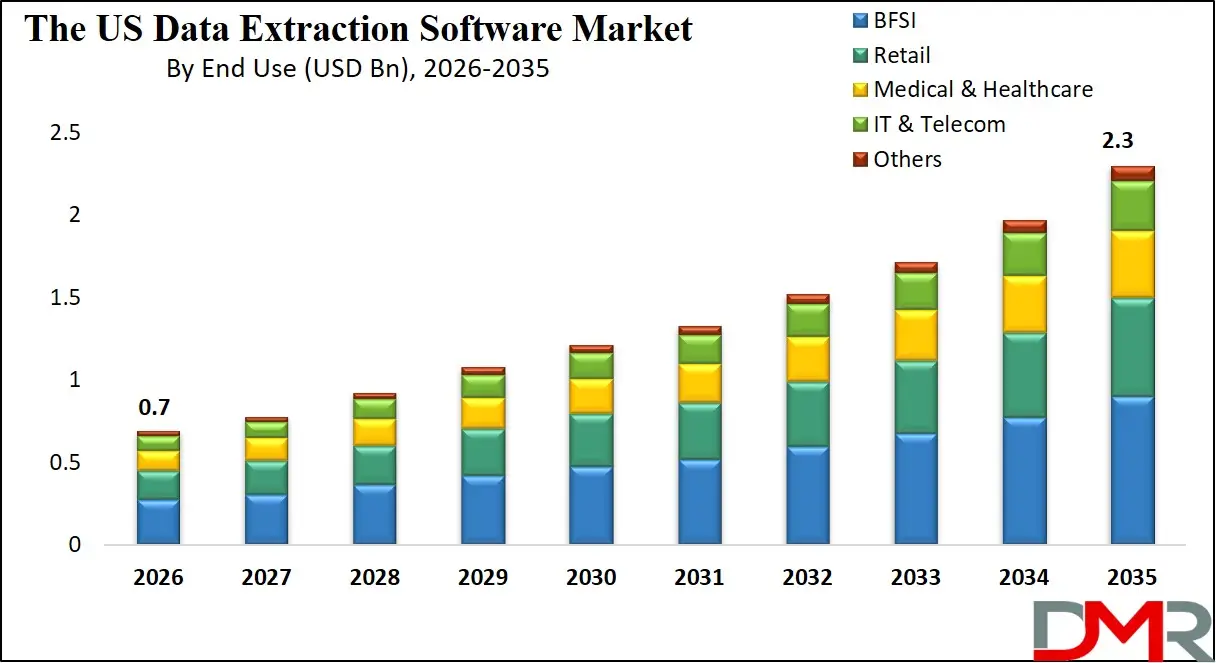
US data extraction software market is projected to grow from USD 0.7 billion in 2026 to USD 2.3 billion by 2035, registering a strong CAGR of 14.3%. This growth is driven by increasing adoption of automation, AI-powered data analytics, and cloud-based data integration tools across industries seeking efficient and accurate data management solutions.
ℹ
To learn more about this report –
Download Your Free Sample Report Here
Data extraction software refers to specialized digital tools designed to automatically collect, retrieve, and organize data from multiple structured and unstructured sources such as websites, databases, documents, APIs, and online applications. These platforms simplify the process of transforming raw information into usable datasets, enabling organizations to perform analytics, reporting, and decision-making with greater speed and accuracy. By leveraging technologies like artificial intelligence, natural language processing, and optical character recognition, data extraction software minimizes manual data entry, reduces human error, and enhances data quality for business intelligence, automation, and compliance purposes.
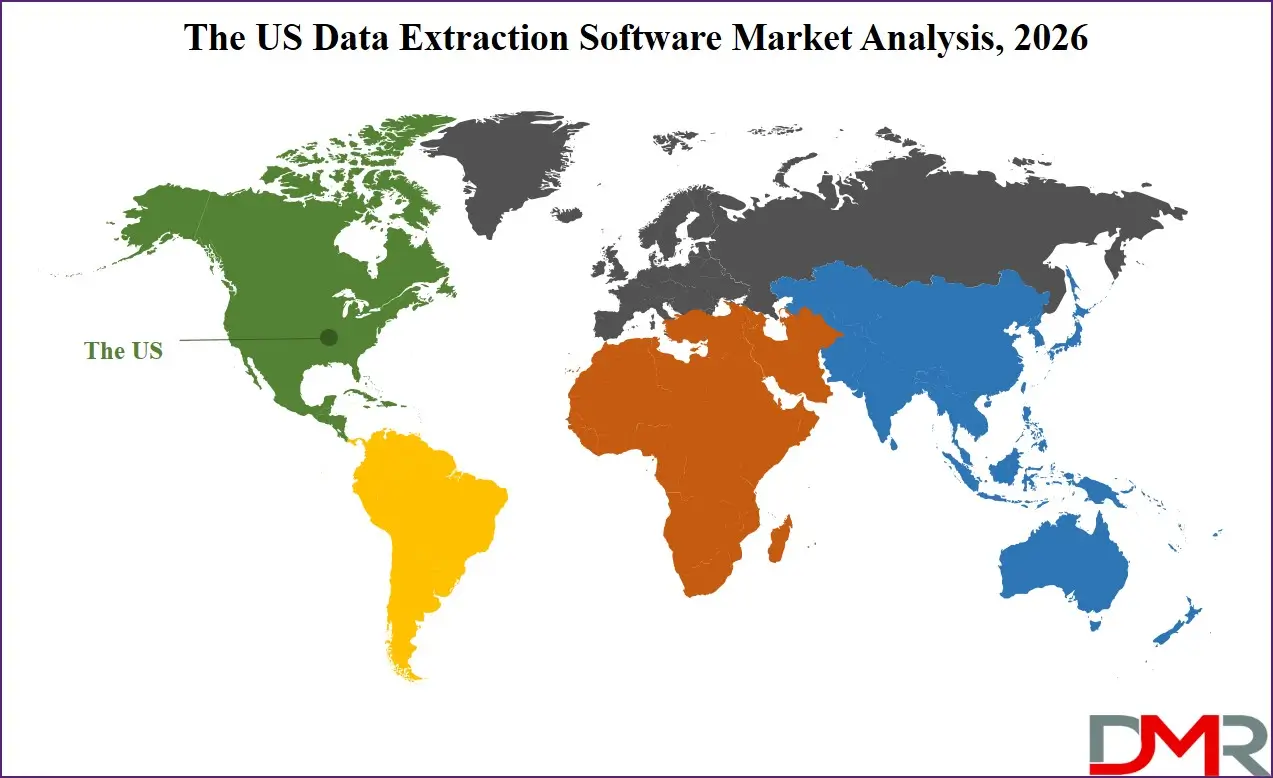
The US data extraction software market represents a rapidly expanding segment of the enterprise software ecosystem, driven by the country’s growing focus on digital transformation, automation, and data-driven decision-making. Businesses across industries such as finance, healthcare, e-commerce, and government are increasingly adopting data extraction tools to streamline information management and improve operational efficiency. The integration of cloud-based solutions, advanced machine learning models, and API-driven data pipelines is enabling organizations to handle vast volumes of heterogeneous data with enhanced precision and scalability.
ℹ
To learn more about this report –
Download Your Free Sample Report Here
This market is characterized by the presence of both established technology providers and emerging startups offering innovative extraction solutions tailored to specific business use cases. The rise of robotic process automation, compliance monitoring, and big data analytics has further accelerated demand for intelligent data extraction platforms. As regulatory standards surrounding data privacy and security continue to evolve, US enterprises are prioritizing software that not only ensures accurate data retrieval but also maintains compliance with frameworks such as GDPR and CCPA.
The US Data Extraction Software Market: Key Takeaways
- Market Value: The US Data Extraction Software market size is expected to reach a value of USD 2.3 billion by 2035 from a base value of USD 0.7 billion in 2026 at a CAGR of 14.3%.
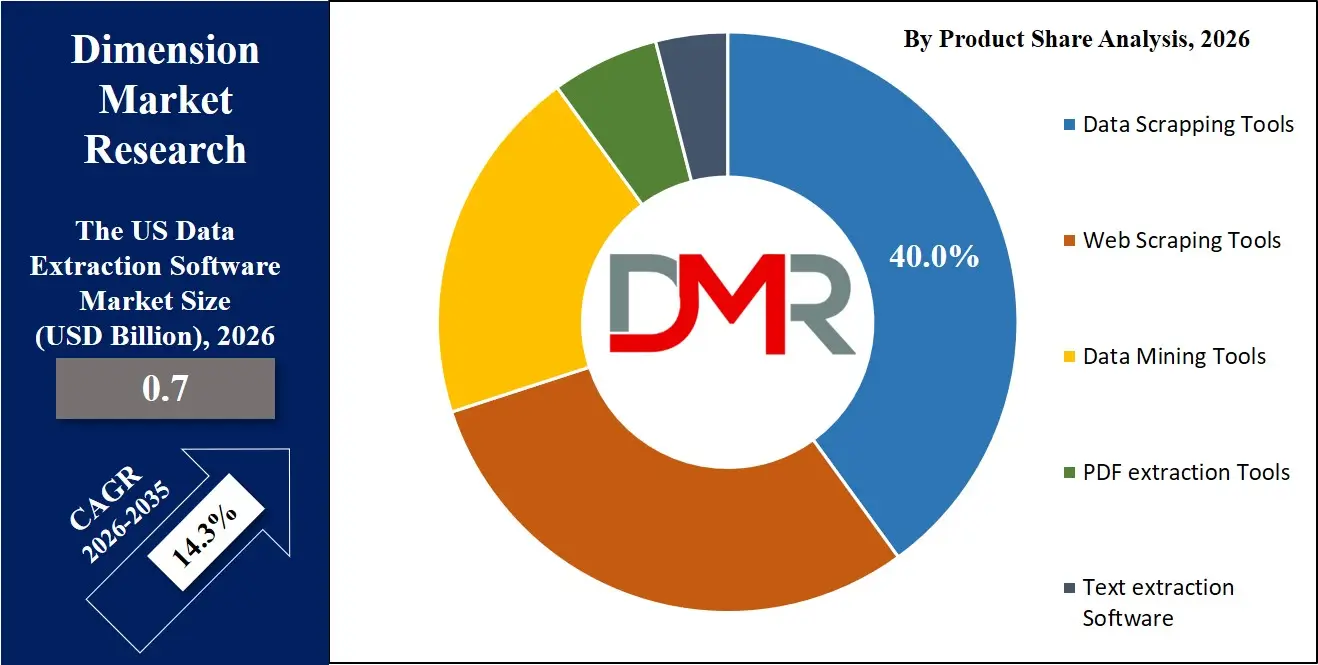
- By Product Segment Analysis: Data Scrapping Tools are expected to maintain their dominance in the product segment, capturing 40.0% of the total market share in 2026.
- By Deployment Segment Analysis: Cloud-based deployment is expected to capture the maximum market share with a value of 70.0% in the deployment segment.
- By Organization Size Segment Analysis: Large Enterprises will dominate the organization size segment, capturing 73.0% of the market share in 2026.
- By Application Segment Analysis: Lead Generation applications will dominate the application segment, capturing 57.0% of the market share in 2026.
- By End-Use Segment Analysis: BFSI will account for the maximum share in the end-use segment, capturing 39.0% of the market share in 2026.
- Key Players: Some key players in the US Data Extraction Software market include International Business Machines Corporation (IBM), UiPath Inc., Hyland Software Inc., Talend Inc., Nintex USA Inc., Fivetran Inc., Hevo Data Inc., Astera Software Corporation, Skyvia Inc., Oxylabs, Nano Net Technologies Inc., and Others.
The US Data Extraction Software Market: Use Cases
- Financial Data Automation and Compliance Management: In the US financial sector, data extraction software is widely used to automate the collection and validation of financial records, invoices, and transactional data from multiple digital and legacy systems. By integrating AI and machine learning, banks and fintech firms can streamline regulatory reporting, ensure compliance with standards such as SOX and CCPA, and enhance fraud detection capabilities. This automation not only reduces manual errors but also accelerates decision-making through real-time financial insights.
- Healthcare Records Digitization and Data Accuracy Enhancement: US healthcare providers leverage data extraction tools to digitize patient records, medical forms, and insurance claims. These platforms extract structured information from unstructured sources such as handwritten prescriptions and lab reports using optical character recognition and NLP. The result is improved interoperability between healthcare systems, faster claims processing, and enhanced patient care analytics while maintaining HIPAA compliance and data security.
- E-commerce Data Integration and Customer Analytics: E-commerce companies across the US utilize data extraction software to gather and consolidate product details, pricing, and customer behavior data from websites and online marketplaces. The extracted information supports dynamic pricing strategies, competitive benchmarking, and personalized marketing campaigns. With cloud-based integration and automated data pipelines, retailers can gain real-time insights into market trends and consumer preferences.
- Legal Document Management and Contract Intelligence: Law firms and corporate legal departments use advanced data extraction solutions to process large volumes of contracts, case files, and compliance documents. By applying AI-driven text recognition and entity extraction, these systems identify key clauses, obligations, and renewal dates, significantly reducing manual review time. This not only improves legal workflow efficiency but also ensures accuracy in risk assessment and regulatory compliance across the US legal landscape.
Impact of Iran Conflict on the US Data Extraction Software Market
- Rising Cloud & Infrastructure Costs: Escalating geopolitical tensions are driving oil price volatility and increasing energy costs, which directly impact data centers and cloud infrastructure expenses in the US. Since data extraction software relies heavily on cloud computing and large scale data processing, higher operational costs can reduce profit margins and slow enterprise adoption.
- Disruptions in Global Tech Supply Chains: The conflict is causing delays in global shipping routes and increasing logistics costs, affecting the availability of hardware components such as servers and semiconductors. This can slow down deployment of data extraction platforms and delay enterprise digital transformation initiatives that depend on data integration and analytics tools.
- Increased Demand for Data Intelligence & Risk Analytics: Geopolitical instability is pushing US enterprises and government agencies to invest more in data extraction, real time analytics, and intelligence software to monitor risks, track supply chain disruptions, and support decision making. This is creating new growth opportunities for data extraction software providers focused on AI driven insights and predictive analytics solutions.
The US Data Extraction Software Market: Stats & Facts
- US Census Bureau (2023–2025 Data & Digital Usage Trends)
- Around 7% of US firms are currently using AI technologies in operations as of 2025.
- AI usage among large firms declined from 13.5% to ~12% between mid to late 2025.
- Approximately 3.9% of firms used AI in late 2023, increasing to over 5% by mid-2024.
- The Census Bureau survey covers ~1.2 million US businesses for digital adoption tracking.
- Data platforms such as Census APIs and microdata systems are continuously updated with monthly and annual datasets releases.
- The 2023 Annual Business Survey datasets were released in 2025 via API driven platforms, reflecting increasing data accessibility.
- The US government maintains large scale microdata access systems for structured data extraction and analytics.
- Census systems integrate business, household, and geographic datasets for analytics frameworks.
- Administrative data is widely used for statistical modeling and data extraction processes
- Monthly retail and economic indicators are generated through automated data extraction systems.
The US Data Extraction Software Market: Market Dynamics
The US Data Extraction Software Market: Driving Factors
Rising Adoption of Automation and AI-Powered Data Management
The growing implementation of automation and artificial intelligence across US enterprises is a key driver for the data extraction software market. Businesses are increasingly integrating AI-based data extraction tools to streamline document processing, minimize manual workload, and improve decision accuracy. The use of intelligent automation in data capture and validation enhances operational efficiency and enables faster insights, especially in data-intensive industries like banking, healthcare, and retail.
Expansion of Cloud-Based Data Integration Solutions
Cloud adoption is accelerating the demand for scalable and flexible data extraction platforms in the US. Organizations are shifting from traditional on-premise systems to cloud-based data integration environments that support seamless data migration, centralized storage, and real-time analytics. This trend allows companies to handle diverse data sources efficiently while ensuring high accessibility, security, and compliance across multiple business functions.
The US Data Extraction Software Market: Restraints
Data Privacy and Regulatory Compliance Challenges
Strict data governance laws in the US, including CCPA and HIPAA, are creating compliance challenges for organizations using automated extraction tools. Companies must ensure that sensitive data collected from various digital touchpoints is handled securely and in accordance with privacy frameworks. Non-compliance risks and complex data protection standards often delay software adoption or require costly compliance investments.
Integration Complexity with Legacy Systems
Many US enterprises still rely on legacy IT infrastructure, making integration with modern data extraction platforms difficult. These outdated systems often lack compatibility with APIs and cloud technologies, limiting real-time data sharing and analytics capabilities. As a result, implementation costs rise, and organizations face longer deployment cycles, reducing the pace of digital transformation.
The US Data Extraction Software Market: Opportunities
Growing Demand for Real-Time Analytics and Business Intelligence
The increasing need for real-time insights is creating strong growth opportunities in the US data extraction software market. Companies are investing in advanced extraction solutions that can transform raw data into actionable intelligence, supporting predictive analytics, trend monitoring, and performance optimization. This demand is especially high among sectors such as finance, logistics, and e-commerce, where timely decision-making is critical for competitiveness.
Emergence of Industry-Specific Data Extraction Solutions
There is a growing opportunity for vendors to develop customized extraction software designed for niche industries. For instance, healthcare requires OCR-based patient data extraction, while legal firms demand contract intelligence solutions. Tailored products that address industry-specific data structures, compliance requirements, and workflow automation needs are expected to gain strong traction in the US market.
The US Data Extraction Software Market: Trends
Integration of Generative AI and Natural Language Processing
The US data extraction software landscape is witnessing a major shift with the integration of generative AI and advanced NLP models. These technologies enable contextual understanding, conversational querying, and intelligent document interpretation. They improve data quality and reduce manual oversight, making extraction more intuitive and human-like across diverse content types such as contracts, images, and emails.
Increased Focus on Data Security and Ethical AI Implementation
As data volumes grow, ensuring ethical AI practices and robust data protection has become a central trend. Vendors are incorporating advanced encryption, anonymization, and AI governance frameworks into their solutions to maintain trust and transparency. This focus on secure, responsible data extraction aligns with rising enterprise priorities around digital ethics and regulatory compliance in the US technology ecosystem.
The US Data Extraction Software Market: Research Scope and Analysis
By Product Analysis
Data scraping tools are expected to continue leading the US data extraction software market, capturing nearly 40.0% of the total market share in 2026. Their strong position is driven by their ability to efficiently extract structured and unstructured data from multiple online and offline sources, including websites, databases, and documents. These tools help businesses gather valuable market intelligence, monitor competitors, analyze consumer behavior, and optimize decision-making processes. The integration of artificial intelligence and machine learning enhances their precision and scalability, allowing real-time data processing with minimal human intervention. As companies increasingly rely on automated data workflows and cloud-based platforms, data scraping tools are becoming essential for managing large data volumes with speed, security, and consistency.
ℹ
To learn more about this report –
Download Your Free Sample Report Here
Web scraping tools, a key subset of data scraping solutions, play a vital role in collecting web-based data such as product listings, news articles, social media content, and pricing information from public websites. These tools enable businesses to automate data extraction from dynamic web pages using scripts, APIs, or specialized crawling software. In the US market, web scraping is widely adopted by e-commerce, finance, and marketing sectors for trend analysis, sentiment monitoring, and competitor tracking. The growing emphasis on real-time analytics, combined with advancements in AI-driven extraction engines, is expanding the scope of web scraping tools as they evolve to handle complex website structures, dynamic content, and large-scale data requirements efficiently.
By Deployment Analysis
Cloud-based deployment is expected to dominate the US data extraction software market in 2026, capturing approximately 70.0% of the deployment segment. This preference is driven by the growing adoption of cloud computing across industries for scalable, flexible, and cost-effective data management solutions. Cloud-based platforms enable real-time data extraction, seamless integration with analytics and business intelligence tools, and easy accessibility from multiple locations without the need for heavy IT infrastructure. Enterprises benefit from automatic software updates, reduced maintenance costs, and enhanced collaboration among teams while ensuring data security and compliance through advanced encryption and cloud governance frameworks. The rapid digital transformation initiatives in sectors such as finance, healthcare, and e-commerce are further accelerating the demand for cloud-deployed data extraction solutions, making them the preferred choice for US businesses seeking efficiency and scalability.
On-premises deployment, while less dominant, remains relevant for organizations with strict data security, regulatory compliance, or legacy system requirements. These solutions are installed locally within a company’s infrastructure, giving full control over data storage, processing, and access management. On-premises platforms are particularly favored in sectors handling sensitive information, such as government agencies, financial institutions, and healthcare providers, where compliance with regulations like HIPAA and CCPA is critical. Although on-premises deployment often involves higher upfront costs and maintenance responsibilities, it offers enhanced customization, control over integration with existing enterprise systems, and the ability to manage sensitive data internally without relying on third-party cloud providers.
By Organization Size Analysis
Large enterprises are expected to dominate the US data extraction software market by organization size, capturing around 73.0% of the segment in 2026. These organizations typically handle vast volumes of structured and unstructured data across multiple departments and geographies, creating a high demand for advanced data extraction solutions. Large enterprises leverage these tools to automate information retrieval from internal databases, customer records, financial documents, and web sources, enabling faster decision-making, operational efficiency, and enhanced business intelligence. The adoption of AI-powered analytics, cloud-based platforms, and integration with enterprise resource planning and customer relationship management systems further strengthens their position in the market. Additionally, large organizations have the financial resources and technical capabilities to implement scalable, robust, and customized data extraction solutions, which contributes to their dominant market share.
Small and medium-sized enterprises (SMEs), while capturing a smaller portion of the market, are increasingly adopting data extraction software to remain competitive and optimize business processes. SMEs use these tools to automate routine data collection tasks, extract insights from customer interactions, monitor competitors, and support marketing strategies without investing heavily in manual labor. Cloud-based and subscription-based deployment models make advanced data extraction accessible to SMEs by reducing upfront costs and providing flexible scalability. As more SMEs embrace digital transformation and data-driven decision-making, their adoption of extraction tools is expected to grow steadily, expanding their presence in the US market.
By Application Analysis
Lead generation applications are expected to dominate the US data extraction software market, capturing around 57.0% of the application segment in 2026. These applications are crucial for businesses aiming to identify and engage potential customers efficiently by extracting relevant information from websites, social media platforms, CRM systems, and public databases. By automating the collection of contact details, behavioral data, and engagement metrics, lead generation tools enable sales and marketing teams to target high-quality prospects, streamline outreach campaigns, and improve conversion rates. Integration with AI-powered analytics and marketing automation platforms further enhances the ability to prioritize leads, track customer interactions, and gain actionable insights, making lead generation a key driver of market adoption in the US.
Data aggregation, on the other hand, focuses on collecting and consolidating data from multiple sources into a unified and analyzable format. In the US market, data aggregation applications are widely used to gather insights from competitor websites, e-commerce platforms, financial reports, and customer feedback. This allows organizations to identify trends, monitor market performance, and make informed strategic decisions. By combining aggregation with advanced analytics and cloud-based processing, businesses can handle large volumes of heterogeneous data efficiently, enabling real-time reporting, improved operational planning, and enhanced business intelligence across industries.
By End-Use Analysis
The BFSI (Banking, Financial Services, and Insurance) sector is expected to account for the largest share of the US data extraction software market, capturing approximately 39.0% of the end-use segment in 2026. Financial institutions generate massive volumes of structured and unstructured data daily, including transaction records, loan applications, insurance claims, and customer interactions. Data extraction software enables these organizations to automate the collection and processing of this information, improving operational efficiency, regulatory compliance, and risk management. By integrating AI and machine learning capabilities, BFSI companies can detect fraud, monitor market trends, and generate actionable insights for strategic decision-making. The adoption of cloud-based extraction platforms further allows for scalable and secure management of critical financial data, reinforcing the sector’s dominance in the market.
In the retail sector, data extraction software is widely applied to collect and analyze data from e-commerce platforms, customer databases, pricing portals, and competitor websites. Retailers leverage these tools to understand consumer behavior, track product performance, optimize inventory management, and design targeted marketing campaigns. Automated data extraction enables real-time insights into sales trends, pricing strategies, and market demand, helping retailers make data-driven decisions efficiently. The integration of cloud solutions and analytics platforms allows retailers to process large datasets from multiple channels simultaneously, enhancing operational agility and improving customer engagement in a highly competitive US market.
The US Data Extraction Software Market Report is segmented on the basis of the following:
By Product
- Data Scrapping Tools
- Web Scraping Tools
- Data Mining Tools
- PDF extraction Tools
- Text extraction Software
- By Deployment
- Cloud
- On-Premises
By Deployment
By Organization Size
By Application
- Lead Generation
- Data Aggregation
- Content Generation
By End Use
- BFSI
- Retail
- Medical & Healthcare
- IT & Telecom
- Others
Impact of Artificial Intelligence on the US Data Extraction Software market
- Enhanced Automation and Accuracy: Artificial intelligence is transforming the US data extraction software market by enabling highly automated and precise information retrieval. AI-driven algorithms, including natural language processing and computer vision, allow systems to understand context, recognize patterns, and extract relevant data from complex and unstructured sources such as scanned documents, emails, social media feeds, and financial statements. This reduces dependency on manual data entry, minimizes human errors, and significantly improves the quality and reliability of extracted datasets, leading to faster and more accurate business operations.
- Scalable Data Processing and Integration: AI technologies empower data extraction platforms to handle vast and varied datasets across multiple formats and sources with exceptional scalability. Through machine learning models, these tools can continuously learn from new data patterns, optimizing extraction efficiency and adaptability. US enterprises benefit from this scalability by automating large-scale data migration, cloud integration, and API-based data synchronization. This capability supports seamless interoperability between data lakes, CRM systems, and analytics platforms, enhancing workflow automation and enabling real-time decision-making.
- Smarter Decision-Making and Predictive Insights: The integration of AI into data extraction software goes beyond data collection, it transforms raw information into actionable intelligence. Advanced analytics powered by AI and predictive modeling enables organizations to identify trends, uncover correlations, and anticipate business opportunities or risks. In the US market, sectors such as finance, healthcare, and retail leverage these insights for strategy optimization, demand forecasting, and compliance monitoring. This AI-driven transformation is making data extraction not just a back-end process but a strategic enabler for data-driven innovation and competitive advantage.
The US Data Extraction Software Market: Competitive Landscape
The US data extraction software market is highly competitive, characterized by rapid technological innovation and continuous product enhancements. Vendors are focusing on developing AI-driven, cloud-enabled, and scalable solutions that can handle large volumes of structured and unstructured data across diverse industries.
ℹ
To learn more about this report –
Download Your Free Sample Report Here
Key strategies include improving automation capabilities, enhancing integration with analytics and business intelligence platforms, and offering flexible deployment models to cater to varying enterprise requirements. The market is also witnessing investments in research and development to incorporate advanced features such as natural language processing, optical character recognition, and predictive analytics. Continuous innovation, coupled with growing demand for real-time data insights and compliance-driven solutions, is intensifying competition and driving vendors to differentiate through performance, security, and customer-centric offerings.
Some of the prominent players in the US Data Extraction Software market are:
- International Business Machines Corporation (IBM)
- UiPath Inc.
- Hyland Software Inc.
- Talend Inc.
- Nintex USA Inc.
- Fivetran Inc.
- Hevo Data Inc.
- Astera Software Corporation
- Skyvia Inc.
- Oxylabs
- Nano Net Technologies Inc.
- AIMLEAP Inc.
- Ocrolus Inc.
- Square 9 Softworks
- Lexion
- Alkymi Inc.
- Adverity
- Bright Data Ltd.
- Grepsr
- AmazingHiring Inc.
- Other Key Players
The US Data Extraction Software Market: Recent Developments
- October 2025: Dynamo Software unveiled its v3.0 platform, introducing advanced AI and automation features designed to address data fragmentation and workflow inefficiencies in alternative investment firms. The platform aims to enhance data accessibility and streamline operations for general and limited partners.
- October 2025: Fivetran and dbt Labs, both supported by Andreessen Horowitz, announced a merger in an all-stock deal. The combined entity is expected to generate nearly USD 600 million in annual revenue, aiming to create a comprehensive data infrastructure company to meet the growing demand for AI-compatible data solutions.
- August 2025: Cloud Software Group acquired Arctera, a data management and protection provider, as part of its strategy to expand its enterprise software portfolio. Arctera, formed from the merger of Veritas’ Enterprise Data Protection division and Cohesity, offers solutions under brands like InfoScale and Backup Exec.
- August 2025: IntelligentDataExtractionCo launched an AI-powered platform tailored for accounts payable teams. This solution automates the extraction of structured data from PDFs, scans, images, and emails, facilitating seamless export to Excel or Google Sheets.
Report Details
| Report Characteristics |
| Market Size (2026) |
USD 0.7 Bn |
| Forecast Value (2035) |
USD 2.3 Bn |
| CAGR (2026–2035) |
14.3% |
| Historical Data |
2021 – 2025 |
| Forecast Data |
2027 – 2035 |
| Base Year |
2025 |
| Estimate Year |
2026 |
| Report Coverage |
Market Revenue Estimation, Market Dynamics, Competitive Landscape, Growth Factors and etc. |
| Segments Covered |
By Product (Data Scraping Tools, Web Scraping Tools, Data Mining Tools, PDF Extraction Tools, Text Extraction Software), By Deployment (Cloud, On-Premises), By Organization Size (Large Enterprises, SMEs), By Application (Lead Generation, Data Aggregation, Content Generation), and By End Use (BFSI, Retail, Medical & Healthcare, IT & Telecom, Others) |
| Country Coverage |
The US |
| Prominent Players |
International Business Machines Corporation, UiPath Inc., Hyland Software Inc., Talend Inc., Nintex USA Inc., Fivetran Inc., Hevo Data Inc., Astera Software Corporation, Skyvia Inc., Oxylabs, Nano Net Technologies Inc., AIMLEAP Inc., Ocrolus Inc., Square 9 Softworks, Lexion, Alkymi Inc., Adverity, Bright Data Ltd., Grepsr, AmazingHiring Inc., and Others. |
| Purchase Options |
We have three licenses to opt for: Single User License (Limited to 1 user), Multi-User License (Up to 5 Users) and Corporate Use License (Unlimited User) along with free report customization equivalent to 0 analyst working days, 3 analysts working days and 5 analysts working days respectively. |
Frequently Asked Questions
What is the size of the US Data Extraction Software market?
▾ The US Data Extraction Software market size is estimated to have a value of USD 0.7 billion in 2026 and is expected to reach USD 2.3 billion by the end of 2035, with a cagr of 14.3%.
Who are the key players in the US Data Extraction Software market?
▾ Some of the major key players in the US Data Extraction Software market are International Business Machines Corporation (IBM), UiPath Inc., Hyland Software Inc., Talend Inc., Nintex USA Inc., Fivetran Inc., Hevo Data Inc., Astera Software Corporation, Skyvia Inc., Oxylabs, Nano Net Technologies Inc., and Others.