Market Overview
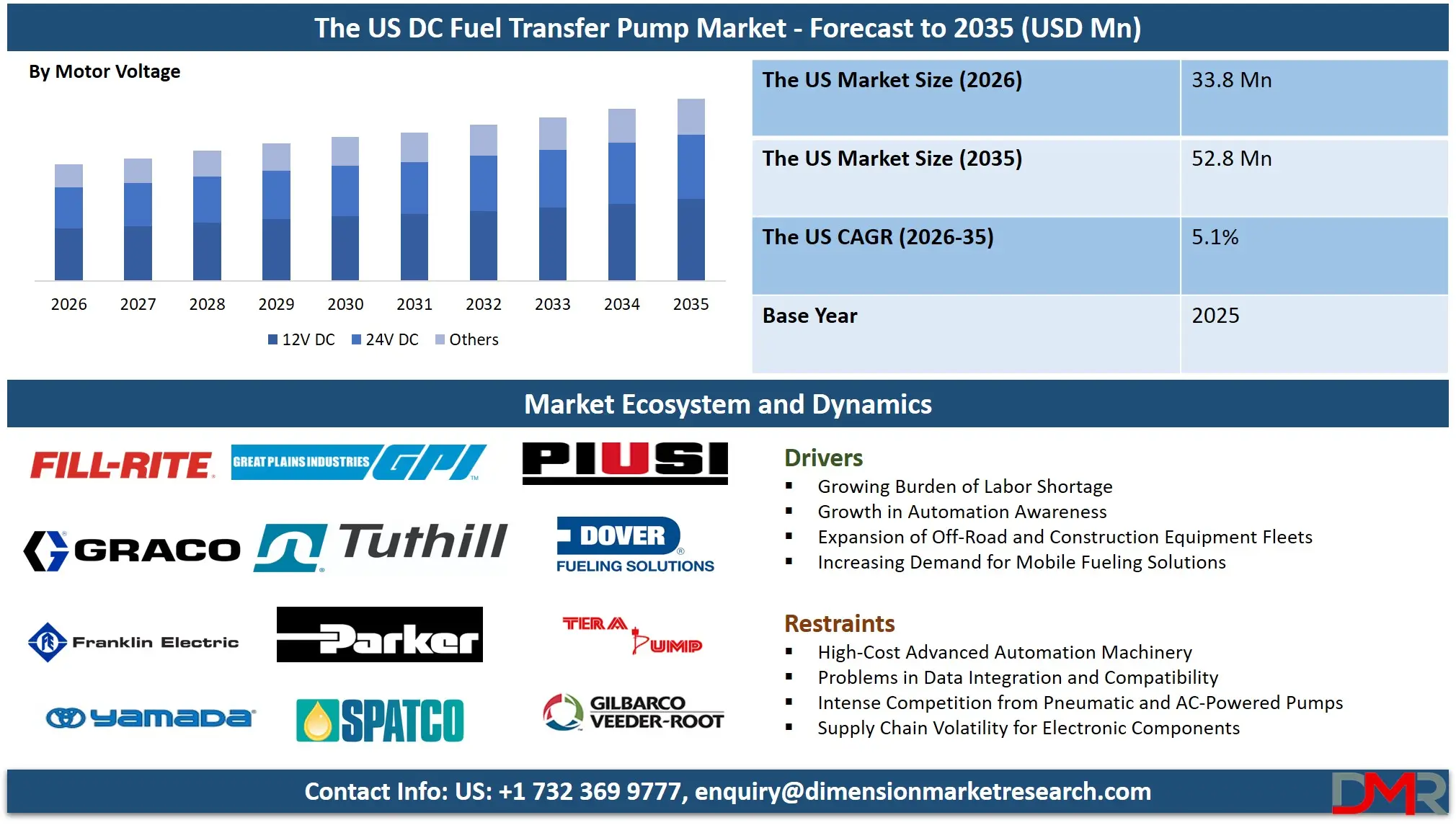
The US DC Fuel Transfer Pump Market size is expected to reach USD 33.8 million in 2026 and grow at a compound annual growth rate of 5.1% to reach a value of USD 52.8 million in 2035.
ℹ
To learn more about this report –
Download Your Free Sample Report Here
A DC fuel transfer pump is an electrically powered pumping system that runs on direct current (typically 12V or 24V) to transfer diesel, gasoline, kerosene, or other fuels from tanks, barrels, or storage containers to vehicles, machinery, or equipment. These systems are increasingly used in mining, military, agriculture, construction, and transportation sectors to improve refueling efficiency, reduce manual handling, and enable remote or off-grid operations.
The market for DC fuel transfer pumps in the US is evolving toward more automated, portable, and voltage-optimized refueling solutions, driven by the expansion of decentralized fuel depots, the rise in mobile refueling fleets, the need for reliable fuel delivery in harsh environments, and the integration of brushless DC (BLDC) motor technology for longer pump life and lower maintenance.
ℹ
To learn more about this report –
Download Your Free Sample Report Here
The US DC Fuel Transfer Pump Market: Key Takeaways and Other Influencing Factors
- Outlook of Market Growth Expansion: The US DC Fuel Transfer Pump Market is projected to reach USD 33.8 million in 2026 and nearly USD 52.8 million by 2035, due to the growing adoption of mobile refueling equipment and off-grid energy logistics.
- High Growth Rate Momentum: The market has the potential to grow at a rate of 5.1% CAGR in the period ranging from 2026 to 2035, because of the increasing fuel consumption in remote mining sites, military field operations, and the shift toward BLDC-based energy-efficient pumps.
- Segment Leadership Structure: The type segment has the highest share of 63.5% in 2026, with Below 1 HP DC pumps at the forefront of the segment. For the application segment, Mining holds the largest share of 58.9%, and the end-user segment, where oil and gas hold the largest market share of 54.1%, indicating high dependence on high-power and heavy-duty fuel transfer solutions.
- Technology Driven Operational Shift: The market is moving to brushless DC motors, IoT-enabled fuel flow monitoring, and corrosion-resistant pump housings, which enhance transfer accuracy and decrease the use of manual siphoning or hand pumps.
- Labor Shortage Burden: As US Bureau of Labor Statistics indicates, the oil & gas and mining industries experience over 700,000 vacancies every year for fuel handling roles, which supports the high demand for automated and portable DC fuel transfer pumps.
- Operational Downtime Insight: Industry data shows that manual fuel transfer errors or spillage incidents happen about every 34 seconds on high-consumption refueling lines, which supports the need for real-time flow-controlled DC pump technologies.
- Reduction of Errors in Large-Volume Lines: According to research in the industry, the probability of fuel contamination and delays is almost 5 times higher in facilities that rely on manual refueling methods, making automated DC fuel transfer pumps a significant factor in reduction and prevention.
Impact of the Iran conflict on the US DC Fuel Transfer Pump Market
The escalation of the Iranian conflict is disrupting global supply chains which influence the output of DC fuel transfer pumps in the US in terms of availability of brushless DC motors and electronic controllers, rising energy prices are raising the cost of transporting and manufacturing pumps, which in turn raises the cost of the system, scarcity of copper windings and industrial-grade seals may affect volumes of production; cybersecurity and operational risks are making differences to the US automation and fuel logistics companies.
The US DC Fuel Transfer Pump Market: Use Cases
- Remote Mining Refueling: This can be applied in the transfer of diesel from storage tanks to heavy mining trucks in off-grid locations, using 24V DC pumps that run continuously with faster flow rates and provide greater precision and less spillage at the point of use.
- Remote System Monitoring: Provides real-time tracking of fuel volume transferred and predictive maintenance alerts by monitoring pump run hours, motor temperature, and flow rate on a remote or centralized dashboard.
- Post-Delivery Fuel Handling: Helps in controlling the output and any form of bottlenecks that may arise after fuel delivery is done through automated DC pump systems with integrated meters.
- Preventive Maintenance Scheduling: Enables the early detection of risks in high-volume refueling lines based on the performance of DC pump motors and seal integrity over long-term use.
The US DC Fuel Transfer Pump Market: Market Dynamics
Driving Factors in the US DC Fuel Transfer Pump Market
Growing Burden of Labor Shortage
The increasing number of vacancies in the oil & gas, mining, and transportation industries in the US is adding to the push to deploy automated and portable refueling solutions. DC fuel transfer pumps can be used to achieve operational efficiency by enabling continuous fuel delivery to increase throughput and eliminate reliance on manual drum pouring or hand pumps.
Growth in Automation Awareness
DC-powered automation devices are being adopted at an accelerated pace because of the growth of remote operations and smart fuel management services. Live transmission of flow data, analytics based on cloud platforms, and linkage of fuel depot ecosystems are enhancing operation management and reducing the dependency of the facility on manual fuel handling.
Restraints in the US DC Fuel Transfer Pump Market
High-Cost Advanced Automation Machinery
The prohibitive nature of BLDC-based fuel transfer pumps and integrated flow meter systems makes these systems inaccessible, and the application of these solutions by small-scale farms or independent contractors may not be welcome. The use of advanced DC pump technology on a large scale basis may not be adopted by cost-sensitive facilities.
Problems in Data Integration and Compatibility
System interoperability and equipment validation have compliance requirements (e.g., EPA, UL) that are strict and hamper market expansion. Some of the problems that affect the implementation of connected DC fuel transfer pumps include cybersecurity, data integration, and compatibility with existing fuel storage tanks or legacy nozzles.
Opportunities in the US DC Fuel Transfer Pump Market
Brushless DC (BLDC) Motors and Smart Flow Control
Adoption of BLDC motor technology in fuel transfer pumps will enable longer pump life, lower electrical consumption, and automated flow regulation. BLDC-based pumps will increase reliability, decrease the number of manual operators required, and improve the value of long-term remote refueling solutions.
Military and Tactical Fuel Logistics Expansion
The growing demand for forward operating base (FOB) refueling and expeditionary operations is creating the need for portable, rugged, and high-flow DC fuel transfer pumps. DC-powered fuel pumps assist with the procedure of continuous fuel separation in unstandardized environments, enabling the control of high-quantity military vehicle refueling as well as offering just-in-time logistics.
Trends in the US DC Fuel Transfer Pump Market
Shift toward Above 1 HP DC Fuel Transfer Pumps
The transition to above 1 HP DC fuel transfer pumps with increased flow rates and decreased operator involvement is self-evident, as low-power pumps are on the decline. The trend assists in maintaining high-speed refueling with a minimum amount of interference with normal production or mission timelines.
Advancements in Wireless and Cloud-Linked Controls
The DC pump data management is changing with the growing application of wireless connectivity, mobile dashboards, and cloud platforms. The automation of fuel handling in the US will be in the form of smooth information sharing, remote diagnostics, and connectivity to fuel inventory management systems.
The US DC Fuel Transfer Pump Market: Research Scope and Analysis
By Type Analysis
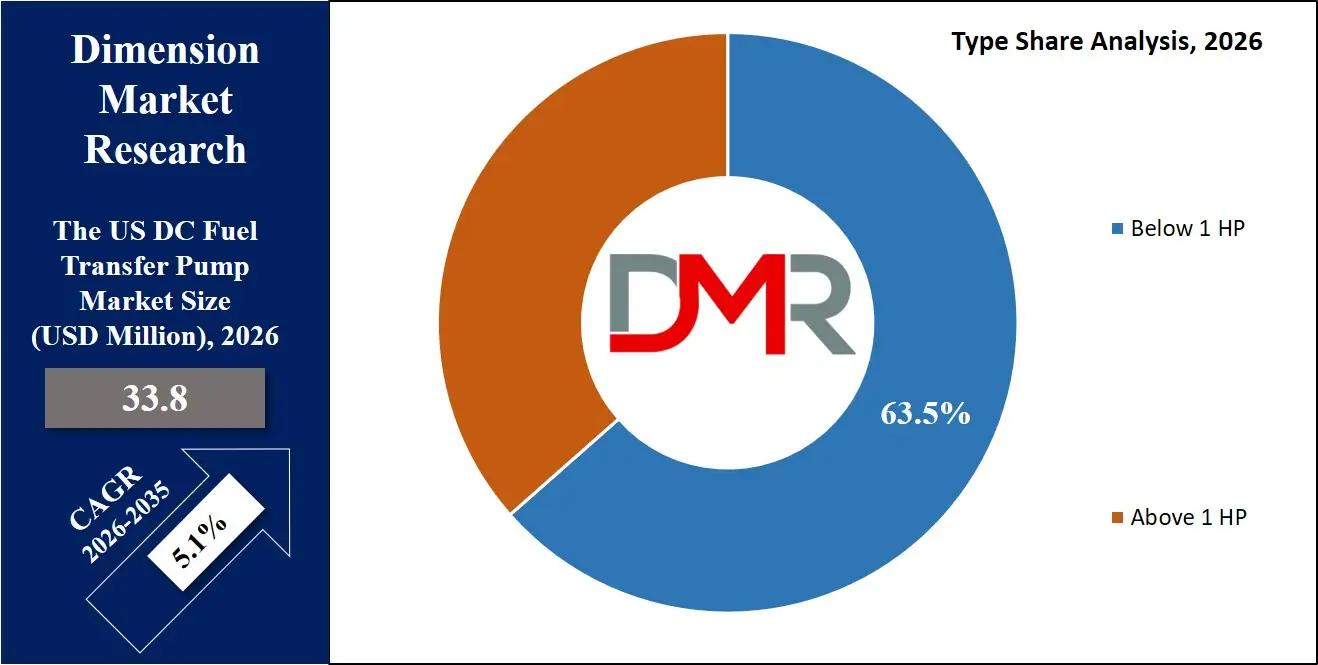
It is estimated that above 1 HP DC pumps will dominate the type segment with a projected share of about 63.5% share in the year 2026 due to the improved flow rates (typically 15–40 GPM), less dependence on manual cranking, and the growing use of these pumps in high-consumption mining and military refueling operations.
ℹ
To learn more about this report –
Download Your Free Sample Report Here
Such pumps help in the continuous transfer of fuel and improved throughput, which helps in the augmentation of usage. On the other hand, below 1 HP DC fuel transfer pumps remain useful in smaller-scale applications like agricultural machinery servicing and portable refueling for light-duty vehicles because of reduced initial investment and lighter weight, although reduced speed and lower duty cycles inhibit their evolution relative to the above 1 HP systems.
By Motor Voltage Analysis
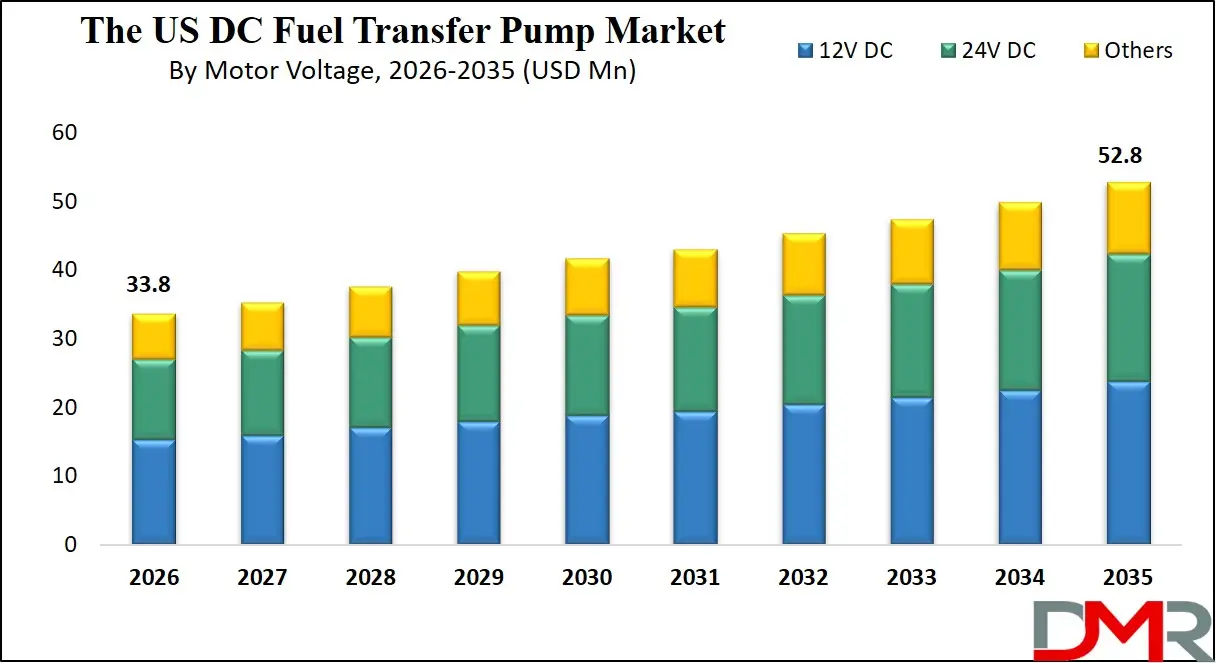
The motor voltage segment is projected to be dominated by 24V DC pumps with approximately 58.5% share of the share in 2026 because of the growing need for higher torque and consistent flow in heavy-duty vehicles and industrial machinery refueling. Within 24V DC, heavy-duty vehicles and industrial machinery are the primary sub-applications. This growth is also helped by a focus on compatibility with commercial truck electrical systems. The 12V DC segment, covering light-duty vehicles and agricultural machinery, remains relevant for smaller fleets and mobile service trucks. The "Others" voltage category, including brushless DC (BLDC) and high-voltage aerospace applications, is becoming more popular in specialized environments requiring efficiency, long life, and aviation-grade reliability.
By Mounting Type Analysis
The mounting type segment is projected to be dominated by fixed pumps with around 59.0% share in 2026 as a result of the rising need for permanent, high-duty-cycle refueling stations in mining depots, military bases, and manufacturing facilities. Fixed pumps are further segmented into small refueling stations and integrated tank systems. This growth is also supported by the emphasis on spill prevention, flow accuracy, and compliance with EPA fueling standards. Portable DC fuel transfer pumps, including manual pumps and battery-powered DC pumps, are still being implemented in agriculture, construction, and emergency response applications at different rates based on mobility needs and frequency of relocation.
By Application Analysis
The application segment is projected to be dominated by mining with approximately 58.9% share in 2026 as a result of the rising need for high-flow, dust-resistant refueling of haul trucks, excavators, and loaders in remote pit operations. This growth is also supported by the emphasis on reducing downtime, preventing fuel contamination, and complying with MSHA standards. Military applications, including forward base refueling and tactical vehicle support, are still being implemented alongside other applications (agriculture, construction, marine) at different rates based on deployment schedules and mission-specific volume requirements.
By End-User Analysis
In 2026, Oil & Gas is projected to take up a larger market share of approximately 54.1% in the end-user segment as a result of high volumes of fuel transfer, highly developed infrastructure of bulk storage depots, and the high preference for industrial-grade DC fuel transfer pumps to ensure precise and consistent fuel delivery. DC fuel pumps are also commonplace in these settings, both in upstream refueling of drilling equipment and in midstream transfer to tanker trucks. Transportation, manufacturing, retail (fuel stations), and other end-users are also increasing their use of DC fuel transfer pumps, as automation is increasingly affordable and accessible for mobile and backup refueling.
The US DC Fuel Transfer Pump Market Report is segmented on the basis of the following:
By Type
By Motor Voltage
- 12V DC
- Light-duty vehicles
- Agricultural machinery
- 24V DC
- Heavy-duty vehicles
- Industrial machinery
- Others
- Brushless DC (BLDC)
- High-voltage aerospace applications
By Mounting Type
- Portable
- Manual Pumps
- Battery-powered DC Pumps
- Fixed
- Small refueling stations
- Integrated tank systems
By Application
By End-User Industry
- Oil & Gas
- Transportation
- Manufacturing
- Retail
- Others
Impact of Artificial Intelligence in the US DC Fuel Transfer Pump Market
The US DC fuel transfer pump market is being improved with the help of artificial intelligence that allows automatic flow rate optimization and makes refueling scheduling decisions more accurate and faster. AI-powered DC pumps facilitate real-time adjustments and detect leaks or abnormal motor currents early on.
AI can be integrated with fuel inventory management systems to enhance predictive knowledge and minimize the workload of operators. Machine learning is also used to process large amounts of fuel consumption data. In general, AI is enhancing efficiency, precision, and the use of modern automated fuel transfer pumps.
The US DC Fuel Transfer Pump Market: Competitive Landscape
The US DC fuel transfer pump market is very competitive with great interest in innovation in portable refueling and brushless DC motor technology.
ℹ
To learn more about this report –
Download Your Free Sample Report Here
Mining, military, transportation, and oil & gas industries are also witnessing improvement in flow rate, motor durability, and voltage flexibility in systems that can be developed by companies in advanced pump systems. The competition is growing with the increase in the adoption of IoT-based fuel monitoring and BLDC motor efficiency. The important growth strategies are product innovation and strategic partnerships with fuel depot operators.
Some of the prominent players in the US DC Fuel Transfer Pump Market are:
- The Gorman-Rupp Company (Fill-Rite)
- Great Plains Industries, Inc. (GPI)
- Piusi S.p.A.
- Graco Inc.
- Tuthill Corporation
- Dover Fueling Solutions
- Franklin Electric Co., Inc.
- Parker-Hannifin Corporation
- Yamada Corporation
- Gilbarco Veeder-Root
- Liquidynamics Inc.
- SPATCO Energy Solutions
- TeraPump Inc.
- GoatThroat Pumps
- Gespasa S.A.
- Macnaught Pty Ltd
- SKF Group
- Groz Engineering Tools Pvt. Ltd.
- Intradin Machinery Co., Ltd.
- Other Key Players
Recent Developments in the US DC Fuel Transfer Pump Market
- January 2026: Dover Fueling Solutions expanded its advanced fuel dispensing and monitoring solutions portfolio, focusing on improved connectivity, automation, and efficiency in fuel transfer and retail fueling operations.
- July 2025: Graco Inc. signed a definitive agreement to acquire Color Service S.r.l., a global manufacturer of precision dosing systems for liquids and powders, enhancing its fluid handling portfolio.
- February 2025: Franklin Electric Co., Inc. announced the acquisition of PumpEng Pty Ltd., expanding its pump portfolio and strengthening its position in industrial and fluid transfer markets.
- May 2024: Great Plains Industries, Inc. introduced the G20 gasoline transfer pump with a modular connection design and enhanced sealing technology to improve efficiency and reduce leakage in fuel transfer operations.
Report Details
| Report Characteristics |
| Market Size (2026) |
USD 33.8 Mn |
| Forecast Value (2035) |
USD 52.8 Mn |
| CAGR (2026–2035) |
5.1% |
| Historical Data |
2021 – 2025 |
| Forecast Data |
2027 – 2035 |
| Base Year |
2025 |
| Estimate Year |
2026 |
| Report Coverage |
Market Revenue Estimation, Market Dynamics, Competitive Landscape, Growth Factors, etc. |
| Segments Covered |
By Type (Below 1 HP, Above 1 HP), By Motor Voltage (12V DC, 24V DC, Others), By Mounting Type (Portable, Fixed), By Application (Mining, Military, Others), By End-User Industry (Oil & Gas, Transportation, Manufacturing, Retail, Others) |
| Country Coverage |
The US |
| Prominent Players |
The Gorman-Rupp Company (Fill-Rite), Great Plains Industries, Inc. (GPI), Piusi S.p.A., Graco Inc., Tuthill Corporation, Dover Fueling Solutions, Franklin Electric Co., Inc., Parker-Hannifin Corporation, Yamada Corporation, Gilbarco Veeder-Root, Liquidynamics Inc., SPATCO Energy Solutions, TeraPump Inc., GoatThroat Pumps, Gespasa S.A., Macnaught Pty Ltd, SKF Group, Groz Engineering Tools Pvt. Ltd., Intradin Machinery Co., Ltd., and Other Key Players |
| Purchase Options |
We have three licenses to opt for: Single User License (Limited to 1 user), Multi-User License (Up to 5 Users) and Corporate Use License (Unlimited User) along with free report customization equivalent to 0 analyst working days, 3 analysts working days and 5 analysts working days respectively. |
Frequently Asked Questions
How big is the US DC Fuel Transfer Pump Market?
▾ The US DC Fuel Transfer Pump Market is valued at USD 33.8 million in 2026 and is projected to reach USD 52.8 million by the end of 2035.
What is the growth rate for the US DC Fuel Transfer Pump Market?
▾ The market is growing at a robust compound annual growth rate (CAGR) of 5.1% over the forecast period of 2026 to 2035.
Who are the key players in the US DC Fuel Transfer Pump Market?
▾ Some of the major key players in the US DC Fuel Transfer Pump Market are The Gorman-Rupp Company (Fill-Rite), Great Plains Industries, Inc. (GPI), Piusi S.p.A., Graco Inc., Tuthill Corporation, and Dover Fueling Solutions, and many others.