US Dry-Cleaning and Laundry Services Market Snapshot
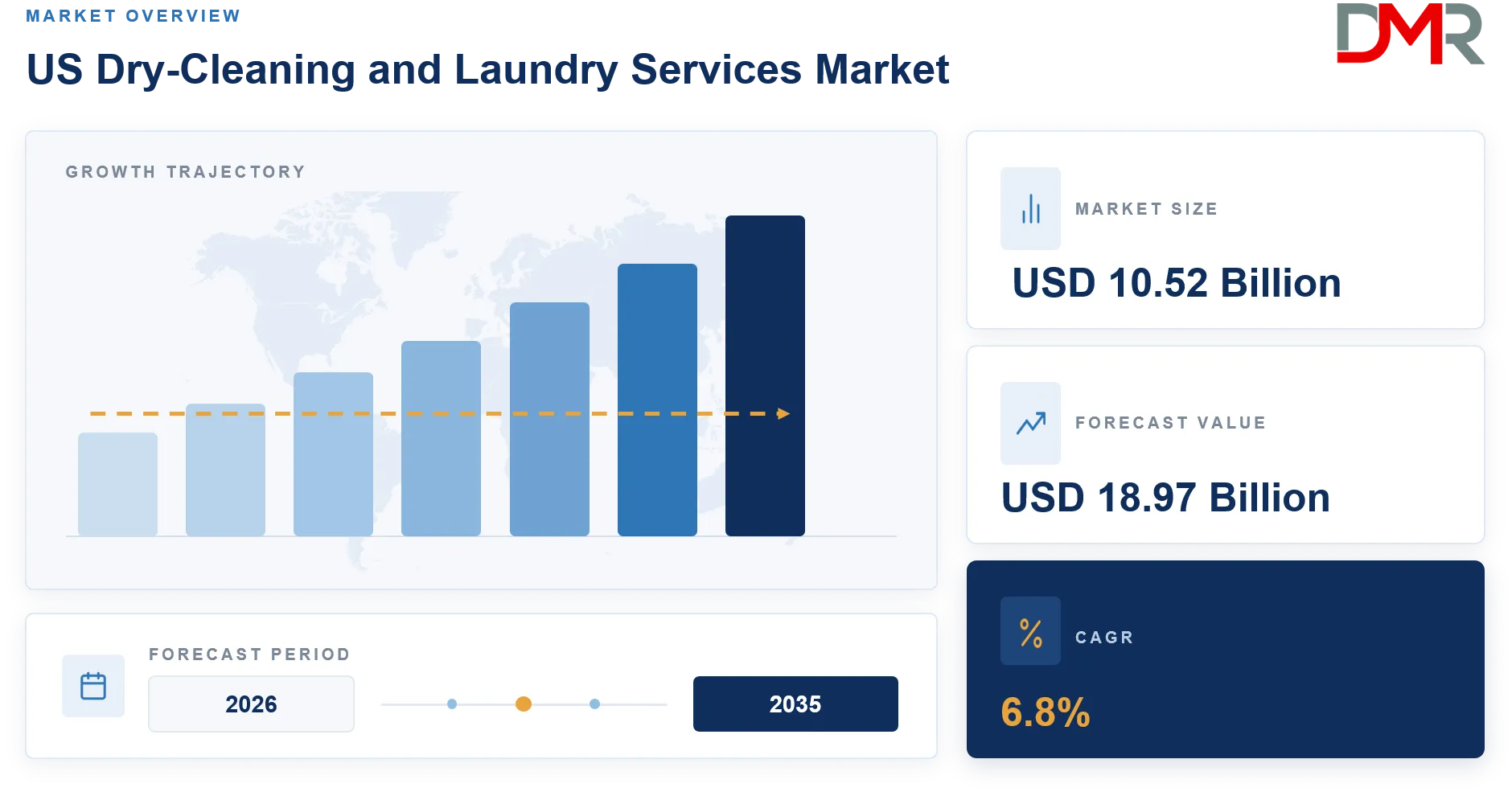
- Market Value: The US Dry-Cleaning and Laundry Services Market size is valued at USD 10.52 billion in 2026 and is projected to reach USD 18.97 billion by 2035.
- CAGR: The US Dry-Cleaning and Laundry Services Market is expected to grow at a CAGR of 6.8% from 2026 to 2035.
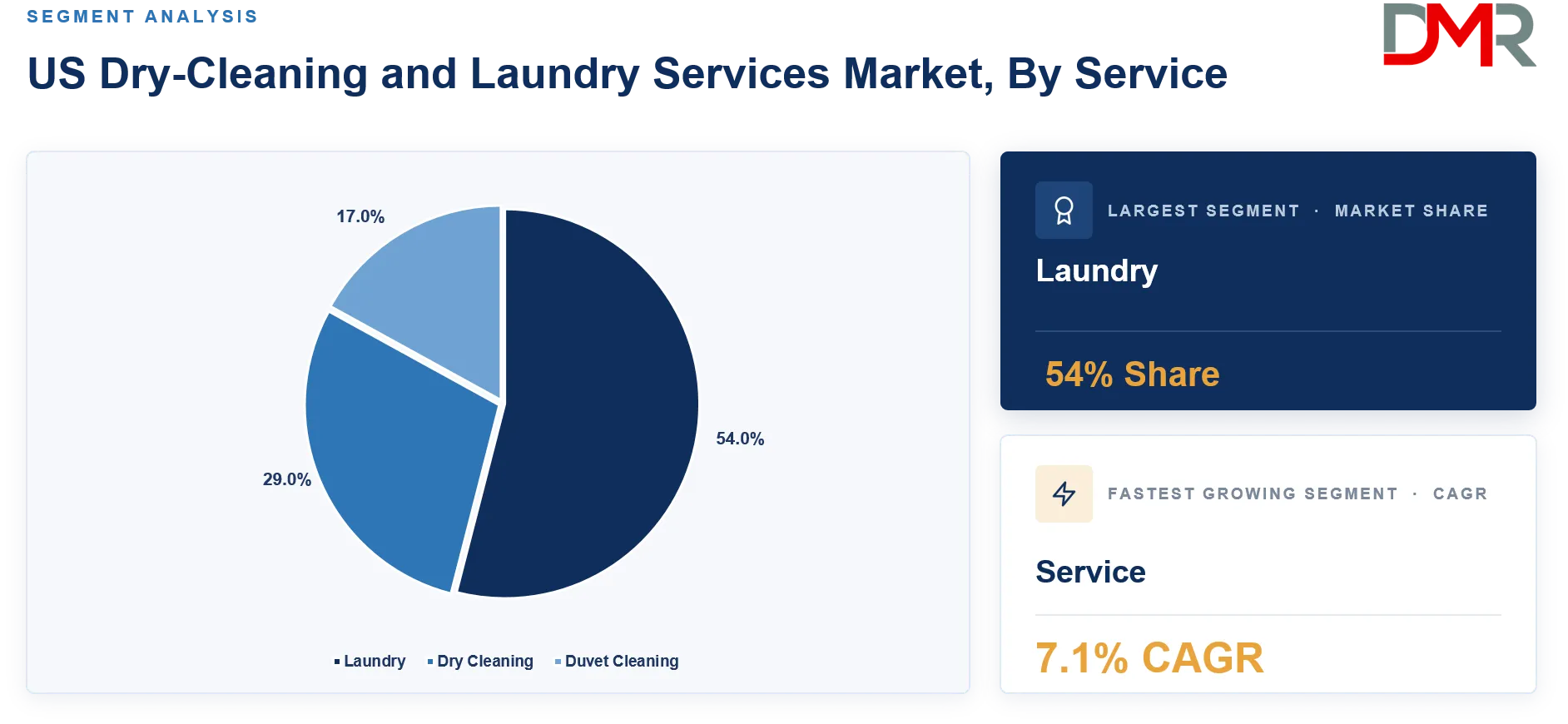
- By Service Analysis: Laundry services led the market with a 54.0% share in 2026, followed by dry cleaning at 38.0% .
- By Application Analysis: Residential applications dominated the US market with a 58.0% share in 2026.
- Major Players: Rinse, Mulberrys Garment Care, Tide Cleaners, Laundry Care Express, ByNext, and Others.
What is the US Dry-Cleaning and Laundry Services Market and its Market Size?
The US Dry-Cleaning and Laundry Services Market size is projected to be valued at USD 10.52 billion in 2026 and is forecast to reach USD 18.97 billion by 2035, expanding at a CAGR of 6.8% during the forecast period. The industry includes professional garment washing, wash-and-fold services, dry cleaning, household textile cleaning, duvet and comforter cleaning, pickup and delivery, and related specialty garment-care services. Under the U.S. industry classification framework, laundry and dry-cleaning activities are represented across categories including coin-operated laundries and drycleaners, dry-cleaning and laundry services except coin-operated establishments, linen supply, and industrial launderers.
ℹ
To learn more about this report –
Download Your Free Sample Report Here
Market growth is increasingly shaped by convenience, urban lifestyles, household time constraints, digital ordering, scheduled pickup and delivery, and outsourcing by commercial customers. Residential demand remains central because routine clothing, bedding, comforters, shirts, and delicate garments create recurring service requirements. Commercial demand adds another stable revenue stream through hospitality, healthcare, offices, restaurants, spas, gyms, property operators, and other businesses that require frequent textile care. Service providers are therefore competing through turnaround time, location density, quality control, digital access, subscription programs, delivery coverage, and environmentally preferable cleaning processes.
Use Cases
- Residential Wash-and-Fold: Households use professional laundry providers to outsource recurring washing, drying, and folding. Demand is strongest among working professionals, families, apartment residents, students, and urban consumers seeking time savings. Scheduled pickup, home delivery, mobile ordering, recurring plans, and predictable turnaround are making outsourced household laundry easier to use on a weekly basis.
- Professional Garment Care: Dry-cleaning services remain important for suits, dresses, formalwear, outerwear, delicate fabrics, structured garments, and items requiring stain treatment or pressing. Premium operators combine cleaning with alterations, repairs, preservation, and specialty care, allowing them to serve customers whose purchasing decision is influenced by garment value, fabric sensitivity, and appearance requirements.
- Commercial Laundry: Hotels, restaurants, healthcare providers, wellness businesses, offices, and property managers outsource laundry when internal processing is inefficient or requires additional labor, equipment, water, energy, and floor space. Commercial accounts can provide cleaners with recurring order volumes and route density, making business-to-business laundry an important expansion area beyond traditional storefront demand.
- Pickup and Delivery: Digital-first operators use scheduled routes to collect garments from homes and workplaces, process items centrally, and return completed orders. Rinse, Tide Cleaners, and Mulberrys Garment Care illustrate the growing importance of pickup and delivery in modern garment care. Tide Cleaners also combines stores, lockers, campus services, business programs, and delivery within its service model.
- Specialty Textile Cleaning: Comforters, duvets, wedding gowns, rugs, leather, suede, household textiles, and other difficult-to-clean products create higher-value service opportunities. These items often require larger-capacity equipment, fabric-specific treatment, professional stain removal, or preservation expertise, enabling operators to broaden average order value beyond standard laundry and everyday dry cleaning.
How AI/Gen AI is Transforming the US Dry-Cleaning and Laundry Services Market?
Artificial intelligence and data-driven automation are becoming useful operating tools for larger laundry and dry-cleaning businesses rather than replacements for garment-care expertise. Operators can use forecasting systems to estimate daily order volumes, balance plant capacity, assign pickup routes, predict turnaround requirements, and schedule labor around demand. Image-assisted garment identification and digital order records can improve item tracking, while automated customer support can answer routine questions about pickups, delivery windows, pricing, order status, and care instructions. For route-based operators, better demand forecasting can also reduce unnecessary driving and improve the number of orders handled within each service zone.
Generative AI can further support customer communication, marketing, employee training, account management, and commercial sales. A multi-location operator can use structured customer and order data to create localized promotions, retention campaigns, and service recommendations for households or business accounts. The greater value, however, comes from connecting intelligent software with point-of-sale systems, route management, barcode or tag tracking, production scheduling, and customer applications. Operators that integrate these systems can gain clearer visibility into repeat usage, lost customers, production bottlenecks, route economics, and service quality while keeping final garment inspection and fabric-care decisions under trained human supervision.
Key Drivers in the US Dry-Cleaning and Laundry Services Market
Convenience-Led Outsourcing of Household Laundry
Time-constrained households are increasing demand for wash-and-fold, pickup, delivery, and recurring laundry services. The value proposition has expanded from garment cleaning to household convenience, particularly in large metropolitan areas where consumers balance work, commuting, childcare, and limited access to in-home laundry equipment. Digital scheduling lowers the effort required to place an order, while subscriptions and recurring pickups can turn occasional users into repeat customers. This shift supports residential demand, which accounted for 58.0% of the US market in 2026.
Expansion of Multi-Channel Garment-Care Models
The industry is moving beyond the traditional counter-only dry cleaner. Providers increasingly combine physical stores with delivery routes, lockers, mobile ordering, commercial accounts, and centralized processing. Tide Cleaners publicly offers stores, lockers, campus service, pickup and delivery, and business solutions, while Rinse emphasizes scheduled doorstep wash-and-fold and dry-cleaning services. These models expand customer reach without requiring every transaction to occur inside a staffed storefront and help operators build service coverage around dense residential and business clusters.
Restraints in the US Dry-Cleaning and Laundry Services Market
Labor, Utilities, Rent, and Route Economics
Laundry processing remains operationally intensive. Businesses must manage sorting, washing, drying, pressing, inspection, packaging, customer service, equipment maintenance, utilities, rent, and delivery labor. Delivery adds convenience but can weaken margins when customers are spread across low-density routes or individual orders are small. Historical BLS productivity data have also shown periods of strong unit labor cost growth for U.S. dry-cleaning and laundry services, highlighting the sector's sensitivity to labor economics. Operators therefore need sufficient order density, plant utilization, pricing discipline, and repeat business to protect profitability.
Transition Away from PCE-Based Dry Cleaning
Environmental regulation is changing equipment and solvent decisions across the dry-cleaning industry. The U.S. EPA finalized a phased prohibition of perchloroethylene, or PCE, in dry cleaning, with the dry-cleaning phaseout extending through December 19, 2034. Newly acquired PCE dry-cleaning machines face earlier restrictions, while existing machines have staged compliance dates. The transition can require capital investment, process changes, staff training, and evaluation of alternative cleaning technologies, creating financial pressure for smaller independent establishments while accelerating modernization across the industry.
Growth Opportunities in the US Dry-Cleaning and Laundry Services Market
Pickup, Delivery, Subscription, and Route-Based Services
One of the strongest opportunities is converting laundry from a location-dependent transaction into a recurring household service. Scheduled pickups, delivery windows, mobile ordering, stored preferences, subscription programs, and automated reminders reduce friction for repeat customers. Rinse operates doorstep wash-and-fold and garment-care services across several major metropolitan areas, while Mulberrys promotes complimentary pickup and delivery alongside app-based access. Providers that develop dense routes around affluent neighborhoods, multifamily properties, offices, and mixed-use communities can increase customer convenience while improving vehicle productivity and order frequency.
Commercial Accounts and Specialty Garment Care
Commercial laundry creates an opportunity to diversify revenue beyond individual household orders. Hotels, restaurants, wellness operators, corporate facilities, short-term accommodation managers, and other businesses generate recurring textile volumes that can improve production utilization. Specialty services provide a second expansion route through wedding gowns, household items, leather, outerwear, alterations, rugs, bedding, and preservation. Mulberrys, for example, extends its offering beyond standard laundry and dry cleaning into alterations, shoe services, wedding dress preservation, and specialty items.
Trends in the US Dry-Cleaning and Laundry Services Market
Digital-First Customer Experience
The customer journey is increasingly managed through websites, applications, text communication, digital payments, pickup scheduling, and order notifications. Convenience now influences competitive positioning alongside cleaning quality and price. Digital systems also allow companies to store garment preferences, track service history, promote recurring plans, and communicate delivery status. This is particularly relevant for urban consumers who may not want to visit a storefront during conventional business hours. As a result, operators are investing in an integrated experience that connects ordering, processing, payment, logistics, and customer support.
Shift Toward Alternative and Environmentally Preferable Processes
The regulatory transition away from PCE is accelerating interest in alternative solvents, professional wet cleaning, updated equipment, and lower-impact garment-care processes. Environmental positioning is also becoming part of brand differentiation. Mulberrys markets eco-conscious garment care, while the broader industry must prepare for federal restrictions on PCE use in dry cleaning. The shift gives well-capitalized operators an opportunity to modernize plants, improve energy and chemical management, and communicate cleaner processing methods to customers who increasingly consider environmental and health factors when choosing service providers.
Research Scope and Analysis
The US Dry-Cleaning and Laundry Services Market is segmented based on service and application. The study evaluates demand patterns across dry cleaning, laundry, duvet and specialty cleaning, commercial applications, and residential applications. The analysis considers service frequency, customer requirements, operating models, digital adoption, pickup and delivery, regulatory changes, competitive positioning, and the contribution of each segment to overall US dry-cleaning and laundry services market growth.
By Service
Laundry services dominated the market with a 54.0% share in 2026, ahead of dry cleaning at 38.0% and duvet and specialty cleaning at 8.0%. Laundry benefits from higher usage frequency because everyday clothing, towels, bedding, and household textiles require regular washing regardless of changes in formal clothing habits. Wash-and-fold services also fit naturally with pickup and delivery models and recurring subscriptions. Dry cleaning remains important for formalwear, business clothing, delicate fabrics, outerwear, and premium garments but faces stronger regulatory and equipment-transition requirements. Duvet and specialty cleaning represents a smaller but valuable category because oversized bedding and sensitive materials are often difficult to process in household machines.
ℹ
To learn more about this report –
Download Your Free Sample Report Here
By Application
Residential applications accounted for 58.0% of the US Dry-Cleaning and Laundry Services Market in 2026, compared with 42.0% for commercial applications. Residential demand is supported by recurring household laundry, professional garment care, bedding cleaning, alterations, and growing use of pickup and delivery. Commercial customers include hospitality operators, restaurants, offices, healthcare-related facilities, wellness businesses, property managers, and other organizations requiring outsourced textile care. Commercial contracts can provide larger and more predictable volumes, while residential customers offer a broader addressable market and opportunities for subscriptions, digital loyalty programs, premium garment services, and convenient doorstep collection.
The US Dry-Cleaning and Laundry Services Market Report is Segmented on the Basis of the Following:
By Service
- Dry Cleaning
- Laundry
- Duvet Cleaning
By Application
Competitive Landscape
The US Dry-Cleaning and Laundry Services Market remains fragmented, with competition spanning independent neighborhood cleaners, laundromats, regional chains, franchises, premium garment-care companies, and digital pickup and delivery platforms. Competitive advantage increasingly depends on more than cleaning quality alone. Operators are differentiating through turnaround speed, pickup coverage, mobile ordering, subscription models, service guarantees, specialty care, commercial account capabilities, environmentally preferable processes, and convenient access points.
Some of the prominent players in the US Dry-Cleaning and Laundry Services Industry are:
- Rinse
- Mulberrys Garment Care
- Tide Cleaners
- Laundry Care Express
- ByNext
- Sparklean Laundry
- Lapels Dry Cleaning
- CD One Price Cleaners
- Bolt Laundry
- Laundry Genie
- Others
Regulatory Landscape
The US Dry-Cleaning and Laundry Services Market operates under federal, state, and local rules covering chemical use, worker safety, wastewater, air emissions, waste handling, and equipment. A major change is the U.S. Environmental Protection Agency's regulation of perchloroethylene (PCE), a solvent historically used in dry cleaning. Under the Toxic Substances Control Act, EPA established restrictions that will phase out PCE use in dry cleaning, with the sector's phaseout extending through December 19, 2034. This transition is influencing equipment replacement, solvent selection, employee training, compliance planning, and capital expenditure across existing plants. Operators must also consider OSHA requirements related to workplace exposure, chemical handling, ventilation, personal protection, and hazard communication. State and municipal wastewater and environmental requirements add another compliance layer for laundry facilities. As regulation tightens, professional wet cleaning, alternative solvents, modern machinery, and better chemical-management systems are becoming increasingly important to long-term operating strategies.
Investment and White Space Analysis
Investment opportunities in the US Dry-Cleaning and Laundry Services Market are shifting toward scalable service models that combine centralized processing, digital ordering, route-based pickup and delivery, recurring residential plans, and commercial accounts. The market's projected expansion from USD 10.52 billion in 2026 to USD 18.97 billion by 2035 creates white space beyond traditional storefront dry cleaning. Attractive areas include underserved suburban delivery zones, multifamily communities, university markets, hospitality clusters, healthcare-related textile services, premium garment care, duvet cleaning, and wash-and-fold subscriptions. Investors can also target modernization of fragmented independent operators through upgraded equipment, point-of-sale systems, automated order tracking, route optimization, and environmentally preferable cleaning processes. Laundry's 54.0% market share in 2026 strengthens the case for recurring, high-frequency services, while the 42.0% commercial application segment provides opportunities for contracted volumes. Consolidating local capacity into efficient processing hubs could further improve plant utilization, geographic coverage, customer retention, and unit economics.
Recent Developments
Report Details
| Report Characteristics |
| Market Size (2026) |
USD 10.52 Bn |
| Forecast Value (2035) |
USD 18.97 Bn |
| CAGR (2026–2035) |
6.8% |
| Historical Data |
2021 – 2025 |
| Forecast Data |
2027 – 2035 |
| Base Year |
2025 |
| Estimate Year |
2026 |
| Segments Covered |
By Service (Dry Cleaning, Laundry, and Duvet Cleaning), By Application (Commercial, and Residential) |
| Regional Coverage |
United States |
Frequently Asked Questions
What is the current size of the US Dry-Cleaning and Laundry Services Market?
▾ The US Dry-Cleaning and Laundry Services Market is valued at USD 10.52 billion in 2026 and is forecast to reach USD 18.97 billion by 2035.
What is the growth rate of the US Dry-Cleaning and Laundry Services Market?
▾ The US Dry-Cleaning and Laundry Services Market is expected to grow at a CAGR of 6.8% during the forecast period from 2026 to 2035.
What factors are driving the growth of the US Dry-Cleaning and Laundry Services Market?
▾ The US Dry-Cleaning and Laundry Services Market is driven by household outsourcing, pickup and delivery, digital ordering, subscriptions, and commercial demand.
What are the major challenges restraining the US Dry-Cleaning and Laundry Services Market?
▾ High labor, utility, rent, equipment, and delivery costs restrain the US Dry-Cleaning and Laundry Services Market, along with the transition away from PCE.
Which segment holds the largest share of the US Dry-Cleaning and Laundry Services Market?
▾ Laundry services hold the largest 54.0% share of the US Dry-Cleaning and Laundry Services Market in 2026, followed by dry cleaning with a 38.0% share.
Who are the leading companies in the US Dry-Cleaning and Laundry Services Market?
▾ Rinse, Mulberrys Garment Care, Tide Cleaners, Laundry Care Express, ByNext, Sparklean Laundry, Lapels Dry Cleaning, CD One Price Cleaners, Bolt Laundry, and Laundry Genie are prominent companies in the US Dry-Cleaning and Laundry Services Market.
How is AI influencing the US Dry-Cleaning and Laundry Services Market?
▾ AI is influencing the US Dry-Cleaning and Laundry Services Market through demand forecasting, route optimization, customer support, order tracking, and scheduling.
What are the future opportunities and trends in the US Dry-Cleaning and Laundry Services Market?
▾ Pickup and delivery, subscriptions, commercial contracts, eco-friendly cleaning, digital platforms, and plant automation offer growth opportunities in the US Dry-Cleaning and Laundry Services Market.